
Business Forecasting Dr Mohammed Alahmed alahmedksu edu sa
Business Forecasting Dr. Mohammed Alahmed alahmed@ksu. edu. sa (011) 4674108 DR. MOHAMMED ALAHMED 1
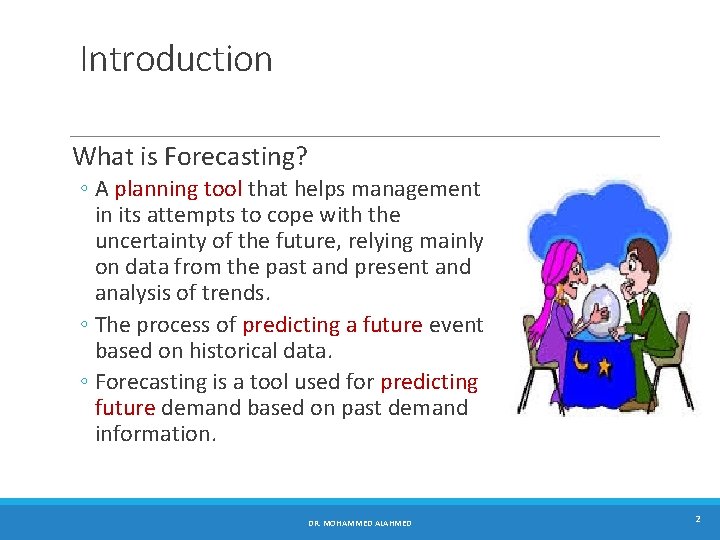
Introduction What is Forecasting? ◦ A planning tool that helps management in its attempts to cope with the uncertainty of the future, relying mainly on data from the past and present and analysis of trends. ◦ The process of predicting a future event based on historical data. ◦ Forecasting is a tool used for predicting future demand based on past demand information. DR. MOHAMMED ALAHMED 2
Why is forecasting important ? 1. We forecast very different things such as weather, traffic, stock market, state of our economy from different perspectives. 2. Almost every business attempt is based on forecasting. 3. Forecasting is an essential element of most business decisions. 4. Forecasting is important in the business decision-making process. 5. Forecasting reduces the range of uncertainty about the future. DR. MOHAMMED ALAHMED 3
Why is forecasting important ? 6. Forecasting can be used for: ◦ Strategic planning (long range planning) ◦ Finance and accounting (budgets and cost controls) ◦ Marketing (future sales, new products) ◦ Production and operations DR. MOHAMMED ALAHMED 4
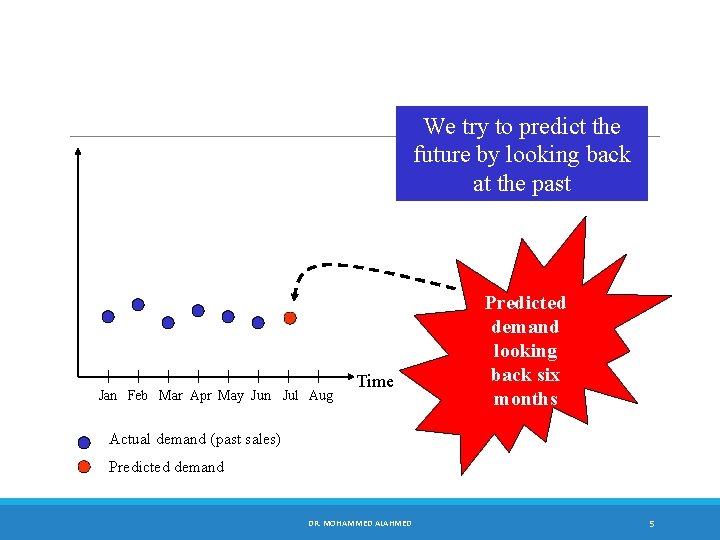
We try to predict the future by looking back at the past Jan Feb Mar Apr May Jun Jul Aug Time Predicted demand looking back six months Actual demand (past sales) Predicted demand DR. MOHAMMED ALAHMED 5
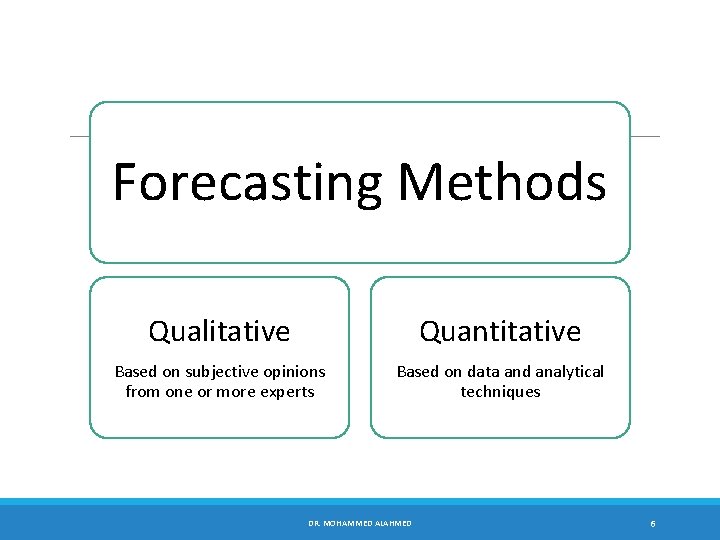
Forecasting Methods Qualitative Quantitative Based on subjective opinions from one or more experts Based on data and analytical techniques DR. MOHAMMED ALAHMED 6
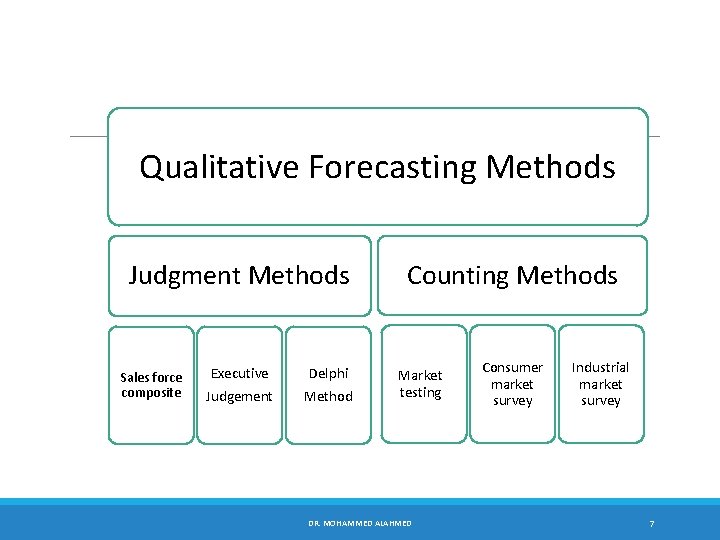
Qualitative Forecasting Methods Judgment Methods Sales force composite Executive Judgement Delphi Method Counting Methods Market testing DR. MOHAMMED ALAHMED Consumer market survey Industrial market survey 7
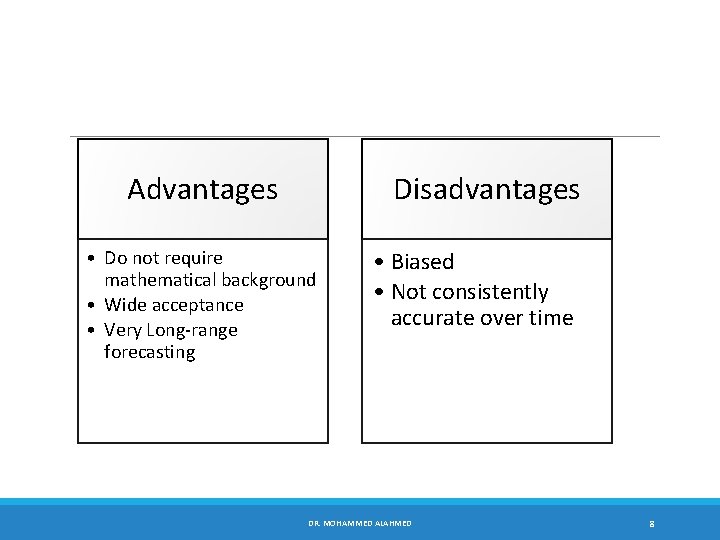
Advantages Disadvantages • Do not require mathematical background • Wide acceptance • Very Long-range forecasting • Biased • Not consistently accurate over time DR. MOHAMMED ALAHMED 8
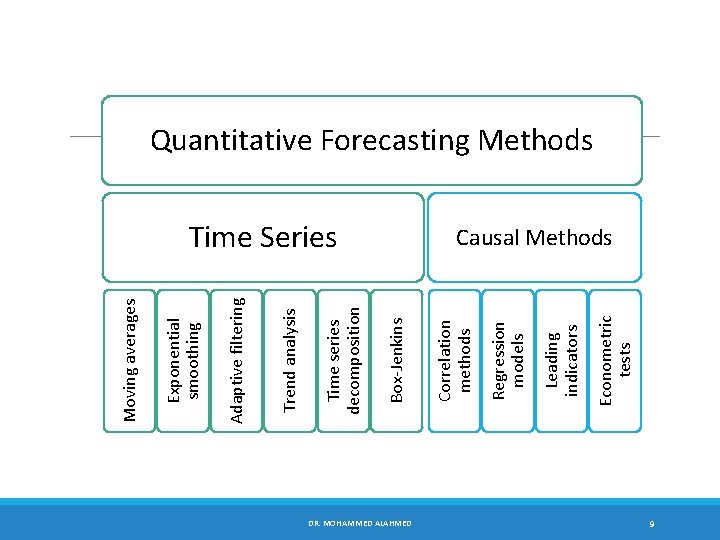
DR. MOHAMMED ALAHMED Econometric tests Leading indicators Regression models Time Series Correlation methods Box-Jenkins Time series decomposition Trend analysis Adaptive filtering Exponential smoothing Moving averages Quantitative Forecasting Methods Causal Methods 9
Selecting a Forecasting Method 1. Data availability ◦ Do you have historical data available? 2. Time horizon for the forecast ◦ Is the forecast for short-run or long-run purposes? 3. Required accuracy ◦ How much accuracy is desired? ◦ Is there a minimum tolerance level of error? 4. Required Resources ◦ How much time and money are you willing to spend on your forecast? DR. MOHAMMED ALAHMED 10
Who needs forecasts? Every organizations, large and small, private and public. ◦ It applies to problems such as: ◦ How much this company worth? (Finance) ◦ Will a new product be successful? (Marketing) ◦ What level of inventories should be kept? (Production) ◦ How can we identify the best job candidates? (Personnel) DR. MOHAMMED ALAHMED 11
Naïve Method 1 § It is based solely on the most recent information available. § Suitable when there is small data set. § Some times it is called the “no change” forecast. § The naïve forecast for each period is the immediately proceeding observation. DR. MOHAMMED ALAHMED 12

Naïve Method 1 The simplest naïve forecasting model, in which the forecast value is equal to the previous observed value, can be described in algebraic form as follows: Since it discards all other observations, it tracks changes rapidly. DR. MOHAMMED ALAHMED 13
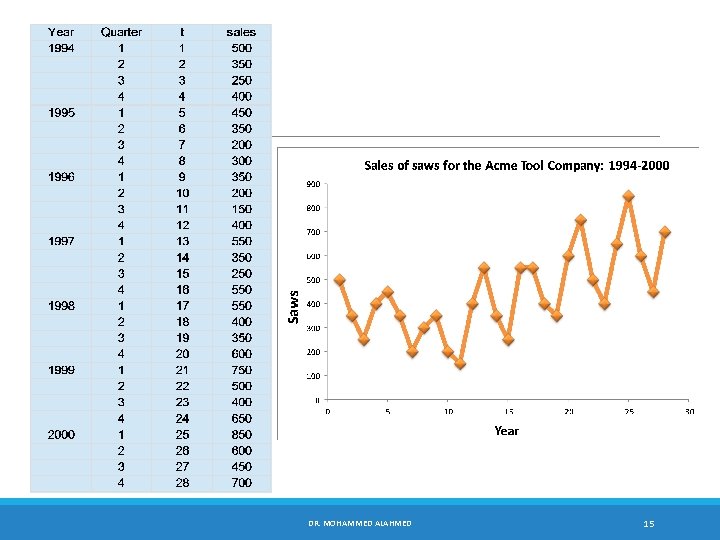
Example: Sales of saws for Acme Tool Company, 1994 -2000 § The following table shows the sales of saws for the Acme tool Company. These data are shown graphically as well. § In both forms of presentation you can see that the sales varied considerably throughout this period, from a low of 150 in 1996 -Q 3 to a high of 850 in 2000 -Q 1. § The Fluctuations in most economic and business series (variables) are best seen after converting the data graphic form. DR. MOHAMMED ALAHMED 14
DR. MOHAMMED ALAHMED 15
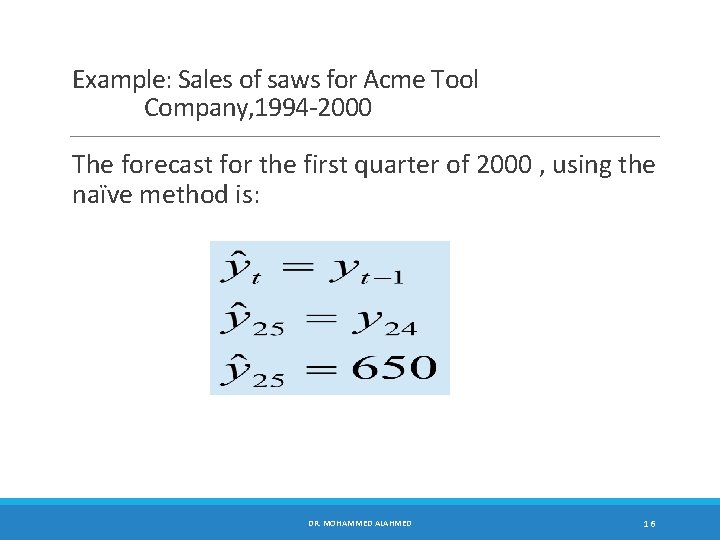
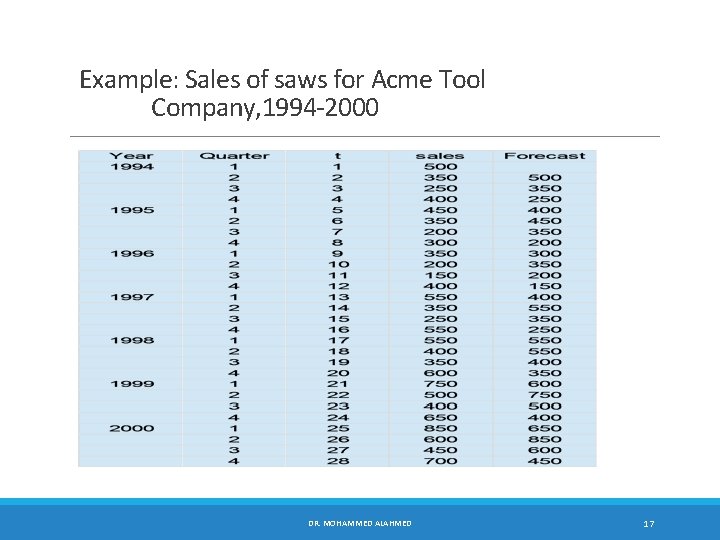
Example: Sales of saws for Acme Tool Company, 1994 -2000 The forecast for the first quarter of 2000 , using the naïve method is: DR. MOHAMMED ALAHMED 16
Example: Sales of saws for Acme Tool Company, 1994 -2000 DR. MOHAMMED ALAHMED 17
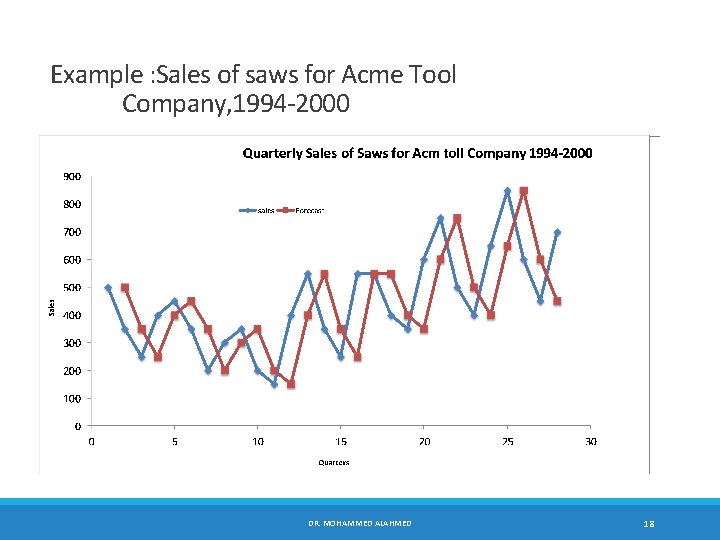
Example : Sales of saws for Acme Tool Company, 1994 -2000 DR. MOHAMMED ALAHMED 18
Naïve Method 2 § One might argue that in addition to considering just the recent observation, it would make sense to consider the direction from which we arrived at the latest observation. § That is: if the series dropped to the latest point, perhaps it is reasonable to assume further drop and if we have observed an increase, it may make sense to factor into our forecast some further increase. DR. MOHAMMED ALAHMED 19
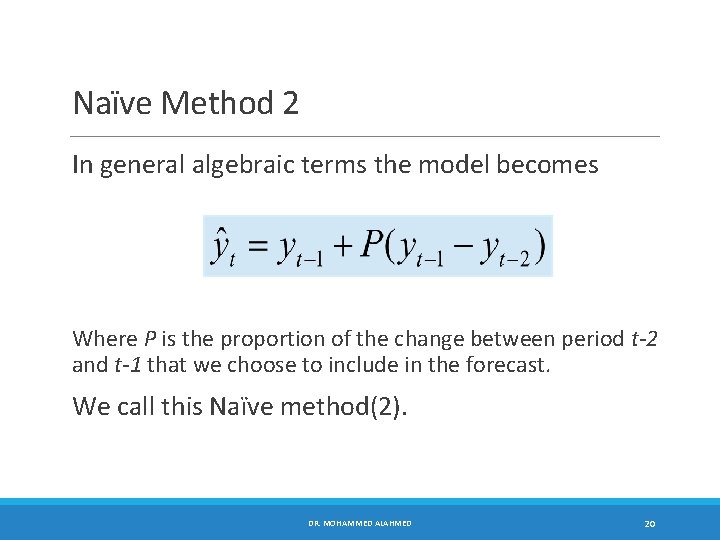
Naïve Method 2 In general algebraic terms the model becomes Where P is the proportion of the change between period t-2 and t-1 that we choose to include in the forecast. We call this Naïve method(2). DR. MOHAMMED ALAHMED 20
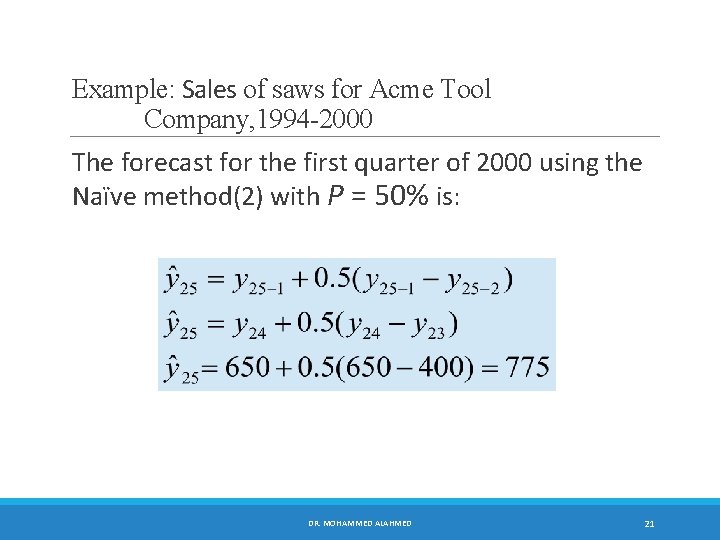
Example: Sales of saws for Acme Tool Company, 1994 -2000 The forecast for the first quarter of 2000 using the Naïve method(2) with P = 50% is: DR. MOHAMMED ALAHMED 21
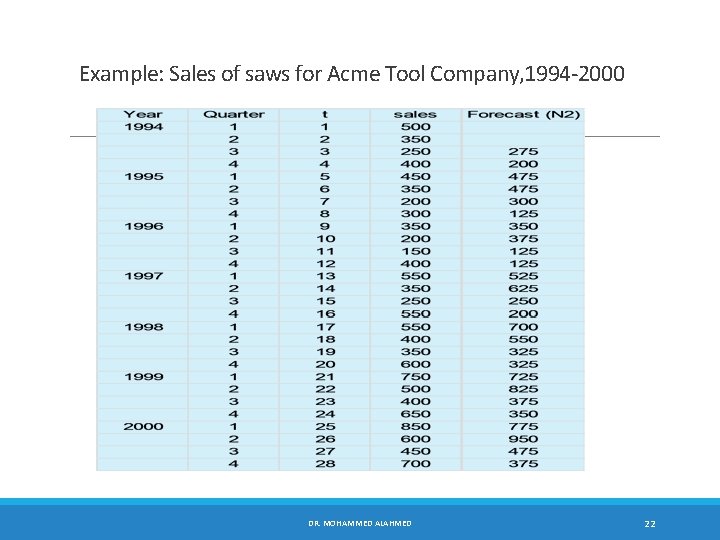
Example: Sales of saws for Acme Tool Company, 1994 -2000 DR. MOHAMMED ALAHMED 22
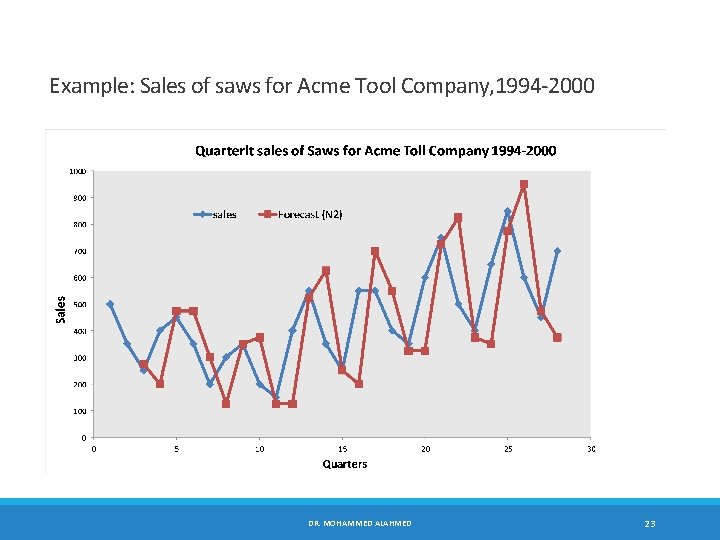
Example: Sales of saws for Acme Tool Company, 1994 -2000 DR. MOHAMMED ALAHMED 23
Evaluating Forecasts § We have looked at two alternative forecasts of the sales for the Acme Tool Company. Which forecast is best depends on the particular year or years you look at. § It is not always possible to find one model that is always best for any given set of business or economic data. § But we need some way to evaluate the accuracy of forecasting models over a number of periods so that we can identify the model that generally works the best. DR. MOHAMMED ALAHMED 24
Evaluating Forecasts Among a number of possible criteria that could be used, five common ones are: 1. 2. 3. 4. 5. 6. Mean absolute error (MAE) Mean percentage error (MPE) Mean absolute percentage error (MAPE) Mean squared Error (MSE) Root Mean squared Error (RMSE) Theil’s U-statistic DR. MOHAMMED ALAHMED 25
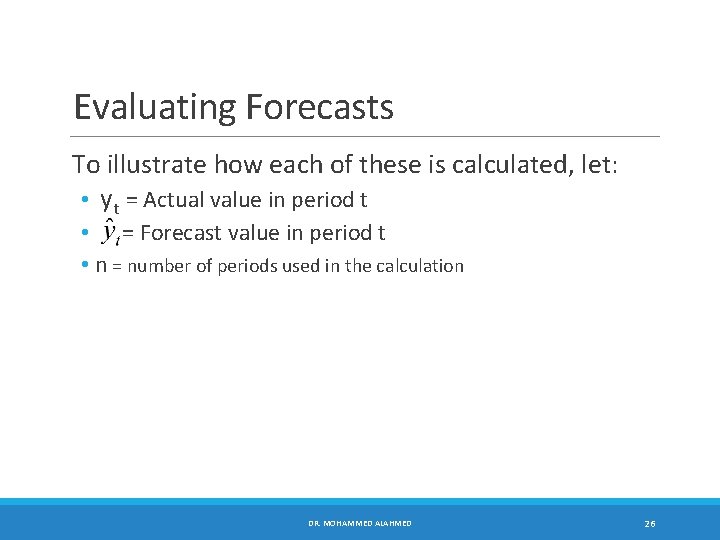
Evaluating Forecasts To illustrate how each of these is calculated, let: • yt = Actual value in period t • = Forecast value in period t • n = number of periods used in the calculation DR. MOHAMMED ALAHMED 26
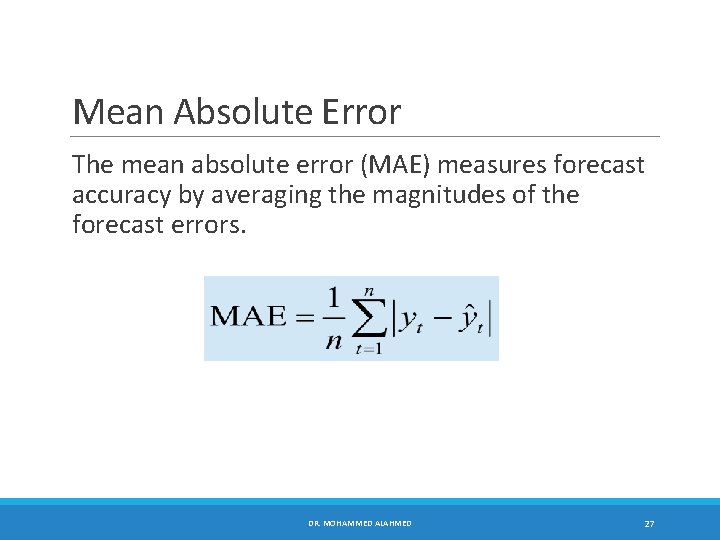
Mean Absolute Error The mean absolute error (MAE) measures forecast accuracy by averaging the magnitudes of the forecast errors. DR. MOHAMMED ALAHMED 27
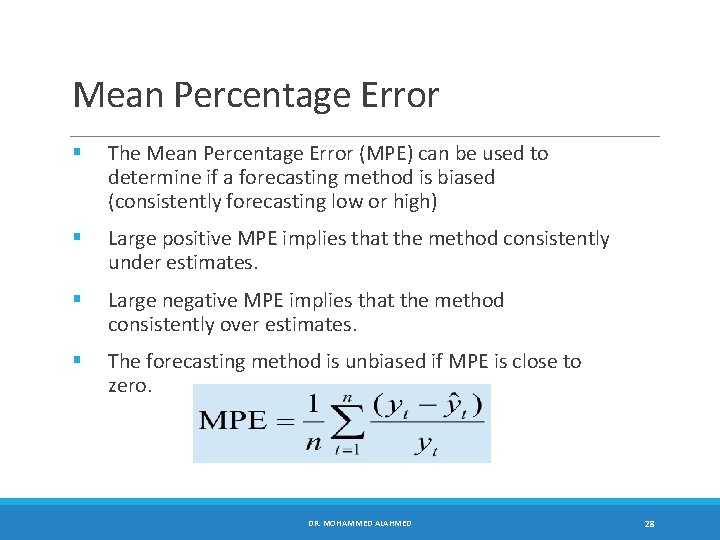
Mean Percentage Error § The Mean Percentage Error (MPE) can be used to determine if a forecasting method is biased (consistently forecasting low or high) § Large positive MPE implies that the method consistently under estimates. § Large negative MPE implies that the method consistently over estimates. § The forecasting method is unbiased if MPE is close to zero. DR. MOHAMMED ALAHMED 28
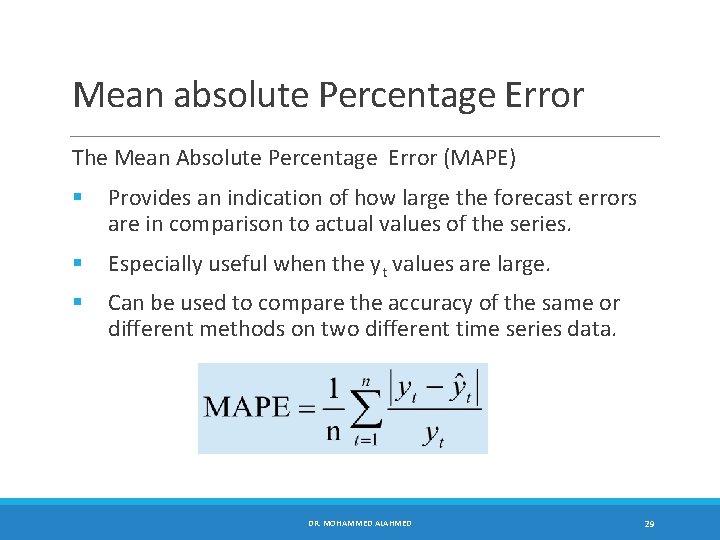
Mean absolute Percentage Error The Mean Absolute Percentage Error (MAPE) § Provides an indication of how large the forecast errors are in comparison to actual values of the series. § Especially useful when the yt values are large. § Can be used to compare the accuracy of the same or different methods on two different time series data. DR. MOHAMMED ALAHMED 29
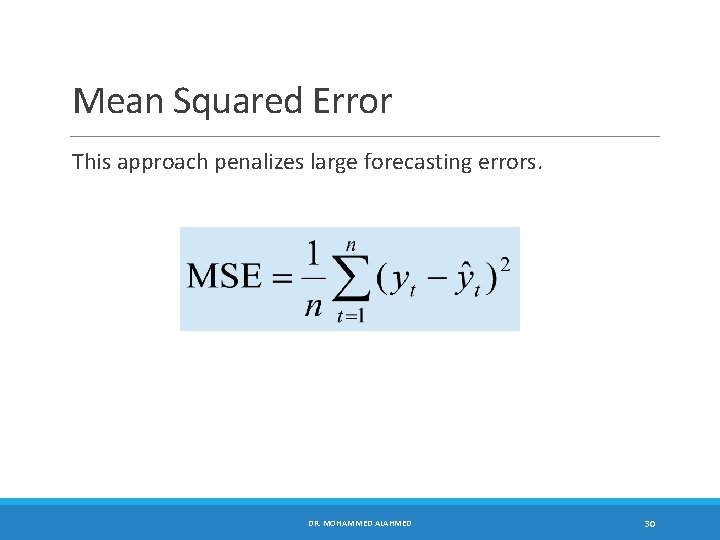
Mean Squared Error This approach penalizes large forecasting errors. DR. MOHAMMED ALAHMED 30
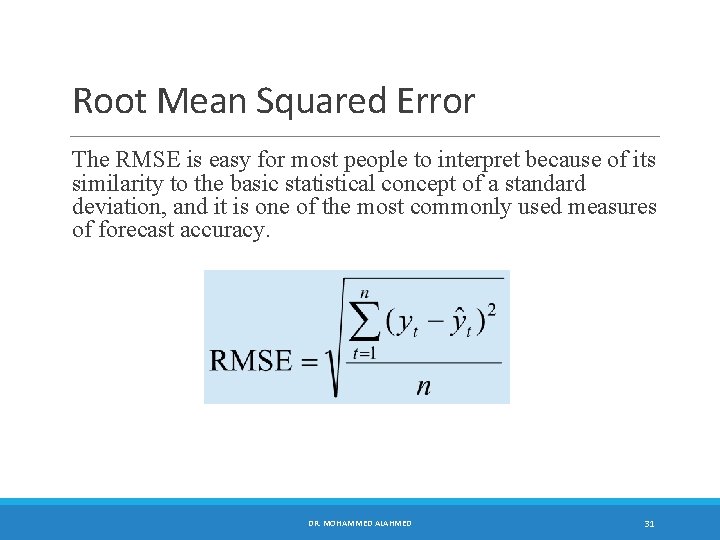
Root Mean Squared Error The RMSE is easy for most people to interpret because of its similarity to the basic statistical concept of a standard deviation, and it is one of the most commonly used measures of forecast accuracy. DR. MOHAMMED ALAHMED 31
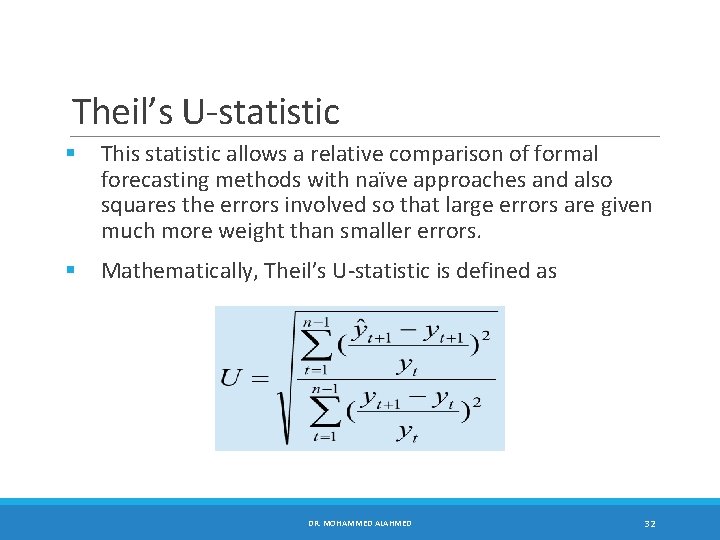
Theil’s U-statistic § This statistic allows a relative comparison of formal forecasting methods with naïve approaches and also squares the errors involved so that large errors are given much more weight than smaller errors. § Mathematically, Theil’s U-statistic is defined as DR. MOHAMMED ALAHMED 32
Theil’s U-statistic § U = 1 The naïve method is as good as the forecasting technique being evaluated. § U < 1 The forecasting technique being used is better than the naïve method. § U > 1 There is no point in using a formal forecasting method since using a naïve method will produce better results DR. MOHAMMED ALAHMED 33
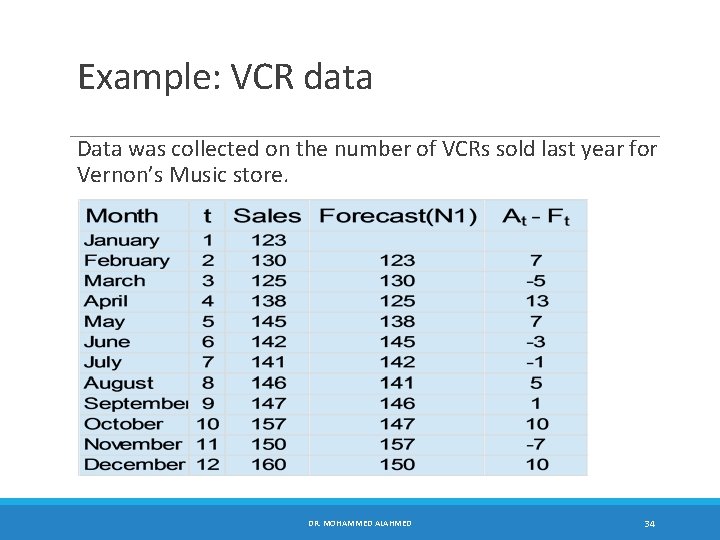
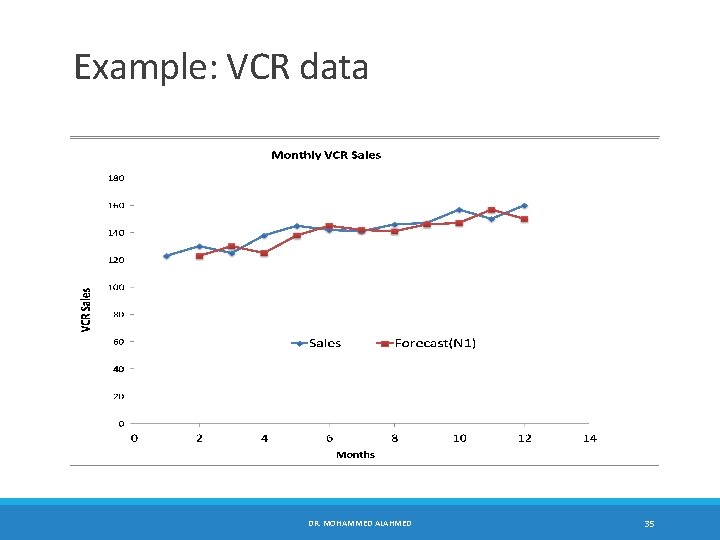
Example: VCR data Data was collected on the number of VCRs sold last year for Vernon’s Music store. DR. MOHAMMED ALAHMED 34
Example: VCR data DR. MOHAMMED ALAHMED 35
Example: VCR data DR. MOHAMMED ALAHMED 36
Example: VCR data DR. MOHAMMED ALAHMED 37
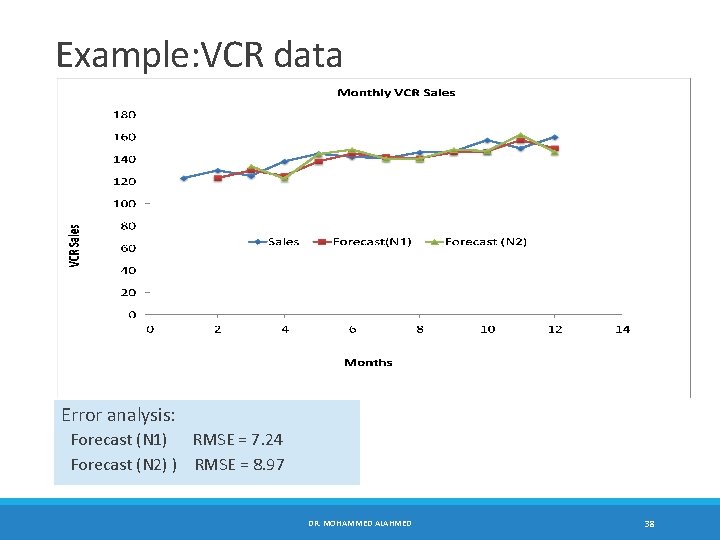
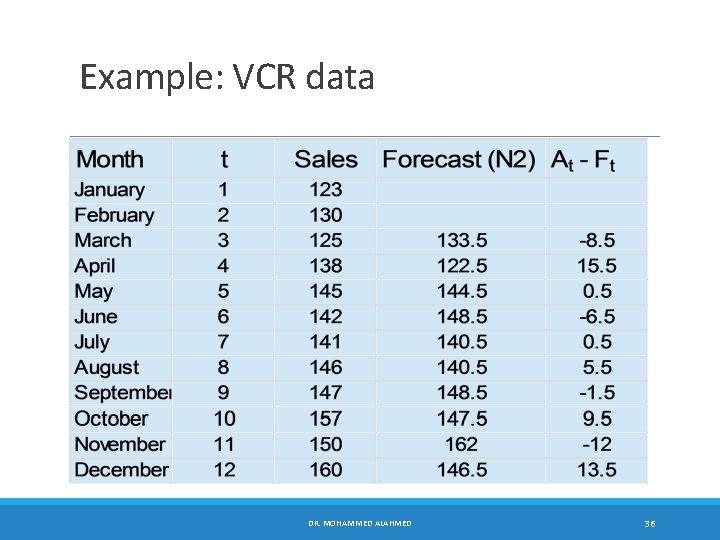
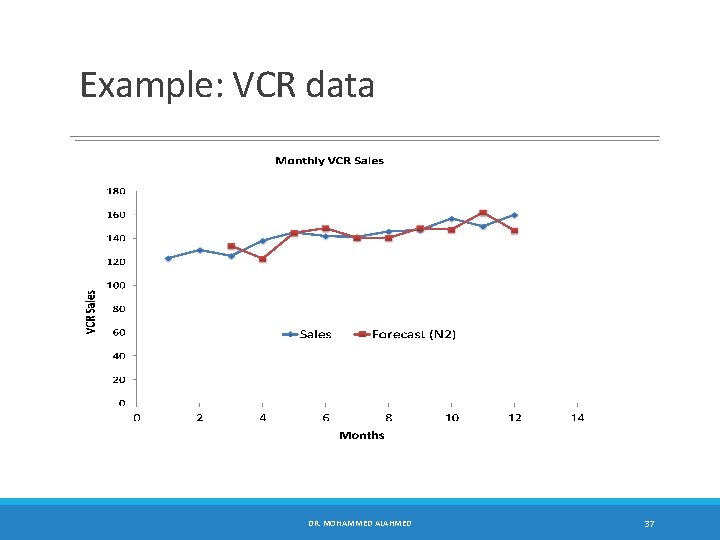
Example: VCR data Error analysis: Forecast (N 1) RMSE = 7. 24 Forecast (N 2) ) RMSE = 8. 97 DR. MOHAMMED ALAHMED 38
Evaluating Forecasts § We will focus on root-mean-squared error (RMSE) to evaluate the relative accuracy of various forecasting methods. § All quantitative forecasting models are developed on the basis of historical data. § When RMSE are applied to the historical data, they are often considered measures of how well various models fit the data (how well they work in the sample). DR. MOHAMMED ALAHMED 39
Evaluating Forecasts § To determine how accurate the models are in actual forecast (out of sample) a hold out period is often used for evaluation. § It is possible that the best model “in sample” may not be the best in “out of sample”. DR. MOHAMMED ALAHMED 40
Using Multiple Forecasts § When forecasting Sales or some other business economic variables, it is best to consider more than one model. § In our example of VCR sales, using the two naïve model, we could take the lowest forecast value as the most pessimistic, the highest as the most optimistic, and the average value as the most likely. § This is the simplest way to combine forecasts. DR. MOHAMMED ALAHMED 41
Sources of Data The quantity and type of data needed in developing forecasts can vary a great deal from one situation to another. ◦ Some forecasting techniques require only data series that is to be forecasted ØNaïve method, exponential smoothing, decomposition method. ◦ Some , like multiple regression methods require a data series for each variable included in the forecasting model. DR. MOHAMMED ALAHMED 42
Sources of Data Sources of data ◦ Internal records of the organization. ◦ Outside of the organization ◦ Trade associations ◦ Governmental and syndicated services There is a wealth of data available on the internet. DR. MOHAMMED ALAHMED 43
- Slides: 43