
Business finance Introduce the aims and objectives for
Business finance • Introduce the aims and objectives for the session. • Define business finance and discuss the internal sources of finance. • Complete a written task on internal sources of finance. • Explain the external sources of finance. • Discuss the external sources of finance. • Show a You. Tube video on external sources of finance. • Arrange the internal and external sources of finance. • cards and discuss with the class. • Describe each source of finance in a written task. • Discuss your evaluations with the class. • Recap the aims and objectives for the session.
Activity 1 Task: A 3 paper and pens What sources of finance are available to businesses? Time: 10 mins
Business finance Businesses cannot survive without finance, whether in the form of initial funds to start the business, working capital to run the business day-to-day, or investment capital to help the business grow. For a new business starting out it is unlikely that external forms of finance will be available. (9/10 fail)
Business finance Apart from capital provided by the entrepreneur and friends and family, sources of finance are likely to be severely limited. These new sole traders and microbusinesses are likely to continue to struggle to find external sources of finance until they establish an effective trading record.
Business finance The most suitable finance option for a business depends on many things: • how much funding is needed; • the amount of time the money is required for; • what the finance will be used for; • the affordability of repayments; • whether or not personal or business assets are available as security; • whether or not the business owner is willing to give up a share of ownership, perhaps through taking on a partner or selling shares.
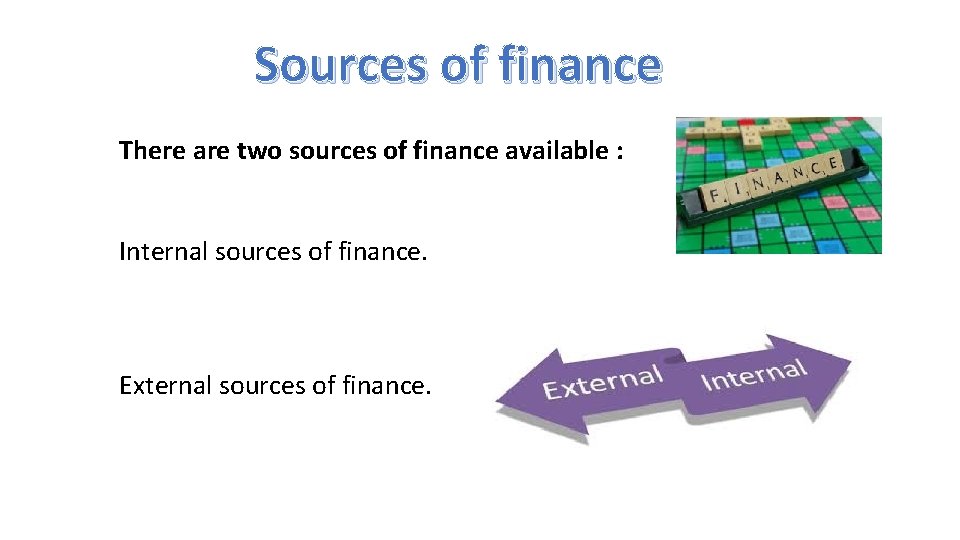
Sources of finance There are two sources of finance available : Internal sources of finance. External sources of finance.

Internal sources of finance • Retained profit • Working capital • Sale of assets
Retained profit This is regarded as the single most important source of finance and is also the cheapest source of finance. As a business becomes more profitable, it makes sense to build up and retain some profit (reserves). This will provide a liquidity buffer and potential funds for growth.
Reserves, reinvested profits, come with only one cost – the loss of profit distribution to owners. Short-term pressures to pay profits to owners (normally shareholders) can, however, restrict the availability of this form of finance.

Working capital By reducing their trade credit period and collecting debts more efficiently, a business may receive money from customers more quickly. However, this is likely to drive customers away (A 04) and may have the opposite effect on making finance available. Reducing stock holdings is another way to release finance but a sudden surge in demand could result in lost Sales (A 04) if the business is unable to meet delivery dates.
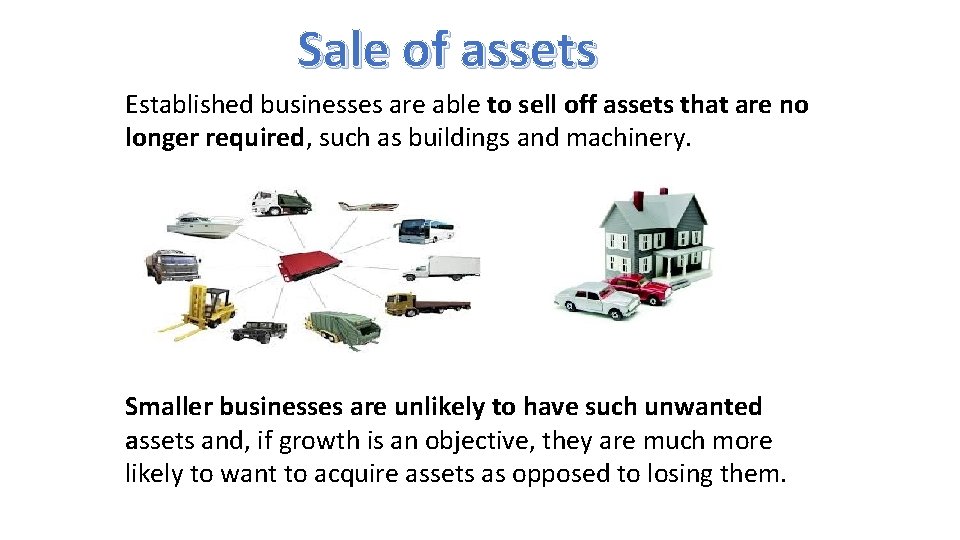
Sale of assets Established businesses are able to sell off assets that are no longer required, such as buildings and machinery. Smaller businesses are unlikely to have such unwanted assets and, if growth is an objective, they are much more likely to want to acquire assets as opposed to losing them.
Activity 2 Task: Your task is to complete a written evaluation of internal sources of finance. Time: 20 mins

External sources of finance • Bank loans • Overdrafts • Trade credit • Factoring • Leasing and hire purchase

External sources of finance • Commercial mortgages • Sale and lease back • Share capital • Venture capitalists • Government assistance
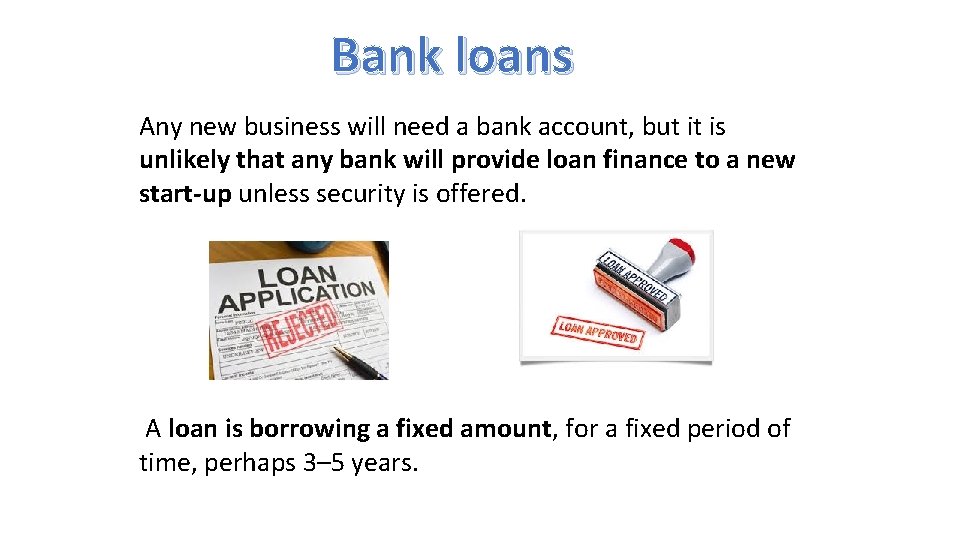
Bank loans Any new business will need a bank account, but it is unlikely that any bank will provide loan finance to a new start-up unless security is offered. A loan is borrowing a fixed amount, for a fixed period of time, perhaps 3– 5 years.

Bank loans Payments made up of interest and capital are made monthly. Security, if available, will very often come in the form of property. Offering security against a loan can make it much easier to get funding and reduces interest rates charged – but increases risk to personal assets (A 04). If the business owner is not able to maintain payments, homes can be lost or business assets removed.

Overdrafts As a business develops an effective trading record then an overdraft facility may be provided by the bank. An overdraft is the facility to withdraw more from an account than is in the bank account, resulting in a negative balance. Businesses often depend upon authorised overdrafts to provide working capital. The nature of business often means that money is paid out on costs before revenue is received. This leaves a funding deficit.

Overdrafts canceled An overdraft is designed to cover this funding deficit and provide working capital. Unfortunately overdrafts can be withdrawn by a bank with just 30 days’ notice (A 04). This means a long-term dependency on an overdraft has dangers. The business relying upon an overdraft for day-to-day funds may find that with a withdrawal of the overdraft facility, they do not have money for paying bills, wages, suppliers etc.

Trade credit This is an interest-free way to raise finance. Businesses buy items such as fuel and raw material and pay for them at a later date – possibly 30– 90 days later. Many suppliers today, however, offer discounts for early payment so delaying payment may result in higher costs (A 04) in the long run. Businesses that take a long time to pay their bills also tend to gain a bad reputation in the marketplace.

BREAK 1 hour

You. Tube video Sources of finance https: //www. youtube. com/watch? v=c 8 h. Iw. Q 5 x. FY 8

Factoring An alternative to an overdraft is for a business to use a factoring service. Factoring is a method of turning invoices into cash. Banks and other financial organisations offer factoring services which pay a proportion of the value of an invoice (80– 85%) when the invoice is issued. The balance, minus a fee, is paid to the business when the invoice is paid. This flexible form of finance (A 04) keeps pace with business growth as the funding is directly linked to the turnover of the company. The factor will also undertake all credit management and collections work.

Factoring The use of this service results in savings in administration costs, which can be substantial, and faster customer payments means lower interest costs on any overdraft facility. Bad debt protection can also be built into the service. Factoring services are only offered to businesses with a good trading record and reliable customers. It is, however, an effective alternative to an overdraft, as the cost is generally lower.

Commercial mortgage If a business owns property a commercial mortgage may be available. With a commercial mortgage the property is used as security against the loan and the loan can be as much as 60 or 70% of the value of the property. Because security is being offered to the lender, the interest rates will be lower than an unsecured loan (A 04).

Commercial mortgage Payments are made monthly for the term of the mortgage. Failure to make repayments may lead to the property being repossessed by the lender. Commercial mortgages might run for 10 or 15 years so generally have predictable costs – this can be helpful with budgeting and predicting cash flow.
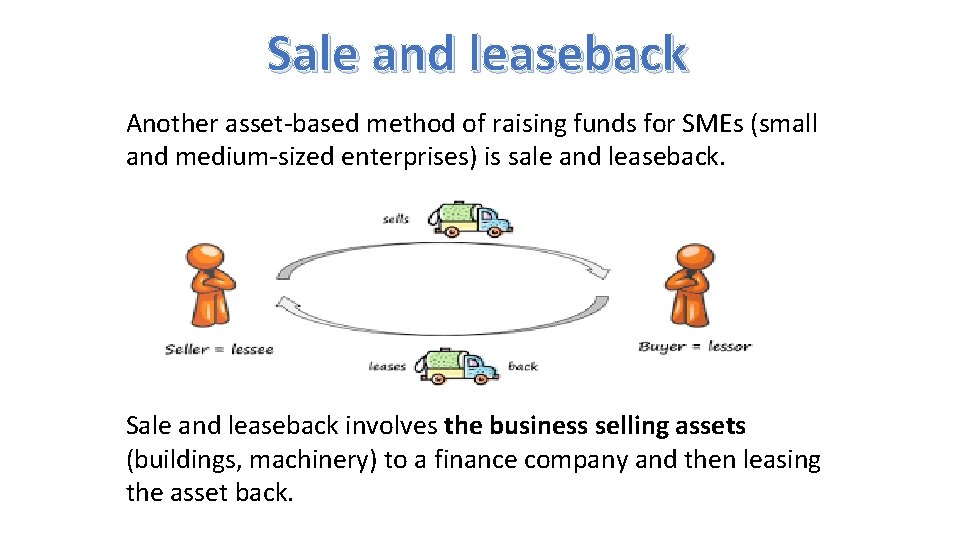
Sale and leaseback Another asset-based method of raising funds for SMEs (small and medium-sized enterprises) is sale and leaseback. Sale and leaseback involves the business selling assets (buildings, machinery) to a finance company and then leasing the asset back.
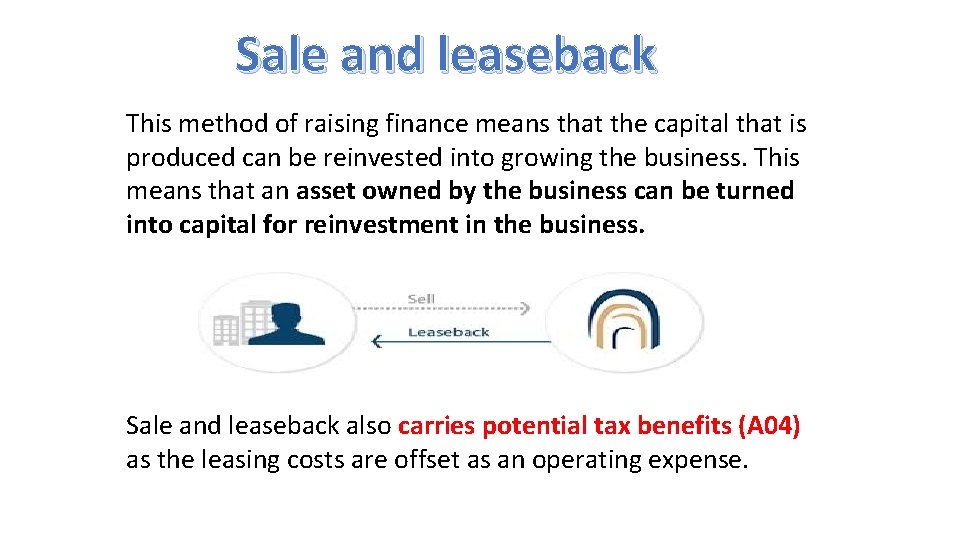
Sale and leaseback This method of raising finance means that the capital that is produced can be reinvested into growing the business. This means that an asset owned by the business can be turned into capital for reinvestment in the business. Sale and leaseback also carries potential tax benefits (A 04) as the leasing costs are offset as an operating expense.
Government assistance Although hard to come by, both local and central government may offer finance to business start-up schemes (Princes Trust Grants) qualifying criteria do tend to be quite narrow and businesses setting up in regions of high unemployment tend to be favoured. The amounts available tend to be relatively small and are for a limited period of time.
Share capital A long-term method of providing funds for growth is to sell shares. This means that the business may move from being a partnership or sole trader to becoming a limited company. There a number of advantages to being a limited company which include limited liability and reduction in risk for the owners. However, the main reason is to bring in new shareholders who invest capital for growth.
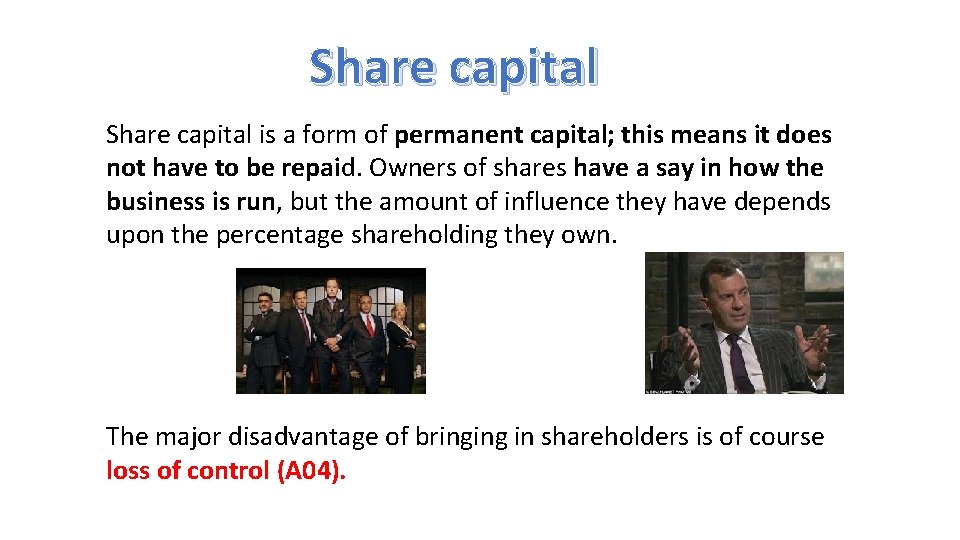
Share capital is a form of permanent capital; this means it does not have to be repaid. Owners of shares have a say in how the business is run, but the amount of influence they have depends upon the percentage shareholding they own. The major disadvantage of bringing in shareholders is of course loss of control (A 04).

Share capital The business owner or owners will have decisions influenced by new investors. Also the new shareholder investors may be looking for an exit strategy within a few years. This means that they are expecting the business to grow rapidly and then they expect to be able to sell their shares, taking their capital gain.
Share capital This is the scenario often seen on Dragons’ Den, the BBC television programme. The question business owners have to answer is how much of a business is the owner willing to give up to gain the finance they need. You. Tube video – Dragons Den https: //www. youtube. com/watch? v=_Qvgu. JJNil. A
Venture capitalists are professional investors who can invest large amounts of capital into small and medium-sized businesses. Venture capitalists and venture capital companies (who exist to invest into growing businesses), will not only take a shareholding but also expect to be fully involved in running the business.

Venture capitalist They will take seats on the board and appoint managers and advisors to help generate success and growth. From the business owners’ point of view, all this input of skills and capital allows the business to grow at a speed that was previously impossible. Some of the best-known internet businesses (Facebook, Google, Twitter) depended upon venture capital to fund growth. Venture capitalists are often quite happy to focus on growth for the short and medium term, with the expectation that profits will come later.
Activity 3 Task: Match the internal and external sources of finance cards. Time: 10 mins and 5 mins discussion
Activity 4 Task: Sources of finance – Exam question. Explain the external sources of finance. Time: 30 mins
Sources of finance questions 1. What are the internal sources of finance ? 2. What is liquidity? 3. What is working capital ? 4. Explain each internal source of finance as a group.
Sources of finance questions 1. What are the external sources of finance ? 2. Explain each source of finance. 3. What is the most likely form of security for a bank loan? 4. What is the main disadvantage of an overdraft ?
Sources of finance 1. What is factoring ? 2. What is an advantage of factoring ? 3. What is a lease or higher purchase? 4. What is a disadvantage of factoring? 5. What is sale and leaseback?
Business finance questions 1. What is share capital ? 2. What is the most common form of share capital? 3. What is a venture capitalist?

Activity 2 Task: Your task is to complete a Kahoot quiz on business finance. Time: 15 mins

Dragons Den pitches – H/W https: //www. youtube. com/watch? v=Oz. H 3 Mux. GVls – Pro. Waste https: //www. youtube. com/watch? v=kzc. Qt. XA 5 Gc 8 – Hungry House https: //www. youtube. com/watch? v=s 8 d 5 wx. GEGc 8 – Zapper

Business finance • Introduce the aims and objectives for the session. • Define business finance and discuss the internal sources of finance. • Complete a written task on internal sources of finance. • Explain the external sources of finance. • Discuss the external sources of finance. • Show a You. Tube video on external sources of finance. • Arrange the internal and external sources of finance • cards and discuss with the class. • Describe each source of finance in a written task. • Discuss your evaluations with the class. • Recap the aims and objectives for the session.
- Slides: 43