
Business Excellence Management Christian Haltner CREDIT SUISSE Director
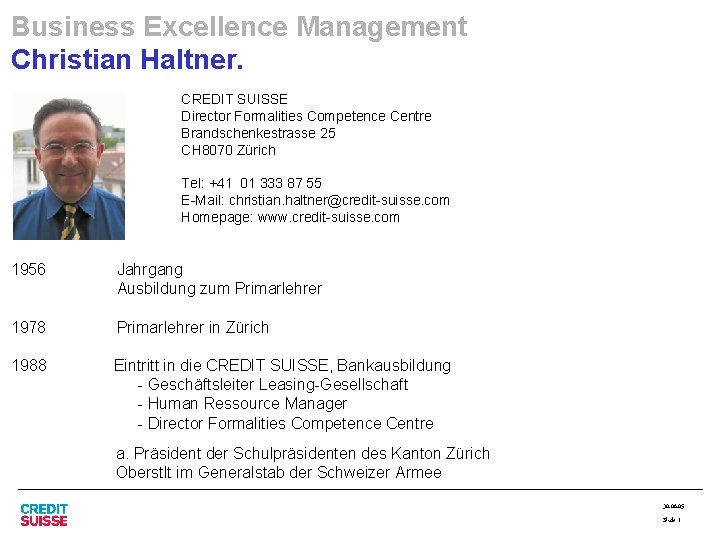
Business Excellence Management Christian Haltner. CREDIT SUISSE Director Formalities Competence Centre Brandschenkestrasse 25 CH 8070 Zürich Tel: +41 01 333 87 55 E-Mail: christian. haltner@credit-suisse. com Homepage: www. credit-suisse. com 1956 Jahrgang Ausbildung zum Primarlehrer 1978 Primarlehrer in Zürich 1988 Eintritt in die CREDIT SUISSE, Bankausbildung - Geschäftsleiter Leasing-Gesellschaft - Human Ressource Manager - Director Formalities Competence Centre a. Präsident der Schulpräsidenten des Kanton Zürich Oberstlt im Generalstab der Schweizer Armee 30. 06. 05 Slide 1
LEAN SIGMA METHODS Operational Excellence Zürich, 30 th of June 2005 Christian Haltner 30. 06. 05 Slide 2
CONTENTS 1. The Methods’ role in Operational Excellence 2. Understanding the Method (DMAIC) 3. Winning with the method! Date: Produced by: 30/06/2005 Central Team – Operational Excellence Slide 3
THE METHODS’ ROLE IN OPERATIONAL EXCELLENCE 30. 06. 05 Slide 4
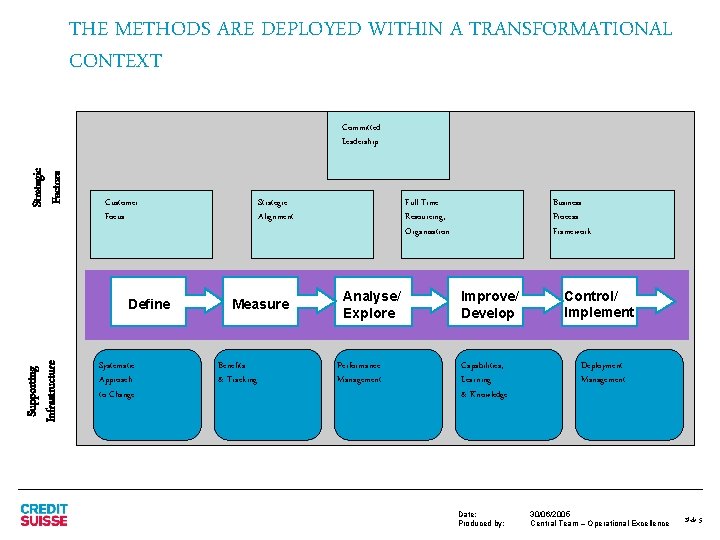
THE METHODS ARE DEPLOYED WITHIN A TRANSFORMATIONAL CONTEXT Strategic Factors Committed Leadership Customer Focus Supporting Infrastructure Define Systematic Approach to Change Strategic Alignment Measure Benefits & Tracking Full Time Resourcing, Organisation Analyse/ Explore Performance Management Business Process Framework Improve/ Develop Capabilities, Learning & Knowledge Date: Produced by: Control/ Implement Deployment Management 30/06/2005 Central Team – Operational Excellence Slide 5
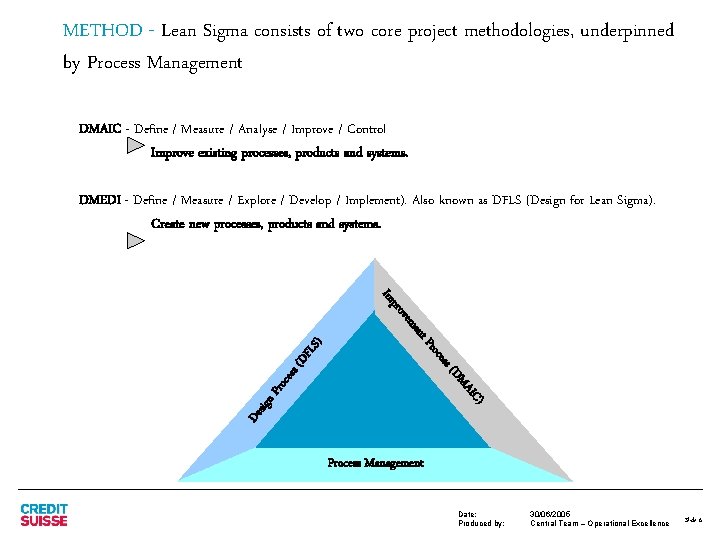
METHOD - Lean Sigma consists of two core project methodologies, underpinned by Process Management DMAIC - Define / Measure / Analyse / Improve / Control Improve existing processes, products and systems. DMEDI - Define / Measure / Explore / Develop / Implement). Also known as DFLS (Design for Lean Sigma). Create new processes, products and systems. ss ( DF De sig ) n. P IC MA roc e s (D ces Pro LS) ent vem pro Im Process Management Date: Produced by: 30/06/2005 Central Team – Operational Excellence Slide 6
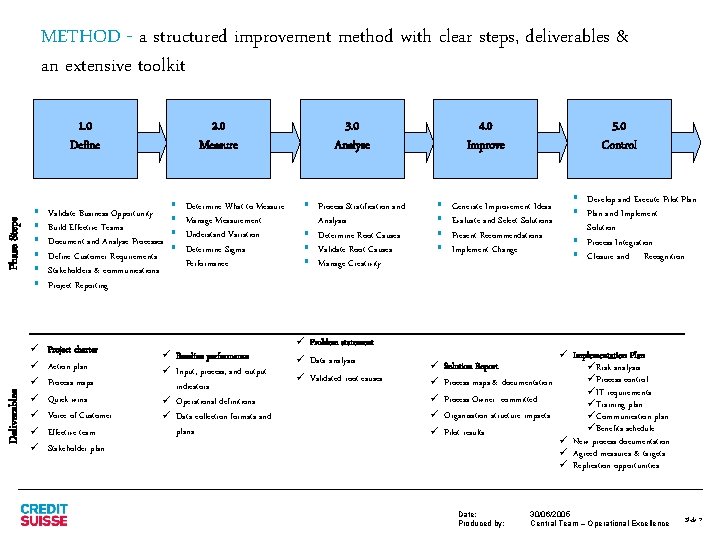
METHOD - a structured improvement method with clear steps, deliverables & an extensive toolkit Deliverables Phase Steps 1. 0 Define § § § ü ü ü ü 2. 0 Measure § Determine What to Measure Validate Business Opportunity § Manage Measurement Build Effective Teams § Understand Variation Document and Analyse Processes § Determine Sigma Define Customer Requirements Performance Stakeholders & communications Project Reporting Project charter Action plan Process maps Quick wins Voice of Customer Effective team Stakeholder plan ü Baseline performance ü Input, process, and output indicators ü Operational definitions ü Data collection formats and plans 3. 0 Analyse § Process Stratification and Analysis § Determine Root Causes § Validate Root Causes § Manage Creativity 4. 0 Improve § § 5. 0 Control Generate Improvement Ideas Evaluate and Select Solutions Present Recommendations Implement Change ü Problem statement ü Data analysis ü Validated root causes ü ü ü Solution Report Process maps & documentation Process Owner committed Organisation structure impacts Pilot results Date: Produced by: § Develop and Execute Pilot Plan § Plan and Implement Solution § Process Integration § Closure and Recognition ü Implementation Plan üRisk analysis üProcess control üIT requirements üTraining plan üCommunication plan üBenefits schedule ü New process documentation ü Agreed measures & targets ü Replication opportunities 30/06/2005 Central Team – Operational Excellence Slide 7
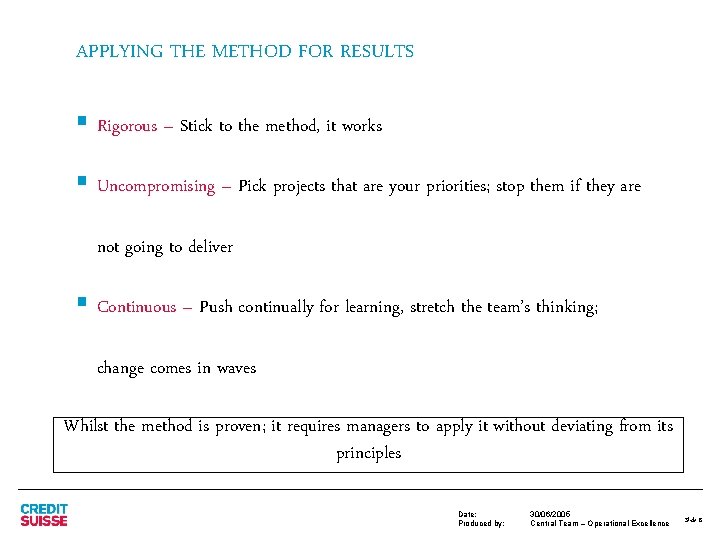
APPLYING THE METHOD FOR RESULTS § Rigorous – Stick to the method, it works § Uncompromising – Pick projects that are your priorities; stop them if they are not going to deliver § Continuous – Push continually for learning, stretch the team’s thinking; change comes in waves Whilst the method is proven; it requires managers to apply it without deviating from its principles Date: Produced by: 30/06/2005 Central Team – Operational Excellence Slide 8
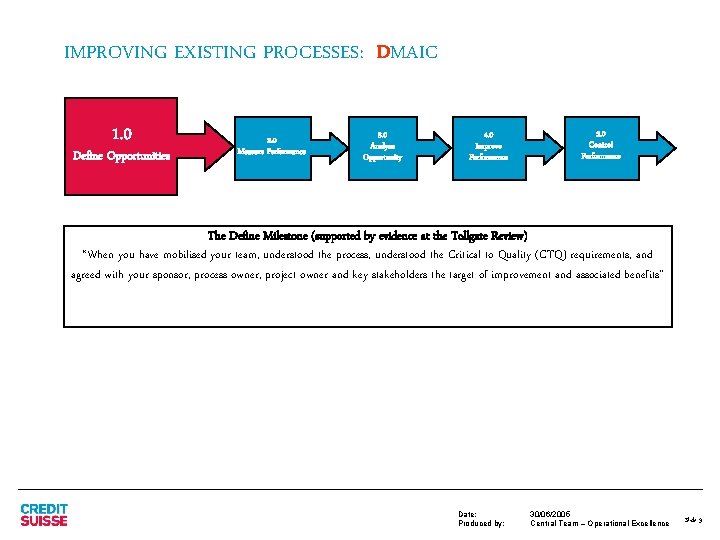
IMPROVING EXISTING PROCESSES: DMAIC 1. 0 Define Opportunities 2. 0 Measure Performance 3. 0 Analyze Opportunity 4. 0 Improve Performance 5. 0 Control Performance The Define Milestone (supported by evidence at the Tollgate Review) “When you have mobilised your team, understood the process, understood the Critical to Quality (CTQ) requirements, and agreed with your sponsor, process owner, project owner and key stakeholders the target of improvement and associated benefits” Date: Produced by: 30/06/2005 Central Team – Operational Excellence Slide 9
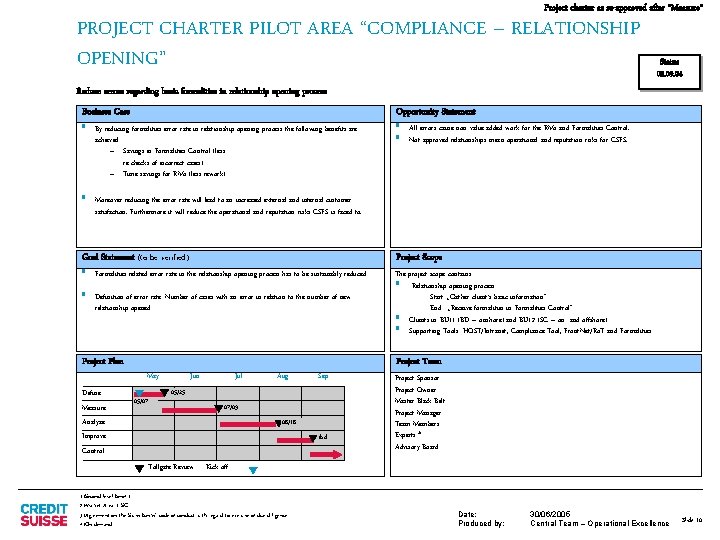
Project charter as re-approved after "Measure" PROJECT CHARTER PILOT AREA “COMPLIANCE – RELATIONSHIP OPENING” Status 03. 09. 04 Reduce errors regarding basic formalities in relationship opening process Business Case § By reducing formalities error rate in relationship opening process the following benefits are achieved: – – § Savings in Formalities Control (less re-checks of incorrect cases) Time savings for RMs (less rework) Moreover reducing the error rate will lead to an increased external and internal customer satisfaction. Furthermore it will reduce the operational and reputation risks CSFS is faced to. Goal Statement (to be verified) § Formalities related error rate in the relationship opening process has to be sustainably reduced § Opportunity Statement § All errors cause non value-added work for the RMs and Formalities Control. § Not approved relationships mean operational and reputation risks for CSFS. Definition of error rate: Number of cases with an error in relation to the number of new relationship opened Project Plan The project scope contains: § Relationship opening process Start: „Gather client’s basic information“ End : „Receive formalities in Formalities Control“ § Clients in BU 11 (BD – onshore) and BU 12 (SC – on- and offshore) § Supporting Tools: HOST/Intranet, Compliance Tool, Front. Net/Ro. T and Formalities Project Team May Define Measure Analyze Improve Control Project Scope 05/07 Jun Jul Aug Sep 05/25 07/09 08/18 tbd Tollgate Review Project Sponsor: Project Owner: Master Black Belt: Project Manager: Team Members: Experts: 4) Advisory Board: Kick-off 1)Second level benefit 2)Market Area 1: SC 3)Agreement on the Swiss banks‘ code of conduct with regard to exercise of due diligence 4)On demand Date: Produced by: 30/06/2005 Central Team – Operational Excellence Slide 10
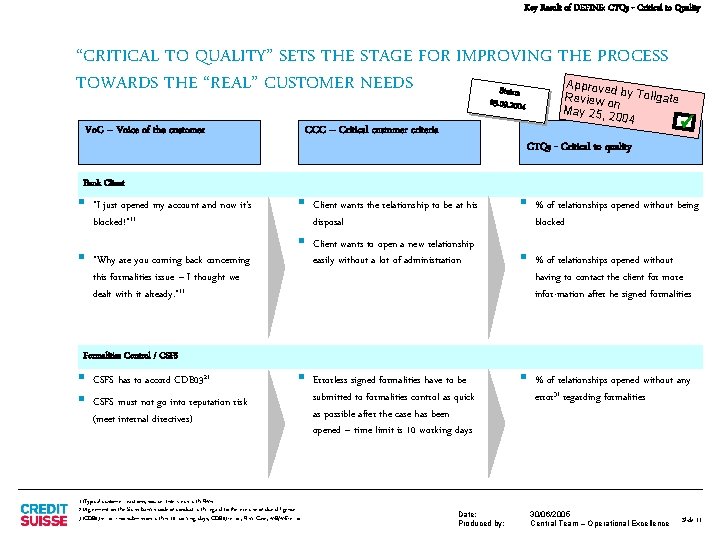
Key Result of DEFINE: CTQs - Critical to Quality “CRITICAL TO QUALITY” SETS THE STAGE FOR IMPROVING THE PROCESS Approve TOWARDS THE “REAL” CUSTOMER NEEDS Status d by Toll 03. 09. 2004 Vo. C – Voice of the customer Bank Client § “I just opened my account and now it’s blocked!” 1) § “Why are you coming back concerning CCC – Critical customer criteria 4 CTQs - Critical to quality § Client wants the relationship to be at his disposal § Client wants to open a new relationship easily without a lot of administration this formalities issue – I thought we dealt with it already. ” 1) gate Review o May 25, n 200 § % of relationships opened without being blocked § % of relationships opened without having to contact the client for more infor-mation after he signed formalities Formalities Control / CSFS § CSFS has to accord CDB 032) § CSFS must not go into reputation risk § Errorless signed formalities have to be (meet internal directives) 1)Typical customer reactions; source: Interviews with RMs 2)Agreement on the Swiss bank’s code of conduct with regard to the exercise of due diligence 3)CDB 03 -error - no submission within 10 working days, CDB 03 -error, Risk Case, MB/ME-error submitted to formalities control as quick as possible after the case has been opened – time limit is 10 working days Date: Produced by: § % of relationships opened without any error 3) regarding formalities 30/06/2005 Central Team – Operational Excellence Slide 11
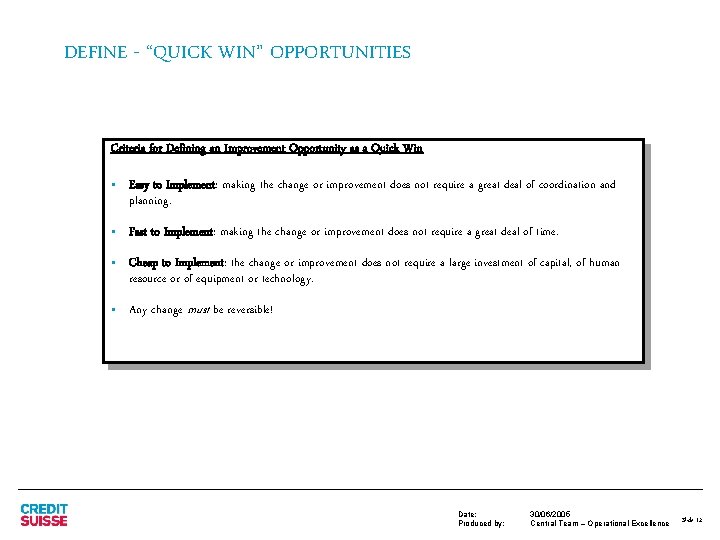
DEFINE - “QUICK WIN” OPPORTUNITIES Criteria for Defining an Improvement Opportunity as a Quick Win § Easy to Implement: making the change or improvement does not require a great deal of coordination and planning. § Fast to Implement: making the change or improvement does not require a great deal of time. § Cheap to Implement: the change or improvement does not require a large investment of capital, of human resource or of equipment or technology. § Any change must be reversible! Date: Produced by: 30/06/2005 Central Team – Operational Excellence Slide 12
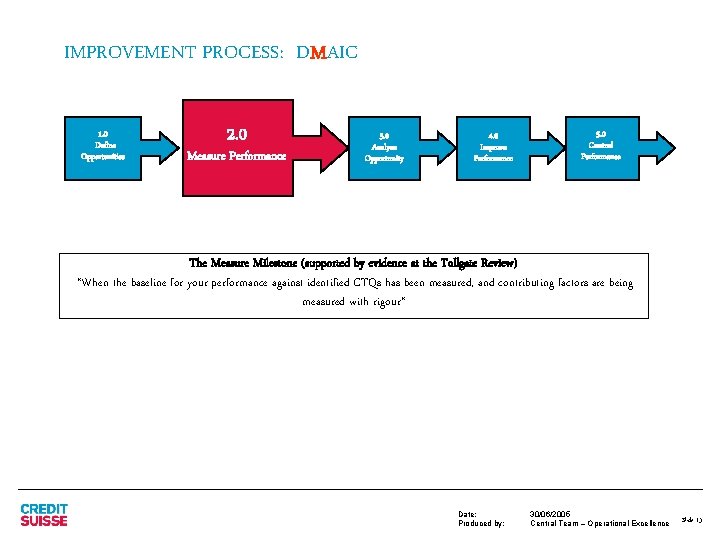
IMPROVEMENT PROCESS: DMAIC 1. 0 Define Opportunities 2. 0 Measure Performance 3. 0 Analyze Opportunity 4. 0 Improve Performance 5. 0 Control Performance The Measure Milestone (supported by evidence at the Tollgate Review) “When the baseline for your performance against identified CTQs has been measured, and contributing factors are being measured with rigour“ Date: Produced by: 30/06/2005 Central Team – Operational Excellence Slide 13
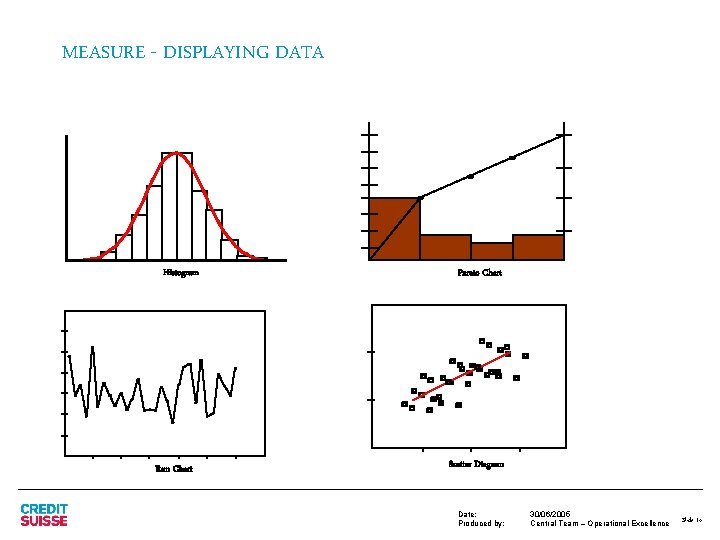
MEASURE - DISPLAYING DATA Histogram Run Chart Pareto Chart Scatter Diagram Date: Produced by: 30/06/2005 Central Team – Operational Excellence Slide 14
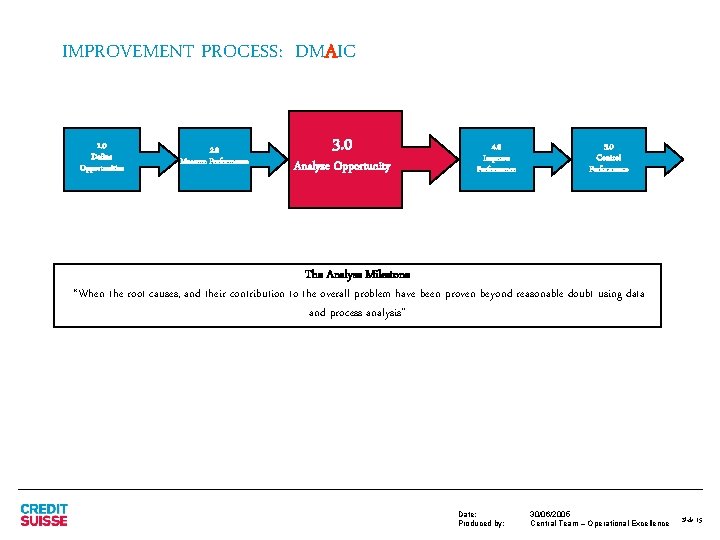
IMPROVEMENT PROCESS: DMAIC 1. 0 Define Opportunities 2. 0 Measure Performance 3. 0 Analyze Opportunity 4. 0 Improve Performance 5. 0 Control Performance The Analyse Milestone “When the root causes, and their contribution to the overall problem have been proven beyond reasonable doubt using data and process analysis” Date: Produced by: 30/06/2005 Central Team – Operational Excellence Slide 15
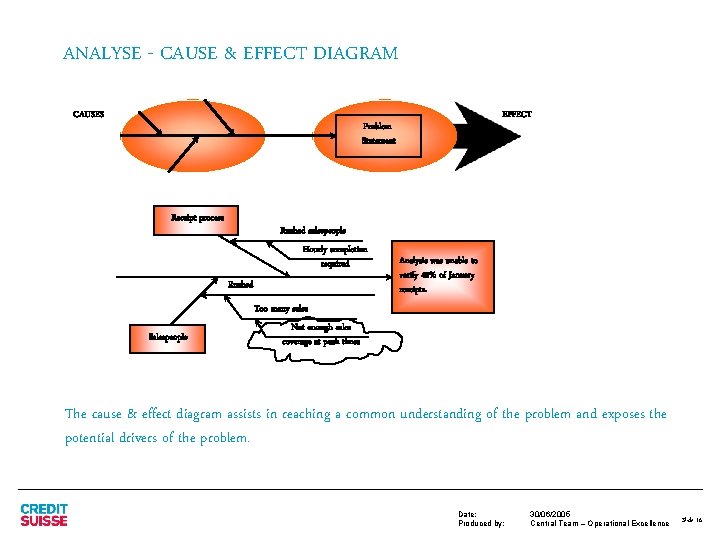
ANALYSE - CAUSE & EFFECT DIAGRAM CAUSES EFFECT Problem Statement Receipt process Rushed salespeople Hourly completion required Rushed Analysis was unable to verify 40% of January receipts. Too many sales Salespeople Not enough sales coverage at peak times The cause & effect diagram assists in reaching a common understanding of the problem and exposes the potential drivers of the problem. Date: Produced by: 30/06/2005 Central Team – Operational Excellence Slide 16
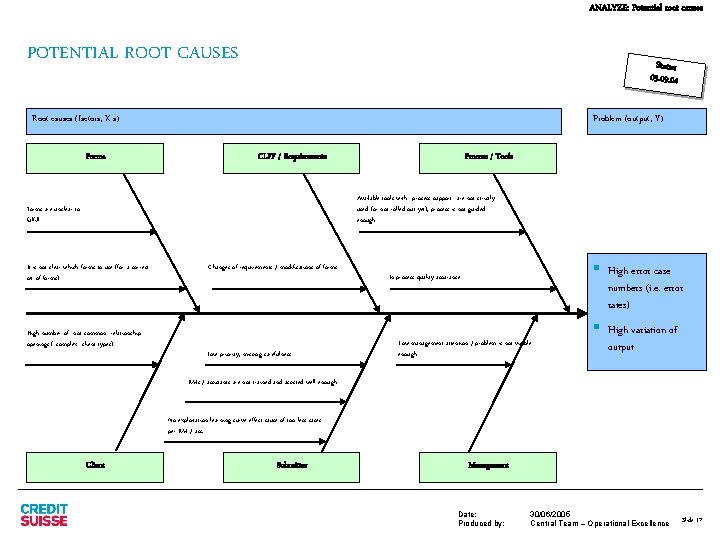
ANALYZE: Potential root causes POTENTIAL ROOT CAUSES Status 03. 09. 04 Root causes (factors; X's) Forms Problem (output, Y) CLFF / Requirements Process / Tools Available tools with "process support" are not strictly used (or not rolled-out yet); process is not guided enough Forms are unclear to fulfill It is not clear which forms to use (for a correct set of forms) High number of "not common" relationship openings ("complex" client types) Changes of requirements / modifications of forms Low priority, missing carefulness § High error case In-process quality assurance numbers (i. e. error rates) Low management attention / problem is not visible enough § High variation of output RMs / assistants are not trained and assisted well enough No exploitation learning curve effect cause of too less cases per RM / ass. Client Submitter Management Date: Produced by: 30/06/2005 Central Team – Operational Excellence Slide 17
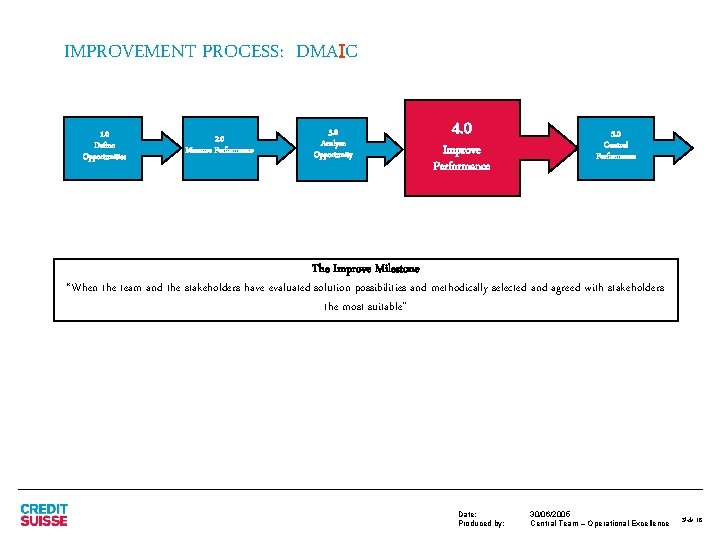
IMPROVEMENT PROCESS: DMAIC 1. 0 Define Opportunities 2. 0 Measure Performance 3. 0 Analyze Opportunity 4. 0 Improve Performance 5. 0 Control Performance The Improve Milestone “When the team and the stakeholders have evaluated solution possibilities and methodically selected and agreed with stakeholders the most suitable” Date: Produced by: 30/06/2005 Central Team – Operational Excellence Slide 18
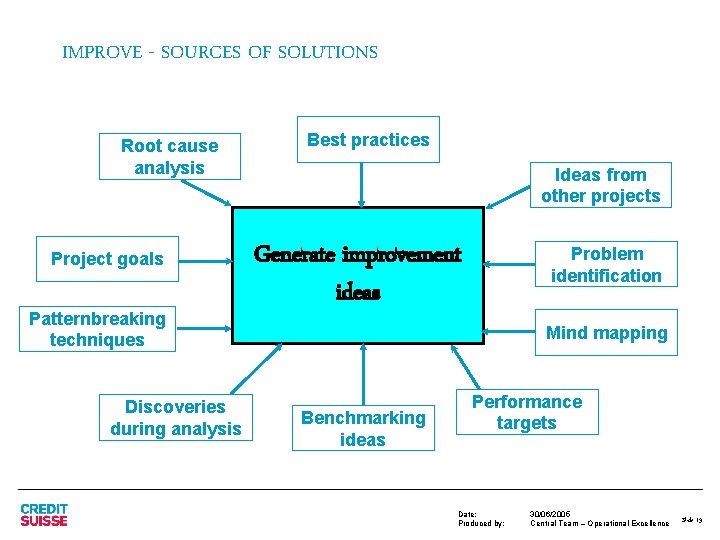
IMPROVE - SOURCES OF SOLUTIONS Root cause analysis Project goals Patternbreaking techniques Discoveries during analysis Best practices Ideas from other projects Generate improvement ideas Problem identification Mind mapping Benchmarking ideas Performance targets Date: Produced by: 30/06/2005 Central Team – Operational Excellence Slide 19
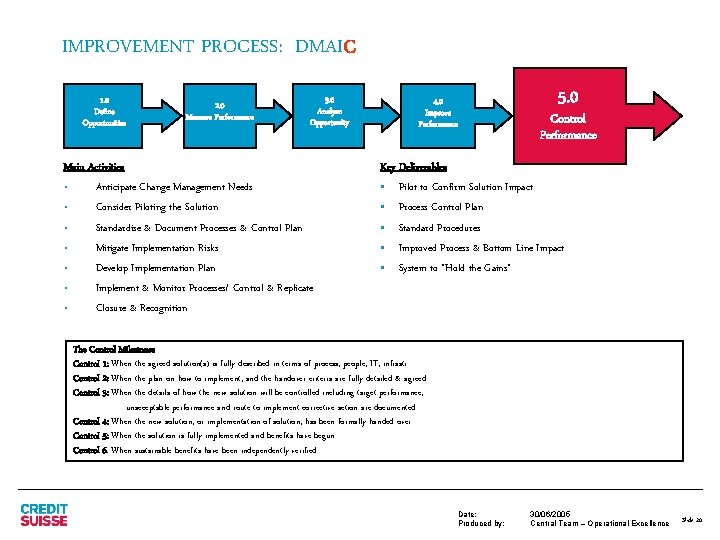
IMPROVEMENT PROCESS: DMAIC 1. 0 Define Opportunities 2. 0 Measure Performance 3. 0 Analyze Opportunity Main Activities § Anticipate Change Management Needs § Consider Piloting the Solution § Standardise & Document Processes & Control Plan § Mitigate Implementation Risks § Develop Implementation Plan § Implement & Monitor Processes/ Control & Replicate § Closure & Recognition 4. 0 Improve Performance 5. 0 Control Performance Key Deliverables § Pilot to Confirm Solution Impact § Process Control Plan § Standard Procedures § Improved Process & Bottom Line Impact § System to “Hold the Gains” The Control Milestones Control 1: When the agreed solution(s) is fully described in terms of process, people, IT, infrastr. Control 2: When the plan on how to implement, and the handover criteria are fully detailed & agreed Control 3: When the details of how the new solution will be controlled including target performance, unacceptable performance and route to implement corrective action are documented Control 4: When the new solution, or implementation of solution, has been formally handed over Control 5: When the solution is fully implemented and benefits have begun Control 6: When sustainable benefits have been independently verified Date: Produced by: 30/06/2005 Central Team – Operational Excellence Slide 20
CONTROL - CRITICAL ELEMENTS OF AN IMPLEMENTATION PLAN § Potential Problem Analysis § Process Control Plan § Training Plan § Communication Plan § Change Management Plan § Budget and Benefits Case § Resource Allocation Scheme § Detailed Implementation Work Plan § ACCOUNTABILITY for Action Date: Produced by: 30/06/2005 Central Team – Operational Excellence Slide 21
- Slides: 21