
Business Ethics in Islam Kaushar Tai Director Aksaa
Business Ethics in Islam Kaushar Tai Director - Aksaa
Learning Outcomes: By the end of the course, delegates will learn: • What is Business Ethics & General Ethics in Islam • Teachings from the Quran and Hadith on Business Ethics • Ethical Approaches to Business • Islamic perspective on Interest (Riba) • Hoarding, Cheating and Deceit in Business • Leniency towards Debtors
In search of The Prophet (peace be upon him) said: "If anyone travels on a road in search of knowledge, Allah SWT will cause him to travel on one of the roads of Paradise. The angels will lower their wings in their great pleasure with one who seeks knowledge. The inhabitants of the heavens and the Earth and (even) the fish in the deep waters will ask forgiveness for the learned man or woman. The superiority of the learned over the devout is like that of the moon, on the night when it is full, over the rest of the stars. The learned are the heirs of the Prophets, and the Prophets leave (no monetary inheritance), they leave only knowledge, and he who takes it takes an abundant portion“ [Abu Dawood] The Prophet (peace be upon him) said: "When Allah desires good for someone, He gives him understanding of the Religion. " [Bukhari].
• Learning through: self, others and presenter • Presenter: only facilitator, facilitating the process of learning • Every good comes from Allah SWT - shortcomings my own responsibility – please forgive me • Come with an open mind an open heart • Today is about picking up tools • People will have varying level of knowledge and back ground • May Allah SWT give us the tawfeeq to put into practice what we learn today
Today is • Allah SWT says: “And remind, for indeed, the reminder benefits the believers” Quran 51: 55 • This session is a reminder for myself - first and foremost. • May Allah SWT give us the tawfiq to put into practice what we will learn today

Allah SWT Says: “And let there be [arising] from you a nation inviting to [all that is] good, enjoining what is right and forbidding what is wrong, and those will be the successful” (Quran - 3: 104)
Are you in Business? This course is about: 1. How can you increase your hasanat 2. How can you avoid falling into sin Self-employed; shop keeper
Self-Motivation by reliance on Allah The Prophet (pbuh) said: “When Allah wishes good for His slave, He hastens to bring about his punishment in this world, and if He does not wish good for him, He withholds the punishment until he is dealt with for his sin on the Day of Resurrection. ”
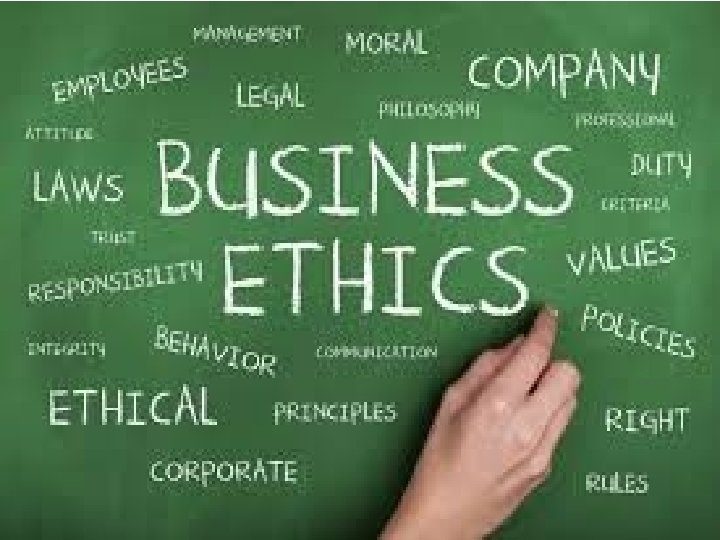
What is Business Ethics • Business Ethics is the moral or just rules and principles within a commercial context. • The duties or obligations that apply to persons engaged in commerce. • Generally speaking, business ethics is a normative discipline, whereby particular ethical standards are formulated and then applied. • It is concerned with the study of what is good and bad, right and wrong, and just and unjust in business.
Ethics in Islam • Islam places the highest emphasis on ethical values in all aspects of human life. • Ethical norms and moral codes are many from the verses of the Qur’an and the teachings of the Prophet pbuh. • They are far reaching and comprehensive. • Islamic teachings strongly stress the observance of ethical and moral code in all aspects of human behaviour.
Islamic Teachings • The Islamic ethical system substantially differs from the secular ethical systems as well as from the moral code advocated by other religions and societies. • It is part of Iman to adhere to a moral code and ethical behaviour in all affairs. • Muslims are required to safeguard their behaviour, deeds, words, thoughts, feelings and intentions. • Certain norms and moral codes have to be observed in their family affairs; in dealings with relatives, with neighbours and friends; in their social affairs and in their business transactions; in fact in all spheres of private and public life.
Moral Ethics applies in every situation For Example – The relationship between a home owner and plumber/electrician/builder etc. – After commissioning work does the worker fulfil the obligation as per mutual contract. – Is the commissioner paying the amount in full and on time. – Are both satisfied in the outcome.
Do Business to Please Allah • Make the first aim to please Allah. Making Profit should be secondary. • Implement Islamic rules of honesty, truthfulness, and good conduct with customers. • The business then is considered to be an Ibadah. & No doubt the business is going to boom, Insha Allah
Important tips in Business • • Be truthful Be open to scrutiny and criticism Have higher goals Pleasing Allah should be the main goal Form an Alliance with other businesses Be clean Do not be involved in Haram Be good to your customers
Truthfulness in business The Prophet pbuh said: “The truthful merchant [is rewarded by being ranked] on the Day of Resurrection with prophets, truthful souls, martyrs and pious people. ” (Tirmidhi, No: 1130)
Be open to scrutiny & criticism • We are all responsible to Allah. If a business is cheating Muslims, Allah will eventually expose those involved. • A Halal business is part of the Muslim community. Therefore, it must be ensure that it meets not only the legal law of the land, but, importantly, the standards of the Quran and Sunnah. (HMC/HFA)
Teachings from the Quran and Hadith • Allah SWT says in the Quran: “You are the best nation that has been raised up for mankind; You enjoin right conduct, forbid evil and believe in Allah. ” (3: 110) • The Prophet pbuh said: “I have been sent for the purpose of perfecting good morals. ” (Ibn Hambal, No: 8595)
Business Enterprise • Islam gives complete freedom to economic enterprise. • Each individual in an Islamic society enjoys complete freedom in the earning of his livelihood. • He can start, manage and organise any kind of business enterprise within the limits set by the Islamic Shari‘ah. • However, freedom does not and must not operate without a sense of responsibility. • An individual is free to pursue his economic activities provided he respects the code of conduct prescribed for the profession, which broadly means choosing things lawful and shunning matters unlawful. • The dictates of the Qur’an and the teachings of the Prophet pbuh serve to set a scale in everybody’s mind to distinguish between the lawful and the unlawful means of earning, and to prohibit or disapprove of all things that are either morally wrong or socially unacceptable.
Islamic approach to Business Ethics • Islam prohibits all activities which may cause harm either to the traders or the consumers in the market. • It encourages the prevalence of free market where everyone earns his sustenance without government intervention. • However, it puts certain restraints in order to eliminate the incidence of injustice and check malpractices and unlawful operations. • If the people fail to take guidance from the Qur’an in matters relating to business transactions, an Islamic state will strive to organize the market transactions on sound Islamic principles.
Islamic approach to Business Ethics • Freedom of enterprise in an Islamic market will, therefore, be regulated by the dictates of the Qur’an and the teachings of the Prophet Muhammad pbuh • During the early centuries of Islam, this function was mainly performed by the institution of Muhasbah (headed by a Muhtasib or market inspector). The institution of Muhasbah was an important institution whose functions were broad-based and varied • Chief among them being keeping a watch on the harmful practices prevalent in the market and the society and checking the incidence of injustice and malpractices in the market. • In the UK we The Trading Standards Authority and others
Rules of ethical discipline in Islamic commercial transactions • Earn Legitimate (Halal) Earnings – And do not consume one another's wealth unjustly or send it [in bribery] to the rulers in order that [they might aid] you [to] consume a portion of the wealth of the people in sin, while you know [it is unlawful]. (Quran 2: 188) “…. . do not consume one another's wealth unjustly but only [in lawful] business by mutual consent. . . ” (Quran 4: 29) (The above verses prohibit the believers to consume the property of others by illegal means. It stresses the importance of mutual consent and gainful exchange)
The Prophet emphasised the legitimate means of earning • A man asked ‘what form of gain is the best? The Prophet pbuh said, ‘A man’s work with his hands, and every legitimate sale’. (Ahmad, No: 1576) This makes it clear that a Muslim trader must be determined to earn only through legitimate means.
Avoiding matters dubious and doubtful. • Leave what makes you doubt for things that do not make you doubt. (Tirmidhi, No: 2442) A true Muslim businessman should be wary of the doubtful things in order to keep himself clear in regard to his faith and his honour because one who falls into doubtful matters is sure to fall into that which is unlawful (Haram).
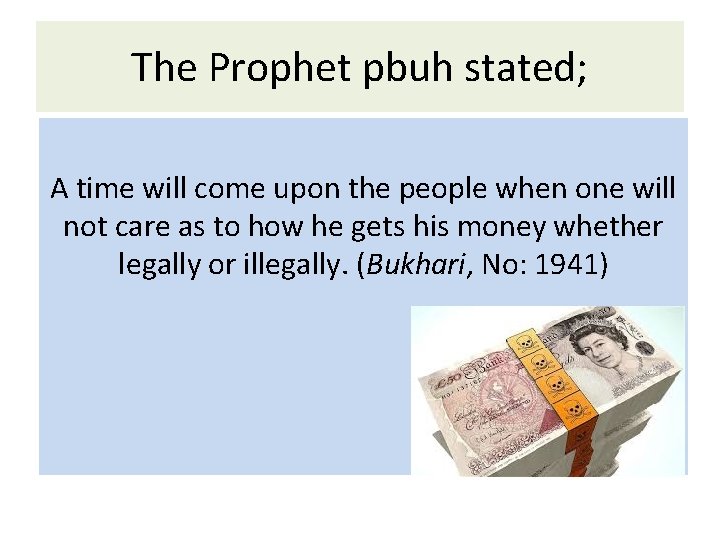
The Prophet pbuh stated; A time will come upon the people when one will not care as to how he gets his money whether legally or illegally. (Bukhari, No: 1941)

Interest (Riba) • Among the most unacceptable business practices strongly condemned in Islam is Riba. (interest), • This is the extra sum the money lender charges from the borrower for deferred payment. Islam forbids all forms of Riba since it involves both oppression and exploitation. • The Qur’an says: “Allah has permitted trading and forbidden Riba (usury). (Quran 2: 275) • “…. do not consume usury, doubled and multiplied, but fear Allah that you may be successful. ” (Quran 3: 130)
Interest (Riba) • The Quran further states: “O you who believe! fear Allah and give up what remains of your demand for usury if you are indeed believers. If you do it not, take notice of war from Allah and his Apostle: but if you turn back you shall have your capital sums; deal not unjustly and you shall not be dealt with unjustly. ” (2: 278 -279)
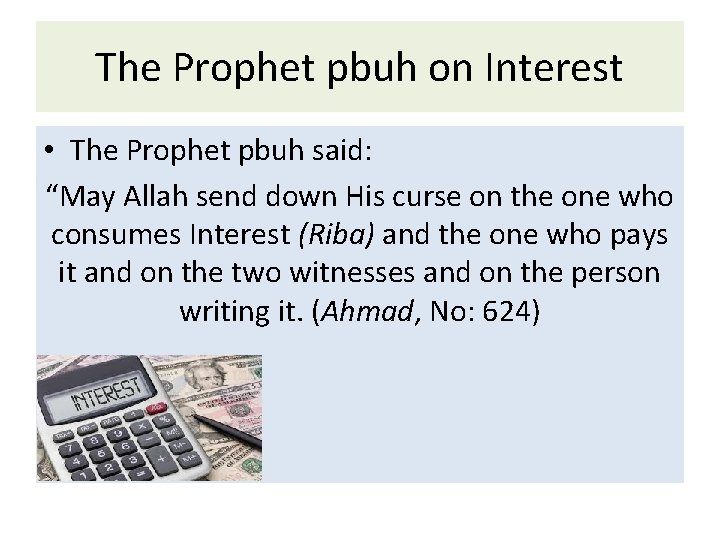
The Prophet pbuh on Interest • The Prophet pbuh said: “May Allah send down His curse on the one who consumes Interest (Riba) and the one who pays it and on the two witnesses and on the person writing it. (Ahmad, No: 624)
Trade through Mutual Consent • Mutual consent between the parties is a necessary condition for the validity of a business transaction. • A sale under coercion is not acceptable in Islam. • Therefore a sale transaction is legal only if it is made through the mutual consent of the parties concerned. • Taking advantage of someone’s plight and charging high price is a form of financial exploitation and as such forbidden in Islam.
Mutual consent paramount • The Prophet pbuh is reported to have said: “A sale is a sale only if it is made through mutual consent. ” (Ibn Majah, No: 2176)
Truthfulness in business • Truthfulness in business transactions and raises the status so much so that he will be at par with the martyrs, in the Hereafter. The Prophet pbuh said: “The truthful merchant [is rewarded by being ranked] on the Day of Resurrection with prophets, truthful souls, martyrs and pious people. ” (Tirmidhi, No: 1130)
The blessings in being truthful • The Prophet pbuh said: “The seller and the buyer have the right to keep or return the goods as long as they have not parted or till they part; and if both the parties spoke the truth and described the defects and qualities [of the goods], then they would be blessed in their transaction, and if they told lies or hid something, then the blessings of their transaction would be lost. ” (Bukhari, No: 1937)
The Prophet pubh said: The Prophet pbhu said: “Traders are wicked people. ” The Companions asked: “O Messenger, has Allah not permitted business” The Messenger replied: “Of course He has declared trading lawful. But they (i. e. the traders) will swear by Allah and do evil, they will not speak but tell lies. ” (Ahmad, No: 14982)
Don’t barter your hereafter • A true Muslim trader will not, therefore, barter his Akhirah (hereafter) for worldly gains. He will avoid fraud, deception, and other dubious means in selling his merchandise. The sense of mutual trust demands that the pros and cons of commodity be revealed to the buyer so that he purchases the commodity in full satisfaction. • Allahs says in the Qur’an: “O you believers! Do not betray Allah and the Messenger, nor knowingly, betray your trusts. ” (8: 27)
Be Lenient to your Debtors • Demand a debt back from the debtor in a decent manner. • The Prophet pbuh said: “May Allah’s mercy be on him who is lenient in his buying, selling, and in demanding back his money [or debts]. ” (Bukhari, No: 1934)
Returning the Debt on time The debtor, in turn, should also give back the debt to the creditor on time with due thanks and politeness. “Abu Rafi‘ reports that the Prophet pbuh took a young camel on loan. When camels came to him in charity, he asked Abu Rafi‘ to give the creditor a young she camel. Abu Rafi‘ pointed out that there was no young camel except for a four–year old camel of a very good quality. The Prophet pbuh said: ‘Give him the best one, for the best amongst you is he who repays the rights of others handsomely’. (Muslim, No: 3002)
Fulfilling Business Obligations • Islamic teachings require a Muslim trader to keep up his trusts, promises and contracts. The basic principles of truth, honesty, integrity and trust are involved in all business dealings • The Quran states: “O you who believe! Fulfil [your] obligations. ” Quran (5: 1)
Keeping promises The prophet pbuh said: “The Muslims are bound by their terms and conditions. " (Abu Da’ud, No: 3120)
Responsibility of the Employer • It is the religious and moral responsibility of the employer to take care of the overall welfare and betterment of his employees. - Fair wages, good working conditions, suitable work and excellent brotherly treatment should be provided to the workers. The Prophet Pbuh explained “Those are your brothers [workers under you] who are around you, Allah has placed them under you. So, if anyone of you has someone under him, he should feed him out of what he himself eats, clothe him like what he himself puts on, and let him not put so much burden onhim that he is not able to bear, [and if that be the case], then lend your help to him. ” (Bukhari, No: 2359)
The Prophet pbuh said: “I will be foe to three persons on the Last Day: one of them being the one who, when he employs a person that has accomplished his duty, does not give him his due. ” (Bukhari, No: 2109)
Paying the wages on time The Prophet pbuh said: “The wages of the labourers must be paid to him before the sweat dries upon his body. ” (Ibn Majah, No: 2434)
Dealing in Prohibited (Haram) Items • Dealing in unlawful items such as dead meat, and pigs is strongly prohibited in Islam. • Dead meat would mean the flesh of any bird or animal dead from natural causes, without being properly slaughtered in an Islamic way. • A Muslim, therefore, will not eat the flesh of such an animal or bird. • Flesh of an electrocuted animal, or of an animal killed by the blow of a blunt weapon, and of the strangled one is also forbidden in Islam. • Also prohibited is the flesh of the animal that has been killed or slaughtered in ways other than Islamic. • It is, therefore, not permissible for a Muslim to trade in dead meat. Likewise, trading in pork or intoxicants and sale of idols and statues is not permitted in Islam
Prohibitions from the Quran “Forbidden to you [for food] are: dead meat, the blood, the flesh of swine and that on which name of other than Allah has been mentioned. ” Quran (5: 1) “O you who believe! intoxicants and gambling [dedication of] stones and [divination by] arrows are an abomination of Satan’s handiwork: so avoid it in order that you may prosper. ” Quran (5: 90)
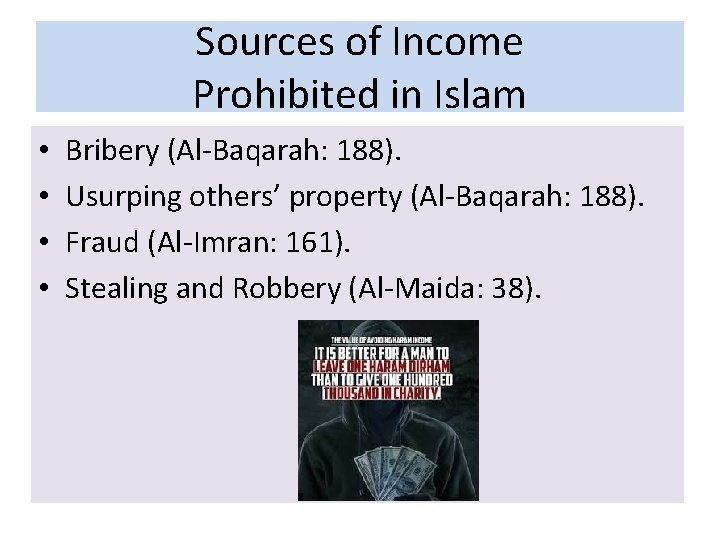
Sources of Income Prohibited in Islam • • Bribery (Al-Baqarah: 188). Usurping others’ property (Al-Baqarah: 188). Fraud (Al-Imran: 161). Stealing and Robbery (Al-Maida: 38).
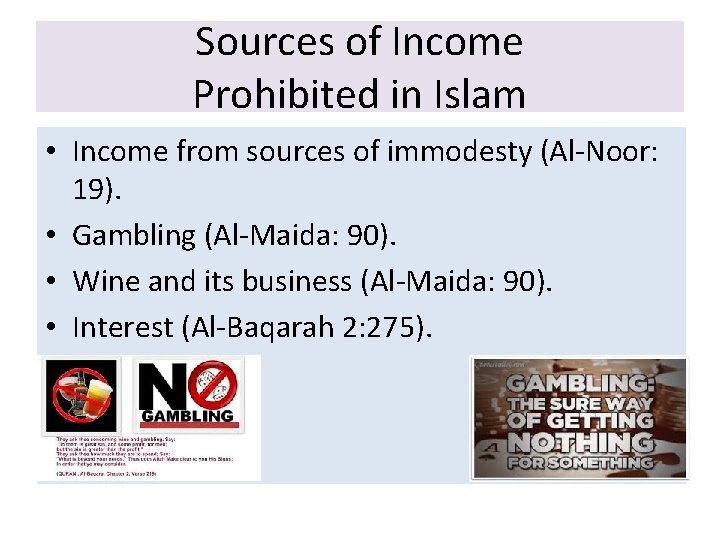
Sources of Income Prohibited in Islam • Income from sources of immodesty (Al-Noor: 19). • Gambling (Al-Maida: 90). • Wine and its business (Al-Maida: 90). • Interest (Al-Baqarah 2: 275).
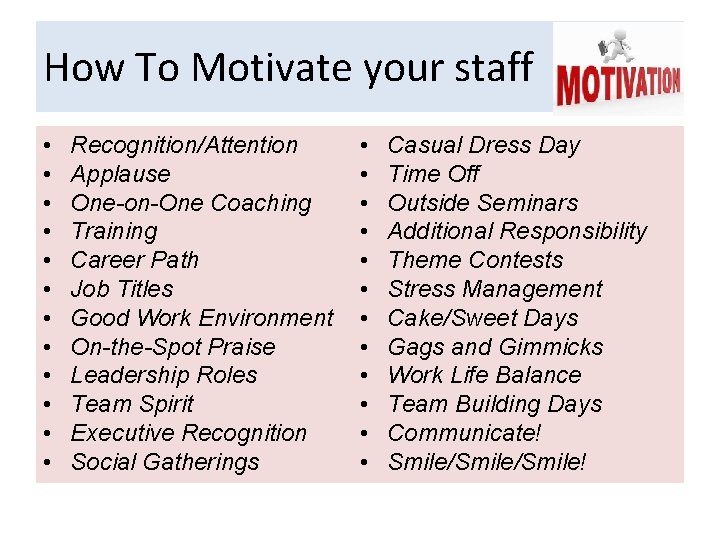
How To Motivate your staff • • • Recognition/Attention Applause One-on-One Coaching Training Career Path Job Titles Good Work Environment On-the-Spot Praise Leadership Roles Team Spirit Executive Recognition Social Gatherings • • • Casual Dress Day Time Off Outside Seminars Additional Responsibility Theme Contests Stress Management Cake/Sweet Days Gags and Gimmicks Work Life Balance Team Building Days Communicate! Smile/Smile!
Moral Conduct • “And measure full when you measure. And weigh with an even balance. This is better and its end is good. ” [Al-Bani-Israel: 35]. • “They who hoard up gold and silver and spend it not in the way of Allah, unto them give tidings (O Muhammad) of a painful doom. ” [Al-Tauba: 34]
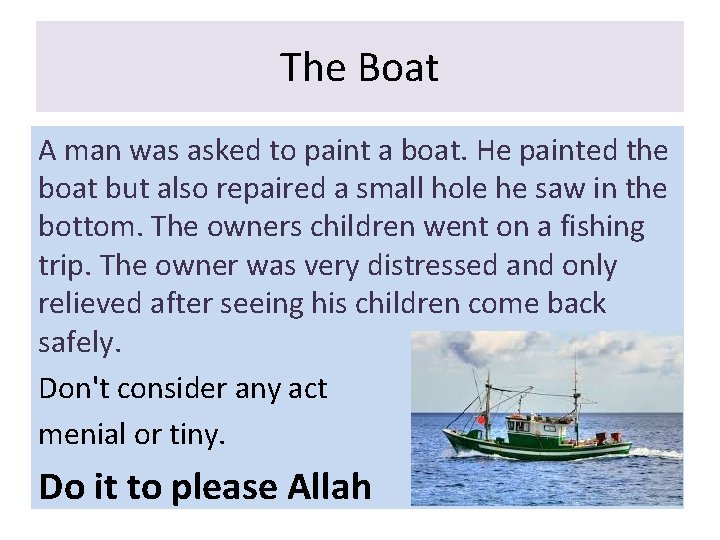
The Boat A man was asked to paint a boat. He painted the boat but also repaired a small hole he saw in the bottom. The owners children went on a fishing trip. The owner was very distressed and only relieved after seeing his children come back safely. Don't consider any act menial or tiny. Do it to please Allah
Moral Conduct • “You resort to oaths as instruments of mutual deceit, so that a person might take greater advantage than another; although, Allah puts you to the test through this. Surely, on the Day of Resurrection, He will make clear the truth concerning the matters over which you differed. ” [Al-Nahl: 92].
Moral Conduct • “Who so desires the reward of the world, then with Allah is the reward both of the world and of the Hereafter. And Allah is Hearing, Seeing. ” [Al-Nisa: 134]. • “And that the man will not get but what he endeavours. And that his endeavour shall soon be seen. ” [An-Najm: 39 -40].
Moral Conduct • “O Believers! Whenever you lend money for a particular period, write and someone among you must write it justly. And the one who can write must not refuse. ” [Al-Baqara: 282]. • Prophet Muhammad (pbuh) has said that “Almighty Allah’s mercy descends on one who is gentle at the time of buying, selling, and requesting payment. ” [Tirmizi].
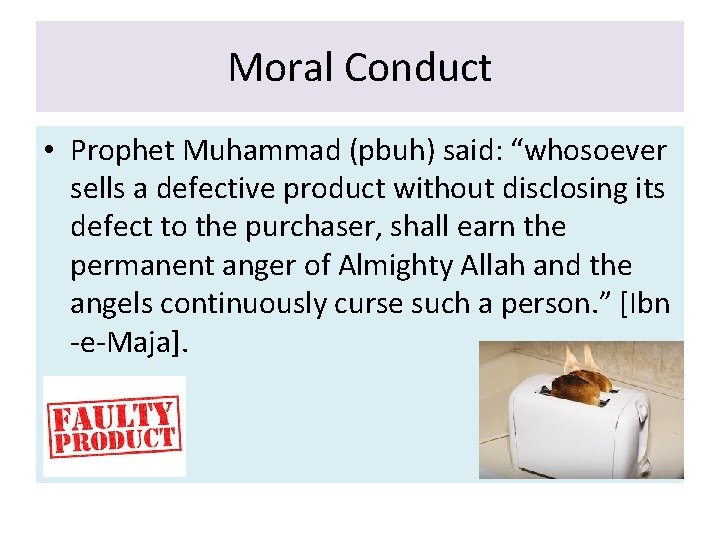
Moral Conduct • Prophet Muhammad (pbuh) said: “whosoever sells a defective product without disclosing its defect to the purchaser, shall earn the permanent anger of Almighty Allah and the angels continuously curse such a person. ” [Ibn -e-Maja].
Moral Conduct • Prophet Muhammad (pbuh) said: “The seller and the buyer have the right to keep or return the goods as long as they have not parted or till they part; and if both the parties spoke the truth and described the defects and qualities [of the goods], then they would be blessed in their transaction, and if they told lies or hid something, then the blessings of their transaction would be lost. ” (Bukhari, No: 1937)
Moral Conduct • Prophet Muhammad (pbuh) has stressed that we should refrain from taking oaths unnecessarily; for although, it helps in the sale of one’s products, it reduces the blessings. [Bukhari; also in Muslim].
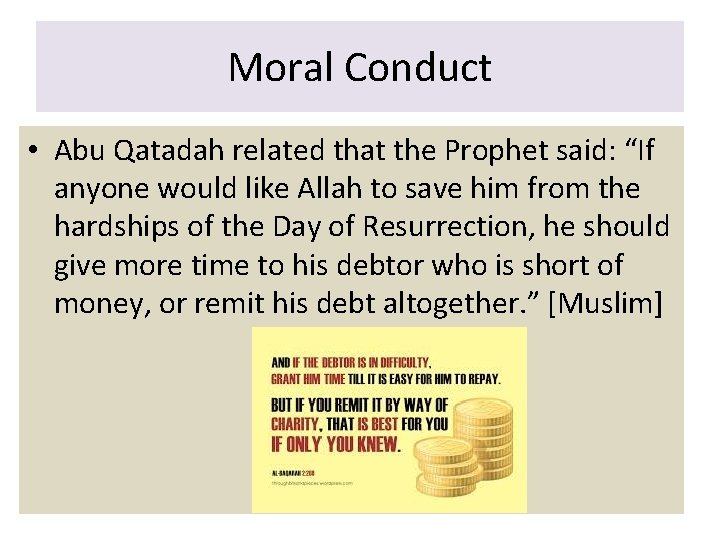
Moral Conduct • Abu Qatadah related that the Prophet said: “If anyone would like Allah to save him from the hardships of the Day of Resurrection, he should give more time to his debtor who is short of money, or remit his debt altogether. ” [Muslim]
Moral Conduct • Prophet Muhammad (pbuh) said: “May Allah’s mercy be on him who is lenient in his buying, selling, and in demanding back his money [or debts]. ” (Bukhari, No: 1934) • Abu Huraira narrated that the Prophet said: “A time will come upon the people when one will not care how one gains one’s money, legally or illegally. ” [Bukhari].
Moral Conduct • It is reported by Jabir that the Prophet said: “The flesh and body that is raised on unlawful sustenance shall not enter Paradise. Hell is more deserving to the flesh that grows on one’s body out of unlawful sustenance. ” [Ahmad].
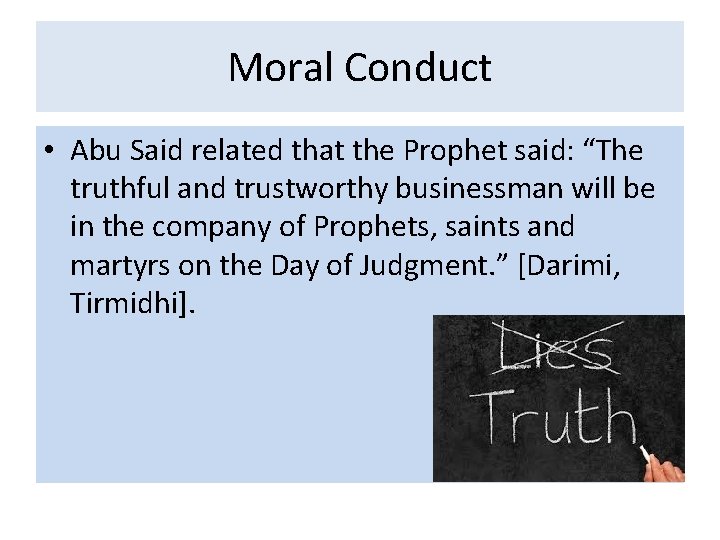
Moral Conduct • Abu Said related that the Prophet said: “The truthful and trustworthy businessman will be in the company of Prophets, saints and martyrs on the Day of Judgment. ” [Darimi, Tirmidhi].
The Prophet pbuh said; “Allah and His Messenger made illegal the trade of alcoholic liquors, dead animals, pigs and idols. ” (Bukhari, No: 2082) The Prophet pbuh also said: “If Allah makes something unlawful, he makes its price also unlawful. ” (Ahmad, No: 2546)
Sale of Al-Gharar (Uncertainty, Risks, Speculation) • This refers to the sale of a commodity or good which is not present at hand; • or the sale of an article or good, the consequences or outcome of which is not yet known; • or a sale involving risks or hazards where one does not know whether at all the commodity will later come into existence. • Such a sale is strictly prohibited in Islam because the quality, whether good or bad, is not known to the buyer at the time of the deal and there is every possibility that the contract may give rise to disputes and disagreements between the concerned parties.
Sale of what is uncertain • The Prophet pbuh, prohibited the sale of what is still in the loins of the male; • or sale of whatever is in the womb of a she–camel; • or sale of birds in the air; • or the sale of fish in the water, • and any transaction which involves Gharar. (i. e. anything that involves deception). • He also forbade the sale of fruits before they look healthy and also the sale of crops until the grain hardens. • Nevertheless, such advance sales would be acceptable if the element of Gharar does not exist and the quality and the quantity of the goods are pretty well known and predictable.

Arbitrarily Fixing the Prices • Islam does not, encourage the practice of price– fixing. • This is because rise and fall in the prices are linked to various factors other than the greediness of the traders and fixing the prices may endanger both public and private interests.
Once the price shot up and the people said: • O Messenger of Allah! Prices have shot up, so fix them for us. Thereupon the Messenger of Allah said: “Allah is the One Who fixes prices, withholds, gives lavishly, and provides, and I hope that when I meet Allah, none of you will have any claim on me for an injustice regarding blood or property. ” (Tirmidhi, No: 1235)
Exceptions to the rule • However, if a trader adopts unfair means, charges unjust prices and indulges in undercutting with a view to doing harm to the smaller traders, public authorities have the right to intervene in the market. • They can and should take steps to fix or control the prices so as to eliminate injustice from the market and allow the trader to earn reasonable profit and the buyer to pay a just and equitable price.
Hoarding of Food stuff • • The Arabic word for hoarding is Ihtikar. It means storing foodstuffs or withholding them in expectation of rise in their prices. Sometimes, a handful of traders operating in the market buy the entire quantity of an item, rice for example, and store it up with the object of selling it later at the time of scarcity to draw maximum profit out of it and to dictate the prices. The consumers are left with no choice but to purchase the article concerned from the one who hoards, as he is the only one in the market who holds it. Sometimes, a trader consorts with the suppliers who will only sell their merchandise to him. As a result, he holds the entire stock of the essential items that other traders do not possess. He is, therefore, in a position to dictate his terms in the market and sell them at an exorbitantly high price to the needy people. This is an unjust practice and a clear case of exploitation and deservedly condemned by Islam.
With regard to Hoarders The Prophet pbuh said: “No one hoards but the traitors (i. e. the sinners). ” (Abu Da’ud, No. 2990) He pbuh also said: “The importer [of an essential commodity] into the town will be fed [by Allah], and the hoarder will have [Allah’s] curse upon him. (Ibn Majah, No: 2144)
Exploitation of one’s Ignorance of Market Conditions One of the most common unethical practices in modern business is to exploit one’s ignorance of market conditions. Sometimes it may happen that a buyer arrives in a town with objects of prime and general necessity for selling them in the market. A local trader may persuade the new-comer to transfer all of the goods to him so that he will sell them on his behalf in the market. He obtains the commodities on a price that is lower than market price and then sells them at a high or exorbitant price. Islam condemns this act of intermediary intervention which involves exploitation of one’s ignorance of market conditions.
The Prophet pbuh said: • To avoid exploitation of one’s Ignorance of Market Conditions the Prophet pbuh stated: “A town dweller should not sell the goods of a desert dweller. ” (Bukhari, No: 2006)
Al-Najsh (defraud) The term Al-Najsh means an action in which a person offers a high price for something, without intending to buy it, but just to cheat or defraud another person who really means to buy it. The person practising it may collaborate with the seller to offer high prices in front of the buyers merely as a means to cheat them. This type of fraudulent transaction is totally prohibited in Islam.
Concerning cheating The Prophet pbuh stated: “Do not harbour envy against one another; do not outbid one another [with a view to raising the price]; do not bear aversion against one another; do not bear enmity against one another; one of you should not enter into a transaction when the other has already entered into it; and be fellow brothers and true servants of Allah. ” (Muslim, No: 4650)
Someone offering a higher price after a deal Islam also forbids the practice of sale over sale and purchase over purchase. This means that it forbids someone to offer a higher price for a commodity after the deal has been accomplished between the parties. Obviously he is offering a higher price in order to spoil the agreement reached between the parties. As a result of this offer the buyer may feel tempted to cancel his contract to sell it at a higher price. It may give rise to disputes and disagreements between brothers. Hence it is strictly prohibited in Islam.
In Summary • Islam strongly condemns all fraudulent practices in business transactions (Al-Ghashsh). That is: • Sale of dead animal, • dubious and vague transactions, • manipulating the prices, • selling the items belonging to a desert dweller by a townsman Al. Najsh (trickery), • false praise and concealment of defects • These are all examples of cheating and fraud i. e. Al-Gashsh. The Prophet pbuh has strongly condemned all such practices in a number of traditions and the believer to abstain from them.
Swearing by Allah • Traders may claim qualities in the merchandise, which don’t exist. They try to persuade the buyers to purchase their commodity by invoking Allah’s name. • Swearing in business for such purposes is forbidden in Islam, be it false or true. • False swearing is an act of sin. • Swearing by Almighty Allah is too great a thing to be used as a means to sell a commodity. • The desirable thing in business transaction is that both the buyer and the seller remain straightforward and truthful in their dealings, so that no one will feel the need to swear by Allah in order to create conviction in the mind of the other party. • The Prophet (sws) is reported to have said: “Swearing [by the seller] may persuade the customer to purchase the goods but the deal will be deprived of Allah’s blessing. ” (Bukhari, No: 1945)
Giving Short measure • One form of deceit is to manipulate weights and measures. • It refers to the act of taking full measures from others and giving them short measures in your turn. • Giving short measures was a common disorder plaguing the pre. Islamic days. • The community of the Prophet Shu‘ayb pbuh was known for practising it with impunity. Consequently, they were destroyed for their persistence in deceit and disbelief in Allah and His Messenger. • Allah the Almighty has repeatedly commanded exactness in weights and measures. One of the verses says: “And give full measure when you measure, and weigh with a just balance. That is good and better in the end. Quran (17: 35)
Dealing in Stolen Goods • Allah SWT has declared stealing unlawful and warned of severe punishment such as cutting the hand of the thief from the wrist joint if the necessary legal conditions for the award of punishment are met. • Even if the thief escapes worldly punishment and gets away with stolen goods, it is not permissible for a Muslim to knowingly purchase or sell these items. • The stolen items are neither to be bought nor sold by those who know the reality. • The Prophet (sws) made the person knowingly buying a stolen commodity a partner to the crime. He said: “The one who knowingly purchases a stolen good, is a partner to the act of sin and the shame. ” (Kanz Al-‘Ammal, No: 9258)
Summary • The fundamental codes of moral behaviour such as truthfulness, trustworthiness, generosity and leniency, adherence to business commitments and contracts, fair treatment of workers, avoidance of evil practices (such as fraud, cheating, deceit, hoarding of foodstuff, exploitations, giving short measures etc. ) provide, to a large extent, the general background of Islamic business ethics.
Summary Sources of income prohibited in Islam 1. 2. 3. 4. 5. Bribery (Al-Baqarah: 188). Usurping others’ property (Al-Baqarah: 188). Fraud (Al-Imran: 161). Stealing and Robbery (Al-Maida: 38). Income from sources of immodesty (Al-Noor: 19). 6. Gambling (Al-Maida: 90). 7. Wine and its business (Al-Maida: 90). 8. Interest (Al-Baqarah: 275).
- Slides: 78