
BUSINESS ETHICS Dutch Bros adopted the Optimists Creed
BUSINESS ETHICS

Dutch Bros. “adopted” the Optimists’ Creed as the “Dutch Creed. ” Every meeting ends with reciting it to help keep a positive outlook THE CREED To be so strong that nothing can disturb your peace of mind. To talk health, happiness and prosperity to every person you meet. To make all your friends feel that there is something in them. To look at the sunny side of everything and make your optimism come true. To think only of the best, to work only for the best, and to expect only the best.

THE CREED To be just as enthusiastic about the success of others as you are about your own. To forget the mistakes of the past and press on to the greater achievements of the future. To wear a cheerful countenance at all times and give every living creature you meet a smile. To give so much time to the improvement of yourself that you have no time to criticize others. To be too large for worry, too noble for anger, too strong for fear, and too happy to permit the presence of trouble.

BUSINESS ETHICS "Let me appeal to your sense of doing things my way" Cartoon by P. C. Vey Copyright 2004, Harvard Business Review
BUSINESS ETHICS Can Business (and Businesses) be “Ethical? ” What does that mean? Do “Ethics” matter More Now than Before? Whose “Ethics” are They? Isn’t the “Best Ethic” maximizing Shareholder Value? What do you say to your “Stakeholders? ”

WHY DO ETHICS MATTER? Does “Doing the Right Thing” Matter? To Whom Does it Matter? What are the Costs to Business of Unethical Behavior?
WHERE DO ETHICS MATTER? In a Court Room: Legal Implications Financial Markets: Reliability of Information Human Resources Markets: How to Attract and Retain the Best and Brightest
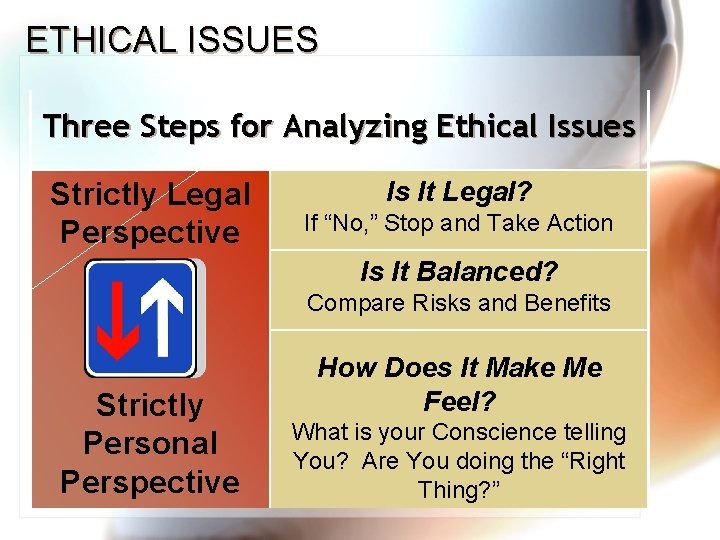
ETHICAL ISSUES Three Steps for Analyzing Ethical Issues Strictly Legal Perspective Is It Legal? If “No, ” Stop and Take Action Is It Balanced? Compare Risks and Benefits Strictly Personal Perspective How Does It Make Me Feel? What is your Conscience telling You? Are You doing the “Right Thing? ”

BUSINESS ETHICS After 3 months on the job, you learn an employee falsified her employment application: she doesn’t have a college degree. As her boss, what do you do? Fire Her Immediately Overlook it, She’s doing a Great Job Balance the Omission's Severity with the Great Job she’s doing plus her Age and Ethnicity
BUSINESS ETHICS Your least effective employee has applied to transfer to another department. And the manager is calling you for a reference… Say the employee is the best one you’ve ever had and you’re heartbroken they’re leaving Be Candid - Tell Everything - Leave out Nothing Tell the manager the employee might be
BUSINESS ETHICS A Relative wants to work in your Department. It could be a promotion and a big pay raise. He’s asking for your advice… Give him the benefit of your inside knowledge Tell him not to apply Tell him that if he gets the job, he’ll have to move out of your house where he’s
BUSINESS ETHICS You discover your Boss lets his Children (who attend an expensive outof-state college) charge calls to the Firm’s Telephone Account and then falsifies his Expense Record… Tell Accounts Payable about what you know Write a Memo reminding everyone about the policy regarding personal use of

UNETHICAL BUSINESS PRACTICES 1. Abusive or Intimidating Behavior 2. Accurate but Incomplete Disclosures 3. Discrimination against Protected Class 4. Receiving/Offering Bribes, Kickbacks or Incentives 5. Theft/Fraud: Expense Accounts/Personal Use of Company Property

BUSINESS ETHICS: APPROACHES COMPLIANCE-BASED Prevent, Detect and Punish Legal Violations INTEGRITY OR VALUESBASED Define Organizational Values and Encourage Employee Commitment to Ethical Aspirations
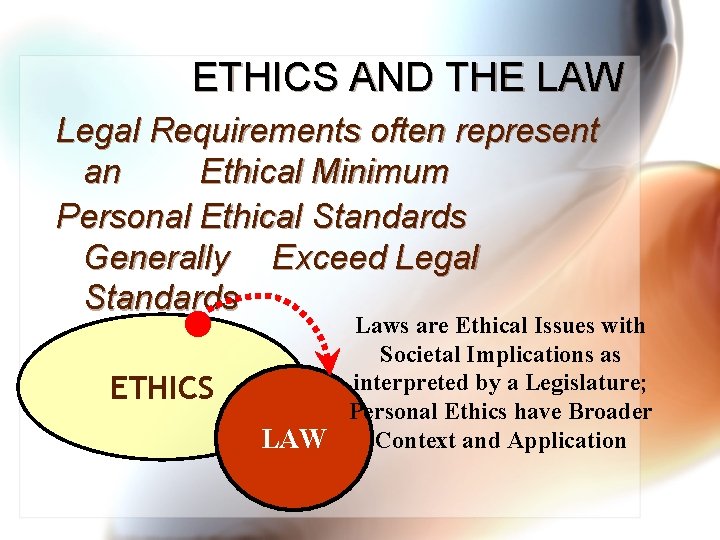
ETHICS AND THE LAW Legal Requirements often represent an Ethical Minimum Personal Ethical Standards Generally Exceed Legal Standards ETHICS Laws are Ethical Issues with Societal Implications as interpreted by a Legislature; Personal Ethics have Broader Context and Application LAW
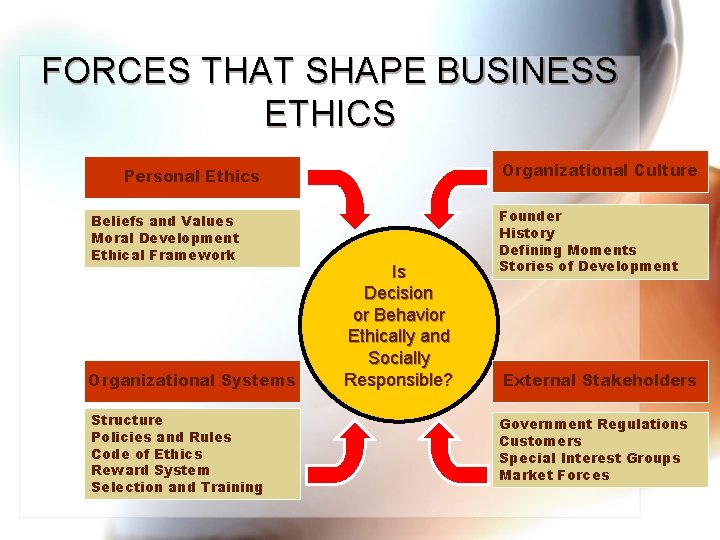
FORCES THAT SHAPE BUSINESS ETHICS Organizational Culture Personal Ethics Beliefs and Values Moral Development Ethical Framework Organizational Systems Structure Policies and Rules Code of Ethics Reward System Selection and Training Is Decision or Behavior Ethically and Socially Responsible? Founder History Defining Moments Stories of Development External Stakeholders Government Regulations Customers Special Interest Groups Market Forces

PERSPECTIVES ON ETHICS Ethical Issues require Persons or Organizations to choose an Action that may get judged as Right or Wrong Business Ethical Issues: Classifications Conflicts of Interest Fairness and Honesty Communications Organizational Relationships
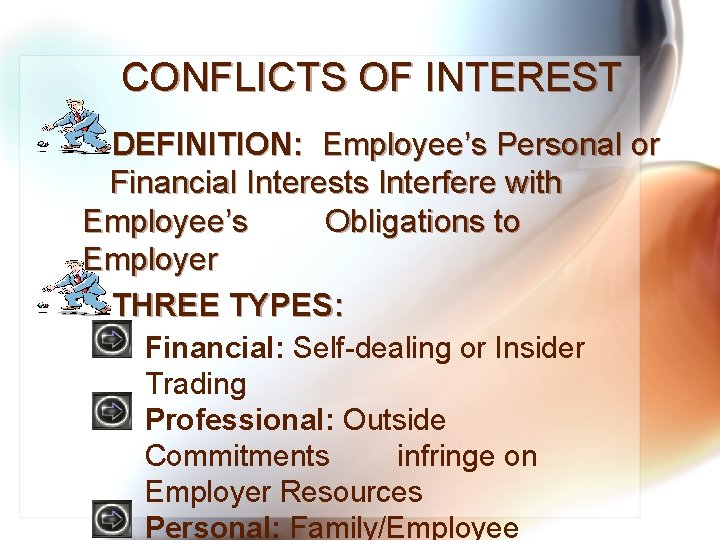
CONFLICTS OF INTEREST DEFINITION: Employee’s Personal or Financial Interests Interfere with Employee’s Obligations to Employer THREE TYPES: Financial: Self-dealing or Insider Trading Professional: Outside Commitments infringe on Employer Resources Personal: Family/Employee
CONFLICTS OF INTEREST BEST RESPONSE? Preventative Measures: Employees free to have unrelated job activities, but… EMPLOYER CAN EXPECT LAWFUL AND CONFLICT-FREE BEHAVIOR Strategically Identify and Manage Potential Conflicts with Written Policies, Standards, Expectations,
STRUCTURES AND SYSTEMS Have a Code of Ethics (standards), but more important, have a Code of Conduct (Actions) Communications Network: Formal and Informal Processes for Reinforcing and Refreshing Formal Reporting system: Ethics Ombudsperson - Unbiased and Neutral but with Authority

ETHICAL CLIMATE/CULTURE More Important than Ethics Program Begins with leadership (all levels) that includes Ethical Considerations in every Decision: Are We Doing the Right Thing? Focus on What’s best for BOTH Employees and Affected Community (stakeholders) Actions louder than Words/Codes:
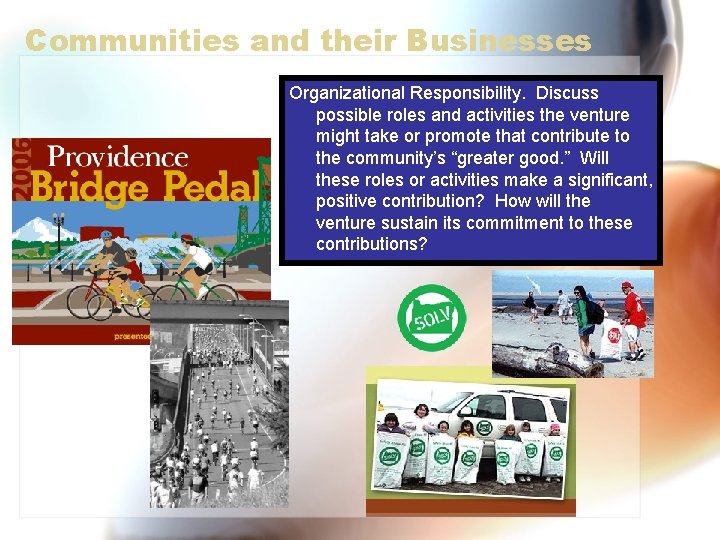
Communities and their Businesses Organizational Responsibility. Discuss possible roles and activities the venture might take or promote that contribute to the community’s “greater good. ” Will these roles or activities make a significant, positive contribution? How will the venture sustain its commitment to these contributions?
CRITERIA GUIDING ETHICAL ACTIONS Employees won’t be Punished for Questioning Authority Employees will be held Accountable (Punished) for Rule Violations Focus on larger organizational/societal Outcomes; Not Personal/self. Interest Would You wish Others to behave
BOTTOM LINE OF ETHICAL LEADERSHIP Decision-making includes Personal, Organizational and societal Values Ethical Values always open to Discussion and Criticism but … Must have Fire Wall between Immutable standards and Caseby-Case Exceptions Accept Responsibility for sound Moral Judgments: It’s in Everyone’s Job Description
- Slides: 24