
Business Enterprise Systems Integrity Service Excellence State of
Business & Enterprise Systems Integrity - Service - Excellence “State of BES” Col Kyle Reybitz Deputy PEO 31 Jan 18 1
Agenda • • • BES Intro/Overview HHQ Guidance Business Capability Acquisition Cycle (BCAC) BES Initiatives/Progress Small Business Breaking Barriers … Since 1947 2
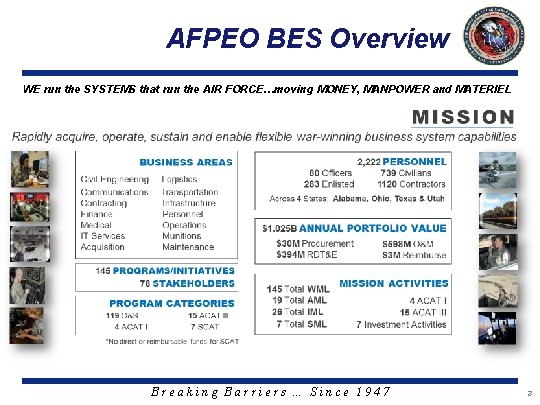
AFPEO BES Overview WE run the SYSTEMS that run the AIR FORCE…moving MONEY, MANPOWER and MATERIEL Breaking Barriers … Since 1947 3
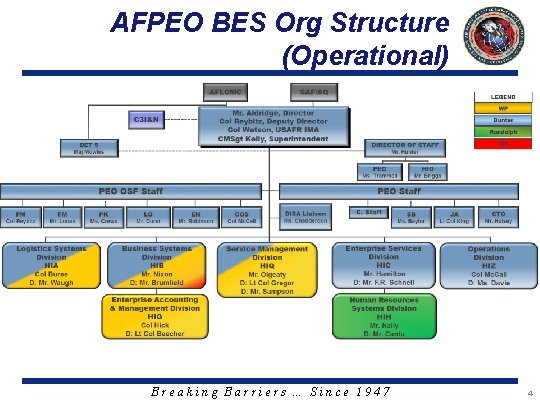
AFPEO BES Org Structure (Operational) Breaking Barriers … Since 1947 4
BES Strategic Goals Goal 1 –Recruit, develop, & retain an agile workforce Goal 2 –Strengthen Customer, Stakeholder and Industry Relationships Goal 3: Drive flexibility & speed into our corporate processes Goal 4: Remove non-value added policies & foster innovation through prototyping & incorporating disruptive technologies Goal 5: Evolve to an adaptive organization structure; thereby, achieving flexibility & increasing mission effectiveness Update Pending Breaking Barriers … Since 1947 5
SECDEF Guidance • 5 Oct 17: Three Lines of Effort • First, restore military readiness as we build a more lethal force. • Second, strengthen alliances and attract new partners. • Third, bring business reforms to the Department of Defense. This line of effort instills budget discipline and effective resource management, develops a culture of rapid and meaningful innovation, streamlines requirements and acquisition processes, and promotes responsible risk taking and personal initiative. Some specific reforms are already in progress, such as the Congressionally-mandated creation of a Chief Management Officer and realignment of the Under Secretary of Defense for Acquisition, Technology and Logistics, as well as the Department's preparations for its first full-scope financial audit in FY 2018. Others are forthcoming, as we seek to modernize the defense travel system, protect our infrastructure and intellectual property, improve information technology business operations efficiency, and implement real cost accounting. Breaking Barriers … Since 1947 6
DEP SECDEF Guidance • 27 Oct 17: Information Technology and Business System Reform • As part of NDAA FY 17 Section 901 • Reform efforts align functionally against 8 major lines of business • IT Reform Priority Areas (Current) • • Reduce IT Commodity Sellers • Enterprise Collaboration Suite (ECAPS) • One NIPR/ One SIPR • Rationalize Business Systems (DCPS, DTS) • Consolidate Cyber/ IT Responsibilities • Accelerate Enterprise Cloud Adoption IT Reform Priority Areas (as identified by Memo) • Time-phased roadmaps that evolve and deploys systems to support business reforms • Reduce total number of systems • Ensure systems have necessary controls to support audit and information integrity Breaking Barriers … Since 1947 7
SAF CIO High Priorities • DMZ Migration • Win 10 Migration • PKI Compliance • Privileged Access Management (PAM) is a virtual or hardened appliance/tool that performs strong 2 factor authentication (2 FA) of privileged users as a proxy for legacy end devices Breaking Barriers … Since 1947 8
Other Ongoing HHQ Efforts • • EITaa. S (C 3 I&N) JEDI (OSD) ITCM (AFICA) Agile “Everything” (MGen Zabel) Data Mgmt (MGen Crider) Bottleneck QRT (C 3 I&N) Mobile (HAF/A 4) • IT Approp/Working Captial Fund? Breaking Barriers … Since 1947 9
New Do. DI 5000. 75 Business Capability Acquisition Cycle n The reason behind the changes: n Do. DI 5000. 02 milestones, models and documentation did not provide the proper structure for managing business systems n In practice… tailoring for a business system often took too much time and effort, making it hard to justify the benefits it produced n The biggest differences from previous state of practice: n Alignment of acquisition, functional, infrastructure and IT investment governance to streamline decision-making n Information-centric approach to evaluating programs rather than reliance on acquisition and requirements documentation n Reflects elimination of statutory requirements for Major Automated Information Systems (repeal of title 10 Chapter 144 A -effective September 30, 2017) Breaking Barriers … Since 1947 10
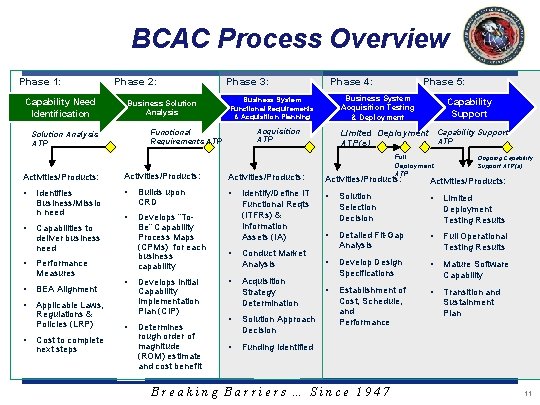
BCAC Process Overview Phase 1: Phase 2: Capability Need Identification Business Solution Analysis Phase 3: Phase 5: Business System Acquisition Testing & Deployment Business System Functional Requirements & Acquisition Planning Acquisition ATP Functional Requirements ATP Solution Analysis ATP Phase 4: Capability Support Limited Deployment Capability Support ATP(s) Full Deployment ATP Ongoing Capability Support ATP(s) Activities/Products: Activities/Products: • Identifies Business/Missio n need • Builds upon CRD • • • Capabilities to deliver business need Limited Deployment Testing Results • • Full Operational Testing Results Performance Measures Conduct Market Analysis Detailed Fit-Gap Analysis • Develops “To. Be” Capability Process Maps (CPMs) for each business capability Solution Selection Decision • • Mature Software Capability • BEA Alignment • Applicable Laws, Regulations & Policies (LRP) Establishment of Cost, Schedule, and Performance • • Acquisition Strategy Determination Develop Design Specifications Transition and Sustainment Plan • Cost to complete next steps • Develops initial Capability Implementation Plan (CIP) • Determines rough order of magnitude (ROM) estimate and cost benefit • • Identify/Define IT Functional Reqts (ITFRs) & Information Assets (IA) • Solution Approach Decision • Funding Identified Breaking Barriers … Since 1947 11
BCAC Implementation Status n AFMAN 63 -144 – Business Capability Requirements, Compliance, and System Acquisition n Under review with BCAC Working Group n Pending 2 -ltr “re-coord” n BES Way-Ahead n Have a few systems in “hybrid” status to exercise the process n Developing instructional templates to support legacy systems n Community of Practice -- forthcoming n Updated information n Briefing Examples n Sustainment Documents Breaking Barriers … Since 1947 12
Other Ongoing HHQ Efforts Breaking Barriers … Since 1947 13
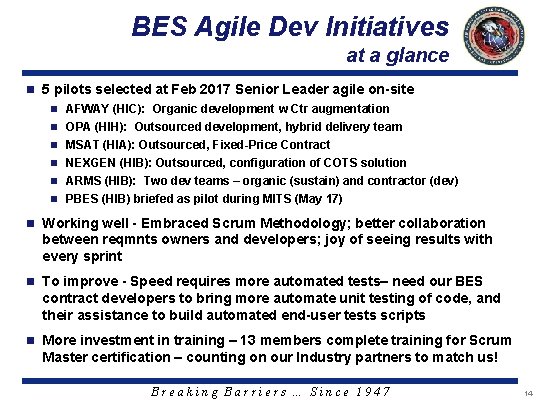
BES Agile Dev Initiatives at a glance n 5 pilots selected at Feb 2017 Senior Leader agile on-site n AFWAY (HIC): Organic development w Ctr augmentation n OPA (HIH): Outsourced development, hybrid delivery team n MSAT (HIA): Outsourced, Fixed-Price Contract n NEXGEN (HIB): Outsourced, configuration of COTS solution n ARMS (HIB): Two dev teams – organic (sustain) and contractor (dev) n PBES (HIB) briefed as pilot during MITS (May 17) n Working well - Embraced Scrum Methodology; better collaboration between reqmnts owners and developers; joy of seeing results with every sprint n To improve - Speed requires more automated tests– need our BES contract developers to bring more automate unit testing of code, and their assistance to build automated end-user tests scripts n More investment in training – 13 members complete training for Scrum Master certification – counting on our Industry partners to match us! Breaking Barriers … Since 1947 14
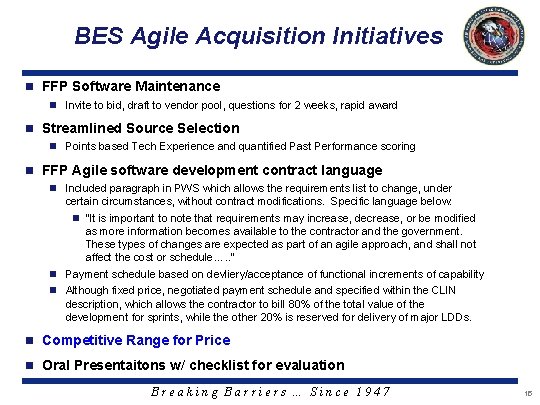
BES Agile Acquisition Initiatives n FFP Software Maintenance n Invite to bid, draft to vendor pool, questions for 2 weeks, rapid award n Streamlined Source Selection n Points based Tech Experience and quantified Past Performance scoring n FFP Agile software development contract language Included paragraph in PWS which allows the requirements list to change, under certain circumstances, without contract modifications. Specific language below: n "It is important to note that requirements may increase, decrease, or be modified as more information becomes available to the contractor and the government. These types of changes are expected as part of an agile approach, and shall not affect the cost or schedule…. . ” n Payment schedule based on devliery/acceptance of functional increments of capability n Although fixed price, negotiated payment schedule and specified within the CLIN description, which allows the contractor to bill 80% of the total value of the development for sprints, while the other 20% is reserved for delivery of major LDDs. n n Competitive Range for Price n Oral Presentaitons w/ checklist for evaluation Breaking Barriers … Since 1947 15
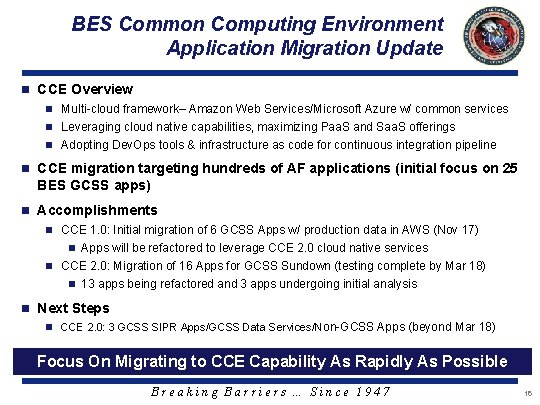
BES Common Computing Environment Application Migration Update n CCE Overview n Multi-cloud framework– Amazon Web Services/Microsoft Azure w/ common services n Leveraging cloud native capabilities, maximizing Paa. S and Saa. S offerings n Adopting Dev. Ops tools & infrastructure as code for continuous integration pipeline n CCE migration targeting hundreds of AF applications (initial focus on 25 BES GCSS apps) n Accomplishments n CCE 1. 0: Initial migration of 6 GCSS Apps w/ production data in AWS (Nov 17) n Apps will be refactored to leverage CCE 2. 0 cloud native services n CCE 2. 0: Migration of 16 Apps for GCSS Sundown (testing complete by Mar 18) n 13 apps being refactored and 3 apps undergoing initial analysis n Next Steps n CCE 2. 0: 3 GCSS SIPR Apps/GCSS Data Services/Non-GCSS Apps (beyond Mar 18) Focus On Migrating to CCE Capability As Rapidly As Possible Breaking Barriers … Since 1947 16
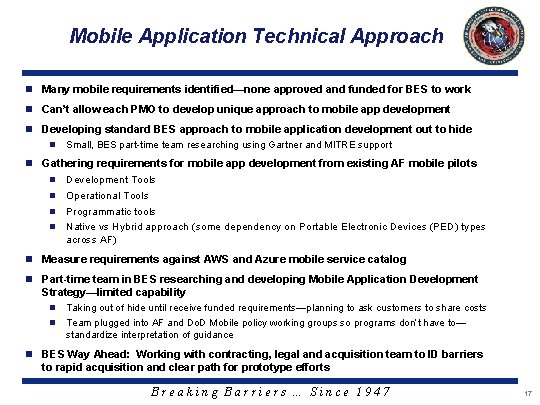
Mobile Application Technical Approach n Many mobile requirements identified—none approved and funded for BES to work n Can’t allow each PMO to develop unique approach to mobile app development n Developing standard BES approach to mobile application development out to hide n Small, BES part-time team researching using Gartner and MITRE support n Gathering requirements for mobile app development from existing AF mobile pilots n Development Tools n Operational Tools n Programmatic tools n Native vs Hybrid approach (some dependency on Portable Electronic Devices (PED) types across AF) n Measure requirements against AWS and Azure mobile service catalog n Part-time team in BES researching and developing Mobile Application Development Strategy—limited capability n n n Taking out of hide until receive funded requirements—planning to ask customers to share costs Team plugged into AF and Do. D Mobile policy working groups so programs don’t have to— standardize interpretation of guidance BES Way Ahead: Working with contracting, legal and acquisition team to ID barriers to rapid acquisition and clear path for prototype efforts Breaking Barriers … Since 1947 17
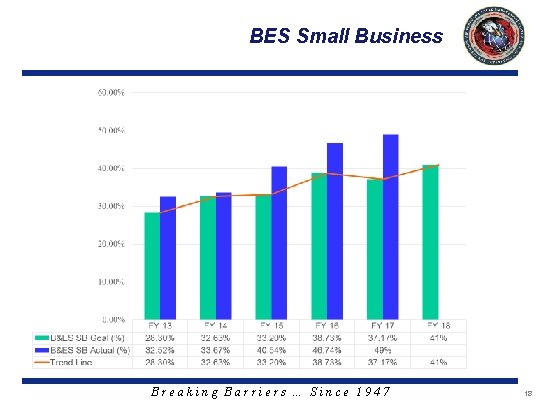
BES Small Business Breaking Barriers … Since 1947 18
BES SMART Reference Guide m o g in o S n o C Breaking Barriers … Since 1947 19
Questions Breaking Barriers … Since 1947 20
- Slides: 20