
BUSINESS ENGLISH LECTURE 26 Synopsis Job Interviews continues
BUSINESS ENGLISH LECTURE 26
Synopsis Job Interviews continues Preparing to Interview Guide to interview Job Interview Workshop Listening activity Job Interview -2
SKILLS YOU POSSESS OR LEARN Listening Acativty

Skills Identification Everyone has hundreds of skills, yet most people can only identify a few. Duties are the basic functions of the activity, skills are the tools used to accomplish the activity. Skills can be broken into three categories: – Occupational Skills (typing, customer service) – Performance Based Skills that you use every day to get along with others and to survive (patience, flexibility, tactfulness – Transferable Skills This category includes the first two categories. 4
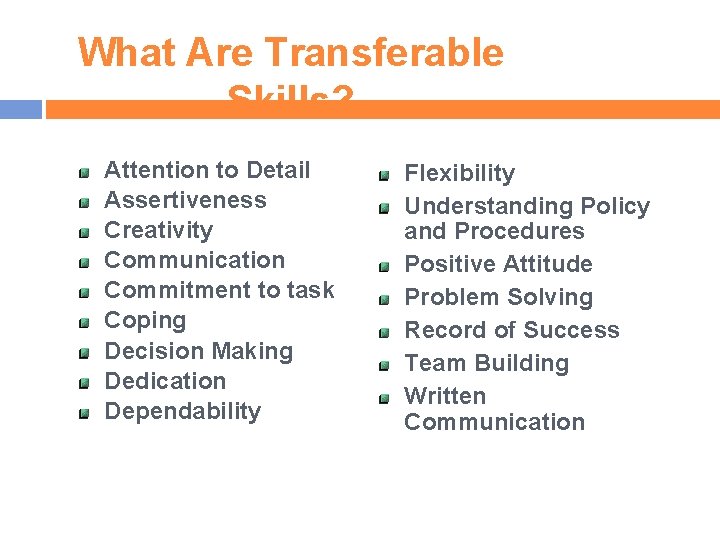
What Are Transferable Skills? Attention to Detail Assertiveness Creativity Communication Commitment to task Coping Decision Making Dedication Dependability Flexibility Understanding Policy and Procedures Positive Attitude Problem Solving Record of Success Team Building Written Communication 5
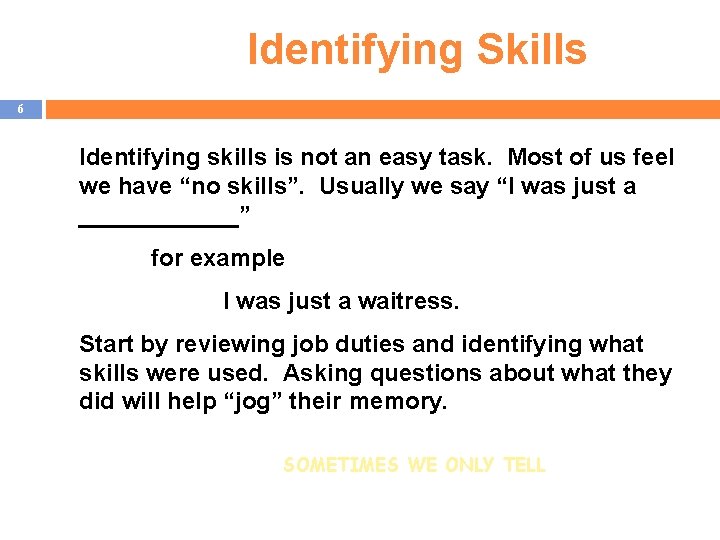
Identifying Skills 6 Identifying skills is not an easy task. Most of us feel we have “no skills”. Usually we say “I was just a ______” for example I was just a waitress. Start by reviewing job duties and identifying what skills were used. Asking questions about what they did will help “jog” their memory. SOMETIMES WE ONLY TELL
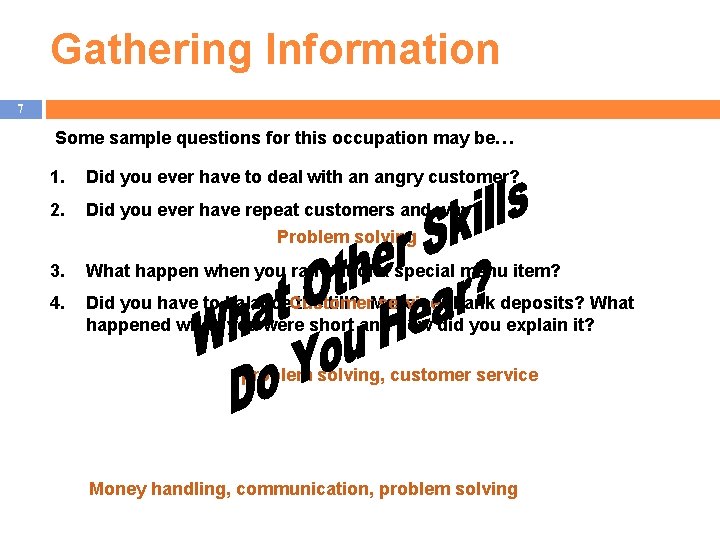
Gathering Information 7 Some sample questions for this occupation may be… 1. Did you ever have to deal with an angry customer? 2. Did you ever have repeat customers and why? Problem solving 3. What happen when you ran out of a special menu item? 4. service Did you have to balance. Customer the till? Make out bank deposits? What happened when you were short and how did you explain it? problem solving, customer service Money handling, communication, problem solving
THE INTERVIEW WORK SHOP 8
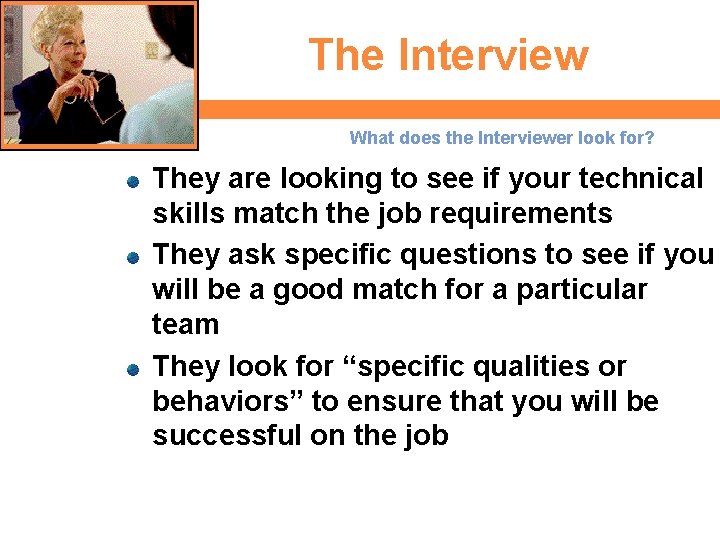
The Interview 9 What does the Interviewer look for? They are looking to see if your technical skills match the job requirements They ask specific questions to see if you will be a good match for a particular team They look for “specific qualities or behaviors” to ensure that you will be successful on the job
Sample Interview Questions 10 What can you tell me about yourself? Why are you interested in this job? What are your strengths? What are your weaknesses? What skills do you bring to the job and to this company?
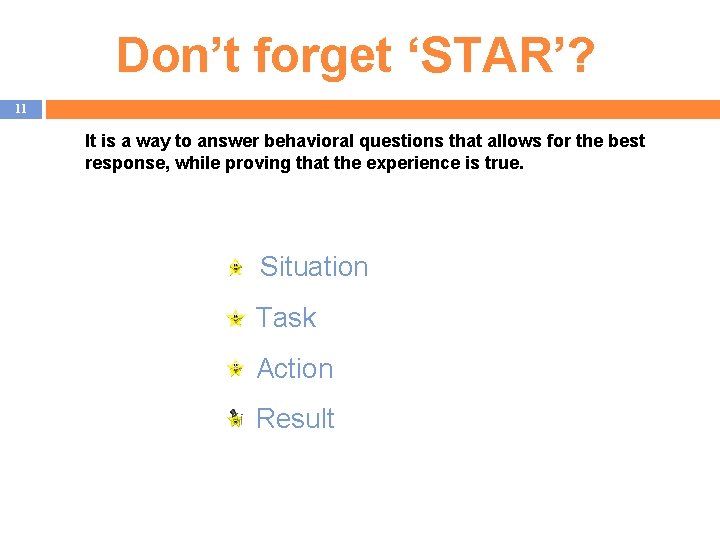
Don’t forget ‘STAR’? 11 It is a way to answer behavioral questions that allows for the best response, while proving that the experience is true. Situation Task Action Result
Sample Behavioral Interview Questions 12 Don’t forget STAR! Can you give me an example of a time you worked on a team to finish a project? What was your contribution? Describe one of the most demanding assignments you’ve had. What problems did you encounter and how did you solve them? Tell me about a presentation you had to give or a project you had to do. How did you prepare for it?
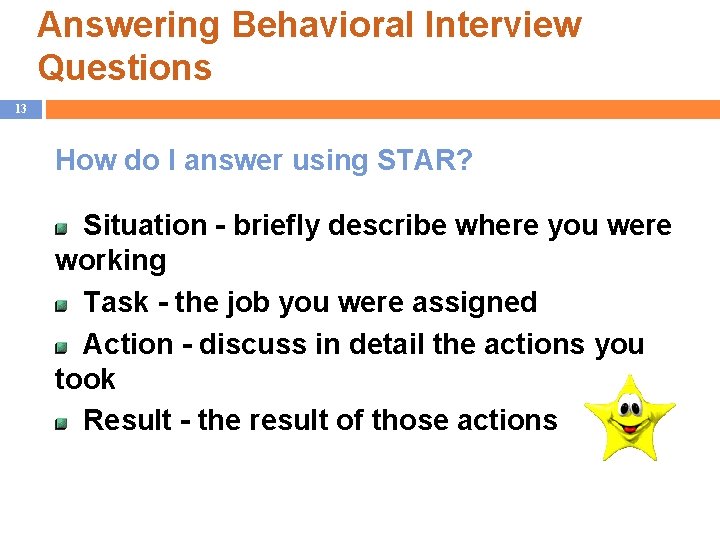
Answering Behavioral Interview Questions 13 How do I answer using STAR? Situation - briefly describe where you were working Task - the job you were assigned Action - discuss in detail the actions you took Result - the result of those actions
SITUATION 14 Describe the employer, location, or area where you were working to give the interviewer the “big picture. ” You don’t need to be too detailed. I worked at ABC Company as a Supervisor in the Shipping and Receiving Department.
TASK 15 Describe the job or task you were assigned. Part of my job was to train newly hired employees in using our highly technical equipment as well as in company policies and procedures.
ACTION 16 Describe the action you took. (Use “I”) I showed Fred, our new employee, how to safely set-up and operate the computerized weighing equipment. I also taught Fred how to inspect the packages to ensure the weight and labels matched. I continued to ask him questions to make sure that he understood all the instructions I had given him.
RESULT Tell the results of the action you took, be sure to use numbers where applicable. I checked in with Fred on a regular basis during his initial training and as a result he became a well trained team member, not only in the equipment he was to use, but also in understanding how the procedures we used affected our department and the company. 17
PRACTICING QUESTIONS 18
What kind of people bug you? Do not name anyone! Talk about a specific personality and what you do to assist your team member to be successful. On a team, I find it hard to work with people who don’t seem to care and avoid the hard tasks. What I have found, is that many times they aren’t aware of the teams expectations or how to accomplish specific tasks. I take the time to check in with team members and have offered my assistance with their tasks. This results in the whole team reaching the desired goal. 19
Tell Me About a Problem You Solved? 20 When I was at DDS Company we purchased a telephone system for our office. It was computer- ized. My coworker was assigned as the administrator. She had a car accident and was going to be gone from work for several weeks.
My supervisor asked me to take over some of her duties. I was not trained on the telephone system, but found a video teaching tape and her book in a file cabinet. As it turned out, I needed to make some administrative changes to the system.
Tell Me About a Problem You Solved? 22 I watched the video and read the book. I followed the instructions and was able to make most of the changes. There was a specific function I could not program so I contacted the company who sold us the system. Through their help line, I was able to complete the changes.
I learned to set up mail boxes, groups, change and forward messages, and set up a time manager. These new skills made me a more valuable employee.
Problem Solving Model 24 Define the problem Set goal - decide on the desired outcome Brainstorm - List alternatives Consider the consequences. . risk vs. . alternatives Decide and act Re-evaluate - did it work and what did I learn?
PREPARING TO INTERVIEW 25
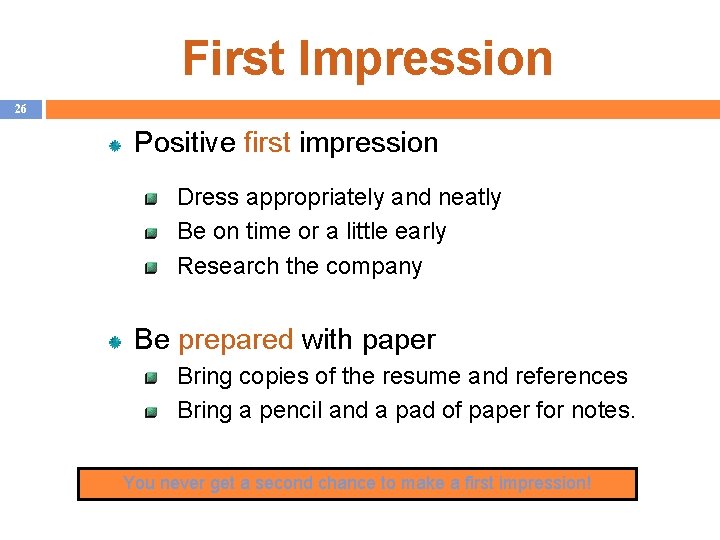
First Impression 26 Positive first impression Dress appropriately and neatly Be on time or a little early Research the company Be prepared with paper Bring copies of the resume and references Bring a pencil and a pad of paper for notes. You never get a second chance to make a first impression!
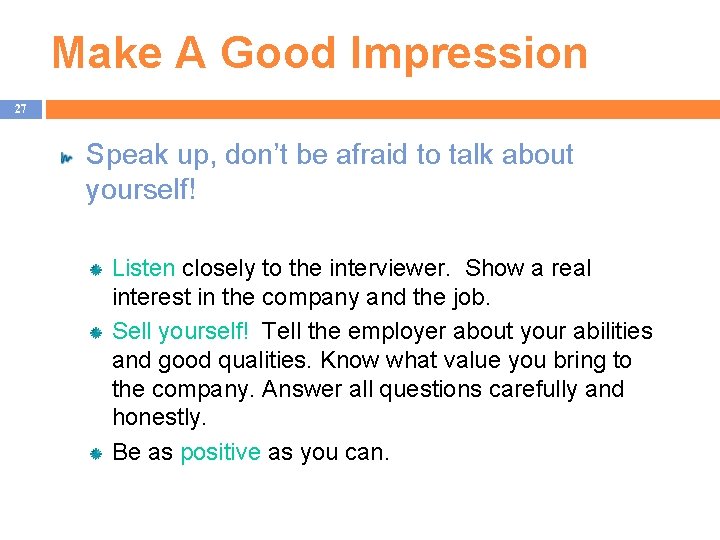
Make A Good Impression 27 Speak up, don’t be afraid to talk about yourself! Listen closely to the interviewer. Show a real interest in the company and the job. Sell yourself! Tell the employer about your abilities and good qualities. Know what value you bring to the company. Answer all questions carefully and honestly. Be as positive as you can.
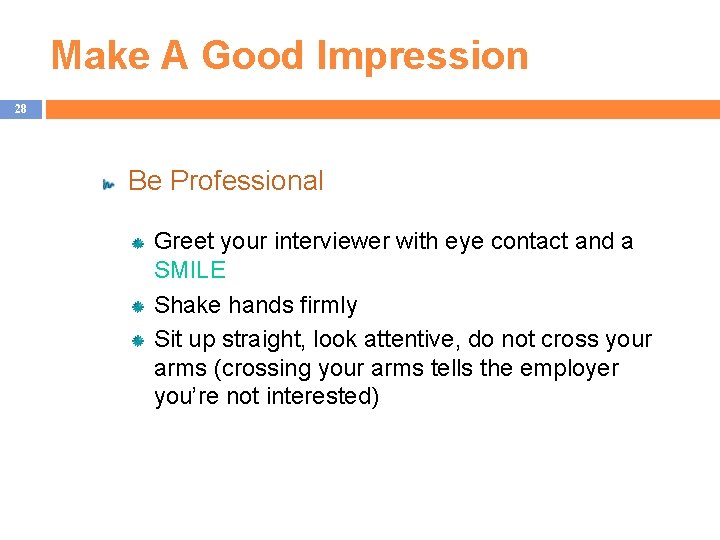
Make A Good Impression 28 Be Professional Greet your interviewer with eye contact and a SMILE Shake hands firmly Sit up straight, look attentive, do not cross your arms (crossing your arms tells the employer you’re not interested)
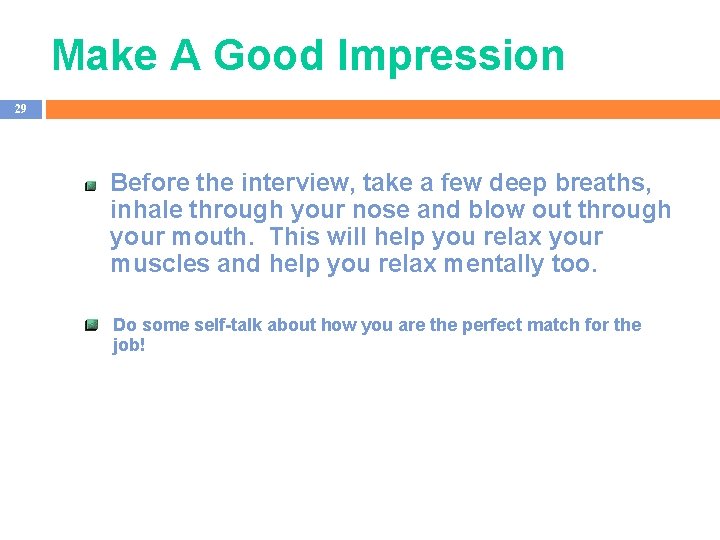
Make A Good Impression 29 Before the interview, take a few deep breaths, inhale through your nose and blow out through your mouth. This will help you relax your muscles and help you relax mentally too. Do some self-talk about how you are the perfect match for the job!
Why Ask Questions? 30 The questions the interviewer asks helps them decide if you are the right person for the job. The questions you ask the interviewer helps you decide if this is the right place for you to be.
Ask The Interviewer 31 Write down at least three questions that you feel are important to you and take these to the interview. Don’t ask questions that say “What’s in it for me? ” Such as; “when is my first day off? ”. Ask questions such as: Why did you choose to work for this company? How will my performance be evaluated? What is the most difficult task I will be doing? What is the process you use when training for this position?
Make A Good Impression 32 Interview Don’ts Don’t Take a friend or a relative with you (unless you need an interpreter ) Act either too shy or too aggressive (balance) Say anything negative about other people Be late. Call the employer as soon as possible and explain why. Ask if you can arrange a new interview time.
Closing the Interview Thank the interviewer for their time. Ask what the next steps will be (such as a second interview) Ask when they plan to make a decision Tell them you are interested in the job (only if you are!) Ask for a business card(s) of the interviewer(s) Send a thank you note Designed and Developed by SE Works 2003© 33
INTERVIEW SKILLS- REVIEW
A Job Interview Is… An opportunity to meet face to face To discuss your qualifications To assess your ability and skills To demonstrate your skills and personality To sell yourself www. mun. ca/cdel
The Keys to a Successful Interview Convey a positive attitude Beware of non-verbal communication Show enthusiasm Keep eye contact with interviewer Pay attention to physical appearance Be knowledgeable of the company Don’t talk yourself out of a job Don’t keep the interviewer waiting www. mun. ca/cdel
The Keys to a Successful Interview Be Prepared: Remain calm when faced with periods of silence Have extra resumes on hand. Have references on hand if not attached to resume. Conduct background research on organization. Silence is not always bad but don’t wait to long. Know your resume Reread it before going into an interview. www. mun. ca/cdel
The Keys to a Successful Interview Arrive early 10 -15 minutes early. Remain calm and collected Listen attentively Show confidence www. mun. ca/cdel
Pre-Interview Stage Assess your career path Research company and position you are seeking Find out what type of interview it is Develop list of potential questions and responses Confirm date, time and location www. mun. ca/cdel
Interview Stage Appropriate dress Create a good first impression Ensure that you understand the question Be yourself Maintain eye contact with the interviewer(s) Appear confident Listen carefully to the questions www. mun. ca/cdel
Interview Stage Bring extra copies of resume and references If you have a career portfolio, bring it Ask questions What is the organization's plan for the next five years? What kind of work can I expect to be doing the first year? How much assistance is made available in developing career goals? What are the opportunities for advancement? Thank them and shake hands Ask for business card www. mun. ca/cdel
Post-Interview Stage Recap interview Request feedback from interviewer Send thank-you letter or email Follow-up within 24 hours Express gratitude for the employer’s time Highlight qualifications Restate your interest in the company/career area Communicate enthusiasm to have met with them www. mun. ca/cdel
4 Types of Interviews Case Interview Behavior Based Interview Telephone Interview Videoconference Interview www. mun. ca/cdel
Case Interview Used to assess logical thinking and problem solving skills Geared around solving problems on the spot Classic business cases are used to test analytic ability, logical thought process, creativity, and comfort with quantitative analysis Example of a Project Case: You are consulting for a major Canadian airline. Every year, they make more sales and every year, they lose more money. What could be causing this? www. mun. ca/cdel
Behavior Based Interview Designed to determine if a candidate possesses certain key competencies. Use specific examples from work history, education and extracurricular activities to demonstrate the skill the interviewer is assessing Example: Describe the system you use for keeping track of multiple projects. How do you track your progress so that you can meet deadlines? How do you stay focused? (commitment to task) www. mun. ca/cdel
Situational Interview Designed to assess your critical thinking, problem solving, and planning abilities What would you if… Often in the form of a scenario Example: You are approached by a member of the media to give your opinion about an issue just discussed at a press conference hosted by your department? What do you do?
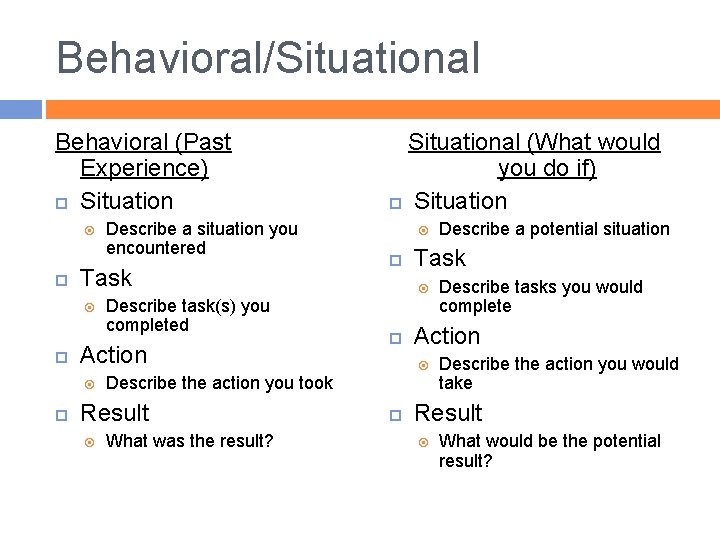
Behavioral/Situational Behavioral (Past Experience) Situation Task Describe task(s) you completed Action Describe a situation you encountered What was the result? Describe tasks you would complete Action Describe a potential situation Task Describe the action you took Result Situational (What would you do if) Situation Describe the action you would take Result What would be the potential result?
Telephone Interview Sound friendly, confident and calm Thank the interviewer for the call Collect your thoughts Smile Get company information Tip: Dress up as if you’re meeting face-to-face www. mun. ca/cdel
Videoconference Interview Dress professionally – they can see you Speak slowly Prepare for silence due to a 5 sec audio delay Be aware of extra movements and noises Be patient – sounds may be distorted Speak up and project your voice Relax and smile www. mun. ca/cdel
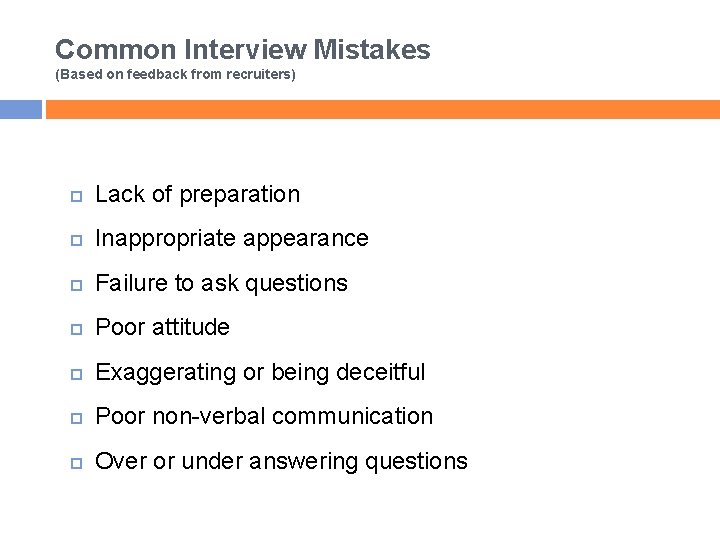
Common Interview Mistakes (Based on feedback from recruiters) Lack of preparation Inappropriate appearance Failure to ask questions Poor attitude Exaggerating or being deceitful Poor non-verbal communication Over or under answering questions www. mun. ca/cdel
Websites http: //www. quintcareers. com/sample_behavioral. html http: //www. mun. ca/cdel (>Students>Career Tips) http: //interview. monster. ca/ http: //www. jobpostings. ca/resource. cfm? id=16 www. mun. ca/cdel
GUIDE TO INTERVIEWING
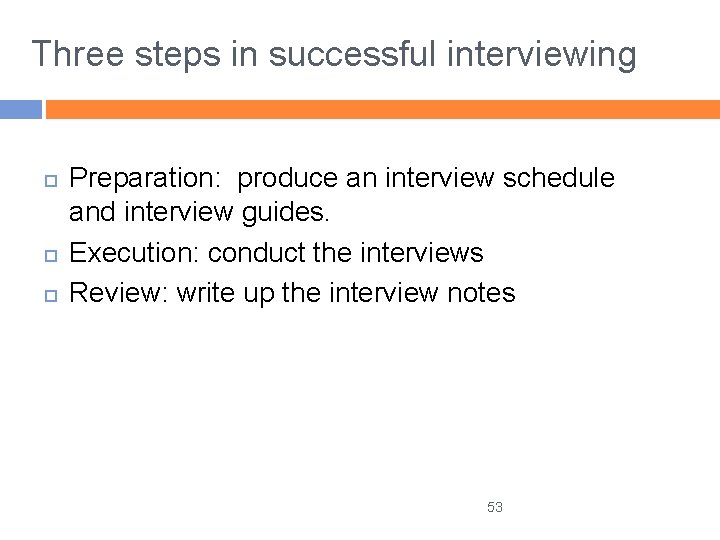
Three steps in successful interviewing Preparation: produce an interview schedule and interview guides. Execution: conduct the interviews Review: write up the interview notes 53
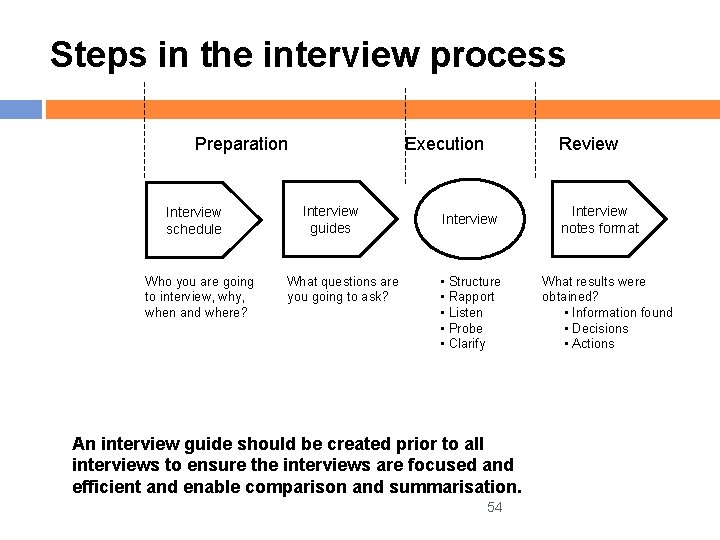
Steps in the interview process Preparation Interview schedule Who you are going to interview, why, when and where? Execution Interview guides What questions are you going to ask? Review Interview • Structure • Rapport • Listen • Probe • Clarify An interview guide should be created prior to all interviews to ensure the interviews are focused and efficient and enable comparison and summarisation. 54 Interview notes format What results were obtained? • Information found • Decisions • Actions
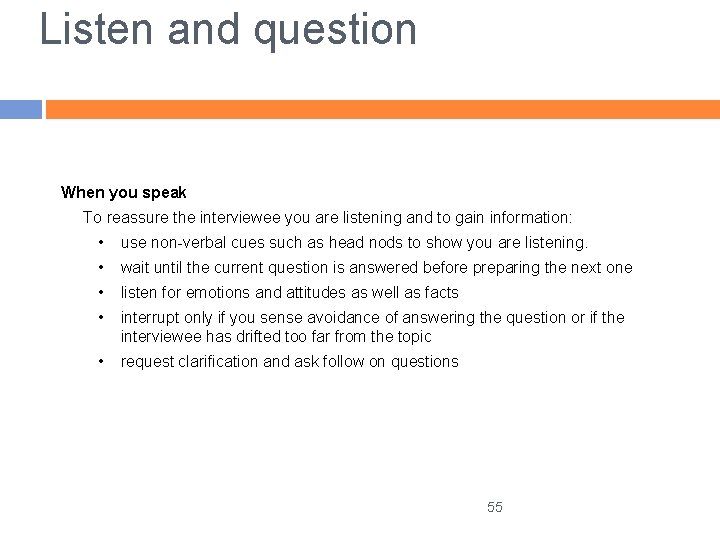
Listen and question When you speak To reassure the interviewee you are listening and to gain information: • use non-verbal cues such as head nods to show you are listening. • wait until the current question is answered before preparing the next one • listen for emotions and attitudes as well as facts • interrupt only if you sense avoidance of answering the question or if the interviewee has drifted too far from the topic • request clarification and ask follow on questions 55
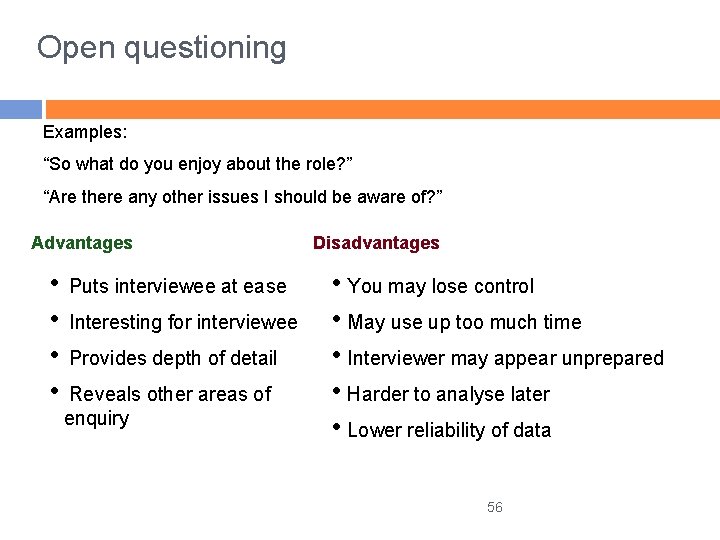
Open questioning Examples: “So what do you enjoy about the role? ” “Are there any other issues I should be aware of? ” Advantages • • Puts interviewee at ease Interesting for interviewee Provides depth of detail Reveals other areas of enquiry Disadvantages • You may lose control • May use up too much time • Interviewer may appear unprepared • Harder to analyse later • Lower reliability of data 56
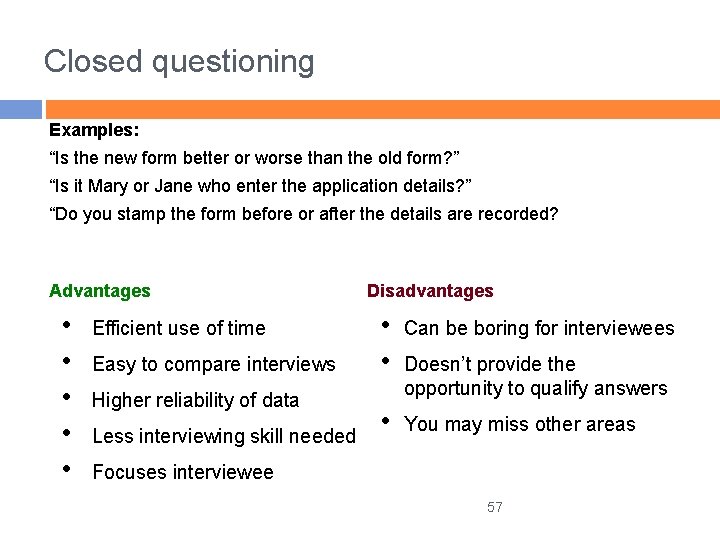
Closed questioning Examples: “Is the new form better or worse than the old form? ” “Is it Mary or Jane who enter the application details? ” “Do you stamp the form before or after the details are recorded? Advantages • • • Efficient use of time Easy to compare interviews Higher reliability of data Less interviewing skill needed Disadvantages • • Can be boring for interviewees • You may miss other areas Doesn’t provide the opportunity to qualify answers Focuses interviewee 57
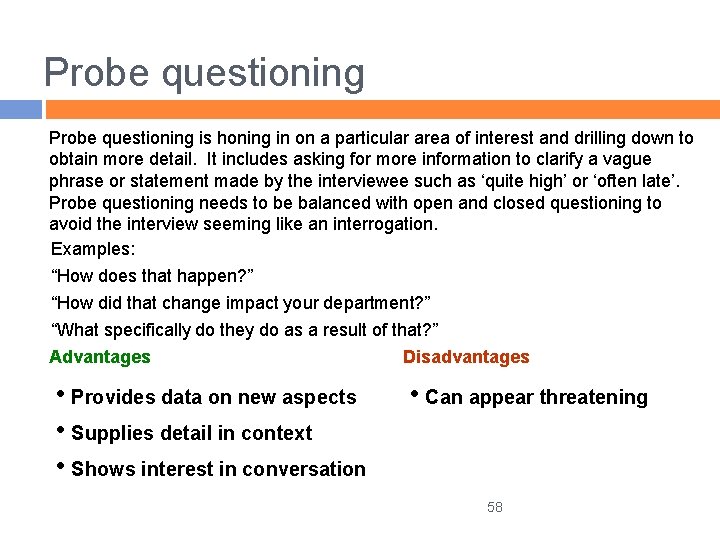
Probe questioning is honing in on a particular area of interest and drilling down to obtain more detail. It includes asking for more information to clarify a vague phrase or statement made by the interviewee such as ‘quite high’ or ‘often late’. Probe questioning needs to be balanced with open and closed questioning to avoid the interview seeming like an interrogation. Examples: “How does that happen? ” “How did that change impact your department? ” “What specifically do they do as a result of that? ” Advantages • Provides data on new aspects • Supplies detail in context • Shows interest in conversation Disadvantages • Can appear threatening 58
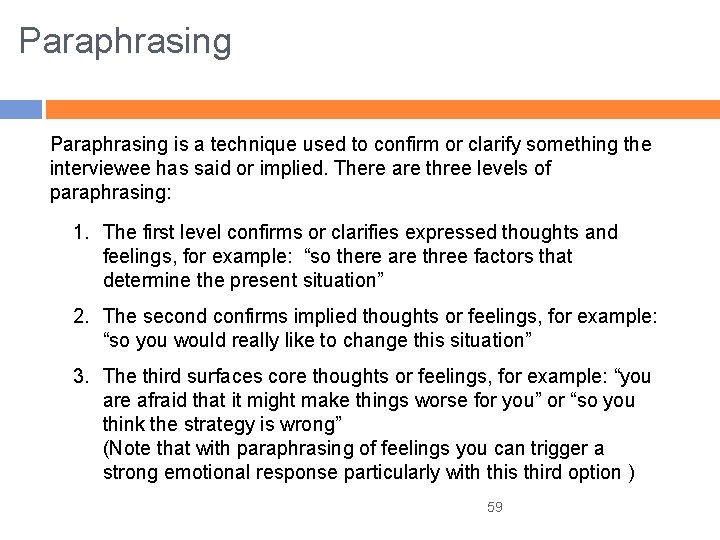
Paraphrasing is a technique used to confirm or clarify something the interviewee has said or implied. There are three levels of paraphrasing: 1. The first level confirms or clarifies expressed thoughts and feelings, for example: “so there are three factors that determine the present situation” 2. The second confirms implied thoughts or feelings, for example: “so you would really like to change this situation” 3. The third surfaces core thoughts or feelings, for example: “you are afraid that it might make things worse for you” or “so you think the strategy is wrong” (Note that with paraphrasing of feelings you can trigger a strong emotional response particularly with this third option ) 59
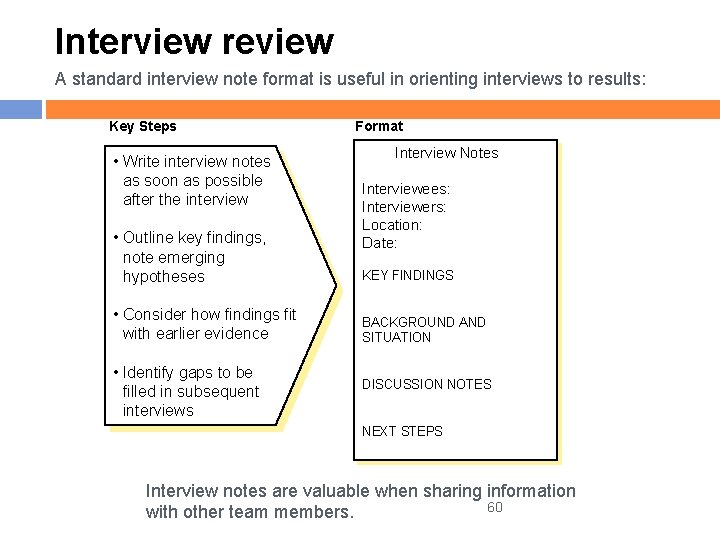
Interview review A standard interview note format is useful in orienting interviews to results: Key Steps • Write interview notes as soon as possible after the interview • Outline key findings, note emerging hypotheses • Consider how findings fit with earlier evidence • Identify gaps to be filled in subsequent interviews Format Interview Notes Interviewees: Interviewers: Location: Date: KEY FINDINGS BACKGROUND AND SITUATION DISCUSSION NOTES NEXT STEPS Interview notes are valuable when sharing information 60 with other team members.
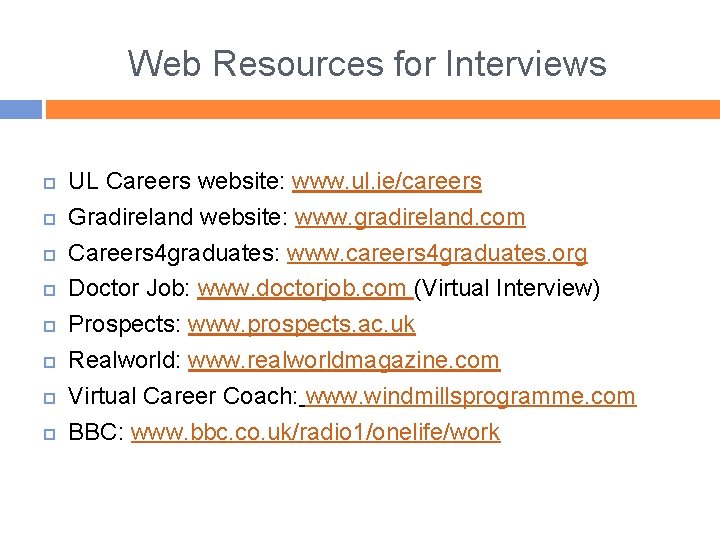
Web Resources for Interviews UL Careers website: www. ul. ie/careers Gradireland website: www. gradireland. com Careers 4 graduates: www. careers 4 graduates. org Doctor Job: www. doctorjob. com (Virtual Interview) Prospects: www. prospects. ac. uk Realworld: www. realworldmagazine. com Virtual Career Coach: www. windmillsprogramme. com BBC: www. bbc. co. uk/radio 1/onelife/work
LISTENING AND LANGUAGE EXPANSION
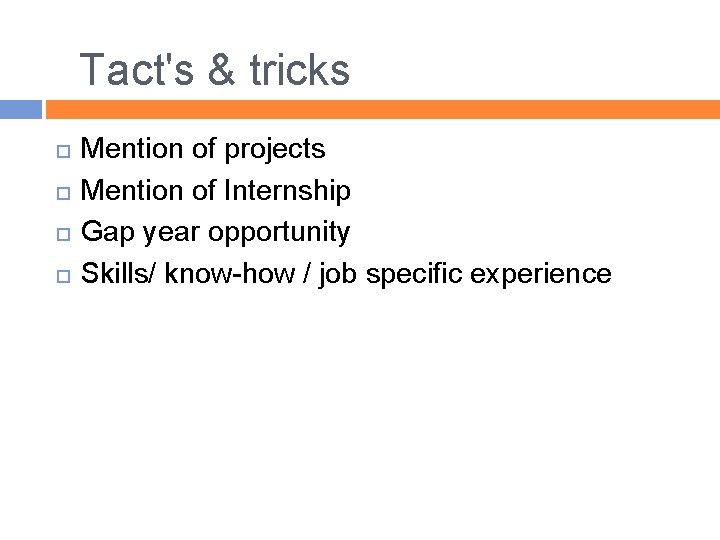
Tact's & tricks Mention of projects Mention of Internship Gap year opportunity Skills/ know-how / job specific experience
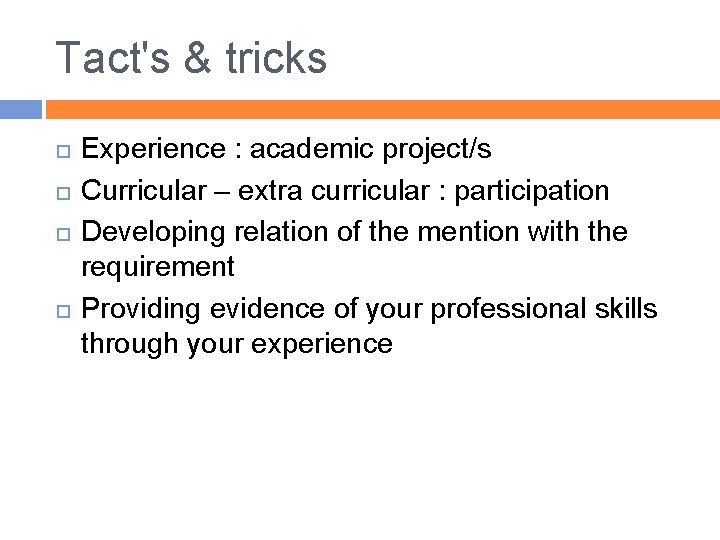
Tact's & tricks Experience : academic project/s Curricular – extra curricular : participation Developing relation of the mention with the requirement Providing evidence of your professional skills through your experience
Interview Part-2 00: 42 -01: 45 Interviewing : Sales meeting Tricky part – no experience Ways to highlight experience
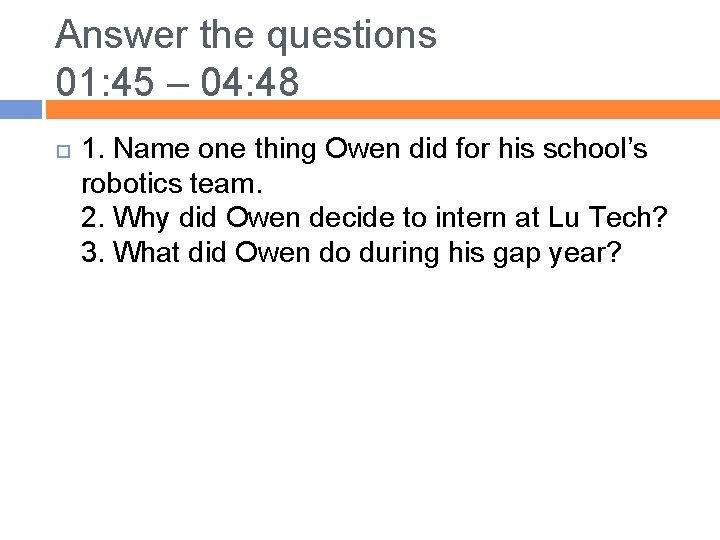
Answer the questions 01: 45 – 04: 48 1. Name one thing Owen did for his school’s robotics team. 2. Why did Owen decide to intern at Lu Tech? 3. What did Owen do during his gap year?
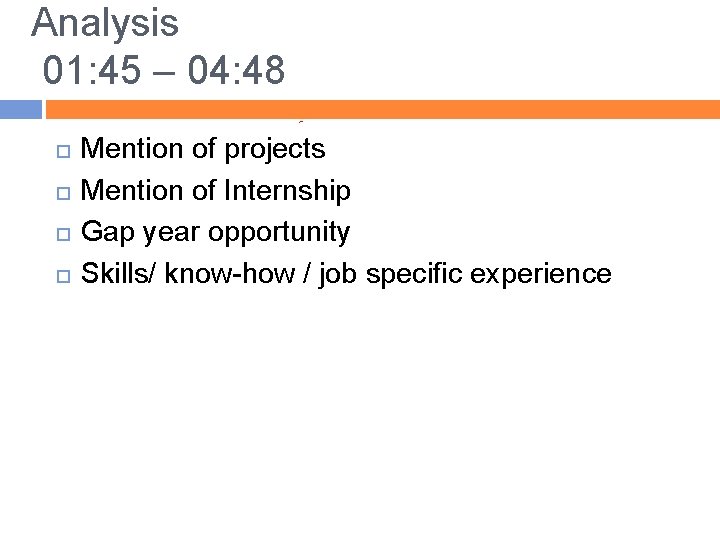
Analysis 01: 45 – 04: 48 Mention of projects Mention of Internship Gap year opportunity Skills/ know-how / job specific experience
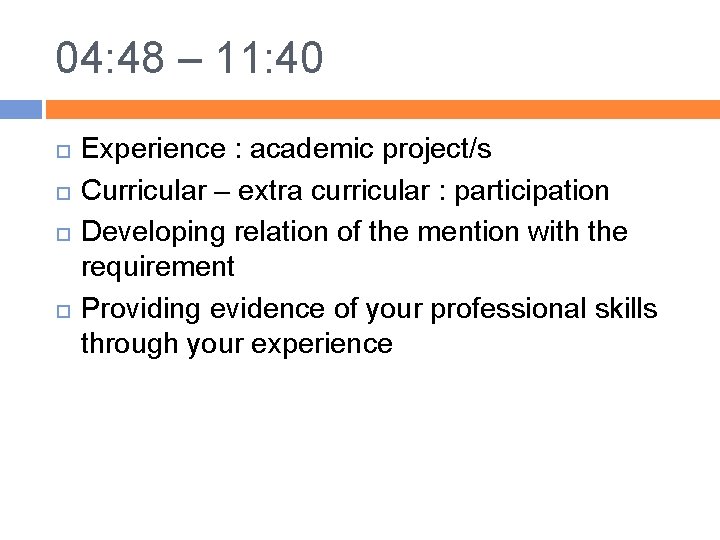
04: 48 – 11: 40 Experience : academic project/s Curricular – extra curricular : participation Developing relation of the mention with the requirement Providing evidence of your professional skills through your experience
11: 40 – 18: 00 Beyond academics : gap time opportunity
Review Job Interviews continues Preparing to Interview Guide to interview Job Interview Workshop Listening activity Job Interview -2
- Slides: 70