
BUSINESS ECONOMICS ENVIRONMENT SUBHASH KUMAR ASSISTANT PROFESSOR GUEST

BUSINESS ECONOMICS & ENVIRONMENT SUBHASH KUMAR ASSISTANT PROFESSOR (GUEST) DEPT. OF COMMERCE CMB COLLEGE DEORH GHOGHARDIHA (MADHUBANI)
ECONOMICS: INTRODUCTION B. COM 1 ST YR, SUB. PAPER-II, UNIT-I
Economics MICRO AND MACRO ECONOMICS
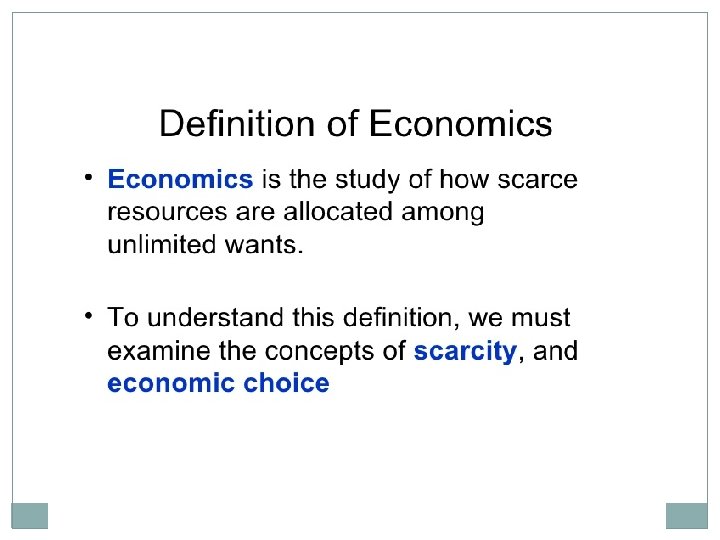
Economics is the study of how society uses its limited resources. Economics is a social science that deals with the production, distribution, and consumption of goods and services. Economics focuses heavily on the four factors of production, which are land, labor, capital, and enterprise. These are the four ingredients that make up economic activity in our world today and can each be studied individually.
Definitions of Economics Science of Material Well-Being “Economics is a study of mankind in the ordinary business of life. It examines that part of individual and social action which is most closely connected with the attainment and with the use of the material requisites of well-being. Thus, it is on the one side a study of wealth and on the other and more important side a part of the study of the man. ” … Alfred Marshall
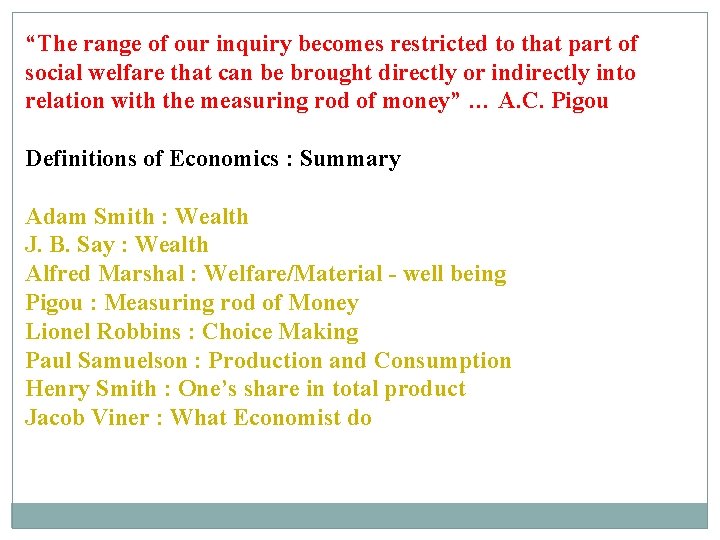
“The range of our inquiry becomes restricted to that part of social welfare that can be brought directly or indirectly into relation with the measuring rod of money” … A. C. Pigou Definitions of Economics : Summary Adam Smith : Wealth J. B. Say : Wealth Alfred Marshal : Welfare/Material - well being Pigou : Measuring rod of Money Lionel Robbins : Choice Making Paul Samuelson : Production and Consumption Henry Smith : One’s share in total product Jacob Viner : What Economist do
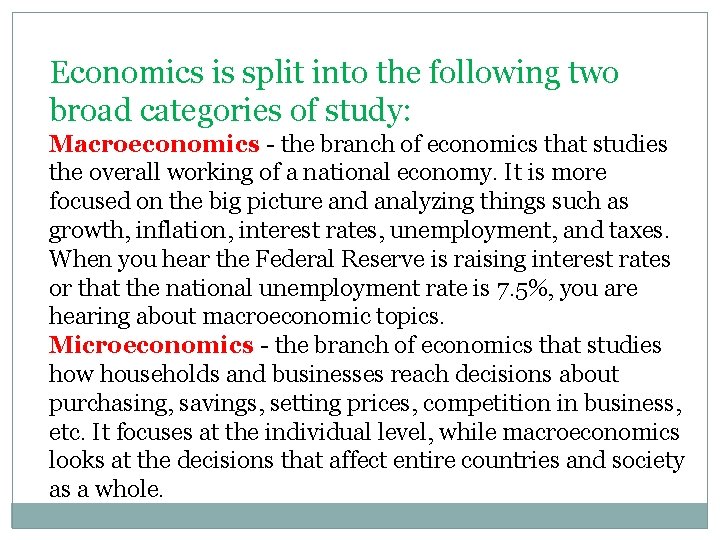
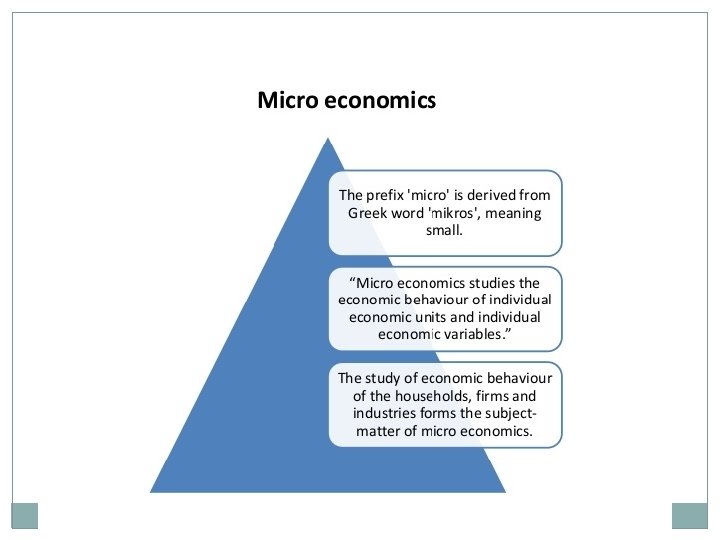
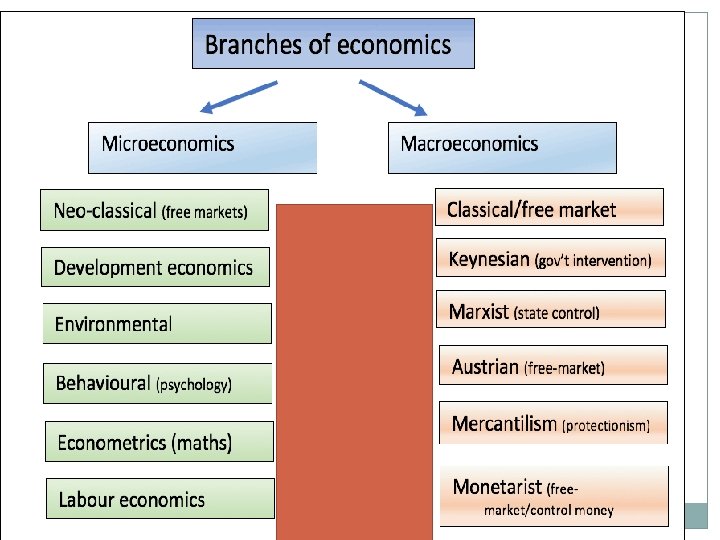
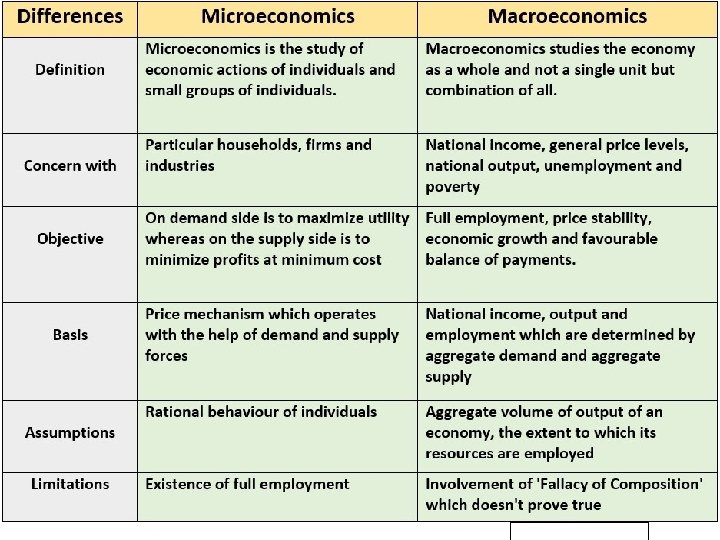
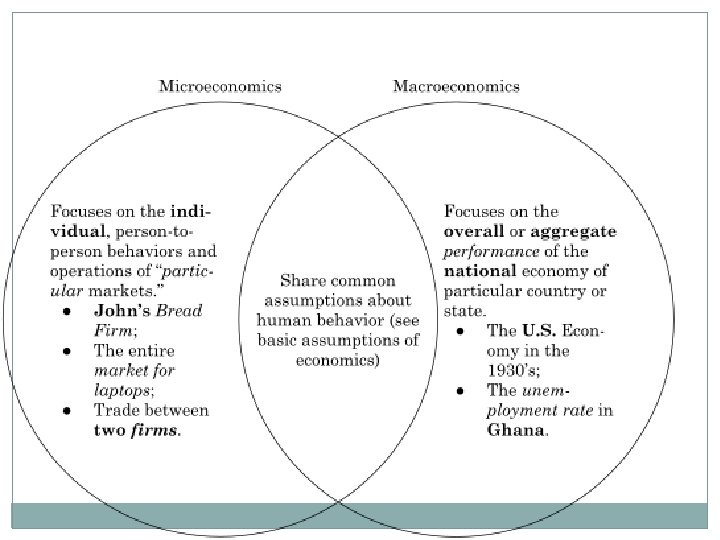
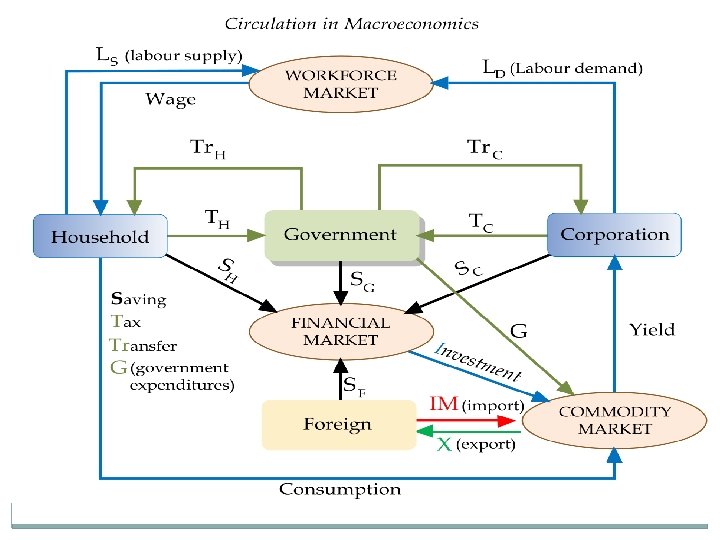
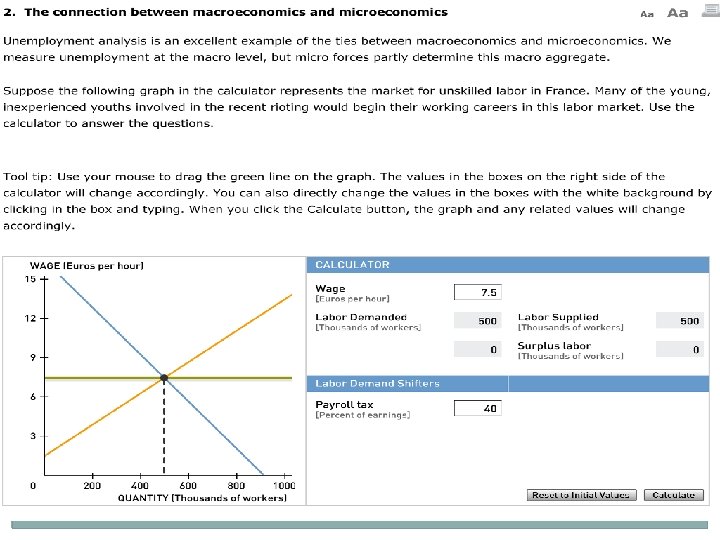
Economics is split into the following two broad categories of study: Macroeconomics - the branch of economics that studies the overall working of a national economy. It is more focused on the big picture and analyzing things such as growth, inflation, interest rates, unemployment, and taxes. When you hear the Federal Reserve is raising interest rates or that the national unemployment rate is 7. 5%, you are hearing about macroeconomic topics. Microeconomics - the branch of economics that studies how households and businesses reach decisions about purchasing, savings, setting prices, competition in business, etc. It focuses at the individual level, while macroeconomics looks at the decisions that affect entire countries and society as a whole.
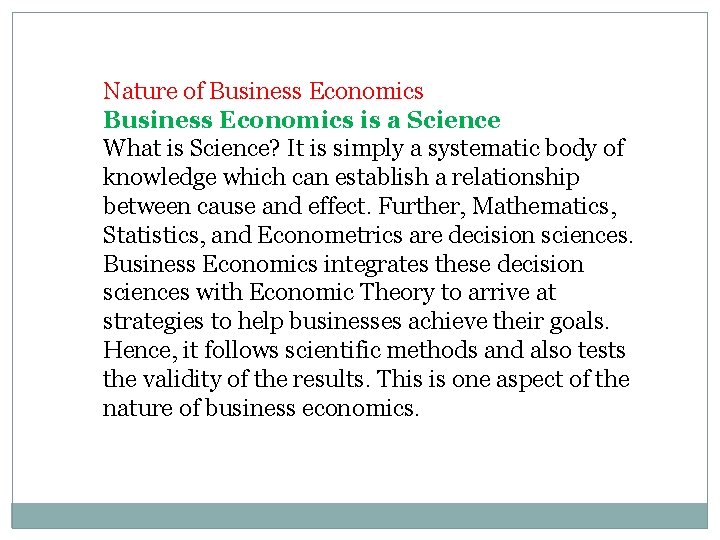
Nature of Business Economics is a Science What is Science? It is simply a systematic body of knowledge which can establish a relationship between cause and effect. Further, Mathematics, Statistics, and Econometrics are decision sciences. Business Economics integrates these decision sciences with Economic Theory to arrive at strategies to help businesses achieve their goals. Hence, it follows scientific methods and also tests the validity of the results. This is one aspect of the nature of business economics.
It is an Art v. Business Economics is an art as it requires the practical application of rules and principle to achieve set objectives. v. Use of Theory of Markets and Private Enterprises v. Business Economics primarily uses theory of markets and private enterprises. It uses theory of the firm and resource allocation in a private enterprise economy. v - Practise of knowledge - Adding your own creative instinct to it
Nature of Economics as a SCIENCE - Body of knowledge - Cause and effect relationship - Has its own methodological apparatus - Measurement - Forecast/Predictions Economics as a Science : but not a PERFECT Science - Unpredictable behavior of mankind - No uniform opinions - Very difficult to make correct predictions - Measurement by money
Economics as Positive Science and Economics as Normative Science: Positive Science: A positive or pure science analyses cause and effect relationship between variables but it does not pass value judgement. Normative Science: As a normative science, economics involves value judgements
Broadly speaking, Economic Theory has evolved along two lines – Positive and Normative. A positive or pure science analyzes the cause and effect relationship between variables in a scientific manner. However, it does not involve any value judgment. In simpler words, it describes the economic behavior of individuals or society without focusing on the desirability of such behavior. On the other hand, normative science involves value judgments. It suggests a course of action under the given circumstances.
Usually, Business Economics is normative in nature. It offers suggestions for the application of economic principles while forming policies, making decisions, and planning for the future. However, firms must understand their environment thoroughly to establish decision rules. This requires the study of positive economic theory. Therefore, we can say that Business Economics combines the essentials of both theories while keeping more emphasis on the normative economic theory.
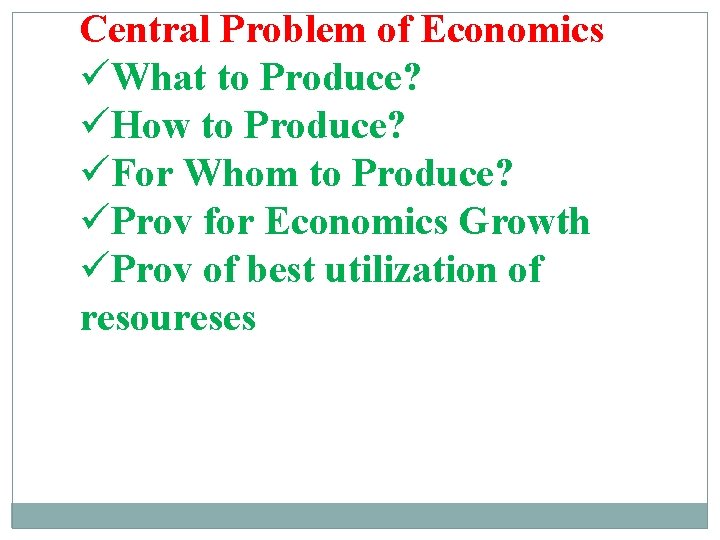
Central Problem of Economics üWhat to Produce? üHow to Produce? üFor Whom to Produce? üProv for Economics Growth üProv of best utilization of resoureses
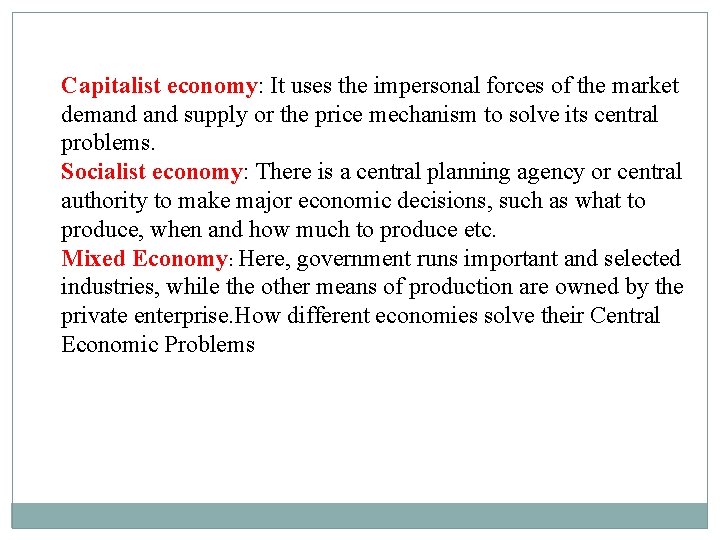
Capitalist economy: It uses the impersonal forces of the market demand supply or the price mechanism to solve its central problems. Socialist economy: There is a central planning agency or central authority to make major economic decisions, such as what to produce, when and how much to produce etc. Mixed Economy: Here, government runs important and selected industries, while the other means of production are owned by the private enterprise. How different economies solve their Central Economic Problems

THANK YOU
- Slides: 24