
BUSINESS DATA COMMUNICATIONS NETWORKING Chapter 4 Data Link
BUSINESS DATA COMMUNICATIONS & NETWORKING Chapter 4 Data Link Layer Fitz. Gerald ● Dennis ● Durcikova Prepared by Taylor M. Wells: College of Business Administration, California State University, Sacramento 4 Copyright © 2015 John Wiley & Sons, Inc. All rights reserved.
Outline • Data Link Layer – Media Access Control • Controlled Access • Contention Access – Error Control • Prevention • Detection • Correction Copyright © 2015 John Wiley & Sons, Inc. All rights reserved. 4 -2
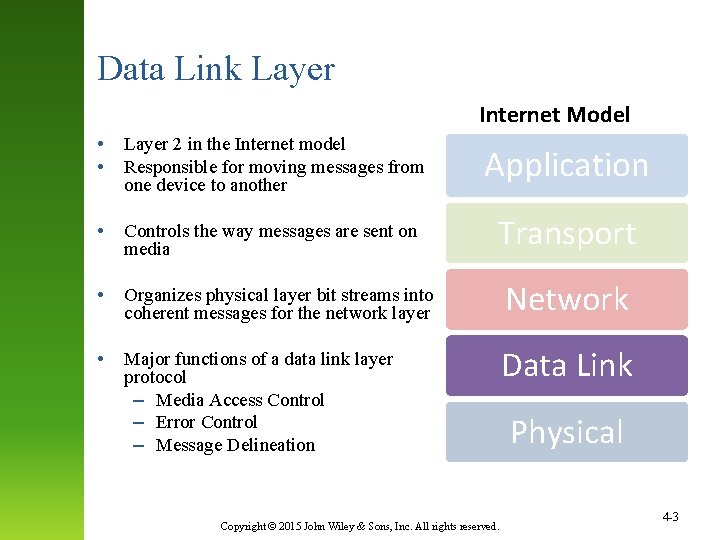
Data Link Layer Internet Model • • Layer 2 in the Internet model Responsible for moving messages from one device to another Application • Controls the way messages are sent on media Transport • Organizes physical layer bit streams into coherent messages for the network layer Network • Major functions of a data link layer protocol – Media Access Control – Error Control – Message Delineation Data Link Copyright © 2015 John Wiley & Sons, Inc. All rights reserved. Physical 4 -3
Media Access Control • Controls which device transmits and when • Important on – Multipoint (shared) circuits – Half-duplex point-to-point circuits • Two approaches to control 1. Contention access 2. Controlled access Copyright © 2015 John Wiley & Sons, Inc. All rights reserved. 4 -4
Media Access Control • Contention – Transmit whenever circuit is available with no centralized control – Common in Ethernet LANs – When devices transmit at the same time, a collision occurs – Devices must be “polite” and follow these steps: 1. “Listen” for traffic 2. If another device is transmitting, wait to transmit 3. Otherwise, transmit (and keep listening) 4. If another device begins to transmit, stop and wait Copyright © 2015 John Wiley & Sons, Inc. All rights reserved. 4 -5
Media Access Control • Controlled access – Common in wireless LANs – Access Request • Each device must get “permission” to transmit, similar to raising a hand – Polling • Roll-call polling – Central device (controller) determines which devices can transmit – Each client is checked periodically to see if it needs to transmit • Hub Polling (token passing) – One device begins the poll and then passes it to another device until it reaches them all Copyright © 2015 John Wiley & Sons, Inc. All rights reserved. 4 -6
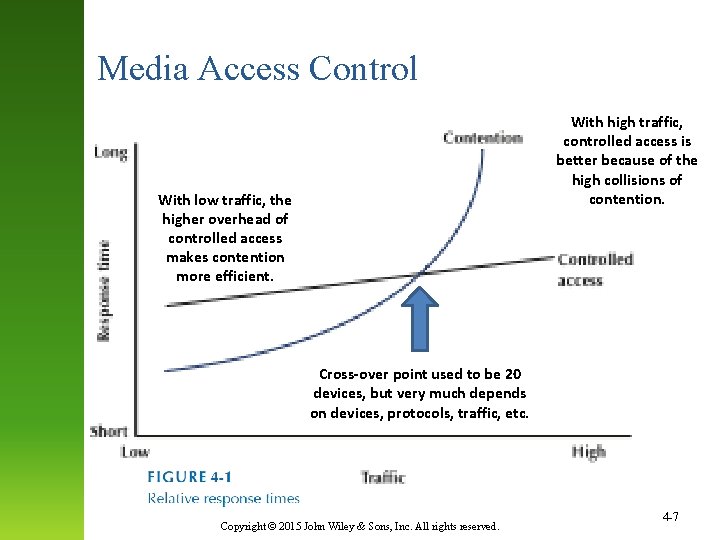
Media Access Control With high traffic, controlled access is better because of the high collisions of contention. With low traffic, the higher overhead of controlled access makes contention more efficient. Cross-over point used to be 20 devices, but very much depends on devices, protocols, traffic, etc. Copyright © 2015 John Wiley & Sons, Inc. All rights reserved. 4 -7
Error Control • Network errors – Types • Corrupted data • Lost data – Caused by problems in transmission (not humans) • Networks should be designed with: – Error prevention – Error detection – Error correction Copyright © 2015 John Wiley & Sons, Inc. All rights reserved. 4 -8
Sources of Network Errors • Line noise and distortion – Major reason for errors and caused by several sources – More likely on electrical media – Undesirable electrical signal – Degrades performance of a circuit – Manifestation • Extra bits • “Flipped” bits • Missing bits Copyright © 2015 John Wiley & Sons, Inc. All rights reserved. 4 -9
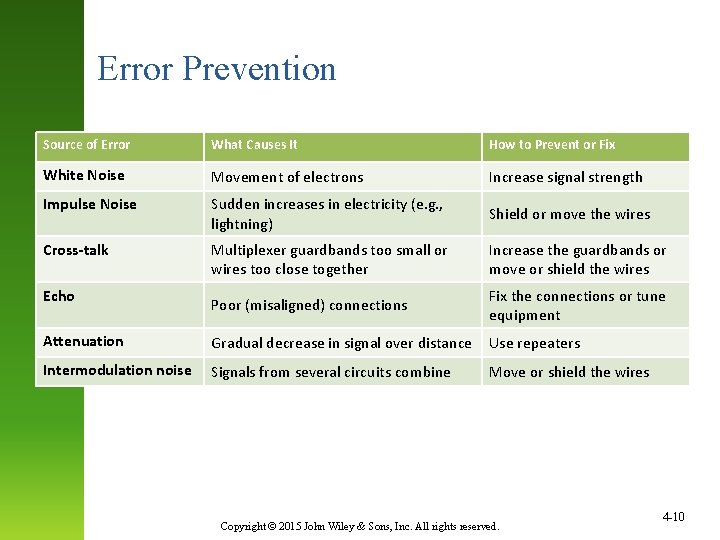
Error Prevention Source of Error What Causes It How to Prevent or Fix White Noise Movement of electrons Increase signal strength Impulse Noise Sudden increases in electricity (e. g. , lightning) Shield or move the wires Cross-talk Multiplexer guardbands too small or wires too close together Increase the guardbands or move or shield the wires Poor (misaligned) connections Fix the connections or tune equipment Attenuation Gradual decrease in signal over distance Use repeaters Intermodulation noise Signals from several circuits combine Move or shield the wires Echo Copyright © 2015 John Wiley & Sons, Inc. All rights reserved. 4 -10
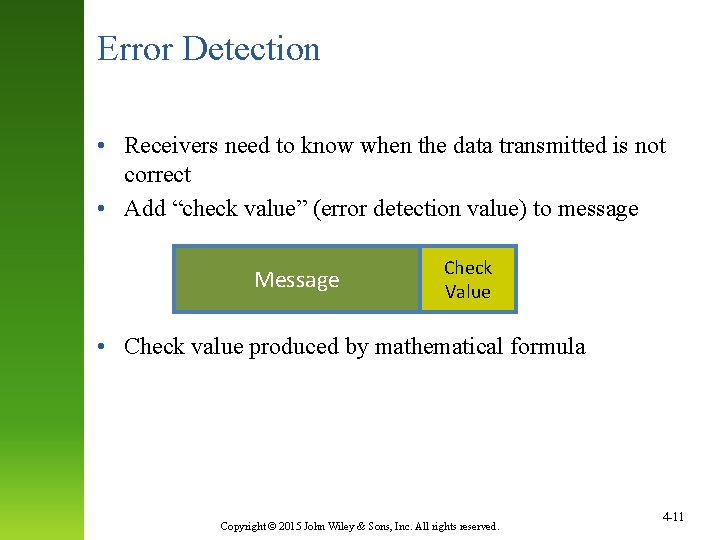
Error Detection • Receivers need to know when the data transmitted is not correct • Add “check value” (error detection value) to message Message Check Value • Check value produced by mathematical formula Copyright © 2015 John Wiley & Sons, Inc. All rights reserved. 4 -11
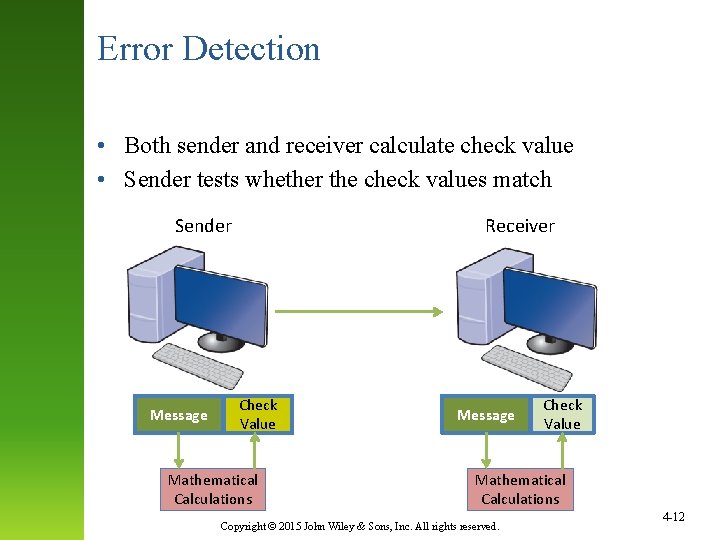
Error Detection • Both sender and receiver calculate check value • Sender tests whether the check values match Sender Message Receiver Check Value Mathematical Calculations Message Check Value Mathematical Calculations Copyright © 2015 John Wiley & Sons, Inc. All rights reserved. 4 -12
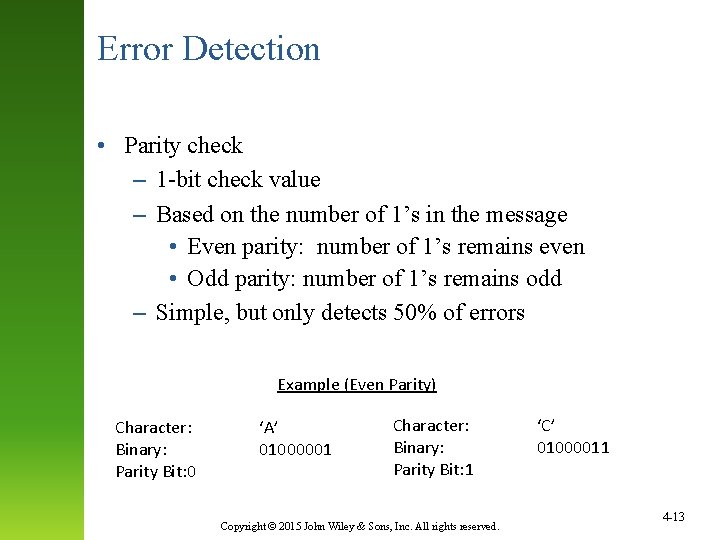
Error Detection • Parity check – 1 -bit check value – Based on the number of 1’s in the message • Even parity: number of 1’s remains even • Odd parity: number of 1’s remains odd – Simple, but only detects 50% of errors Example (Even Parity) Character: Binary: Parity Bit: 0 ‘A’ 01000001 Character: Binary: Parity Bit: 1 Copyright © 2015 John Wiley & Sons, Inc. All rights reserved. ‘C’ 01000011 4 -13
Error Detection • Checksum – 1 -byte (typically) check value – Checksum algorithms vary in the creation of check values – Detects 95% of errors Copyright © 2015 John Wiley & Sons, Inc. All rights reserved. 4 -14
Error Detection • Cyclic redundancy check (CRC) – Treats message as a single binary number – Divides by a preset number – Uses remainder as the check value • Preset number is chosen so that remainder is the correct number of bits • Modes: – CRC-16 (~99. 998% error detection rate) – CRC-32 (>99. 99999% error detection rate) Copyright © 2015 John Wiley & Sons, Inc. All rights reserved. 4 -15
Error Correction • Once detected, errors must be corrected • Error correction techniques – Retransmission (or backward error correction) • Retransmission is simple and most common • Automatic Repeat re. Quest (ARQ) – Stop-and-wait ARQ – Continuous ARQ • This can also provide flow control by limiting the number of messages sent – Forward error correction • Receiving device can correct messages without retransmission Copyright © 2015 John Wiley & Sons, Inc. All rights reserved. 4 -16
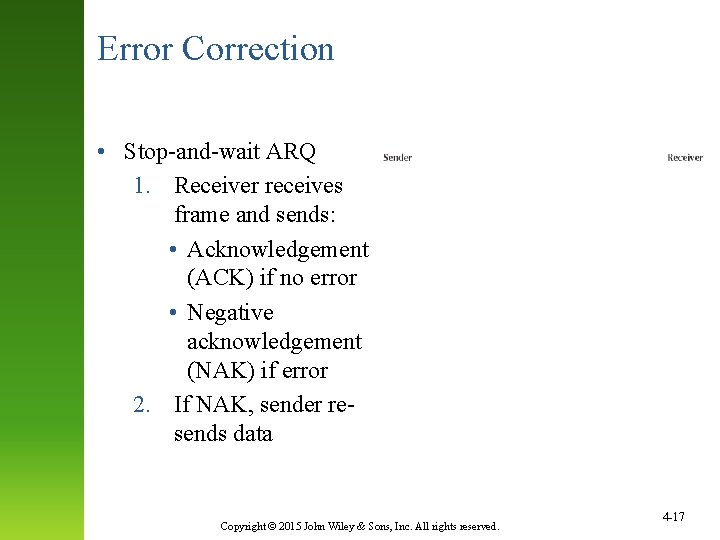
Error Correction • Stop-and-wait ARQ 1. Receiver receives frame and sends: • Acknowledgement (ACK) if no error • Negative acknowledgement (NAK) if error 2. If NAK, sender resends data Copyright © 2015 John Wiley & Sons, Inc. All rights reserved. Frame 1 ACK Frame 2 NAK Frame 2 ACK 4 -17
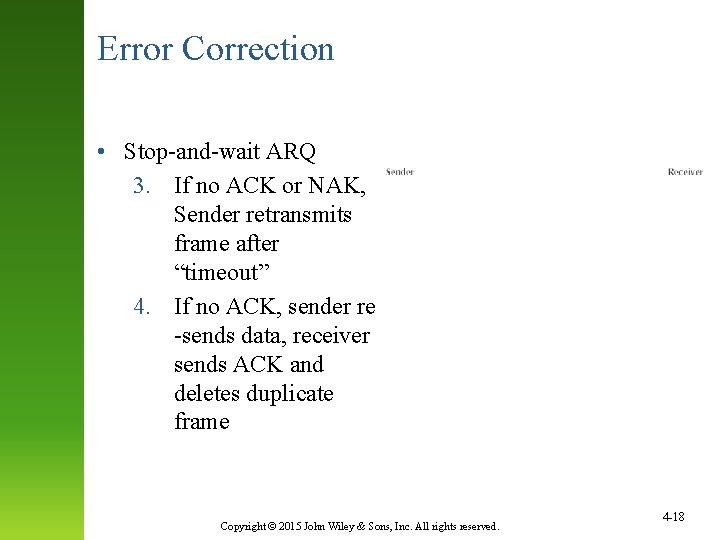
Error Correction • Stop-and-wait ARQ 3. If no ACK or NAK, Sender retransmits frame after “timeout” 4. If no ACK, sender re -sends data, receiver sends ACK and deletes duplicate frame Frame 3 ACK Frame 4 Duplicate Deleted ACK Copyright © 2015 John Wiley & Sons, Inc. All rights reserved. 4 -18
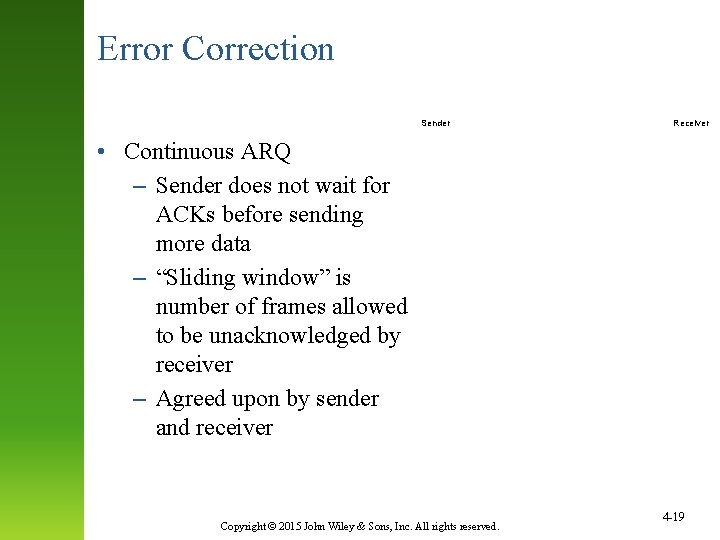
Error Correction Sender • Continuous ARQ – Sender does not wait for ACKs before sending more data – “Sliding window” is number of frames allowed to be unacknowledged by receiver – Agreed upon by sender and receiver Receiver Frame 1 No errors detected Frame 2 No errors detected ACK 1 Frame 3 Errors detected ACK 2 Frame 4 No errors detected NAK 3 Frame 3 No errors detected ACK 4 ACK 3 Copyright © 2015 John Wiley & Sons, Inc. All rights reserved. 4 -19
Error Correction • Forward error correction – Includes a certain level of redundancy in transmitted data so that receiving device can correct errors – Does not require retransmission – Used only when retransmission is impossible, very costly, or time consuming (e. g. , satellite connections) Copyright © 2015 John Wiley & Sons, Inc. All rights reserved. 4 -20
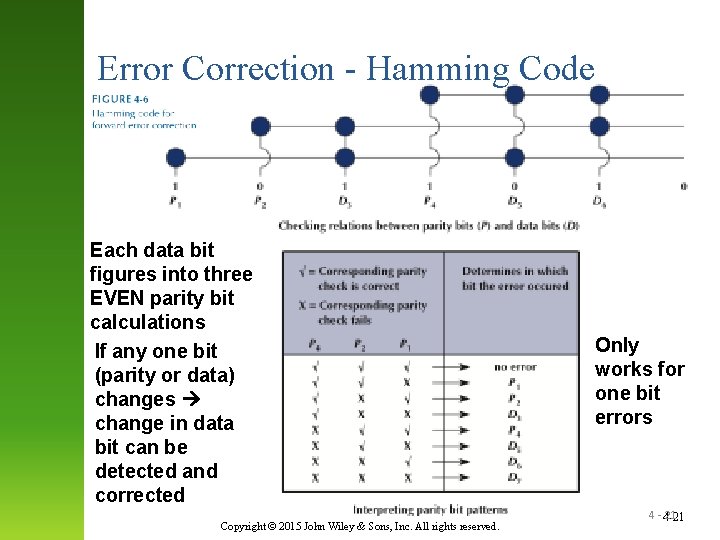
Error Correction - Hamming Code Each data bit figures into three EVEN parity bit calculations If any one bit (parity or data) changes change in data bit can be detected and corrected Copyright © 2015 John Wiley & Sons, Inc. All rights reserved. Only works for one bit errors 4 - 4 -21 21
Error Correction • Error control in practice – On wired connections, errors are quite rare – Most data link layer software today does not correct errors, only detect them and discard frames with errors – Error correction must then be done at a higher layer (Transport) Copyright © 2015 John Wiley & Sons, Inc. All rights reserved. 4 -22
- Slides: 22