
BUSINESS DATA COMMUNICATIONS NETWORKING Chapter 12 Network Management

BUSINESS DATA COMMUNICATIONS & NETWORKING Chapter 12 Network Management Fitz. Gerald ● Dennis ● Durcikova Prepared by Taylor M. Wells: College of Business Administration, California State University, Sacramento 12 Copyright © 2015 John, Wiley & Sons, Inc. All rights reserved.
Outline • • • What Do Network Managers Do? Designing for Network Performance Network Management Standards Managing Network Traffic Configuration Management Performance Management End User Support Cost Management Implications for Management Copyright © 2015 John, Wiley & Sons, Inc. All rights reserved. 12 -2
Network Management • Network management is the process of operating, monitoring, and controlling the network to ensure it works as intended and provides value to its users Copyright © 2015 John, Wiley & Sons, Inc. All rights reserved. 12 -3
What Do Network Managers Do? Operational Tasks • Manage the day-to-day operations of the network • Provide support to network users • Ensure the network is operating reliably • Evaluate and acquire network hardware, software, and services • Manage the network technical staff • Manage the network budget, with emphasis on controlling costs Copyright © 2015 John, Wiley & Sons, Inc. All rights reserved. 12 -4
What Do Network Managers Do? Strategic Tasks • Develop a strategic (long-term) networking and voice communications plan to meet the organization’s policies and goals • Keep abreast of the latest technological developments in computers, data communications devices, network software, telephone technologies, and the Internet • Assist senior management in understanding the business implications of network decisions and the role of the network in business operations Copyright © 2015 John, Wiley & Sons, Inc. All rights reserved. 12 -5
Designing for Network Performance • Managed Networks – Managed devices • Provide the features of unmanaged devices, plus the ability to configure, manage, and monitor the device • More expensive initial investment, but may save money in management • Can report when issues arise Copyright © 2015 John, Wiley & Sons, Inc. All rights reserved. 12 -6
Designing for Network Performance • Device management software (point management software) – Allows manager to monitor performance and configuration of devices on network • System management software • Application management software Copyright © 2015 John, Wiley & Sons, Inc. All rights reserved. 12 -7
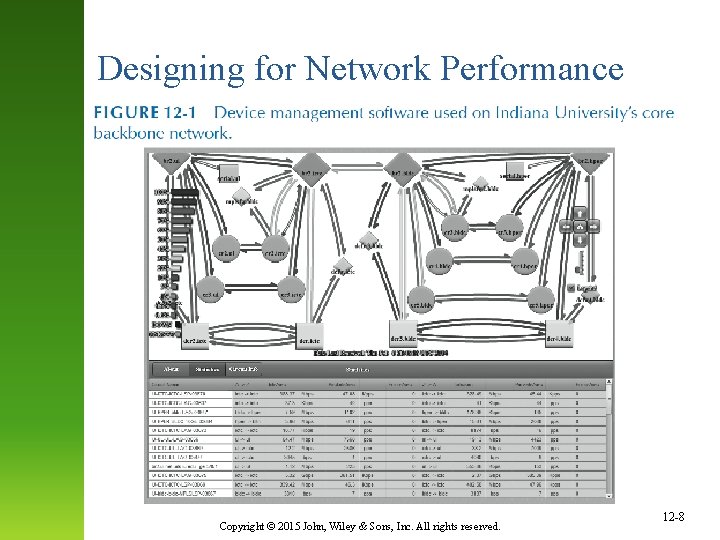
Designing for Network Performance Copyright © 2015 John, Wiley & Sons, Inc. All rights reserved. 12 -8
Network Management Standards • Simple network management protocol (SNMP) – Most commonly used protocol for managing network devices – The network management software uses SNMP to communicated with software agents on managed devices – Data is stored in management information base (MIB) Copyright © 2015 John, Wiley & Sons, Inc. All rights reserved. 12 -9
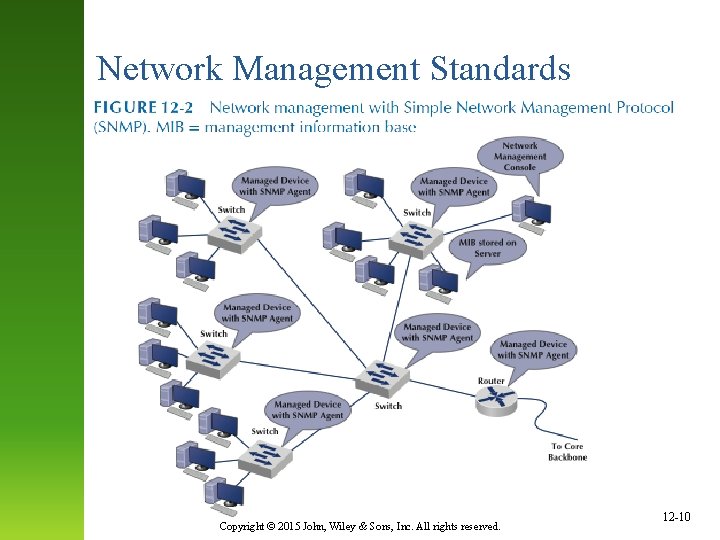
Network Management Standards Copyright © 2015 John, Wiley & Sons, Inc. All rights reserved. 12 -10
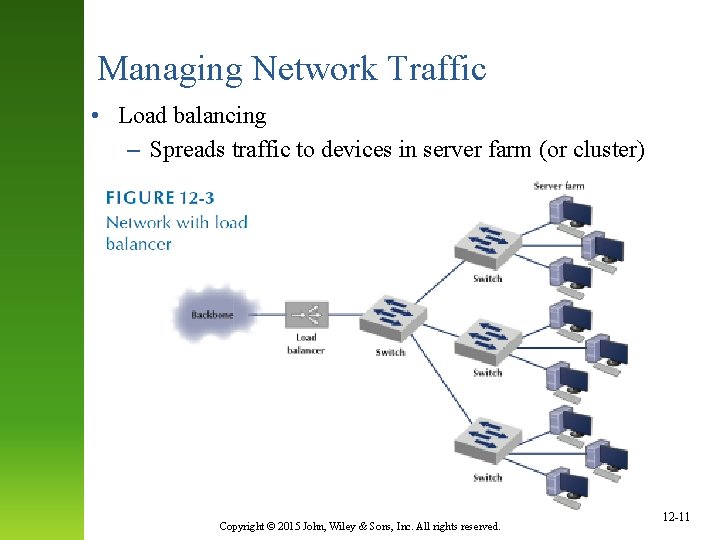
Managing Network Traffic • Load balancing – Spreads traffic to devices in server farm (or cluster) Copyright © 2015 John, Wiley & Sons, Inc. All rights reserved. 12 -11
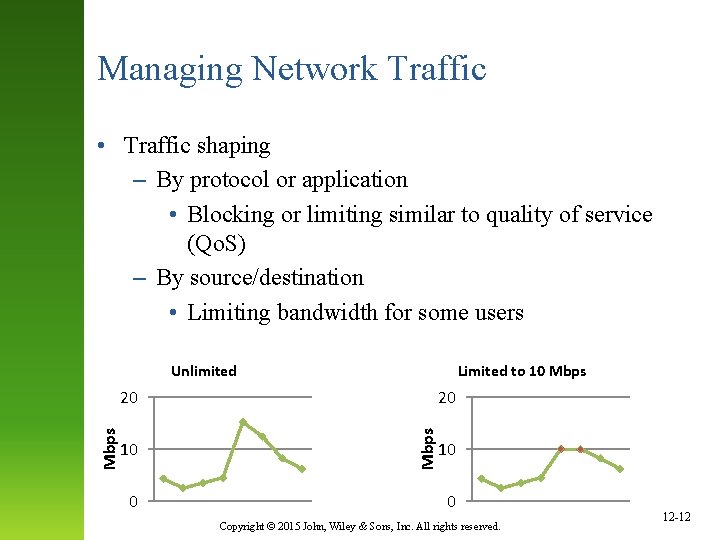
Managing Network Traffic • Traffic shaping – By protocol or application • Blocking or limiting similar to quality of service (Qo. S) – By source/destination • Limiting bandwidth for some users Unlimited Limited to 10 Mbps 10 0 20 Mbps 20 10 0 Copyright © 2015 John, Wiley & Sons, Inc. All rights reserved. 12 -12
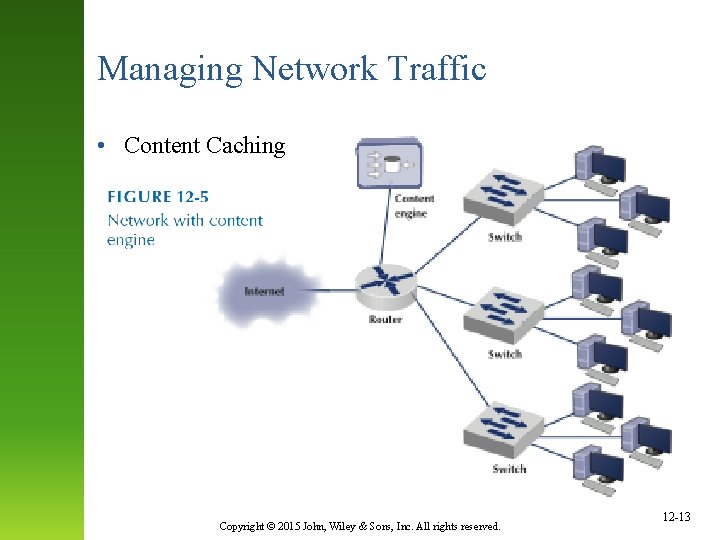
Managing Network Traffic • Content Caching Copyright © 2015 John, Wiley & Sons, Inc. All rights reserved. 12 -13
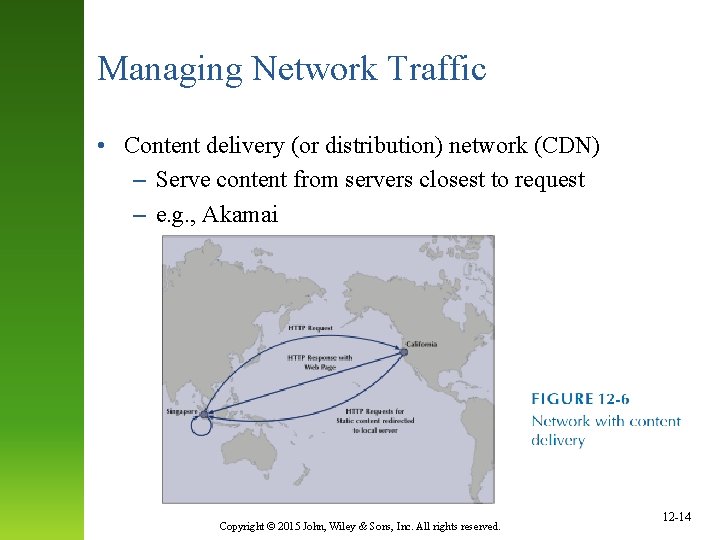
Managing Network Traffic • Content delivery (or distribution) network (CDN) – Serve content from servers closest to request – e. g. , Akamai Copyright © 2015 John, Wiley & Sons, Inc. All rights reserved. 12 -14
Configuration Management • Configuring Network and Clients – Adding and deleting user accounts – Updating software on client computers – Desktop Management • Documenting Configuration – Network diagrams – Network components – Network software – User/application profiles Copyright © 2015 John, Wiley & Sons, Inc. All rights reserved. 12 -15
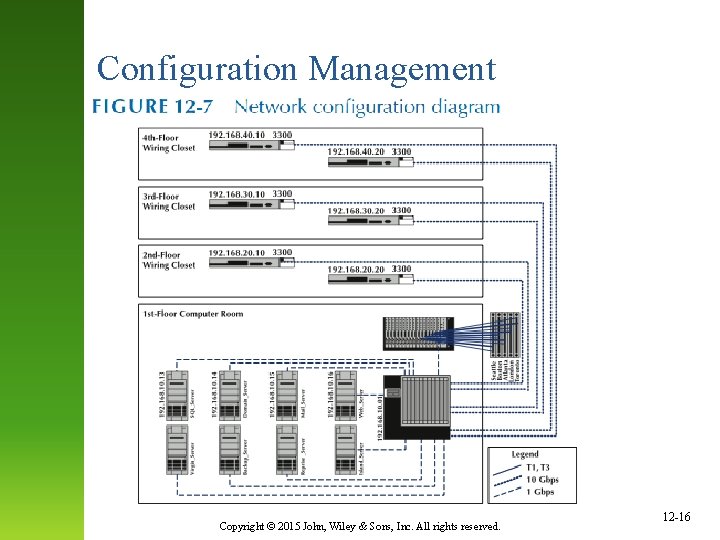
Configuration Management Copyright © 2015 John, Wiley & Sons, Inc. All rights reserved. 12 -16
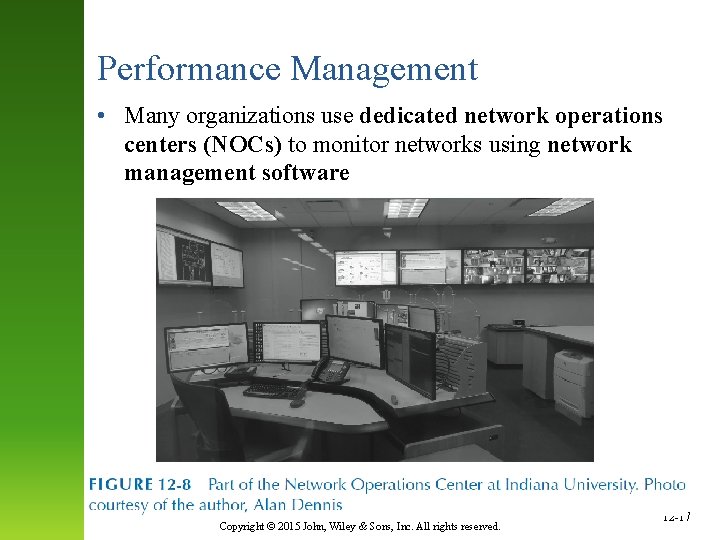
Performance Management • Many organizations use dedicated network operations centers (NOCs) to monitor networks using network management software Copyright © 2015 John, Wiley & Sons, Inc. All rights reserved. 12 -17
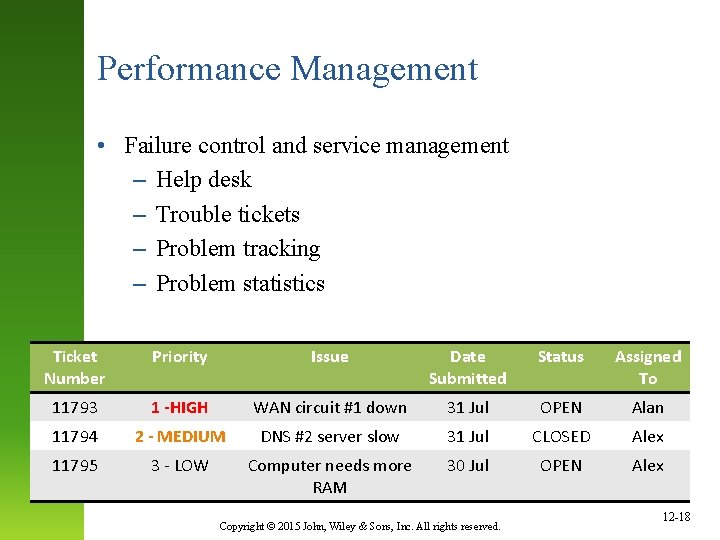
Performance Management • Failure control and service management – Help desk – Trouble tickets – Problem tracking – Problem statistics Ticket Number Priority Issue Date Submitted Status Assigned To 11793 1 -HIGH WAN circuit #1 down 31 Jul OPEN Alan 11794 2 - MEDIUM DNS #2 server slow 31 Jul CLOSED Alex 11795 3 - LOW Computer needs more RAM 30 Jul OPEN Alex Copyright © 2015 John, Wiley & Sons, Inc. All rights reserved. 12 -18
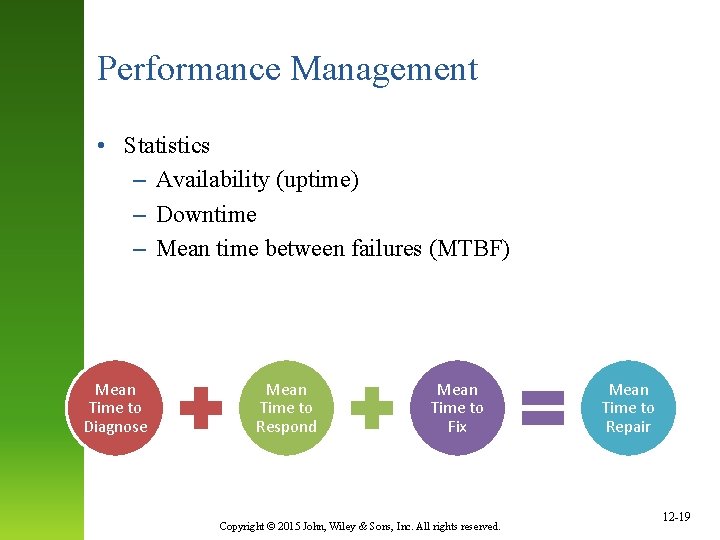
Performance Management • Statistics – Availability (uptime) – Downtime – Mean time between failures (MTBF) Mean Time to Diagnose Mean Time to Respond Mean Time to Fix Copyright © 2015 John, Wiley & Sons, Inc. All rights reserved. Mean Time to Repair 12 -19
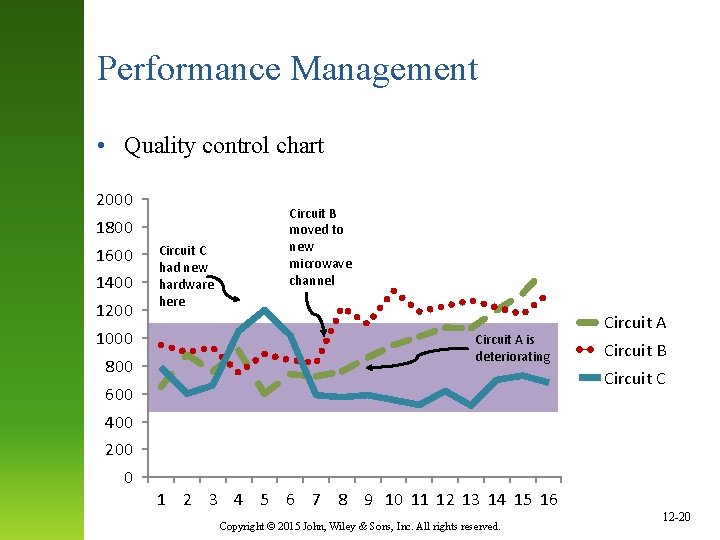
Performance Management • Quality control chart 2000 1800 1600 1400 1200 1000 800 Circuit C had new hardware here Circuit B moved to new microwave channel Circuit A is deteriorating Circuit A Circuit B Circuit C 600 400 200 0 1 2 3 4 5 6 7 8 9 10 11 12 13 14 15 16 Copyright © 2015 John, Wiley & Sons, Inc. All rights reserved. 12 -20
End User Support • Solving the problems users encounter while using the network • Major sources of problems with user equipment – Hardware device failures, generally easiest to fix – Lack of user knowledge on properation, also easier to fix – Problems with software, software settings or software incompatibility, generally hardest to fix • Training is an ongoing responsibility of network manager Copyright © 2015 John, Wiley & Sons, Inc. All rights reserved. 12 -21
Cost Management • Total Cost of Ownership (TCO) – A measure of direct and indirect costs to operate a device (e. g. , computer) per year – Includes cost of • Repairs and software/hardware upgrades • Support staff (maintain, install, administer, etc. ) • Training and technical support • Time “wasted” by the user when problems occur – TCO of a Windows computer • Estimated to be $5, 000 and $10, 000 per computer per year • Largest component is lost time – Some alternative measures (e. g. , NCO) only include direct costs • Estimated at $1, 500 – $3, 500 per computer per year Copyright © 2015 John, Wiley & Sons, Inc. All rights reserved. 12 -22
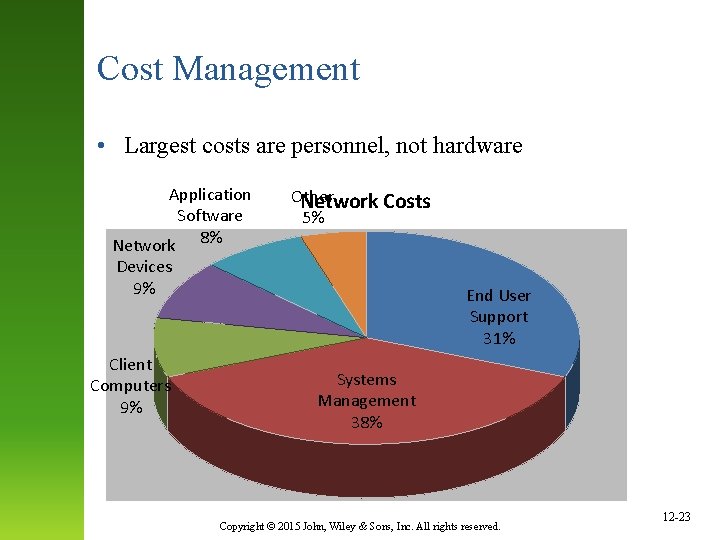
Cost Management • Largest costs are personnel, not hardware Application Software Network 8% Other Network Costs 5% Devices 9% Client Computers 9% End User Support 31% Systems Management 38% Copyright © 2015 John, Wiley & Sons, Inc. All rights reserved. 12 -23
Cost Management • Cost reduction steps – Develop standard hardware/software configurations for client computers, servers, and network devices – Automate as much of the network management process as possible – Reduce the cost of installing new hardware/software by working with vendors – Centralize help desks – Move to thin client or cloud-based architectures Copyright © 2015 John, Wiley & Sons, Inc. All rights reserved. 12 -24
Implications for Management • Network management requires technical understanding and management skills • Managers must explain the business value of the networks to justify its increasing cost • Network management is increasing its complexity • Qualified personnel costs much more than hardware Copyright © 2015 John, Wiley & Sons, Inc. All rights reserved. 12 -25
- Slides: 25