
Business Data Communications Chapter Four Components of a
Business Data Communications Chapter Four Components of a Local Area Network Business Data Communications, by Allen Dooley, (c) 2005 Pearson Prentice Hall Chapter Four 1
Primary Learning Objectives n n n n Identify key components that compose a area network (LAN) Understand the meaning of “topology” Describe selected LAN physical components Describe selected LAN logical components Identify common LAN devices Explain Standard versus Fast Ethernet Define metered versus site licensing Understand LAN design considerations Business Data Communications, by Allen Dooley, (c) 2005 Pearson Prentice Hall local 2
Local Area Network (LAN) Components n n Are physical and logical Physical or hardware elements include: n n Logical or software elements include: n n NICs, servers, clients, printers, cables, hubs, switches, routers Network operating systems, client operating systems, device drivers, monitoring and troubleshooting tools Logical elements also incorporate documented procedures Business Data Communications, by Allen Dooley, (c) 2005 Pearson Prentice Hall 3
Local Area Network (LAN) Components n n n Both physical and logical elements need to be installed, configured, and maintained Once implemented, elements must be monitored Monitoring may reveal that troubleshooting is required: n n To troubleshoot is to evaluate the causes of a problem so as to take corrective measures Troubleshooting tools can be hardware, software, a combination of these, or documented procedures Business Data Communications, by Allen Dooley, (c) 2005 Pearson Prentice Hall 4
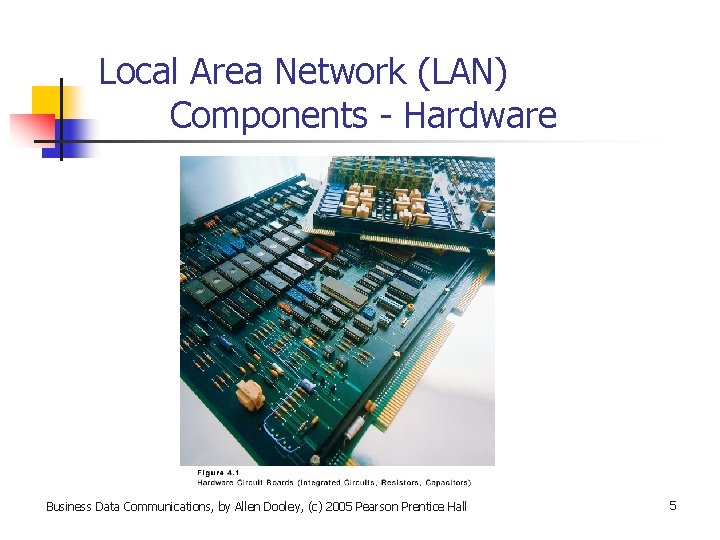
Local Area Network (LAN) Components - Hardware Business Data Communications, by Allen Dooley, (c) 2005 Pearson Prentice Hall 5
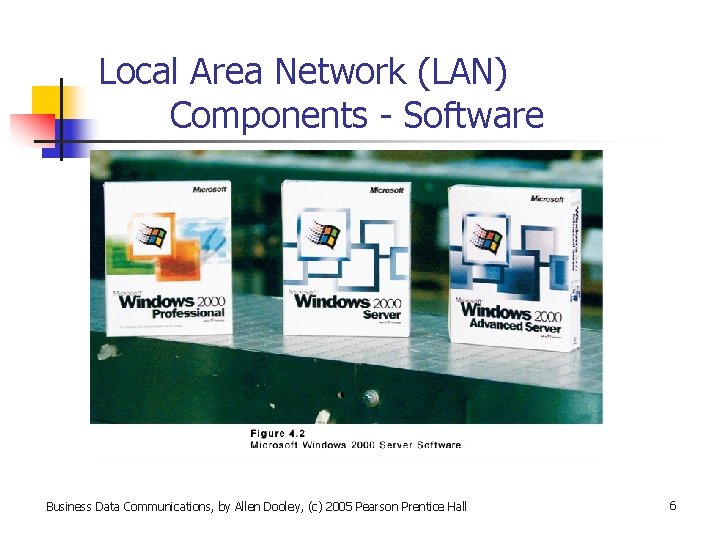
Local Area Network (LAN) Components - Software Business Data Communications, by Allen Dooley, (c) 2005 Pearson Prentice Hall 6
Topology n A topology: n n n Is an additional LAN characteristic Is both logical and physical Refers to the way that pieces of a network are physically connected Determines how network-connected devices access the physical network Three common topologies are: n n n Star Ring Business Data Communications, by Allen Dooley, (c) 2005 Pearson Prentice Hall 7
Topology – Star n n n A traditional star topology has a central controlling device Other networked devices connect to the central device using point-to-point circuits The central device is usually a mainframe or minicomputer n n Devices connecting to the mainframe/mini-computer are referred to as terminals A star can centralize network resources and management, but can also be a single point of failure Business Data Communications, by Allen Dooley, (c) 2005 Pearson Prentice Hall 8

Topology – Standard Star Business Data Communications, by Allen Dooley, (c) 2005 Pearson Prentice Hall 9
Topology – Ring n Developed by IBM n n n Uses a single cable such that a closed loop is created, hence the term “ring” Circling the ring, in one direction, is a token: n n IBM also developed the Token Ring Protocol, later formalized as the 802. 5 by the IEEE Used by networked devices that need to communicate Either free or busy Performs well in networks with heavy traffic Not widely implemented due to cost and complexity Business Data Communications, by Allen Dooley, (c) 2005 Pearson Prentice Hall 10
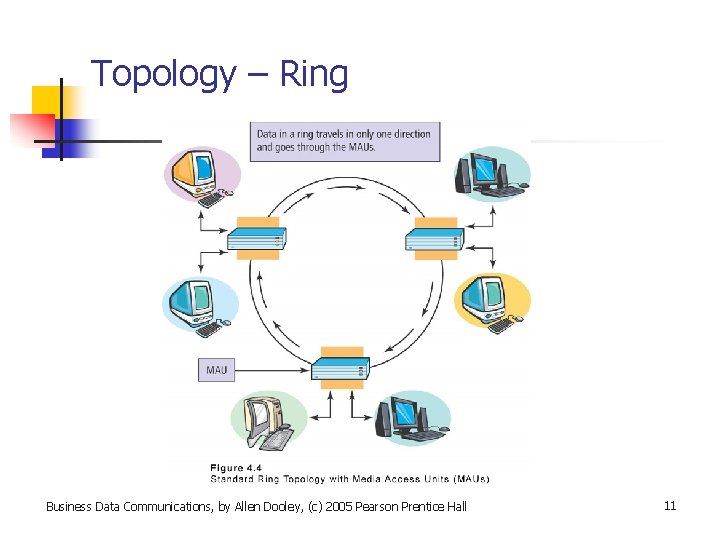
Topology – Ring Business Data Communications, by Allen Dooley, (c) 2005 Pearson Prentice Hall 11
Topology – Bus n Uses a central cable, but does not form a closed loop n n Uses a broadcast mechanism n n Data packets placed on the bus go to all devices on the bus The bus topology most commonly uses the IEEE 802. 3 Ethernet protocol n n Conceptually more like a pipeline along which network communications travel 802. 3, a contention-based protocol using CSMA/CD In a network with high traffic volume a standard bus using 802. 3 can lack efficiency Business Data Communications, by Allen Dooley, (c) 2005 Pearson Prentice Hall 12
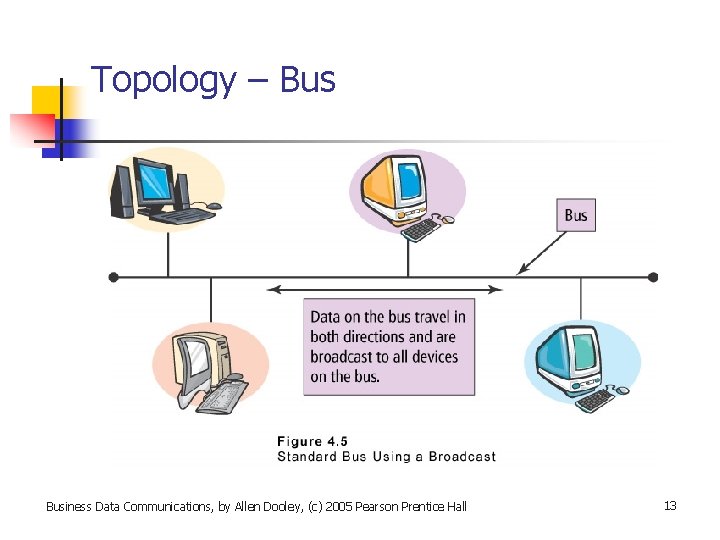
Topology – Business Data Communications, by Allen Dooley, (c) 2005 Pearson Prentice Hall 13
LAN Physical Components n The Physical components of a LAN’s hardware include: n n n n Network Interface Cards (NICs) Media Servers Clients Hubs Switches Routers Business Data Communications, by Allen Dooley, (c) 2005 Pearson Prentice Hall 14
LAN Physical Components -Network Interface Card n When selecting a NIC, certain features must be evaluated: n n n n Bus width Cache Direct memory access Bus mastering Throughput Auto-sensing capability NICs have a physical address, expressed hexadecimally for Ethernet cards: 08: 00: 5 A: 28: E 4: F 8 n The 1 st six digits identify the manufacturer; the last six, the card serial number Business Data Communications, by Allen Dooley, (c) 2005 Pearson Prentice Hall 15

LAN Physical Components -Network Interface Card n n Internal NICs are plugged into an expansion slot on the computer’s motherboard The PCI slots on this Intel motherboard could be used for an internal NIC Business Data Communications, by Allen Dooley, (c) 2005 Pearson Prentice Hall PCI Slots in White 16
LAN Physical Components -Media n n n “Media” is plural, “medium” is singular and refers to a specific type of physical circuit In LANs, the most common medium is unshielded twisted wire Pair, or UTP is categorized from CAT 1, lowest quality, to CAT 7, highest quality n n n The higher category number the greater the throughput capacity CAT 5, a popular UTP choice, supports speeds from 10 Mbps to 100 Mbps LAN wiring most often runs from the networked device to a wiring closet Business Data Communications, by Allen Dooley, (c) 2005 Pearson Prentice Hall 17
LAN Physical Components – Servers n n Servers generally control and manage networked resources in a LAN Depending on use, key server elements include: n n n n Primary memory or RAM Cache NIC capacity Processor; speed as well as number must be considered Hard Drive; capacity as well as speed must be considered Operating system Degree of fault tolerance: mirroring versus duplexing Server farms play an important role in today’s society Business Data Communications, by Allen Dooley, (c) 2005 Pearson Prentice Hall 18
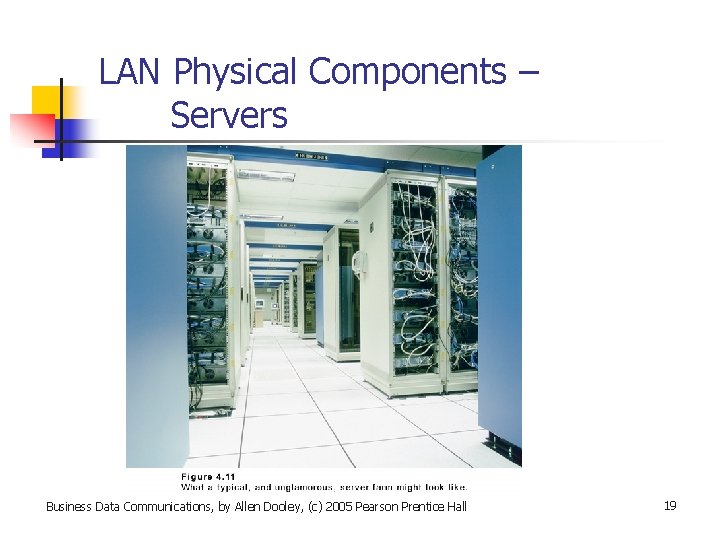
LAN Physical Components – Servers Business Data Communications, by Allen Dooley, (c) 2005 Pearson Prentice Hall 19
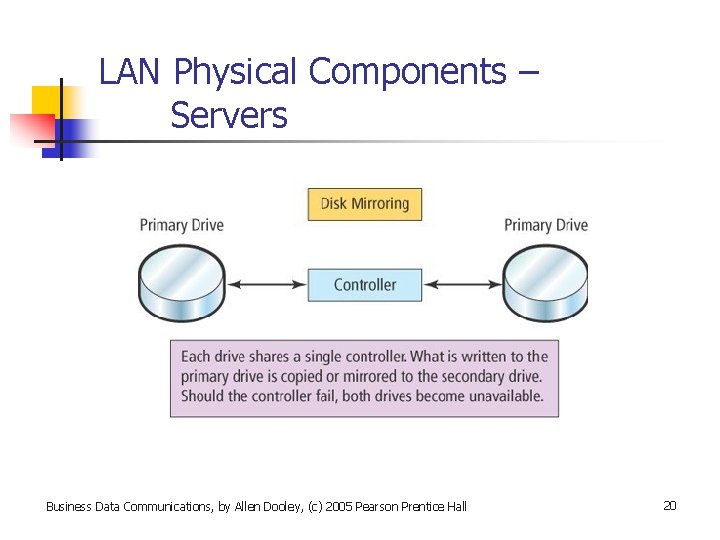
LAN Physical Components – Servers Business Data Communications, by Allen Dooley, (c) 2005 Pearson Prentice Hall 20
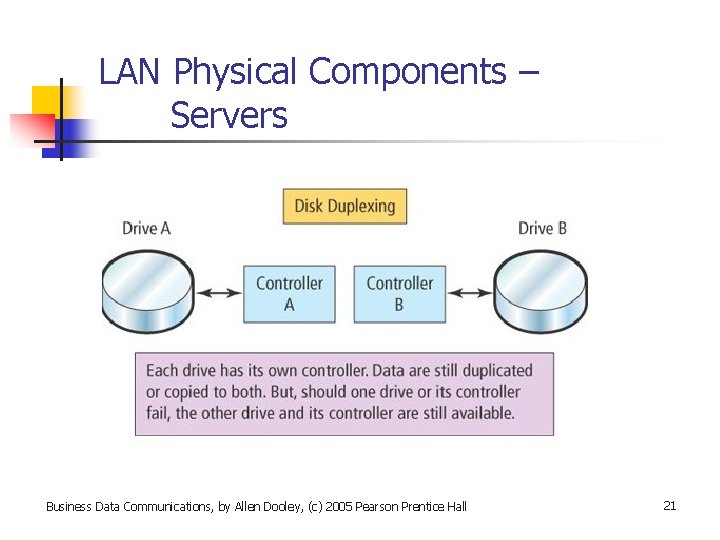
LAN Physical Components – Servers Business Data Communications, by Allen Dooley, (c) 2005 Pearson Prentice Hall 21
LAN Physical Components – Clients n n Clients connect users to the network A client could be a desktop computer, a powerful workstation, a cell phone, a personal digital assistant, or any number of other networkable devices Like servers, clients require a NIC Clients require an operating system appropriate to the way they are to be used: n n Modern client operating systems incorporate “network aware” capability, and can be configured in a peer-to-peer network Most LANs configure clients in a client/server model Business Data Communications, by Allen Dooley, (c) 2005 Pearson Prentice Hall 22
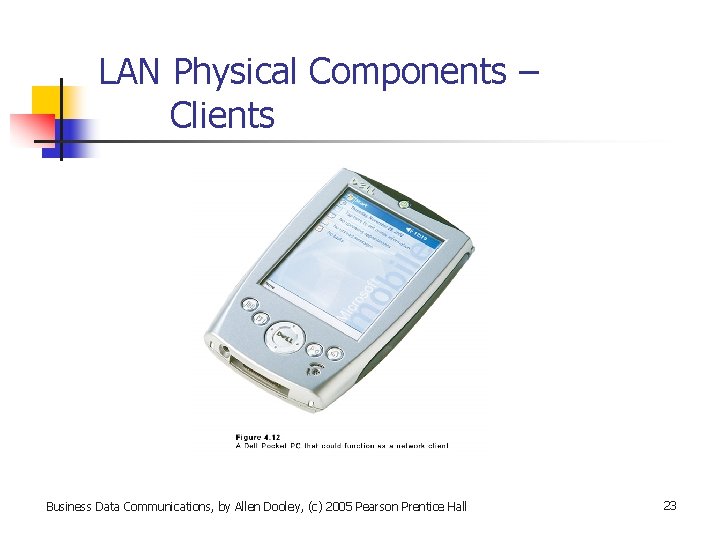
LAN Physical Components – Clients Business Data Communications, by Allen Dooley, (c) 2005 Pearson Prentice Hall 23
LAN Devices n n Two devices particularly associated with LANs are switches and routers Switches: n n Create Point-to-point circuits between themselves and their connected devices Have largely replaced hubs in modern Ethernet LANs Are less expensive than routers, and have displaced but not eliminated routers, causing routers to be pushed to the edge of the network Are capable, based on the switch, of multilayer support for the data link and/or network layers Business Data Communications, by Allen Dooley, (c) 2005 Pearson Prentice Hall 24
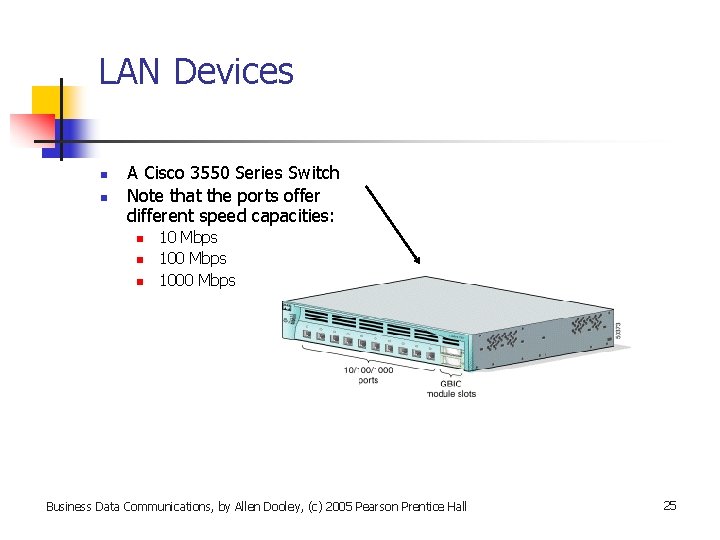
LAN Devices n n A Cisco 3550 Series Switch Note that the ports offer different speed capacities: n n n 10 Mbps 1000 Mbps Business Data Communications, by Allen Dooley, (c) 2005 Pearson Prentice Hall 25
LAN Devices n Routers: n n n Function at the network layer of the OSI and TCP/IP models Are capable of connecting different logical networks Are required for different logical networks to communicate with each other Are more expensive than switches Use routing tables that are updated either manually, or automatically through software Do not broadcast packets Business Data Communications, by Allen Dooley, (c) 2005 Pearson Prentice Hall 26
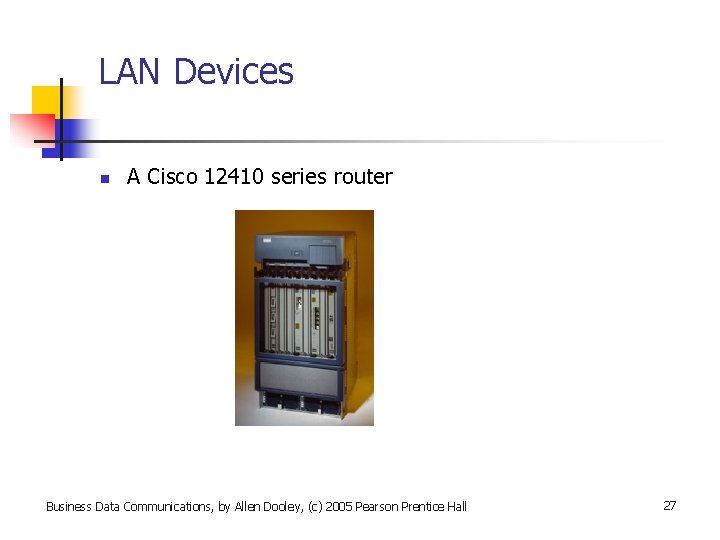
LAN Devices n A Cisco 12410 series router Business Data Communications, by Allen Dooley, (c) 2005 Pearson Prentice Hall 27
Standard versus Fast Ethernet n n The underlying Ethernet 802. 3 architecture has not changed What has changed: n n n Switches can be used in a hierarchy: n n n The types of devices used within an Ethernet LAN (switches instead of hubs) The diameter an Ethernet LAN can be configured for (250 meters versus 2, 500 meters) Faster, more expensive switches at the top Slower, less expensive switches at the bottom For Fast Ethernet, 100 Base. X has been the market winner Business Data Communications, by Allen Dooley, (c) 2005 Pearson Prentice Hall 28
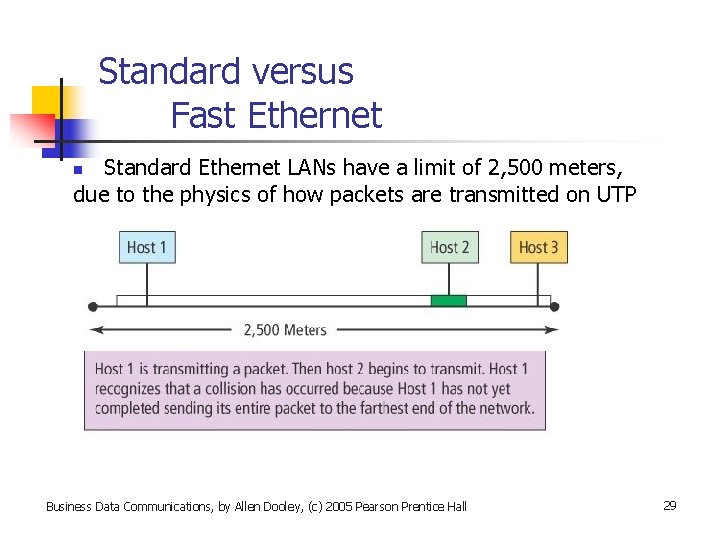
Standard versus Fast Ethernet Standard Ethernet LANs have a limit of 2, 500 meters, due to the physics of how packets are transmitted on UTP n Business Data Communications, by Allen Dooley, (c) 2005 Pearson Prentice Hall 29
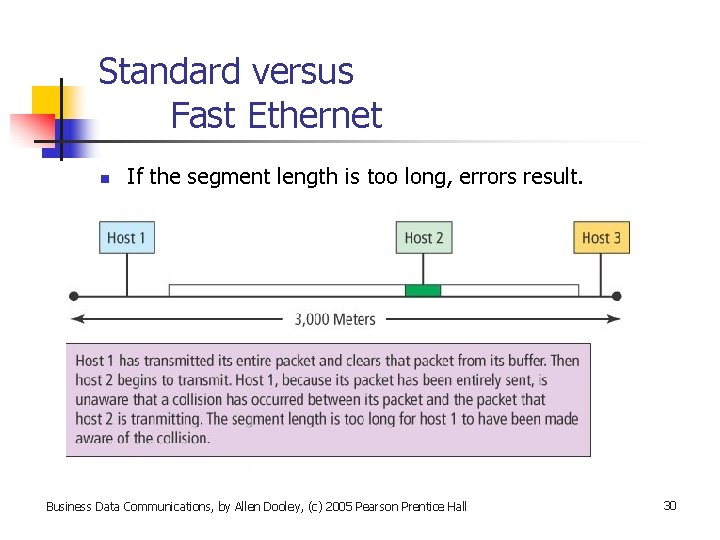
Standard versus Fast Ethernet n If the segment length is too long, errors result. Business Data Communications, by Allen Dooley, (c) 2005 Pearson Prentice Hall 30
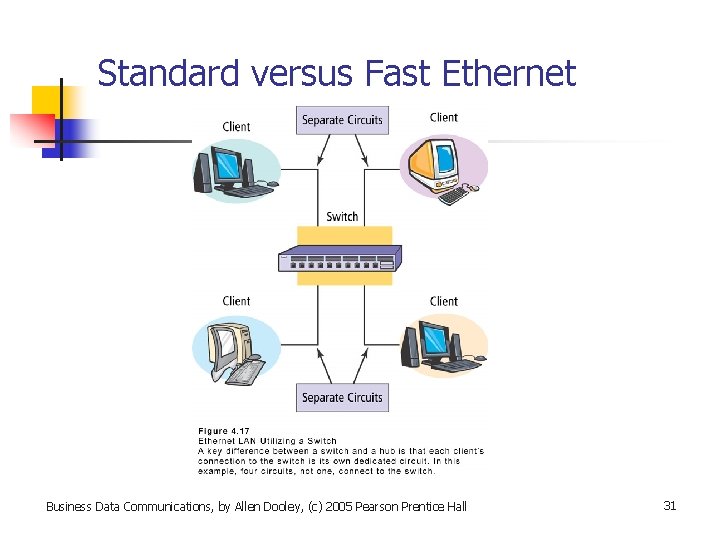
Standard versus Fast Ethernet Business Data Communications, by Allen Dooley, (c) 2005 Pearson Prentice Hall 31
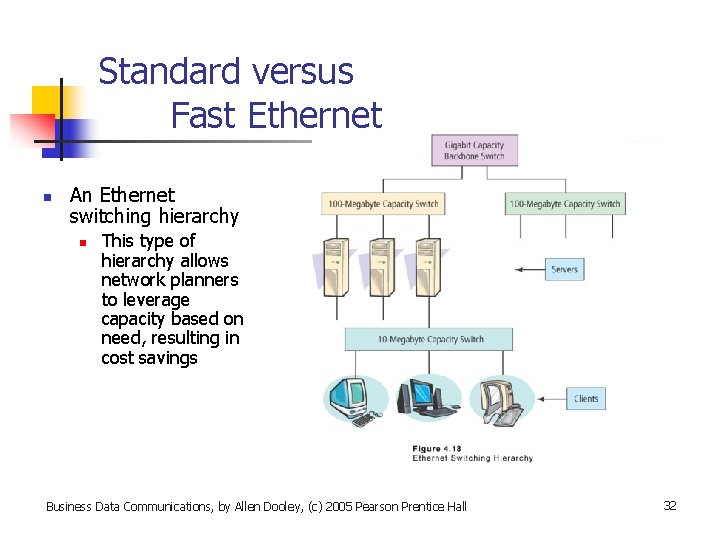
Standard versus Fast Ethernet n An Ethernet switching hierarchy n This type of hierarchy allows network planners to leverage capacity based on need, resulting in cost savings Business Data Communications, by Allen Dooley, (c) 2005 Pearson Prentice Hall 32
Metered Licensing versus Site Licensing n In a business, two common forms of licensing are metered licensing and site licensing n n n Licensing is a critical issue in the network, legally and ethically Licensing policies should be part of any business’s documented network procedures Licensing documentation is often used in audits, both internal and external to the business Business Data Communications, by Allen Dooley, (c) 2005 Pearson Prentice Hall 33
Metered Licensing versus Site Licensing n With a metered license: n n n The business buys a limited number of licenses for a given application Software maintains a count of the number of licenses As users login to use the application, the metered license counter is incremented When the maximum value is reached, new users will be denied access to the application, until an already logged-in user terminates his or her session If the metered value is too small, user frustration results If the metered value is too large, cost inefficiency results Business Data Communications, by Allen Dooley, (c) 2005 Pearson Prentice Hall 34
Metered Licensing versus Site Licensing n With a site license: n n n The business is buying a licensing right to use an application for the entire organization, covering the entire site For an application used by a majority of staff, clients, or general users, a site license can offer cost savings An application that is rarely used, or used only by a few, is a questionable candidate for site licensing Business Data Communications, by Allen Dooley, (c) 2005 Pearson Prentice Hall 35
LAN Design Considerations n n There is no one solution that is right for all businesses Designing a LAN solution requires answering numerous questions: n n n n What What is the budget? applications must be supported? staff is available or required? are the security issues? scale is the network for? are the facility requirements? areas of the network are most vulnerable? documentation is available or required? Business Data Communications, by Allen Dooley, (c) 2005 Pearson Prentice Hall 36
In Summary n n n n LAN Components are either physical, logical, or both A LAN has a topology Common elements within a LAN include media, servers, clients, NICs, switches, and routers Most LANs use a form of Ethernet Newer forms of Ethernet have not changed Ethernet's underlying architecture LAN licensing is an important legal and ethical issue LAN design must be driven by a business’s specific requirements Business Data Communications, by Allen Dooley, (c) 2005 Pearson Prentice Hall 37
- Slides: 37