
Business Cycles Fluctuations in Real GDP The total


Business Cycles Fluctuations in Real GDP (The total market value of all final goods and services produced in a country in a given year, equal to total consumer, investment and government spending, plus the value of exports, minus the value of imports) referred to as Business Cycles. • The duration and intensity of each phase of the Business Cycle are not always clear. • Business Cycles are typical of Market, Capitalistic economies due to the free nature of those economic systems.
What is a business cycle? n A business cycle refers to periods of expansion and contraction. A peak is the high point following a period of economic expansion. A trough is the low point following a period of economic decline.
Definition n Acc to Professor Haberler “ The Business Cycle in the general sense may be defined as an alternation of periods of prosperity and depression of good and bad trade.

Types of Cycles: 1. The Short Kitchen Cycle: Joseph Kitchin - 1923 -British Economist - Also Known as Minor Cycle. - 40 Month duration - Dis b/w Major and Minor Cycle-1923 - Major Cycle-composed of 2 or 3 Minor cycle. 2. The Long Jugler Cycle: Jugler-1862 -French Economist - Also Known as Major Cycle - Fluctuation of business activity b/w successive crises - Duration- 9 ½ yrs
Types of Cycles: 3. The Very Long Kondratieff Cycle: N. D. Kondratieff-1952 -Russian Economist Very Long cycle – Kondratieff wave - Duration –More than 50 yrs - 4. Building Cycle: Warren & Pearson -2 American Economist-1937 - Relates to the building Construction - Duration- twice that of Major Cycle -18 Yr 5. Kuznets Cycle: Prof. Simon Kuznets- American Economist - Propounded new cycle- Secular Swing-16 -22 yr - dwarfs -7 to 11 yrs – relatively insignificance
Phases Of a Business Cycle n A typical Cycle is generally divided in to four Phases 1. 2. 3. 4. Expansion Or Prosperity Or the Upswing Or Boom Recession Or Upper-turning point. Contraction or Depression or Downswing Revival Or Recovery Or Lower Turning Point

% Change in Real GDP Recession Or Peak Expansion 0% Contraction Recovery

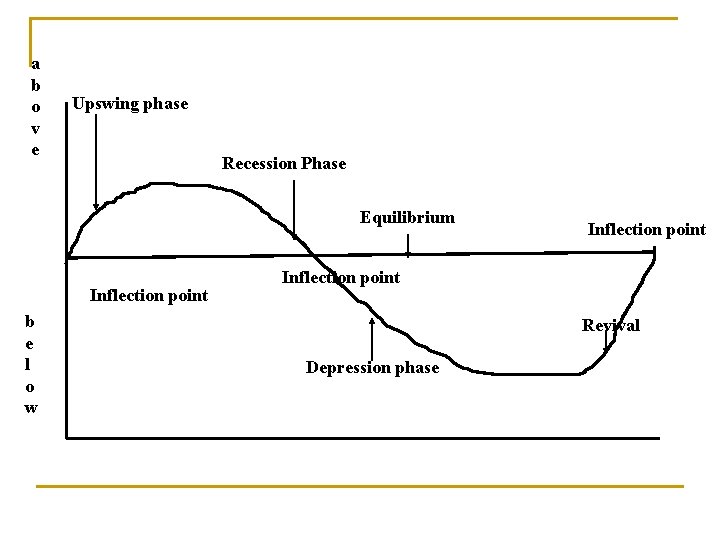
a b o v e Upswing phase Recession Phase Equilibrium Inflection point b e l o w Inflection point Revival Depression phase
Expansions Or Boom • Expansions are periods of increasing Real GDP. • Unemployment decreases, businesses expand, and Personal Consumption increases. • As expansions continue, there tend to be upward pressures on prices (inflation) and interest rates.
Peak Or Recession • A peak is a period when the economy starts to level off. • Businesses postpone new investments, and consumer saving tends to increase. • Rising prices and interest rates tend to restrict purchases and investments, often leading to a Contraction.
Contraction Or Depression • A Contraction is a period of declining Real GDP. • Consumer spending decreases, and unemployment increases as businesses layoff workers and shorten work hours. • Interest rates and prices level off, and often decline during long contractions.
Long Term Contractions n Recession: Six months of declining Real GDP n Depression: Twelve months of declining Real GDP coupled with at least 15% unemployment.
Trough Or Recovery Or Lower Turning Point n A Trough is the bottom of a Contraction. Lower interest rates and prices bring customers back to markets.
Things That Affect the Business Cycle n Business Investment: High levels of business investment (capital good increases like machinery and equipment) promote expansion. Low levels of business investment contribute to contraction. n Money and credit: When interest rates go up, people borrow less, and this less money is circulating in the economy, thus contributing to a contraction.
Things That Affect the Business Cycle n Public Expectations: People will increase their spending if they believe the economy is strong. This helps promote expansion. n External Factors: Like energy crisis and war.
Theories Of Trade Cycle n 1. Sun-Spot Theory Or Climatic Theory: Jevons & Moore -based on climatic variation - Climatic variation are due to spots of sun so it is called sun-spot theory. 2. Psychological Theory: A. C. Pigou, Beveridge & others - Psychological feelings

Theories Of Trade Cycle n 3. Hawtrey’s Theory Or Monetary Theory: - Trade cycle is purely a Monetary Phenomenon” & Natural Causes like climatic condition, earthquake etc. , -Changes in flow of money - Inflation & Deflation created by ROI n 4. Von Hayek’s Theory Or Over-Investment Theory: Prof Von Hayek. - basis of Monetary Over-investment and consequent over-production
Theories Of Trade Cycle n 5. Over Saving Or Under Consumption Theory: - Trade cycle is purely a Monetary Phenomenon” & Natural Causes like climatic condition, earthquake etc. , -Changes in flow of money - Inflation & Deflation created by ROI n 4. Von Hayek’s Theory Or. Psychological Theory: A. C. Pigou, Beveridge & others - Psychological feelings
- Slides: 20