
Business Cycle Series of periods of growing and
Business Cycle § Series of periods of growing and shrinking economic activity § Measured by increase/decrease in RGDP
4 Phases § 1. Expansion: economic activity begins to increase (RGDP increasing, UE down) § 2. Peak: period of increase econ. activity § 3. Contraction: period of slowed econ. activity (UE increasing) § 4. Trough: lowest level

2 Categories of Business Changes § 1. Recession: 2 or more consecutive fiscal quarters of declining GDP § Producers/consumers scale back § UE increases § 2. Expansion: Spending and production increases § Prices increase § UE decreases
Monetary Policy § Monetarists § Feds power to control money supply and credit 1. Believe competitive markets provide econ. stability 2. Less inclined to support govt. interaction 3. FEDERAL RESERVE (3 Tools) 4. ADAM SMITH 1. “Wealth of Nations” 2. Laissez faire
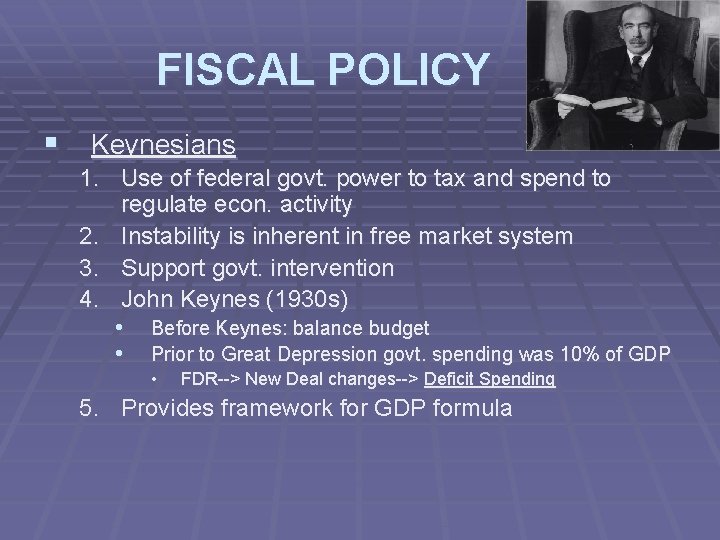
FISCAL POLICY § Keynesians 1. Use of federal govt. power to tax and spend to regulate econ. activity 2. Instability is inherent in free market system 3. Support govt. intervention 4. John Keynes (1930 s) • Before Keynes: balance budget • Prior to Great Depression govt. spending was 10% of GDP • FDR--> New Deal changes--> Deficit Spending 5. Provides framework for GDP formula
Government Budget § Deficit § Expenditures exceed revenues § Surplus § Expenditures are less than revenues
National Debt vs. Deficit § Debt § TOTAL amount owed by govt § Deficit § YEARLY amount § Add all deficits and subtract few surpluses=ND
How big is this number? § There are one millions in a trillion. § One trillion is more stars than there are in the § § § entire Milky Way galaxy 12 Trillion $1 bills, laid end to end, side to side, would pave every interstate, highway, and country road in America -- twice. A trillion $10 bills, taped end to end, would wrap around the Earth more than 380 times. You could spend $10 M a day and it would still take you 273 years to spend $1 trillion
DOES IT AFFECT YOU? 1. Transfer of purchasing power to public sector § Larger Debt = Larger Interest payments = More Taxes = Less Spending 2. Taxes needed to pay interest § Decrease incentive to work Who owns our debt? What would happen if we defaulted?
- Slides: 10