
Business Communication Skills for Managers Module 14 Finding
Business Communication Skills for Managers Module 14: Finding a Job
Why learn to network and apply for jobs?

Professional Skill Building
Learning Outcomes: Professional Skill Building 14. 1 Discuss how to gain skills necessary for professional life 14. 1. 1 List specific skills that will be necessary for your career path 14. 1. 2 List transferable skills that will be valuable for any career path 14. 1. 3 Explain how to acquire necessary skills, both in and out of class, for your career goals 14. 1. 4 Describe the stages of career development
Skills for a Career What are skills that employers want? • Professionals with scientific acumen • Active listening skills • Service orientation • Oral comprehension abilities • Teamwork skills Hard skills: concrete abilities that you learn and master Soft skills: skills that have changed very little over time
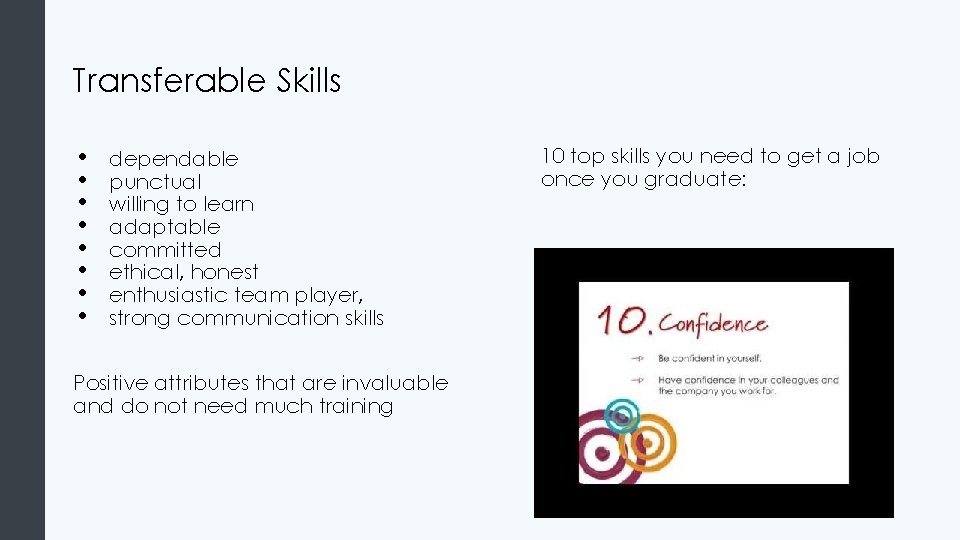
Transferable Skills • • dependable punctual willing to learn adaptable committed ethical, honest enthusiastic team player, strong communication skills Positive attributes that are invaluable and do not need much training 10 top skills you need to get a job once you graduate:
Acquiring Necessary Skills Mark Atwood, director of open-source engagement at Hewlett-Packard Enterprise curated this list of skills: learn how to write clearly, learn how to speak, be reachable, learn about computers, build community relationships, attend conferences & events, find projects and get involved, collaborate, keep profiles up to date, keep learning Get involved in part-time work, extracurricular activities, with employment and career development
Stages of Career Development What is career development? Lifelong process in which we become aware of, interested in, knowledgeable about, and skilled in a career Five Main Stages: 1. 2. 3. 4. 5. Growing (4 -13 years) Exploring (teenage years to mid-twenties) Establishing (mid-twenties to mid-forties) Maintaining (mid-forties to mid-sixties Reinventing (mid-sixties into retirement)
Stages of Career Development (cont. ) Career Support: • • • Seek career development office on campus Read cooks on career development Have a career roadmap: know yourself, explore options, gain knowledge, put it all together find Internet sites for career planning Use paid agencies, if this is possible
Discussion There are five main stages of career development. Each stage correlates with attitudes, behaviors, and relationships we all tend to have at that point and age. As we progress through each stage and reach the milestones identified, we prepare to move on to the next one. Spend five minutes writing your responses to the following questions: Which stage of career development do you feel you are in currently? Think about each stage. What challenges are you facing now? Where are you headed? Discuss your responses with a partner.
Networking

Learning Outcomes: Networking 14. 2 Discuss the importance of networking, and identify strategies to increase your professional network 14. 2. 1 Identify strategies for networking
Strategies for Networking Process in which people build relationships with one another for the purpose of helping achieve professional goals Share business cards, resumes, cover letters, as well as share information about conferences, special events and even soliciting headhunters Can occur anywhere and at any time, and expands with each new relationship you establish What are some ways that you network?
Strategies for Networking (cont. ) How do you get started? • Remember that hope is not a plan, keenly focus your activities on getting a job, you need business cards, you need to register your own domain name, attend networking events, master Linkedin, think about parents’ friends, create world you want to live in Sources for developing professional networks: • Meetup groups, social media, conferences, internships, websites, family members, advisers, alumni association, vendors, coworkers, networking events, etc.
Résumés and Cover Letters
Learning Outcomes: Résumés and Cover Letters 14. 3 Produce a résumé and a cover letter 14. 3. 1 Discuss the purpose and contents of a résumé 14. 3. 2 Identify characteristics of an effective résumé 14. 3. 3 Create a résumé customized for a specific job opening 14. 3. 4 Identify characteristics of an effective cover letter
The Purpose of Résumés Inventory of your education, work experience, job-related skills, accomplishments, and more Elements of a successful résumé 1. Reverse chronological résumé 2. Functional résumé 3. Hybrid résumé 4. Video, infographic, Web-site résumé
Writing Effective Résumés To begin, put best experiences together. The order may change depending on where you are in your career Purpose is not to get a job, but to get to the next level in the screening process Dig in deeper to provide your work experience, volunteer experience, and education/training
Practice Question 1 Leandro started at his current company as a college intern. After graduation, the company hired him, and he has been steadily promoted over the last seven years until he reached his current position as the IT manager. Friends at other companies have told him that he could apply his IT skills and become a coder, which would earn him more money and put him in a much more exciting cutting-edge industry. Leandro hasn't had to create a resume in almost a decade. Given his current position and the kind of job he's hoping to get, what kind of resume should he create? a) a reverse-chronological resume b) a hybrid resume c) a video resume
Activity The purpose of this activity is to find real-world examples of résumés with a small group. Make a list with the URL to each, and discuss the strengths and weaknesses of the ones you’ve found: 1. Reverse chronological résumé 2. Functional résumé 3. Hybrid résumé 4. Video, infographic, Web-site résumé
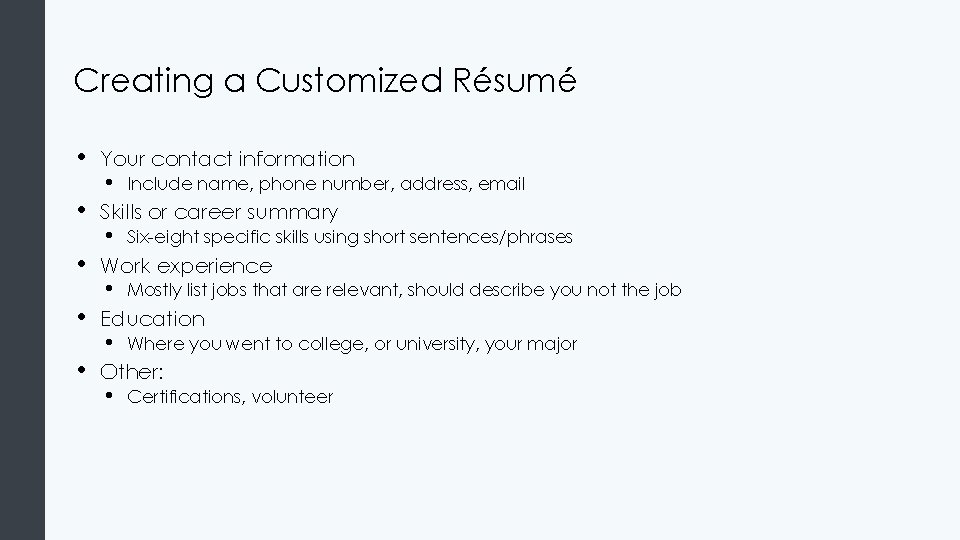
Creating a Customized Résumé • • • Your contact information • Include name, phone number, address, email Skills or career summary • Six-eight specific skills using short sentences/phrases Work experience • Mostly list jobs that are relevant, should describe you not the job Education • Where you went to college, or university, your major Other: • Certifications, volunteer
Writing Effective Cover Letters A cover letter is a letter of introduction that you attach to your resume: introduces yourself and explains why you are suitable for the job Characteristics: • Get attention of employer • Set you apart from competition • Identify position you are interested in • Specify how you learned about position/company • Present highlights of skills/accomplishments • Please eye and ear • Reflect genuine interest
Interviewing
Learning Outcomes: Interviewing 14. 2 Discuss the importance of networking, and identify strategies to increase your professional network 14. 2. 1 Identify strategies for networking
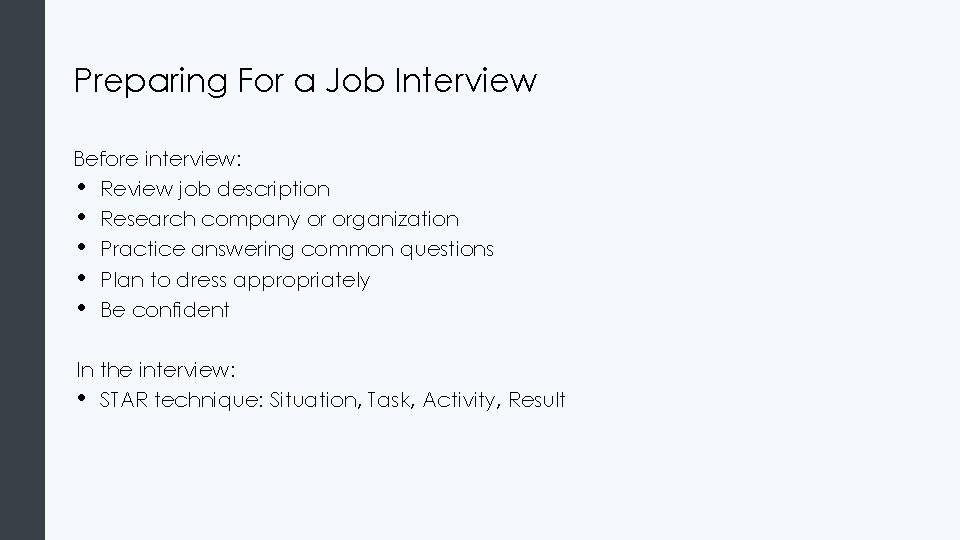
Preparing For a Job Interview Before interview: • Review job description • Research company or organization • Practice answering common questions • Plan to dress appropriately • Be confident In the interview: • STAR technique: Situation, Task, Activity, Result
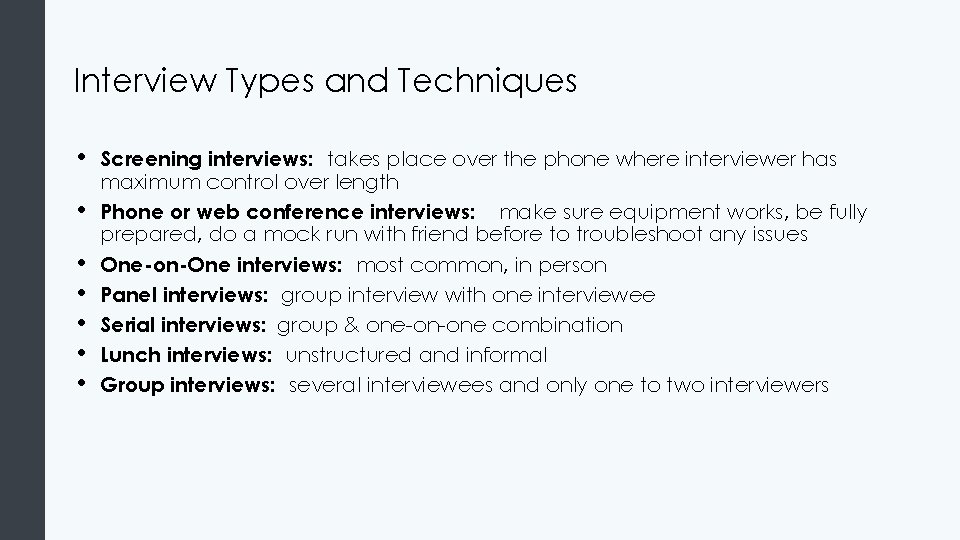
Interview Types and Techniques • • Screening interviews: takes place over the phone where interviewer has maximum control over length Phone or web conference interviews: make sure equipment works, be fully prepared, do a mock run with friend before to troubleshoot any issues One-on-One interviews: most common, in person Panel interviews: group interview with one interviewee Serial interviews: group & one-on-one combination Lunch interviews: unstructured and informal Group interviews: several interviewees and only one to two interviewers
Interview Questions Prepare as much as possible by doing research and listing examples of actions you are proud of Be prepared to talk about the following: Tell me about yourself Why are you interested in this position? How has your education prepared you for this job? What would you most like to accomplish in this position? What type of people do you have little patience for, Describe time you worked as part of a team
Practice Question 2 Ever since Noelle’s last company shut down and laid everyone off, she has spent days searching for work, fixing her résumé, and confirming appointments. In the two or three interviews she has had, she felt positive, but then came another rejection letter. It was nice that her mom’s friend, who worked in HR, offered to help Noelle before this next interview by giving her a nice folder with a copy of her résumé, cover letter, and a pen. She also printed out a separate sheet of references. Which of the following things should Noelle remember to do as she prepares? a) booking a hair appointment for styling only before each interview b) making a list of her soft skills and memorizing them c) review the job advertisement
Quick Review • • • What are way to gain skills necessary for professional life? Why is it important to network? What are strategies to increase your professional network? How do you produce a résumé and a cover letter What is the importance of networking? What are strategies to increase your professional network?
- Slides: 29