
Business Communication Skills for Managers Module 11 Communicating
Business Communication Skills for Managers Module 11: Communicating Different Messages
Why learn to effectively communicate different messages?

Informative Business Messages
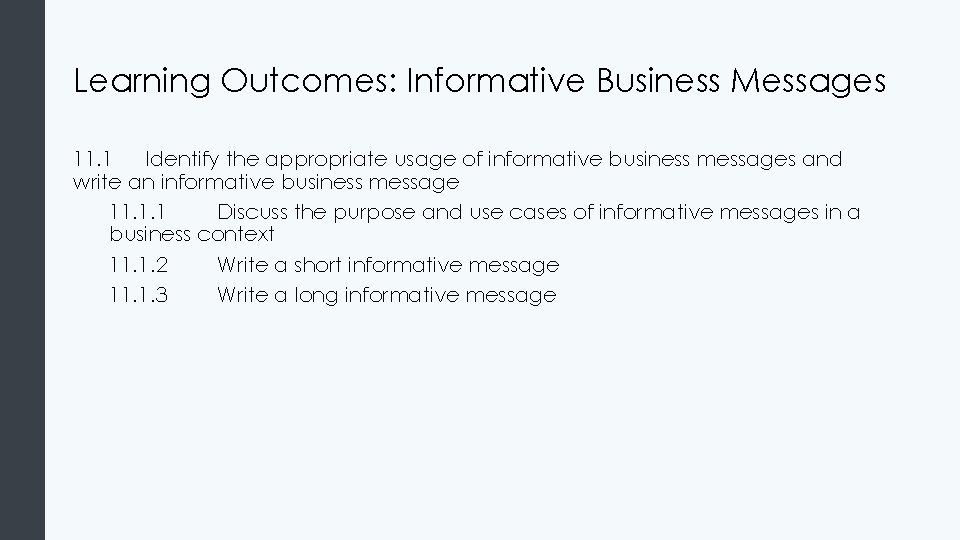
Learning Outcomes: Informative Business Messages 11. 1 Identify the appropriate usage of informative business messages and write an informative business message 11. 1. 1 Discuss the purpose and use cases of informative messages in a business context 11. 1. 2 Write a short informative message 11. 1. 3 Write a long informative message
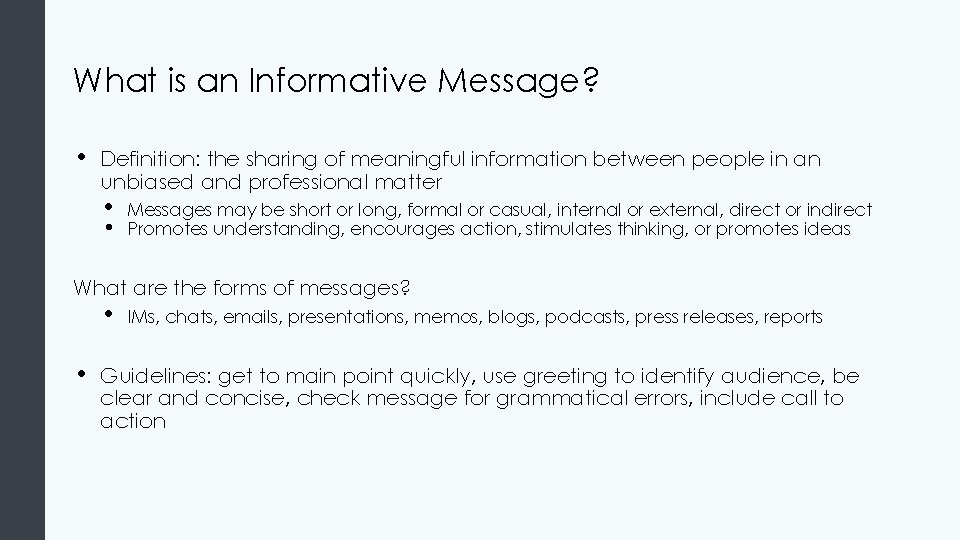
What is an Informative Message? • Definition: the sharing of meaningful information between people in an unbiased and professional matter • • Messages may be short or long, formal or casual, internal or external, direct or indirect Promotes understanding, encourages action, stimulates thinking, or promotes ideas What are the forms of messages? • • IMs, chats, emails, presentations, memos, blogs, podcasts, press releases, reports Guidelines: get to main point quickly, use greeting to identify audience, be clear and concise, check message for grammatical errors, include call to action
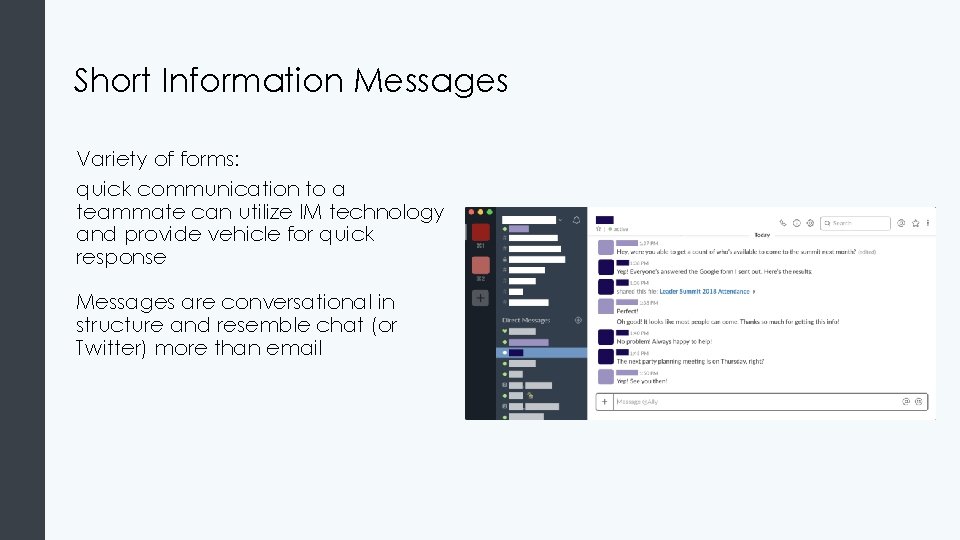
Short Information Messages Variety of forms: quick communication to a teammate can utilize IM technology and provide vehicle for quick response Messages are conversational in structure and resemble chat (or Twitter) more than email
Long Informative Messages Context of message is key to success Delivery Methods • Emails are still the “default” delivery method in business • Blogs can be used to inform about, promote, and build a brand • Presentations communicate large amounts of detailed information or graphics to convey complex ideas • Podcasts give businesses opportunity to engage in more casual conversation
Practice Question 1 What is wrong with this informative message? To: All employees From: HR Subject: Benefit packages are ready to pick up It is that time of year again to reenroll for your health benefits. Teh packets are on my desk and can be picked up at any time. Pls do so as soon as possible. Thank you, Sally Jones, HR Specialist 505 -221 -3456

Team-Focused Messages
Learning Outcomes: Team-Focused Messages 11. 2 Discuss the importance of team-focused communication in business 11. 2. 1 Discuss the purpose and use cases of team-focused messages in a business context 11. 2. 2 Write a short team-focused message 11. 2. 3 Write a long team-focused message
What is a Team-Focused Message? Benefits: • Increases creativity due to sharing of ideas & experiences • Increases productivity from collaborative and empowered teams • Teams promote wider sense of ownership • Teams encourage healthy risk-taking • Teams contribute to employee satisfaction The key is how organizations can create the proper environment to foster team creation, collaboration, and growth
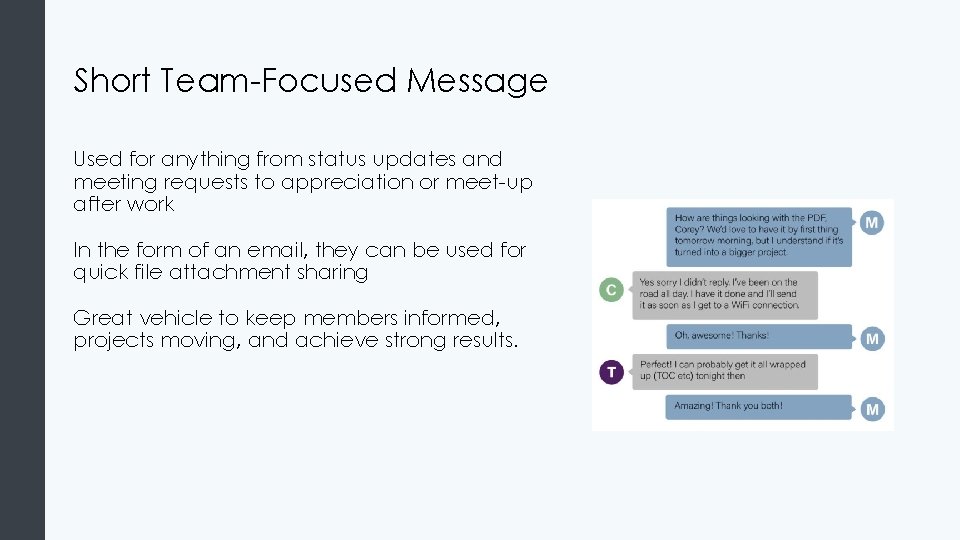
Short Team-Focused Message Used for anything from status updates and meeting requests to appreciation or meet-up after work In the form of an email, they can be used for quick file attachment sharing Great vehicle to keep members informed, projects moving, and achieve strong results.
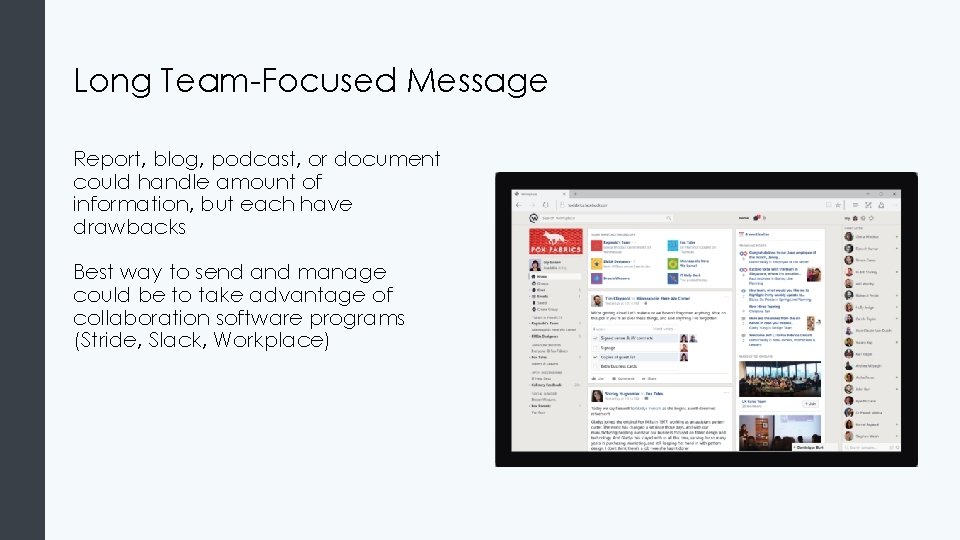
Long Team-Focused Message Report, blog, podcast, or document could handle amount of information, but each have drawbacks Best way to send and manage could be to take advantage of collaboration software programs (Stride, Slack, Workplace)
Discussion Choose one of the Workplace Case Studies and discuss the benefits of short team messages and long team messages using this platform. With a partner select an organization that interests you, read the case study, and share what you see as the benefits to this platform.
Professional Criticism
Learning Outcomes: Professional Criticism 11. 3 Write a business message criticizing internal or external business situations 11. 3. 1 Differentiate between different types of criticism in business 11. 3. 2 Write an external critical message to a company you're not associated with 11. 3. 3 Write an external critical message to an existing customer 11. 3. 4 Write an internal critical message to a person you manage 11. 3. 5 Write an internal critical message to another colleague
Types of Criticism Definition: “the act of expressing disapproval and of noting the problems or faults of a person or thing” Negative thoughts can be applied to the actions of colleagues, customers, or vendors What is direct vs. indirect criticism? What is a constructive style of criticism? What is the passive vs. the active voice? The goal is to improve the behavior of a person while avoiding personal attacks and blaming.
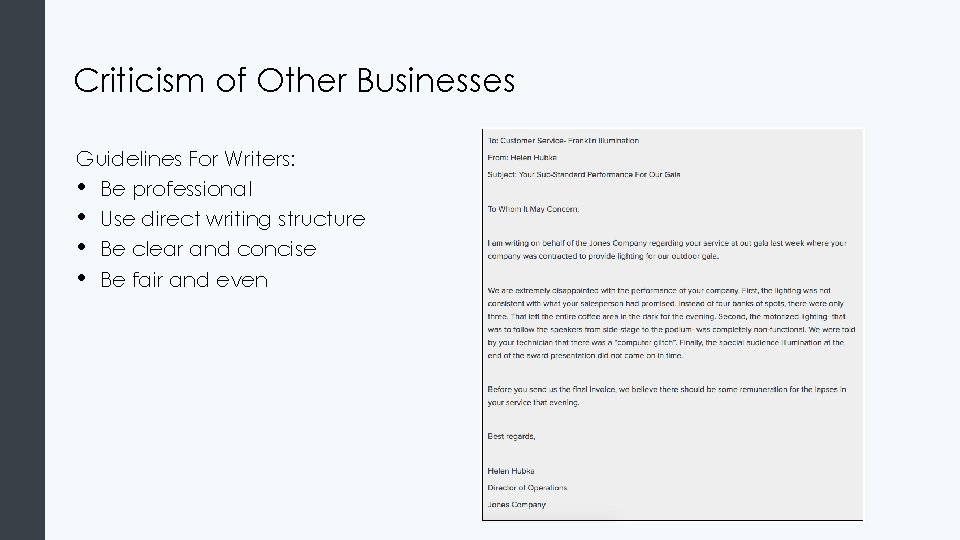
Criticism of Other Businesses Guidelines For Writers: • Be professional • Use direct writing structure • Be clear and concise • Be fair and even
Criticism of Customers When the need to send a critical message to a customer arises, we should take a step back and think through several factors. What is the exact outcome we desire? How can we communicate firmly yet tactfully so as to maintain our good business relationship? What facts need to be included in the message? An indirect strategy would be best • Start with complementary language about how valued relationship is • Next, provide a full explanation of facts and any context should be given • Finally, criticism should be followed by warm closing
Criticism of Employees What effective criticism should be positively intended and appropriately motivated: • Specific: exactly what behavior is being considered • Objective: recipient not only gets the message but is willing to do something about it. If your criticism is objective, it is much harder to resist. • Constructive: conscious avoiding personal attacks Criticism must have an aim of constructing, scaffolding, or improving situation. Can fight ideas that keep people down with ideas that unlock new opportunities
Criticism of Colleagues Guidelines: • Direct comments at behavior, not person • Keep tone neutral and objective • Try to include positive behaviors as well as behavior to be improved • Suggest positive steps in resolving issue
Activity How can this written criticism of a colleague be improved? Revise this statement so that you’re specific, constructive, and objective. With a partner, talk over how you can revise this statement so that it helps the person receiving the feedback. Message: Sometimes when you are asked to help with a problem, you simply create more problems for the team. Instead of finding a fix quickly, you spend way too long explaining how the problem makes you feel. Your intimate knowledge of the technology of the project makes you indispensable, so I need you make some improvements.
Responding to Criticism
Learning Outcomes: Responding to Criticism 11. 4 Write a response to criticism 11. 4. 1 Discuss key points to a professional response to criticism 11. 4. 2 Discuss ways to remain professional when you're feeling frustrated with others or a situation 11. 4. 3 Write a short message responding to internal or external criticism 11. 4. 4 Write a long message responding to internal or external criticism
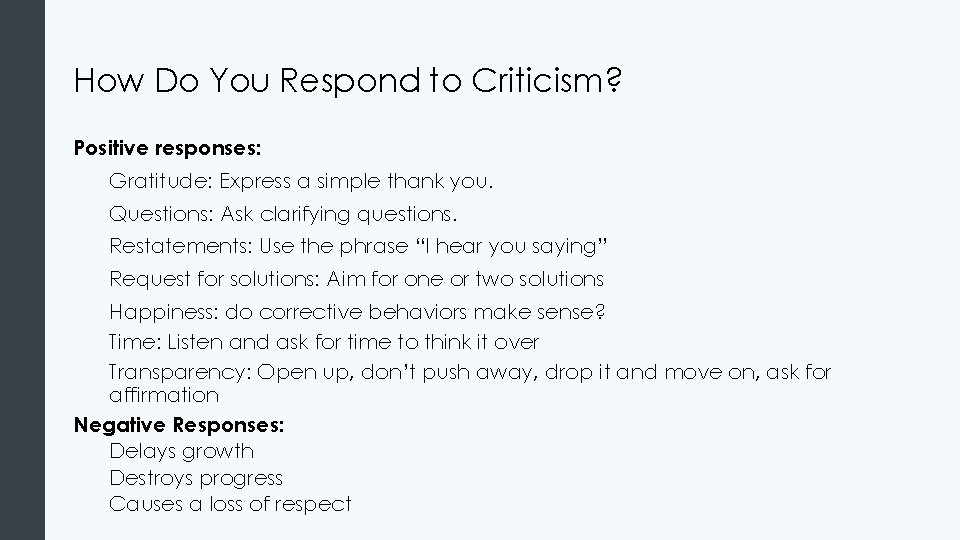
How Do You Respond to Criticism? Positive responses: Gratitude: Express a simple thank you. Questions: Ask clarifying questions. Restatements: Use the phrase “I hear you saying” Request for solutions: Aim for one or two solutions Happiness: do corrective behaviors make sense? Time: Listen and ask for time to think it over Transparency: Open up, don’t push away, drop it and move on, ask for affirmation Negative Responses: Delays growth Destroys progress Causes a loss of respect
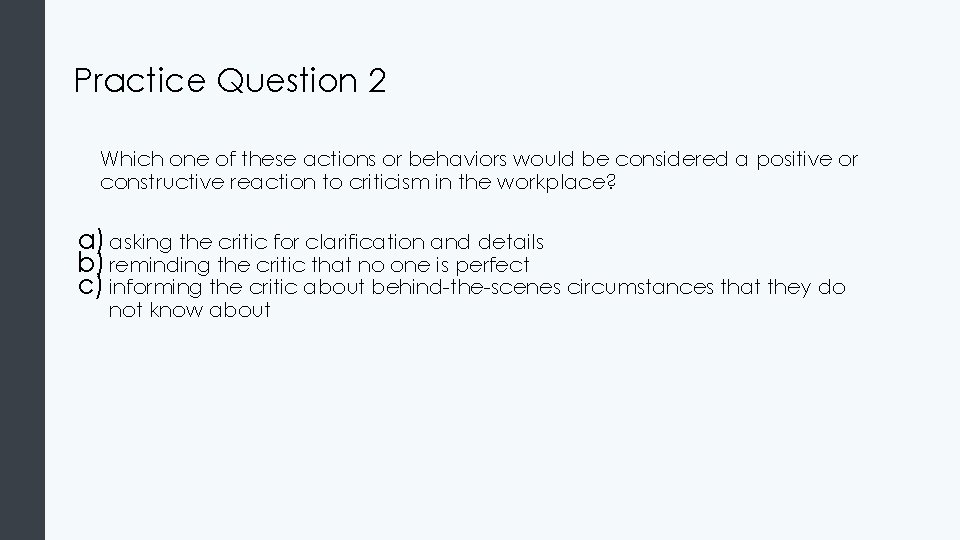
Practice Question 2 Which one of these actions or behaviors would be considered a positive or constructive reaction to criticism in the workplace? a) asking the critic for clarification and details b) reminding the critic that no one is perfect c) informing the critic about behind-the-scenes circumstances that they do not know about
Remaining Professional When You’re Frustrated What does it mean to be “Professional” Possessing knowledge and expertise, being in a positive mood, meeting obligations on time, respecting those you interact with, having proper language, etc. Techniques to help deal with emotional reactions to negative situations at work • Acceptance: step back and acknowledge emotions • Displacement: change of scenery • Articulation: talk out emotions with source of issue • Improvement: understand source so it can be solved going forward
Short Responses to Criticism 7 tips for dealing with criticism on social media from Caron Beesley 1. Get listening 2. Should you respond? 3. Don’t let negative comments linger 4. Always acknowledge, never deny 5. How to apologize 6. Take conversation offline 7. The bottom line
Long Responses to Criticism Keep emotions under control and be professional and grateful no matter how you feel about criticism. Guidelines for those on receiving end of criticism: • Solicit all of the facts, don’t be afraid to ask for details • Acknowledge what is stated and paraphrase • Agree if criticism is true, apologize if necessary • Disagree if criticism is not accurate; be respectful • Think about finding compromise position to alleviate concerns
Quick Review What are some appropriate informative business messages use cases? What is the best way to write an informative business message? Why is team-focused communication in business important? What are some best practices when you write a business message criticizing internal or external business situations? How do you write a response to criticism?
- Slides: 30