
Business Communication Process and Product 8 e Mary
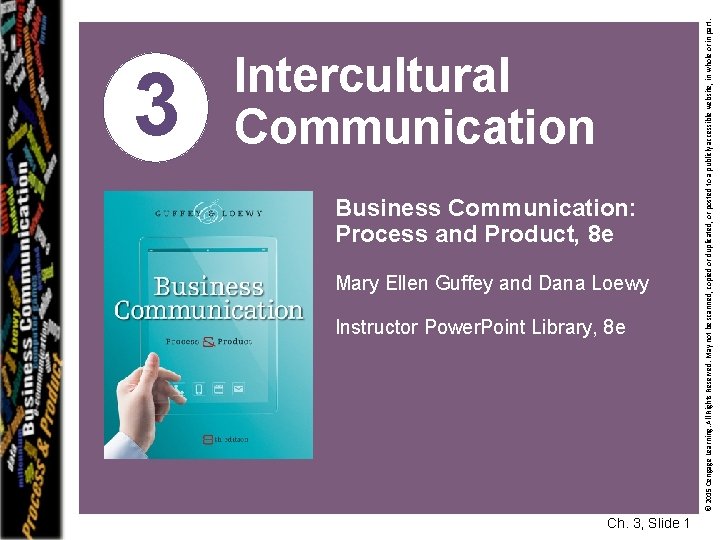
Business Communication: Process and Product, 8 e Mary Ellen Guffey and Dana Loewy Instructor Power. Point Library, 8 e Ch. 3, Slide 1 © 2015 Cengage Learning. All Rights Reserved. May not be scanned, copied or duplicated, or posted to a publicly accessible website, in whole or in part. 3 Intercultural Communication
Understand the powerful effects of globalization and the major trends fueling it. Ch. 3, Slide 2 © 2015 Cengage Learning. All Rights Reserved. May not be scanned, copied or duplicated, or posted to a publicly accessible website, in whole or in part. Learning Objective 1
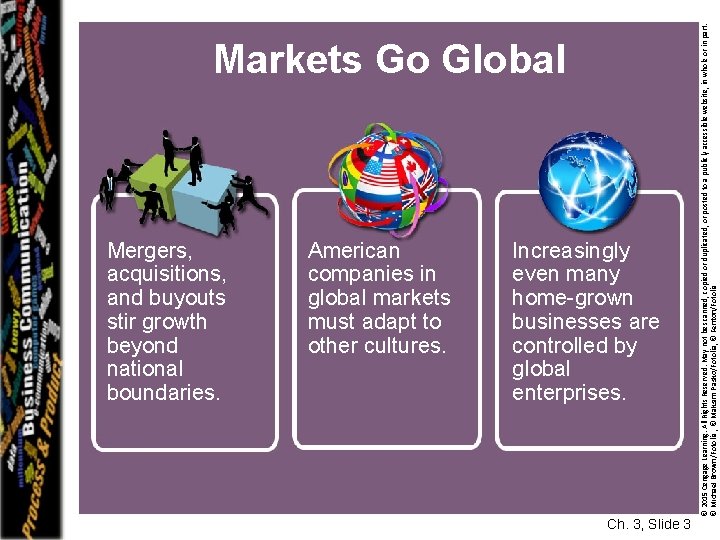
Mergers, acquisitions, and buyouts stir growth beyond national boundaries. American companies in global markets must adapt to other cultures. Increasingly even many home-grown businesses are controlled by global enterprises. Ch. 3, Slide 3 © 2015 Cengage Learning. All Rights Reserved. May not be scanned, copied or duplicated, or posted to a publicly accessible website, in whole or in part. © Michael Brown/Fotolia , © Maksim Pasko/Fotolia, © Fenton/Fotolia Markets Go Global
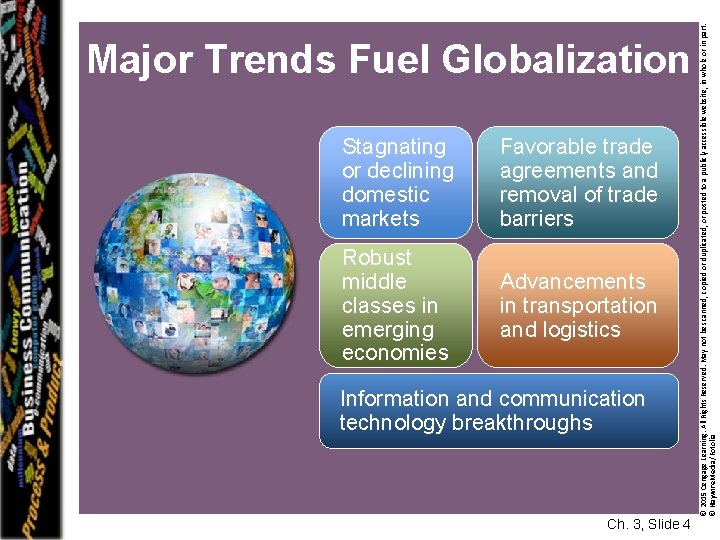
Stagnating or declining domestic markets Favorable trade agreements and removal of trade barriers Robust middle classes in emerging economies Advancements in transportation and logistics Information and communication technology breakthroughs Ch. 3, Slide 4 © 2015 Cengage Learning. All Rights Reserved. May not be scanned, copied or duplicated, or posted to a publicly accessible website, in whole or in part. © Haywire. Media/Fotolia Major Trends Fuel Globalization
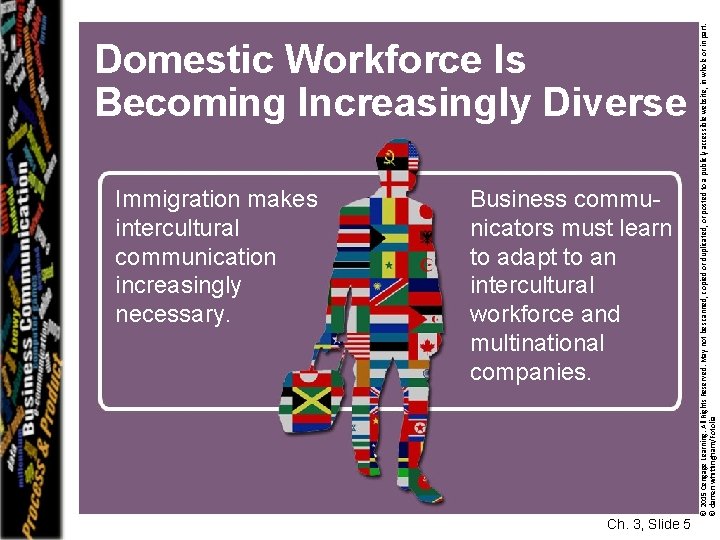
Immigration makes intercultural communication increasingly necessary. Business communicators must learn to adapt to an intercultural workforce and multinational companies. Ch. 3, Slide 5 © 2015 Cengage Learning. All Rights Reserved. May not be scanned, copied or duplicated, or posted to a publicly accessible website, in whole or in part. © darren whittingham/Fotolia Domestic Workforce Is Becoming Increasingly Diverse
Define culture, name its primary characteristics, and explain five key dimensions of culture including context, individualism, time orientation, power distance, and communication style. Ch. 3, Slide 6 © 2015 Cengage Learning. All Rights Reserved. May not be scanned, copied or duplicated, or posted to a publicly accessible website, in whole or in part. Learning Objective 2
• Culture is learned. • Cultures are inherently logical. • Culture is the basis of self-identity and community. • Culture combines the visible and invisible. • Culture is dynamic. Ch. 3, Slide 7 © 2015 Cengage Learning. All Rights Reserved. May not be scanned, copied or duplicated, or posted to a publicly accessible website, in whole or in part. © denis_pc/Fotolia Characteristics of Culture
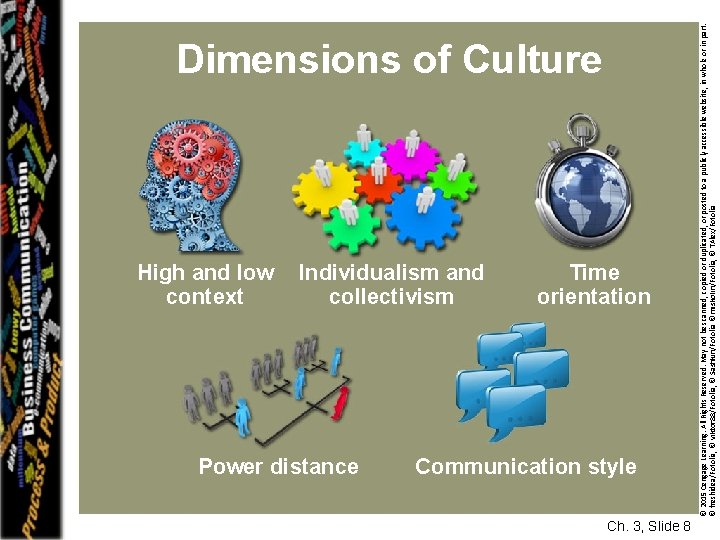
High and low context Individualism and collectivism Power distance Time orientation Communication style Ch. 3, Slide 8 © 2015 Cengage Learning. All Rights Reserved. May not be scanned, copied or duplicated, or posted to a publicly accessible website, in whole or in part. © freshidea/Fotolia, © viktor 88/Fotolia, © Sashkin/Fotolia © miskolin/Fotolia, © TAlex/Fotolia Dimensions of Culture
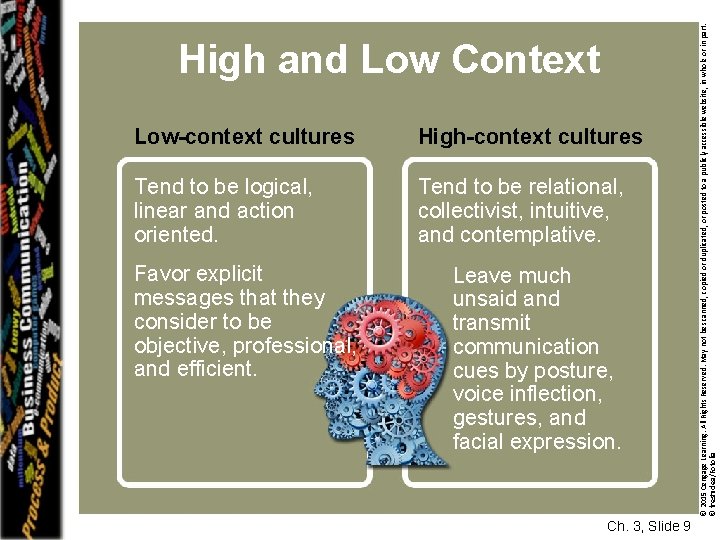
Low-context cultures High-context cultures Tend to be logical, linear and action oriented. Tend to be relational, collectivist, intuitive, and contemplative. Favor explicit messages that they consider to be objective, professional, and efficient. Leave much unsaid and transmit communication cues by posture, voice inflection, gestures, and facial expression. Ch. 3, Slide 9 © 2015 Cengage Learning. All Rights Reserved. May not be scanned, copied or duplicated, or posted to a publicly accessible website, in whole or in part. © freshidea/Fotolia High and Low Context
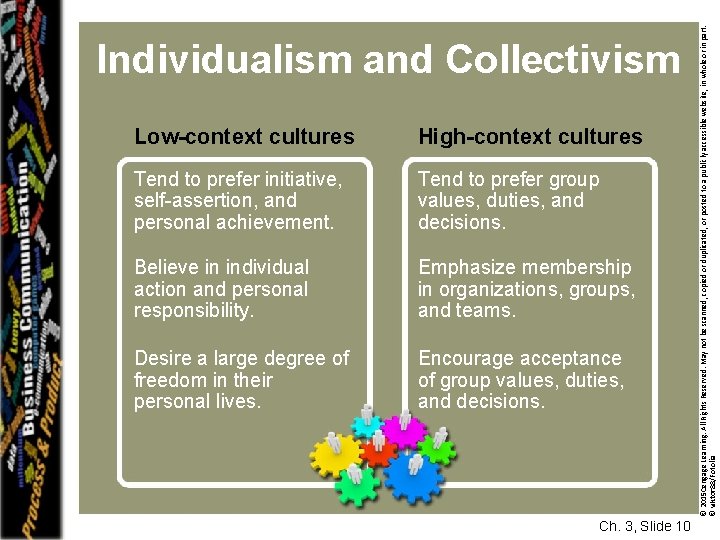
Low-context cultures High-context cultures Tend to prefer initiative, self-assertion, and personal achievement. Tend to prefer group values, duties, and decisions. Believe in individual action and personal responsibility. Emphasize membership in organizations, groups, and teams. Desire a large degree of freedom in their personal lives. Encourage acceptance of group values, duties, and decisions. Ch. 3, Slide 10 © 2015 Cengage Learning. All Rights Reserved. May not be scanned, copied or duplicated, or posted to a publicly accessible website, in whole or in part. © viktor 88/Fotolia Individualism and Collectivism
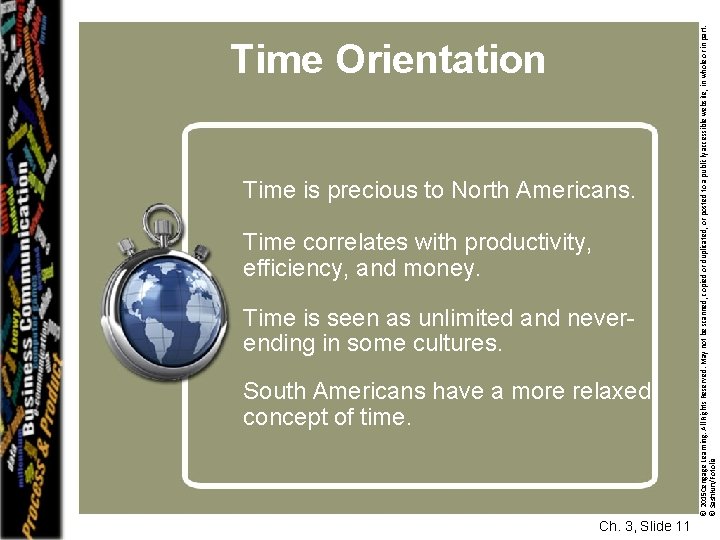
Time is precious to North Americans. Time correlates with productivity, efficiency, and money. Time is seen as unlimited and neverending in some cultures. South Americans have a more relaxed concept of time. Ch. 3, Slide 11 © 2015 Cengage Learning. All Rights Reserved. May not be scanned, copied or duplicated, or posted to a publicly accessible website, in whole or in part. © Sashkin/Fotolia Time Orientation
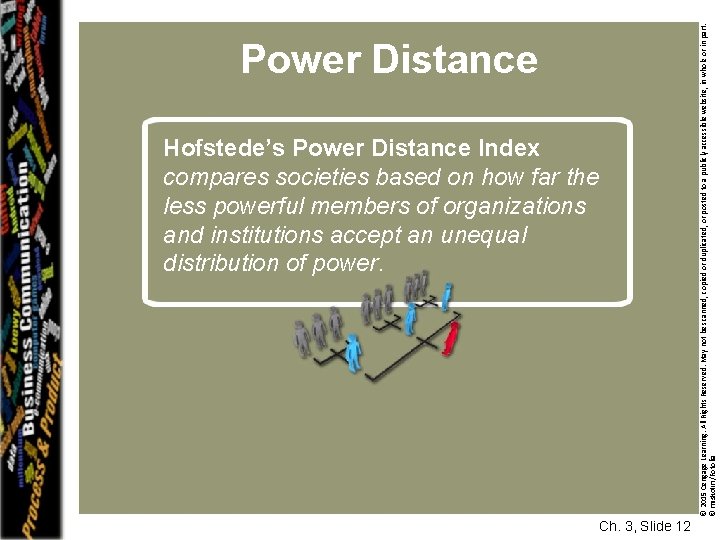
© 2015 Cengage Learning. All Rights Reserved. May not be scanned, copied or duplicated, or posted to a publicly accessible website, in whole or in part. © miskolin/Fotolia Power Distance Hofstede’s Power Distance Index compares societies based on how far the less powerful members of organizations and institutions accept an unequal distribution of power. Ch. 3, Slide 12

High power distance countries Low power distance countries Subordinates expect formal hierarchies and embrace relatively authoritarian, paternalistic power relationships. Subordinates consider themselves as equals of their supervisors. Relationships between individuals of varying power tend to be more democratic, egalitarian, and informal. Ch. 3, Slide 13 © 2015 Cengage Learning. All Rights Reserved. May not be scanned, copied or duplicated, or posted to a publicly accessible website, in whole or in part. © miskolin/Fotolia Power Distance
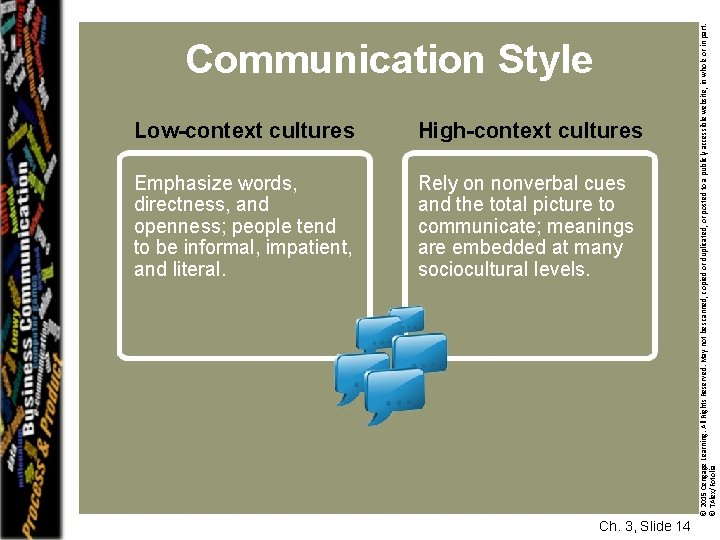
Low-context cultures High-context cultures Emphasize words, directness, and openness; people tend to be informal, impatient, and literal. Rely on nonverbal cues and the total picture to communicate; meanings are embedded at many sociocultural levels. Ch. 3, Slide 14 © 2015 Cengage Learning. All Rights Reserved. May not be scanned, copied or duplicated, or posted to a publicly accessible website, in whole or in part. © TAlex/Fotolia Communication Style
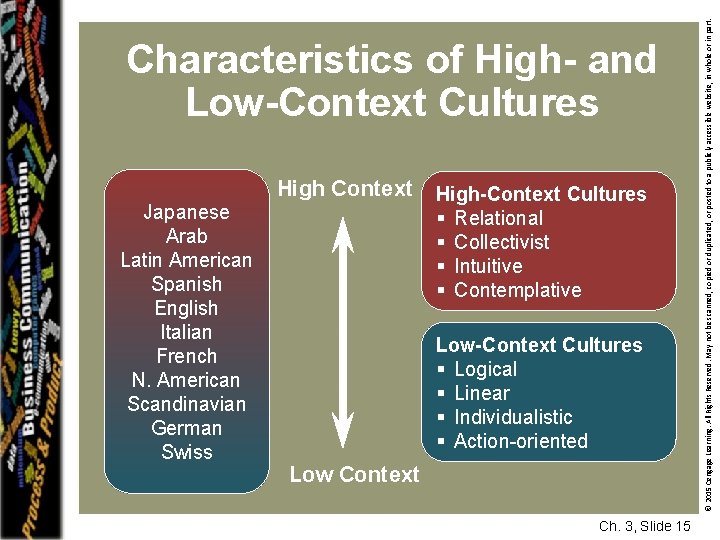
Japanese Arab Latin American Spanish English Italian French N. American Scandinavian German Swiss High Context High-Context Cultures § Relational § Collectivist § Intuitive § Contemplative Low-Context Cultures § Logical § Linear § Individualistic § Action-oriented Low Context Ch. 3, Slide 15 © 2015 Cengage Learning. All Rights Reserved. May not be scanned, copied or duplicated, or posted to a publicly accessible website, in whole or in part. Characteristics of High- and Low-Context Cultures
U. S. Proverbs He who holds the gold makes the rules. Waste not, want not. The early bird gets the worm. If at first you don’t succeed, try again. Ch. 32, Slide 16 © 2015 Cengage Learning. All Rights Reserved. May not be scanned, copied or duplicated, or posted to a publicly accessible website, in whole or in part. © puckillustrations/Fotolia Proverbs Reflect Culture
Chinese Proverbs A man who waits for a roast duck to fly into his mouth must wait a very, very long time. A man who says it cannot be done should not interrupt a man doing it. Ch. 3, Slide 17 © 2015 Cengage Learning. All Rights Reserved. May not be scanned, copied or duplicated, or posted to a publicly accessible website, in whole or in part. © puckillustrations/Fotolia Proverbs Reflect Culture
Other Proverbs No one is either rich or poor who has not helped himself to be so. (German) Words do not make flour. (Italian) Wealth that comes in at the door unjustly goes out at the windows. (Egyptian) Ch. 3, Slide 18 © 2015 Cengage Learning. All Rights Reserved. May not be scanned, copied or duplicated, or posted to a publicly accessible website, in whole or in part. © puckillustrations/Fotolia Proverbs Reflect Culture
Discuss strategies for enhancing intercultural effectiveness, reflect on nonverbal intercultural communication, assess how social media affect intercultural communication, and apply techniques for successful oral and written interactions across cultures. Ch. 3, Slide 19 © 2015 Cengage Learning. All Rights Reserved. May not be scanned, copied or duplicated, or posted to a publicly accessible website, in whole or in part. Learning Objective 3
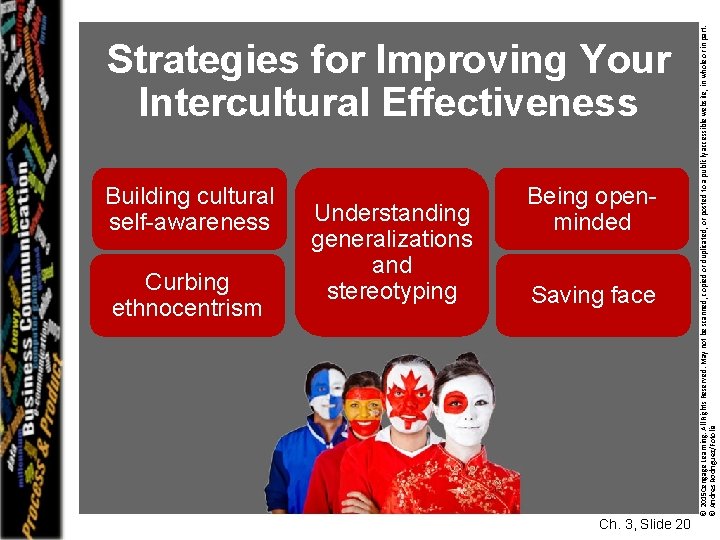
Building cultural self-awareness Curbing ethnocentrism Understanding generalizations and stereotyping Being openminded Saving face Ch. 3, Slide 20 © 2015 Cengage Learning. All Rights Reserved. May not be scanned, copied or duplicated, or posted to a publicly accessible website, in whole or in part. © Andres Rodriguez/Fotolia Strategies for Improving Your Intercultural Effectiveness
Stereotype Ne g ati ve! Oversimplified behavioral pattern applied uncritically to groups Ch. 3, Slide 21 © 2015 Cengage Learning. All Rights Reserved. May not be scanned, copied or duplicated, or posted to a publicly accessible website, in whole or in part. How We Form Judgments
Prejudice Ne g ati ve! Rigid attitude based on erroneous beliefs or preconceptions Ch. 3, Slide 22 © 2015 Cengage Learning. All Rights Reserved. May not be scanned, copied or duplicated, or posted to a publicly accessible website, in whole or in part. How We Form Judgments

Prototype Po sit ive ! Mental representation based on characteristics that are flexible and open to new definitions Ch. 3, Slide 23 © 2015 Cengage Learning. All Rights Reserved. May not be scanned, copied or duplicated, or posted to a publicly accessible website, in whole or in part. How We Form Judgments
Question 1: Why is it important to make generalizations in describing cultural prototypes? Ch. 3, Slide 24 © 2015 Cengage Learning. All Rights Reserved. May not be scanned, copied or duplicated, or posted to a publicly accessible website, in whole or in part. How We Form Judgments
Question 2: Are all generalizations invalid? Ch. 3, Slide 25 © 2015 Cengage Learning. All Rights Reserved. May not be scanned, copied or duplicated, or posted to a publicly accessible website, in whole or in part. How We Form Judgments
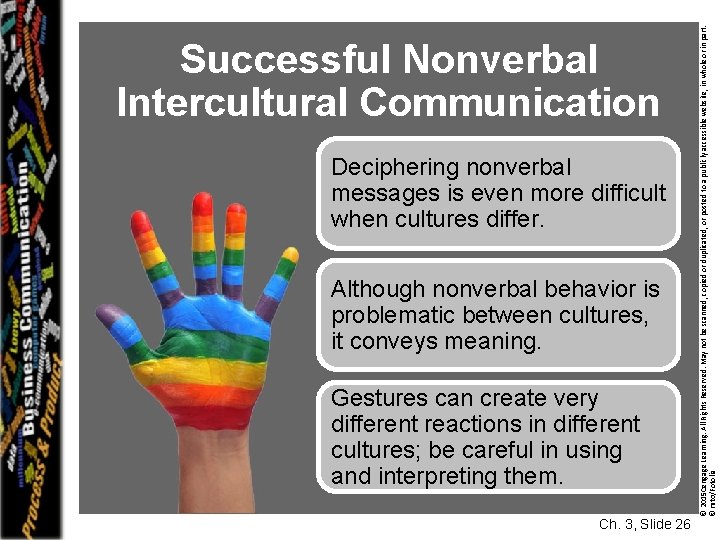
Deciphering nonverbal messages is even more difficult when cultures differ. Although nonverbal behavior is problematic between cultures, it conveys meaning. Gestures can create very different reactions in different cultures; be careful in using and interpreting them. Ch. 3, Slide 26 © 2015 Cengage Learning. All Rights Reserved. May not be scanned, copied or duplicated, or posted to a publicly accessible website, in whole or in part. © nito/Fotolia Successful Nonverbal Intercultural Communication
Descriptiveness: Giving descriptive feedback instead of judgmental feedback Nonjudgmentalism: Being tolerant, which helps prevent defensive reactions. Supportiveness: Encouraging others with head nods, eye contact, and facial expressions. Ch. 3, Slide 27 © 2015 Cengage Learning. All Rights Reserved. May not be scanned, copied or duplicated, or posted to a publicly accessible website, in whole or in part. Techniques for Achieving Intercultural Competence
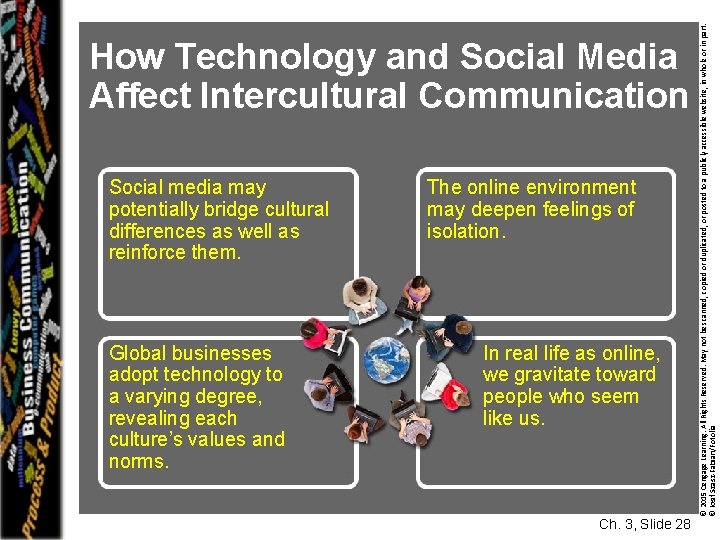
Social media may potentially bridge cultural differences as well as reinforce them. Global businesses adopt technology to a varying degree, revealing each culture’s values and norms. The online environment may deepen feelings of isolation. In real life as online, we gravitate toward people who seem like us. Ch. 3, Slide 28 © 2015 Cengage Learning. All Rights Reserved. May not be scanned, copied or duplicated, or posted to a publicly accessible website, in whole or in part. © Iosif Szasz-Fabian/Fotolia How Technology and Social Media Affect Intercultural Communication
Regional and cultural differences persist. Media designers adapt to cultural preferences. However, aside from language, regional differences on Facebook and Twitter seem minor. Ch. 3, Slide 29 © 2015 Cengage Learning. All Rights Reserved. May not be scanned, copied or duplicated, or posted to a publicly accessible website, in whole or in part. © glopphy/Fotolia, © nattstudio/Fotolia Social Networking: Erasing or Deepening Cultural Differences
Learn foreign phrases. Observe eye messages. Use simple English. Speak slowly and enunciate clearly. Encourage accurate feedback. Ch. 3, Slide 30 © 2015 Cengage Learning. All Rights Reserved. May not be scanned, copied or duplicated, or posted to a publicly accessible website, in whole or in part. © i. Qoncept/Fotolia Improving Conversations in Intercultural Environments
Accept blame. Listen without interrupting. Smile when appropriate. Follow up in writing. Ch. 3, Slide 31 © 2015 Cengage Learning. All Rights Reserved. May not be scanned, copied or duplicated, or posted to a publicly accessible website, in whole or in part. © puckillustrations/Fotolia Enhancing Intercultural Oral Communications
Adjust your writing style and tone. Avoid humor to prevent misunderstandings. Use short sentences and short paragraphs. Observe title and rank. Ch. 3, Slide 32 © 2015 Cengage Learning. All Rights Reserved. May not be scanned, copied or duplicated, or posted to a publicly accessible website, in whole or in part. © raven/Fotolia Improving Intercultural Written Communication
Avoid ambiguous expressions. Strive for clarity. Use correct grammar. Cite numbers carefully. Ch. 3, Slide 33 © 2015 Cengage Learning. All Rights Reserved. May not be scanned, copied or duplicated, or posted to a publicly accessible website, in whole or in part. © raven/Fotolia Improving Intercultural Written Communication
Grasp the complexities of ethics across cultures, including business practices abroad, bribery, prevailing customs, and methods for coping. Ch. 3, Slide 34 © 2015 Cengage Learning. All Rights Reserved. May not be scanned, copied or duplicated, or posted to a publicly accessible website, in whole or in part. Learning Objective 4
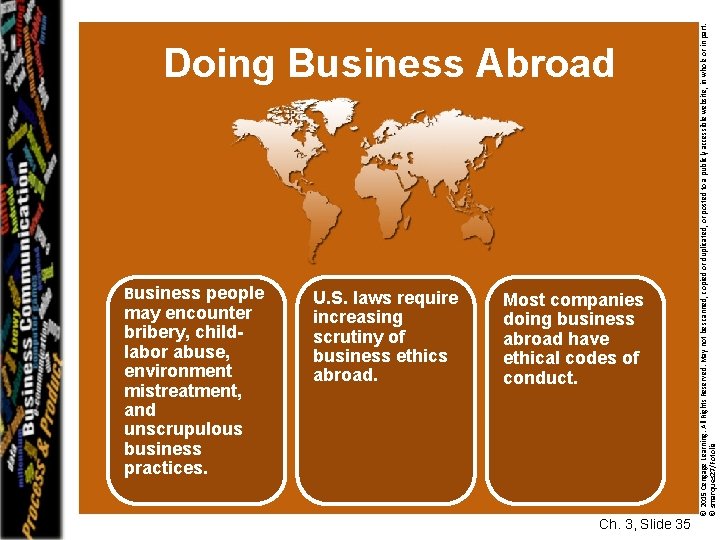
Business people may encounter bribery, childlabor abuse, environment mistreatment, and unscrupulous business practices. U. S. laws require increasing scrutiny of business ethics abroad. Most companies doing business abroad have ethical codes of conduct. Ch. 3, Slide 35 © 2015 Cengage Learning. All Rights Reserved. May not be scanned, copied or duplicated, or posted to a publicly accessible website, in whole or in part. © smarques 27/Fotolia Doing Business Abroad
Foreign Corrupt Practices Act of 1977 – prohibits payments to foreign officials for the purpose of obtaining or retaining business; applies only to U. S. companies. Sarbanes-Oxley Act – a tool in the anticorruption battle; forbids off-the-book bribes. Global treaty promoted by the Organization for Economic Cooperation and Development (OECD) in 1999 – bans bribery of foreign government officials. Ch. 3, Slide 36 © 2015 Cengage Learning. All Rights Reserved. May not be scanned, copied or duplicated, or posted to a publicly accessible website, in whole or in part. Anti-Bribery Laws
• Broaden your view. • Avoid reflex judgments. • Find alternatives. • Refuse business if options violate your basic values. Ch. 3, Slide 37 © 2015 Cengage Learning. All Rights Reserved. May not be scanned, copied or duplicated, or posted to a publicly accessible website, in whole or in part. © smarques 27/Fotolia, © denis_pc/Fotolia Ethical Decision Making Across Borders
• Embrace transparency. • Don’t rationalize shady decisions. • Resist legalistic strategies. Ch. 3, Slide 38 © 2015 Cengage Learning. All Rights Reserved. May not be scanned, copied or duplicated, or posted to a publicly accessible website, in whole or in part. © smarques 27/Fotolia, © denis_pc/Fotolia Ethical Decision Making Across Borders
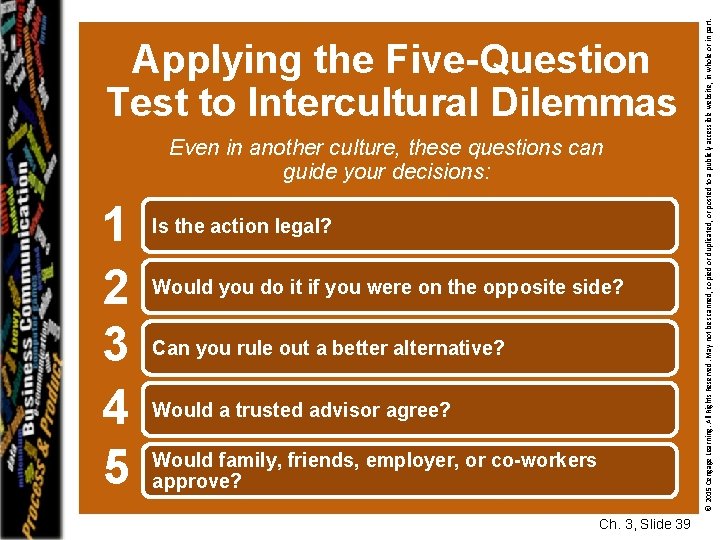
Even in another culture, these questions can guide your decisions: 1 2 3 4 5 Is the action legal? Would you do it if you were on the opposite side? Can you rule out a better alternative? Would a trusted advisor agree? Would family, friends, employer, or co-workers approve? Ch. 3, Slide 39 © 2015 Cengage Learning. All Rights Reserved. May not be scanned, copied or duplicated, or posted to a publicly accessible website, in whole or in part. Applying the Five-Question Test to Intercultural Dilemmas
Explain the advantages and challenges of workforce diversity, and address approaches for improving communication among diverse workplace audiences. Ch. 3, Slide 40 © 2015 Cengage Learning. All Rights Reserved. May not be scanned, copied or duplicated, or posted to a publicly accessible website, in whole or in part. Learning Objective 5
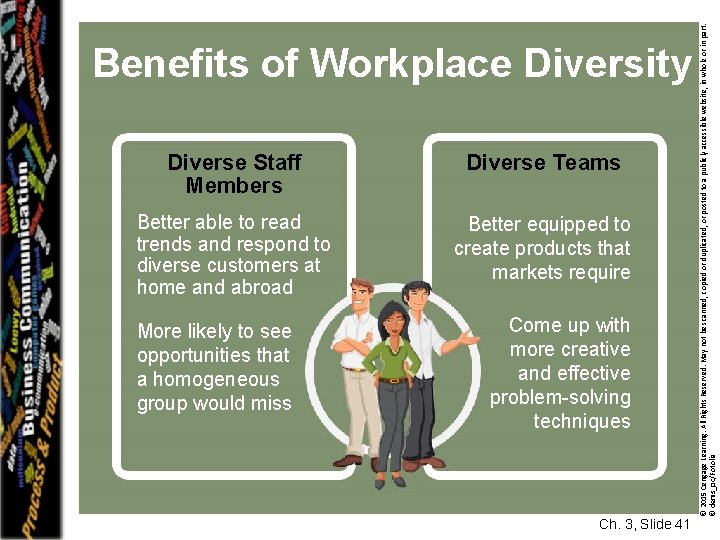
Diverse Staff Members Diverse Teams Better able to read trends and respond to diverse customers at home and abroad Better equipped to create products that markets require More likely to see opportunities that a homogeneous group would miss Come up with more creative and effective problem-solving techniques Ch. 3, Slide 41 © 2015 Cengage Learning. All Rights Reserved. May not be scanned, copied or duplicated, or posted to a publicly accessible website, in whole or in part. © denis_pc/Fotolia Benefits of Workplace Diversity
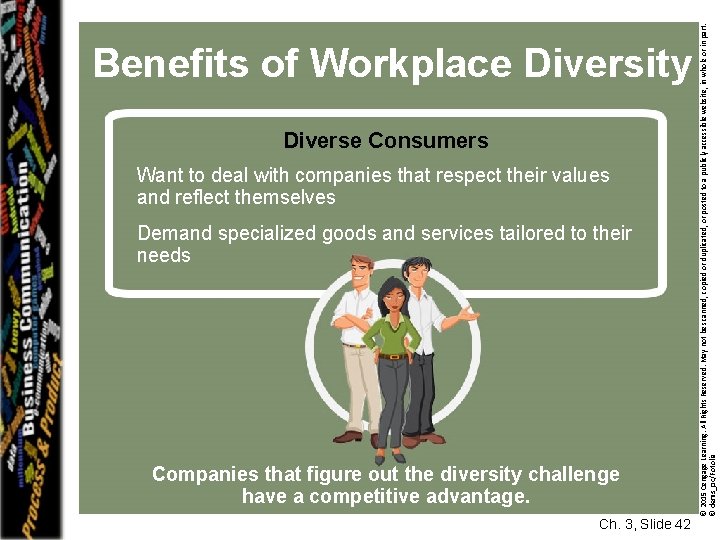
Diverse Consumers Want to deal with companies that respect their values and reflect themselves Demand specialized goods and services tailored to their needs Companies that figure out the diversity challenge have a competitive advantage. Ch. 3, Slide 42 © 2015 Cengage Learning. All Rights Reserved. May not be scanned, copied or duplicated, or posted to a publicly accessible website, in whole or in part. © denis_pc/Fotolia Benefits of Workplace Diversity
Companies that cultivate diversity suffer fewer discrimination lawsuits, fewer union clashes, and less government scrutiny. Diversity is a critical bottomline business strategy to improve employee relationships and to increase productivity. The government and corporations increasingly contract only with suppliers who can show “cultural readiness. ” Ch. 3, Slide 43 © 2015 Cengage Learning. All Rights Reserved. May not be scanned, copied or duplicated, or posted to a publicly accessible website, in whole or in part. © andris_torms/Fotolia Benefits of Workplace Diversity to Businesses
Diversity can cause divisiveness, discontent, and clashes. Many identity groups may have legitimate gripes (gender issues, sexism, harassment, communication style). Ch. 3, Slide 44 © 2015 Cengage Learning. All Rights Reserved. May not be scanned, copied or duplicated, or posted to a publicly accessible website, in whole or in part. Diversity and Discord
• Seek training. • Understand the value of differences. • Don’t expect conformity. • Make fewer assumptions. • Build on similarities. Ch. 3, Slide 45 © 2015 Cengage Learning. All Rights Reserved. May not be scanned, copied or duplicated, or posted to a publicly accessible website, in whole or in part. © denis_pc/Fotolia Improving Communication Among Diverse Workplace Audiences
Ch. 3, Slide 46 © 2015 Cengage Learning. All Rights Reserved. May not be scanned, copied or duplicated, or posted to a publicly accessible website, in whole or in part. © kyoko/Fotolia END
- Slides: 46