
Business Communication Lecturer Gareth Jones Class 7 Routine
Business Communication Lecturer: Gareth Jones Class 7: Routine Business Messages
Today �Bad News Messages ◦ 3 Step Writing Process ◦ Strategies ◦ Audience Centered Tone ◦ Direct/Indirect Approaches ◦ Types of Bad News Messages Business Communication (BUS-101) 4 th December 2009 2
Bad News Messages �No one likes to hear “no” �We want to make our message effective and less hurtful to maintain a good relationship with the audience Business Communication (BUS-101) 4 th December 2009 3
Bad News Messages �Apply the 3 step writing process ◦ Planning ◦ Writing ◦ Completing Business Communication (BUS-101) 4 th December 2009 4
Bad News Messages �Planning ◦ Analyse the Audience – figure out how they will react ◦ Gather important facts to make message more effective Business Communication (BUS-101) 4 th December 2009 5

Bad News Messages �Writing ◦ Define main ideas ◦ Cover all relevant points ◦ Choose direct/indirect style ◦ Pay attention to word choice Business Communication (BUS-101) 4 th December 2009 6
Bad News Messages �Completing ◦ Make sure organisation is good ◦ Correct typos, errors, etc. Business Communication (BUS-101) 4 th December 2009 7
Strategies �Present bad news �Have your audience accept news �Maintain good relationships �Maintain a good image for your company �Reduce future messages Business Communication (BUS-101) 4 th December 2009 8
Strategies �Use an “Audience-Centered Tone” �It’s not what you say, it’s how you say it (10% how it’s said, 90% what is said) �Positive Words �Respectful Language Business Communication (BUS-101) 4 th December 2009 9
Strategies �After reading the message, the Audience must: ◦ Understand the news ◦ Accept the news ◦ See news as fair ◦ Have positive thoughts about you ◦ Feel good about themselves Business Communication (BUS-101) 4 th December 2009 10
Strategies �We must decide to use the direct or indirect approach �Put yourself in the audience’s shoes. ◦ How will they react? ◦ How Important is the message? ◦ How well do you know them? Business Communication (BUS-101) 4 th December 2009 11

Direct Approach �Intro: Clear Statement of the bad news �Body: Reasons for the decision; provide alternatives. �Closing: Positive statement to maintain a good relationship Business Communication (BUS-101) 4 th December 2009 12

Direct Approach �Good because it makes message shorter �Saves time �Use a tactful tone, focus on reasons for your decision Business Communication (BUS-101) 4 th December 2009 13
Indirect Approach �Open with a Buffer �Logical, neutral explanation of reasons �Clear statement of the bad news �Close with a positive statement that is helpful and friendly Business Communication (BUS-101) 4 th December 2009 14

Indirect Approach �You should: ◦ Use a neutral subject line in emails or memos ◦ Use a buffer Business Communication (BUS-101) 4 th December 2009 15
Neutral subject lines �When using the indirect approach in an email, memo, or letter we must use a neutral subject line.
Neutral subject lines �Our subject line must say what the message is about without saying any bad news
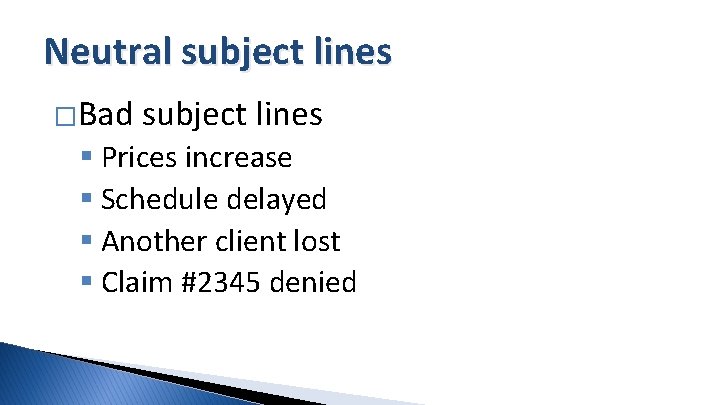
Neutral subject lines �Bad subject lines Prices increase Schedule delayed Another client lost Claim #2345 denied
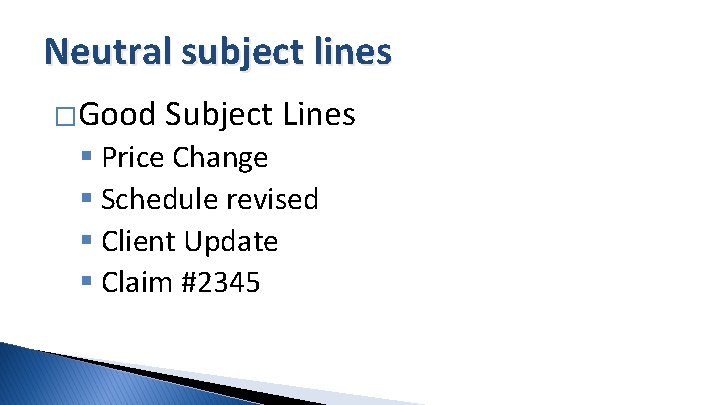
Neutral subject lines �Good Subject Lines Price Change Schedule revised Client Update Claim #2345
Neutral subject lines �Use these with the indirect approach
Neutral subject lines �For replies to messages and emails, simply hit “reply” in your email client
Neutral subject lines �re: Coursework assignment �re: Meeting Schedule �re: Job Application
I’m sorry �In English, saying “I’m sorry” doesn’t always mean you are apologising �It is used quite often
I’m sorry �Using “I’m sorry” in a bad news message is OK I’m sorry we cannot help I’m sorry to hear that I’m sorry to tell you
I’m sorry �This is not quite the same as apologising though.
Indirect Approach �Buffer – a neutral transition to bad news �Can show agreement, appreciation, fairness, praise, etc. Business Communication (BUS-101) 4 th December 2009 26
Indirect Approach �Buffer ◦ Be honest, positive, and brief. ◦ Don’t trick the audience. Business Communication (BUS-101) 4 th December 2009 27
Indirect Approach �A good buffer: ◦ Does not mislead the reader ◦ Is neutral ◦ Is relevant ◦ Is respectful ◦ Is short ◦ Is unapologetic Business Communication (BUS-101) 4 th December 2009 28
Indirect Approach �Open with a Buffer ◦ Logical, neutral explanation of reasons ◦ Clear statement of the bad news ◦ Close with a positive statement that is helpful and friendly Business Communication (BUS-101) 4 th December 2009 29
Indirect Approach �Give reasons ◦ Say positive reasons first, then negative. ◦ Show that the decision is fair ◦ Provide facts Business Communication (BUS-101) 4 th December 2009 30
Indirect Approach �Give reasons ◦ Don’t say how the news is good for your company ◦ Don’t apologise ◦ Don’t provide negative comments Business Communication (BUS-101) 4 th December 2009 31
Indirect Approach �Open with a Buffer ◦ Logical, neutral explanation of reasons ◦ Clear statement of the bad news ◦ Close with a positive statement that is helpful and friendly Business Communication (BUS-101) 4 th December 2009 32
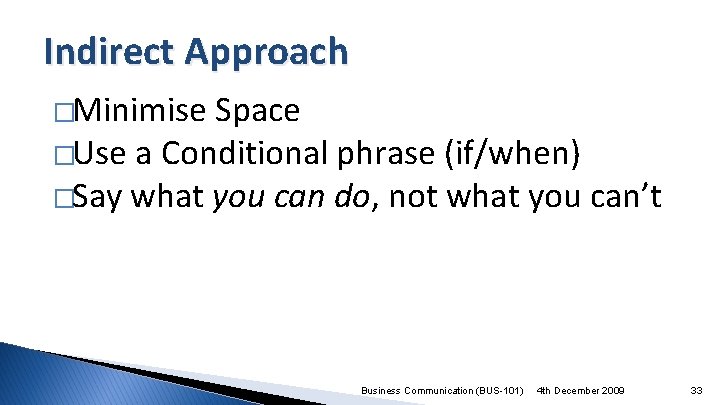
Indirect Approach �Minimise Space �Use a Conditional phrase (if/when) �Say what you can do, not what you can’t Business Communication (BUS-101) 4 th December 2009 33
Indirect Approach �Open with a Buffer ◦ Logical, neutral explanation of reasons ◦ Clear statement of the bad news ◦ Close with a positive statement that is helpful and friendly Business Communication (BUS-101) 4 th December 2009 34
Indirect Approach �End it on a positive note. �Follow the guidelines from the direct approach Business Communication (BUS-101) 4 th December 2009 35
Indirect Approach �Be sincere �Be confident �Keep it positive �Limit future correspondence �Be optimistic Business Communication (BUS-101) 4 th December 2009 36
Indirect Approach �We will look at the different types of bad news messages that you should know Business Communication (BUS-101) 4 th December 2009 37
Types of Bad News �Negative Answers to Routine Requests �Negative Company News �Negative Employment Messages Business Communication (BUS-101) 4 th December 2009 38
Types of Bad News �Negative Answers to Routine Requests �Negative Company News �Negative Employment Messages Business Communication (BUS-101) 4 th December 2009 39
Types of Bad News �Refusing requests for information ◦ Use the direct or indirect approach Business Communication (BUS-101) 4 th December 2009 40
Types of Bad News �Refusing invitations and favours ◦ Use the direct approach if you have a good relationship with the reader ◦ Use the indirect approach if you don’t know the reader well Business Communication (BUS-101) 4 th December 2009 41
Types of Bad News �Refusing claims and adjustments �Use the indirect approach ◦ Don’t accept responsibility ◦ Don’t blame the customer Business Communication (BUS-101) 4 th December 2009 42
Types of Bad News �Demonstrate your understanding �Explain your refusal �Suggest alternative action Business Communication (BUS-101) 4 th December 2009 43
Types of Bad News �Negative Answers to Routine Requests �Negative Company News �Negative Employment Messages Business Communication (BUS-101) 4 th December 2009 44
Types of Bad News �Giving bad news about products ◦ Use the direct approach within your own organisation ◦ Use the indirect approach for other customers Business Communication (BUS-101) 4 th December 2009 45
Types of Bad News �Bad news about your company ◦ Focus on reasons and possible customer benefits Business Communication (BUS-101) 4 th December 2009 46
Types of Bad News �Negative Answers to Routine Requests �Negative Company News �Negative Employment Messages Business Communication (BUS-101) 4 th December 2009 47
Types of Bad News �Negative employment messages ◦ Direct approach when talking about someone else’s job ◦ Indirect approach when talking about the reader’s job Business Communication (BUS-101) 4 th December 2009 48
Types of Bad News �Rejecting reference requests ◦ Use tact and consideration ◦ Use the indirect approach Business Communication (BUS-101) 4 th December 2009 49
Types of Bad News �Rejecting job applications ◦ Treat reader with respect ◦ Use the direct approach Business Communication (BUS-101) 4 th December 2009 50
Types of Bad News 1. 2. 3. Tell them they have not been hired Give clear reasons why Suggest alternatives Business Communication (BUS-101) 4 th December 2009 51
Types of Bad News �Terminating employment ◦ Must be especially careful to avoid bad feelings or legal action Business Communication (BUS-101) 4 th December 2009 52
Next time �Persuasive messages Business Communication (BUS-101) 4 th December 2009 53
- Slides: 53