
Business Communication Chapter 4 Basics of English Grammar
Business Communication Chapter 4 Basics of English Grammar Copyright 2010 South-Western Cengage Learning
Parts of Speech Noun Pronoun Adjective Verb 4. 1 Parts of Speech and Sentences Adverb Preposition Conjunction Interjection 2
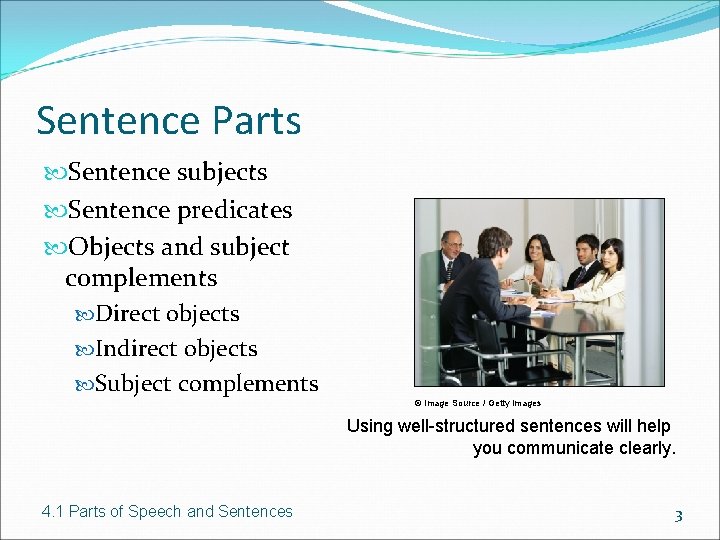
Sentence Parts Sentence subjects Sentence predicates Objects and subject complements Direct objects Indirect objects Subject complements © Image Source / Getty Images Using well-structured sentences will help you communicate clearly. 4. 1 Parts of Speech and Sentences 3
Clauses, Phrases, and Fragments Clause: a group of words with a subject and a predicate Phrase: a group of related words with no subject or predicate Fragment: an incomplete sentence that may or may not have meaning 4. 1 Parts of Speech and Sentences 4
Sentence Structure Simple sentences Example: Theodore sings and acts. Compound sentences Example: Erin loves to ride horses; Manuel loves to draw horses. Complex sentences Example: Although it is important to proofread a written message, many people feel they do not have the time. 4. 1 Parts of Speech and Sentences 5
Nouns Noun: a word used to name people, places, or things Common nouns Proper nouns Singular and plural nouns Collective nouns Possessive nouns 4. 2 Nouns, Pronouns, and Adjectives 6
Pronouns Pronoun: a word used in the place of a noun Personal pronouns Nominative case Objective case Possessive case Intensive and reflective pronouns Interrogative and demonstrative pronouns 4. 2 Nouns, Pronouns, and Adjectives 7
Pronoun-Antecedent Agreement Pronoun antecedent: a noun or phrase that is replaced by a pronoun Pronouns and antecedents should agree in: Person Number Gender Compound antecedents Indefinite pronoun agreement 4. 2 Nouns, Pronouns, and Adjectives 8
Adjectives Adjective: a word that describes or limits nouns and pronouns Articles Nouns and pronouns used as adjectives Compound adjectives 4. 2 Nouns, Pronouns, and Adjectives 9
Adjectives Comparison of adjectives Positive degree Comparative degree Superlative degree Absolute adjectives 4. 2 Nouns, Pronouns, and Adjectives 10
Verbs Verb: a word that expresses action, a state of being, or a condition Types of verbs Action verbs Linking verbs State of being verbs 4. 3 Verbs and Adverbs 11
Verbs Tenses Simple tenses Present Past Future Perfect tenses Present perfect Past perfect Future perfect 4. 3 Verbs and Adverbs 12
Verbs Transitive verbs Intransitive verbs Voice Active voice Passive voice 4. 3 Verbs and Adverbs 13
Subject and Verb Agreement Number Intervening phrases “A number, ” “the number” Names of companies Amounts Compound subjects 4. 3 Verbs and Adverbs 14
Adverbs Adverb: a word that modifies an action verb, an adjective, or another adverb Conjunctive adverbs Comparison of adverbs Positive degree Comparative degree Superlative degree 4. 3 Verbs and Adverbs 15
Prepositions Preposition: a word that connects a noun or pronoun to other words to form a phrase Prepositions introduce phrases Prepositional phrases may modify: Nouns (acting as adjectives) Action verbs Adjectives Adverbs 4. 4 Prepositions, Conjunctions, and Interjections 16
Conjunctions Conjunction: a word or phrase that joins two or more words, phrases, or clauses Coordinate conjunctions Correlative conjunctions Subordinate conjunctions Parallel construction 4. 4 Prepositions, Conjunctions, and Interjections 17
Interjections Interjection: a word or phrase used primarily to express strong emotion Have no grammatical relationship with other words in the sentence 4. 4 Prepositions, Conjunctions, and Interjections 18
Vocabulary active voice adjective adverb clause collective noun conjunction direct object fragment indirect object interjection noun passive voice phrase possessive noun predicate preposition pronoun antecedent sentence subject verb tense 19
- Slides: 19