
BUSINESS CASE FOR MAGNET DESIGNATION Carolyn Baggett Florida

BUSINESS CASE FOR MAGNET DESIGNATION Carolyn Baggett Florida Atlantic University
MAGNET RECOGNITION PROGRAM “The power of nursing drives exceptional performance and helps organizations meet the demands of today’s complex healthcare environment for better care, better access, and lower cost. ” “With excellence in nursing care comes excellence in patient care. Magnet recognition provides a roadmap for nurse executives to achieve these goals. ” (Drenkard, K. , 2013, S 3)
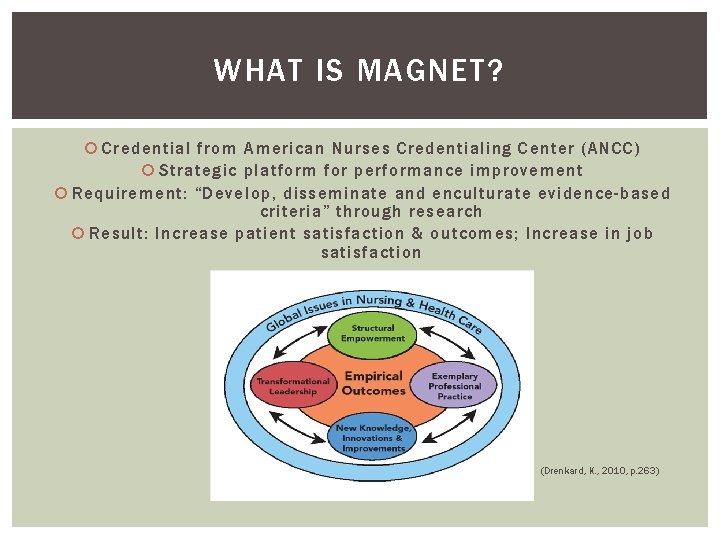
WHAT IS MAGNET? Credential from American Nurses Credentialing Center (ANCC ) Strategic platform for performance improvement Requirement: “Develop, disseminate and enculturate evidence-based criteria” through research Result: Increase patient satisfaction & outcomes; Increase in job satisfaction (Drenkard, K. , 2010, p. 263)
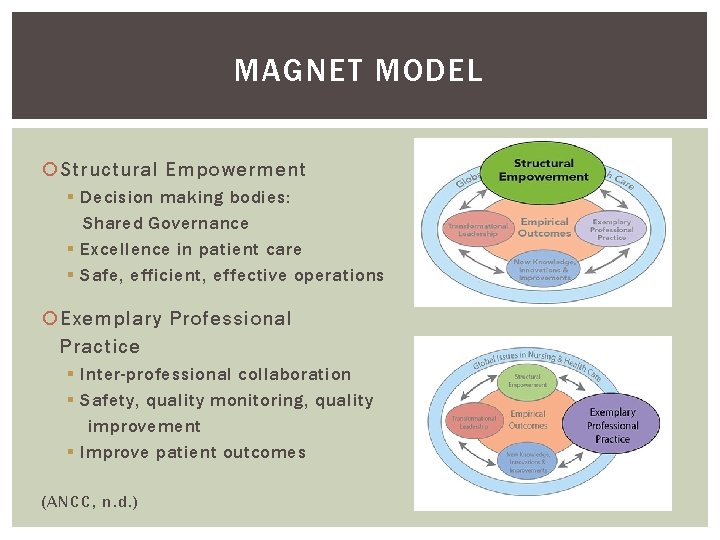
MAGNET MODEL Structural Empowerment § Decision making bodies: Shared Governance § Excellence in patient care § Safe, efficient, effective operations Exemplary Professional Practice § Inter-professional collaboration § Safety, quality monitoring, quality improvement § Improve patient outcomes (ANCC, n. d. )

MAGNET MODEL New Knowledge, Innovations & Improvements § Explore best practices for patients § Integrate Evidence-Based Practice § Research clinical & operational processes Empirical Outcomes § Measurement of quality outcomes to nursing leadership and practice (ANCC, n. d. )
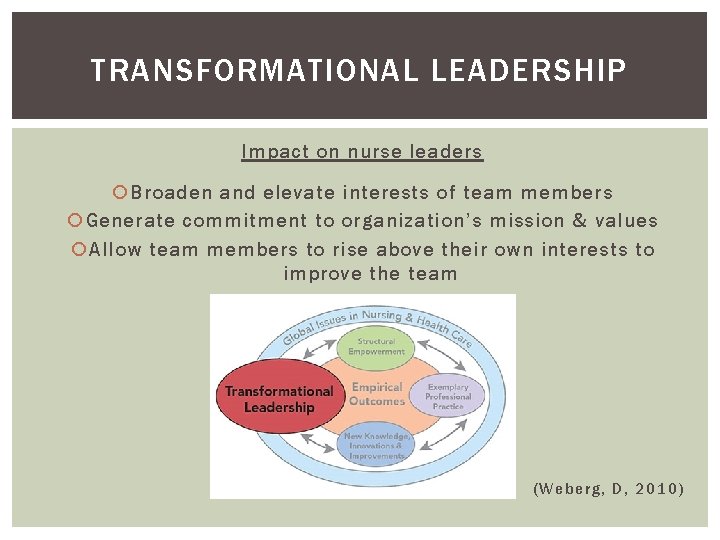
TRANSFORMATIONAL LEADERSHIP Impact on nurse leaders Broaden and elevate interests of team members Generate commitment to organization’s mission & values Allow team members to rise above their own interests to improve the team (Weberg, D, 2010)
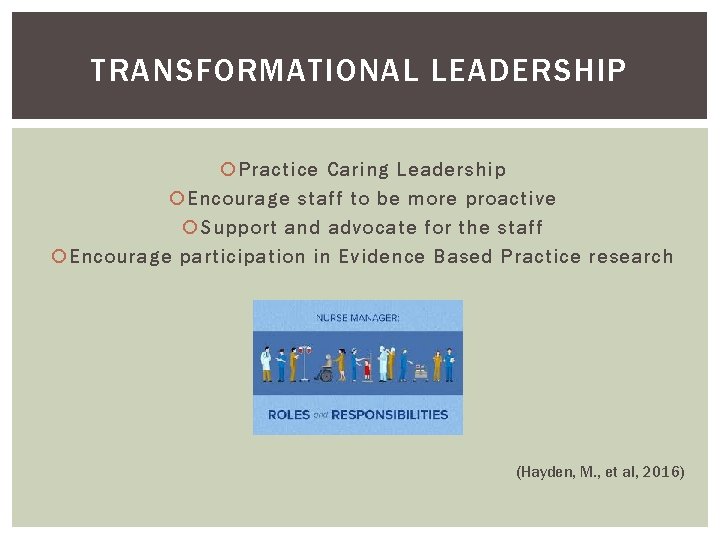
TRANSFORMATIONAL LEADERSHIP Practice Caring Leadership Encourage staff to be more proactive Support and advocate for the staff Encourage participation in Evidence Based Practice research (Hayden, M. , et al, 2016)
TRANSFORMATIONAL LEADERSHIP Outcomes Create positive work environment Improve staff retention Empower bedside practitioner (Weberg, D, 2010)
RETURN ON INVESTMENT Improve quality indicators Reduce costs Increase reimbursement (Drenkard, K. , 2010)
RETURN ON INVESTMENT: HR § Increase RN retention § Decrease RN burnout § Decrease RN vacancy rate § Decrease RN turnover rate (Drenkard, K. , 2010; Renter, M. & Allen, A. , 2014)
RETURN ON INVESTMENT: COST Decrease in RN agency rates § Cost $40 -$60/hour Decrease in staff turnover § Cost of turnover for one RN: $ 38, 900 - $59, 700 § Average lost annually: $5. 13 M- $7. 86 M Value-Based Purchasing § 30% of score based on patient reports of care § Increase in HCAHPS survey scores § Decrease in 30 -day readmissions § Increase reimbursement (Drenkard, K. , 2010; Mc. Hugh, M. , 2013; Russell, J. , 2010; Smith, S. , 2014; NSI Nursing solutions, 2017)
RETURN ON INVESTMENT: SERVICE § Better outcomes in nurse job satisfaction § 85% are very or somewhat satisfied § Better patient satisfaction scores § Lower mortality rate § More RNs with BSN & Specialty certifications § Career development & continuing education (Drenkard, K. , 2010; Mc. Hugh, M. et al. , 2013)
RETURN ON INVESTMENT: QUALITY & SAFETY § Lower incidence of pressure ulcers: Daily cost of $5177 § Lower incidence of falls: Each fall costs $1019 - $4235 § Better mortality outcomes (30 days from admission) § Decrease Occupational Health Injuries: § Needle sticks (Average 67/year/hospital): $405/event § Musculoskeletal injuries: $50, 000 - $100, 000 per injury (Drenkard, K. 2010)
RETURN ON INVESTMENT: OVERALL Increase operating margin (due to investment in nursing services) 4% to 16% Typical 500 bed hospital estimates savings: $2, 308, 350 - $2, 323, 350 (Drenkard, K. , 2010)
REFERENCES American Nurses Credentialing Center (ANCC). (n. d. ). Magnet Model. Obtained October 17, 2017 from http: //www. nursecredentialing. org/Magnet/ Program. Overview/New-Magnet-Model Drenkard K. (2010). The business case for Magnet. J Nurs Adm. 40(6): 263 -71. Drenkard K. (2013). The value of Magnet. J Nurs Adm. 43(10): S 2 -3. Hayden, M. , Wolf, G. , Zedreck-Gonzalez, J. (2016). Beyond Magnet Designation. Journal of Nursing Administration, 46 (10), 530 -534. Mc. Hugh M, Kelly LA, Smith HL, Wu ES, Vanak JM, Aiken LH. (2013). Lower mortality in Magnet hospitals. Med Care. 51(5): 382 -8. Mc. Hugh MD, Ma C. (2013). Hospital nursing and 30 -day readmissions among Medicare patients with heart failure, acute myocardial infarction, and pneumonia. Med Care. 51(1): 52 -9.
REFERENCES NSI Nursing Solutions. (2017). 2017 National Health Care Retention & RN Staffing Report. Obtained from http: //www. nsinursingsolutions. com/ Renter, M. & Allen, A. (2014, Mar). How Magnet designation affects nurse retention: An evidence-based research project. Obtained October 12, 2017 from https: //www. americannursetoday. com/how-magnetdesignation-affects-nurse-retention-an-evidence-basedresearch-project/ Russell, J. (2010, Sept. ). Journey to Magnet [TM]: costs vs. benefits. Nursing Economics, 28(5), 340 -342. Smith, S. (2014, Feb). Magnet hospitals: Higher rates of patient satisfaction. Policy, Politics & Nursing Practice, 15(1 -2 ), 30 -41. Weberg, D. (2010). Transformational leadership and staff retention. Nursing Administration Quarterly, 34(3 ), 246 -258.
- Slides: 16