
Business and Government Business and Government INTRODUCTION The
Business and Government
Business and Government INTRODUCTION �The govt & business relationship is a social problem, b’se the relationship b/w business & govt is in crisis. �Its needs re-thinking, re-appraisal & re -structuring. �In developing countries, there are no clear rules & regulations, too many laws and confusing procedures & new problems such as the environment, which cannot be fitted into the existing relationship.
Business and Government INTRODUCTION �The prevailing confusion threatens govt even more than business. �It undermines its capacity to make policies & give directions. �It makes them hesident and timid in areas where effective leadership is needed. �Thus a competent & effective govt is the first. need for the complex industrial society
Business and Government INTRODUCTION �The influence of political environment of business is enormous. �The political system prevailing in a country decides, promotes, fosters, encourages, shelters, directs & controls the business activities of that country. �A political syatem which is stable, honest, efficient & dynamic & which ensures political participation of the people & assures personal security to the citizens, is a primary factor for economic development. �The rich countries of today owned their success mainly to the political system they enjoyed.
Government Responsibilities towards Business �There was a time when the role of govt was just maintain law & order. �After independence, our govt has been playing significant role in regulating business activities.
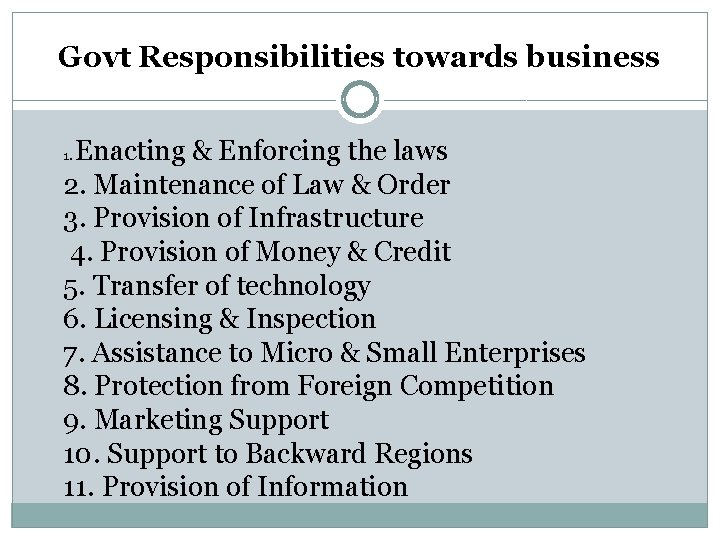
Govt Responsibilities towards business Enacting & Enforcing the laws 2. Maintenance of Law & Order 3. Provision of Infrastructure 4. Provision of Money & Credit 5. Transfer of technology 6. Licensing & Inspection 7. Assistance to Micro & Small Enterprises 8. Protection from Foreign Competition 9. Marketing Support 10. Support to Backward Regions 11. Provision of Information 1.
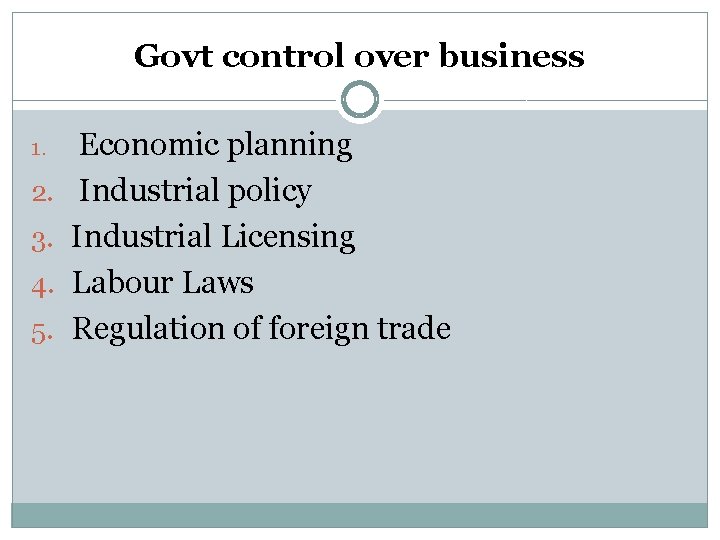
Govt control over business 1. 2. 3. 4. 5. Economic planning Industrial policy Industrial Licensing Labour Laws Regulation of foreign trade
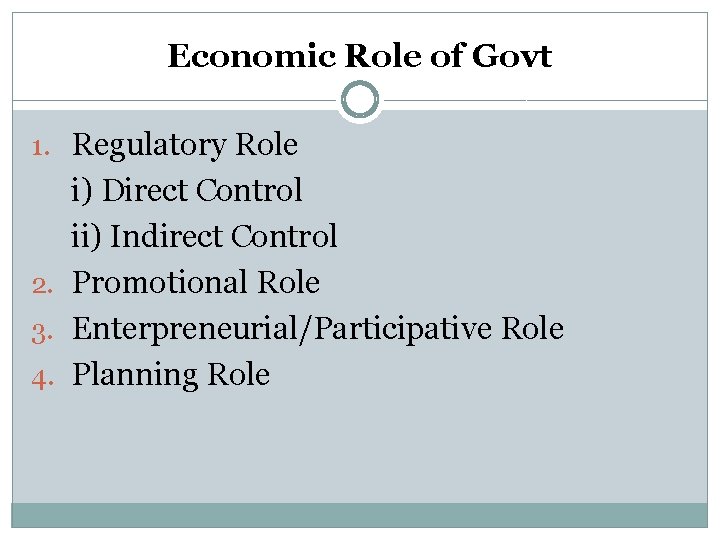
Economic Role of Govt 1. Regulatory Role i) Direct Control ii) Indirect Control 2. Promotional Role 3. Enterpreneurial/Participative Role 4. Planning Role
Government’s Regulatory Influence on Business Factors to Consider Regarding Government Regulation �Protection �Scope �Cost
Government’s Regulatory Influence on Business 1. 2. 3. 4. 5. Federal Regulatory Agency Has decision-making authority Establishes standards or guidelines conferring benefits and imposing restrictions on business conduct Operates principally in the sphere of domestic business activity Has its head and/or members appointed by the president (generally subject to Senate confirmation) Has its legal procedures generally governed by the Administrative Procedures Act
Government’s Regulatory Influence on Business Types of Regulation �Economic regulation Interstate Commerce Commission (ICC) Civil Aeronautics Board (CAB) Federal Communications Commission (FCC) �Social regulation Environmental Protection Agency (EPA) Occupational Safety and Health Administration (OSHA) Equal Employment Opportunity Commission (EEOC)
Government’s Regulatory Influence on Business Reasons for Regulation �Controls natural monopolies �Controls negative externalities �Achieves social goals �Other reasons Controls excess profits Controls excessive competition
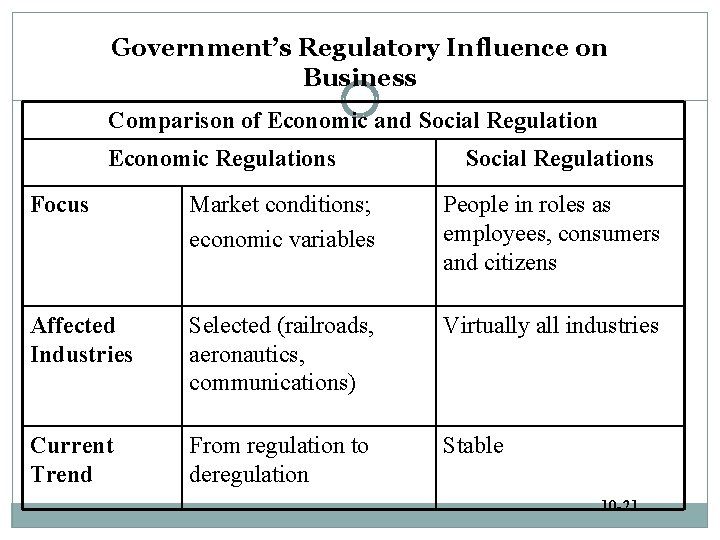
Government’s Regulatory Influence on Business Comparison of Economic and Social Regulation Economic Regulations Social Regulations Focus Market conditions; economic variables People in roles as employees, consumers and citizens Affected Industries Selected (railroads, aeronautics, communications) Virtually all industries Current Trend From regulation to deregulation Stable 10 -21
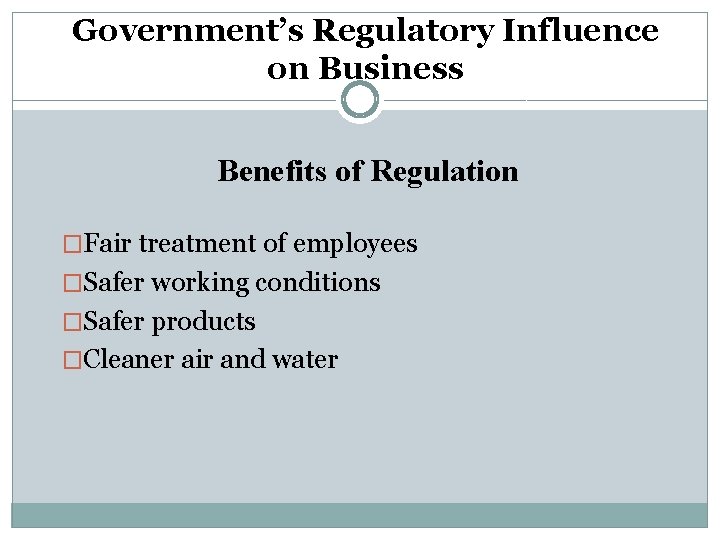
Government’s Regulatory Influence on Business Benefits of Regulation �Fair treatment of employees �Safer working conditions �Safer products �Cleaner air and water
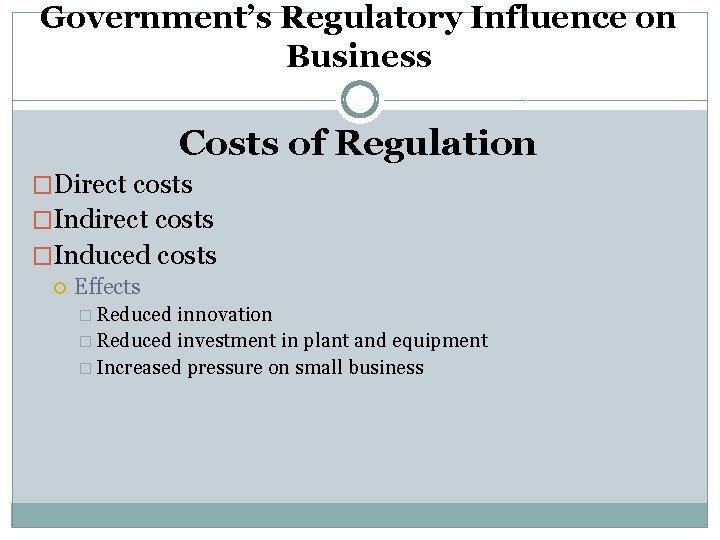
Government’s Regulatory Influence on Business Costs of Regulation �Direct costs �Induced costs Effects � Reduced innovation � Reduced investment in plant and equipment � Increased pressure on small business
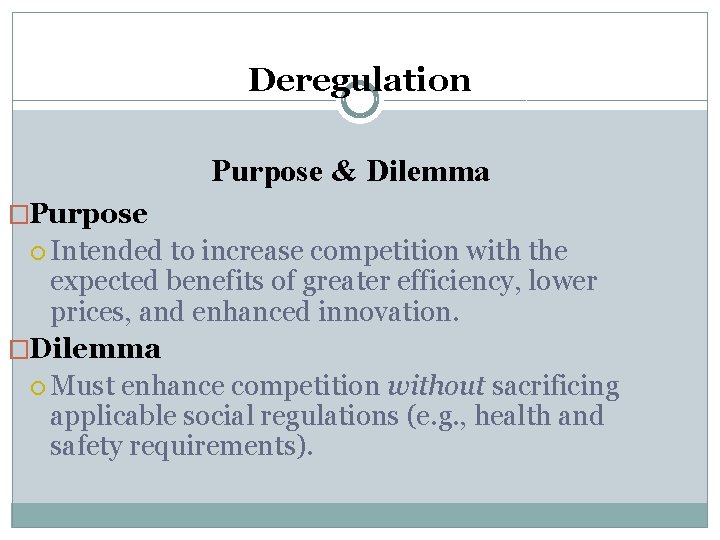
Deregulation Purpose & Dilemma �Purpose Intended to increase competition with the expected benefits of greater efficiency, lower prices, and enhanced innovation. �Dilemma Must enhance competition without sacrificing applicable social regulations (e. g. , health and safety requirements).
Government’s Role in Influencing Business 1. Prescribes the rules of the game for 2. 3. 4. 5. business. Purchases business’ products and services. Uses it contracting power to get business to do things it wants. Is a major promoter and subsidizer of business. Is the owner of vast quantities of productive equipment and wealth.
Government’s Role in Influencing Business 6. 7. 8. 9. 10. Is an architect of economic growth. Is a financier. Is the protector of various interests in society against business exploitation. Directly manages large areas of private business. Is the repository of the social conscience and redistributes resources to meet social objectives
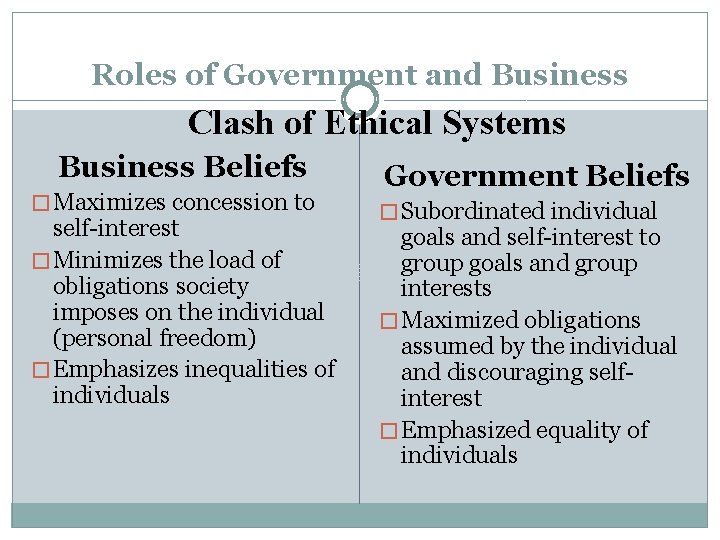
Roles of Government and Business Clash of Ethical Systems Business Beliefs � Maximizes concession to self-interest � Minimizes the load of obligations society imposes on the individual (personal freedom) � Emphasizes inequalities of individuals Government Beliefs � Subordinated individual goals and self-interest to group goals and group interests � Maximized obligations assumed by the individual and discouraging selfinterest � Emphasized equality of individuals
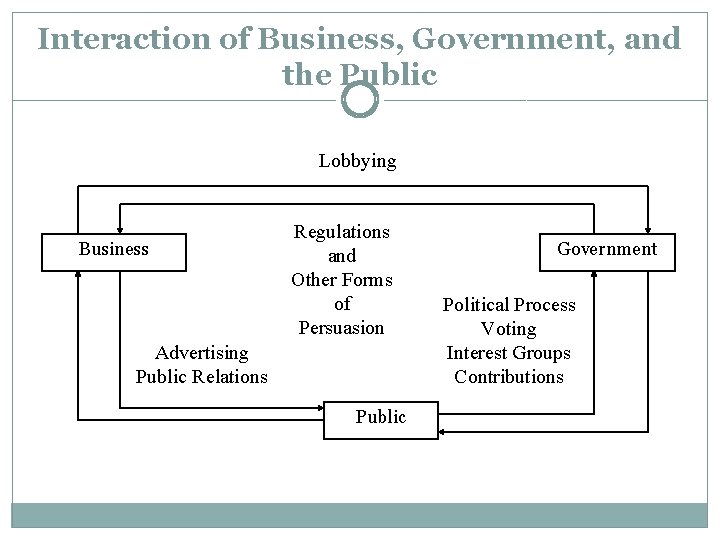
Interaction of Business, Government, and the Public Lobbying Business Regulations and Other Forms of Persuasion Advertising Public Relations Public Government Political Process Voting Interest Groups Contributions
Interaction of Business, Government, and the Public �Government/business relationship �Public/government relationship �Business/public relationship
Government’s Non-regulatory Influence on Business Two Major Non-regulatory Issues �Industrial policy �Privatization
Government’s Nonregulatory Influence on Business Industrial Policy: Schools of Thought �Accelerationists �Adjusters �Targeters �Central planners �Bankers
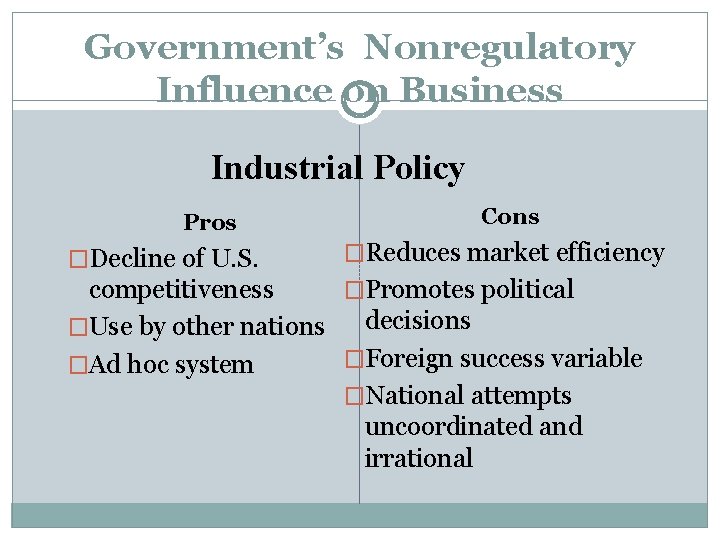
Government’s Nonregulatory Influence on Business Industrial Policy Pros �Decline of U. S. Cons �Reduces market efficiency competitiveness �Promotes political decisions �Use by other nations �Foreign success variable �Ad hoc system �National attempts uncoordinated and irrational
Government’s Nonregulatory Influence on Business Privatization �Producing versus providing a service �Privatization debate Federalization of certain functions � Airport security
Government’s Nonregulatory Influence on Business Other Nonregulatory Influences �Major employer �Major lender �Large purchaser �Taxation �Major influence Subsidies Transfer payments �Major competitor �Monetary policy �Moral persuasion
- Slides: 26