
Business and Economic Forecasting Lecture 1 A Review
Business and Economic Forecasting Lecture 1 A Review of Basic Statistical Concepts Copyright © 2012 Pearson Education, Inc. publishing as Prentice Hall
Basic Vocabulary VARIABLES Variables are characteristics of an item or individual and are what you analyze when you use a statistical method. DATA Data are the different values associated with a variable. OPERATIONAL DEFINITIONS Data values are meaningless unless their variables have operational definitions, universally accepted meanings that are clear to all associated with an analysis. Copyright © 2012 Pearson Education, Inc. publishing as Prentice Hall
Basic Vocabulary POPULATION A population consists of all the items or individuals about which you want to draw a conclusion. The population is the “large group. ” SAMPLE A sample is the portion of a population selected for analysis. The sample is the “small group. ” PARAMETER A parameter is a numerical measure that describes a characteristic of a population. STATISTIC A statistic is a numerical measure that describes a characteristic of a sample. Copyright © 2012 Pearson Education, Inc. publishing as Prentice Hall

Population vs. Sample Population Measures used to describe the population are called parameters Copyright © 2012 Pearson Education, Inc. publishing as Prentice Hall Sample Measures used to describe the sample are called statistics

Types of Variables § § Categorical (qualitative) variables have values that can only be placed into categories, such as “yes” and “no. ” Numerical (quantitative) variables have values that represent quantities. § § Discrete variables arise from a counting process Continuous variables arise from a measuring process Copyright © 2012 Pearson Education, Inc. publishing as Prentice Hall
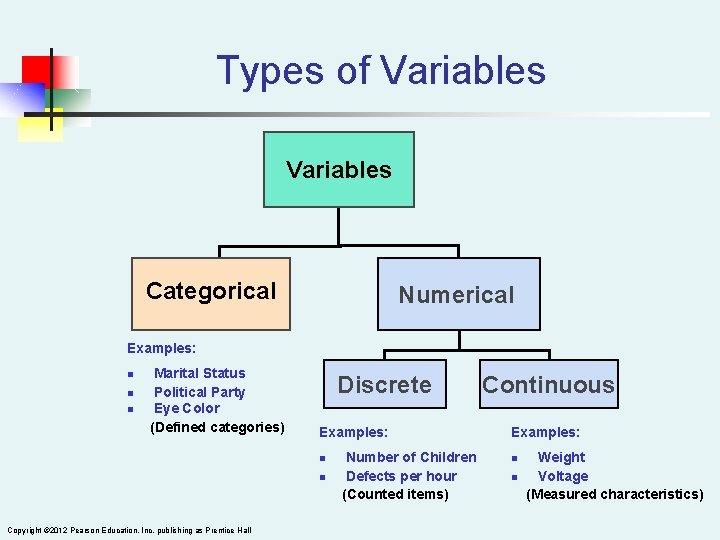
Types of Variables Categorical Numerical Examples: n n n Marital Status Political Party Eye Color (Defined categories) Discrete Examples: n n Copyright © 2012 Pearson Education, Inc. publishing as Prentice Hall Number of Children Defects per hour (Counted items) Continuous Examples: n n Weight Voltage (Measured characteristics)
Summary Definitions § § § DCOVA The central tendency is the extent to which all the data values group around a typical or central value. The variation is the amount of dispersion or scattering of values The shape is the pattern of the distribution of values from the lowest value to the highest value. Copyright © 2012 Pearson Education, Inc. publishing as Prentice Hall
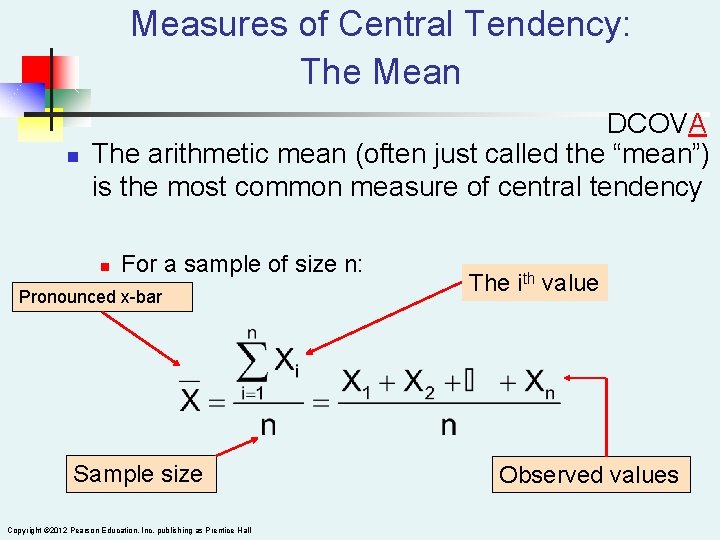
Measures of Central Tendency: The Mean n DCOVA The arithmetic mean (often just called the “mean”) is the most common measure of central tendency n For a sample of size n: Pronounced x-bar Sample size Copyright © 2012 Pearson Education, Inc. publishing as Prentice Hall The ith value Observed values
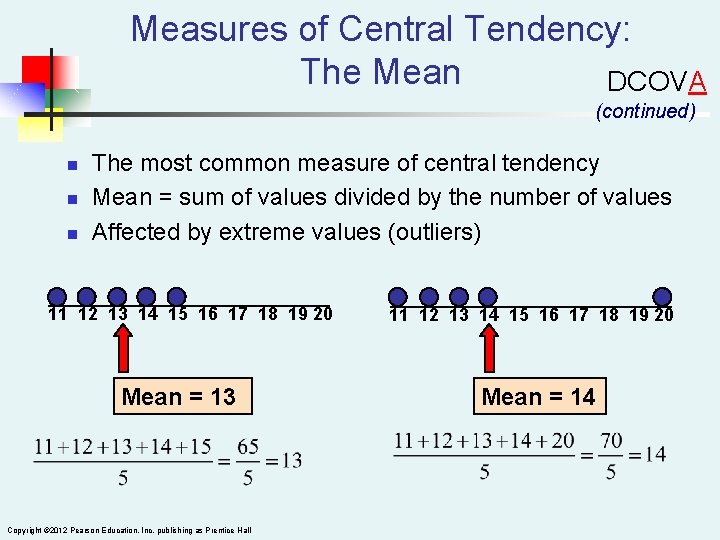
Measures of Central Tendency: The Mean DCOVA (continued) n n n The most common measure of central tendency Mean = sum of values divided by the number of values Affected by extreme values (outliers) 11 12 13 14 15 16 17 18 19 20 Mean = 13 Copyright © 2012 Pearson Education, Inc. publishing as Prentice Hall 11 12 13 14 15 16 17 18 19 20 Mean = 14
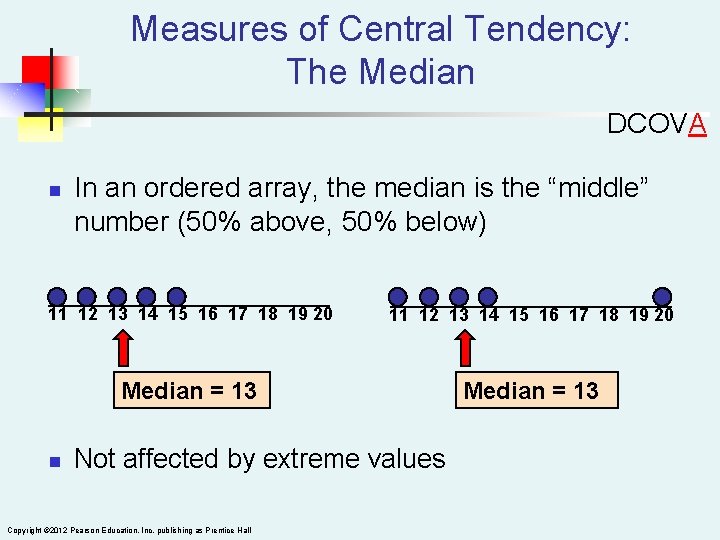
Measures of Central Tendency: The Median DCOVA n In an ordered array, the median is the “middle” number (50% above, 50% below) 11 12 13 14 15 16 17 18 19 20 Median = 13 n Not affected by extreme values Copyright © 2012 Pearson Education, Inc. publishing as Prentice Hall
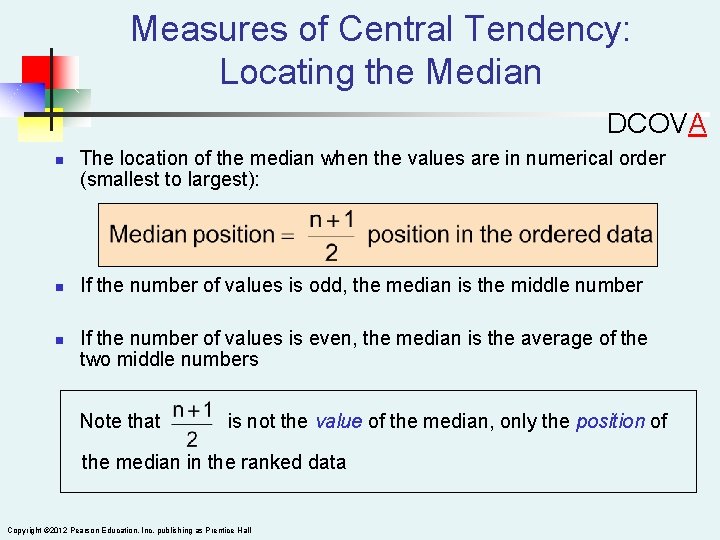
Measures of Central Tendency: Locating the Median DCOVA n n n The location of the median when the values are in numerical order (smallest to largest): If the number of values is odd, the median is the middle number If the number of values is even, the median is the average of the two middle numbers Note that is not the value of the median, only the position of the median in the ranked data Copyright © 2012 Pearson Education, Inc. publishing as Prentice Hall
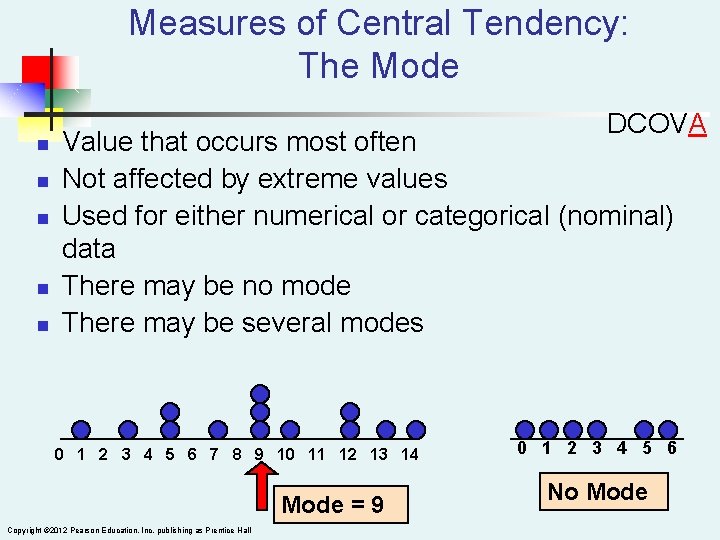
Measures of Central Tendency: The Mode n n n DCOVA Value that occurs most often Not affected by extreme values Used for either numerical or categorical (nominal) data There may be no mode There may be several modes 0 1 2 3 4 5 6 7 8 9 10 11 12 13 14 Mode = 9 Copyright © 2012 Pearson Education, Inc. publishing as Prentice Hall 0 1 2 3 4 5 6 No Mode

Measures of Central Tendency: Review Example DCOVA House Prices: $2, 000 $ 500, 000 $ 300, 000 $ 100, 000 Sum $ 3, 000 Copyright © 2012 Pearson Education, Inc. publishing as Prentice Hall § § § Mean: ($3, 000/5) = $600, 000 Median: middle value of ranked data = $300, 000 Mode: most frequent value = $100, 000
Measures of Central Tendency: Which Measure to Choose? DCOVA § § § The mean is generally used, unless extreme values (outliers) exist. The median is often used, since the median is not sensitive to extreme values. For example, median home prices may be reported for a region; it is less sensitive to outliers. In some situations it makes sense to report both the mean and the median. Copyright © 2012 Pearson Education, Inc. publishing as Prentice Hall
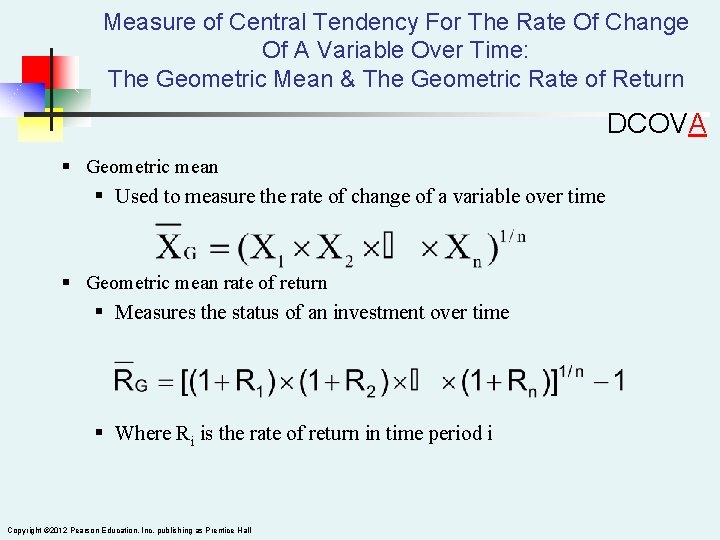
Measure of Central Tendency For The Rate Of Change Of A Variable Over Time: The Geometric Mean & The Geometric Rate of Return DCOVA § Geometric mean § Used to measure the rate of change of a variable over time § Geometric mean rate of return § Measures the status of an investment over time § Where Ri is the rate of return in time period i Copyright © 2012 Pearson Education, Inc. publishing as Prentice Hall

The Geometric Mean Rate of Return: Example DCOVA An investment of $100, 000 declined to $50, 000 at the end of year one and rebounded to $100, 000 at end of year two: 50% decrease 100% increase The overall two-year per year return is zero, since it started and ended at the same level. Copyright © 2012 Pearson Education, Inc. publishing as Prentice Hall

The Geometric Mean Rate of Return: Example (continued) DCOVA Use the 1 -year returns to compute the arithmetic mean and the geometric mean: Arithmetic mean rate of return: Geometric mean rate of return: Copyright © 2012 Pearson Education, Inc. publishing as Prentice Hall Misleading result More representative result
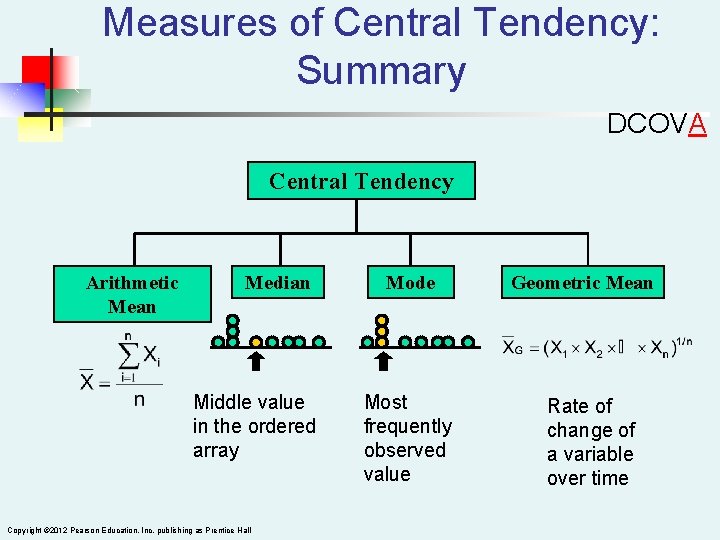
Measures of Central Tendency: Summary DCOVA Central Tendency Arithmetic Mean Median Middle value in the ordered array Copyright © 2012 Pearson Education, Inc. publishing as Prentice Hall Mode Most frequently observed value Geometric Mean Rate of change of a variable over time
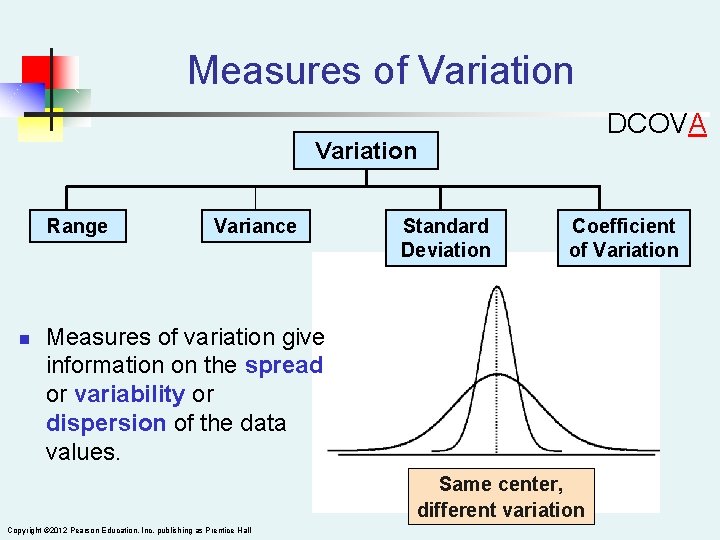
Measures of Variation DCOVA Variation Range n Variance Standard Deviation Coefficient of Variation Measures of variation give information on the spread or variability or dispersion of the data values. Same center, different variation Copyright © 2012 Pearson Education, Inc. publishing as Prentice Hall
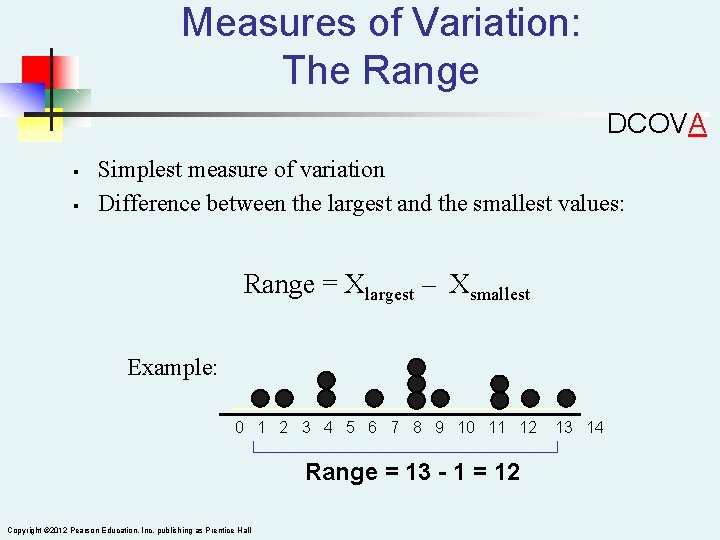
Measures of Variation: The Range DCOVA § § Simplest measure of variation Difference between the largest and the smallest values: Range = Xlargest – Xsmallest Example: 0 1 2 3 4 5 6 7 8 9 10 11 12 Range = 13 - 1 = 12 Copyright © 2012 Pearson Education, Inc. publishing as Prentice Hall 13 14
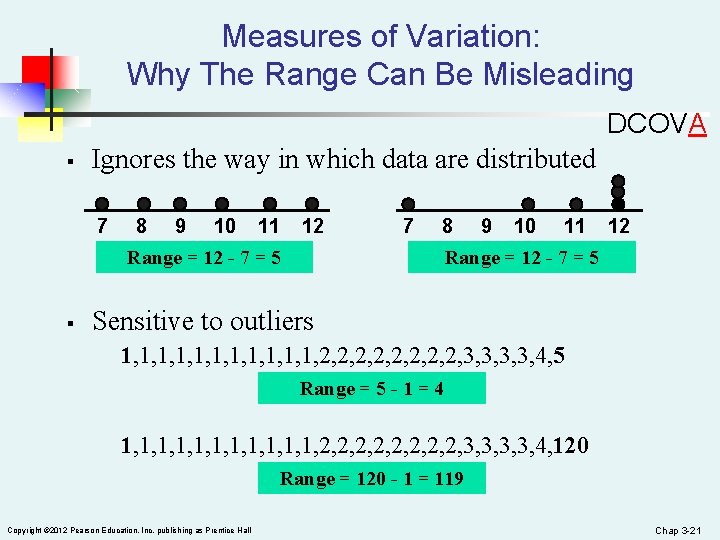
Measures of Variation: Why The Range Can Be Misleading DCOVA § Ignores the way in which data are distributed 7 8 9 10 11 12 7 8 Range = 12 - 7 = 5 § 9 10 11 12 Range = 12 - 7 = 5 Sensitive to outliers 1, 1, 1, 2, 2, 3, 3, 4, 5 Range = 5 - 1 = 4 1, 1, 1, 2, 2, 3, 3, 4, 120 Range = 120 - 1 = 119 Copyright © 2012 Pearson Education, Inc. publishing as Prentice Hall Chap 3 -21
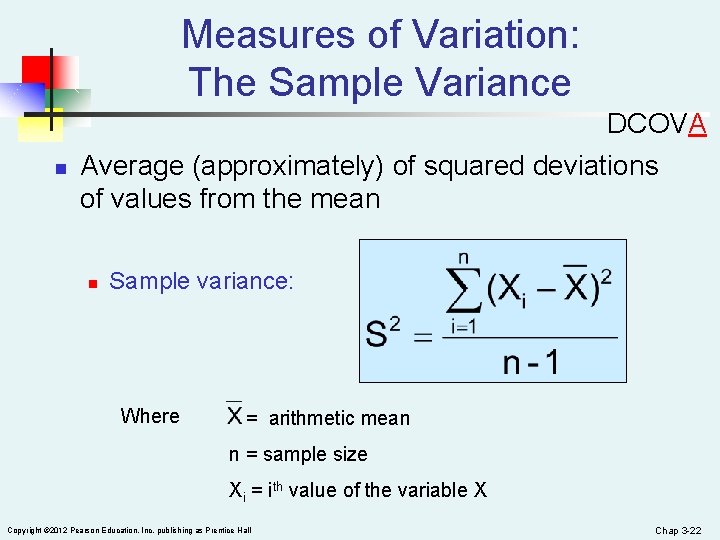
Measures of Variation: The Sample Variance n DCOVA Average (approximately) of squared deviations of values from the mean n Sample variance: Where = arithmetic mean n = sample size Xi = ith value of the variable X Copyright © 2012 Pearson Education, Inc. publishing as Prentice Hall Chap 3 -22
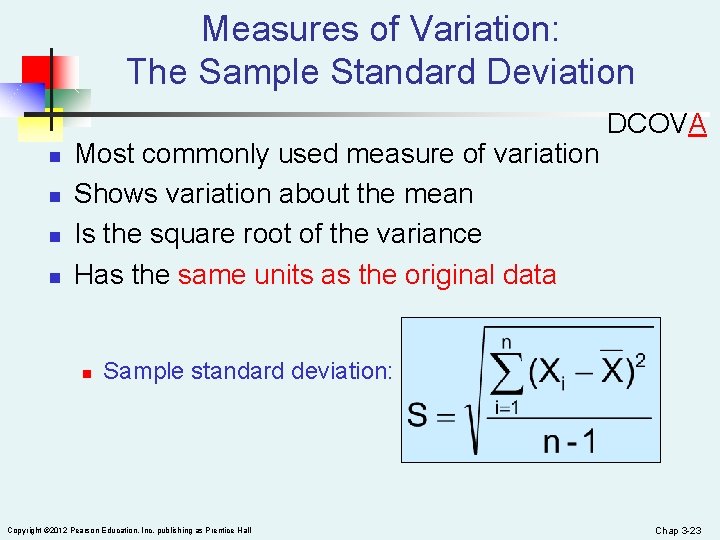
Measures of Variation: The Sample Standard Deviation n n Most commonly used measure of variation Shows variation about the mean Is the square root of the variance Has the same units as the original data n DCOVA Sample standard deviation: Copyright © 2012 Pearson Education, Inc. publishing as Prentice Hall Chap 3 -23
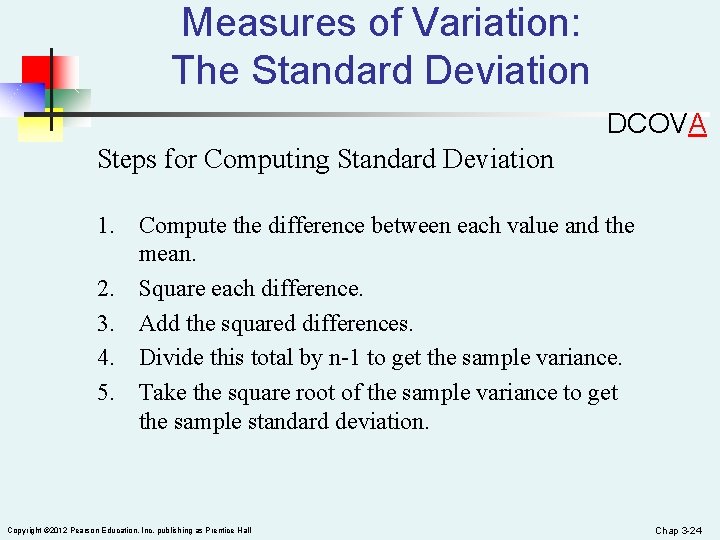
Measures of Variation: The Standard Deviation DCOVA Steps for Computing Standard Deviation 1. 2. 3. 4. 5. Compute the difference between each value and the mean. Square each difference. Add the squared differences. Divide this total by n-1 to get the sample variance. Take the square root of the sample variance to get the sample standard deviation. Copyright © 2012 Pearson Education, Inc. publishing as Prentice Hall Chap 3 -24
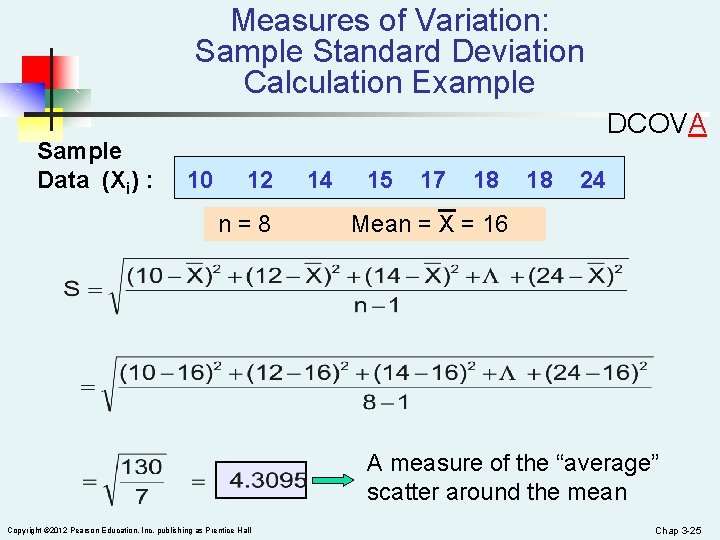
Measures of Variation: Sample Standard Deviation Calculation Example Sample Data (Xi) : DCOVA 10 12 n=8 14 15 17 18 18 24 Mean = X = 16 A measure of the “average” scatter around the mean Copyright © 2012 Pearson Education, Inc. publishing as Prentice Hall Chap 3 -25
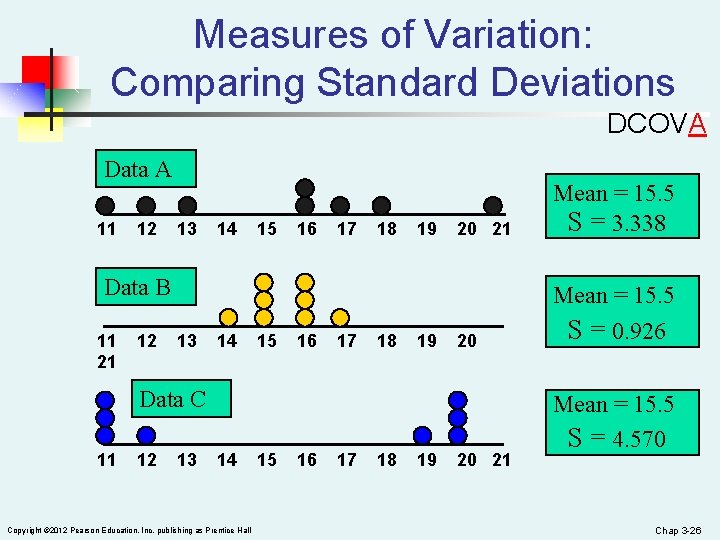
Measures of Variation: Comparing Standard Deviations DCOVA Data A 11 12 13 14 15 16 17 18 19 20 21 Mean = 15. 5 S = 3. 338 20 Mean = 15. 5 S = 0. 926 Data B 11 21 12 13 14 15 16 17 18 19 Data C 11 12 13 14 Copyright © 2012 Pearson Education, Inc. publishing as Prentice Hall 15 16 17 18 19 20 21 Mean = 15. 5 S = 4. 570 Chap 3 -26
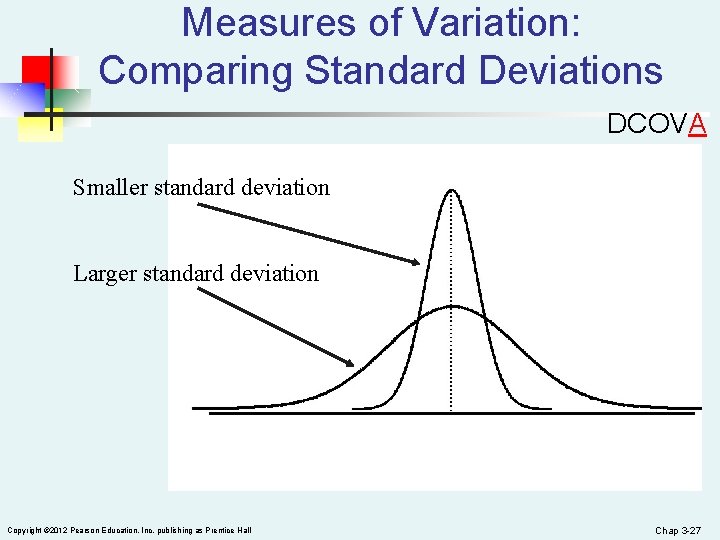
Measures of Variation: Comparing Standard Deviations DCOVA Smaller standard deviation Larger standard deviation Copyright © 2012 Pearson Education, Inc. publishing as Prentice Hall Chap 3 -27
Measures of Variation: Summary Characteristics § § DCOVA The more the data are spread out, the greater the range, variance, and standard deviation. The more the data are concentrated, the smaller the range, variance, and standard deviation. If the values are all the same (no variation), all these measures will be zero. None of these measures are ever negative. Copyright © 2012 Pearson Education, Inc. publishing as Prentice Hall Chap 3 -28
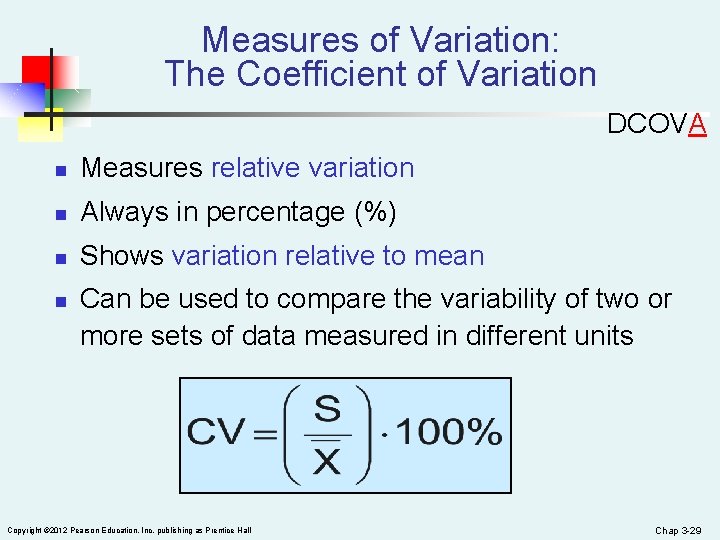
Measures of Variation: The Coefficient of Variation DCOVA n Measures relative variation n Always in percentage (%) n Shows variation relative to mean n Can be used to compare the variability of two or more sets of data measured in different units Copyright © 2012 Pearson Education, Inc. publishing as Prentice Hall Chap 3 -29
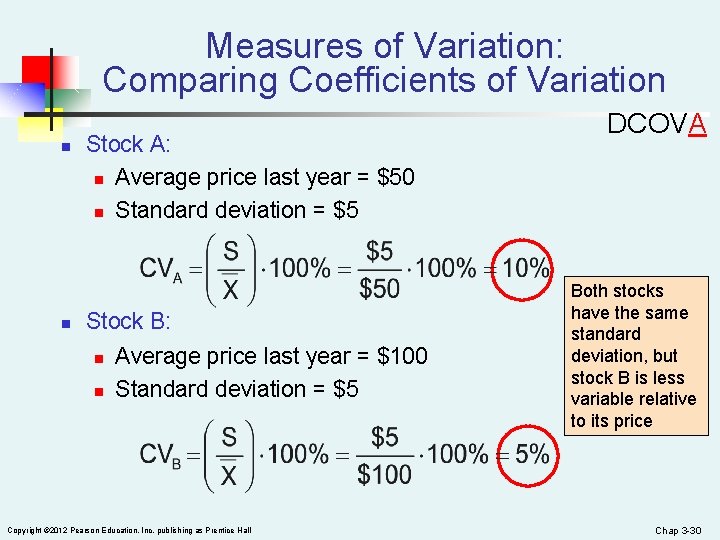
Measures of Variation: Comparing Coefficients of Variation n n Stock A: n Average price last year = $50 n Standard deviation = $5 Stock B: n n Average price last year = $100 Standard deviation = $5 Copyright © 2012 Pearson Education, Inc. publishing as Prentice Hall DCOVA Both stocks have the same standard deviation, but stock B is less variable relative to its price Chap 3 -30
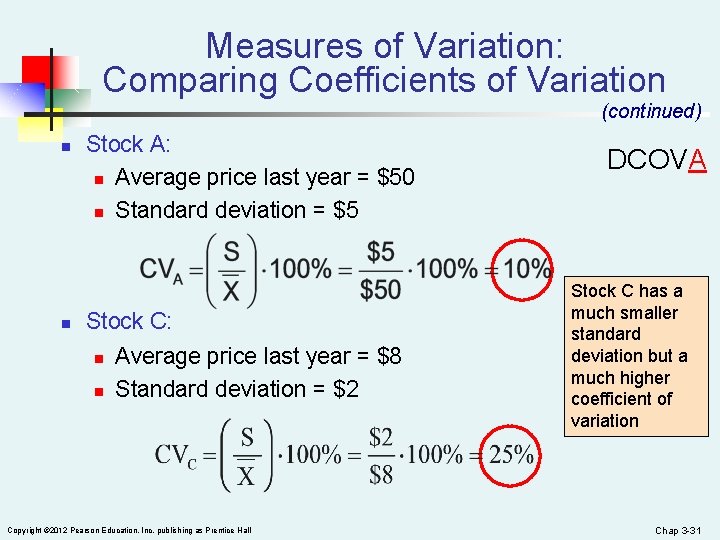
Measures of Variation: Comparing Coefficients of Variation (continued) n n Stock A: n Average price last year = $50 n Standard deviation = $5 Stock C: n n Average price last year = $8 Standard deviation = $2 Copyright © 2012 Pearson Education, Inc. publishing as Prentice Hall DCOVA Stock C has a much smaller standard deviation but a much higher coefficient of variation Chap 3 -31
Shape of a Distribution DCOVA n Describes how data are distributed n Two useful shape related statistics are: n Skewness n n Measures the amount of asymmetry in a distribution Kurtosis n Measures the relative concentration of values in the center of a distribution as compared with the tails Copyright © 2012 Pearson Education, Inc. publishing as Prentice Hall Chap 3 -32
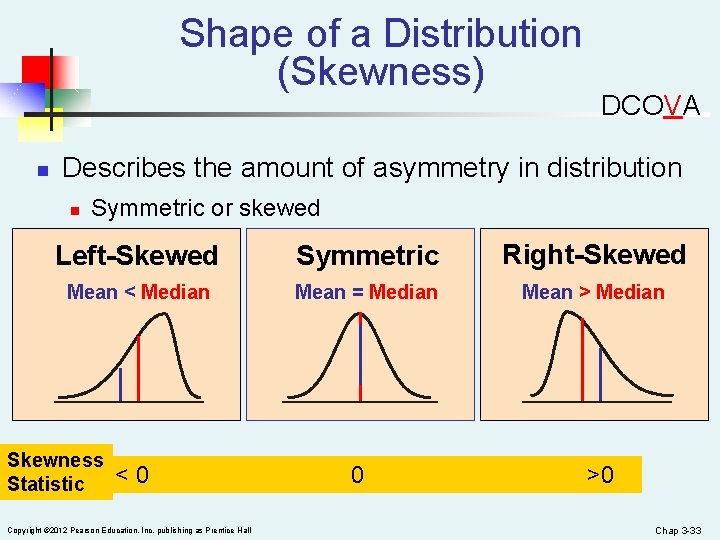
Shape of a Distribution (Skewness) n DCOVA Describes the amount of asymmetry in distribution n Symmetric or skewed Left-Skewed Symmetric Right-Skewed Mean < Median Mean = Median Mean > Median Skewness Statistic <0 Copyright © 2012 Pearson Education, Inc. publishing as Prentice Hall 0 >0 Chap 3 -33
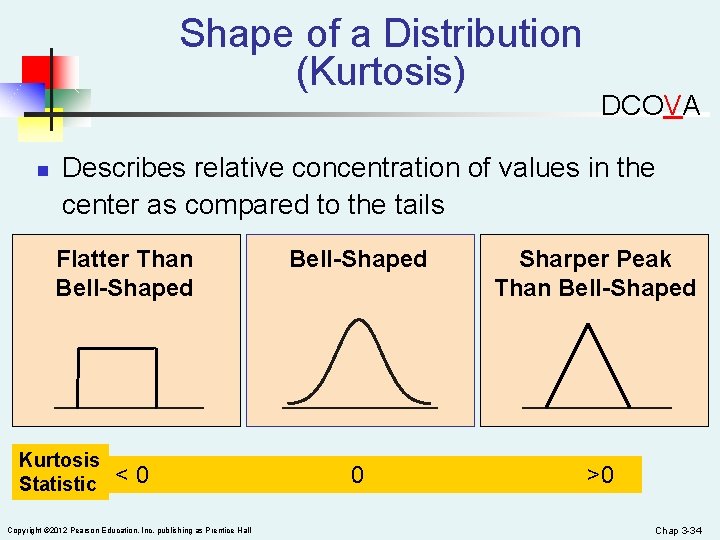
Shape of a Distribution (Kurtosis) n DCOVA Describes relative concentration of values in the center as compared to the tails Flatter Than Bell-Shaped Kurtosis Statistic <0 Copyright © 2012 Pearson Education, Inc. publishing as Prentice Hall Bell-Shaped Sharper Peak Than Bell-Shaped 0 >0 Chap 3 -34
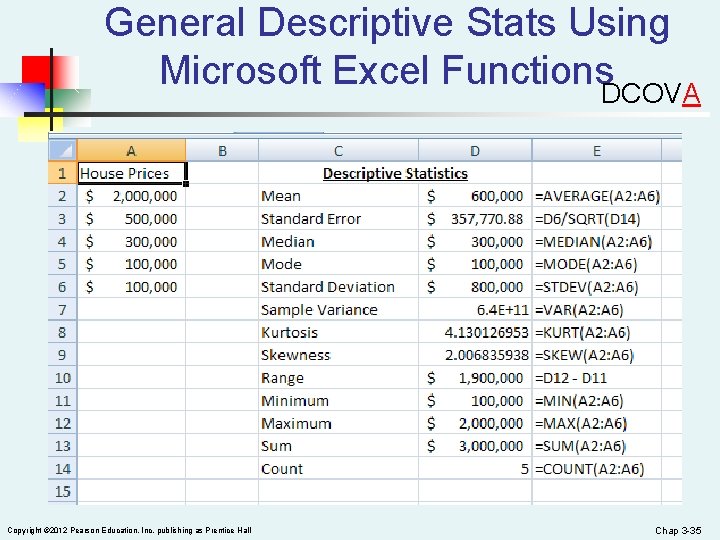
General Descriptive Stats Using Microsoft Excel Functions. DCOVA Copyright © 2012 Pearson Education, Inc. publishing as Prentice Hall Chap 3 -35
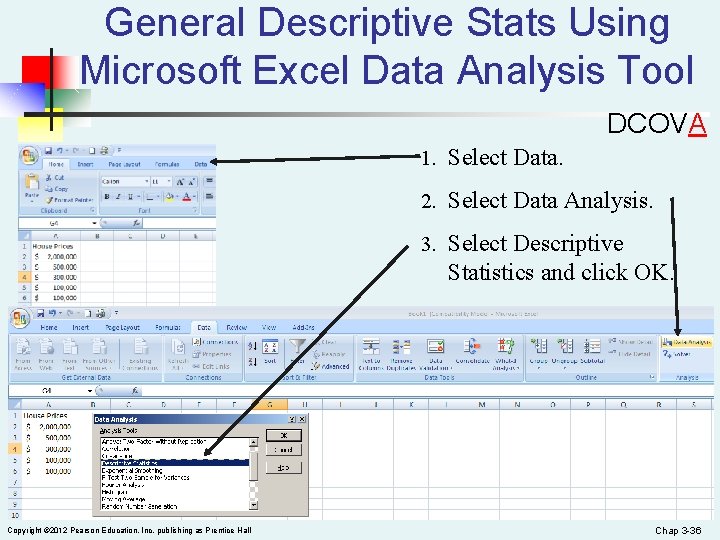
General Descriptive Stats Using Microsoft Excel Data Analysis Tool DCOVA 1. Select Data. 2. Select Data Analysis. 3. Select Descriptive Statistics and click OK. Copyright © 2012 Pearson Education, Inc. publishing as Prentice Hall Chap 3 -36
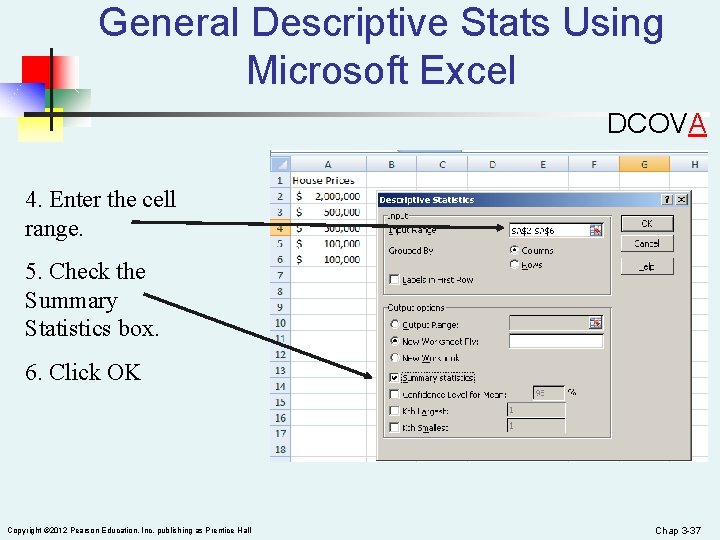
General Descriptive Stats Using Microsoft Excel DCOVA 4. Enter the cell range. 5. Check the Summary Statistics box. 6. Click OK Copyright © 2012 Pearson Education, Inc. publishing as Prentice Hall Chap 3 -37
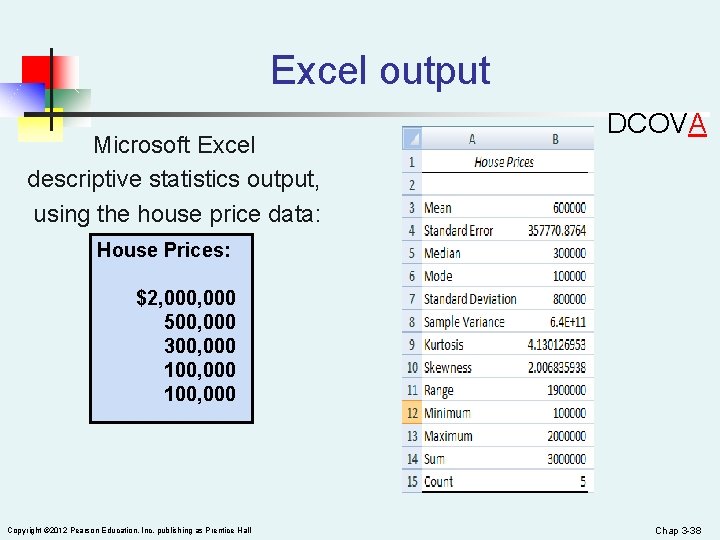
Excel output Microsoft Excel descriptive statistics output, using the house price data: DCOVA House Prices: $2, 000 500, 000 300, 000 100, 000 Copyright © 2012 Pearson Education, Inc. publishing as Prentice Hall Chap 3 -38
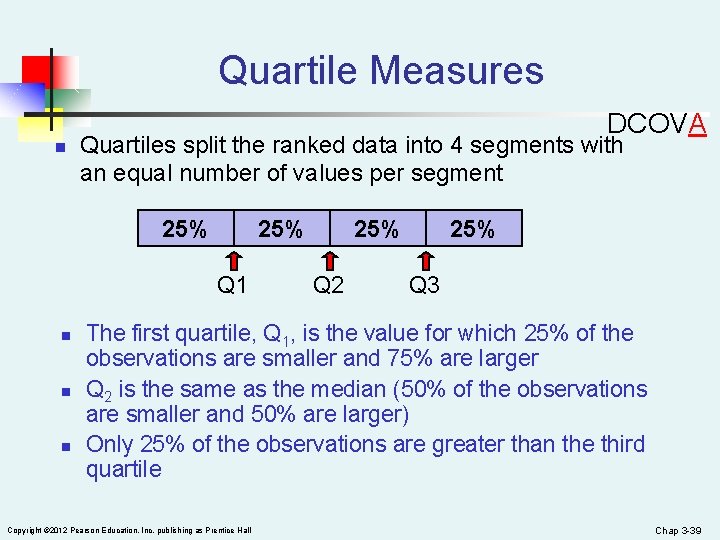
Quartile Measures DCOVA n Quartiles split the ranked data into 4 segments with an equal number of values per segment 25% Q 1 n n n 25% Q 2 25% Q 3 The first quartile, Q 1, is the value for which 25% of the observations are smaller and 75% are larger Q 2 is the same as the median (50% of the observations are smaller and 50% are larger) Only 25% of the observations are greater than the third quartile Copyright © 2012 Pearson Education, Inc. publishing as Prentice Hall Chap 3 -39
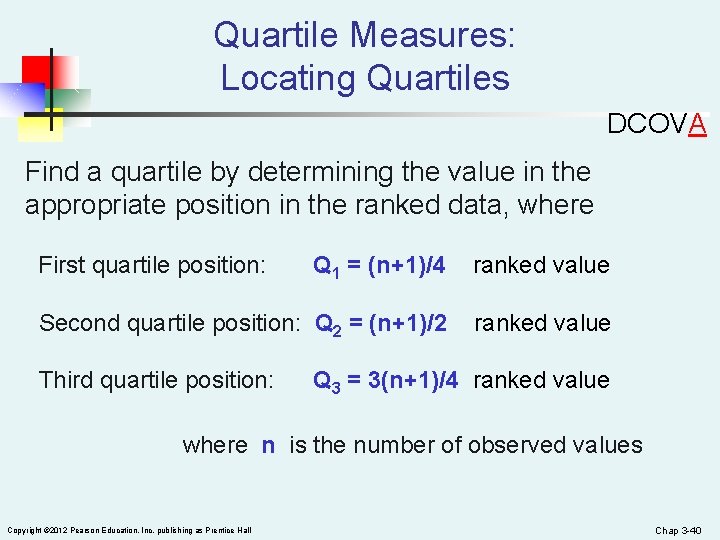
Quartile Measures: Locating Quartiles DCOVA Find a quartile by determining the value in the appropriate position in the ranked data, where First quartile position: Q 1 = (n+1)/4 ranked value Second quartile position: Q 2 = (n+1)/2 ranked value Third quartile position: Q 3 = 3(n+1)/4 ranked value where n is the number of observed values Copyright © 2012 Pearson Education, Inc. publishing as Prentice Hall Chap 3 -40
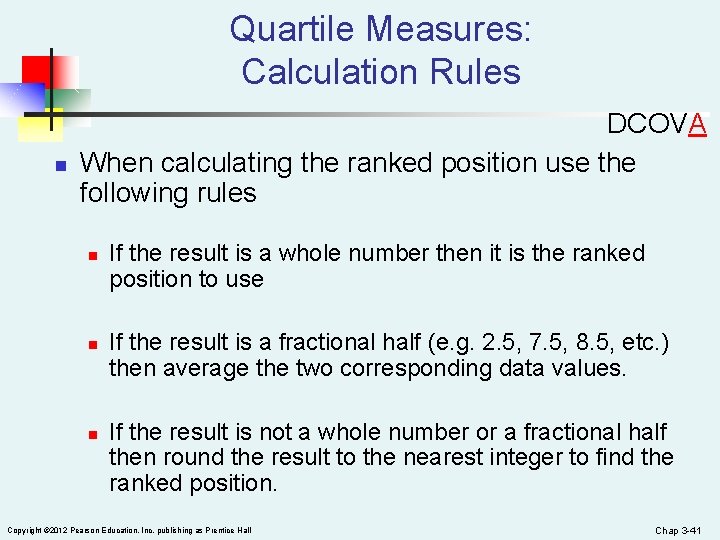
Quartile Measures: Calculation Rules n DCOVA When calculating the ranked position use the following rules n n n If the result is a whole number then it is the ranked position to use If the result is a fractional half (e. g. 2. 5, 7. 5, 8. 5, etc. ) then average the two corresponding data values. If the result is not a whole number or a fractional half then round the result to the nearest integer to find the ranked position. Copyright © 2012 Pearson Education, Inc. publishing as Prentice Hall Chap 3 -41
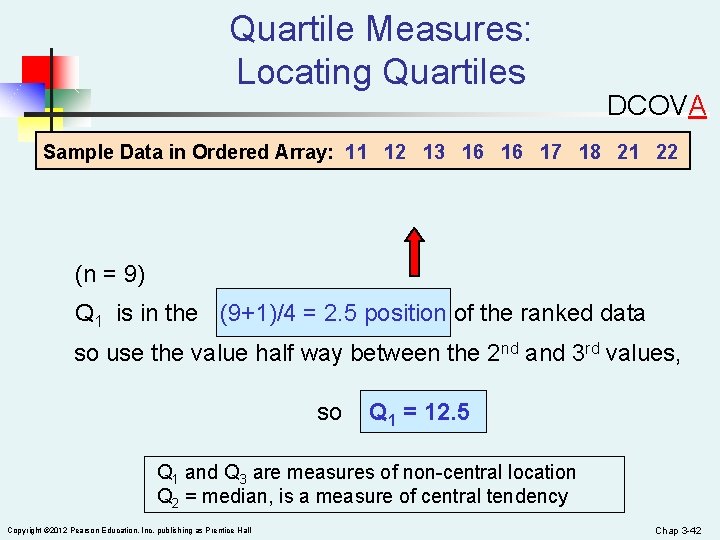
Quartile Measures: Locating Quartiles DCOVA Sample Data in Ordered Array: 11 12 13 16 16 17 18 21 22 (n = 9) Q 1 is in the (9+1)/4 = 2. 5 position of the ranked data so use the value half way between the 2 nd and 3 rd values, so Q 1 = 12. 5 Q 1 and Q 3 are measures of non-central location Q 2 = median, is a measure of central tendency Copyright © 2012 Pearson Education, Inc. publishing as Prentice Hall Chap 3 -42
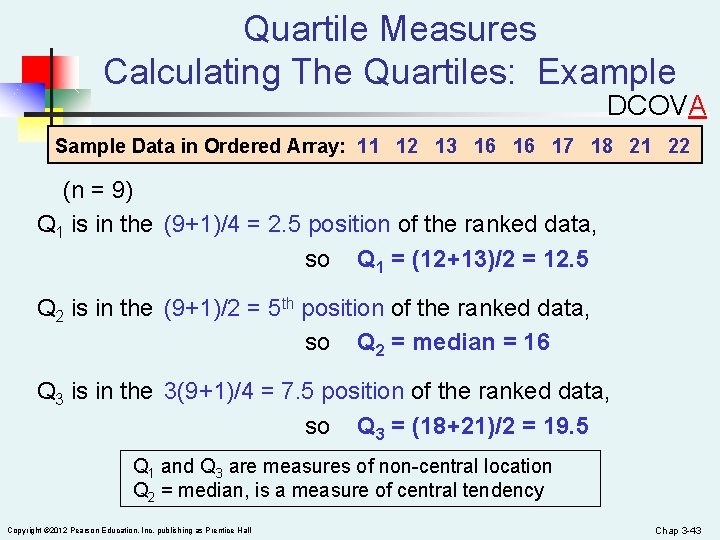
Quartile Measures Calculating The Quartiles: Example DCOVA Sample Data in Ordered Array: 11 12 13 16 16 17 18 21 22 (n = 9) Q 1 is in the (9+1)/4 = 2. 5 position of the ranked data, so Q 1 = (12+13)/2 = 12. 5 Q 2 is in the (9+1)/2 = 5 th position of the ranked data, so Q 2 = median = 16 Q 3 is in the 3(9+1)/4 = 7. 5 position of the ranked data, so Q 3 = (18+21)/2 = 19. 5 Q 1 and Q 3 are measures of non-central location Q 2 = median, is a measure of central tendency Copyright © 2012 Pearson Education, Inc. publishing as Prentice Hall Chap 3 -43
Quartile Measures: The Interquartile Range (IQR) DCOVA n n The IQR is Q 3 – Q 1 and measures the spread in the middle 50% of the data The IQR is also called the midspread because it covers the middle 50% of the data The IQR is a measure of variability that is not influenced by outliers or extreme values Measures like Q 1, Q 3, and IQR that are not influenced by outliers are called resistant measures Copyright © 2012 Pearson Education, Inc. publishing as Prentice Hall Chap 3 -44
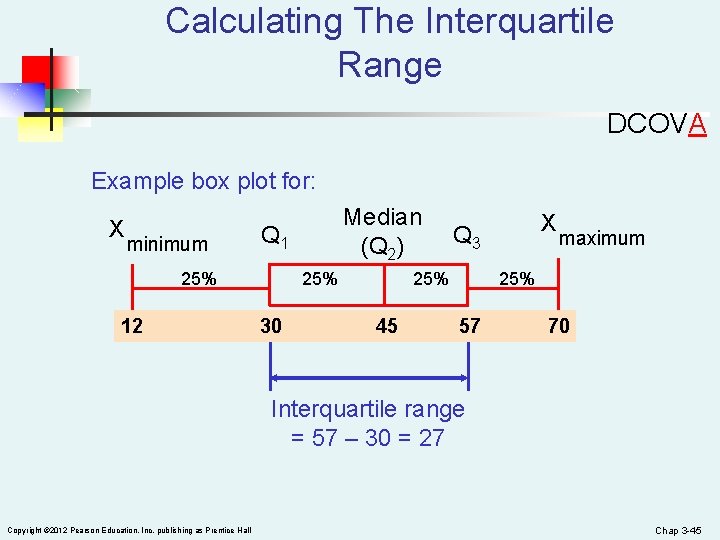
Calculating The Interquartile Range DCOVA Example box plot for: X minimum Q 1 25% 12 Median (Q 2) 25% 30 25% 45 X Q 3 maximum 25% 57 70 Interquartile range = 57 – 30 = 27 Copyright © 2012 Pearson Education, Inc. publishing as Prentice Hall Chap 3 -45
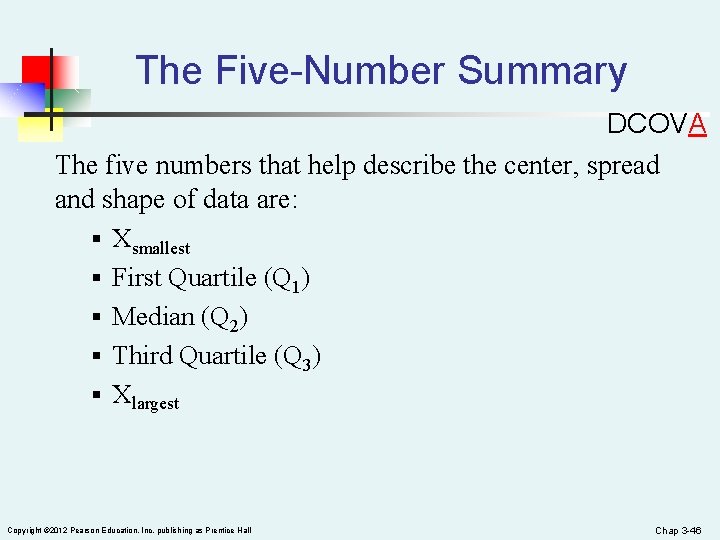
The Five-Number Summary DCOVA The five numbers that help describe the center, spread and shape of data are: § Xsmallest § First Quartile (Q 1) § Median (Q 2) § Third Quartile (Q 3) § Xlargest Copyright © 2012 Pearson Education, Inc. publishing as Prentice Hall Chap 3 -46
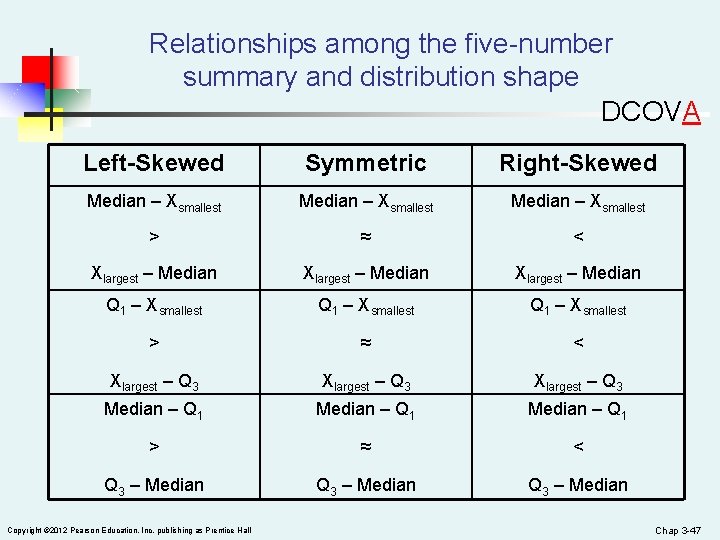
Relationships among the five-number summary and distribution shape DCOVA Left-Skewed Symmetric Right-Skewed Median – Xsmallest > ≈ < Xlargest – Median Q 1 – Xsmallest > ≈ < Xlargest – Q 3 Median – Q 1 > ≈ < Q 3 – Median Copyright © 2012 Pearson Education, Inc. publishing as Prentice Hall Chap 3 -47
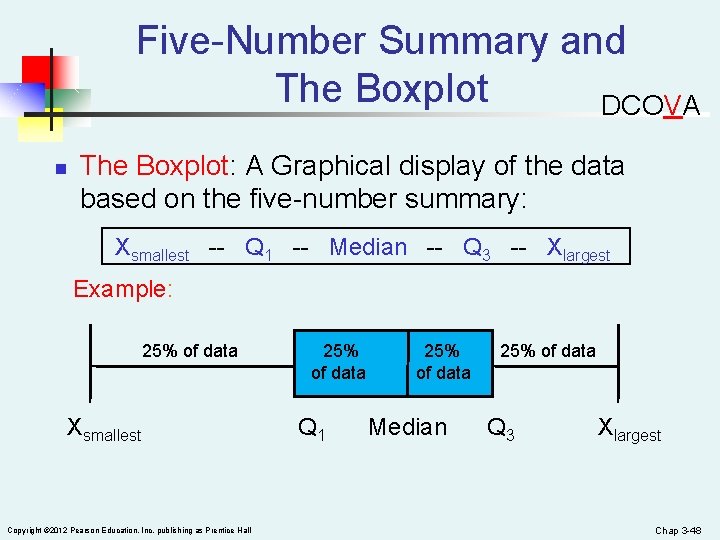
Five-Number Summary and The Boxplot DCOVA n The Boxplot: A Graphical display of the data based on the five-number summary: Xsmallest -- Q 1 -- Median -- Q 3 -- Xlargest Example: 25% of data Xsmallest Copyright © 2012 Pearson Education, Inc. publishing as Prentice Hall 25% of data Q 1 25% of data Median 25% of data Q 3 Xlargest Chap 3 -48
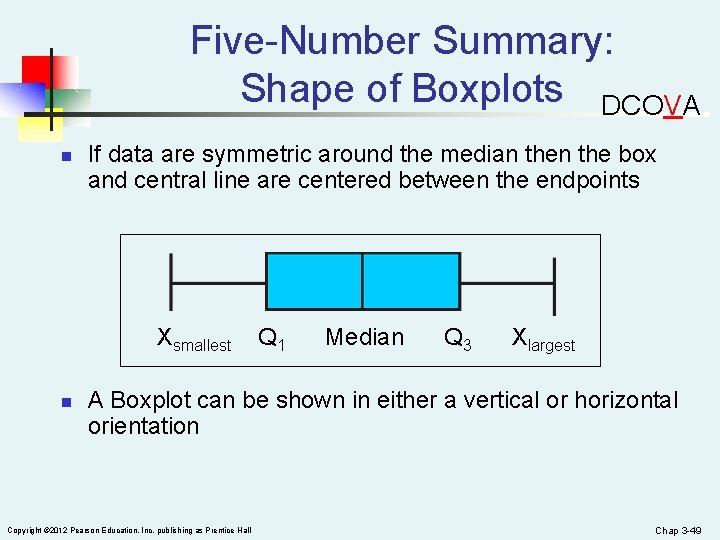
Five-Number Summary: Shape of Boxplots DCOVA n If data are symmetric around the median the box and central line are centered between the endpoints Xsmallest n Q 1 Median Q 3 Xlargest A Boxplot can be shown in either a vertical or horizontal orientation Copyright © 2012 Pearson Education, Inc. publishing as Prentice Hall Chap 3 -49
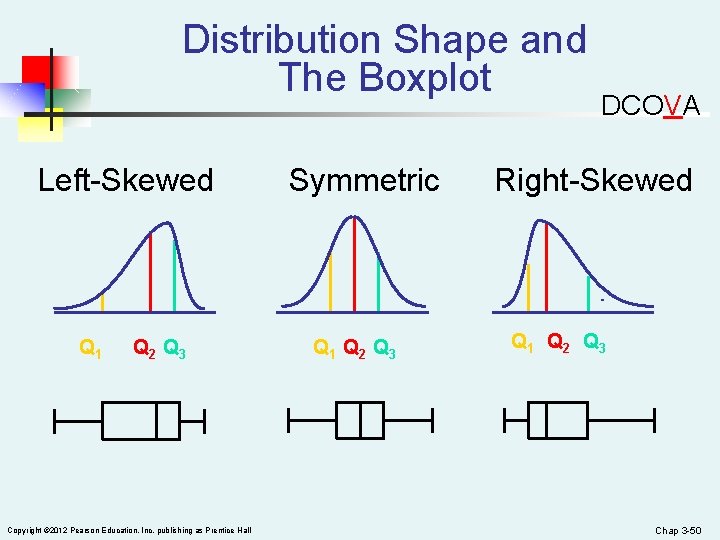
Distribution Shape and The Boxplot Left-Skewed Q 1 Q 2 Q 3 Copyright © 2012 Pearson Education, Inc. publishing as Prentice Hall Symmetric Q 1 Q 2 Q 3 DCOVA Right-Skewed Q 1 Q 2 Q 3 Chap 3 -50
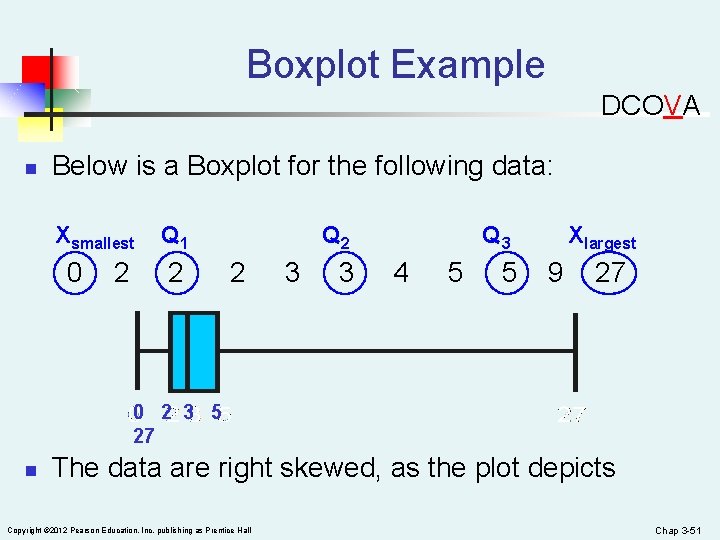
Boxplot Example DCOVA n Below is a Boxplot for the following data: Xsmallest 0 2 Q 1 2 Q 2 2 3 3 Q 3 4 5 5 Xlargest 9 27 0 2 3 5 27 n The data are right skewed, as the plot depicts Copyright © 2012 Pearson Education, Inc. publishing as Prentice Hall Chap 3 -51
Numerical Descriptive Measures for a Population § § § DCOVA Descriptive statistics discussed previously described a sample, not the population. Summary measures describing a population, called parameters, are denoted with Greek letters. Important population parameters are the population mean, variance, and standard deviation. Copyright © 2012 Pearson Education, Inc. publishing as Prentice Hall Chap 3 -52
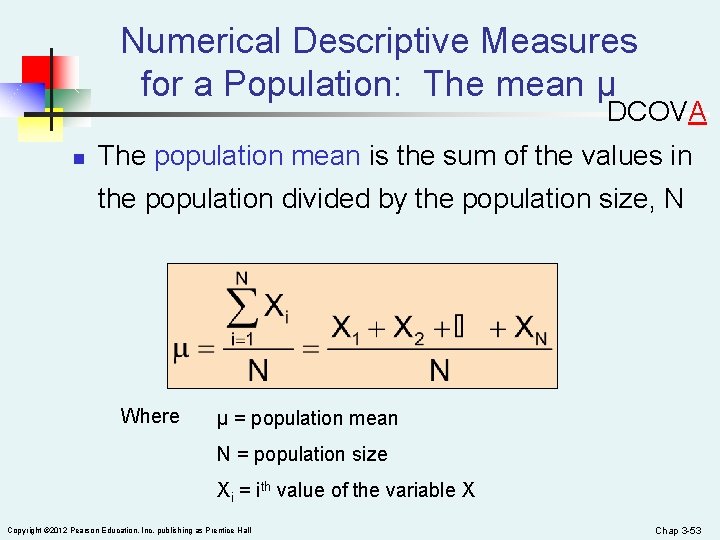
Numerical Descriptive Measures for a Population: The mean µ DCOVA n The population mean is the sum of the values in the population divided by the population size, N Where μ = population mean N = population size Xi = ith value of the variable X Copyright © 2012 Pearson Education, Inc. publishing as Prentice Hall Chap 3 -53
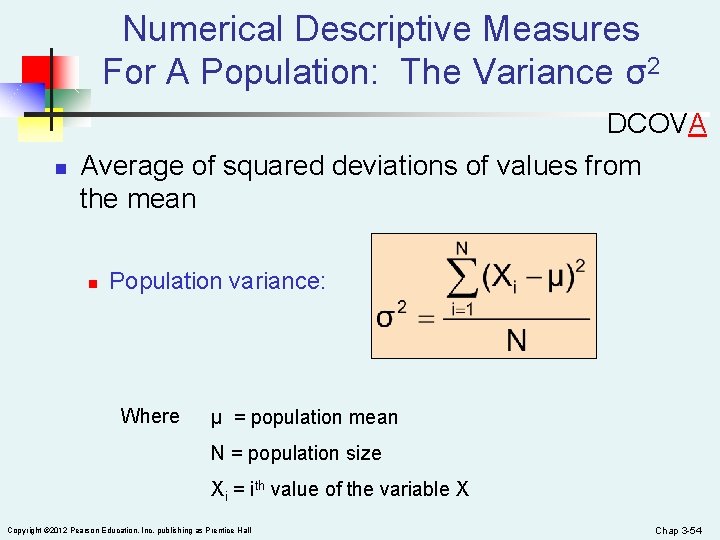
Numerical Descriptive Measures For A Population: The Variance σ2 n DCOVA Average of squared deviations of values from the mean n Population variance: Where μ = population mean N = population size Xi = ith value of the variable X Copyright © 2012 Pearson Education, Inc. publishing as Prentice Hall Chap 3 -54
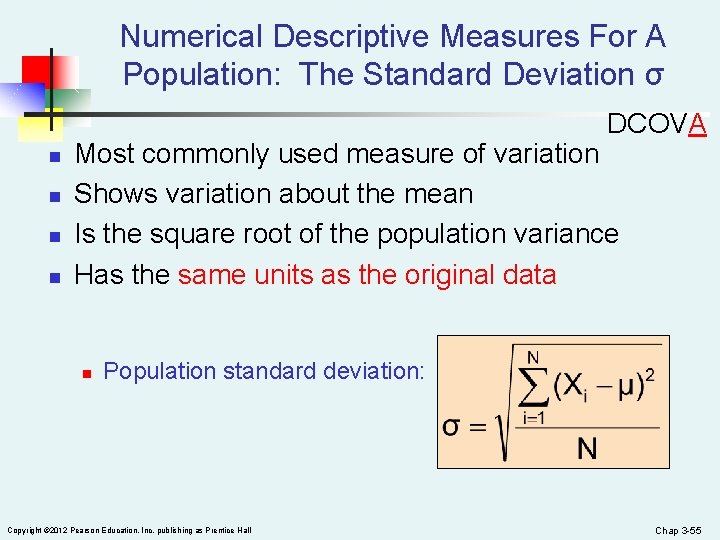
Numerical Descriptive Measures For A Population: The Standard Deviation σ DCOVA n n Most commonly used measure of variation Shows variation about the mean Is the square root of the population variance Has the same units as the original data n Population standard deviation: Copyright © 2012 Pearson Education, Inc. publishing as Prentice Hall Chap 3 -55
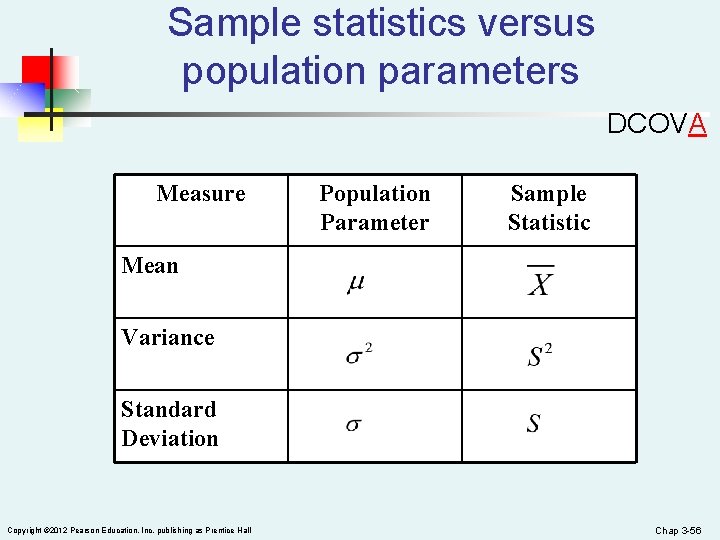
Sample statistics versus population parameters DCOVA Measure Population Parameter Sample Statistic Mean Variance Standard Deviation Copyright © 2012 Pearson Education, Inc. publishing as Prentice Hall Chap 3 -56
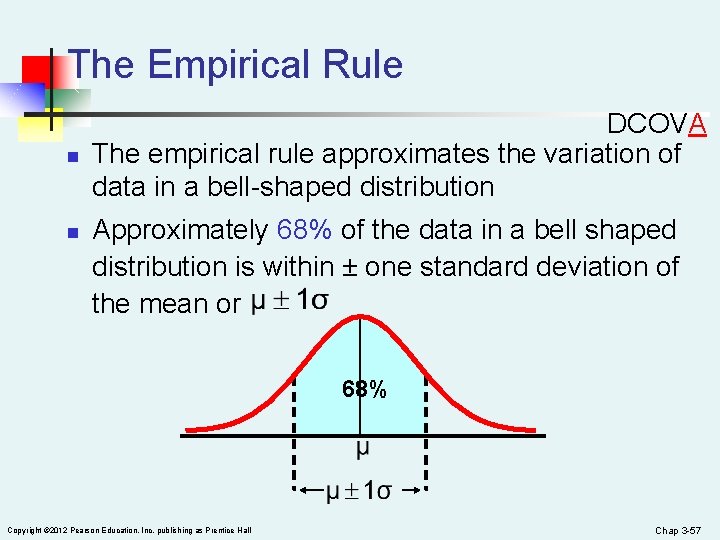
The Empirical Rule n n DCOVA The empirical rule approximates the variation of data in a bell-shaped distribution Approximately 68% of the data in a bell shaped distribution is within ± one standard deviation of the mean or 68% Copyright © 2012 Pearson Education, Inc. publishing as Prentice Hall Chap 3 -57
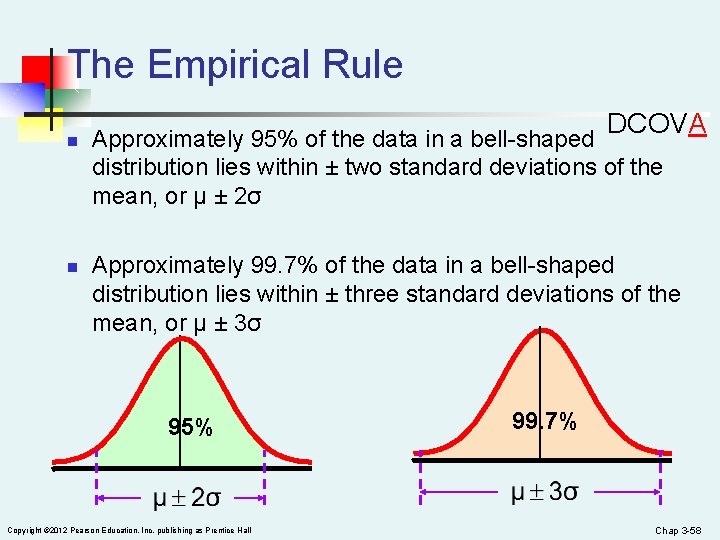
The Empirical Rule n n DCOVA Approximately 95% of the data in a bell-shaped distribution lies within ± two standard deviations of the mean, or µ ± 2σ Approximately 99. 7% of the data in a bell-shaped distribution lies within ± three standard deviations of the mean, or µ ± 3σ 95% Copyright © 2012 Pearson Education, Inc. publishing as Prentice Hall 99. 7% Chap 3 -58
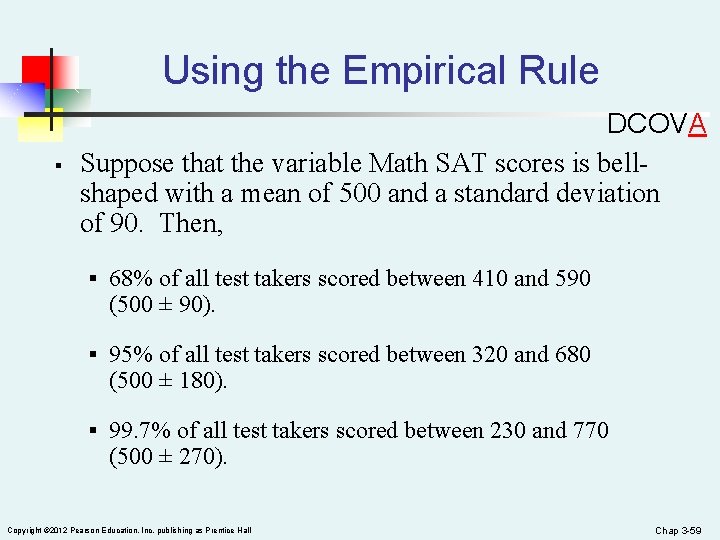
Using the Empirical Rule § DCOVA Suppose that the variable Math SAT scores is bellshaped with a mean of 500 and a standard deviation of 90. Then, § 68% of all test takers scored between 410 and 590 (500 ± 90). § 95% of all test takers scored between 320 and 680 (500 ± 180). § 99. 7% of all test takers scored between 230 and 770 (500 ± 270). Copyright © 2012 Pearson Education, Inc. publishing as Prentice Hall Chap 3 -59
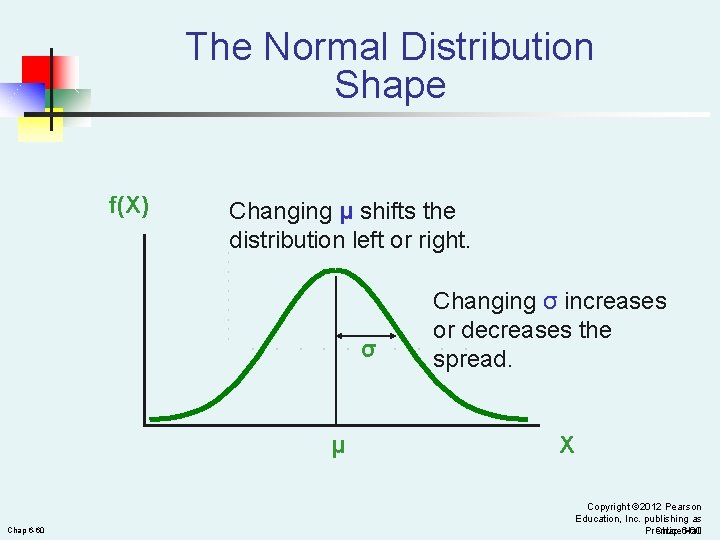
The Normal Distribution Shape f(X) Changing μ shifts the distribution left or right. σ μ Chap 6 -60 Changing σ increases or decreases the spread. X Copyright © 2012 Pearson Education, Inc. publishing as Chap 6 -60 Prentice Hall
The Standardized Normal n n n Chap 6 -61 Any normal distribution (with any mean and standard deviation combination) can be transformed into the standardized normal distribution (Z) Need to transform X units into Z units The standardized normal distribution (Z) has a mean of 0 and a standard deviation of 1 Copyright © 2012 Pearson Education, Inc. publishing as Chap 6 -61 Prentice Hall
Locating Extreme Outliers: Z-Score DCOVA § § To compute the Z-score of a data value, subtract the mean and divide by the standard deviation. The Z-score is the number of standard deviations a data value is from the mean. A data value is considered an extreme outlier if its Zscore is less than -3. 0 or greater than +3. 0. The larger the absolute value of the Z-score, the farther the data value is from the mean. Copyright © 2012 Pearson Education, Inc. publishing as Prentice Hall Chap 3 -62
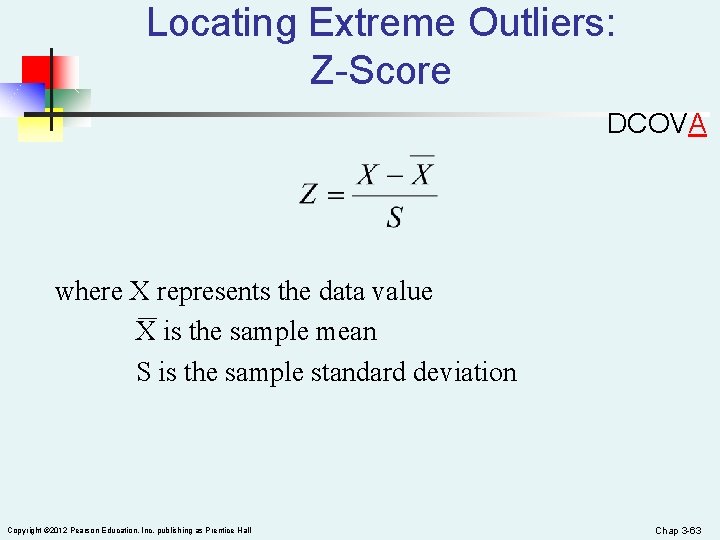
Locating Extreme Outliers: Z-Score DCOVA where X represents the data value X is the sample mean S is the sample standard deviation Copyright © 2012 Pearson Education, Inc. publishing as Prentice Hall Chap 3 -63
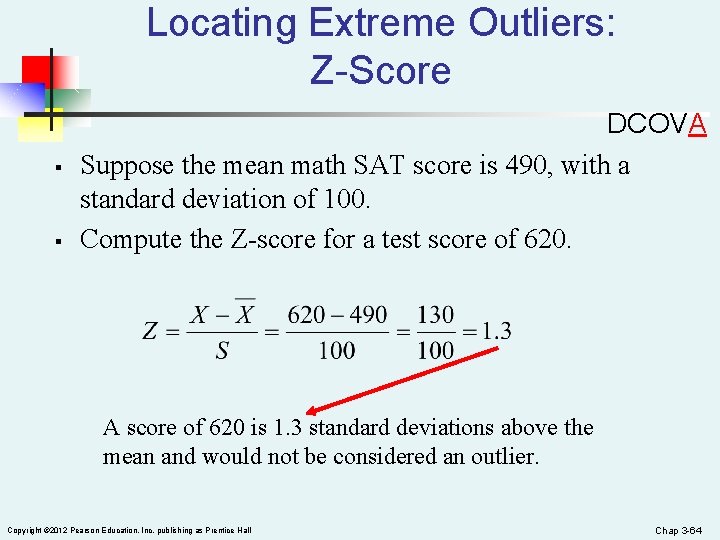
Locating Extreme Outliers: Z-Score § § DCOVA Suppose the mean math SAT score is 490, with a standard deviation of 100. Compute the Z-score for a test score of 620. A score of 620 is 1. 3 standard deviations above the mean and would not be considered an outlier. Copyright © 2012 Pearson Education, Inc. publishing as Prentice Hall Chap 3 -64
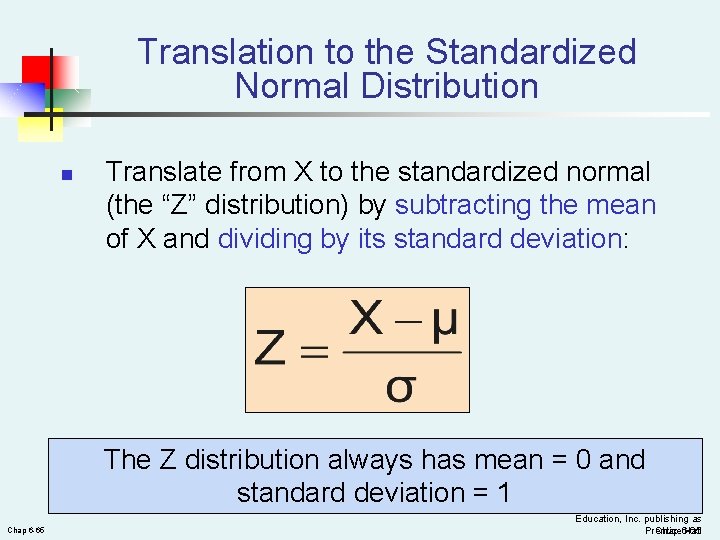
Translation to the Standardized Normal Distribution n Translate from X to the standardized normal (the “Z” distribution) by subtracting the mean of X and dividing by its standard deviation: The Z distribution always has mean = 0 and standard deviation = 1 Chap 6 -65 Copyright © 2012 Pearson Education, Inc. publishing as Chap 6 -65 Prentice Hall
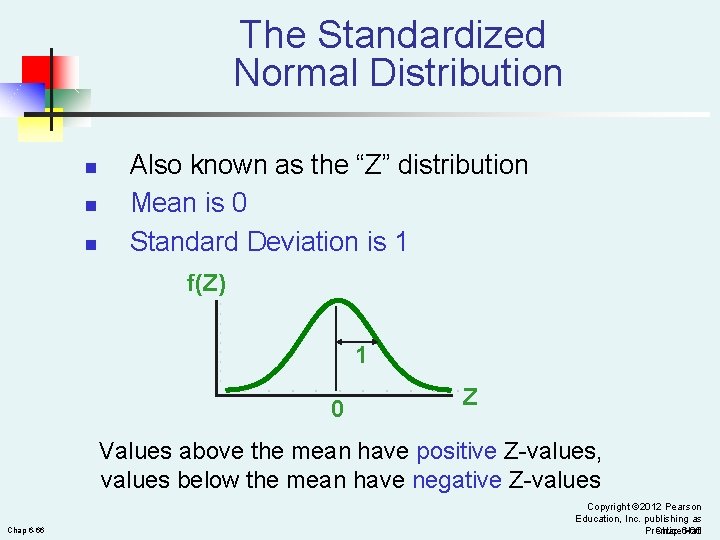
The Standardized Normal Distribution n Also known as the “Z” distribution Mean is 0 Standard Deviation is 1 f(Z) 1 0 Z Values above the mean have positive Z-values, values below the mean have negative Z-values Chap 6 -66 Copyright © 2012 Pearson Education, Inc. publishing as Chap 6 -66 Prentice Hall
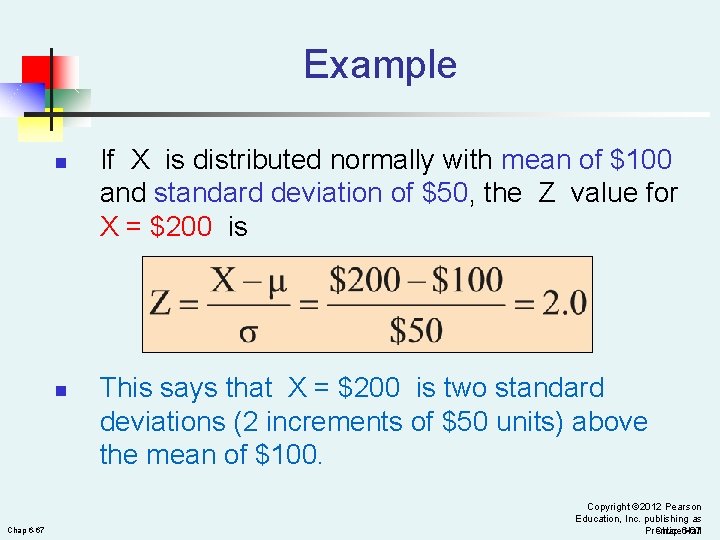
Example n n Chap 6 -67 If X is distributed normally with mean of $100 and standard deviation of $50, the Z value for X = $200 is This says that X = $200 is two standard deviations (2 increments of $50 units) above the mean of $100. Copyright © 2012 Pearson Education, Inc. publishing as Chap 6 -67 Prentice Hall
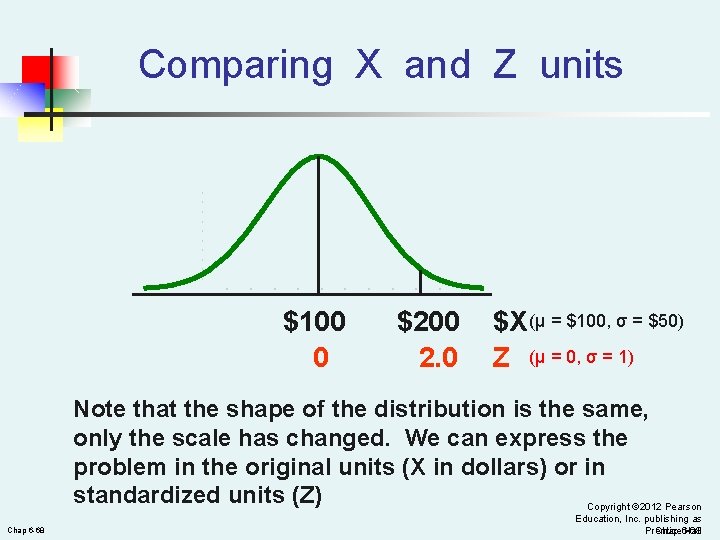
Comparing X and Z units $100 0 $200 2. 0 $X (μ = $100, σ = $50) Z (μ = 0, σ = 1) Note that the shape of the distribution is the same, only the scale has changed. We can express the problem in the original units (X in dollars) or in standardized units (Z) Copyright © 2012 Pearson Chap 6 -68 Education, Inc. publishing as Chap 6 -68 Prentice Hall
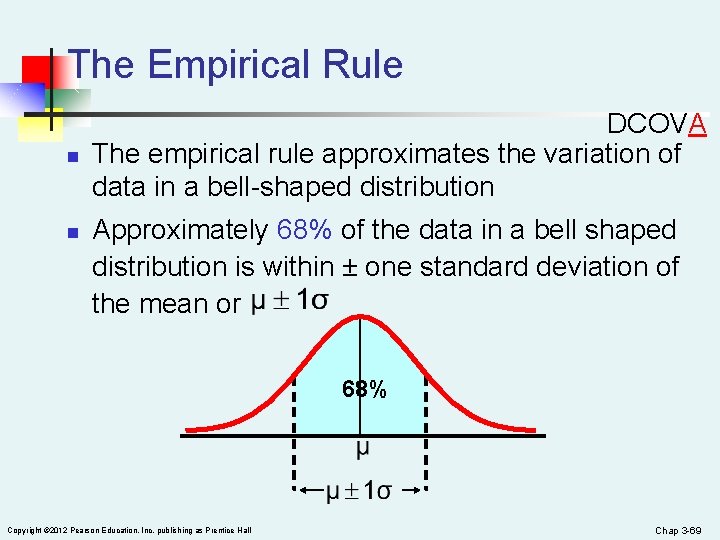
The Empirical Rule n n DCOVA The empirical rule approximates the variation of data in a bell-shaped distribution Approximately 68% of the data in a bell shaped distribution is within ± one standard deviation of the mean or 68% Copyright © 2012 Pearson Education, Inc. publishing as Prentice Hall Chap 3 -69
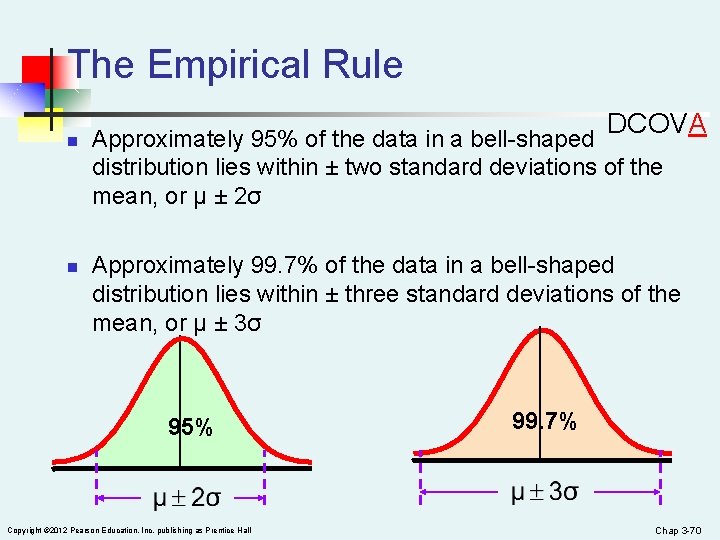
The Empirical Rule n n DCOVA Approximately 95% of the data in a bell-shaped distribution lies within ± two standard deviations of the mean, or µ ± 2σ Approximately 99. 7% of the data in a bell-shaped distribution lies within ± three standard deviations of the mean, or µ ± 3σ 95% Copyright © 2012 Pearson Education, Inc. publishing as Prentice Hall 99. 7% Chap 3 -70
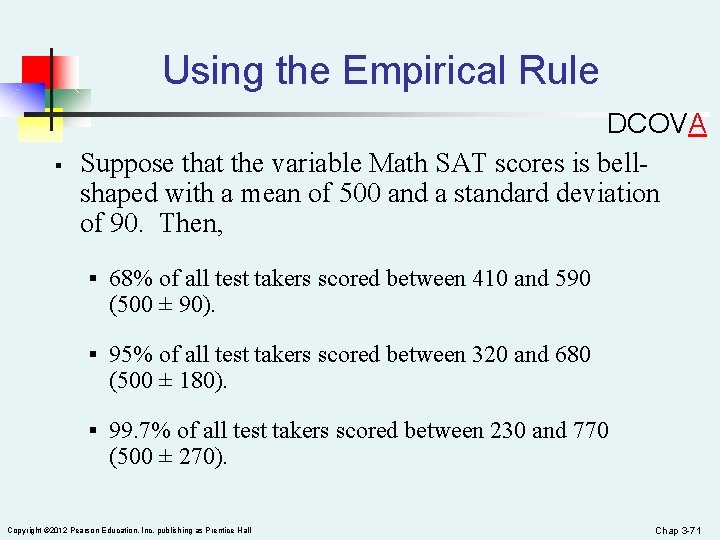
Using the Empirical Rule § DCOVA Suppose that the variable Math SAT scores is bellshaped with a mean of 500 and a standard deviation of 90. Then, § 68% of all test takers scored between 410 and 590 (500 ± 90). § 95% of all test takers scored between 320 and 680 (500 ± 180). § 99. 7% of all test takers scored between 230 and 770 (500 ± 270). Copyright © 2012 Pearson Education, Inc. publishing as Prentice Hall Chap 3 -71
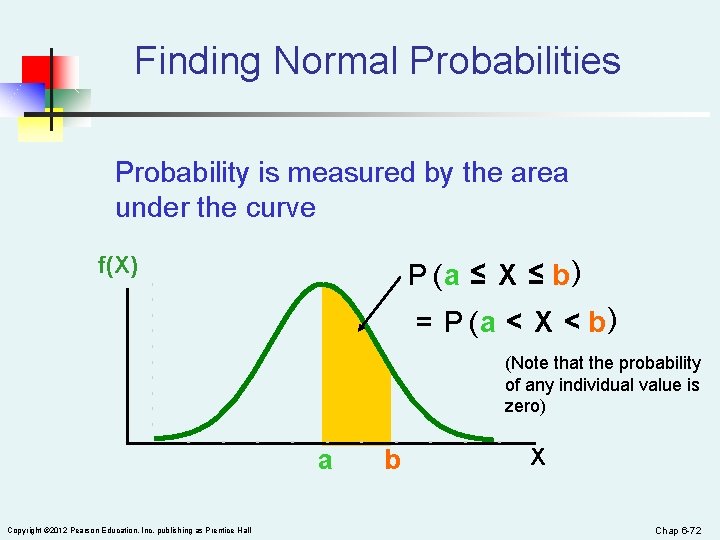
Finding Normal Probabilities Probability is measured by the area under the curve f(X) P (a ≤ X ≤ b) = P (a < X < b) (Note that the probability of any individual value is zero) a Copyright © 2012 Pearson Education, Inc. publishing as Prentice Hall b X Chap 6 -72
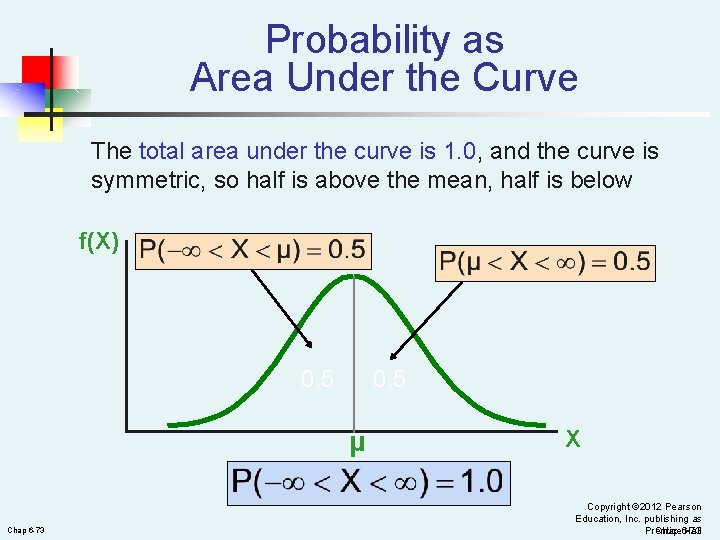
Probability as Area Under the Curve The total area under the curve is 1. 0, and the curve is symmetric, so half is above the mean, half is below f(X) 0. 5 μ Chap 6 -73 X Copyright © 2012 Pearson Education, Inc. publishing as Chap 6 -73 Prentice Hall
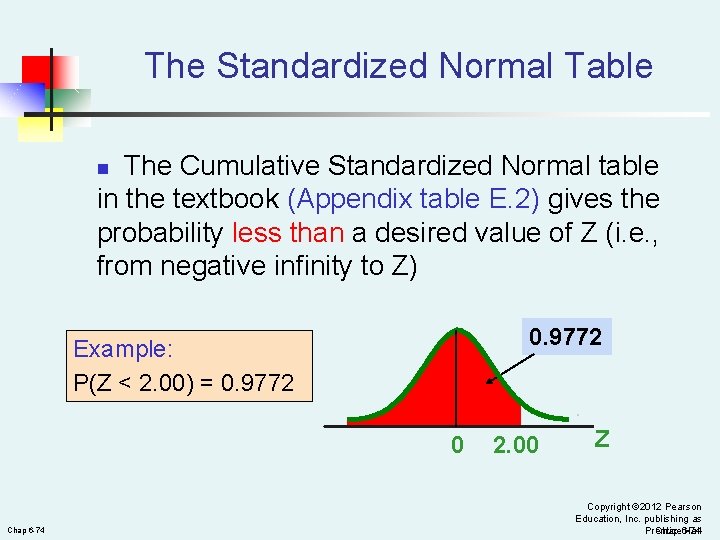
The Standardized Normal Table The Cumulative Standardized Normal table in the textbook (Appendix table E. 2) gives the probability less than a desired value of Z (i. e. , from negative infinity to Z) n 0. 9772 Example: P(Z < 2. 00) = 0. 9772 0 Chap 6 -74 2. 00 Z Copyright © 2012 Pearson Education, Inc. publishing as Chap 6 -74 Prentice Hall
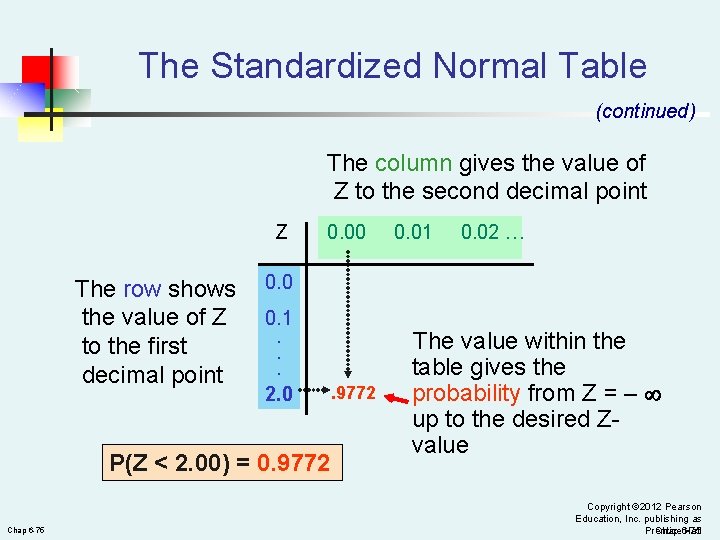
The Standardized Normal Table (continued) The column gives the value of Z to the second decimal point Z The row shows the value of Z to the first decimal point 0. 00 0. 02 … 0. 0 0. 1 . . . 2. 0 P(Z < 2. 00) = 0. 9772 Chap 6 -75 0. 01 . 9772 The value within the table gives the probability from Z = up to the desired Zvalue Copyright © 2012 Pearson Education, Inc. publishing as Chap 6 -75 Prentice Hall
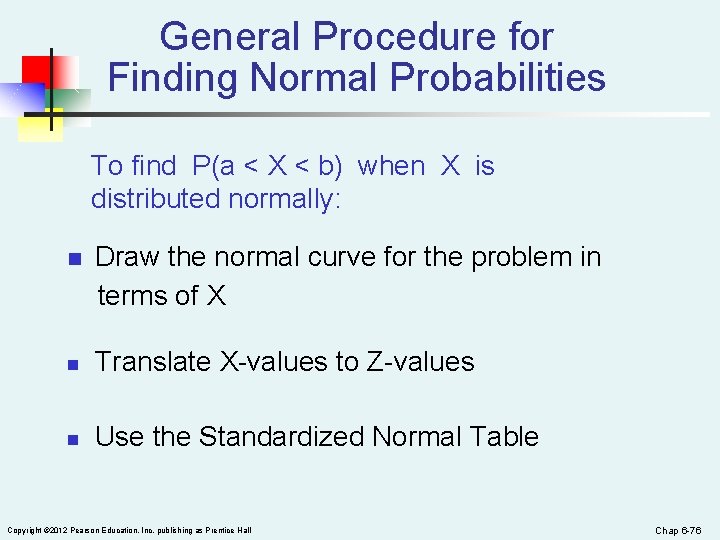
General Procedure for Finding Normal Probabilities To find P(a < X < b) when X is distributed normally: n Draw the normal curve for the problem in terms of X n Translate X-values to Z-values n Use the Standardized Normal Table Copyright © 2012 Pearson Education, Inc. publishing as Prentice Hall Chap 6 -76
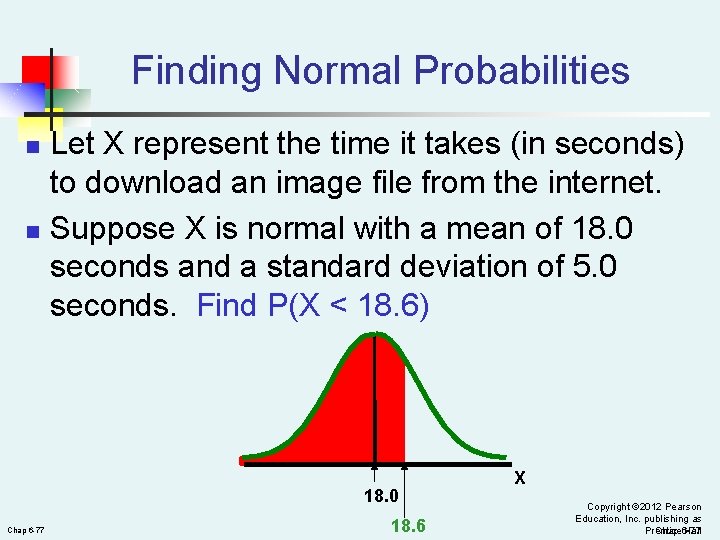
Finding Normal Probabilities n n Let X represent the time it takes (in seconds) to download an image file from the internet. Suppose X is normal with a mean of 18. 0 seconds and a standard deviation of 5. 0 seconds. Find P(X < 18. 6) 18. 0 Chap 6 -77 18. 6 X Copyright © 2012 Pearson Education, Inc. publishing as Chap 6 -77 Prentice Hall
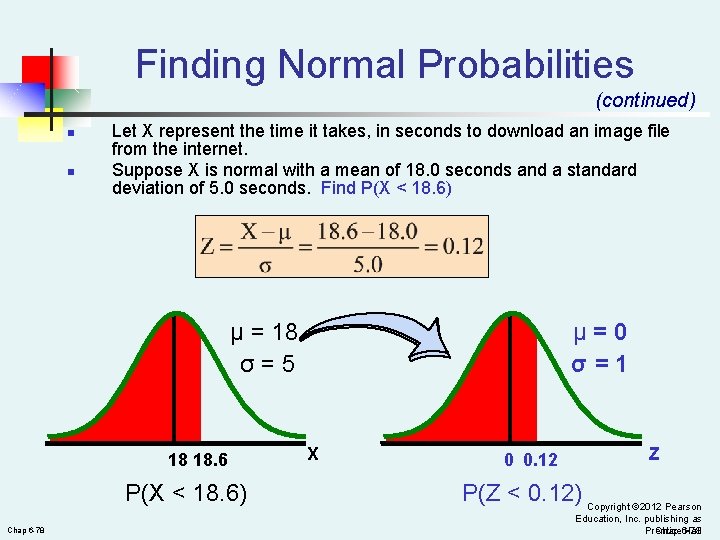
Finding Normal Probabilities (continued) n n Let X represent the time it takes, in seconds to download an image file from the internet. Suppose X is normal with a mean of 18. 0 seconds and a standard deviation of 5. 0 seconds. Find P(X < 18. 6) μ = 18 σ=5 18 18. 6 P(X < 18. 6) Chap 6 -78 μ=0 σ=1 X 0 0. 12 Z P(Z < 0. 12) Copyright © 2012 Pearson Education, Inc. publishing as Chap 6 -78 Prentice Hall
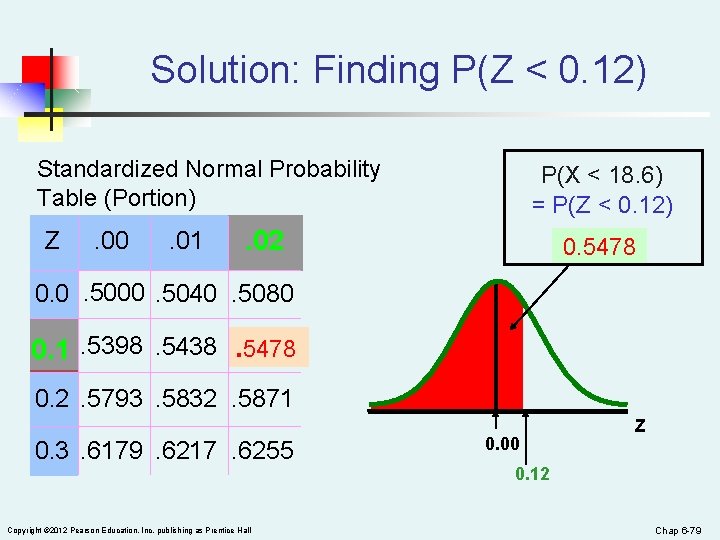
Solution: Finding P(Z < 0. 12) Standardized Normal Probability Table (Portion) Z . 00 . 01 P(X < 18. 6) = P(Z < 0. 12) . 02 0. 5478 0. 0. 5000. 5040. 5080 0. 1. 5398. 5438. 5478 0. 2. 5793. 5832. 5871 0. 3. 6179. 6217. 6255 Copyright © 2012 Pearson Education, Inc. publishing as Prentice Hall 0. 00 Z 0. 12 Chap 6 -79
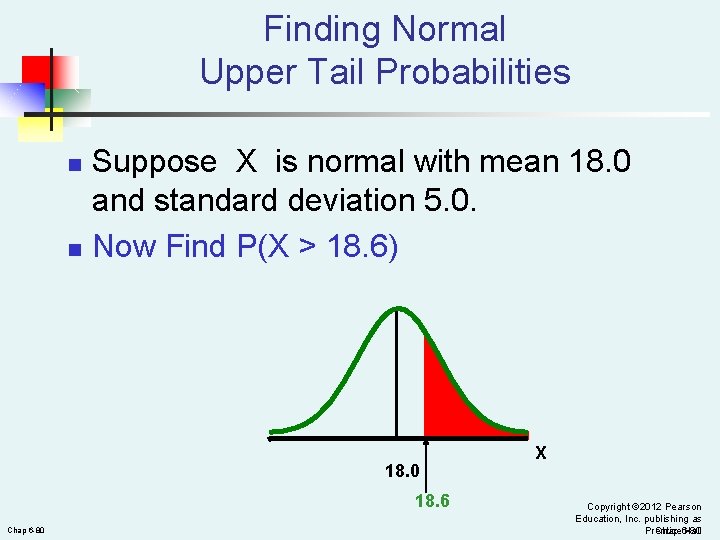
Finding Normal Upper Tail Probabilities n n Suppose X is normal with mean 18. 0 and standard deviation 5. 0. Now Find P(X > 18. 6) 18. 0 18. 6 Chap 6 -80 X Copyright © 2012 Pearson Education, Inc. publishing as Chap 6 -80 Prentice Hall
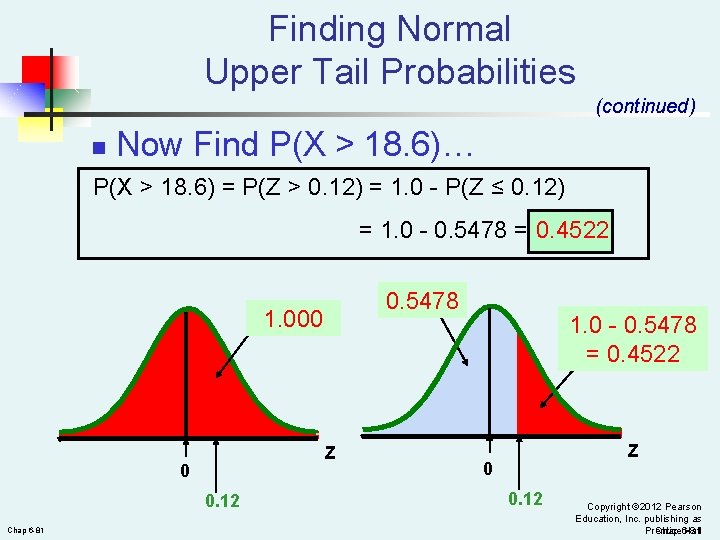
Finding Normal Upper Tail Probabilities (continued) n Now Find P(X > 18. 6)… P(X > 18. 6) = P(Z > 0. 12) = 1. 0 - P(Z ≤ 0. 12) = 1. 0 - 0. 5478 = 0. 4522 0. 5478 1. 000 Z 0 0. 12 Chap 6 -81 1. 0 - 0. 5478 = 0. 4522 Z 0 0. 12 Copyright © 2012 Pearson Education, Inc. publishing as Chap 6 -81 Prentice Hall
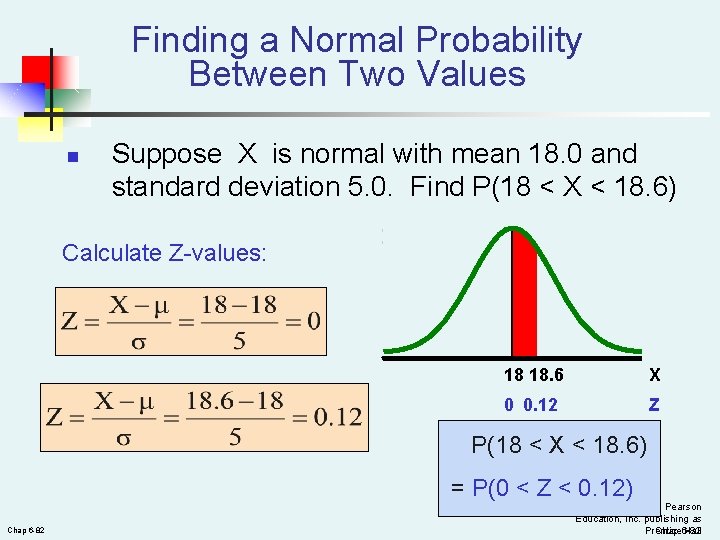
Finding a Normal Probability Between Two Values n Suppose X is normal with mean 18. 0 and standard deviation 5. 0. Find P(18 < X < 18. 6) Calculate Z-values: 18 18. 6 X 0 0. 12 Z P(18 < X < 18. 6) = P(0 < Z < 0. 12) Chap 6 -82 Copyright © 2012 Pearson Education, Inc. publishing as Chap 6 -82 Prentice Hall
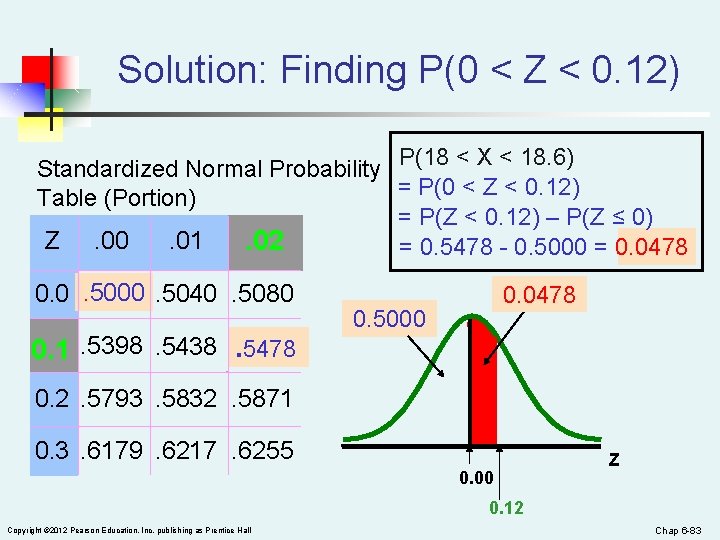
Solution: Finding P(0 < Z < 0. 12) Standardized Normal Probability P(18 < X < 18. 6) = P(0 < Z < 0. 12) Table (Portion) = P(Z < 0. 12) – P(Z ≤ 0) Z. 00. 01. 02 = 0. 5478 - 0. 5000 = 0. 0478 0. 0. 5000. 5040. 5080 0. 1. 5398. 5438. 5478 0. 0478 0. 5000 0. 2. 5793. 5832. 5871 0. 3. 6179. 6217. 6255 0. 00 Z 0. 12 Copyright © 2012 Pearson Education, Inc. publishing as Prentice Hall Chap 6 -83
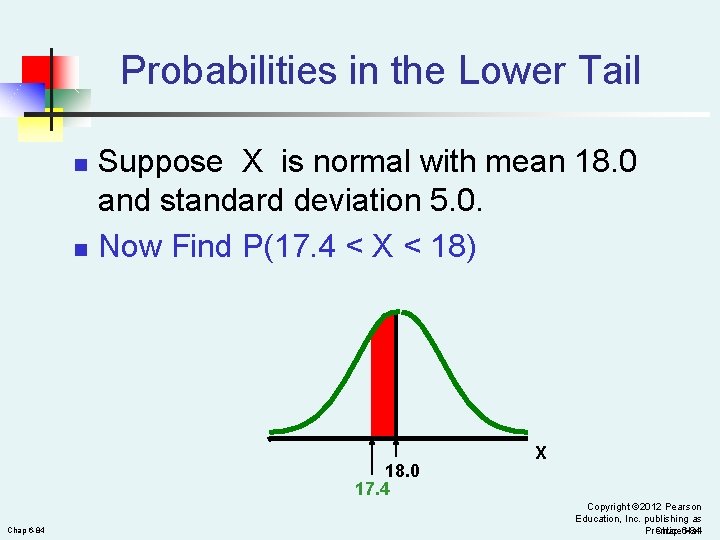
Probabilities in the Lower Tail n n Suppose X is normal with mean 18. 0 and standard deviation 5. 0. Now Find P(17. 4 < X < 18) 18. 0 17. 4 Chap 6 -84 X Copyright © 2012 Pearson Education, Inc. publishing as Chap 6 -84 Prentice Hall
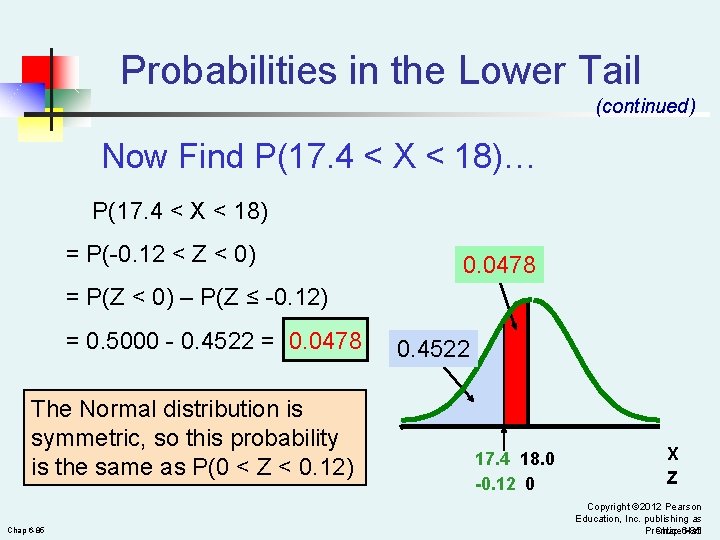
Probabilities in the Lower Tail (continued) Now Find P(17. 4 < X < 18)… P(17. 4 < X < 18) = P(-0. 12 < Z < 0) 0. 0478 = P(Z < 0) – P(Z ≤ -0. 12) = 0. 5000 - 0. 4522 = 0. 0478 The Normal distribution is symmetric, so this probability is the same as P(0 < Z < 0. 12) Chap 6 -85 0. 4522 17. 4 18. 0 -0. 12 0 X Z Copyright © 2012 Pearson Education, Inc. publishing as Chap 6 -85 Prentice Hall
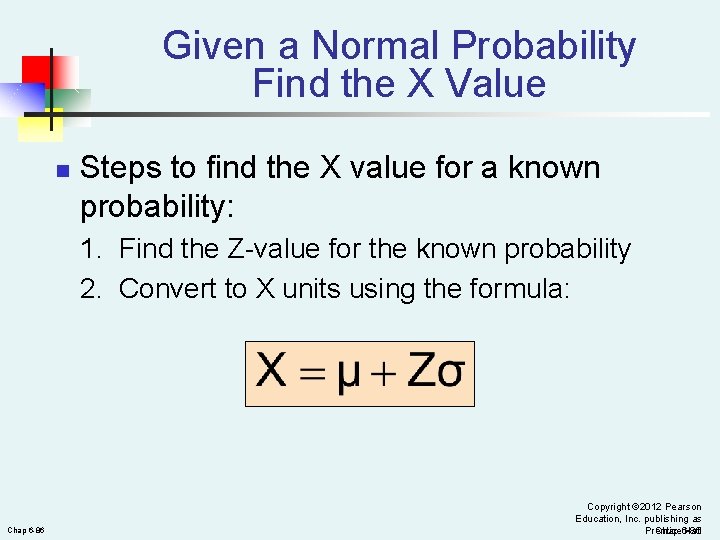
Given a Normal Probability Find the X Value n Steps to find the X value for a known probability: 1. Find the Z-value for the known probability 2. Convert to X units using the formula: Chap 6 -86 Copyright © 2012 Pearson Education, Inc. publishing as Chap 6 -86 Prentice Hall
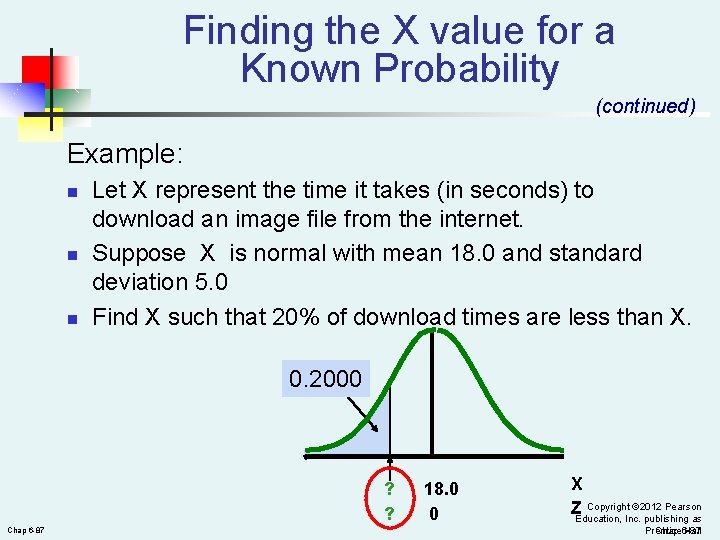
Finding the X value for a Known Probability (continued) Example: n n n Let X represent the time it takes (in seconds) to download an image file from the internet. Suppose X is normal with mean 18. 0 and standard deviation 5. 0 Find X such that 20% of download times are less than X. 0. 2000 ? ? Chap 6 -87 18. 0 0 X Copyright © 2012 Pearson ZEducation, Inc. publishing as Chap 6 -87 Prentice Hall
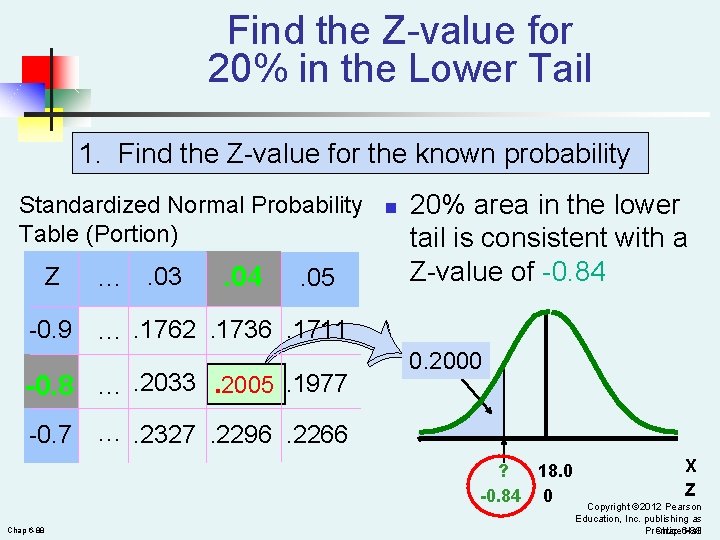
Find the Z-value for 20% in the Lower Tail 1. Find the Z-value for the known probability Standardized Normal Probability Table (Portion) Z -0. 9 … . 03 . 04 . 05 20% area in the lower tail is consistent with a Z-value of -0. 84 …. 1762. 1736. 1711 -0. 8 …. 2033. 2005. 1977 -0. 7 n 0. 2000 …. 2327. 2296. 2266 ? 18. 0 -0. 84 0 Chap 6 -88 X Z Copyright © 2012 Pearson Education, Inc. publishing as Chap 6 -88 Prentice Hall
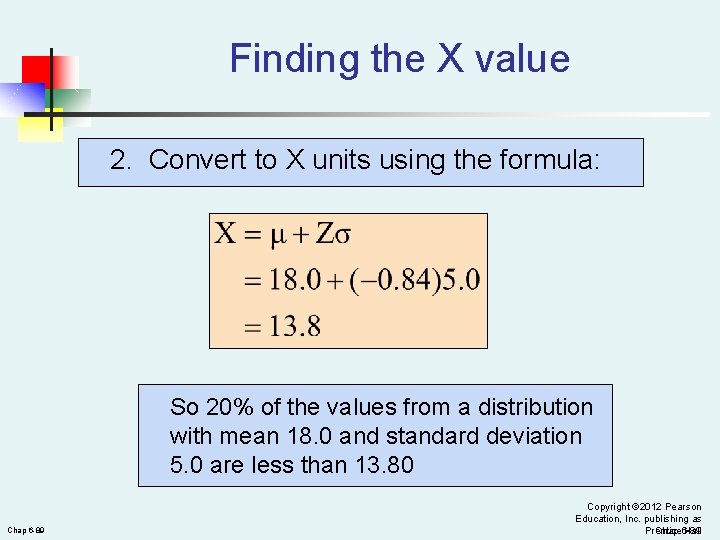
Finding the X value 2. Convert to X units using the formula: So 20% of the values from a distribution with mean 18. 0 and standard deviation 5. 0 are less than 13. 80 Chap 6 -89 Copyright © 2012 Pearson Education, Inc. publishing as Chap 6 -89 Prentice Hall
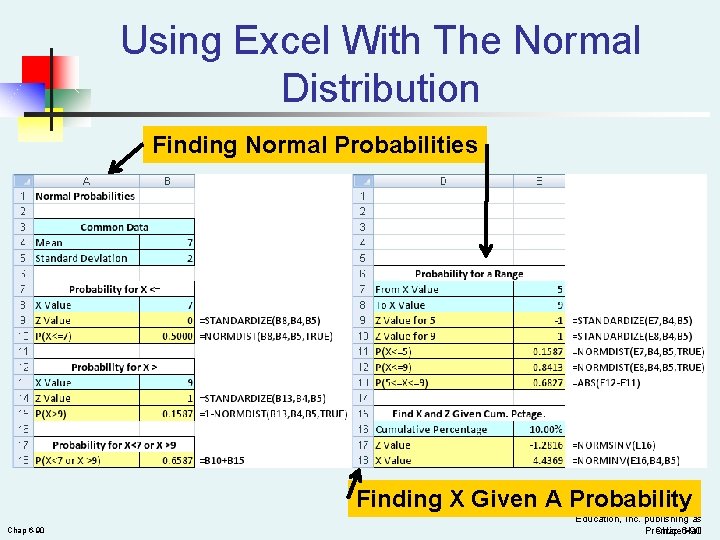
Using Excel With The Normal Distribution Finding Normal Probabilities Finding X Given A Probability Copyright © 2012 Pearson Chap 6 -90 Education, Inc. publishing as Chap 6 -90 Prentice Hall
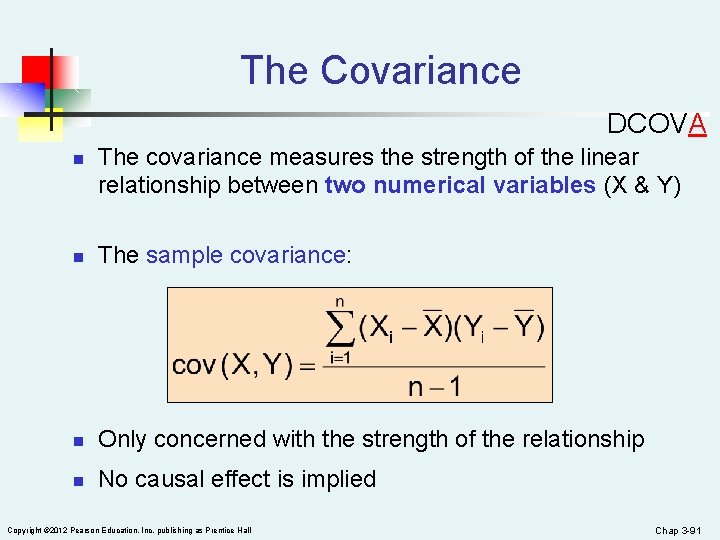
The Covariance DCOVA n The covariance measures the strength of the linear relationship between two numerical variables (X & Y) n The sample covariance: n Only concerned with the strength of the relationship n No causal effect is implied Copyright © 2012 Pearson Education, Inc. publishing as Prentice Hall Chap 3 -91
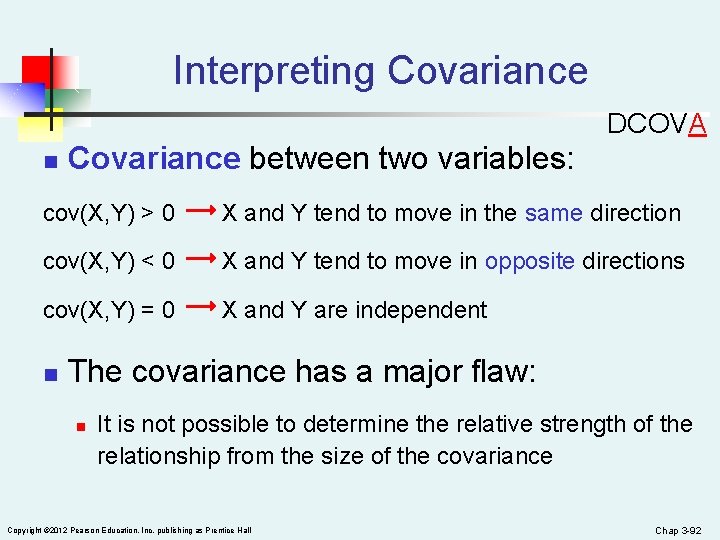
Interpreting Covariance DCOVA n Covariance between two variables: cov(X, Y) > 0 X and Y tend to move in the same direction cov(X, Y) < 0 X and Y tend to move in opposite directions cov(X, Y) = 0 X and Y are independent n The covariance has a major flaw: n It is not possible to determine the relative strength of the relationship from the size of the covariance Copyright © 2012 Pearson Education, Inc. publishing as Prentice Hall Chap 3 -92
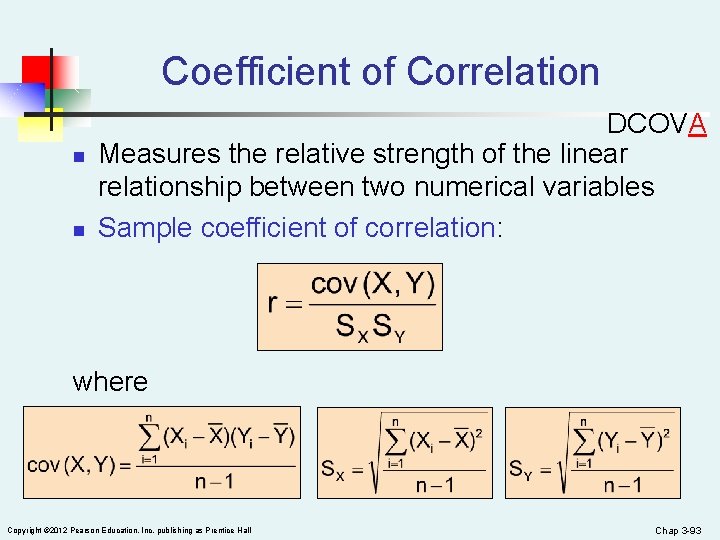
Coefficient of Correlation n n DCOVA Measures the relative strength of the linear relationship between two numerical variables Sample coefficient of correlation: where Copyright © 2012 Pearson Education, Inc. publishing as Prentice Hall Chap 3 -93
Features of the Coefficient of Correlation DCOVA n The population coefficient of correlation is referred as ρ. n The sample coefficient of correlation is referred to as r. n Either ρ or r have the following features: n Unit free n Ranges between – 1 and 1 n The closer to – 1, the stronger the negative linear relationship n The closer to 1, the stronger the positive linear relationship n The closer to 0, the weaker the linear relationship Copyright © 2012 Pearson Education, Inc. publishing as Prentice Hall Chap 3 -94
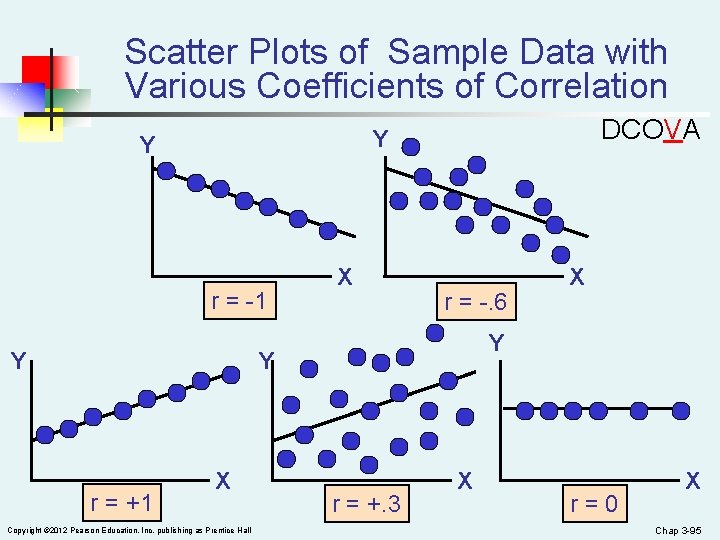
Scatter Plots of Sample Data with Various Coefficients of Correlation DCOVA Y Y r = -1 Y X r = -. 6 Y Y r = +1 X Copyright © 2012 Pearson Education, Inc. publishing as Prentice Hall X r = +. 3 X r=0 X Chap 3 -95
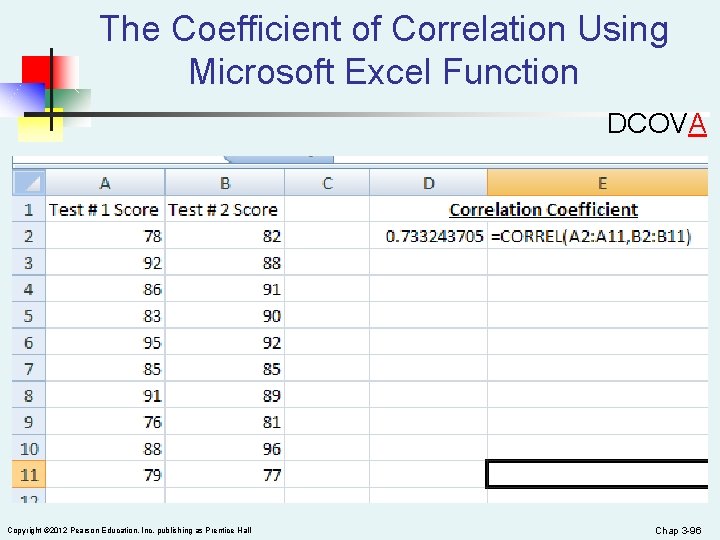
The Coefficient of Correlation Using Microsoft Excel Function DCOVA Copyright © 2012 Pearson Education, Inc. publishing as Prentice Hall Chap 3 -96
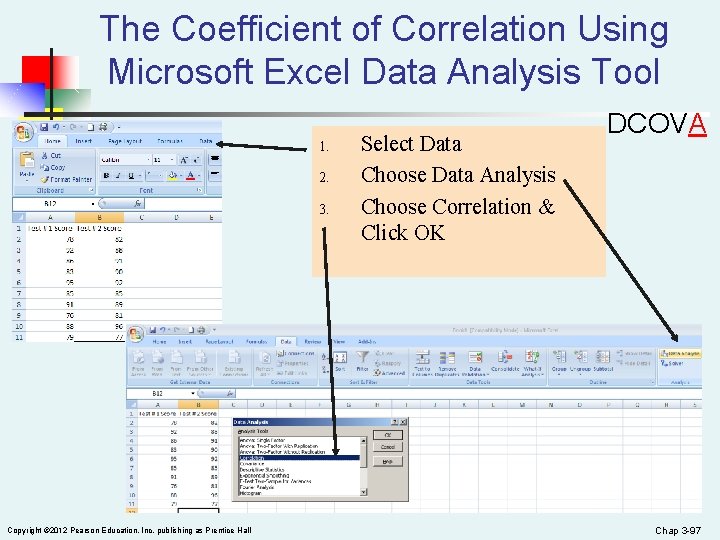
The Coefficient of Correlation Using Microsoft Excel Data Analysis Tool 1. 2. 3. Copyright © 2012 Pearson Education, Inc. publishing as Prentice Hall Select Data Choose Data Analysis Choose Correlation & Click OK DCOVA Chap 3 -97
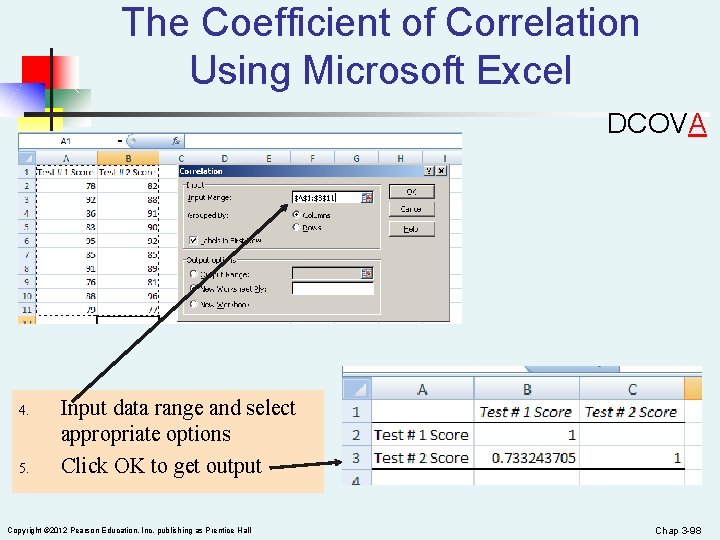
The Coefficient of Correlation Using Microsoft Excel DCOVA 4. 5. Input data range and select appropriate options Click OK to get output Copyright © 2012 Pearson Education, Inc. publishing as Prentice Hall Chap 3 -98
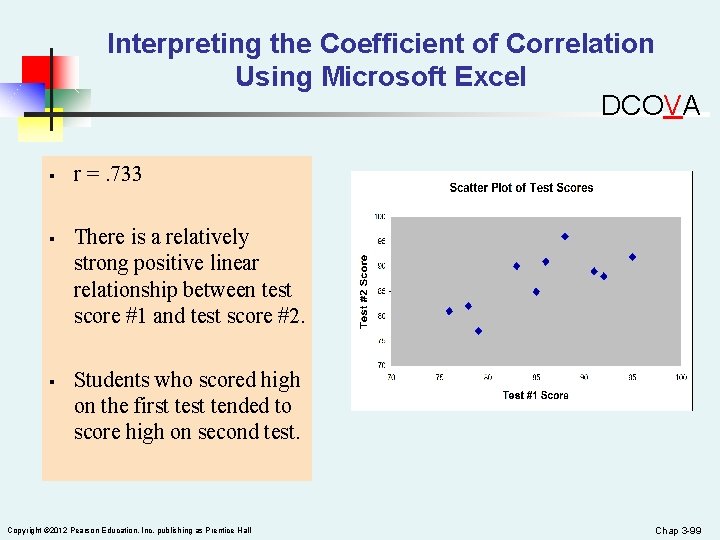
Interpreting the Coefficient of Correlation Using Microsoft Excel DCOVA § § § r =. 733 There is a relatively strong positive linear relationship between test score #1 and test score #2. Students who scored high on the first tended to score high on second test. Copyright © 2012 Pearson Education, Inc. publishing as Prentice Hall Chap 3 -99
- Slides: 99