
Business Analysis Business Analysis Concepts Enterprise Analysis Identify

Business Analysis
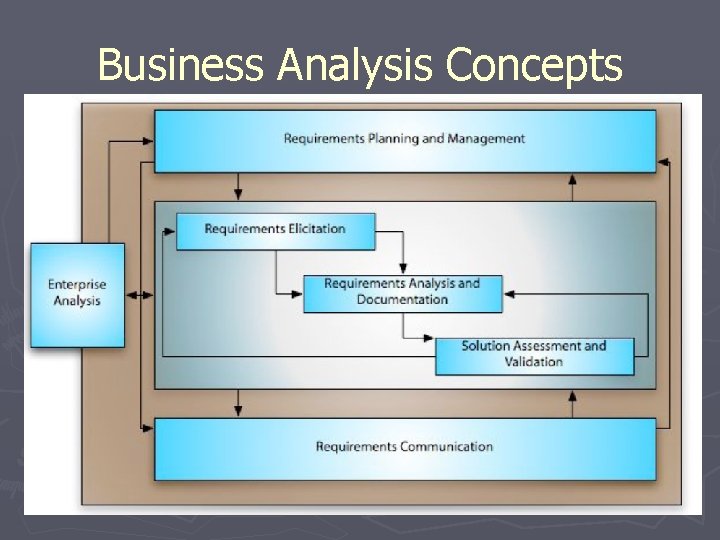
Business Analysis Concepts
Enterprise Analysis ► Identify business opportunities ► Understand the business strategy ► Identify Business Value models in terms of the organization ► Select projects based on strategic alignment
Strategic Plan Development ► Tasks § Conduct competitive analysis and benchmark studies that serve as input to the strategic planning process § Help plan and facilitate strategic planning sessions. ► Deliverables § Strategic Plan Document
Strategic Goal Development ► Tasks § Facilitate strategic goal setting sessions. ► Deliverable § Strategic Goals, Themes and Measures
Business Architecture Development ► Tasks § Using information from the strategic plan and goals, the Business Architecture is developed/maintained. ► Deliverable § Business architecture document
Feasibility Study Report ► Tasks § Collaborate with subject matter experts and facilitates the team to: Identify solution options ► Examine the feasibility of each option ► Determine the most viable option ► ► Deliverables § Feasibility Study Report
Business Case Development ► Tasks § Collaborate with subject matter experts and management to: Scope the proposed project ► Make time and cost estimates ► Quantify business benefits ► Prepare the business case. ► ► Deliverables § Business Case Document
New Project Proposal ► Tasks § ► The BA collects the relevant information about the proposed new project and provides the executive presentation and decision package to the business sponsor to propose a new project to the organizational project investment governance body. Deliverables § Executive Presentation
Requirements Planning & Management ► ► Ensure all stakeholders are represented during requirements gathering Ensure common understanding and coordination of efforts and activities in the project BA team effectively monitors and responds to challenges and slippage Changes are captured correctly and consistently
Team Role Management ► Tasks § Identify and document team roles § Identify and document team stakeholders § Divide work among team members
Define Requirements Risks ► Tasks § Identify Requirements Risks § Define Requirements Risk mitigation approach § Define Requirements Risk management approach
Define Requirements Activities ► Tasks § § Determine Requirements Elicitation Activities Determine Requirements Documentation Activities Determine Requirements Communication Activities Determine Requirements Implementation Activities
Estimate Work ► Tasks § § § Identify milestones Define units of work Estimate effort per unit of work Estimate duration per unit of work Define assumptions Identify risks
Track Requirements Activities ► Tasks § Determine the project/product metrics § Collect project/product metrics § Report project/product metrics
Manage Requirements Change ► Tasks § § Plan Requirements Change Understand changes to requirement Document the changes to requirements Analyze chage requests
Requirements Elicitation ► Tasks § Capture detailed requirements from stakeholders § Ensure the requirements have the following properties Accurate ► Detailed ► Complete ► Non-conflicting ►
Skills ► ► ► ► Eliciting and accessing information Interviewing Facilitating collaborative sessions Observation Resolving conflicts, achieving consensus Thinking abstractly Writing business documentation Listening and oral communication
Techniques ► ► ► ► ► Brainstorming Document Analysis Focus Group Interface Analysis Interview Observation Prototyping Requirements Workshop Survey/Questionnaire
Requirements Analysis and Documentation ► Analyzes raw data captured from the elicitation process. ► Objective § ► Develop analysis models to determine gaps in the information provided by stakeholder. Document this information in a manner that is clear to the design team Deliverables § Requirements documents that will be used by the project team to develop estimates for the time, resources, and budget required to implement the project.
Tasks ► ► ► ► ► Structure requirements Create business domain model Analyze user requirements Analyze functional requirements Analyze supplementary quality of service requirements Determine assumptions and constraints Determine requirements attributes Document requirements Validate requirements Verify requirements
Tasks ► Structure requirements § Split the requirements into appropriate groups ► Create business domain model § Create the as-is and to-be models ► Analyze user requirements § Review requirements to ensure the needs of each stakeholder is met ► Analyze functional requirements § Review for gaps, errors and inconsistencies
Tasks ► Analyze supplementary and quality of service requirements § Review SLAs to ensure they are viable ► ► ► ► ► Environmental Requirements § § § Audit Localization/Globalization Legal/Regulatory § § Hardware Software § § § Failure & Disaster Recovery Maintainability Scalability Interface Requirements Operational Performance Privacy Quality Safety Security Training
Tasks ► Determine assumptions and constraints § Identify aspects of the problem domain that will limit or impact the design of the solution. ► ► ► Business constraints Technical constraints Determine requirements attributes § Detail requirements metadata § Create requirements documents to facilitate common understanding of solution Document requirements Validate requirements § Ensure that the stated requirements correctly and fully implement the solution
Tasks ► Verify requirements § Ensure that requirements are defined clearly enough to allow design and implementation ► ► ► ► Allocatable Attainable Complete Consistent Correct Detailed Feasible Measurable Testable Necessary Prioritized Traceable Unambiguous Understandable Verifiable
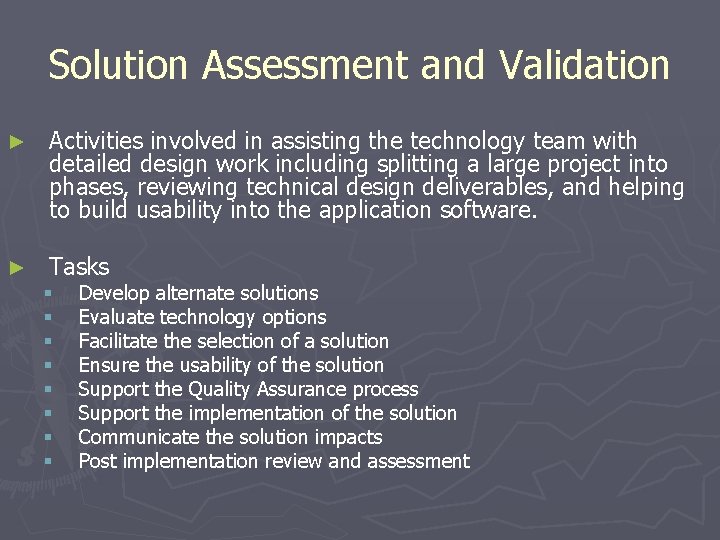
Solution Assessment and Validation ► Activities involved in assisting the technology team with detailed design work including splitting a large project into phases, reviewing technical design deliverables, and helping to build usability into the application software. ► Tasks § § § § Develop alternate solutions Evaluate technology options Facilitate the selection of a solution Ensure the usability of the solution Support the Quality Assurance process Support the implementation of the solution Communicate the solution impacts Post implementation review and assessment
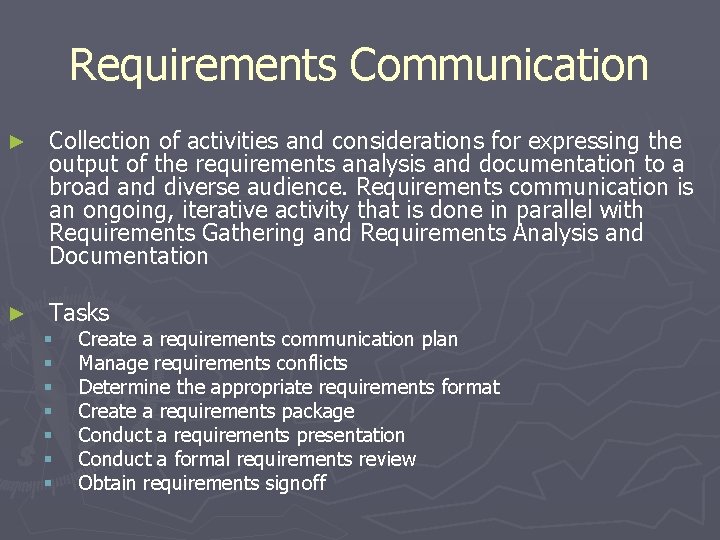
Requirements Communication ► Collection of activities and considerations for expressing the output of the requirements analysis and documentation to a broad and diverse audience. Requirements communication is an ongoing, iterative activity that is done in parallel with Requirements Gathering and Requirements Analysis and Documentation ► Tasks § § § § Create a requirements communication plan Manage requirements conflicts Determine the appropriate requirements format Create a requirements package Conduct a requirements presentation Conduct a formal requirements review Obtain requirements signoff
- Slides: 27