
Business Accounting Chapter 2 Free Enterprise System CHOICE
Business Accounting Chapter 2
Free Enterprise System
• CHOICE: –produce what you want & use money as you wish
• INNOVATION: –new and better products and services
• COMPETITION: –businesses compete and try to make profit
• ENTREPRENEURSHIP: –taking risks on new ideas in business and transforming them into real-world applications
Profit and Loss
• Profit: –money earned above amount spent, • needed to continue operating in long term
• Loss: –more costs than earnings
Three types of businesses:
• Service: –provides service for fee
• Merchandising: – resells final goods to consumer
• Manufacturing: –turns raw material into finished product
• Capital: – money invested in a business by an owner
Three forms of business organization: • Sole Proprietorship • Partnership • Corporation
Sole Proprietorship • has only one owner • oldest and most common; • easiest to form • owner keeps profit
Partnership • bound by partnership agreement • money to be invested • responsibilities • division of profits and losses
Corporation • needs charter – (permission from state) • has life of its own • owned by shareholders • many start as sole proprietorship or partnership
The Role of Accounting • record and report accurate, timely, useful, financial information as it relates to the profits and losses of a business • Accounting is the language of business.
Generally Accepted Accounting Principles (GAAP) • Basic accounting rules apply to all businesses. • Different businesses may use different accounting systems but follow same rules.
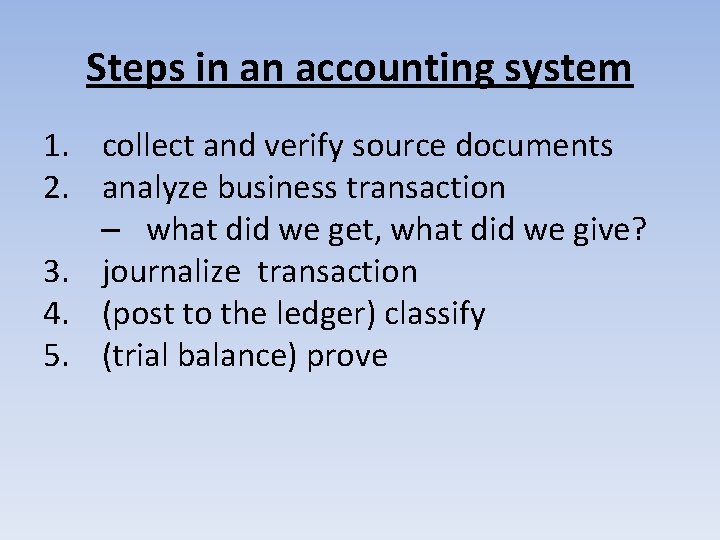
Steps in an accounting system 1. collect and verify source documents 2. analyze business transaction – what did we get, what did we give? 3. journalize transaction 4. (post to the ledger) classify 5. (trial balance) prove
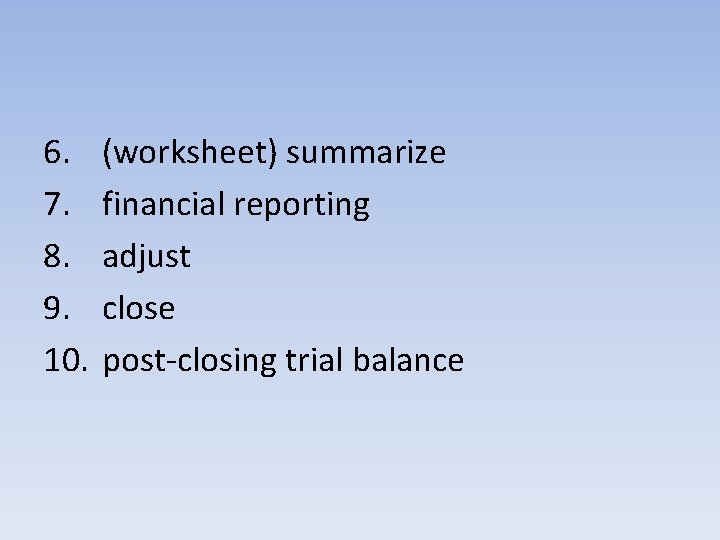
6. 7. 8. 9. 10. (worksheet) summarize financial reporting adjust close post-closing trial balance
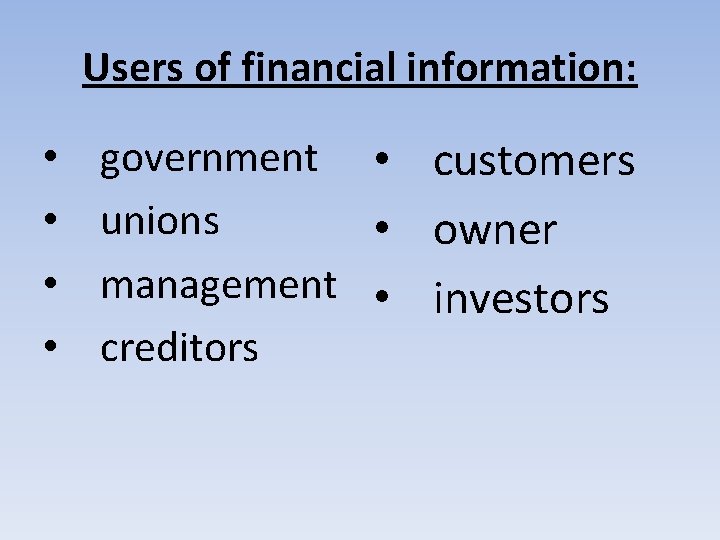
Users of financial information: • • government • customers unions • owner management • investors creditors
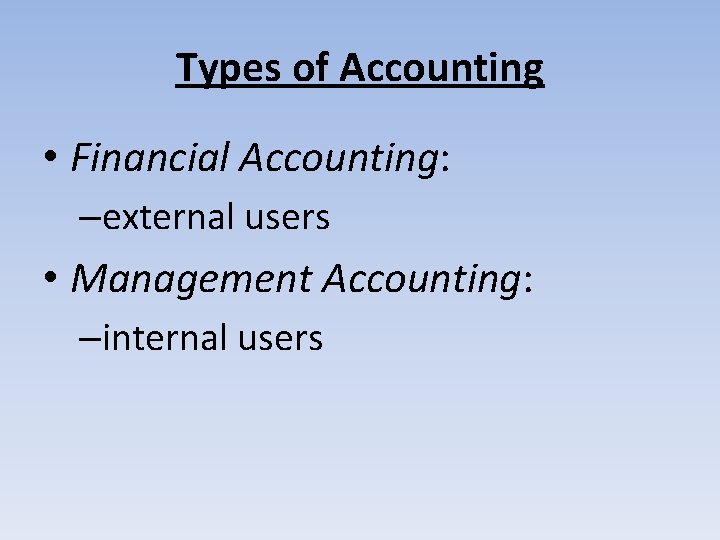
Types of Accounting • Financial Accounting: –external users • Management Accounting: –internal users
Accounting Assumptions
1. accounting records contain only information related to the business entity 2. business will continue to operate as a going concern
3. money amounts of fixed buying power are the unit of measure for transactions 4. the time period covered by an accounting report is a fiscal period or accounting period
- Slides: 27