
BUS 418 Chapter 15 Questionnaire Design As easy
BUS 418: Chapter 15 Questionnaire Design • As easy to compose as a good poem • But, it is usually the result of long, painstaking work • Naïve newcomers who believe common sense and good grammar are all that are needed to construct a questionnaire soon learn hasty efforts are inadequate.
Decisions in Questionnaire Design 1. 2. 3. 4. 5. 6. 7. 8. 9. What should be the title of my survey? How do I introduce my topic? Do I need a cover letter? What instructions do I provide the respondent? What should be asked? How should each question be phrased? In what sequence should the questions be arranged? What questionnaire layout will best serve the research objectives? How should the questionnaire be pretested? Does the questionnaire need to be revised? (Note: It probably will need to be revised several times. )
What Should Be Asked? • Questionnaire relevance – Collect only the data necessary to solve the problem – Be careful not to leave out needed variables – Don’t forget demographics and psychographics • Questionnaire accuracy – Information is reliable and valid. – Question wording is critical to reduce error and increase accuracy.
Wording Questions • Open-ended questions – Most beneficial in exploratory research – Costs are much greater than for fixed due to coding, editing, and analyzing the data. • Fixed-alternative questions – Alternatives should be mutually exclusive • Most questionnaires include both.
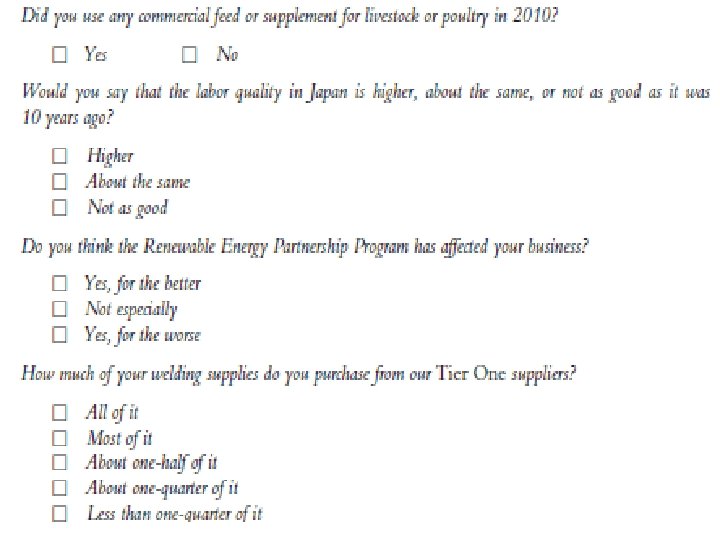

Types of Fixed-Alternative Questions • The simple-dichotomy (dichotomous) question requires the respondent to choose one of two alternatives. The answer can be a simple “yes” or “no” or a choice between “this” and “that. ” For example: Did you have any overnight travel for work-related activities last month? • Several types of questions provide the respondent with multiple-choice alternatives. The determinant-choice question requires the respondent to choose one—and only one—response from among several possible alternatives. For example: Please give us some information about your flight. In which section of the aircraft did you sit? • The frequency-determination question is a determinant-choice question that asks for an answer about the general frequency of occurrence. For example: How frequently do you watch MTV?
• The checklist question allows the respondent to provide multiple answers to a single question. The respondent indicates past experience, preference, and the like merely by checking off items. In many cases the choices are adjectives that describe a particular object. A typical checklist question might ask the following: Please check which, if any, of the following sources of information about investments you regularly use. • Alternatives should be totally exhaustive, meaning that all the response options are covered and that every respondent has an alternative to check. • The alternatives should also be mutually exclusive, meaning there should be no overlap among categories and only one dimension of an issue should be related to each alternative. • 10, 000– 30, 000/ 10, 000– 29, 999
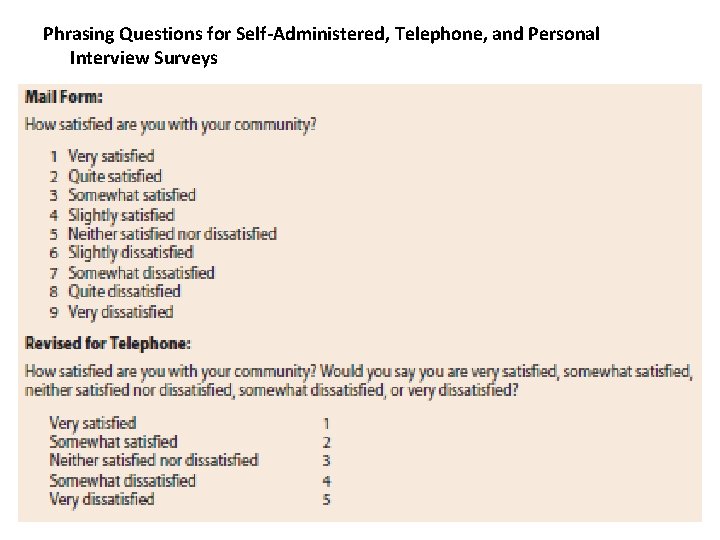
Phrasing Questions for Self-Administered, Telephone, and Personal Interview Surveys
Guidelines for Constructing Questions • Avoid Complexity: use simple, conversational language • Avoid leading and loaded questions Many people are using dry cleaning less because of improved wash-and-wear clothes. How do you feel wash-and-wear clothes have affected your use of dry cleaning facilities in the past 4 years? What most influences your vote in major elections? • Avoid ambiguity: be as specific as possible How often does the company shut down production for sanitary maintenance? What media do you rely on most? • Avoid double-barreled items Did your plant use any commercial feed or supplement for livestock or poultry in 2010? • Avoid making assumptions Should General Electric continue to pay its outstanding quarterly dividends? • Avoid burdensome questions that may tax the respondent’s memory • Make certain questions generate variance Did you have any overnight travel for work-related activities last month?
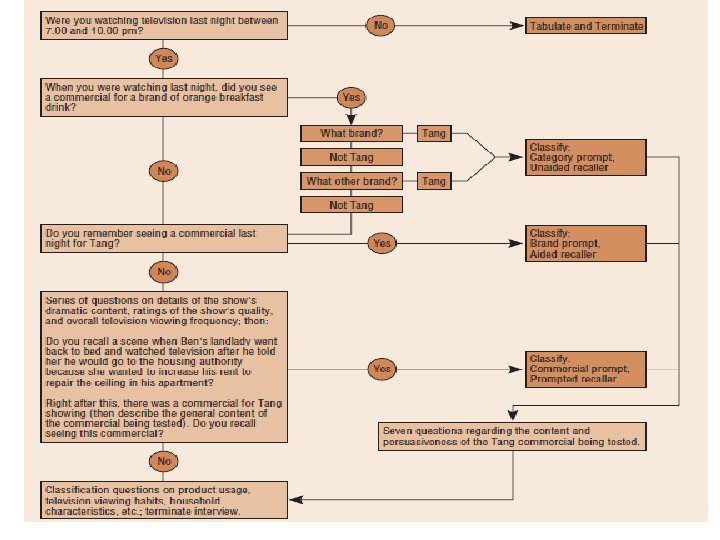
• What Is the Best Question Sequence? Order bias can result from a particular answer’s position in a set of answers or from the sequencing of questions. Funnel technique from general to specific Filter question minimizes the chance of asking questions that are inapplicable. Asking a human resource manager “How would you rate third party administrator (TPA) of your employee health plan? ” may elicit a response even though the organization does not utilize a TPA. The respondent may wish to please the interviewer with an answer. A filter question such as “Does your organization use a third party administrator (TPA) for your employee health plan? ” followed by “If you answered Yes to the previous question, how would you rate your TPA on. . . ? ” Pivot question, can be used to obtain income information and other data that respondents may be reluctant to provide. For example, “Is your total family income over or under 50, 000? ” IF UNDER, ASK, “Is it over or under 25, 000? ” IF OVER, ASK, “Is it over or under 75, 000? ”
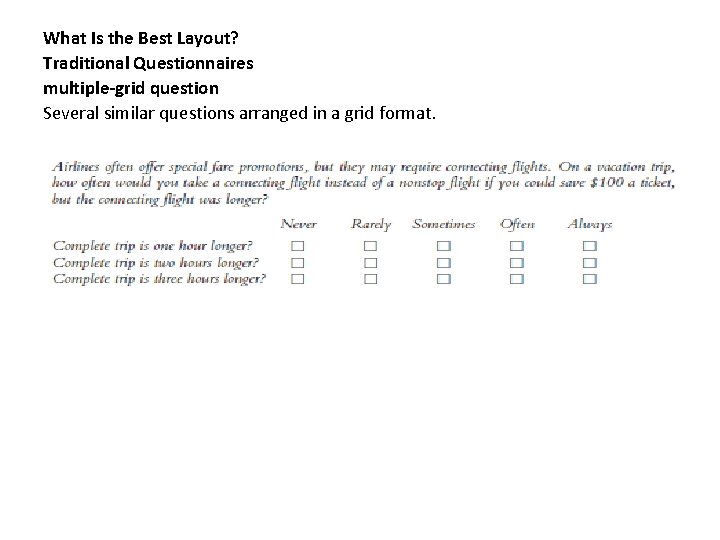
What Is the Best Layout? Traditional Questionnaires multiple-grid question Several similar questions arranged in a grid format.
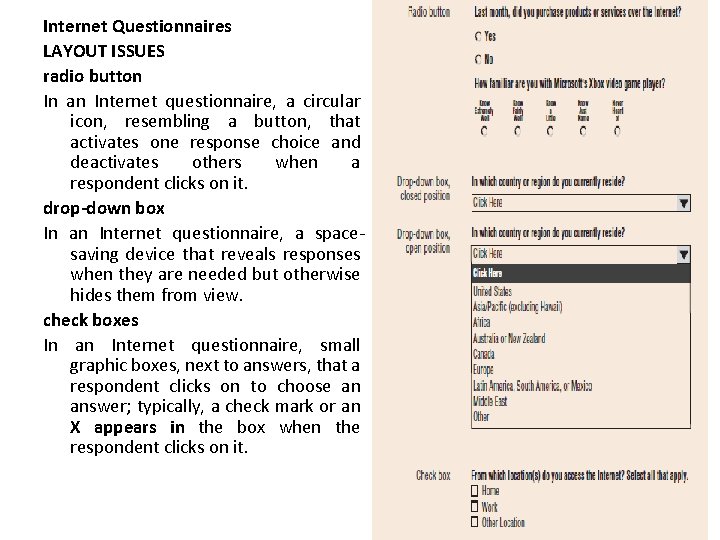
Internet Questionnaires LAYOUT ISSUES radio button In an Internet questionnaire, a circular icon, resembling a button, that activates one response choice and deactivates others when a respondent clicks on it. drop-down box In an Internet questionnaire, a spacesaving device that reveals responses when they are needed but otherwise hides them from view. check boxes In an Internet questionnaire, small graphic boxes, next to answers, that a respondent clicks on to choose an answer; typically, a check mark or an X appears in the box when the respondent clicks on it.
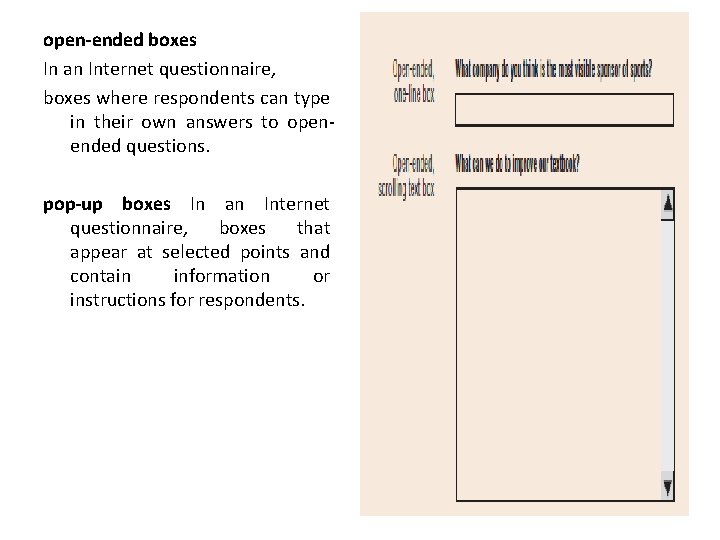
open-ended boxes In an Internet questionnaire, boxes where respondents can type in their own answers to openended questions. pop-up boxes In an Internet questionnaire, boxes that appear at selected points and contain information or instructions for respondents.
SOFTWARE THAT MAKES QUESTIONNAIRES INTERACTIVE variable piping software Software that allows variables to be inserted into an Internet questionnaire as a respondent is completing it. error trapping Using software to control the flow of an Internet questionnaire—for example, to prevent respondents from backing up or failing to answer a question. forced answering software Software that prevents respondents from continuing with an Internet questionnaire if they fail to answer a question. interactive help desk In an Internet questionnaire, a live, real-time support feature that solves problems or answers questions respondents may encounter in completing the questionnaire
How Much Pretesting and Revising Are Necessary? Once your questionnaire is complete, pretest it with a few respondents from your sample. Ask them to please complete the survey. While they are completing the survey or right after they have completed the survey ask them to point out any part of the survey (including all questions) that are difficult, confusing, etc.
- Slides: 16