
BURNS AND INHALATION INJURY BY Dr MOHAMMED MEGAHED
BURNS AND INHALATION INJURY BY Dr. MOHAMMED MEGAHED

• Classifications of inhalation injury have been developed according to several different schemes. One of the first schemes was developed as a result of observations made at the Cocoanut Grove fire of 1942 and grouped patients according to outcomes and their initial symptoms.
• Signs of cyanosis and dyspnea that occurred within a few hours of the insult could be attributable to development of pulmonary edema. At 24 hours, upper airway edema was found to be increased and necessitated establishment of an airway (tracheostomy, intubation). After 48 hours, the final group of patients developed worsening respiratory symptoms due to atelectasis and subsequent pneumonia.
• smoke, which is dry and has a low specific heat , causes damage to upper airways whereas steam, which has 4000 times the heat-carrying capacity, can cause more extensive tracheobronchia damage. ' • The clinical symptoms that appear initially are stridor, hypoxia , and respiratory distress.
• The level of injury produced by inhalation of particulate matter depends on the diameter of the matter. Large-diameter particles less than 100 urn enter the airway but usually do not travel beyond the upper respiratory tract. Particles less than 10 urn can reach the lower tracheobronchial tree and particles less than 5 urn can reach the terminal bronchus and alveolus. Particulate matter can cause direct mechanical damage and can also carry toxins beyond the level of the initial inhalation.
PATHOLOGY • UPPER AIRWAY INJURY • Upper airway structures that are in direct danger from inhalation injur y include the mucous membranes of the nasopharynx, hypopharynx, epiglottis, and larynx. The mucous membranes of these structures can undergo a significant amount of inflammation due to direct injury. • LOWER AIRWAY INJURY • • Thermal Injury. Tracheobronchial Injury. Parenchymal Damage. Direct damage to the lung epithelium causes the recruitment of inflammatory mediators thatproduce increased parenchymal damage
• DAMAGE FROM ASPHXIANTS Smoke generates compounds-carbon monoxide (CO) and cyanide-that are absorbed systemically and impair oxygen utilization and delivery.
CO is an odorless nonirritating gas that is responsible for up to 600 accidental deaths per year • Neurologic symptoms are often the first manifestation of CO poisoning Mild carboxyhemoglobin levels (5% to 10%) are usually well tolerated. When concentrations reach 10% to 30% symptoms begin to manifest. Headaches, nausea, and dizziness are common in itial symptoms in mild to moderate CO poisoning. With severe poisoning (50% carboxyhemoglobin levels), more dangerous neurologic symptoms occur, such as syncope, seizures , and comas. • The CO half-life decreases from 6 to 8 hour s to 40 to 80 minutes with 1 hour of treatment with 100% oxygen. Whe n adminis tered in a hyperbaric chamber the half-li fe decreases to 15 to 30 minutes.
cyanid poisoning • Physical manifestations of cyanid poisoning include headache and confusion, followed by coma, seizures, fixed pupils, bradycardia, hypotension , arrhythmias, heart block, and cardiac failure. Diagnostic tests include measurement of blood con cent ration s of cyan id e, which are considered toxic at levels of 0. 5 mg/ L. 10 • Treatment of cyanide inhalation includes administration of oxygen as well as decontamination agents. Amyl and sodium nitrates • These compounds Induce , the forn: a tion of methemoglobin to which cyanide has a high affin ity, Methemoglobin thus act s as a scavenger for cyanide,
FEATURES OF SPECIFIC IRRITANTS • • • Acrolein. Hydrogen Chloride. Phosgene Amonia Nitrogen Oxide. Sulfur Dioxide
POSTINHALATION PULMONARY COMPLICATIONS • • • LOCAL FACTORS Ciliary Dysfunctions. The Pulmonary Alveolar Macrophage. Surfactant. Infections. Pathogens. In thermal injury, pneumonias are a common complication of the clinical course. • The Acute Respiratory Distress Syndrome.
ONGOING PULMONARY DAMAGE AFTER INHALATION INJURY • Oxygen Toxicity • Fluid Management. • Long-Term Sequelae. consequences. Long-term studies of survivors of inhalation injury may have symptoms similar to asthma such as cough , dyspnea , and symptoms of obstruction. Bronchiectasis, a dilat ion of the bronchial tree, and bronchiolitis obliterans are both rare occurrences that lead to pulmonary dysfunctions and symptoms of
TREATMENT • Medical Management. The cornerstones of management include adequate fluid resuscitation, maintenance of airway patency, adequate and effectivemechanical ventilation when required, and vigilant surveillance for infectious complications. • Pulmonary Toilet. Endoscopic intervention has several roles in the evaluation and treatment of inhalation injur y. In the initial injury period airway edema and mucosal sloughing can present in the first 12 to 24 hours. Laryngoscopy and bronchoscopy are used in this period to evaluate the extent of injury to tracheobronchial mucosa and provide predictive indicators for airway patency and collapse
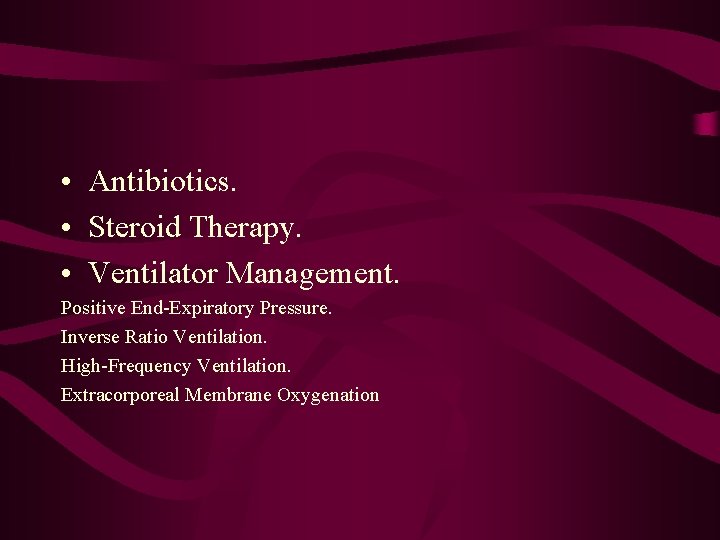
• Antibiotics. • Steroid Therapy. • Ventilator Management. Positive End-Expiratory Pressure. Inverse Ratio Ventilation. High-Frequency Ventilation. Extracorporeal Membrane Oxygenation
- Slides: 14