
Burnout and Death Anxiety in Hospice Social Workers
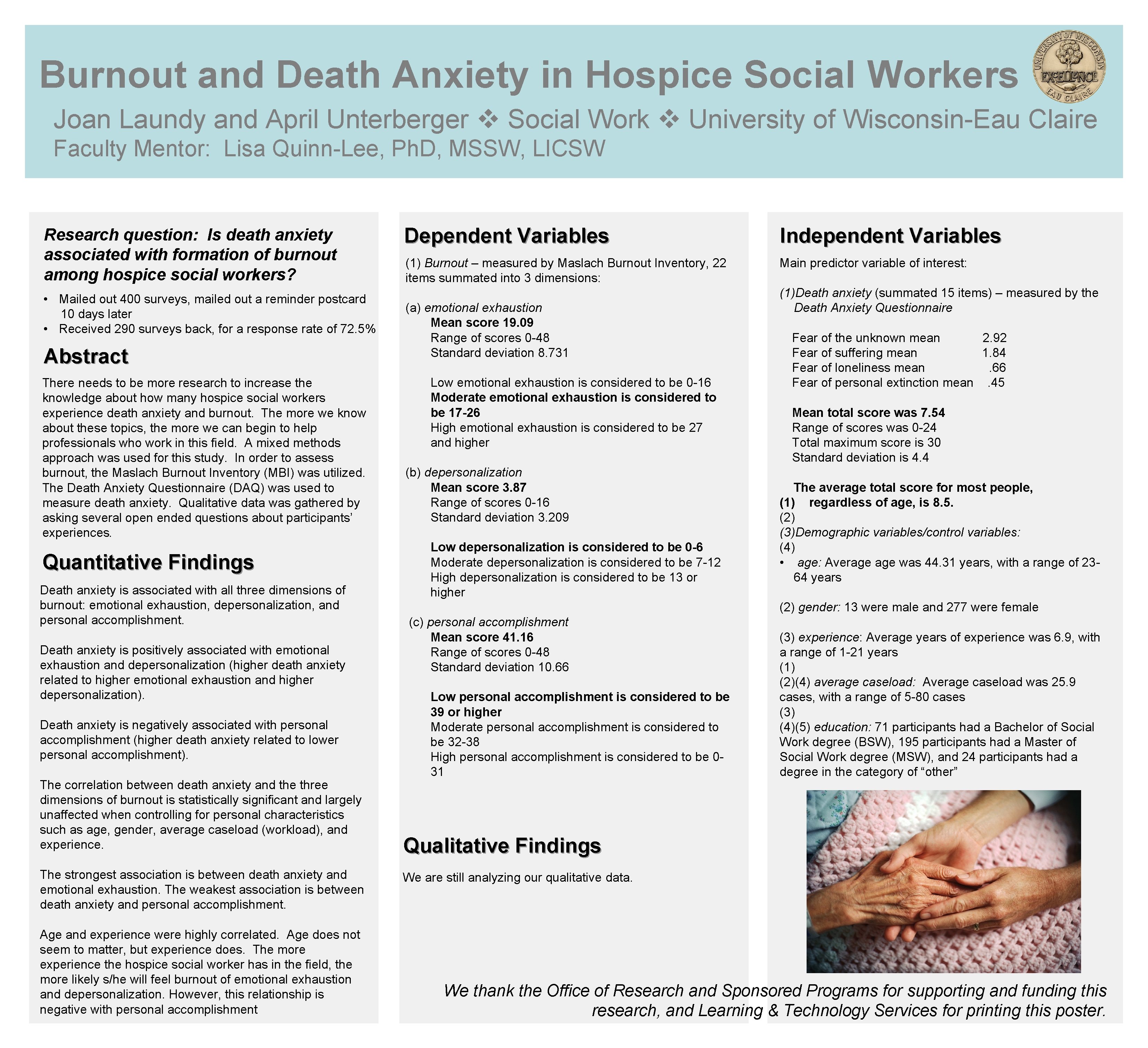
Burnout and Death Anxiety in Hospice Social Workers Joan Laundy and April Unterberger Social Work University of Wisconsin-Eau Claire Faculty Mentor: Lisa Quinn-Lee, Ph. D, MSSW, LICSW Research question: Is death anxiety associated with formation of burnout among hospice social workers? • Mailed out 400 surveys, mailed out a reminder postcard 10 days later • Received 290 surveys back, for a response rate of 72. 5% Abstract There needs to be more research to increase the knowledge about how many hospice social workers experience death anxiety and burnout. The more we know about these topics, the more we can begin to help professionals who work in this field. A mixed methods approach was used for this study. In order to assess burnout, the Maslach Burnout Inventory (MBI) was utilized. The Death Anxiety Questionnaire (DAQ) was used to measure death anxiety. Qualitative data was gathered by asking several open ended questions about participants’ experiences. Quantitative Findings Death anxiety is associated with all three dimensions of burnout: emotional exhaustion, depersonalization, and personal accomplishment. Death anxiety is positively associated with emotional exhaustion and depersonalization (higher death anxiety related to higher emotional exhaustion and higher depersonalization). Death anxiety is negatively associated with personal accomplishment (higher death anxiety related to lower personal accomplishment). The correlation between death anxiety and the three dimensions of burnout is statistically significant and largely unaffected when controlling for personal characteristics such as age, gender, average caseload (workload), and experience. The strongest association is between death anxiety and emotional exhaustion. The weakest association is between death anxiety and personal accomplishment. Age and experience were highly correlated. Age does not seem to matter, but experience does. The more experience the hospice social worker has in the field, the more likely s/he will feel burnout of emotional exhaustion and depersonalization. However, this relationship is negative with personal accomplishment Dependent Variables Independent Variables (1) Burnout – measured by Maslach Burnout Inventory, 22 items summated into 3 dimensions: Main predictor variable of interest: (1)Death anxiety (summated 15 items) – measured by the Death Anxiety Questionnaire (a) emotional exhaustion Mean score 19. 09 Range of scores 0 -48 Standard deviation 8. 731 Low emotional exhaustion is considered to be 0 -16 Moderate emotional exhaustion is considered to be 17 -26 High emotional exhaustion is considered to be 27 and higher (b) depersonalization Mean score 3. 87 Range of scores 0 -16 Standard deviation 3. 209 Low depersonalization is considered to be 0 -6 Moderate depersonalization is considered to be 7 -12 High depersonalization is considered to be 13 or higher (c) personal accomplishment Mean score 41. 16 Range of scores 0 -48 Standard deviation 10. 66 Low personal accomplishment is considered to be 39 or higher Moderate personal accomplishment is considered to be 32 -38 High personal accomplishment is considered to be 031 Fear of the unknown mean 2. 92 Fear of suffering mean 1. 84 Fear of loneliness mean . 66 Fear of personal extinction mean . 45 Mean total score was 7. 54 Range of scores was 0 -24 Total maximum score is 30 Standard deviation is 4. 4 The average total score for most people, (1) regardless of age, is 8. 5. (2) (3)Demographic variables/control variables: (4) • age: Average was 44. 31 years, with a range of 2364 years (2) gender: 13 were male and 277 were female (3) experience: Average years of experience was 6. 9, with a range of 1 -21 years (1) (2)(4) average caseload: Average caseload was 25. 9 cases, with a range of 5 -80 cases (3) (4)(5) education: 71 participants had a Bachelor of Social Work degree (BSW), 195 participants had a Master of Social Work degree (MSW), and 24 participants had a degree in the category of “other” Qualitative Findings We are still analyzing our qualitative data. We thank the Office of Research and Sponsored Programs for supporting and funding this research, and Learning & Technology Services for printing this poster.
- Slides: 1