
BURN COLD INJURY 90 02 24 ACLS CH
BURN , COLD INJURY 90 -02 -24 急診醫學科 李芳年 醫師 ACLS ( CH 9 ) - BURN 1
INJURY DUE TO BURN AND COLD ACLS ( CH 9 ) - BURN 2

OBJECTIVES n n n Estimate burn size, and determine presence of associated injuries. Outline innitial stabilization, treatment measures, and transfer criteria. Identify special problems and methods of treatment. ACLS ( CH 9 ) - BURN 3
BURN / COLD INJURIES n Management Principles n n Timely application Maintain: n n n Airway Hemodynamic stability Fluid / electrolyte balance Normal body temperature Prevent complications ACLS ( CH 9 ) - BURN 4
n Injury Due To Burn ACLS ( CH 9 ) - BURN 5
LIFE-SAVING MEASURES n n Establish airway Identify signs of distress Initiate supportive measures Obtain history ACLS ( CH 9 ) - BURN 6
n CLINICAL INDICATIONS n n n Carbonaceous sputum Facial burns Hair singeing Carbon deposites Inflamed oropharynx History n Inhalation Injury ACLS ( CH 9 ) - BURN 7
LIFE-SAVING MEASURES n Remove all: n n n Injurious material Clothing, jewelry Prevent hypothermia Two, large-caliber Ivs Ringer’s lactate ACLS ( CH 9 ) - BURN 8
ASSESSMENT n History n n Mechanism of ijury Associated illness Allergies Tetanus status ACLS ( CH 9 ) - BURN 9
n Rule of Nines ACLS ( CH 9 ) - BURN 10
ASSESSMENT n Estimate Burn Size n Surface of patient’s palm represents 1% body surface area ACLS ( CH 9 ) - BURN 11
n Second-degree Burn ACLS ( CH 9 ) - BURN 12
n Third-degree Burn ACLS ( CH 9 ) - BURN 13
MANAGEMENT n Airway n n Assess for injury Establish and maintain patient airway early ACLS ( CH 9 ) - BURN 14
n n Inhalation Injury Early Management ACLS ( CH 9 ) - BURN 15
MANAGEMENT n Breathing n n n Assume CO exposure Inhalation of toxic fumes or carbon particles Direct thermal injury ACLS ( CH 9 ) - BURN 16

MANAGEMENT n Breathing n n Oxygen / ventilate Endotracheal intubation ABGs Carboxyhemoglobin levels ACLS ( CH 9 ) - BURN 17
MANAGEMENT n Circulation n n Monitor vital signs Hourly urinary outputs n n Adult: 30 – 50 m. L / hr Child: 1. 0 m. L / kg / hr ACLS ( CH 9 ) - BURN 18
MANAGEMENT n Circulation – Estimate of Fluid Needs n n n 2 – 4 m. L Ringer’s lactate / kg / % BSA in first 24 hours One-half in first 8 hours One-half in next 16 hours Based on time from injury Monitor patient response ACLS ( CH 9 ) - BURN 19
MANAGEMENT n Develop Treatment plan n n n Estimate burn size / depth Identify associated injuries Weigh patient Baseline blood analyses Chest films Document on flow sheet ACLS ( CH 9 ) - BURN 20
MANAGEMENT n Maintain Peripheral Circulation n Remove all connstricting devices Assess distal circulation Escharotomy – surgical consultation ACLS ( CH 9 ) - BURN 21
Escharotomy Sites ACLS ( CH 9 ) - BURN 22
Escharotomy ACLS ( CH 9 ) - BURN 23
MANAGEMENT n Nasogastric Intubation n Nausea, vomiting, distention Burn > 20% BSA Medications n n Narcotics – Spare use, IV only Antibiotics – Not indicated early ACLS ( CH 9 ) - BURN 24
MANAGEMENT n Wound Care n n Cover with clean linen Do not n n n Break blisters Apply antiseptics Apply cold water ACLS ( CH 9 ) - BURN 25
MANAGEMENT n Acid / Alkali Burns n n n Duration, concentration, and amount Flush with copious amount of water for 20 – 30 minutes Brush away dry chemical before irrigation ACLS ( CH 9 ) - BURN 26
Chemical Burns ACLS ( CH 9 ) - BURN 27
n Electrical burn result in damage to the fascia and muscle, and may spare the overlying skin Fasciotomy – Electrical Burn ACLS ( CH 9 ) - BURN 28
MANAGEMENT n Electrical Burn n n ABCs Myoglobinuria n n n ↑Fluid: 100 m. L urine / hr Mannitol: 25 g IV Metabolic acidosis n n Maintain adequate perfusion Sodium Bicarbonate ACLS ( CH 9 ) - BURN 29
TRANSFER CRITERIA n n n 2 nd, 3 rd degree burns > 10% BSA in age < 10 and > 50 years 2 nd, 3 rd degree burns > 20% BSA 2 nd, 3 rd degree burns to face, eyes, ears, hands, feet, genitalia, perineum, and major loints ACLS ( CH 9 ) - BURN 30
TRANSFER CRITERIA n n n 3 rd degree burns > 5% BSA Electrical and chemical burns Inhalation injury Pre-existing illness, associated injuries Children Special situations ACLS ( CH 9 ) - BURN 31
TRANSFER PROCEDURE n n Coordinate with burn-center physician Transfer with all n n Documentation / information Laboratory results ACLS ( CH 9 ) - BURN 32
Injury Due To Cold ACLS ( CH 9 ) - BURN 33
COLD INJURY FACTORS n n n n Temperature Duration of exposure Enviromental conditions Immobilizzation Moisture Vascular disease Open wounds ACLS ( CH 9 ) - BURN 34
TISSUE-FREEZING INJURY FROSTBITE n n 1 st Degree: Hyperemia, edema 2 nd Degree: Vesicles, parttial-thickness skin necrosis 3 rd Degree: Full-thickness skin necrosis 4 th Degree: Skin, muscle, bone necrosis ACLS ( CH 9 ) - BURN 35
Second-degree Frostbite ACLS ( CH 9 ) - BURN 36
Fourth-degree Frostbite ACLS ( CH 9 ) - BURN 37
MANAGEMENT n n Do nor delay Remove clothing Warmed blankets Rewarm frozen part ACLS ( CH 9 ) - BURN 38
MANAGEMENT n n Preserve damaged tissue Prevent infection Elevate and expose injured part Analgesics / tetanus / antibiotics ACLS ( CH 9 ) - BURN 39
HYPOTHERMIA n n Core temperature < 35 degrees Rapid / slow drop in core temperature Elderly and children at greater risk Low-range thermometer required ACLS ( CH 9 ) - BURN 40
HYPOTHERMIA n Clinical Findings n n Core temperature < 35 degrees Depressed level of consciousness Gray, cyanotic, variable vital signs Absence of cardiorespiratory activity ACLS ( CH 9 ) - BURN 41
MANAGEMENT n n n ABCs, IV access Oxygenate and ventilate Prevent heat loss and rewarm Assess for associated disorders Blood analyses ACLS ( CH 9 ) - BURN 42
MANAGEMEN n Passive External Rewarming n n n Active Core Rewarming n n n Warm enviroment Warmed blankets and IV fluids Surgical rewarming techniques Do not delay transfer Not dead until warm and dead ACLS ( CH 9 ) - BURN 43
? ACLS ( CH 9 ) - BURN 44
SUMMARY n Burn Injury n n Recognize inhalation injury Establish airway Fluid resuscitation Rremove all clothing ACLS ( CH 9 ) - BURN 45
SUMMARY n Burn Injury n n n Identify extend, depth of burn Establish fluid guidelines Initiate burn flow sheet Obtain baseline lab / radiology Maintain peripheral circulation Identify burns requiring transfer ACLS ( CH 9 ) - BURN 46
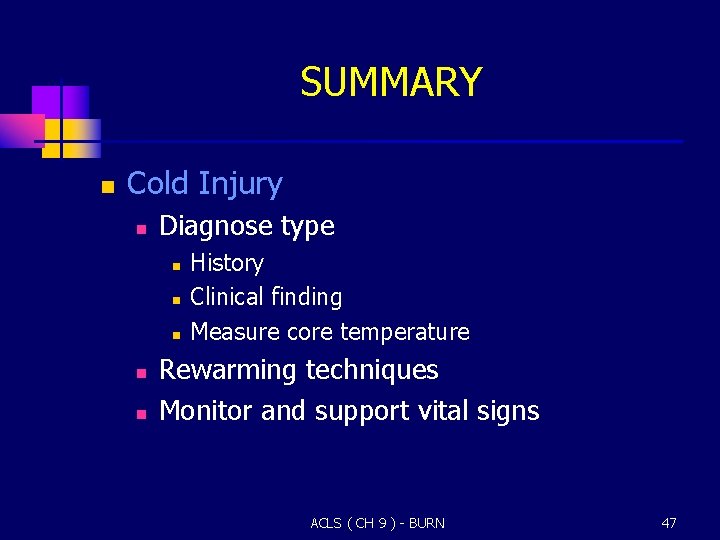
SUMMARY n Cold Injury n Diagnose type n n n History Clinical finding Measure core temperature Rewarming techniques Monitor and support vital signs ACLS ( CH 9 ) - BURN 47
- Slides: 47