
BumpertoBumper the Complete Guide to TractorTrailer Operations Handling
Bumper-to-Bumper, the Complete Guide to Tractor-Trailer Operations Handling Doubles and Triples Copyright 2004 by Mike Byrnes & Assoc. , Inc. 1
Introduction This topic identifies the challenges of coupling, uncoupling and driving with doubles and triples. l Step-by-step coupling and uncoupling procedures are presented. l On-the-road handling techniques are presented. l 2 Copyright 2004 by Mike Byrnes & Assoc. , Inc.
Overview: On completing this lesson, you will be able to: List and describe the different combinations of tractors and trailers. l State the complexities of loading doubles and triples. l 3 Copyright 2004 by Mike Byrnes & Assoc. , Inc.
Overview: On completing this lesson, you will be able to: Describe the procedures for coupling and uncoupling doubles and triples. l Describe the on-road handling characteristics of doubles and triples. l Explain the importance of vehicle control when using the freeway. l 4 Copyright 2004 by Mike Byrnes & Assoc. , Inc.
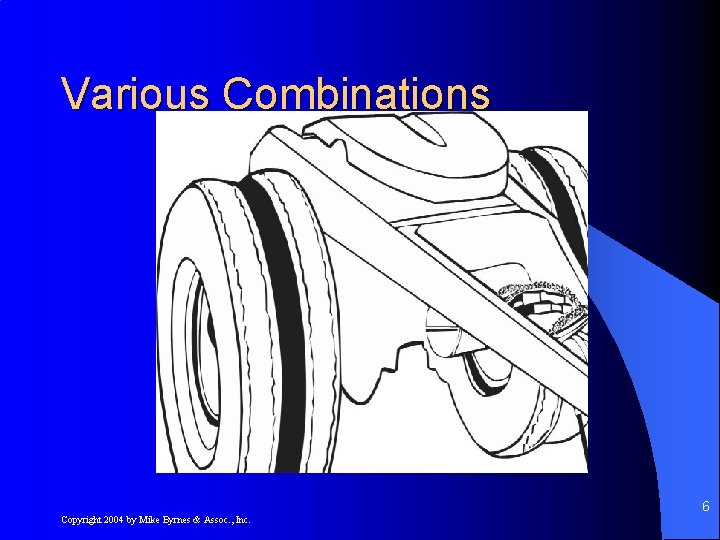
Various Combinations Almost all of the nation's highway freight is hauled by a three-axle tractor pulling a two-axle semitrailer, an 18 -wheeler. l A double is a tractor and two trailers. l A turnpike double is: l – a tractor – two full-length tandem trailers – and a dolly. 5 Copyright 2004 by Mike Byrnes & Assoc. , Inc.
Various Combinations 6 Copyright 2004 by Mike Byrnes & Assoc. , Inc.
Various Combinations A Rocky Mountain double is a tractor, a full-length tandem trailer, a dolly and a short, single-axle trailer, or pup. l A western double is a tractor, two pups and a dolly. l A triple is a tractor and three trailers. l 7 Copyright 2004 by Mike Byrnes & Assoc. , Inc.

Loading Doubles and Triples l Make sure the: – load is secured properly – total weight and the axle weights are within legal limits. l Couple the heaviest trailer directly behind the tractor. 8 Copyright 2004 by Mike Byrnes & Assoc. , Inc.
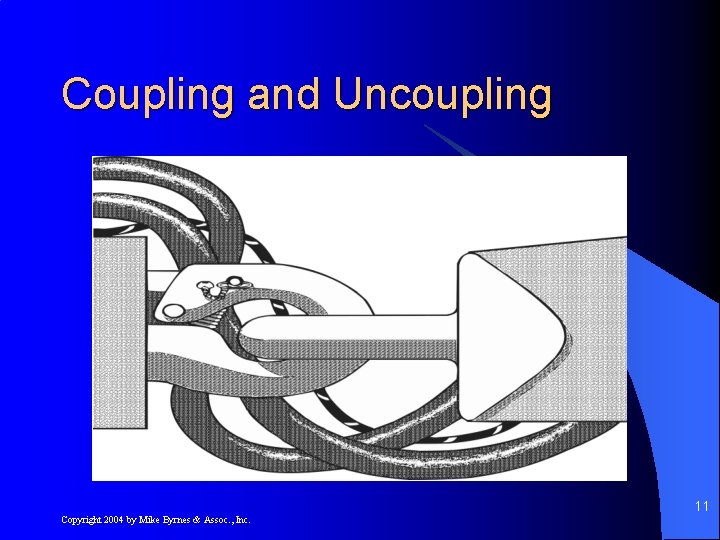
Coupling and Uncoupling Drivers must have a CDL Doubles/Triples Endorsement to pull double or triple trailers. l A double rig consists of: l – a tractor – two trailers – a converter gear. 9 Copyright 2004 by Mike Byrnes & Assoc. , Inc.
Coupling and Uncoupling l A triple rig consists of: – a tractor – three trailers – two converter gears. 10 Copyright 2004 by Mike Byrnes & Assoc. , Inc.
Coupling and Uncoupling 11 Copyright 2004 by Mike Byrnes & Assoc. , Inc.

Coupling and Uncoupling l Coupling doubles – Make a visual inspection of the: area l tractor l two trailers. l 12 Copyright 2004 by Mike Byrnes & Assoc. , Inc.
Coupling and Uncoupling Couple the tractor with the heaviest trailer. l Set the spring brakes on the uncoupled trailer and chock the wheels. l Inspect the dolly and put it in front of the uncoupled trailer. l 13 Copyright 2004 by Mike Byrnes & Assoc. , Inc.

Coupling and Uncoupling Back the coupled trailer in front of the dolly and put the trailer air supply valve in the emergency position. l Hook the dolly eye hook onto the pintle hook of the coupled trailer. l 14 Copyright 2004 by Mike Byrnes & Assoc. , Inc.
Coupling and Uncoupling 15 Copyright 2004 by Mike Byrnes & Assoc. , Inc.
Coupling and Uncoupling Raise the dolly's landing gear and connect the dolly's air lines and electrical cord to the back of the coupled trailer. l Make sure the uncoupled trailer's height is correct (slightly lower than the dolly's fifth wheel). l Connect the air lines and electrical lines from the dolly to the uncoupled trailer. l 16 Copyright 2004 by Mike Byrnes & Assoc. , Inc.

Coupling and Uncoupling Inspect the area around the un-coupled trailer. l Put on the four-way flashers and the trailer air supply valve in the normal position. l Test the brake lines. l Restart the engine, pull the trailer air supply valve back out. l 17 Copyright 2004 by Mike Byrnes & Assoc. , Inc.
Coupling and Uncoupling Release the tractor-only brake and slowly back the dolly under the unconnected trailer until you hear and feel the fifth wheel jaws lock around the kingpin. l Raise the unconnected trailer's landing gear just slightly to prevent damage if the trailer moves. l 18 Copyright 2004 by Mike Byrnes & Assoc. , Inc.
Coupling and Uncoupling Shift into low and slowly pull the tractor forward to make sure you have coupled. l Get out of the cab, visually check the coupling. There should be no space between the upper and lower fifth wheel. l Secure the locking lever. l 19 Copyright 2004 by Mike Byrnes & Assoc. , Inc.
Coupling and Uncoupling Close the dolly air tank petcock and the rearmost trailer's shut-off valves. l Open the front-most trailer's shut-off valves. l Then crank up the trailer landing gear and secure the landing gear handle. l 20 Copyright 2004 by Mike Byrnes & Assoc. , Inc.
Coupling and Uncoupling Test the air brakes. l Open and close the emergency air valve of the rearmost trailer. l No air means something is wrong. l 21 Copyright 2004 by Mike Byrnes & Assoc. , Inc.
Coupling and Uncoupling If you found air, return to the cab and apply 20 to 30 pounds of brake application with the hand valve. l Return to the rear and open and close the service air valve. l No air means something is wrong. l 22 Copyright 2004 by Mike Byrnes & Assoc. , Inc.
Coupling and Uncoupling If there is air, remove the chocks. l Recheck everything. l Raise the trailer land gear. l Then move the truck forward at about two to five mph and test the trailer brakes with the hand valve. l If everything is in order, you're ready to couple triples. l 23 Copyright 2004 by Mike Byrnes & Assoc. , Inc.
Coupling and Uncoupling l Coupling triples – To couple a third trailer, couple the last trailer to the second trailer first. – Simply repeat the process of coupling the first and second trailer (coupling doubles). – Couple the tractor to the first trailer. – Then couple the first trailer to the second trailer. 24 Copyright 2004 by Mike Byrnes & Assoc. , Inc.
Coupling and Uncoupling l Uncoupling doubles – If you are not going to leave all the trailers at the terminal, you should remain coupled to the last trailer you dock. 25 Copyright 2004 by Mike Byrnes & Assoc. , Inc.
Coupling and Uncoupling l The steps to uncouple doubles are as follows: – Set the parking brakes, chock the rearmost trailer's wheels. – Crank down the landing gear on the rearmost trailer slightly to remove some weight from the dolly. 26 Copyright 2004 by Mike Byrnes & Assoc. , Inc.
Coupling and Uncoupling l l Disconnect the air lines and pigtail between the dolly and the rearmost trailer and secure them. Close the valves on the rear of the front-most trailer and drain the dolly air tank. Release the fifth wheel locking mechanism on the dolly. Drive off with the dolly to the desired location, then set the brakes and put down the dolly jack stand. 27 Copyright 2004 by Mike Byrnes & Assoc. , Inc.
Coupling and Uncoupling Disconnect the safety chains. Chock the wheels. l Disconnect the dolly's air and electrical lines and the dolly from the front-most trailer. l Back the first trailer into the dock and then uncouple the tractor from the first trailer. l 28 Copyright 2004 by Mike Byrnes & Assoc. , Inc.
Coupling and Uncoupling l Return to the rearmost trailer, couple the tractor to it and dock it. 29 Copyright 2004 by Mike Byrnes & Assoc. , Inc.
Coupling and Uncoupling l Uncoupling triples – Leave the rearmost trailers coupled to each other and dock the first trailer. – Return to the rearmost trailers, unhook them, and pull the second trailer and dolly away, then go back for the last trailer. 30 Copyright 2004 by Mike Byrnes & Assoc. , Inc.
Handling Characteristics l Combination trailers are: – heavier – longer – more complex. 31 Copyright 2004 by Mike Byrnes & Assoc. , Inc.
Handling Characteristics l With combination trailers it takes longer to: – load – inspect – change lanes – park – couple and uncouple. 32 Copyright 2004 by Mike Byrnes & Assoc. , Inc.
Handling Characteristics For safety, go slow and take your time. l Tractors pulling doubles are more likely to be in crashes than those pulling one trailer. l 33 Copyright 2004 by Mike Byrnes & Assoc. , Inc.
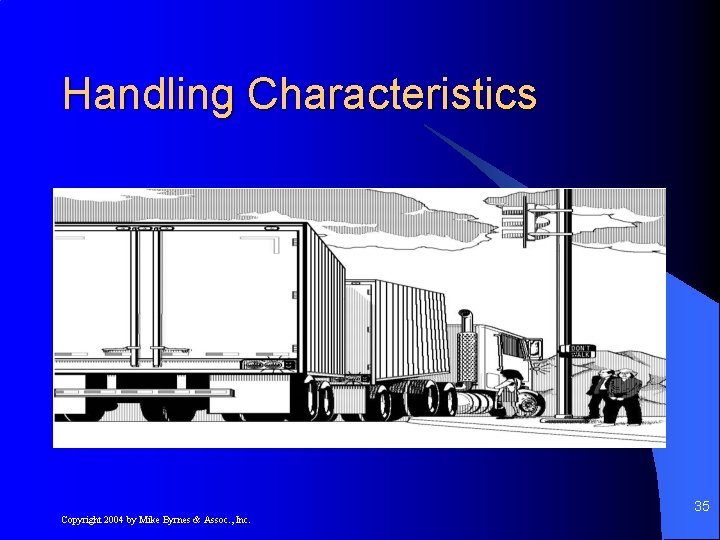
Handling Characteristics l Steering Characteristics – Go slow and make your maneuvers with care. – More pivot points make slippery road surfaces even more dangerous. 34 Copyright 2004 by Mike Byrnes & Assoc. , Inc.
Handling Characteristics 35 Copyright 2004 by Mike Byrnes & Assoc. , Inc.
Handling Characteristics l Cornering Characteristics – Double pups will turn tighter than most tractor semitrailers. – If you're not pulling double pups, you'll need more space to make a right turn. – Longer combinations offtrack more than shorter ones. 36 Copyright 2004 by Mike Byrnes & Assoc. , Inc.
Handling Characteristics l Stopping Capabilities – At 60 mph, a loaded tractor-trailer usually takes about 300 feet to stop. – A loaded double or triple rig will take even longer to stop. – An empty double or triple needs the most time and distance to stop. 37 Copyright 2004 by Mike Byrnes & Assoc. , Inc.
Handling Characteristics l Stopping Capabilities – The faster you go, the longer it takes to stop. – Make sure your brakes are properly adjusted. – Allow more following distance. – Go slowly. 38 Copyright 2004 by Mike Byrnes & Assoc. , Inc.
Handling Characteristics l Parking – Avoid backing doubles and triples. – Park where you can pull straight out again. 39 Copyright 2004 by Mike Byrnes & Assoc. , Inc.
Using The Freeway Avoid emergency stops on the freeway. l Doubles jackknife more often than singles. l Take your time. l 40 Copyright 2004 by Mike Byrnes & Assoc. , Inc.
Using the Freeway l Freeway Ramps – Overturns on freeway exit ramps usually happen because the truck is going too fast for the curve. 41 Copyright 2004 by Mike Byrnes & Assoc. , Inc.
Test Your Knowledge What are the different combinations of tractors and trailers? l What are the complexities of loading doubles and triples? l What are the procedures for coupling and uncoupling doubles and triples? l 42 Copyright 2004 by Mike Byrnes & Assoc. , Inc.
Test Your Knowledge What are the on-road handling characteristics of doubles and triples? l What is the importance of vehicle control when using the freeway? l 43 Copyright 2004 by Mike Byrnes & Assoc. , Inc.

Observation Skills Test 44 Copyright 2004 by Mike Byrnes & Assoc. , Inc.
Summary Various combinations l Loading doubles and triples l Coupling and uncoupling l Handling characteristics l Using the freeway l 45 Copyright 2004 by Mike Byrnes & Assoc. , Inc.
Where to Get More Information Bumper to Bumper, The Complete Guide to Tractor-Trailer Operations, Chapter 21 l Barron’s How to Prepare for the Commercial Driver’s License Truck Driver’s Test, Chapter 11 l 46 Copyright 2004 by Mike Byrnes & Assoc. , Inc.
- Slides: 46