
BumpertoBumper the Complete Guide to TractorTrailer Operations Auxiliary
Bumper-to-Bumper, the Complete Guide to Tractor-Trailer Operations Auxiliary Brakes Copyright 2004 by Mike Byrnes & Assoc. , Inc. 1
Introduction l This topic gives information on auxiliary brakes: – what they are – how they work and – when you should (and should not) use them. 2 Copyright 2004 by Mike Byrnes & Assoc. , Inc.
Overview On completing this lesson, you will be able to: l Define auxiliary brakes and describe what they do. 3 Copyright 2004 by Mike Byrnes & Assoc. , Inc.
Overview On completing this lesson, you will be able to: l List the types of auxiliary brakes and describe their differences. Included should be information concerning at least one type of: – engine retarder – exhaust brake – hydraulic retarder – electric retarder. 4 Copyright 2004 by Mike Byrnes & Assoc. , Inc.
Overview On completing this lesson, you will be able to: l State when the driver should, and should not, use auxiliary brakes. 5 Copyright 2004 by Mike Byrnes & Assoc. , Inc.
What They Are Auxiliary brakes, or vehicle retarders, are separate from the service brake system. l Auxiliary brakes help the service brake system by: l – slowing the vehicle – controlling the vehicle when slowing or descending a grade – saving wear and tear on the service brakes. 6 Copyright 2004 by Mike Byrnes & Assoc. , Inc.
What They Are Auxiliary brakes should be used to slow, but not stop a vehicle. l Auxiliary brakes reduce: l – service brake maintenance – tire wear – trip time. l They also help your service brakes to last longer. 7 Copyright 2004 by Mike Byrnes & Assoc. , Inc.
What They Are l Auxiliary brakes: – give you better control of the vehicle – reduce service brake overheating and brake fade – reduce brake lining and drum wear – slow the vehicle more smoothly – reduce driver fatigue – provide better control on downgrades. 8 Copyright 2004 by Mike Byrnes & Assoc. , Inc.
What They Are l Auxiliary brakes are becoming more popular and more necessary due to: – aerodynamic designs of modern rigs – trends toward heavier payloads – the lifting of certain weight restrictions – increased popularity of pulling combination trailers. 9 Copyright 2004 by Mike Byrnes & Assoc. , Inc.

Types Of Auxiliary Brakes Some auxiliary brakes work by slowing the engine. l Other auxiliary brakes work differently. l 10 Copyright 2004 by Mike Byrnes & Assoc. , Inc.
Types of Auxiliary Brakes l The Engine Retarder – Engine retarders work by changing the timing in the valves. 11 Copyright 2004 by Mike Byrnes & Assoc. , Inc.

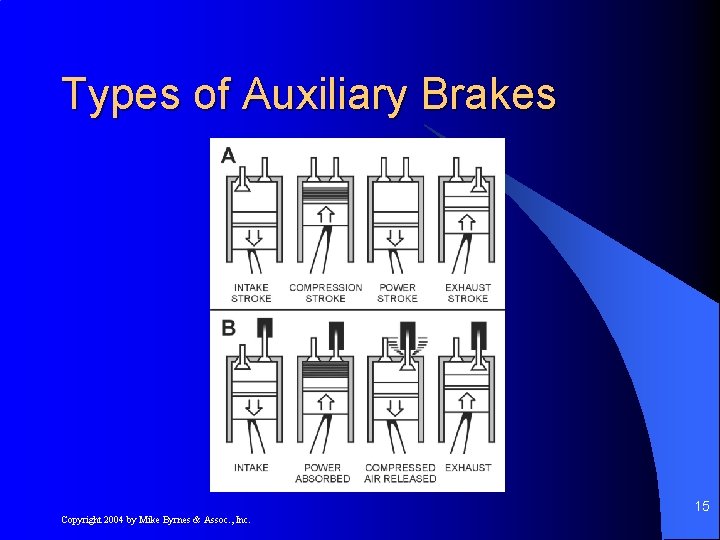
Types of Auxiliary Brakes l The Engine Retarder – The driver switches on the engine retarder. – Just before the piston reaches top dead center, the exhaust valve opens and releases the compressed air before fuel is injected. – The energy used to compress the air goes up the exhaust stack and out into the atmosphere. – No energy is transmitted to the drive train. Thus, the engine slows, as does the rig. – The most popular engine retarder is the Jacobs, or Jake, Brake. 12 Copyright 2004 by Mike Byrnes & Assoc. , Inc.
Types of Auxiliary Brakes The Jake Brake l The four major components of any Jake Brake are the: l – solenoid valve – control valve – master piston – slave piston. 13 Copyright 2004 by Mike Byrnes & Assoc. , Inc.
Types of Auxiliary Brakes l The Jake Brake – The solenoid valve starts the movement of pressurized engine oil to the brake housing and the control valve regulates it. – The master piston senses engine timing and transmits it to the slave piston. – At the proper time the slave piston moves and opens the engine exhaust valves. 14 Copyright 2004 by Mike Byrnes & Assoc. , Inc.
Types of Auxiliary Brakes 15 Copyright 2004 by Mike Byrnes & Assoc. , Inc.
Types of Auxiliary Brakes l The Jake Brake – The Jake Brake usually operates automatically whenever you take your foot off the throttle. – The switch that turns the Jake Brake on and off is on the dash. – With different dash control systems, the Jake Brake can control how many cylinders it affects and uses to provide braking. – When more cylinders are used, more braking force is created. 16 Copyright 2004 by Mike Byrnes & Assoc. , Inc.
Types of Auxiliary Brakes l The Jake Brake – One dash control is a three position on-off switch: off l low l high. l – Another dash control uses two switches, one to turn the system on and off and the other to control the application. 17 Copyright 2004 by Mike Byrnes & Assoc. , Inc.
Types of Auxiliary Brakes l The Exhaust Brake – The exhaust brake slows the rig by partly closing the engine's exhaust system. – Instead of sending energy to the driveline, the engine works hard to force the exhaust buildup out of the stack. 18 Copyright 2004 by Mike Byrnes & Assoc. , Inc.
Types of Auxiliary Brakes l The Williams Blue Ox exhaust brake – The main components of this brake system are the: brake housing l air cylinder l baffle plate. l 19 Copyright 2004 by Mike Byrnes & Assoc. , Inc.
Types of Auxiliary Brakes l The Williams Blue Ox exhaust brake – When you activate this retarder, the air cylinder moves the baffle plate. – The baffle plate nearly closes off the exhaust pipe. – This creates back pressure in the exhaust system. – Instead of the exhaust flowing freely out the exhaust pipe, the piston has to work hard to force out the exhaust. – As the pressure builds up, the engine has to work harder to try to push more exhaust out of the stack. 20 Copyright 2004 by Mike Byrnes & Assoc. , Inc.
Types of Auxiliary Brakes l The Hydraulic Retarder – The hydraulic retarder causes the engine to work against the pressure of a fluid, usually transmission fluid or engine oil. – The hydraulic retarder has a rotor and stator. – Once the hydraulic retarder unit activates, engine oil pumps into the unit through a valve. – The vanes of the turning rotor pick up the oil and force it against the stator. 21 Copyright 2004 by Mike Byrnes & Assoc. , Inc.
Types of Auxiliary Brakes l The Hydraulic Retarder – Since the oil cannot turn the stator it acts as a drag on the engine, thus slowing the truck. – You can control the amount of oil allowed to enter the unit and the retarding effect. – This retarder can be set to work automatically or it can be operated manually. 22 Copyright 2004 by Mike Byrnes & Assoc. , Inc.
Types of Auxiliary Brakes l The Hydraulic Retarder – The Caterpillar, or Cat, Brake. Saver is usually mounted between the engine and the flywheel. – Detroit Allison has two types of hydraulic retarder: an add-on l a built-in part of the transmission. l 23 Copyright 2004 by Mike Byrnes & Assoc. , Inc.
Types of Auxiliary Brakes l The Hydraulic Retarder – An add-on hydraulic retarder is also called an output retarder. – Besides hydraulic fluid, this retarder also uses a friction clutch that continues retarding at low speeds, making this retarder more versatile. – A built-in hydraulic retarder is also called an input retarder. 24 Copyright 2004 by Mike Byrnes & Assoc. , Inc.
Types of Auxiliary Brakes l The Hydraulic Retarder – Hale retarder l This hydraulic auxiliary brake works at low rpm and you can control the amount of retardation. 25 Copyright 2004 by Mike Byrnes & Assoc. , Inc.
Types of Auxiliary Brakes l The Electric Retarder – Electric retarders are driveline devices. – They work by creating powerful electromagnetic fields that pull on the driveline or on the trailer axle and slow the vehicle. 26 Copyright 2004 by Mike Byrnes & Assoc. , Inc.
Types of Auxiliary Brakes l The Electric Retarder – The Jacobs ER This electric retarder mounts on the drive shaft. l It has four retarding positions and works off a hand control, foot control or both. l Its powerful alternator can put enough drag on the driveline to stop the vehicle. l Its greatest advantage is that it can be used on any type of heavy duty vehicle. l 27 Copyright 2004 by Mike Byrnes & Assoc. , Inc.
Types of Auxiliary Brakes l The Electric Retarder – The Ilasa This electric retarder is similar to the Jacobs ER. l It can be mounted on a tractor axle, but it's intended to be mounted on a trailer axle. l It has two rotors, one on each side of a very powerful electromagnet. l It's more powerful than the Jacobs ER, but it's also a lot heavier. l 28 Copyright 2004 by Mike Byrnes & Assoc. , Inc.
When To Use Your Auxiliary Brakes l How you will use your auxiliary brakes depends in part on the type of system that is in your truck. 29 Copyright 2004 by Mike Byrnes & Assoc. , Inc.
When to Use Your Auxiliary Brakes l No matter what type of vehicle retarder your truck uses, you'll activate it in the following situations: – bobtailing – city driving – highway driving – driving in adverse weather conditions – driving in rolling terrain – driving down hills. 30 Copyright 2004 by Mike Byrnes & Assoc. , Inc.
When to Use Your Auxiliary Brakes l Bobtailing: – Do not use the retarder when you bobtail. Do not use it when you're pulling an empty trailer, either. – If the retarder is on and the service brakes are applied in these circumstances, the wheels may lock up. 31 Copyright 2004 by Mike Byrnes & Assoc. , Inc.
When to Use Your Auxiliary Brakes l City Driving – Although most auxiliary brakes will stall the engine at low rpm, some still function very well. – Other retarders work best at high rpm and should be turned off during periods of low rpm driving. – Because the Jake Brake is noisy, you should rarely use it in town. – When a hydraulic retarder is used with an automatic transmission, the transmission fluid can overheat. 32 Copyright 2004 by Mike Byrnes & Assoc. , Inc.
When to Use Your Auxiliary Brakes l Highway Driving – In normal weather conditions when the road surface is flat, leave your auxiliary brakes on all the time. 33 Copyright 2004 by Mike Byrnes & Assoc. , Inc.
When to Use Your Auxiliary Brakes l Driving in Adverse Weather Conditions – If you leave your auxiliary brakes on in wet or slippery conditions, you increase the risk of a skid or a jackknife. – If ice or snow covers the road, turn off the retarder. – If the road is clear, but the weather is generally wet and the temperature is below freezing, turn the retarder off whenever you approach a bridge or a freeway ramp. 34 Copyright 2004 by Mike Byrnes & Assoc. , Inc.
When to Use Your Auxiliary Brakes l Driving in Adverse Weather Conditions – If it begins to rain, turn the retarder off for the first 15 minutes. These are the most dangerous minutes of a rainstorm because as the water mixes with the oil buildup on the road, the surface becomes very slippery. – If it's raining or the road is wet, reduce retarder power. If your retarder doesn't have more than one setting, turn it off. 35 Copyright 2004 by Mike Byrnes & Assoc. , Inc.
When to Use Your Auxiliary Brakes l Driving in Rolling Terrain – Service brakes don't cool much between downgrades in rolling terrain. – Instead of relying on your service brakes, turn on your retarder and select a gear that lets you go down those hills at a safe and controlled speed. – Gear down, keep the engine speed near its rated rpm and let the retarder do the work. 36 Copyright 2004 by Mike Byrnes & Assoc. , Inc.
When to Use Your Auxiliary Brakes l Driving Down Hills – Before you start down a hill, choose a gear that will let you descend at a constant, controlled speed with almost no use of the service brakes. – With engine retarders, use the same gear you used, or would use, to climb the hill. 37 Copyright 2004 by Mike Byrnes & Assoc. , Inc.
When to Use Your Auxiliary Brakes l Driving Down Hills – With exhaust retarders, use one gear lower than the gear you used, or would use, to climb the hill. – With hydraulic retarders, if the retarder is a built-in part of the transmission, use the same gear you used, or would use, to climb the hill. 38 Copyright 2004 by Mike Byrnes & Assoc. , Inc.
When to Use Your Auxiliary Brakes l Driving Down Hills – If the retarder is an add-on, use one gear higher than the one you used, or would use to climb the hill. – With electric retarders, use one gear higher than the one you used, or would use, to climb the hill. 39 Copyright 2004 by Mike Byrnes & Assoc. , Inc.
When to Use Your Auxiliary Brakes l Driving Down Hills – Don't rely on the retarder to do all the work of stopping the vehicle. – Always drive at a safe speed. 40 Copyright 2004 by Mike Byrnes & Assoc. , Inc.
Test Your Knowledge l What are auxiliary brakes and what do they do? 41 Copyright 2004 by Mike Byrnes & Assoc. , Inc.
Test Your Knowledge What types of auxiliary brakes are there and how do they differ? l Include information concerning at least one type of: l – engine retarder – exhaust brake – hydraulic retarder – electric retarder. 42 Copyright 2004 by Mike Byrnes & Assoc. , Inc.
Test Your Knowledge l When should you use auxiliary brakes, and when should you not use auxiliary brakes? 43 Copyright 2004 by Mike Byrnes & Assoc. , Inc.
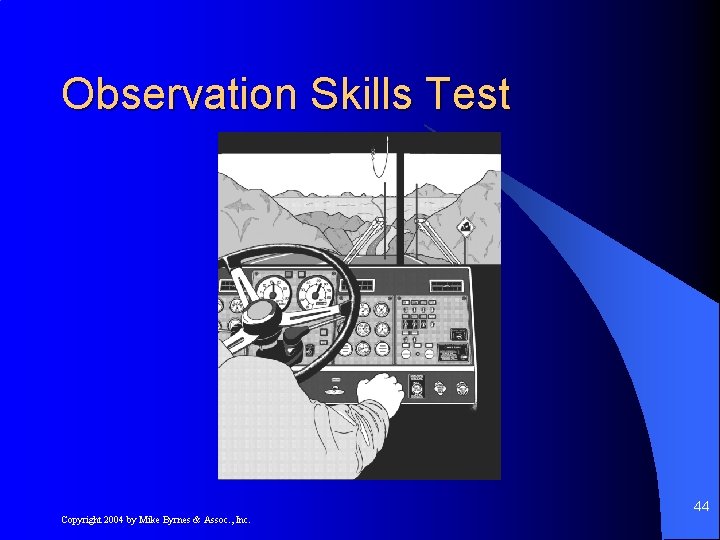
Observation Skills Test 44 Copyright 2004 by Mike Byrnes & Assoc. , Inc.
Summary What auxiliary brakes are l Types of auxiliary brakes l When to use your auxiliary brakes l 45 Copyright 2004 by Mike Byrnes & Assoc. , Inc.
Where to Get More Information l Bumper to Bumper, The Complete Guide to Tractor-Trailer Operations, Chapter 22 46 Copyright 2004 by Mike Byrnes & Assoc. , Inc.
- Slides: 46