
BULLYING VICTIMIZATION RESEARCH AND RECOMMENDED INTERVENTIONS Lead authors
BULLYING VICTIMIZATION RESEARCH AND RECOMMENDED INTERVENTIONS Lead authors: Dr. George Bear, Dr. Lindsey Mantz, and Angela Harris University of Delaware Funding and support from: DE Positive Behavior Support Project – School Climate & Student Success
MODULE STRUCTURE • Module series goal: • Provide information to schools that can lead to improvements in school climate and behavioral outcomes. • Module narratives provide additional information to accompany Power. Point Presentation. • Endnotes throughout slides correspond to the references in the module narrative. • Gold star = Resource on Delaware PBS website
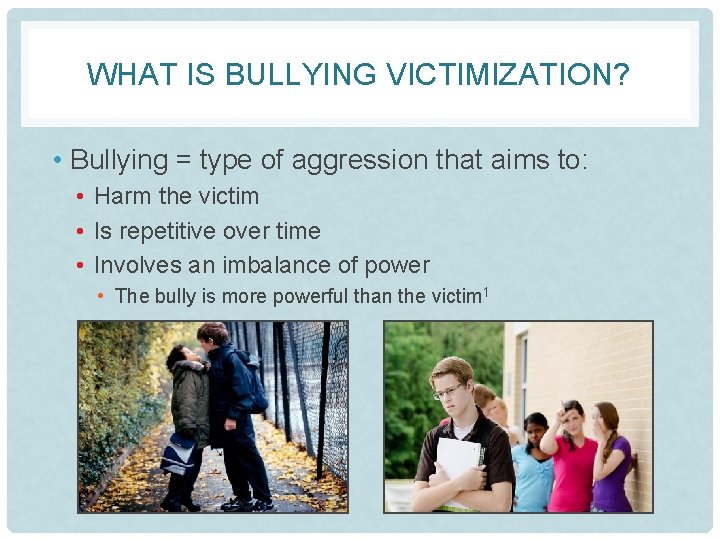
WHAT IS BULLYING VICTIMIZATION? • Bullying = type of aggression that aims to: • Harm the victim • Is repetitive over time • Involves an imbalance of power • The bully is more powerful than the victim 1
BULLYING IN DELAWARE • Delaware law defines bullying as: • Intentional actions that occur in physical, verbal, written, or electronic form towards a student, school employee, or school volunteer that: • cause reasonable fear or substantial harm to the victim’s physical or emotional well-being, or damage to property • are pervasive/persistent or characterized by a power differential that creates a hostile educational environment • interfere with a safe environment • include coercing others to cause the above harmful actions
DELAWARE SCHOOL SURVEYS • Assesses four types of bullying victimization (verbal, physical, social/relational, and cyber) • Delaware Bullying Victimization Scale • Assesses students’ reports of the extent to which they have personally experienced each of the four types of bullying during the current school year • Bullying school-wide subscale on the Delaware School Climate Scale • Assesses bullying in general throughout the school • Items that ask if students bully one another, threaten and bully others, and worry about others bullying them
NEGATIVE EFFECTS OF BULLYING VICTIMIZATION • Greater internalizing problems • E. g. depression, anxiety, and loneliness 1 -12 • Increased risk of suicide ideation, suicide attempts, and self-injury 13 -16 • Increased risk of participation in delinquent and problem behaviors • E. g. substance use, stealing, physical fighting, and vandalism 17 -18 • Greater difficulty making friends and greater risk for social rejection and isolation 1, 15, 19 -20 • Lower social competence 21 • Lower self-esteem 11, 15, 19 and increased levels of selfcriticism 12
NEGATIVE EFFECTS OF BULLYING VICTIMIZATION Less Lower At risk • Attachment or connectedness to school 2, 22 8, • E. g. greater fear, anxiety, and avoidance towards school 23 -25 • Academic engagement, achievement, and classroom concentration 8, 11, 20, 26 -28 • For psychosomatic problems • E. g. headaches, stomach pain, sleeping problems 4
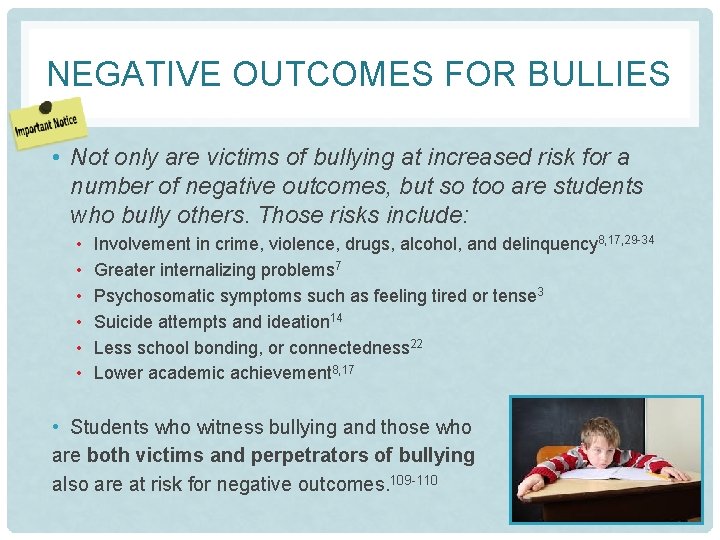
NEGATIVE OUTCOMES FOR BULLIES • Not only are victims of bullying at increased risk for a number of negative outcomes, but so too are students who bully others. Those risks include: • • • Involvement in crime, violence, drugs, alcohol, and delinquency 8, 17, 29 -34 Greater internalizing problems 7 Psychosomatic symptoms such as feeling tired or tense 3 Suicide attempts and ideation 14 Less school bonding, or connectedness 22 Lower academic achievement 8, 17 • Students who witness bullying and those who are both victims and perpetrators of bullying also are at risk for negative outcomes. 109 -110
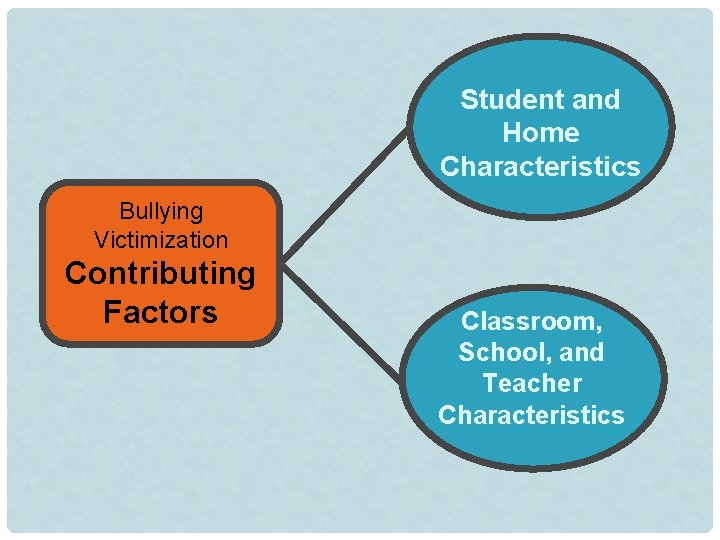
Student and Home Characteristics Bullying Victimization Contributing Factors Classroom, School, and Teacher Characteristics
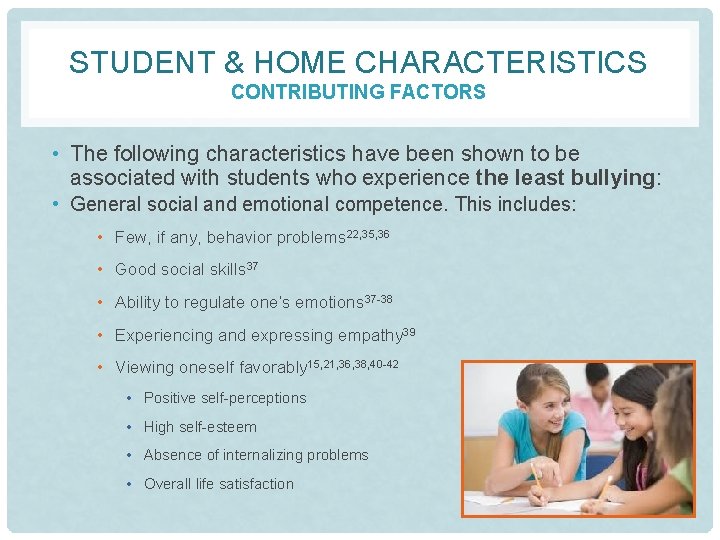
STUDENT & HOME CHARACTERISTICS CONTRIBUTING FACTORS • The following characteristics have been shown to be associated with students who experience the least bullying: • General social and emotional competence. This includes: • Few, if any, behavior problems 22, 35, 36 • Good social skills 37 • Ability to regulate one’s emotions 37 -38 • Experiencing and expressing empathy 39 • Viewing oneself favorably 15, 21, 36, 38, 40 -42 • Positive self-perceptions • High self-esteem • Absence of internalizing problems • Overall life satisfaction
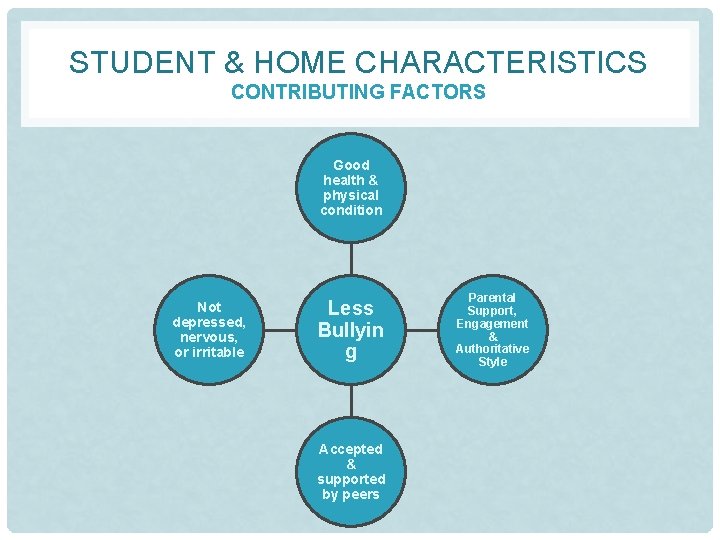
STUDENT & HOME CHARACTERISTICS CONTRIBUTING FACTORS Good health & physical condition Not depressed, nervous, or irritable Less Bullyin g Accepted & supported by peers Parental Support, Engagement & Authoritative Style
STUDENT & HOME CHARACTERISTICS CONTRIBUTING FACTORS • Although not malleable, other characteristics of students place them at increased risk of being bullied: • Students with disabilities, especially those with observable behavior problems 56 -59 • Students who identify as lesbian, gay, bisexual, transgender, or questioning 51, 60 -61 • Mixed results for race 7, 53, 62 -66 • Males tend to experience more bullying (and bully others) more than females (verbal and physical bullying)1, 19, 21, 38, 40, 44, 53, 67 • Females bully and are bullied with more verbal, relational and social forms of bullying 9, 11, 19, 53 • Mixed results for age and grade level 1, 9, 23, 62, 68 -69, 106 • Within the same grade, younger children are bullied more 36 • Mixed results for religion • Muslim & Jewish students more likely to be victims 114 -116

CLASSROOMS, SCHOOLS, AND TEACHERS CONTRIBUTING FACTORS • Less bullying occurs in schools and classrooms characterized by the following: • Positive teacher-student relationships and teacher support 27, 44, 47, 65, 7073 • This includes students: Viewing teachers as disapproving of bullying Believing teachers will respond to bullying Believing teachers are aware of peer group interactions Willing to seek help from teachers for bullying Believing that teachers encourage them to express points of view
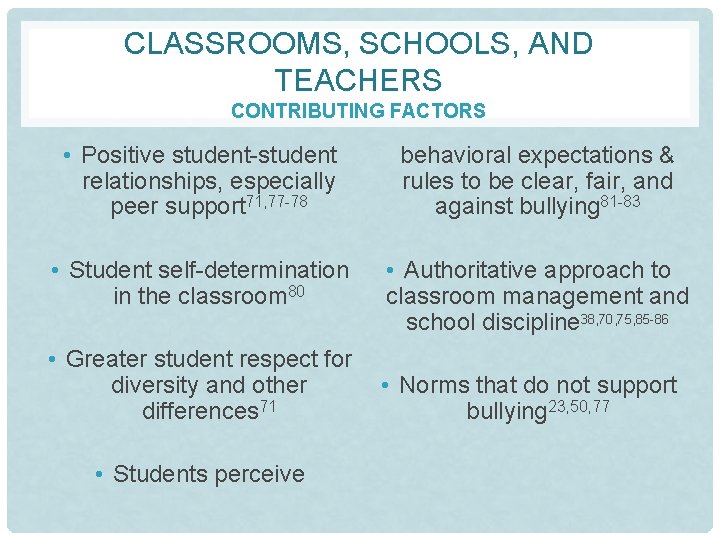
CLASSROOMS, SCHOOLS, AND TEACHERS CONTRIBUTING FACTORS • Positive student-student relationships, especially peer support 71, 77 -78 behavioral expectations & rules to be clear, fair, and against bullying 81 -83 • Student self-determination in the classroom 80 • Authoritative approach to classroom management and school discipline 38, 70, 75, 85 -86 • Greater student respect for diversity and other differences 71 • Students perceive • Norms that do not support bullying 23, 50, 77
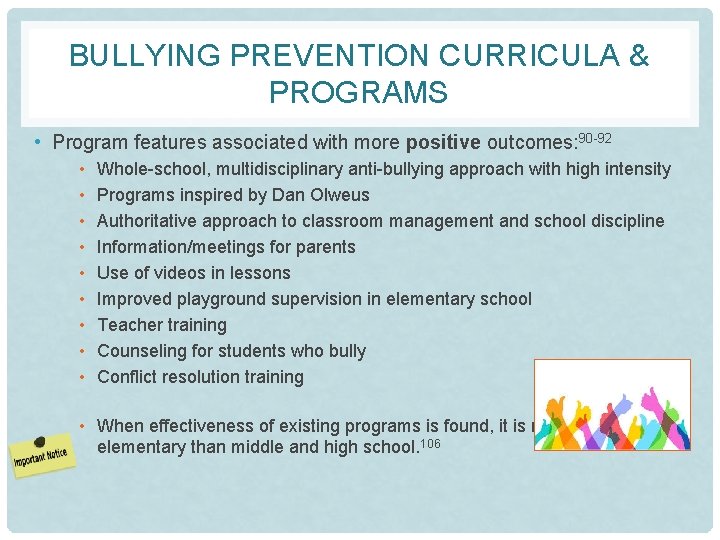
BULLYING PREVENTION CURRICULA & PROGRAMS • Program features associated with more positive outcomes: 90 -92 • • • Whole-school, multidisciplinary anti-bullying approach with high intensity Programs inspired by Dan Olweus Authoritative approach to classroom management and school discipline Information/meetings for parents Use of videos in lessons Improved playground supervision in elementary school Teacher training Counseling for students who bully Conflict resolution training • When effectiveness of existing programs is found, it is more likely to be in elementary than middle and high school. 106
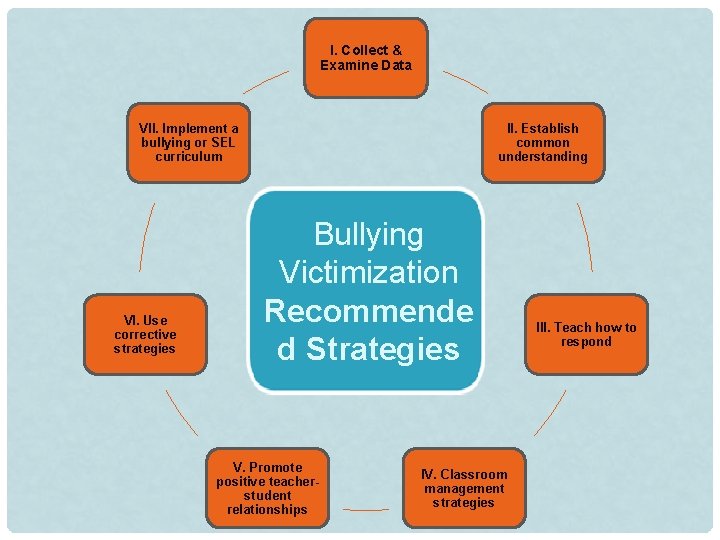
I. Collect & Examine Data VII. Implement a bullying or SEL curriculum VI. Use corrective strategies II. Establish common understanding Bullying Victimization Recommende d Strategies V. Promote positive teacherstudent relationships IV. Classroom management strategies III. Teach how to respond
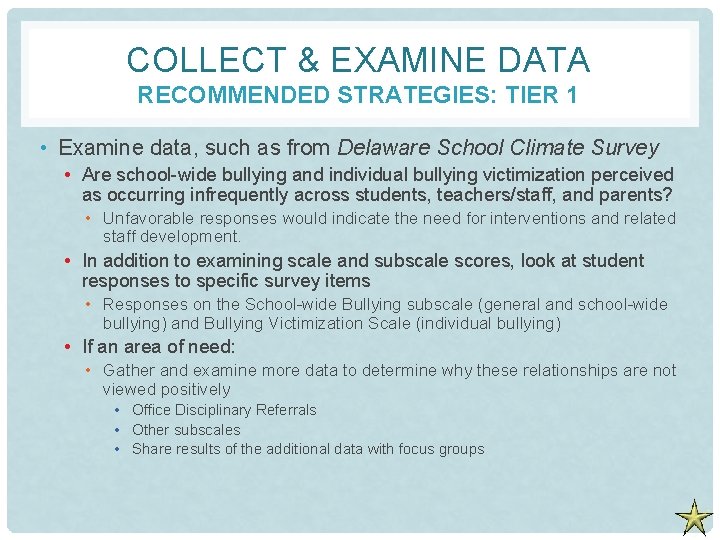
COLLECT & EXAMINE DATA RECOMMENDED STRATEGIES: TIER 1 • Examine data, such as from Delaware School Climate Survey • Are school-wide bullying and individual bullying victimization perceived as occurring infrequently across students, teachers/staff, and parents? • Unfavorable responses would indicate the need for interventions and related staff development. • In addition to examining scale and subscale scores, look at student responses to specific survey items • Responses on the School-wide Bullying subscale (general and school-wide bullying) and Bullying Victimization Scale (individual bullying) • If an area of need: • Gather and examine more data to determine why these relationships are not viewed positively • Office Disciplinary Referrals • Other subscales • Share results of the additional data with focus groups
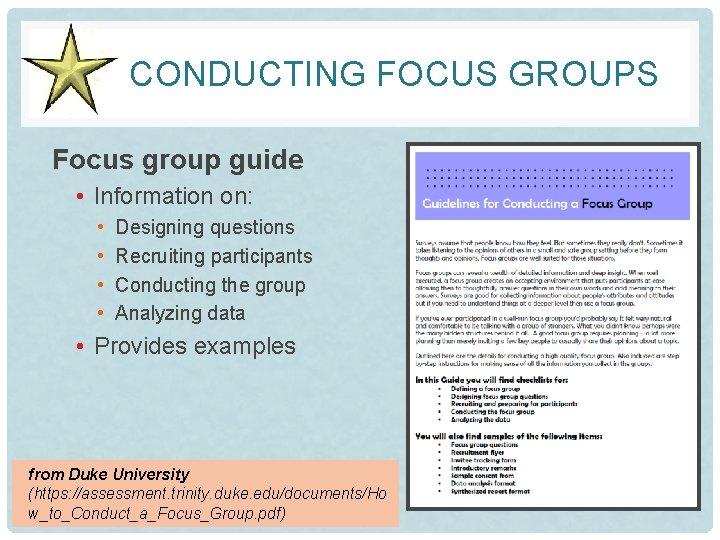
CONDUCTING FOCUS GROUPS Focus group guide • Information on: • • Designing questions Recruiting participants Conducting the group Analyzing data • Provides examples from Duke University (https: //assessment. trinity. duke. edu/documents/Ho w_to_Conduct_a_Focus_Group. pdf)
ESTABLISH COMMON UNDERSTANDING OF BULLYING & ANTI-BULLYING EXPECTATIONS RECOMMENDED STRATEGIES: TIER 1 To do this, schools should… • Have a clear definition & understanding of bullying • Include cyberbullying & the responsibility of the school in such cases • Have teachers & staff reflect upon their own attitudes towards bullying • Teachers, staff, students, and parents should recognize what acts do and do not constitute bullying • Emphasize the consequences of bullying for those who bully and for the victim and school climate
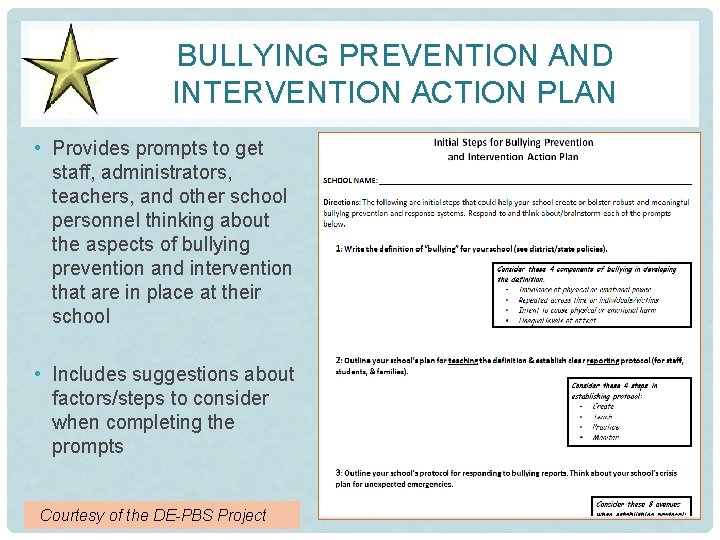
BULLYING PREVENTION AND INTERVENTION ACTION PLAN • Provides prompts to get staff, administrators, teachers, and other school personnel thinking about the aspects of bullying prevention and intervention that are in place at their school • Includes suggestions about factors/steps to consider when completing the prompts Courtesy of the DE-PBS Project
TEACH STUDENTS HOW TO RESPOND TO BULLYING RECOMMENDED STRATEGIES: TIER 1 • Teach students how they might best respond to bullying • Develop an anonymous process by which students can report all forms of bullying, including cyberbullying consequences for students who bully others • Make families aware of procedures and policies • Identify non-classroom areas where bullying is most likely to occur • Develop school-wide expectations that promote prosocial behavior • Encourage school staff to seek out and prevent bullying, aggression, victims of bullying so they receive and peer rejection help • Develop clear and consistent
CLASSROOM MANAGEMENT AND SCHOOL-WIDE STRATEGIES RECOMMENDED STRATEGIES: TIER 1 • Model prosocial behaviors • Use praise and rewards strategically • Ensure there are clear behavioral and academic expectations, routines, and procedures; fair rules & consequences, & monitoring of student behavior • Apply the above to help prevent cyberbullying • Highlight prosocial behavior & the absence of bullying in these expectations • Communicate the importance of social acceptance, the consequences of bullying, and the role of bystanders • Observe peer interactions • Arrange students’ seating to promote opportunities for positive social interactions and social acceptance, and to avoid bullying
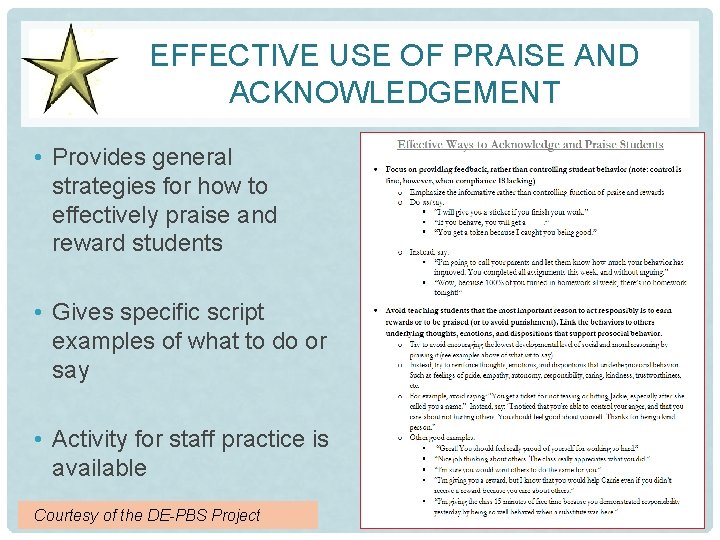
EFFECTIVE USE OF PRAISE AND ACKNOWLEDGEMENT • Provides general strategies for how to effectively praise and reward students • Gives specific script examples of what to do or say • Activity for staff practice is available Courtesy of the DE-PBS Project
STRATEGIES THAT PROMOTE POSITIVE TEACHER-STUDENT RELATIONSHIPS RECOMMENDED STRATEGIES: TIER 1 Spend time with and get to know every student Greet students when they come into school every day Notice when students are having difficulties and listen Treat students equally and do not indicate favorites Allow your students to get to know you better Have fun and use humor, when appropriate Attend sports/extracurricular activities
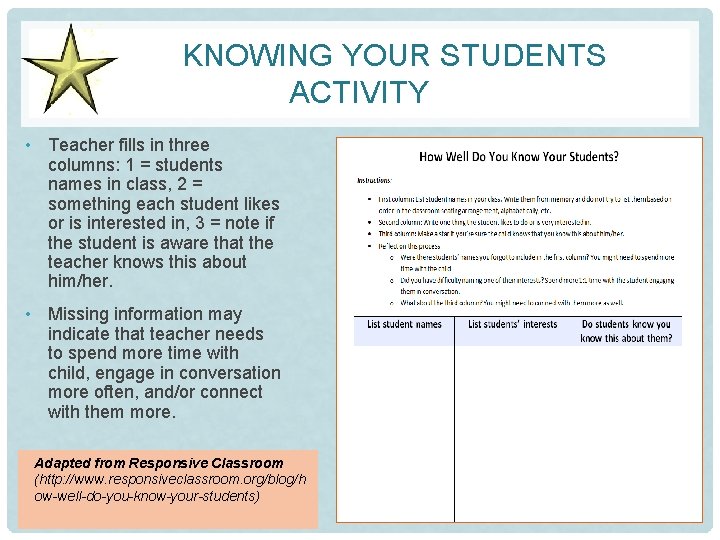
KNOWING YOUR STUDENTS ACTIVITY • Teacher fills in three columns: 1 = students names in class, 2 = something each student likes or is interested in, 3 = note if the student is aware that the teacher knows this about him/her. • Missing information may indicate that teacher needs to spend more time with child, engage in conversation more often, and/or connect with them more. Adapted from Responsive Classroom (http: //www. responsiveclassroom. org/blog/h ow-well-do-you-know-your-students)
USE APPROPRIATE CORRECTIVE STRATEGIES RECOMMENDED STRATEGIES: TIER 1 When minor bullying behaviors are observed… • Correct the behavior immediately • Always combine correction with recognition of positive behaviors • Use inductive discipline • Emphasize impact of the behavior on the victim and relations with others • Communicate that it is the behavior you dislike, not the student • Communicate that it is a shared responsibility to help improve the misbehavior • Communicate optimism that the bullying behavior will not be repeated
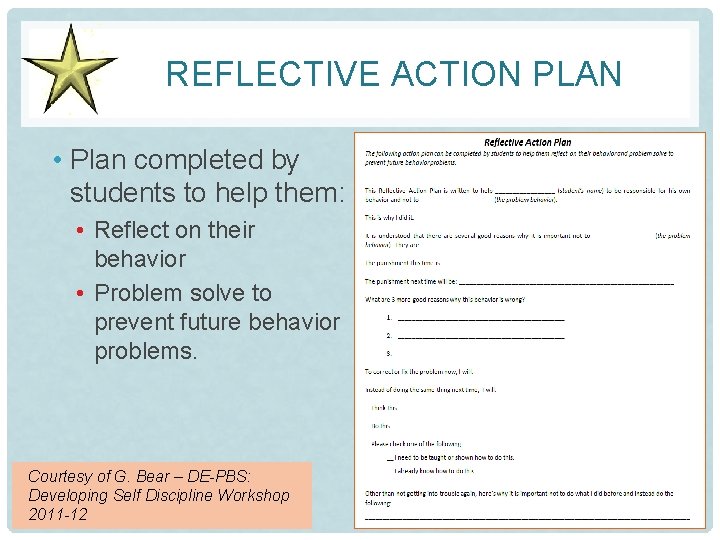
REFLECTIVE ACTION PLAN • Plan completed by students to help them: • Reflect on their behavior • Problem solve to prevent future behavior problems. Courtesy of G. Bear – DE-PBS: Developing Self Discipline Workshop 2011 -12
IMPLEMENT A UNIVERSAL BULLYING PREVENTION OR SEL CURRICULUM RECOMMENDED STRATEGIES: TIER 1 Packaged programs available for purchase/training that are supported by research showing they reduce bullying victimization in elementary schools: • Ki. Va Bullying Prevention Program • Olweus Bullying Prevention Program • Second Step • Focuses on social-emotional skills • Other popular programs (e. g. SWPBIS, Restorative Justice, Bully Proofing Your School, and Second Step: Bullying Prevention Unit) have been shown to lead to positive outcomes but not reduced bullying victimization
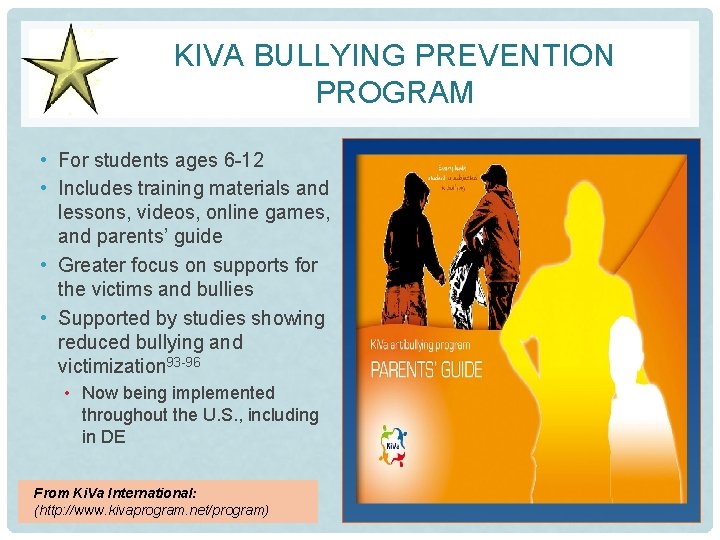
KIVA BULLYING PREVENTION PROGRAM • For students ages 6 -12 • Includes training materials and lessons, videos, online games, and parents’ guide • Greater focus on supports for the victims and bullies • Supported by studies showing reduced bullying and victimization 93 -96 • Now being implemented throughout the U. S. , including in DE From Ki. Va International: (http: //www. kivaprogram. net/program)
d e d n e m m o c s e e i R g e 3 t a & r 2 St r e i T t d u t S a s ent
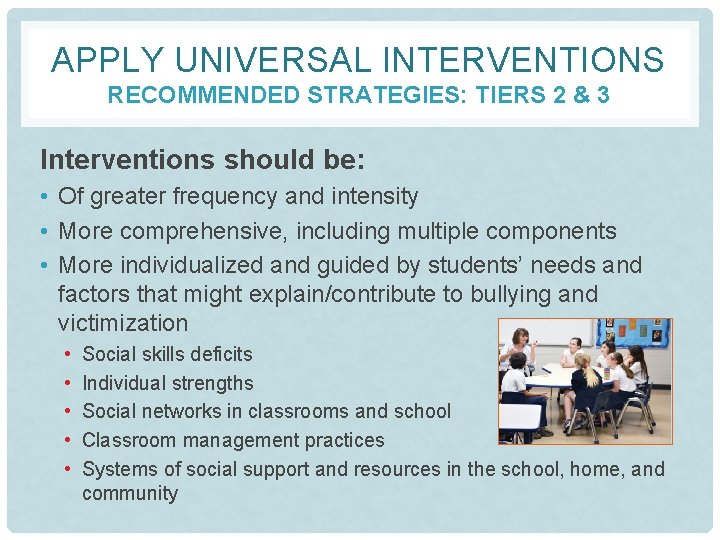
APPLY UNIVERSAL INTERVENTIONS RECOMMENDED STRATEGIES: TIERS 2 & 3 Interventions should be: • Of greater frequency and intensity • More comprehensive, including multiple components • More individualized and guided by students’ needs and factors that might explain/contribute to bullying and victimization • • • Social skills deficits Individual strengths Social networks in classrooms and school Classroom management practices Systems of social support and resources in the school, home, and community
PROVIDE SOCIAL SKILLS/SEL TRAINING RECOMMENDED STRATEGIES: TIERS 2 & 3 • Target specific prosocial skills and antisocial behaviors related to social acceptance, friendships, and bullying victimization • Use lessons from a Tier 1 bullying prevention or SEL curriculum • E. g. Steps to Respect or Second Step • Use evidence-based curriculum lessons designed for use at Tiers 2 and 3 • E. g. Incredible Years, Coping Power, and PEERS • Include training for targeted students and their parents • Use caution in grouping students together (i. e. in Tier 2 interventions) who share similar antisocial behaviors. This may result in “deviancy training, ” with peers modeling and reinforcing antisocial behavior 104 -105
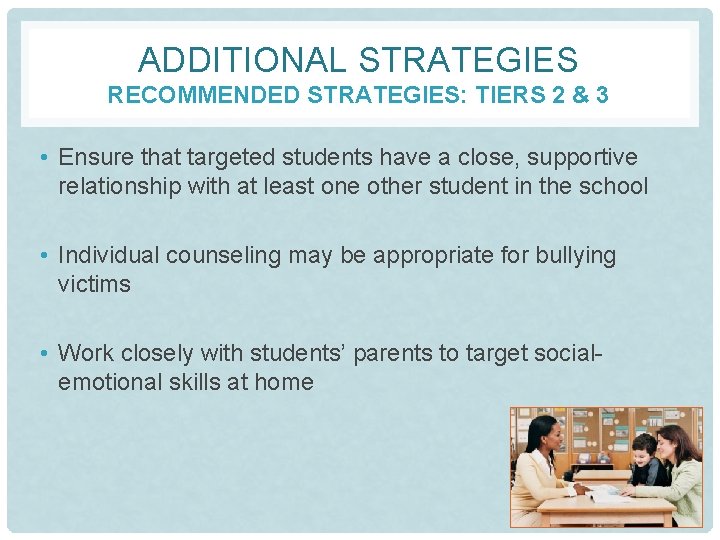
ADDITIONAL STRATEGIES RECOMMENDED STRATEGIES: TIERS 2 & 3 • Ensure that targeted students have a close, supportive relationship with at least one other student in the school • Individual counseling may be appropriate for bullying victims • Work closely with students’ parents to target socialemotional skills at home
n a l ap g o n d i o k t a g M s goin y b i s o Wh t action a h ? w n e wh
THANK YOU • Based on areas of need identified by data, check out other resources provided through the School Climate and Student Success Module Series. • www. delawarepbs. org • Questions can be directed to Sarah Hearn • skhearn@udel. edu
BULLYING VICTIMIZATION • Lead Authors: Dr. George Bear, Dr. Lindsey Mantz, and Angela Harris, M. A. • University of Delaware & Delaware Positive Behavior Support Project • Research Narrative Reviewed by: Dr. Michelle Demarary • Northern Illinois University • Power. Point Developed and Reviewed by: Angela Harris, M. A. , Sarah Hearn, M. Ed. , and Laura Davidson, M. A. • University of Delaware & Delaware Positive Behavior Support Project • Audio Recorded by: Sydney Morales, M. A. • University of Delaware & Delaware Positive Behavior Support Project • Funding and Support from: The Delaware Department of Education through the Delaware Positive Behavior Support Project and the School Climate and Student Success Grant
- Slides: 36