
Bullying Prevention in a PBi S School Drawn
Bullying Prevention in a PBi. S School Drawn from the Olweus Bully Prevention Program and the work on Bully Prevention of Stiller, Bruce , Ross, Scott , Horner, Robert H.
“Bullying. . . ” A student is being bullied when he or she is exposed, repeatedly and over time, to negative actions on the part of one or more students. © The Olweus Bullying Prevention Group, 2004
Bullying involves an imbalance in power or strength. The student who is bullied has difficulty defending himself/herself. © The Olweus Bullying Prevention Group, 2004
Web Sites l http: //www. pbis. org/pbis_resource_detail_ page. aspx? PBIS_Resource. ID=785 l http: //www. clemson. edu/olweus/
Big Ideas from PBIS l All “bully proofing” skills are more effective if the school has first established a set of POSITIVE school-wide behavioral expectations. l Great care is needed to prevent a “bullyproofing” effort from becoming a “bullytraining” program.
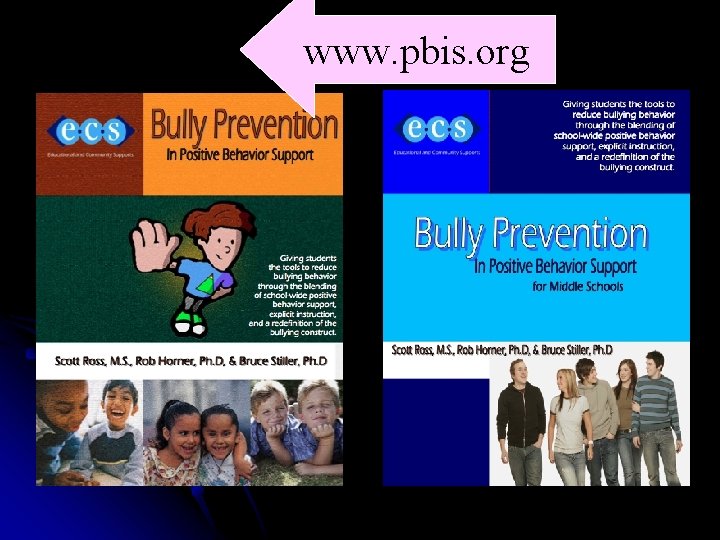
www. pbis. org
The Olweus Bullying Prevention Program © The Olweus Bullying Prevention Group, 2004
Similarities of Two Approaches School-wide effort l Teaching of skills critical l Guided by school-wide rules l Multi-year effort l Targeted strategies for student who bully and targets of bullying l Harness the power of the observer (peers) l Guided by data l
Differences l l Olweus’s first rule is, We Don’t Bully Others PBS rule names the desired behavior, we treat others with respect PBS teaches a stop signal from target to bully Olweus emphasizes role of bystanders in supporting the target. Does not create expectation for the target to confront the bully
Bullying involves an imbalance in power or strength. The student who is bullied has difficulty defending himself/herself. © The Olweus Bullying Prevention Group, 2004
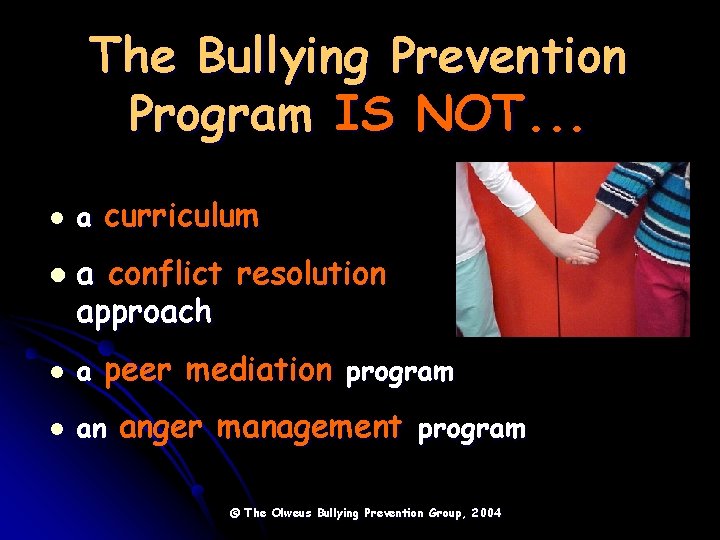
The Bullying Prevention Program IS NOT. . . l l a curriculum a conflict resolution approach l a peer mediation program l an anger management program © The Olweus Bullying Prevention Group, 2004
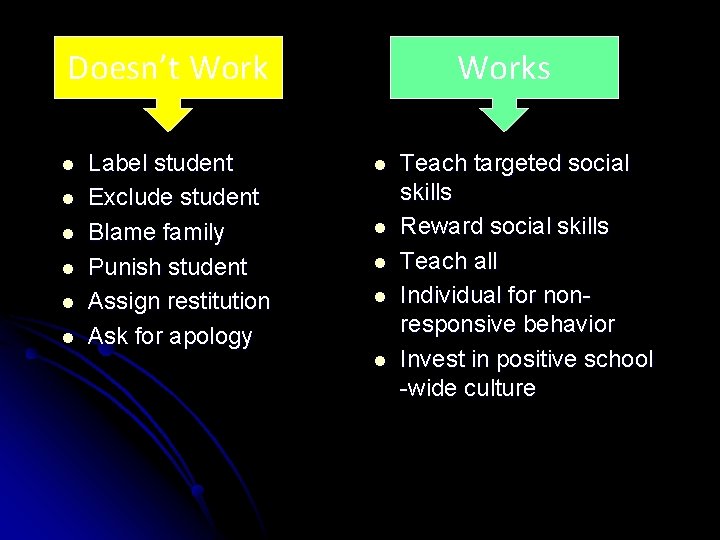
Doesn’t Work l l l Label student Exclude student Blame family Punish student Assign restitution Ask for apology Works l l l Teach targeted social skills Reward social skills Teach all Individual for nonresponsive behavior Invest in positive school -wide culture

PBIS l Step 1: Establish a social culture l Teach school-wide behavioral expectations Be respectful, be responsible, be safe Teach all students a “stop” response If someone is disrespectful to you If someone is disrespectful to someone you are with l Teach “walking away” l Teach what to do if someone asks you to “stop” l
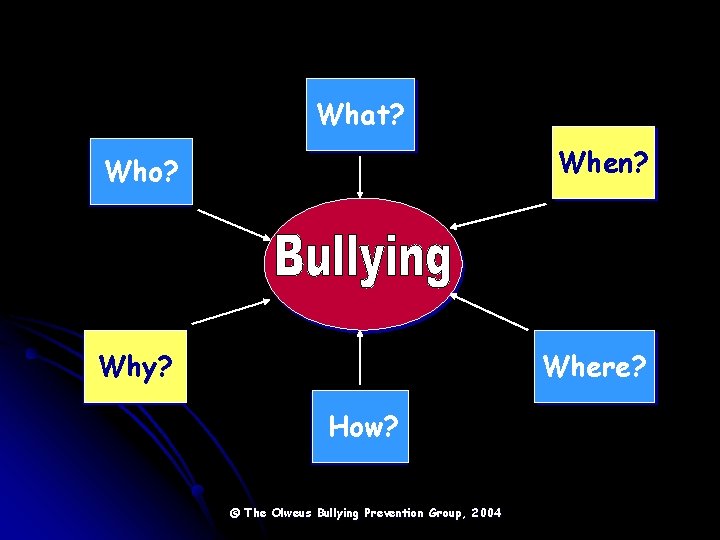
What? Who? When? Why? Where? How? © The Olweus Bullying Prevention Group, 2004
BULLYING = PEER ABUSE © The Olweus Bullying Prevention Group, 2004
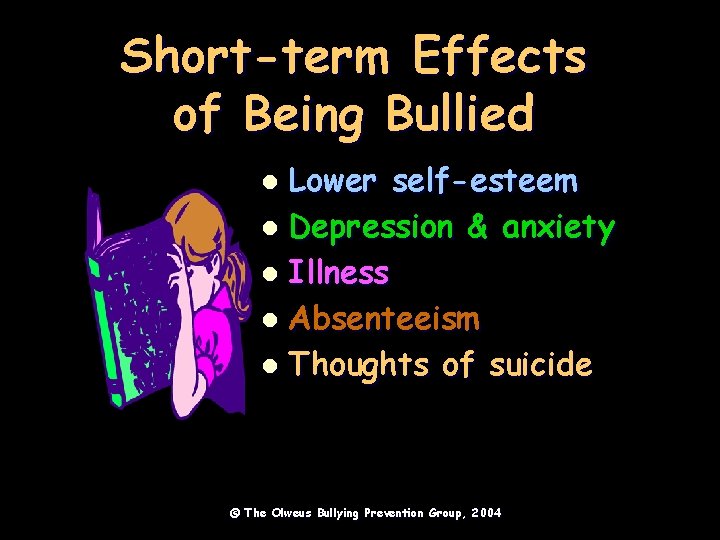
Short-term Effects of Being Bullied Lower self-esteem l Depression & anxiety l Illness l Absenteeism l Thoughts of suicide l © The Olweus Bullying Prevention Group, 2004
Lasting Effects of Being Bullied l Lower self-esteem l Higher rates of depression l Higher rates of Post Traumatic Stress © The Olweus Bullying Prevention Group, 2004
Bullying Behavior l l l Often part of a conductdisordered behavior pattern This pattern may continue into young adulthood Olweus study: Were 4 times as likely to have 3 or more convictions by age 24 © The Olweus Bullying Prevention Group, 2004
8. True or False? l Most students who observe bullying don’t think they should get involved. False B © The Olweus Bullying Prevention Group, 2004
Kids Who Observe (Melton et al. , 1998) What do you usually do when you see a student being bullied? l l l 38% Nothing--I think the bullying is OK/I take part/I just watch 27% I don’t do anything, but I think I should help 35% I try to help him or her © The Olweus Bullying Prevention Group, 2004
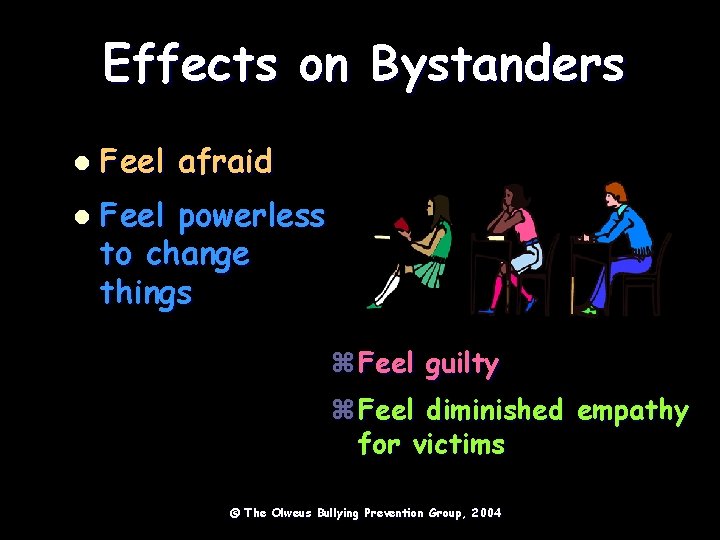
Effects on Bystanders l l Feel afraid Feel powerless to change things z Feel guilty z Feel diminished empathy for victims © The Olweus Bullying Prevention Group, 2004
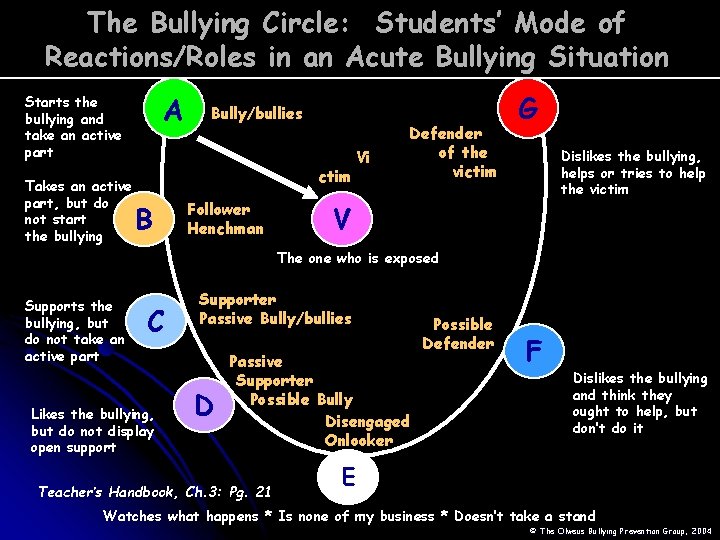
The Bullying Circle: Students’ Mode of Reactions/Roles in an Acute Bullying Situation A Starts the bullying and take an active part Takes an active part, but do not start the bullying Bully/bullies ctim B Follower Henchman Vi Defender of the victim G Dislikes the bullying, helps or tries to help the victim V The one who is exposed Supports the bullying, but do not take an active part C Likes the bullying, but do not display open support Supporter Passive Bully/bullies D Passive Supporter Possible Bully Disengaged Onlooker Teacher’s Handbook, Ch. 3: Pg. 21 Possible Defender F Dislikes the bullying and think they ought to help, but don’t do it E Watches what happens * Is none of my business * Doesn’t take a stand © The Olweus Bullying Prevention Group, 2004
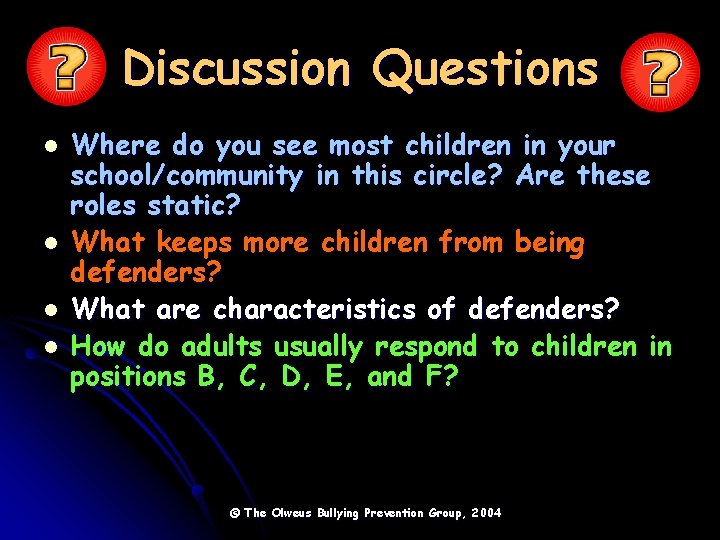
Discussion Questions l l Where do you see most children in your school/community in this circle? Are these roles static? What keeps more children from being defenders? What are characteristics of defenders? How do adults usually respond to children in positions B, C, D, E, and F? © The Olweus Bullying Prevention Group, 2004
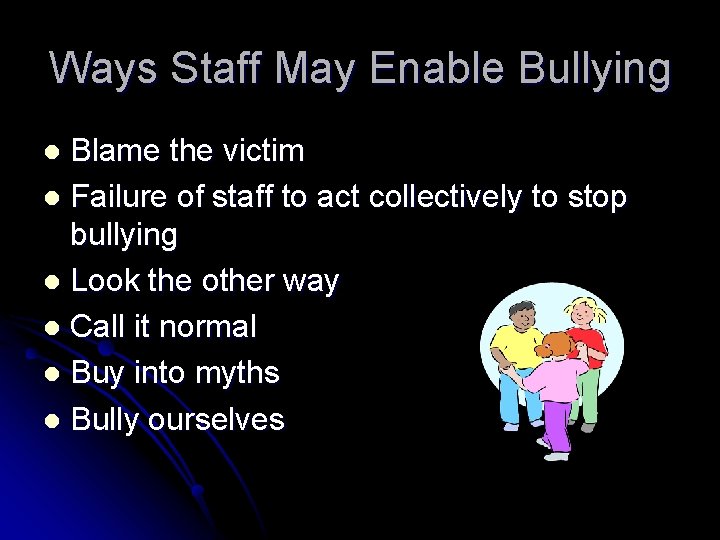
Ways Staff May Enable Bullying Blame the victim l Failure of staff to act collectively to stop bullying l Look the other way l Call it normal l Buy into myths l Bully ourselves l
Top Ten Strategies for Effective Bullying Prevention HRSA's National Bullying Prevention Campaign, 2004
Effective Bullying Prevention Strategy #1 ü Focus on the whole school environment HRSA's National Bullying Prevention Campaign, 2004
Effective Bullying Prevention Strategy #2 ü Assess bullying at your school HRSA's National Bullying Prevention Campaign, 2004
Effective Bullying Prevention Strategy #3 ü Garner staff/parent support HRSA's National Bullying Prevention Campaign, 2004
Effective Bullying Prevention Strategy #4 ü Form a group at school to coordinate bullying prevention/ intervention activities HRSA's National Bullying Prevention Campaign, 2004
Effective Bullying Prevention Strategy #5 ü Provide training for ALL staff members HRSA's National Bullying Prevention Campaign, 2004
Effective Bullying Prevention Strategy #6 ü Establish and enforce school rules and policies regarding bullying HRSA's National Bullying Prevention Campaign, 2004
Against Bullying l l We will not bully others. We will try to help students who are bullied. We will make it a point to include students who are easily left out. When we know somebody is being bullied, we will tell an adult at school and an adult at home. © The Olweus Bullying Prevention Group, 2004
Effective Bullying Prevention Strategy #7 ü Increase adult supervision in “hot spots” for bullying HRSA's National Bullying Prevention Campaign, 2004
The “Teachable Moment” Stop the bullying l Support the victim l Name the bullying behavior l Refer to the school rules l Impose immediate consequences (if appropriate) l Empower the bystander l
The “Teachable Moment” Stop the bullying l Support the victim l Name the bullying behavior l Refer to the school rules l Impose immediate consequences (if appropriate) l Empower the bystander l
Effective Bullying Prevention Strategy #8 ü Intervene consistently and appropriately in bullying incidents HRSA's National Bullying Prevention Campaign, 2004
Effective Bullying Prevention Strategy #9 ü Focus some classroom time on bullying prevention and intervention HRSA's National Bullying Prevention Campaign, 2004
Effective Bullying Prevention Strategy #10 ü Continue efforts over time HRSA's National Bullying Prevention Campaign, 2004
Recommendations l l Focus on bullying once there is fidelity with the universal implementation of PBi. S Add bullying rules to the matrix in all environments Teach students about bullying and the bullying rules and give them the tools (reporting, helping those who are bullied, including all in activities) to help In year two of PBS effort survey staff and students about bullying in your school
More Recommendations Teach all staff how to intervene when they see bullying l Increase adult supervision in hot spots. l Develop targeted strategies to counsel students who bully and support for students who are targets l
• Olweus Bullying Prevention Program web site, Clemson University http: //www. clemson. edu/olweus/ • HRSA Anti-Bullying Campaign web site: http: //www. stopbullyingnow. hrsa. gov/ • SAMHSA, 15 Plus Campaign website: http: //www. mentalhealth. samhsa. gov/15 plus © The Olweus Bullying Prevention Group, 2004
Too often we underestimate the power of a smile, a kind word, a listening ear, an honest compliment, or the smallest act of caring, all of which have the potential to turn a life around. - Leo Buscaglia
- Slides: 42