
Bulletproof Transient Error Handling with Polly Transient Errors

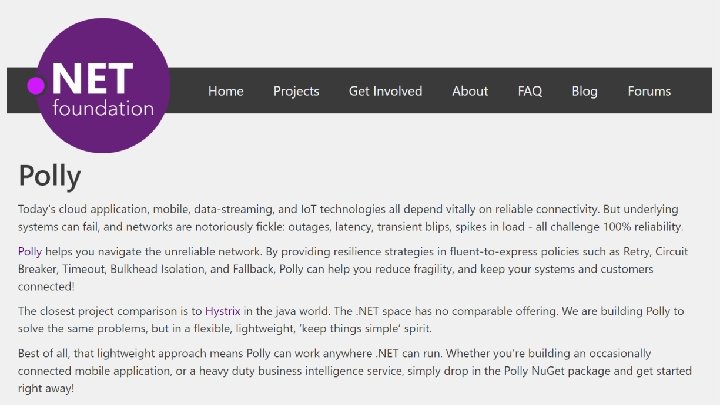
Bulletproof Transient Error Handling with Polly

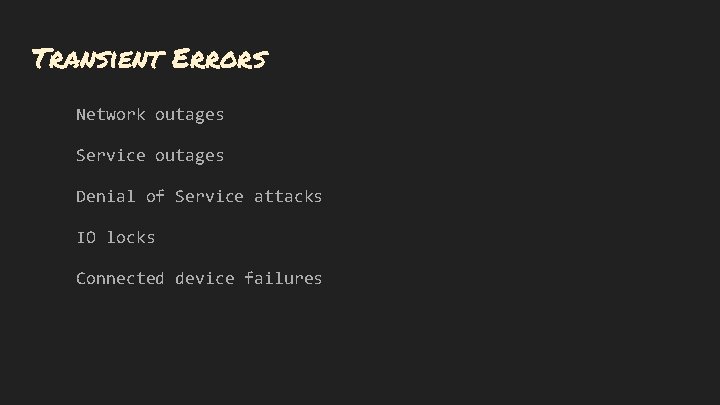
Transient Errors Network outages Service outages Denial of Service attacks IO locks Connected device failures
What happens when you flood a struggling service with requests?

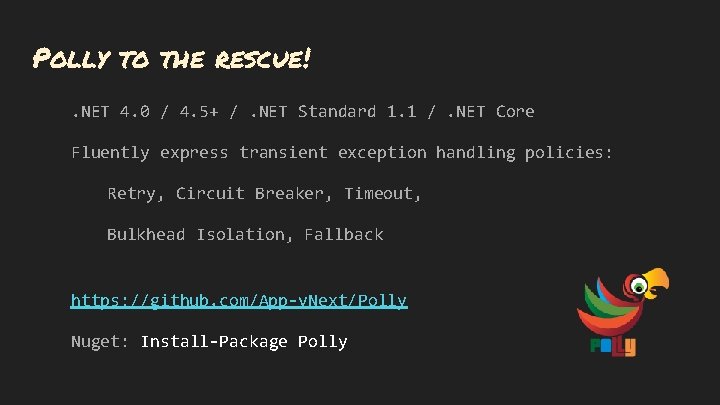
Polly to the rescue!. NET 4. 0 / 4. 5+ /. NET Standard 1. 1 /. NET Core Fluently express transient exception handling policies: Retry, Circuit Breaker, Timeout, Bulkhead Isolation, Fallback https: //github. com/App-v. Next/Polly Nuget: Install-Package Polly
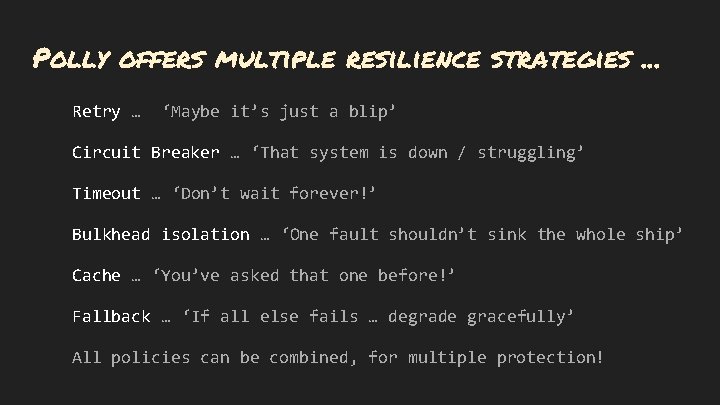
Polly offers multiple resilience strategies. . . Retry … ‘Maybe it’s just a blip’ Circuit Breaker … ‘That system is down / struggling’ Timeout … ‘Don’t wait forever!’ Bulkhead isolation … ‘One fault shouldn’t sink the whole ship’ Cache … ‘You’ve asked that one before!’ Fallback … ‘If all else fails … degrade gracefully’ All policies can be combined, for multiple protection!
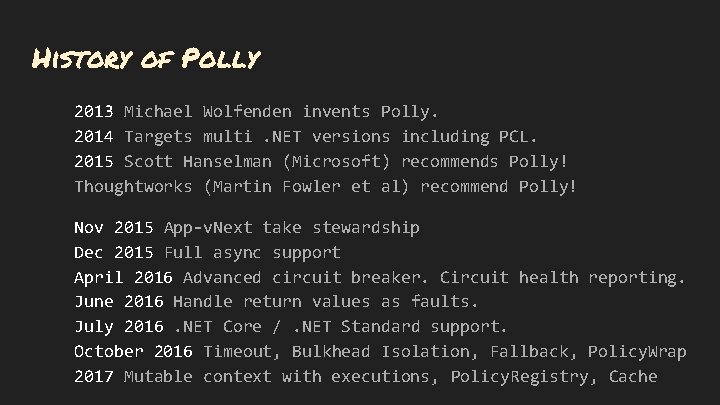
History of Polly 2013 Michael Wolfenden invents Polly. 2014 Targets multi. NET versions including PCL. 2015 Scott Hanselman (Microsoft) recommends Polly! Thoughtworks (Martin Fowler et al) recommend Polly! Nov 2015 App-v. Next take stewardship Dec 2015 Full async support April 2016 Advanced circuit breaker. Circuit health reporting. June 2016 Handle return values as faults. July 2016. NET Core /. NET Standard support. October 2016 Timeout, Bulkhead Isolation, Fallback, Policy. Wrap 2017 Mutable context with executions, Policy. Registry, Cache
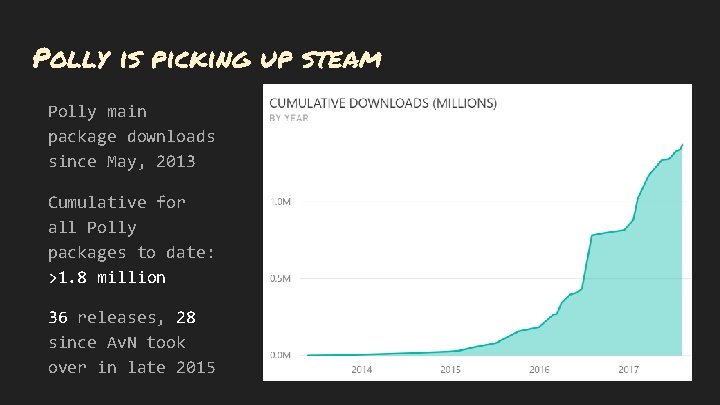
Polly is picking up steam Polly main package downloads since May, 2013 Cumulative for all Polly packages to date: >1. 8 million 36 releases, 28 since Av. N took over in late 2015
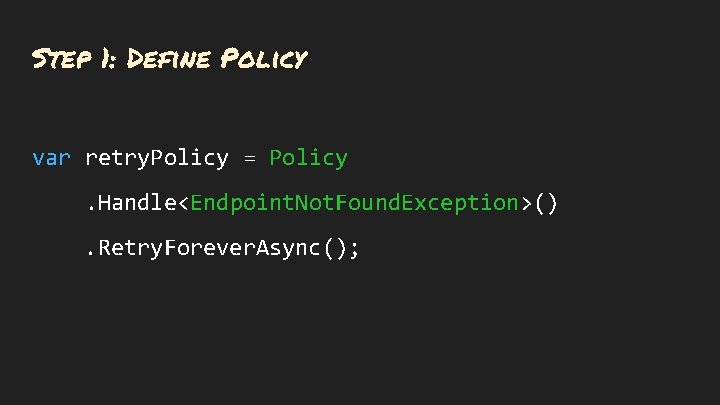
Step 1: Define Policy var retry. Policy = Policy. Handle<Endpoint. Not. Found. Exception>(). Retry. Forever. Async();
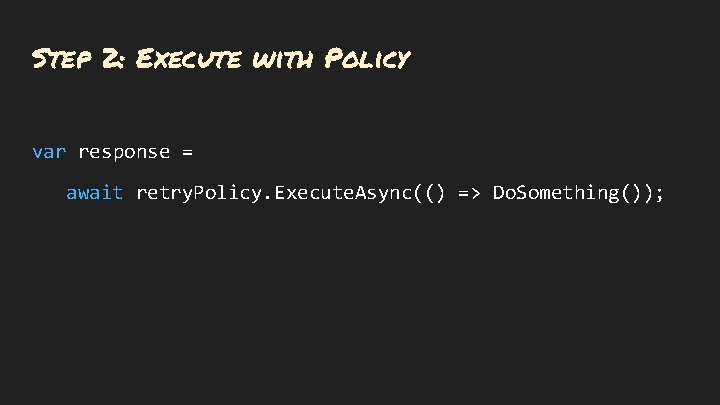
Step 2: Execute with Policy var response = await retry. Policy. Execute. Async(() => Do. Something());

Retry Patterns Retry immediately on failure. Specify number of retries. Wait and Retry with a timeout in between each try. Change the timeout between each retry, eg exponential backoff. Retry Forever Keep retrying until succeeds. Retry addresses. . . ‘It’s probably a blip. go - it might succeed. ’ Give it another
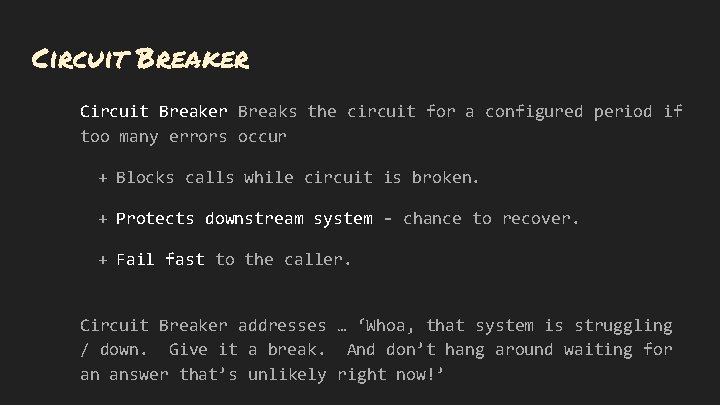
Circuit Breaker Breaks the circuit for a configured period if too many errors occur + Blocks calls while circuit is broken. + Protects downstream system - chance to recover. + Fail fast to the caller. Circuit Breaker addresses … ‘Whoa, that system is struggling / down. Give it a break. And don’t hang around waiting for an answer that’s unlikely right now!’
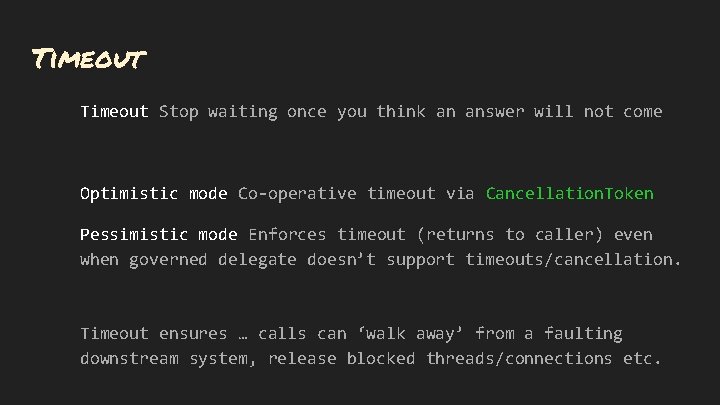
Timeout Stop waiting once you think an answer will not come Optimistic mode Co-operative timeout via Cancellation. Token Pessimistic mode Enforces timeout (returns to caller) even when governed delegate doesn’t support timeouts/cancellation. Timeout ensures … calls can ‘walk away’ from a faulting downstream system, release blocked threads/connections etc.
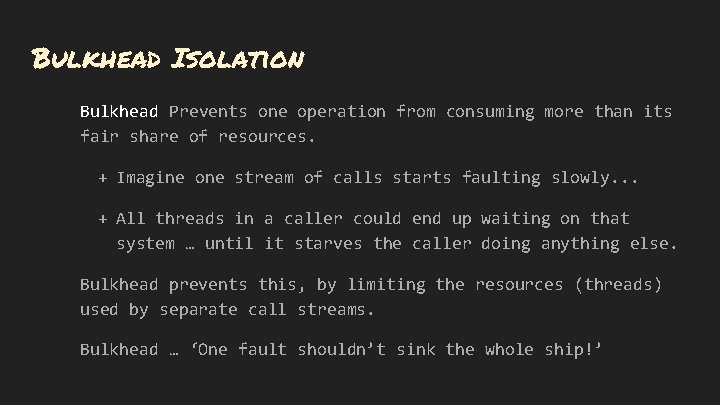
Bulkhead Isolation Bulkhead Prevents one operation from consuming more than its fair share of resources. + Imagine one stream of calls starts faulting slowly. . . + All threads in a caller could end up waiting on that system … until it starves the caller doing anything else. Bulkhead prevents this, by limiting the resources (threads) used by separate call streams. Bulkhead … ‘One fault shouldn’t sink the whole ship!’
Read-through Cache A certain proportion of calls will be duplicates. Serve from cache if you can - reduce latency and save calls. + Pluggable interface – simple to add any cache provider you like + Eg Memory. Cache, Redis, Azure, Amazon Cache, etc + Extension point for serialization/deserialization Cache addresses … ‘You’ve asked that one before!’
Fallback Specifies a substitute value to provide (or action to run) when an operation still fails. Fallback addresses … ‘Failures will occur … prepare how you will respond when that happens’
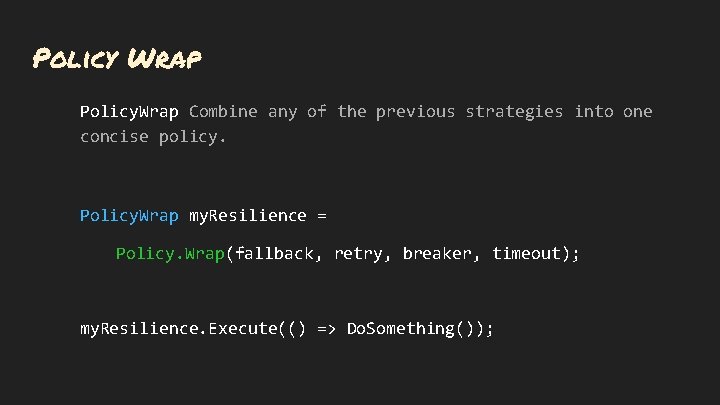
Policy Wrap Policy. Wrap Combine any of the previous strategies into one concise policy. Policy. Wrap my. Resilience = Policy. Wrap(fallback, retry, breaker, timeout); my. Resilience. Execute(() => Do. Something());
Policy Basics Define how transient exceptions should be handled Fluent and concise Thread-safe Reusable across call sites Sync and async Chain policies together Apply to any Action or Func (service calls, data stores, web requests, mobile connectivity)
Demos https: //github. com/App-v. Next/Polly-Samples
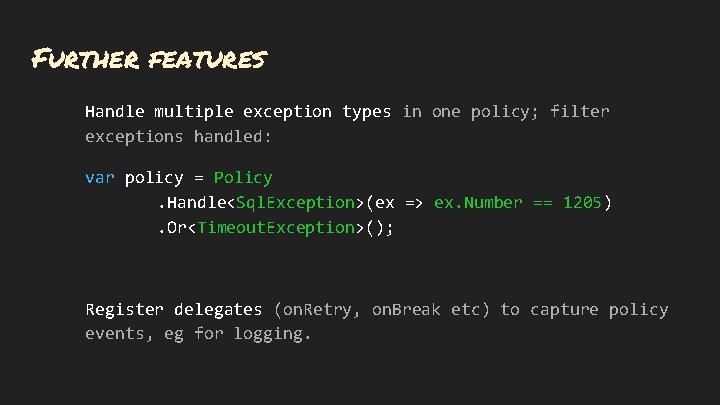
Further features Handle multiple exception types in one policy; filter exceptions handled: var policy = Policy. Handle<Sql. Exception>(ex => ex. Number == 1205). Or<Timeout. Exception>(); Register delegates (on. Retry, on. Break etc) to capture policy events, eg for logging.
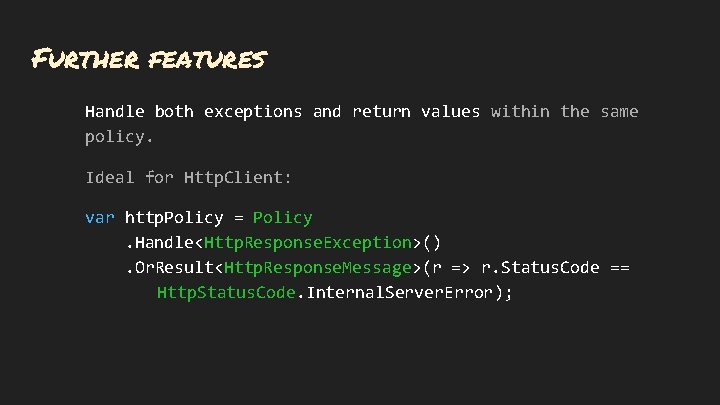
Further features Handle both exceptions and return values within the same policy. Ideal for Http. Client: var http. Policy = Policy. Handle<Http. Response. Exception>(). Or. Result<Http. Response. Message>(r => r. Status. Code == Http. Status. Code. Internal. Server. Error);
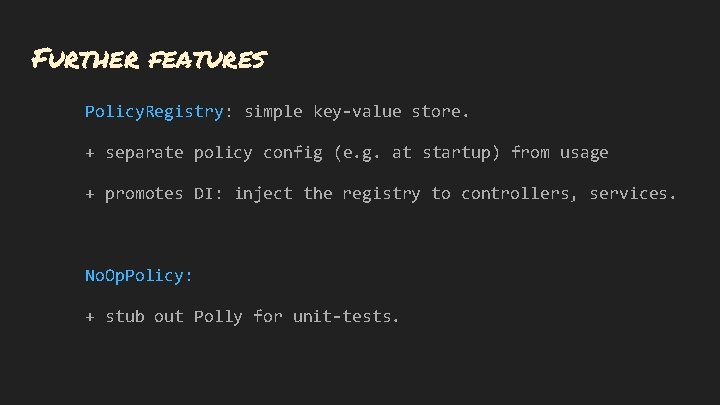
Further features Policy. Registry: simple key-value store. + separate policy config (e. g. at startup) from usage + promotes DI: inject the registry to controllers, services. No. Op. Policy: + stub out Polly for unit-tests.
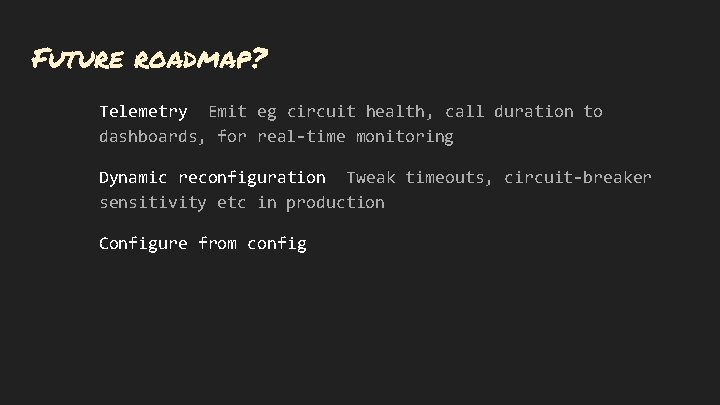
Future roadmap? Telemetry Emit eg circuit health, call duration to dashboards, for real-time monitoring Dynamic reconfiguration Tweak timeouts, circuit-breaker sensitivity etc in production Configure from config
Polly Wiki Future Roadmap Extended documentation Configuration recommendations Patterns Unit-testing strategies https: //github. com/App-v. Next/Polly/wiki
Polly Slack channel and Blog http: //www. pollytalk. org/ (slack) Ask questions Discuss the roadmap http: //www. thepollyproject. org/ (blog) Project updates, the inside track
App v. Next Polly team Carl Franklin. NET Rocks, Music to Code By Joel Hulen Enterprise software and cloud architect Dylan Reisenberger. NET, enterprise architect, special interest in microservices, messaging, cloud, resilience. … and all you folks who want to make open-source contributions … https: //github. com/App-v. Next/Polly/

THANK YOU!
- Slides: 29