
Buildings University Innovators and Leaders Development BUILD 2015
Buildings University Innovators and Leaders Development (BUILD) 2015 Funding Opportunity Announcement: DE-FOA-0001167 Webinar: Nov 19, 2014 Pat Phelan Program Manager, Emerging Technologies Building Technologies Office
None of the information presented here is legally binding. The content included in this presentation is only intended to summarize the contents of funding opportunity DE-FOA-0001167. Any content within this presentation that appears inconsistent from the FOA language is superseded by the FOA language. All Applicants are strongly encouraged to carefully read the FOA guidelines and adhere to them. Neither the U. S. Department of Energy (DOE) nor the Federal employees associated with DOE working on this presentation shall be held liable for errors committed by applicants based on potentially incorrect or inaccurate information presented herein. NOTE: It is DOE policy that employees cannot communicate directly with individual potential applicants. All technical questions on the FOA or the application process must be submitted through the FAQ located on the Funding Opportunity Exchange website at: https: //eere-exchange. energy. gov/“ or other specific questions to BUILDFOA@hq. doe. gov 2
What is a Funding Opportunity Announcement? 1. Contains instructions for potential applicants; 2. Provides the objectives of the funding opportunity; 3. Outlines directions for successfully submitting the application: – Eligibility, – Required documents, – Technical objectives, – Review criteria and scoring; and 4. Includes conditions associated with federal funding. 3
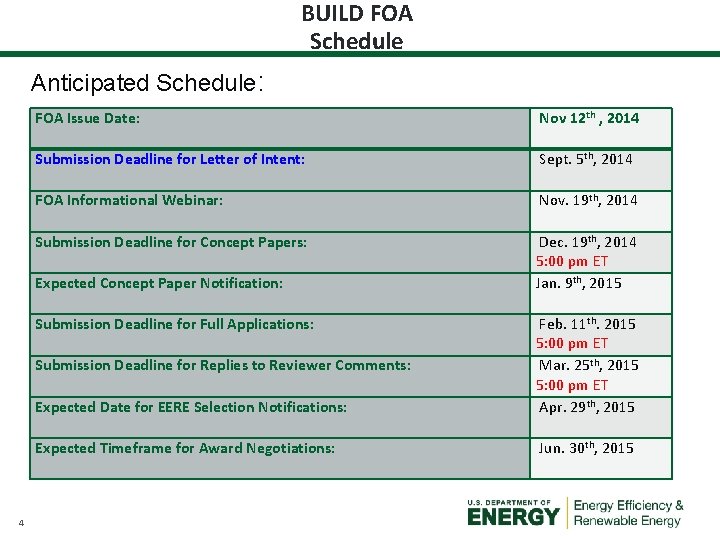
BUILD FOA Schedule Anticipated Schedule: FOA Issue Date: Nov 12 th , 2014 Submission Deadline for Letter of Intent: Sept. 5 th, 2014 FOA Informational Webinar: Nov. 19 th, 2014 Submission Deadline for Concept Papers: Dec. 19 th, 2014 5: 00 pm ET Jan. 9 th, 2015 Expected Concept Paper Notification: Submission Deadline for Full Applications: Expected Date for EERE Selection Notifications: Feb. 11 th. 2015 5: 00 pm ET Mar. 25 th, 2015 5: 00 pm ET Apr. 29 th, 2015 Expected Timeframe for Award Negotiations: Jun. 30 th, 2015 Submission Deadline for Replies to Reviewer Comments: 4
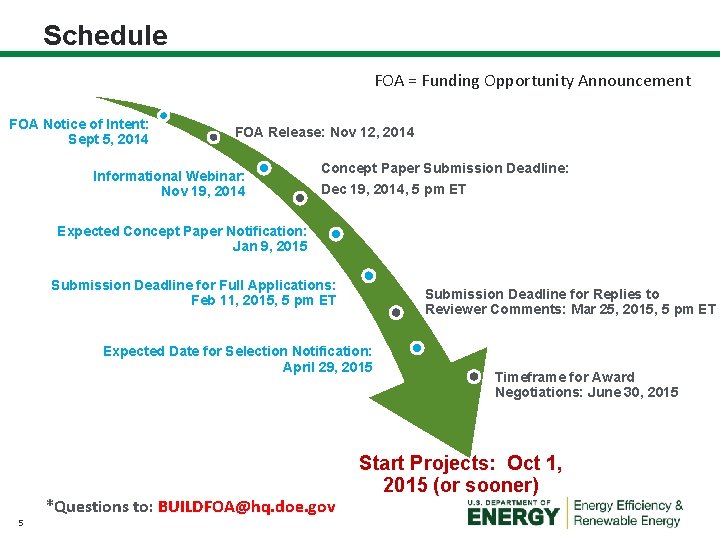
Schedule FOA = Funding Opportunity Announcement FOA Notice of Intent: Sept 5, 2014 FOA Release: Nov 12, 2014 Informational Webinar: Nov 19, 2014 Concept Paper Submission Deadline: Dec 19, 2014, 5 pm ET Expected Concept Paper Notification: Jan 9, 2015 Submission Deadline for Full Applications: Feb 11, 2015, 5 pm ET Submission Deadline for Replies to Reviewer Comments: Mar 25, 2015, 5 pm ET Expected Date for Selection Notification: April 29, 2015 5 *Questions to: BUILDFOA@hq. doe. gov Timeframe for Award Negotiations: June 30, 2015 Start Projects: Oct 1, 2015 (or sooner)
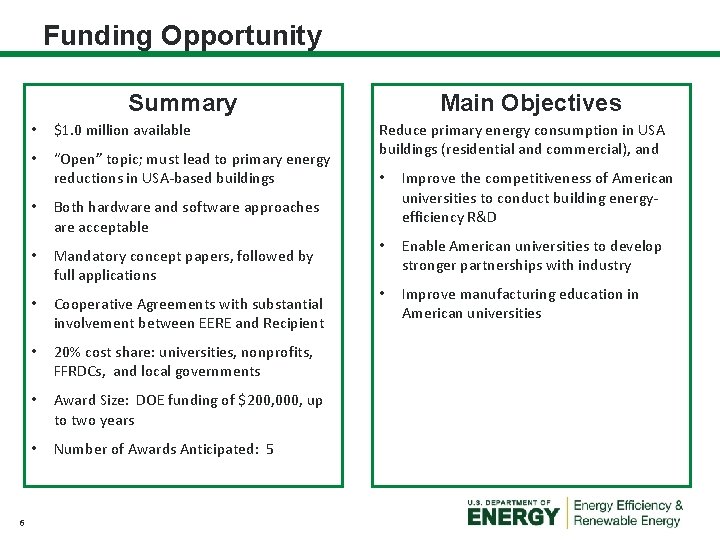
Funding Opportunity Summary 6 • $1. 0 million available • “Open” topic; must lead to primary energy reductions in USA-based buildings • Both hardware and software approaches are acceptable • Mandatory concept papers, followed by full applications • Cooperative Agreements with substantial involvement between EERE and Recipient • 20% cost share: universities, nonprofits, FFRDCs, and local governments • Award Size: DOE funding of $200, 000, up to two years • Number of Awards Anticipated: 5 Main Objectives Reduce primary energy consumption in USA buildings (residential and commercial), and • Improve the competitiveness of American universities to conduct building energyefficiency R&D • Enable American universities to develop stronger partnerships with industry • Improve manufacturing education in American universities
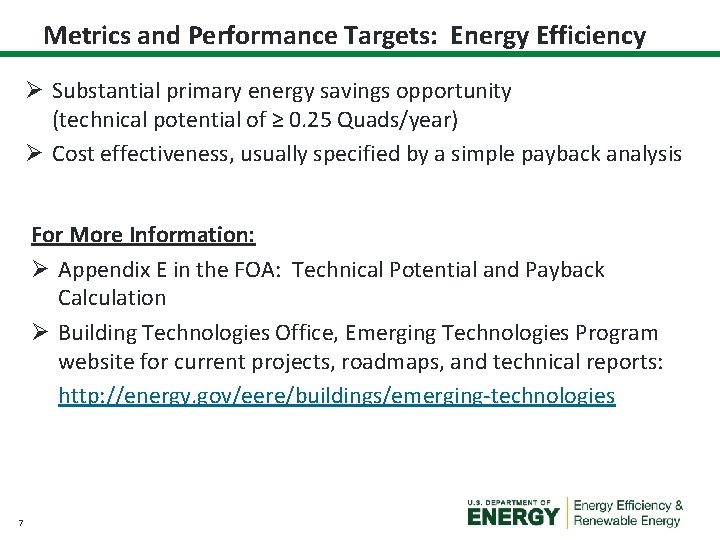
Metrics and Performance Targets: Energy Efficiency Ø Substantial primary energy savings opportunity (technical potential of ≥ 0. 25 Quads/year) Ø Cost effectiveness, usually specified by a simple payback analysis For More Information: Ø Appendix E in the FOA: Technical Potential and Payback Calculation Ø Building Technologies Office, Emerging Technologies Program website for current projects, roadmaps, and technical reports: http: //energy. gov/eere/buildings/emerging-technologies 7
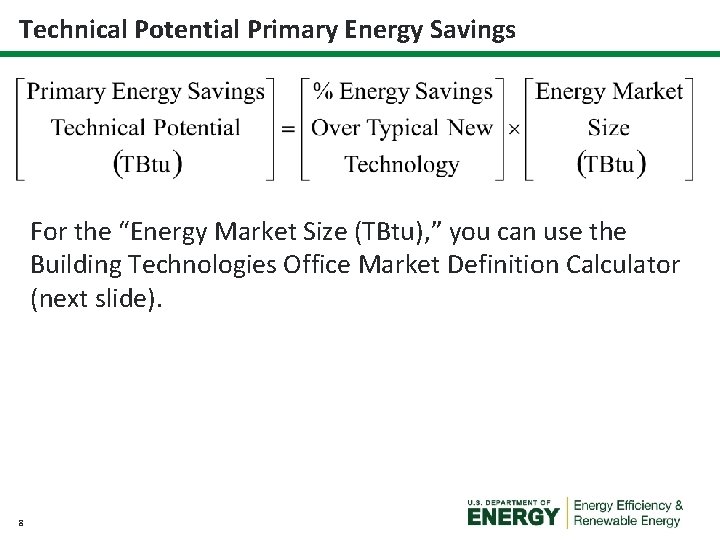
Technical Potential Primary Energy Savings For the “Energy Market Size (TBtu), ” you can use the Building Technologies Office Market Definition Calculator (next slide). 8
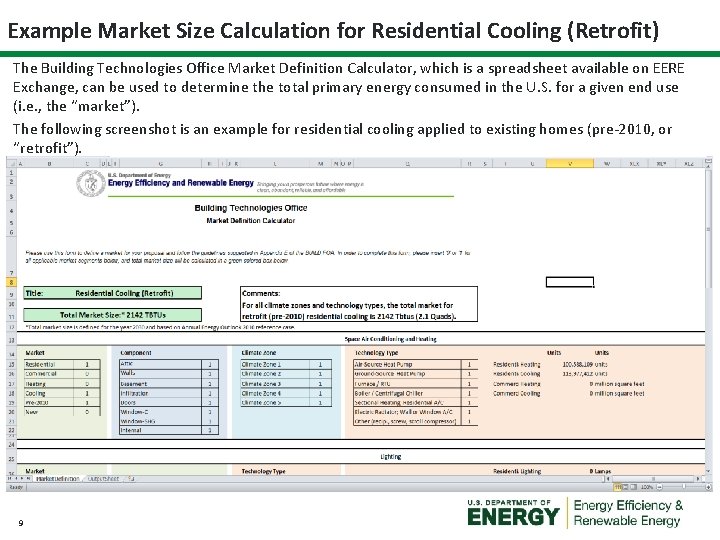
Example Market Size Calculation for Residential Cooling (Retrofit) The Building Technologies Office Market Definition Calculator, which is a spreadsheet available on EERE Exchange, can be used to determine the total primary energy consumed in the U. S. for a given end use (i. e. , the “market”). The following screenshot is an example for residential cooling applied to existing homes (pre-2010, or “retrofit”). 9
BUILD Program Metrics Ø Ø Ø Ø Invention disclosures submitted to DOE Licensing agreements Follow-on funding secured (grants, investment, etc. ) Spin-off companies started Products commercialized, including cost and performance information Improved manufacturing processes implemented by a company Number of undergraduate & graduate students participating in the program Building energy efficiency and/or manufacturing education improvements, such as increased enrollment in relevant courses, new courses, and student participation in professional development classes Ø Number of student participants employed in building energy efficiency or related manufacturing within 1 year of graduation Ø Number of student participants employed in building energy efficiency or related manufacturing within 5 years of graduation (voluntary) Ø Technical potential primary energy savings for commercialized technologies or approaches developed in part through this program 10
Other Requirements Institutional requirements Ø Lead institution must be an Institution of Higher Education: § Universities, 2 -year community colleges, predominately undergraduate institutions, etc. Ø Faculty or other PIs/Co-PIs with relevant expertise in energy efficiency, manufacturing (for projects developing hardware), and commercialization Ø Minimum of 50% of the project direct costs to be used to support undergraduate students (salaries, stipends, materials & supplies, equipment, travel, etc. ) Teaming With an Industrial Partner Ø Although not required at the beginning of a project, by the end of Year 1 each project must include an external industrial partner § Industrial partner must enhance the university team’s capabilities to bring their technology to market § Manufacturers, national labs, utilities, non-profits, etc. are allowed Applicable Technology Readiness Level (TRL) Ø Proposed technologies or approaches can be any TRL short of a commercialized technology (TRL 8) Ø Applicants should describe the “next logical step” for their project after 2 years of DOE BUILD support 11
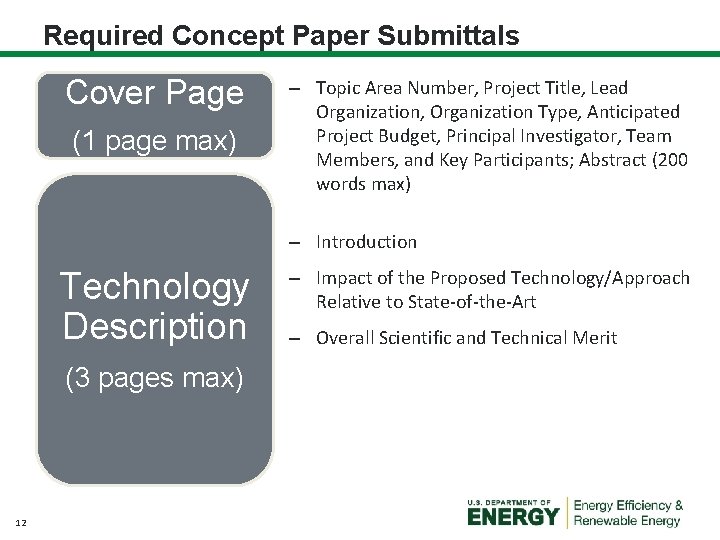
Required Concept Paper Submittals Cover Page (1 page max) – Topic Area Number, Project Title, Lead Organization, Organization Type, Anticipated Project Budget, Principal Investigator, Team Members, and Key Participants; Abstract (200 words max) – Introduction Technology Description (3 pages max) 12 – Impact of the Proposed Technology/Approach Relative to State-of-the-Art – Overall Scientific and Technical Merit
Concept Papers: Technical Review Criteria Criterion 1: Impact of the Proposed Technology Relative to State of the Art (50%) This criterion involves consideration of the following factors: • Method used to identify current state of the art technology • If technical success is achieved, the proposed idea would significantly improve technical and economic performance relative to the state of the art. Criterion 2: Overall Scientific and Technical Merit (50%) This criterion involves consideration of the following factors: • The proposed technology is unique and innovative; and • The proposed approach is without major technical flaws. EERE will make an “Encourage” or “Discourage” recommendation to applicants to submit a Full Application. A “Discourage” recommendation does not prevent the applicant from submitting a Full Application, but is intended to convey EERE’s lack of programmatic interest in the proposal. 13
Program Policy Factors 1) The degree to which the proposed project, including proposed cost shares, optimizes the use of available EERE funding to achieve programmatic objectives; 2) The level of industry involvement and demonstrated ability to commercialize energy or related technologies; 3) Technical, market, organizational, and environmental risks associated with the project; 4) Whether the proposed project is likely to lead to increased employment and manufacturing in the U. S. ; 5) Whether the proposed project will accelerate transformational technological advances in areas that industry by itself is not likely to undertake because of technical and financial uncertainty; 6) The degree to which the proposed project directly addresses EERE’s statutory mission and strategic goals. 14
Cost Share: Minimum 20% of Total Project Costs 1. Must be eligible under the award conditions; 2. Verifiable from the recipient's records; 3. Not included as contributions for any other federallyassisted project or program; 4. Necessary and reasonable for proper and efficient accomplishment of project or program objectives; and 5. Allowable under the cost principles applicable to the type of entity incurring the cost. See Appendix B 15 15
Key Points - Recommendations § Double check your entries in EERE Exchange – Submissions could be deemed non-compliant due to an incorrect entry § Make sure you hit the submit button § Follow formatting criteria and page lengths stated in the FOA § Use the tables provided in the FOA to help construct a compliant application § Suggest submittals occur 48 hours before the due date (note: due date is 5: 00 pm ET) – Avoid last-minute rush with EERE Exchange. EERE will not accept submissions that are late due to heavy network traffic. 16 16
Logistics Data Produced Under the Award Annual Compliance Audits • The Government normally retains unlimited rights to technical data produced under Government financial assistance awards, including the right to distribute to the public. • For-profit prime recipients: an annual compliance audit by an independent auditor may be required if expenditures of Federal funds > $500, 000 during a fiscal year • “Protected data” may be protected from public disclosure for up to 5 years. • Invention disclosures may be protected from public disclosure for a reasonable time in order to allow for filing a patent application. • Other recipients: A-133 audit is required if expenditures of Federal funds > $500, 000 in a fiscal year • Submit Questions to BUILDFOA@hq. doe. gov. • Answers posted at https: //EERE-Exchange. energy. gov , DE-FOA-0001167 Effective 12/26/2014, the DOE Financial Assistance regulations contained in 10 CFR 600 will be superseded by the Financial Assistance regulations contained in 2 CFR 200 (codified in Part IX of 2 CFR) 17
- Slides: 17