
BUILDING YOUR DOSSIER FOR PROMOTION TO ASSOCIATE PROFESSOR
BUILDING YOUR DOSSIER FOR PROMOTION TO ASSOCIATE PROFESSOR WHAT’S IMPORTANT? John Colicelli, Ph. D. Professor, Biological Chemistry Assistant Dean for Academic Affairs Richard H. Gold, M. D. , Emeritus Professor, Radiological Sciences Assistant Dean for Academic Affairs

WHERE DOES MY COMPLETED DOSSIER GO? DEPARTMENT DEAN writes a letter of evaluation and recommendation. ACADEMIC PERSONNEL OFFICE COUNCIL ON ACADEMIC PERSONNEL (CAP) votes and makes a recommendation to the VC. In rare cases CAP appoints an ad hoc Review Committee that includes a representative from your Department. VICE CHANCELLOR FOR ACADEMIC PERSONNEL makes the final decision. DEPARTMENT
WHAT IS CAP? -The Council on Academic Personnel is a 14 -member committee of the Academic Senate, charged with reviewing the scholarly, creative, teaching and service activities of faculty seeking Appointment, Promotion, and certain types of advancement. -CAP strives to ensure equity and to maintain standards of teaching, scholarship and other forms of creativity, professional competence, and service throughout the UCLA campus. -Clin. CAP, a subcommittee of CAP, is responsible for evaluating faculty in the Health Sciences Clinical Professor series. Faculty in the Adjunct Professor series are evaluated by an ad hoc committee of CAP members.
INCREASE YOUR ACADEMIC PROCESS IQ! Consult or download the “Junior Faculty Guide to a Successful Career – Keys to Advancement and Promotion at UCLA” on the website of the DGSOM Office of Academic Affairs https: //medschool. ucla. edu/academic-affairs under the tab “Academic Forms & Resources. ” The website also contains a special edition of the “Guide” directed to junior faculty in the Health Sciences Clinical Professor series.
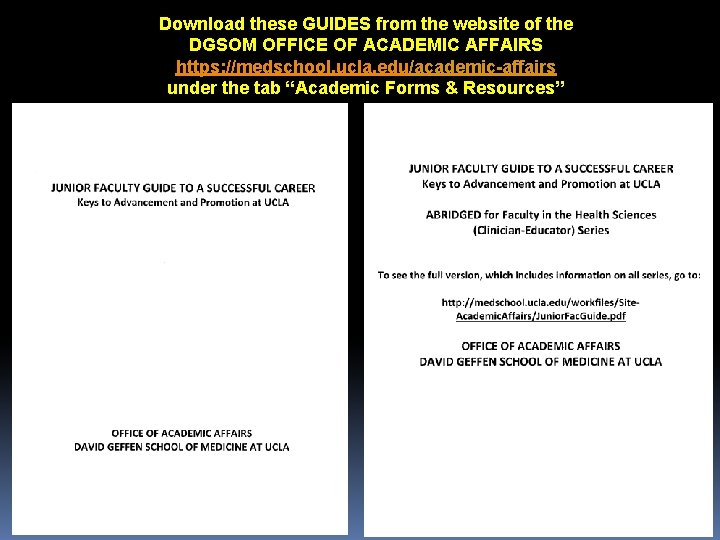
Download these GUIDES from the website of the DGSOM OFFICE OF ACADEMIC AFFAIRS https: //medschool. ucla. edu/academic-affairs under the tab “Academic Forms & Resources”
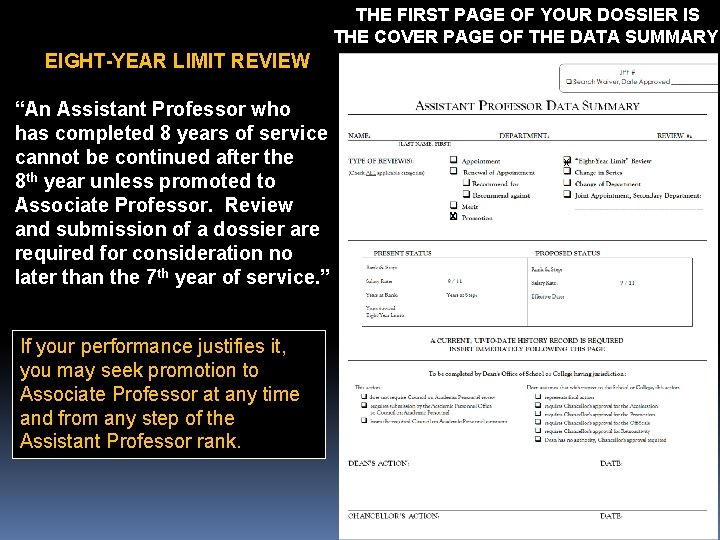
THE FIRST PAGE OF YOUR DOSSIER IS THE COVER PAGE OF THE DATA SUMMARY EIGHT-YEAR LIMIT REVIEW “An Assistant Professor who has completed 8 years of service cannot be continued after the 8 th year unless promoted to Associate Professor. Review and submission of a dossier are required for consideration no later than the 7 th year of service. ” If your performance justifies it, you may seek promotion to Associate Professor at any time and from any step of the Assistant Professor rank. H X X
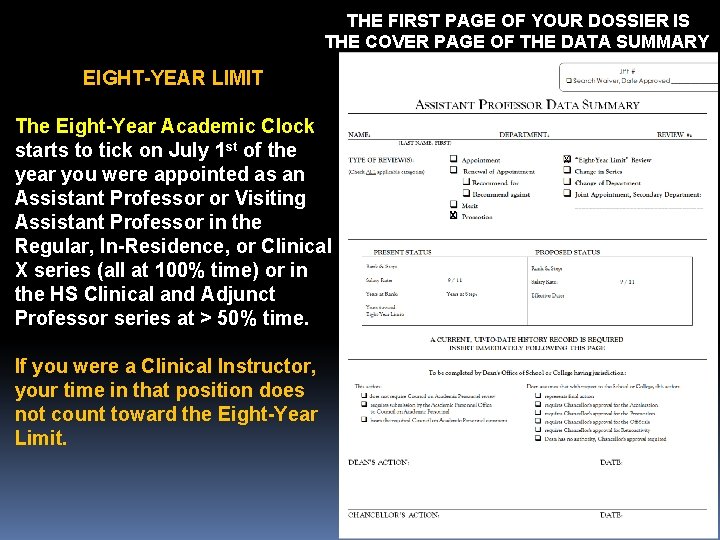
THE FIRST PAGE OF YOUR DOSSIER IS THE COVER PAGE OF THE DATA SUMMARY H EIGHT-YEAR LIMIT The Eight-Year Academic Clock starts to tick on July 1 st of the year you were appointed as an Assistant Professor or Visiting Assistant Professor in the Regular, In-Residence, or Clinical X series (all at 100% time) or in the HS Clinical and Adjunct Professor series at > 50% time. If you were a Clinical Instructor, your time in that position does not count toward the Eight-Year Limit. X X
EIGHT-YEAR LIMIT TIME OFF THE CLOCK Time Off the Clock, with a corresponding extension of the eight-year limit, may be requested for X “childbearing, child rearing (male and female faculty), a serious health condition, disability, Xbereavement, or a significant circumstance or event that disrupts a faculty member’s ability to pursue his or her duties. ” APM - 133 -17 (h) Up to 2 separate events, 1 -year max for each event Please request leave as far in advance as possible – you can always cancel.
COVID-19 -IMPACT-RELATED CHANGES -Extra year off the clock – from 8 years to 9 years. -One-year delay to fourth-year appraisal, upon request. The Fourth-Year Appraisal, conducted during the fourth-year, assesses your progress and any weakness in your performance. It provides constructive advice on how to improve your performance and enhance your prospects for promotion.

CONTENTS OF YOUR DOSSIER FOR PROMOTION -Forms documenting that you have been mentored -Employment history at the University of California -Faculty vote on your promotion -Letter of Recommendation from your Department Chair -Report of your Department’s elected or ad hoc review committee -Statement of contributions to diversity or inclusion (required) -Teaching record -Service record -Honors and tokens of special recognition -Research grants -Bibliography -Invited lectures and poster presentations -Certification statements -Personal statement (self-statement) (recommended) -5 most significant publications (Regular, In-Residence, or Adjunct Prof) -Copies of publications since your appointment -CV -Letters of evaluation -Teaching evaluations (by students and peers) -Supplemental material
FORMS DOCUMENTING THAT YOU HAVE BEEN MENTORED -Mentoring includes guidance in academic process and guidance in career and professional development. -All Assistant Professors must be mentored by Associate or full Professors assigned by your Department Chair. -Formal mentoring must occur every 6 months at minimum and be documented (excluding confidential information), but INFORMAL MENTORING IS THE KEY TO ACADEMIC SUCCESS! -SEEK YOUR MENTOR’S ADVICE EARLY AND OFTEN!
EMPLOYMENT HISTORY AT UC Shown chronologically by rank and step FACULTY VOTE ON YOUR PROMOTION Total ayes, nays, abstentions, absentees LETTER OF RECOMMENDATION FROM YOUR DEPARTMENT CHAIR OR REPORT OF YOUR DEPARTMENT’S ELECTED OR AD HOC REVIEW COMMITTEE Summarizes: -Your teaching responsibilities -Evaluations of your teaching and your professional competence -Your scholarly and other creative accomplishments -Your service activities (at UCLA and beyond) -Highlights from evaluation letters LETTER OF RECOMMENDATION FROM YOUR DEPARTMENT CHAIR -Department deliberations and recommendation -Likely reasons for any negative votes
TEACHING -List the formal courses in which you taught each year. Indicate if you were the Course Chair. Indicate if you contributed as a guest lecturer (i. e. , 1 or a few lectures on a topic) -List your UCLA lectures and other teaching (e. g. , journal club organizer, dissertation committees). Mark activities promoting gender or ethnic diversity with (DIV) after each. -List mentees according to academic level with inclusive dates, mentored presentations at regional and national meetings, other important mentored accomplishments, and the mentee’s awards. -List mentees’ research grants on which you were the mentor. -List training grants in which you have a role. Include granting agency, title, inclusive dates, your role (P. I. , co-P. I. ) and name of P. I. if not you, your percent effort, and direct costs going to you.
SERVICE -Service on committees: Academic Senate, Department, DGSOM and UCLA Health System, University (UCLA or UC) -Service to professional and governmental organizations, including grant agencies, and foundations -Service to journals, especially membership on an editorial board (provide years of service for each entry) -Service to the community -Place (DIV) after each activity promoting diversity. -If using an abbreviation in place of an organization’s full name, provide full name and initials at first use, then initials alone in later entries.
SERVICE – CAVEAT: DON’T OVERDO IT! As an Assistant Professor your commitment to service is expected to be modest so you have enough time for the creative, scholarly, clinical, and teaching activities that are essential to your success. Although service to your Department, the Healthcare System and the DGSOM should be judiciously limited, rare opportunities to perform service to professional, scientific or governmental organizations, or to the community, should be exploited.
HONORS AND SPECIAL RECOGNITIONS For each, include the year and a brief description of significance. RESEARCH GRANTS -In the Regular Professor or Professor-in-Residence series, independent scholarly activity supported by your own peer-reviewed extramural grants demonstrates your status as an independent investigator! -When listing grants, include the granting agency, title of the grant, inclusive dates, your role (P. I. , co-investigator), name of the P. I. if not you, percent effort, and the annual direct costs going to you.
BIBLIOGRAPHY -Publications of primary interest are those since your appointment. -Indicate new material (since last review) with a bracket. -Print your name in bold type wherever it appears. In the Regular or In-Residence series, indicators of independence are first- or senior (corresponding) authorship of peer-reviewed research publications in high-impact journals, and the absence of your mentor among the authors. Note co-first or co-corresponding author status if applicable. -If you played a critical role but were not first or corresponding author, explain your contribution in a sentence following the reference. List review articles separately from research papers.
INVITED LECTURES -Your most important lectures are those at regional, national, or international conferences / workshops / courses and at extramural healthcare or educational institutions. -List the title of your presentation, the venue, and the date. If the presentation has multiple authors list your name in bold type. -List conferences that you organized or chaired. Also indicate if you chaired or moderated a session. POSTER PRESENTATIONS List title, venue, date and authors, with your name in bold type.
CERTIFICATION STATEMENTS Two Certification Statements, a “prior” Certification Statement and an “after” Certification Statement, require your signature. The “prior” Certification Statement is to be read and signed prior to Department deliberations. This entitles you to name intramural and/or extramural people you would like as evaluators, as well as those you would like to exclude. (This does not necessarily prohibit their evaluation of your performance, but it puts you on record as considering them biased or non-objective. ) When suggesting evaluators, consider those who are best able to describe your contributions to any collaborative and interdisciplinary work.
CERTIFICATION STATEMENTS Two Certification Statements, a “prior” Certification Statement and an “after” Certification Statement, require your signature. The “after” Certification Statement is read and signed after the Department has deliberated your case and after you exercise your right to review, if you desire, redacted versions of the review committee report, Chair’s letter, and letters of evaluation. You may add to the dossier a statement challenging any aspect of the Department vote and recommendation. (Your Department Chair may exert the privilege of writing a supplementary “confidential” letter not subject to your review. )
PERSONAL STATEMENT (SELF-STATEMENT) Although a Personal Statement (Self-Statement) is not mandatory, it is strongly recommended. -A Personal Statement makes your case more compelling by humanizing the facts in your Data Summary. -Use it to provide context for your achievements. -Your statement will be read by members of your Department, people writing letters of evaluation, the Dean’s Office, and CAP. Try to keep the language as simple as possible so it can be understood by those outside your field of study. -Try to limit the length of your Personal Statement to 3 pages or less.
PERSONAL STATEMENT (SELF-STATEMENT) -Highlight your scholarly achievements and creative activities, including those in progress, your clinical and professional competence, teaching accomplishments, and administrative and leadership roles. -Describe the significance of your service contributions. -Describe the significance of any honors. -Mention any pending grants and your role in them. -Describe your goals and aspirations. -Before submitting your Personal Statement, consider reviewing it with your mentor.
PERSONAL STATEMENT – IMPACT OF COVID-19 You may wish to explain in your Personal Statement the impact of COVID-19 on your productivity. Alternatively, you may add a separate, optional Pandemic Impact Statement to describe the challenges you faced and the modifications you made in your teaching, scholarly or creative activities, and service to overcome them.
COPIES OF PUBLICATIONS SINCE YOUR APPOINTMENT Required only for fourth-year appraisals and promotions in the Regular, In-Residence, or Adjunct Professor series. FIVE MOST SIGNIFICANT PUBLICATIONS -Required only for promotion in the Regular, In-Residence, and Adjunct Professor series. -List them as they appear in your bibliography. -After each, briefly describe its significance and your role. -Consider reviewing with your mentor your 5 choices and your accompanying statements.
CURRICULUM VITAE See example in “Junior Faculty Guide to a Successful Career. ” -Your CV is the primary document by which you will be reviewed for promotion and the only document furnished to the writers of letters of evaluation. -It is your autobiography – the record of your activities as a faculty member and the record of your scholarly and creative achievements. -Organizations should be listed by their full names rather than abbreviations, at least the first time. -Use bold type wherever your name appears in a list of authors. -Include patents, provisional patents, and applications for patents. -Keep your CV complete and keep it current!
LETTERS OF EVALUATION -You will be requested to provide names of evaluators. They should be of a rank higher than yours – the higher the rank and the more authoritative in your field the better! -For faculty in the Health Sciences Clinical Professor series, only letters from intramural evaluators are required for promotion to the associate professor rank – letters from extramural evaluators are optional. -For faculty in the Regular, In Residence, Clinical X and Adjunct Professor series, only letters from extramural evaluators are required for promotion to the associate professor ranks – letters from intramural evaluators are optional.
LETTERS OF EVALUATION -For intramural evaluators (as required or by choice) consider naming your mentor and UCLA collaborators who are familiar with your research or other creative work. -Ask your mentor to suggest other evaluators. -To avoid any perception of bias, your Department should select an equal number of evaluators. -The combined list of extramural evaluators includes those selected by you and those selected by your Chair. Those selected by your Chair should include at least three or four at a higher rank than you (preferably full Professor) who have not collaborated or had a close association with you. -Except for the rare CONFIDENTIAL letter from the Chair, you may write a rebuttal to any redacted letter in your file.
TEACHING EVALUATIONS -Trainees and peers should be encouraged to add comments to evaluation forms. -Evaluation forms from peers and trainees may be complemented with letters from peers and trainees. -Especially valuable are letters from past trainees who can evaluate the impact of your teaching and mentoring skills.
SUPPLEMENTAL MATERIAL -You may augment your dossier with a supplement containing or documenting creative accomplishments other than publications. -Members of the Health Sciences Clinical Professor series who choose to partake in creative activities derived from their primary responsibilities in clinical teaching and patient care will find inspiration in the long list of creative activities featured in the “Junior Faculty Guide to a Successful Career – Abridged for Faculty in the Health Sciences Clinical series, ” based on the list in Appendix 8 of THE CALL.
SUPPLEMENTAL MATERIAL The list of creative activities in the “Junior Faculty Guide to a Successful Career – Abridged for Faculty in the Health Sciences Clinical Series” includes not only activities related to the development of publications and presentations and participation in research, but also: -Development of educational curricula -Administration of a teaching program, healthcare facility, or clinical service -Advancement of professional education -Original material in handouts for lectures -Informational brochures for physicians or patients -Education materials, such as teaching files, placed on resident website -Development of clinical guidelines or pathways -Contributions to programs to improve patient care or patient safety -Contributions to medical information or health record systems -Contributions to community outreach or informational programs

Thanks for coming, and GOOD LUCK!
- Slides: 31