
Building the UNs sustainable development goals into the
Building the UN’s sustainable development goals into the curriculum Addressing the new quality agenda for Higher Education Emeritus Professor Geoff Scott Western Sydney University
Key themes • Work ready plus graduates need opportunities to explore invention for social benefit in their studies • A focus on social not just commercial entrepreneurship is necessary • Colleges and Universities are ideally positioned to help their country address the UN Sustainable Development Goals through entrepreneurship projects • Good ideas with no ideas on how to implement them are wasted ideas
Why bother? • • Ensuring the fitness of purpose not just the fitness for purpose of our tertiary education programs In the current context we need graduates who are not only ‘work ready’ for today (competent) but ‘work ready plus’ (capable) for an uncertain tomorrow 95% of the world’s political leaders have a degree We need graduates who are practiced in developing and implementing solutions to the challenges of social, cultural and environmental sustainability not just economic sustainability Universities & colleges are uniquely positioned to help their country address the UN’s Sustainable Development Goals using social enterprise capstones Social enterprise aligns with key objectives for the development of many countries and the ‘moral purpose’ of their approach to education. Students increasingly want these sorts of experiences as part of their college/university studies What is assessed is what is learnt
UN Sustainable Development Goals 2030 1. 2. 3. 4. 5. 6. 7. 8. 9. 10. 11. 12. 13. 14. 15. 16. 17. No poverty Zero Hunger Good health & well-being Quality Education (including sustainability in the curriculum) Gender Equality Clean water Affordable & clean energy Decent work & economic growth Industry, innovation & infrastructure Reduced inequality Sustainable cities & communities Responsible consumption & production Climate action Life below water Life on land Peace, justice & strong institutions Partnerships to achieve the goals
Defining social entrepreneurship • A social enterprise has a social and/or environmental mission as part of its core purpose. Such organizations seek profits only in order to achieve their missions. • Social entrepreneurship relates to entrepreneurial action by organisations and individuals that creates significant social value for communities and people. It involves • – Identifying an unjust situation, a need for change; – identifying an opportunity in this unjust equilibrium, developing a social value proposition, and bringing to bear inspiration, creativity, to identify a relevant and feasible way to improve the situation; – Trialing, implementing, enhancing and then scaling up what works best; – Whilst ensuring that there are sufficient funds to support and sustain this work Commercial entrepreneurship is about personal benefit and profit maximisation. Social entrepreneurship is about benefitting others – such enterprises make money but no one takes it out – the profits are dedicated solely to scale up
Judging that a social enterprise is ‘successful • Money is being made out of waste - cradle to cradle design is in place • Minimum defaults on micro-finance loans • Positive health outcomes • Gross domestic ‘happiness’ (Bhutan); improved social harmony; New Zealand’s ‘well-being’ budget 2019; decreased crime rates • More equitable distribution of wealth • Increased participation in post-secondary education/employment • Positive feedback from participants • Successful scale up and sustainability of the initiative • Government and legislative support for scale up • Repeat business • Positive press coverage

Examples of social entrepreneurship linked to the SDGs • Mobile phones and food security in Sri Lanka • Sanduk Ruit and interocular lenses in Nepal • Spinnifex and nanocellulose in Australia • Citrus Farm and the Foskor development trust in South Africa • Maggots in Benin • 3 D solar souvenirs made by the rubbish pickers in Delhi • ‘Fast fashion’, biolitics and the circular economy • Pig farms and African snails in the Pacific • South Africa’s North West University Enterprising Women Programme and Student Rag Community Service initiatives • Leather from mushrooms

Examples of social entrepreneurship linked to the SDGs • Harvard’s Living lab projects • Biomimicry inventions • Citizen intelligence and SDGs 11 and 16 • Enactus UK’s social enterprise projects with 59 universities. For example: – – – ‘Budget bite’s Norwich – University of East Anglia (SDGs 2 & 12) ‘Kenya Jiko’ – Imperial College, London (SDGs 1, 3 & 7) ‘Foodprint’ – University of Nottingham (SDGs 1, 2, 3, 10 & 12) ‘Fog catcher’ Morocco – University of Edinburgh (SDGs 1, 6 & 11) ‘Source’ affordable lighting Philippines – University of Surrey 1, 3, 7, 10 & 11) • Western Sydney University – Riverfarm and SURF projects – WSU first in Australia and 11 th in the world on the new Times SDG impact rankings

International Links and Networks interested in building the SDGs into the curriculum • The Copernicus Alliance, UNU RCEs, AASHE, ACTS • The Association of Commonwealth Universities, The Global Alliance of Universities SDG accord and the International Association of Universities are all now giving focus to ESD • The Alliance for Sustainability Leadership in the UK • The Social Enterprise World Forum Christchurch 2017 • The International Conference of Entrepreneurship Educators Oxford September 2019 • The Social Enterprise Academy • Oikos St Galen • Enactus
Characteristics of an effective social entrepreneur and a work ready plus graduate • Strong, clear moral purpose • Ability to listen, link, leverage and then lead, always in that order • A ‘why don’t we’ not a ‘why don’t you’ approach • Possession of the key capabilities identified in our studies of successful early career graduates in 9 professions. An ability to: – – – Remain calm when things go awry Tolerate ambiguity, take sensible risks, persevere Work productively and empathise with diversity Think laterally, think ahead and adapt during implementation Build and sustain productive networks • Business and change implementation savvy
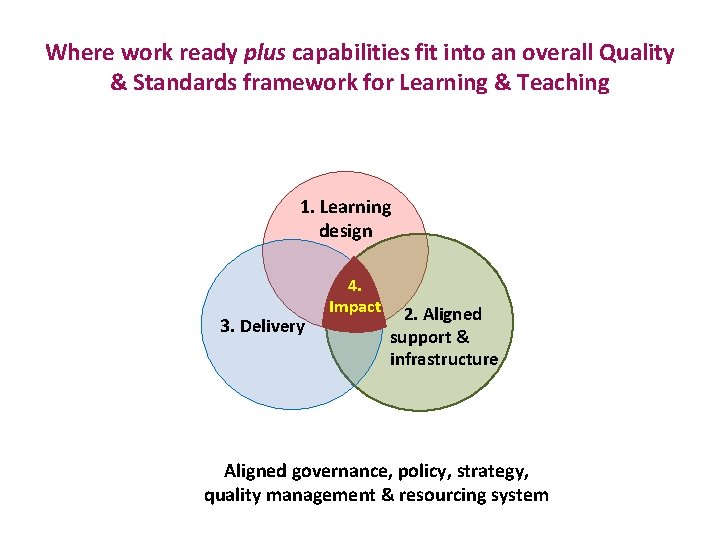
Where work ready plus capabilities fit into an overall Quality & Standards framework for Learning & Teaching 1. Learning design 3. Delivery 4. Impact 2. Aligned support & infrastructure Aligned governance, policy, strategy, quality management & resourcing system
‘Flipping’ the curriculum design & review process - The Six Keys in FLIPCurric ‘Right’ (evidence-based, benchmarked, peer-confirmed): • Program level outcomes – relevant, desirable, feasible, clear, comprehensively considered against multiple reference points • Mapping – confirmation that all program level outcomes are being picked up in units of study in a scaffolded way • Assessment tasks – demonstrably fit-for-purpose (valid assessment tasks which address the mapped L. O. s for each unit) • Grading – agreed, operational picture of what indicators will be used to allocate different grade levels • Calibration – peer agreed indicators for different grade levels • Learning design and resources – fit-for-purpose learning design, learning resources, with an aligned student support system and capable staff available to deliver it.
What are learning outcomes? The capabilities and competencies students are expected to demonstrate they have developed to a required standard by the end of a program or unit of study They include personal, interpersonal and cognitive capabilities and the key knowledge and skills necessary for effective early career performance and societal participation (See successful graduate studies for a valid framework)
The idea of producing work ready plus graduates People who are not just work ready for today but work ready plus for tomorrow (95% of the world’s leaders have a degree). The plus can include being: • Sustainability literate • Change implementation savvy • Creative and inventive not just ‘regurgitative’ • Clear on where one stands on the tacit assumptions driving the 21 st century agenda, assumptions like: - ‘growth is good’ - ‘consumption is happiness’ - ‘ICT is always the answer’ - ‘globalisation is great’
Powerful Assessment • Assess less but better • What you learn is what you assess • Focus on the capabilities that count and ability to draw appropriately from and deliver key skills and knowledge • Dilemma-based, problem based, integrated assessment (real world or simulated) – decreases the chance of plagiarism • Creativity and invention not just regurgitation • How to scale this up in large U. G. programs
Social Enterprise in the curriculum • UN Regional Centres of Expertise in Education for Sustainable Development • Campus as a living laboratory – Rolling funds and a social entrepreneurship unit of study – WSU Riverfarm – Social Studio in Melbourne – pathways to further study • Sydney School of Entrepreneurship • Blue Economy on the campus and in HE community engagement projects • Redevelopment of the Royal University of Phonm Penh • 2010 audit of sustainability in the HE curriculum • National networks: AASHE, ACTS, Copernicus • NSW TAFE Outreach programs • See the full list of programs now underway in the discussion paper
Making it happen • Listen, link, leverage then lead • Start small, learn by doing and build on your successes - ready, fire, aim • Undertake a stocktake on what is already happening and build a good practice website on this – acknowledge current initiatives • In identifying good practice use agreed indicators of what success in practice looks like • Develop a national clearing house to save ‘reinvention of the wheel’ • Promote initiatives in this area as a unique focus on your national provision to international students • For further suggestions see the Making it Happen Section of the FLIPCurric site at: http: //flipcurric. edu. au/
Key insights and what next? • One aspect of this talk you found particularly interesting • One aspect you would like to know more about • What is one initiative you think your institution should now pursue?
Further reading and resources • • • British Council (2017): Social entrepreneurship in education: empowering the next generation, British Council, At: https: //www. britishcouncil. org/sites/default/files/british_council_social_entrepreneurship_in_education_web_final. pd f Martin, R & Osberg, S (2007): ‘Social Entrepreneurship: The Case for Definition’, Stanford Social Innovation Review At: https: //ssir. org/articles/entry/social_entrepreneurship_the_case_for_definition Mills, Rebecca and Siegfried, Alina (2015), Mission driven entrepreneurship: new frontiers of impact entrepreneurship, Edmund Hillary Fellowship, At: https: //stories. ehf. org/the-new-frontiers-of-impact-entrepreneurship-cc 6 cbce 64 f 0 c Schwab Foundation (2018): What is social entrepeneurship? Schwab Foundation in partnership with the World Economic Forum at: https: //www. schwabfound. org/what-is-socialentrepreneurship Scott, G (2016): FLIPCurric at: http: //flipcurric. edu. au/ OLT, Canberra. Scott, G (2016): Transforming graduate capabilities and achievement standards for a sustainable future, At: http: //flipcurric. edu. au/sites/flipcurric/media/107. pdf Scott, G (2019): ‘Preparing work ready plus graduates for an uncertain future’ In Higgs, J, Crisp, G and Letts, W (2019): ‘Education for Employability: learning for future possibilities’, Brill, Leiden, Boston & Singapore. Scott, G (2019): Social Enterprise and Sustainable Development in the Age of Acceleration, Envigogika 14 (1) March, 2019 Social Enterprise Word Forum (2017): 2017 Final Report, SEWF, Christchurch, New Zealand. At: https: //www. sewf 2017. org/images/docs/SEWF-2017 -Final-Report. pdf United Nations University (2018): The Blue Economy Innovations, Gunther Pauli & UNU
- Slides: 19