
Building the Right IP Call Center Strategy Joe

Building the Right IP Call Center Strategy Joe Mc. Fadden Vice President, Marketing, Nuasis
IP Urban Legends Fact or Fiction? Fiction Fact “Voice Quality is not Business Ready” Vo. IP on a managed network with Qo. S is business quality; Vo. IP on the open Internet may not be “My network isn’t ready for Vo. IP” Enterprise routers are typically enabled with Qo. S and only need to be configured for it “Vo. IP solutions aren’t reliable” The network needs to be reliable, but some Vo. IP applications can recover from network failures “Vo. IP solutions aren’t secure” Security can be achieved – as part of an overall enterprise network security strategy
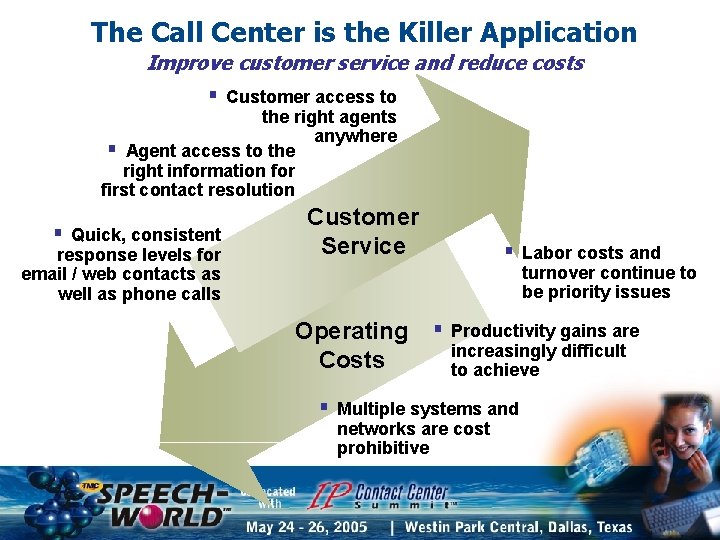
The Call Center is the Killer Application Improve customer service and reduce costs § Customer access to the right agents anywhere § Agent access to the right information for first contact resolution § Quick, consistent response levels for email / web contacts as well as phone calls Customer Service § Labor costs and turnover continue to be priority issues Operating Costs § Productivity gains are increasingly difficult to achieve § Multiple systems and networks are cost prohibitive
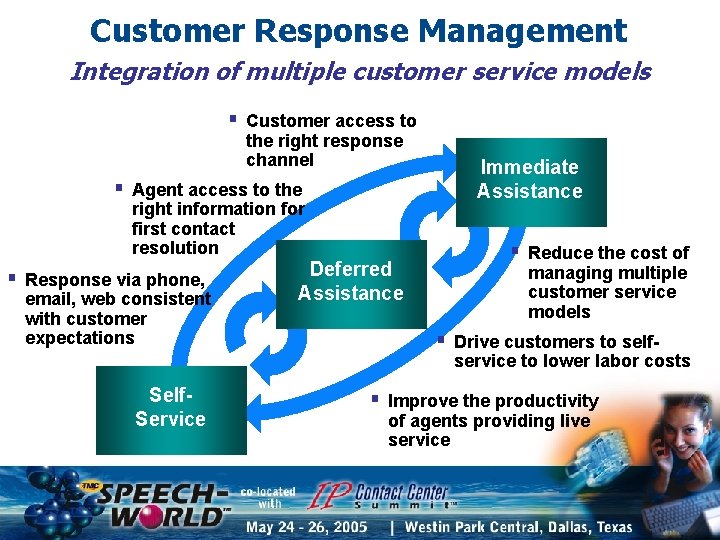
Customer Response Management Integration of multiple customer service models § Customer access to the right response channel § Agent access to the right information for first contact resolution § Response via phone, email, web consistent with customer expectations Deferred Assistance Immediate Assistance § Reduce the cost of managing multiple customer service models § Drive customers to self- service to lower labor costs Self. Service § Improve the productivity of agents providing live service
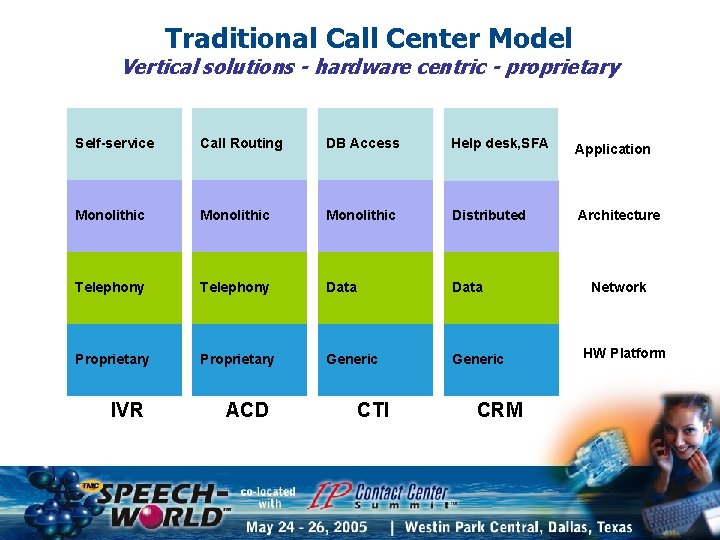
Traditional Call Center Model Vertical solutions - hardware centric - proprietary Self-service Call Routing DB Access Help desk, SFA Application Monolithic Distributed Architecture Telephony Data Proprietary Generic IVR ACD CTI CRM Network HW Platform
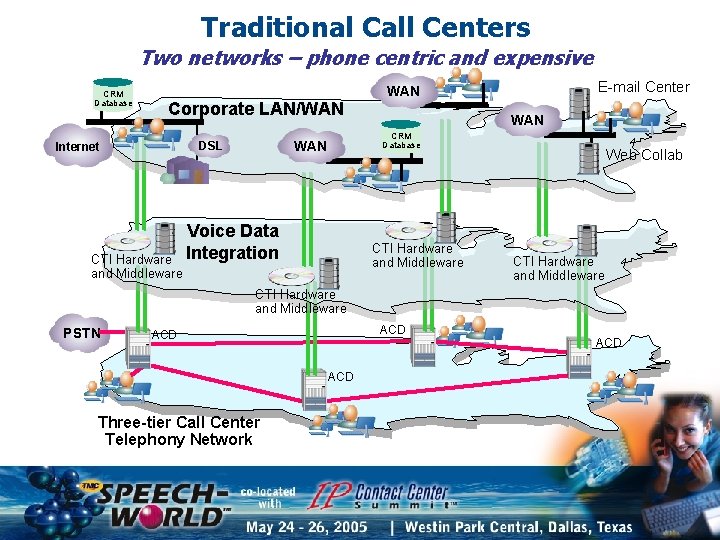
Traditional Call Centers Two networks – phone centric and expensive CRM Database Corporate LAN/WAN CTI Hardware and Middleware WAN CRM Database WAN DSL Internet E-mail Center WAN Voice Data Integration CTI Hardware and Middleware Web Collab CTI Hardware and Middleware PSTN ACD ACD Three-tier Call Center Telephony Network ACD
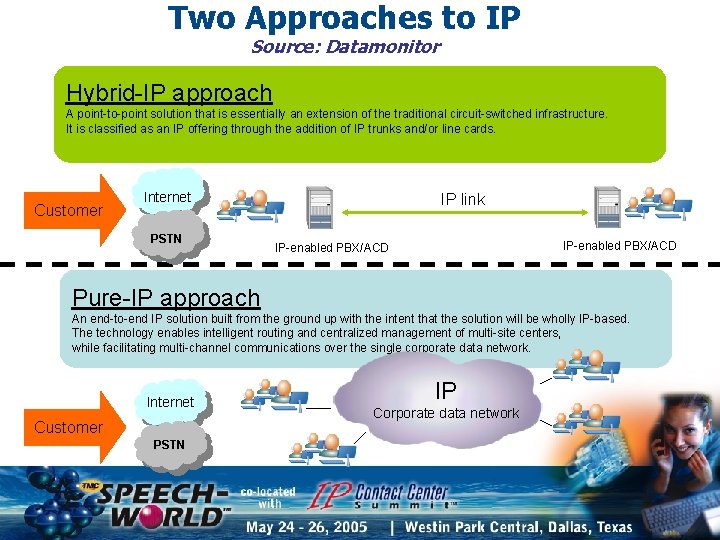
Two Approaches to IP Source: Datamonitor Hybrid-IP approach A point-to-point solution that is essentially an extension of the traditional circuit-switched infrastructure. It is classified as an IP offering through the addition of IP trunks and/or line cards. Customer Internet PSTN IP link IP-enabled PBX/ACD Pure-IP approach An end-to-end IP solution built from the ground up with the intent that the solution will be wholly IP-based. The technology enables intelligent routing and centralized management of multi-site centers, while facilitating multi-channel communications over the single corporate data network. Internet Customer PSTN IP Corporate data network
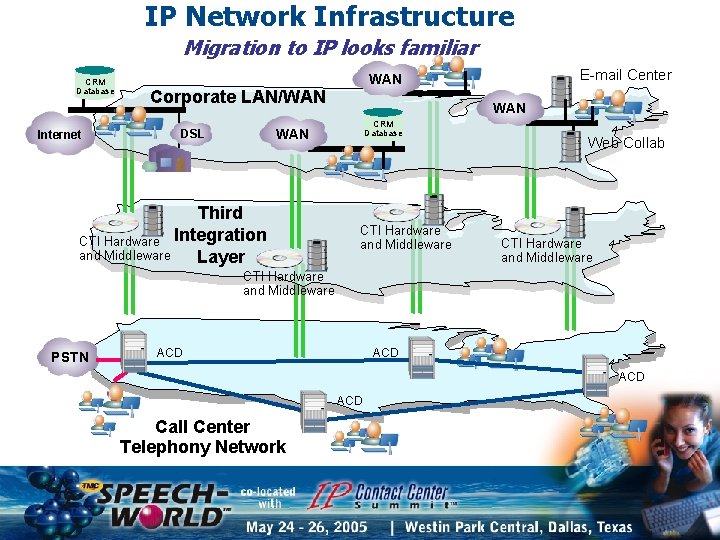
IP Network Infrastructure Migration to IP looks familiar CRM Database Internet Corporate LAN/WAN CRM Database WAN DSL Third CTI Hardware Integration and Middleware Layer E-mail Center WAN CTI Hardware and Middleware Web Collab CTI Hardware and Middleware PSTN ACD ACD Call Center Telephony Network
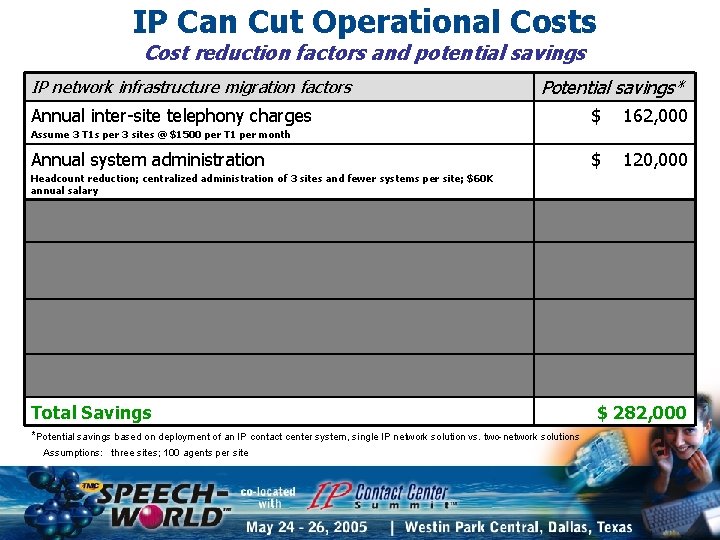
IP Can Cut Operational Costs Cost reduction factors and potential savings IP network infrastructure migration factors Potential savings* Annual inter-site telephony charges $ 162, 000 $ 120, 000 Assume 3 T 1 s per 3 sites @ $1500 per T 1 per month Annual system administration Headcount reduction; centralized administration of 3 sites and fewer systems per site; $60 K annual salary Annual labor costs $ 1, 800, 000 Assume $40 K annual per agent; 15% labor reduction by networking multiple centers together Annual support / maintenance / license contracts $ 80, 000 $ 750, 000 Compared against two-network systems with disparate media platforms, CTI hardware & software, duplicate site components. CTI application deployments Hardware / software / professional services for CRM screen pop to agent desktop or intelligent call routing ($250, 000 per deployment) Annual CTI application agent productivity $ 1, 200, 000 Assumes 18 -20 second reduced call times for 300 agents for 3 minute average call time. Total Savings *Potential savings based on deployment of an IP contact center system, single IP network solution vs. two-network solutions Assumptions: three sites; 100 agents per site $ 282, 000
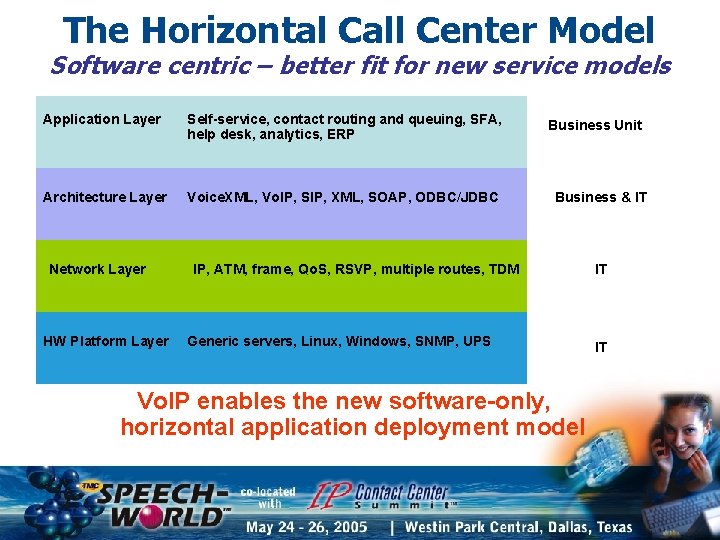
The Horizontal Call Center Model Software centric – better fit for new service models Application Layer Self-service, contact routing and queuing, SFA, help desk, analytics, ERP Architecture Layer Voice. XML, Vo. IP, SIP, XML, SOAP, ODBC/JDBC Network Layer HW Platform Layer Business Unit Business & IT IP, ATM, frame, Qo. S, RSVP, multiple routes, TDM Generic servers, Linux, Windows, SNMP, UPS Vo. IP enables the new software-only, horizontal application deployment model IT IT
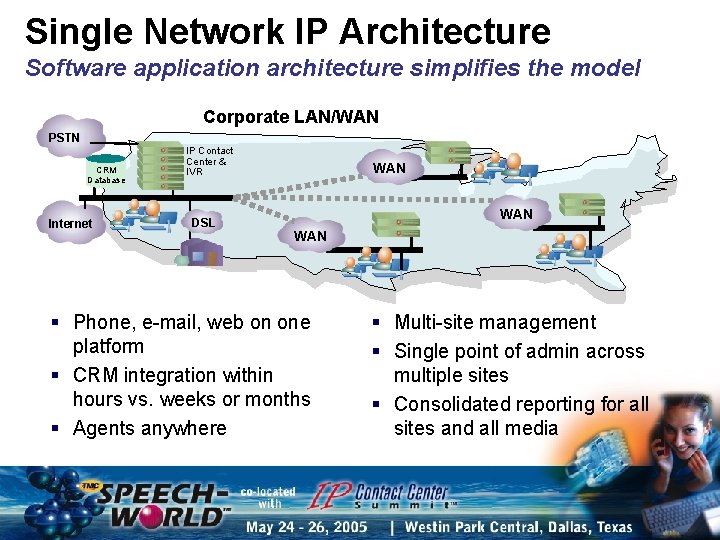
Single Network IP Architecture Software application architecture simplifies the model Corporate LAN/WAN PSTN CRM Database Internet IP Contact Center & IVR DSL WAN WAN § Phone, e-mail, web on one platform § CRM integration within hours vs. weeks or months § Agents anywhere § Multi-site management § Single point of admin across multiple sites § Consolidated reporting for all sites and all media
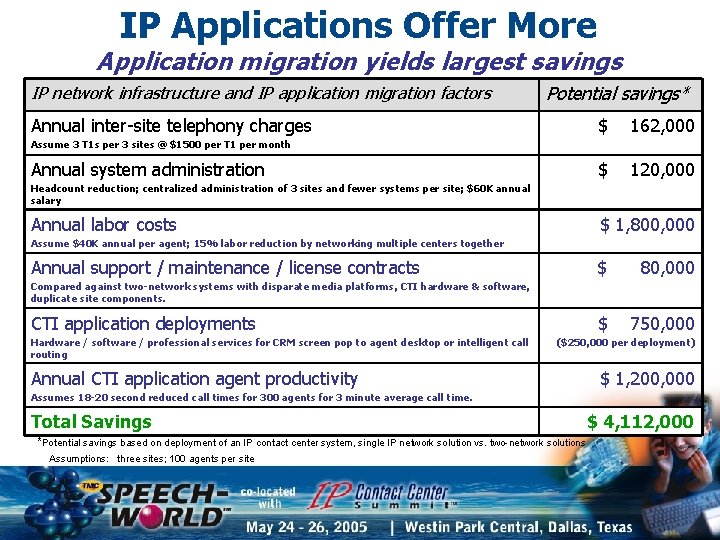
IP Applications Offer More Application migration yields largest savings IP network infrastructure and IP application migration factors Potential savings* Annual inter-site telephony charges $ 162, 000 $ 120, 000 Assume 3 T 1 s per 3 sites @ $1500 per T 1 per month Annual system administration Headcount reduction; centralized administration of 3 sites and fewer systems per site; $60 K annual salary Annual labor costs $ 1, 800, 000 Assume $40 K annual per agent; 15% labor reduction by networking multiple centers together Annual support / maintenance / license contracts $ 80, 000 $ 750, 000 Compared against two-network systems with disparate media platforms, CTI hardware & software, duplicate site components. CTI application deployments Hardware / software / professional services for CRM screen pop to agent desktop or intelligent call routing ($250, 000 per deployment) Annual CTI application agent productivity $ 1, 200, 000 Assumes 18 -20 second reduced call times for 300 agents for 3 minute average call time. Total Savings *Potential savings based on deployment of an IP contact center system, single IP network solution vs. two-network solutions Assumptions: three sites; 100 agents per site $ 4, 112, 000
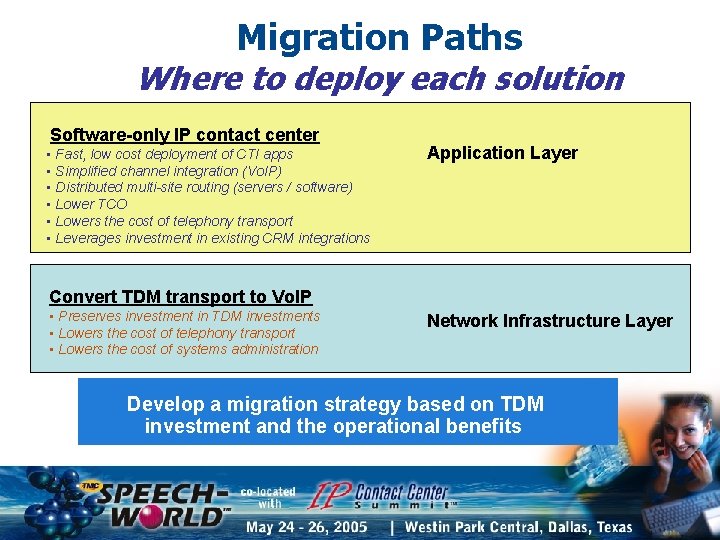
Migration Paths Where to deploy each solution Software-only IP contact center • Fast, low cost deployment of CTI apps • Simplified channel integration (Vo. IP) • Distributed multi-site routing (servers / software) • Lower TCO • Lowers the cost of telephony transport • Leverages investment in existing CRM integrations Application Layer Convert TDM transport to Vo. IP • Preserves investment in TDM investments • Lowers the cost of telephony transport • Lowers the cost of systems administration Network Infrastructure Layer Develop a migration strategy based on TDM investment and the operational benefits
Creating a Migration Plan Considerations • Business readiness for delivery of a “consistent customer experience” • Network readiness for voice and critical CRM applications • Pure IP solution (application) vs. hybrid IP (infrastructure) • Ease of integration to enterprise applications (cost of CTI) • Complexity of user interface for agents and administrators • Mission critical system reliability
How Do I Get Started? Migration typically begins with an initiative • Business initiatives o o Improved customer service Consistent customer experience Multiple media channels (voice, e-mail, Web, etc. ) Linking multiple sites • Disaster recovery • Line of business visibility o Decrease operations costs • Outsourcing • Offshoring • Technology initiatives o o o Move beyond PBX call routing ACD replacement IVR application CTI Project (Screen Pop) Vo. IP
Where Would I Start? What drives the decisions? • Application migration o o o Move a line of business that needs automation Move a functional group that needs continuity across locations Move an internal functional group e. g. help desk • Technology migration o o o ACD replacement at a site CTI Project (Screen Pop) at a site Replace inter-site trunking with Vo. IP
Making the Transformation Sample Checklist • Clearly define your strategy o Match your business strategy, technology strategy, culture, existing infrastructure, etc. o Select the approach that fits your environment • Understand mission critical nature of contact centers • Prepare for change o IT/Telecom o Business Ops • Collaborate in planning, design, implementation, and support • Assess and design network infrastructure (LAN/WAN)
Next Steps Take action based on what you have heard • Determine how IP can make an impact for you • Business process strategy o o Budgeted projects ROI • Technology strategy o o Architecture Migration strategy • Investigation o o o Network readiness Vo. IP system reliability Vo. IP system quality
- Slides: 19