
Building The New American Nation Chapters 5 6
Building The New American Nation Chapters 5 -6. 1
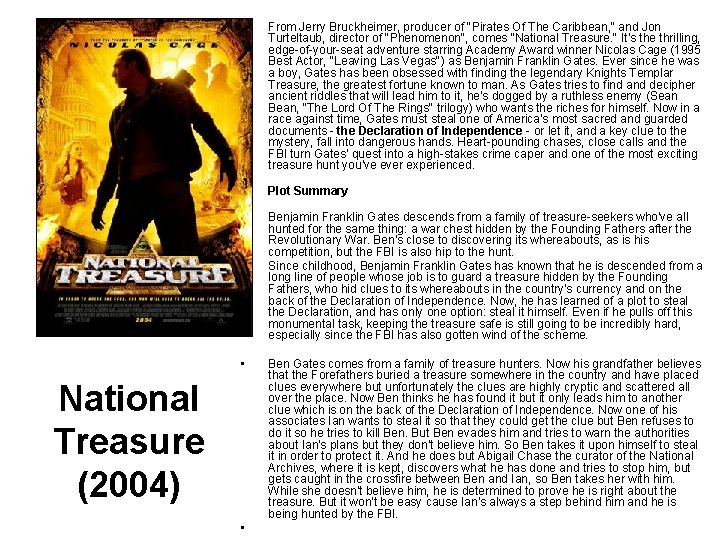
• From Jerry Bruckheimer, producer of "Pirates Of The Caribbean, " and Jon Turteltaub, director of "Phenomenon", comes "National Treasure. " It's the thrilling, edge-of-your-seat adventure starring Academy Award winner Nicolas Cage (1995 Best Actor, "Leaving Las Vegas") as Benjamin Franklin Gates. Ever since he was a boy, Gates has been obsessed with finding the legendary Knights Templar Treasure, the greatest fortune known to man. As Gates tries to find and decipher ancient riddles that will lead him to it, he's dogged by a ruthless enemy (Sean Bean, "The Lord Of The Rings" trilogy) who wants the riches for himself. Now in a race against time, Gates must steal one of America's most sacred and guarded documents - the Declaration of Independence - or let it, and a key clue to the mystery, fall into dangerous hands. Heart-pounding chases, close calls and the FBI turn Gates' quest into a high-stakes crime caper and one of the most exciting treasure hunt you've ever experienced. • Plot Summary • Benjamin Franklin Gates descends from a family of treasure-seekers who've all hunted for the same thing: a war chest hidden by the Founding Fathers after the Revolutionary War. Ben's close to discovering its whereabouts, as is his competition, but the FBI is also hip to the hunt. Since childhood, Benjamin Franklin Gates has known that he is descended from a long line of people whose job is to guard a treasure hidden by the Founding Fathers, who hid clues to its whereabouts in the country's currency and on the back of the Declaration of Independence. Now, he has learned of a plot to steal the Declaration, and has only one option: steal it himself. Even if he pulls off this monumental task, keeping the treasure safe is still going to be incredibly hard, especially since the FBI has also gotten wind of the scheme. • • National Treasure (2004) • Ben Gates comes from a family of treasure hunters. Now his grandfather believes that the Forefathers buried a treasure somewhere in the country and have placed clues everywhere but unfortunately the clues are highly cryptic and scattered all over the place. Now Ben thinks he has found it but it only leads him to another clue which is on the back of the Declaration of Independence. Now one of his associates Ian wants to steal it so that they could get the clue but Ben refuses to do it so he tries to kill Ben. But Ben evades him and tries to warn the authorities about Ian's plans but they don't believe him. So Ben takes it upon himself to steal it in order to protect it. And he does but Abigail Chase the curator of the National Archives, where it is kept, discovers what he has done and tries to stop him, but gets caught in the crossfire between Ben and Ian, so Ben takes her with him. While she doesn't believe him, he is determined to prove he is right about the treasure. But it won't be easy cause Ian's always a step behind him and he is being hunted by the FBI.


Shays’ Rebellion • Shays's Rebellion, 1786– 87, armed insurrection by farmers in W Massachusetts against the state government. Debtridden farmers, struck by the economic depression that followed the American Revolution, petitioned the state senate to issue paper money and to halt foreclosure of mortgages on their property and their own imprisonment for debt as a result of high land taxes. Sentiment was particularly high against the commercial interests who controlled the state senate in Boston, and the lawyers who hastened the farmers' bankruptcy by their exorbitant fees for litigation. When the state senate failed to undertake reform, armed insurgents in the Berkshire Hills and the Connecticut valley, under the leadership of Daniel Shays and others, began (Aug. , 1786) forcibly to prevent the county courts from sitting to make judgments for debt. In September they forced the state supreme court at Springfield to adjourn. Early in 1787, Gov. James Bowdoin appointed Gen. Benjamin Lincoln to command 4, 400 men against the rebels. Before these troops arrived at Springfield, Gen. William Shepard's soldiers there had repelled an attack on the federal arsenal. The rebels, losing several men, had dispersed, and Lincoln's troops pursued them to Petersham, where they were finally routed. Shays escaped to Vermont. Most of the leaders were pardoned almost immediately, and Shays was finally pardoned in June, 1788. The rebellion influenced Massachusetts's ratification of the U. S. Constitution; it also swept Bowdoin out of office and achieved some of its legislative goals.
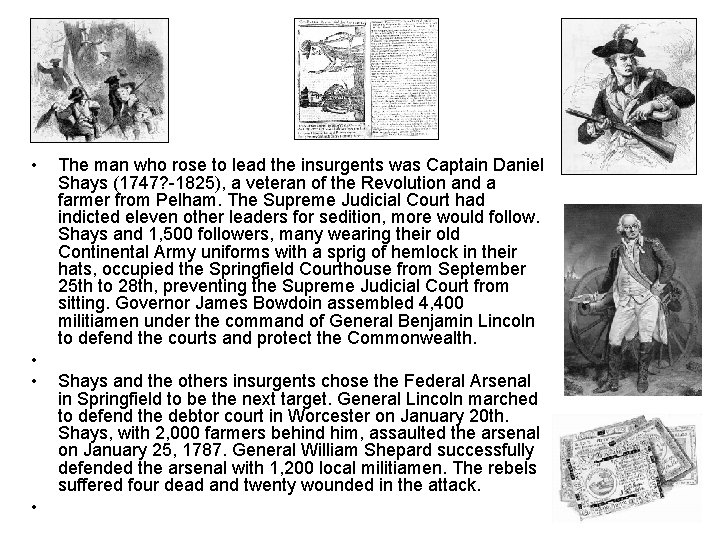
• • The man who rose to lead the insurgents was Captain Daniel Shays (1747? -1825), a veteran of the Revolution and a farmer from Pelham. The Supreme Judicial Court had indicted eleven other leaders for sedition, more would follow. Shays and 1, 500 followers, many wearing their old Continental Army uniforms with a sprig of hemlock in their hats, occupied the Springfield Courthouse from September 25 th to 28 th, preventing the Supreme Judicial Court from sitting. Governor James Bowdoin assembled 4, 400 militiamen under the command of General Benjamin Lincoln to defend the courts and protect the Commonwealth. Shays and the others insurgents chose the Federal Arsenal in Springfield to be the next target. General Lincoln marched to defend the debtor court in Worcester on January 20 th. Shays, with 2, 000 farmers behind him, assaulted the arsenal on January 25, 1787. General William Shepard successfully defended the arsenal with 1, 200 local militiamen. The rebels suffered four dead and twenty wounded in the attack.
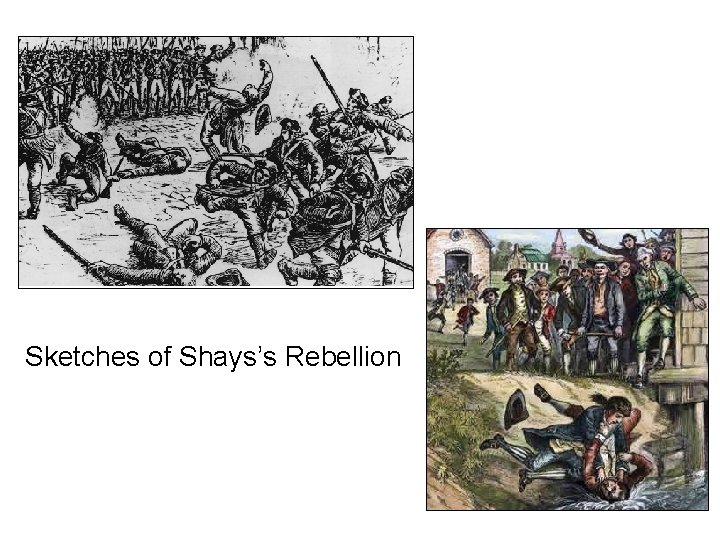
Sketches of Shays’s Rebellion
The Articles of Confederation • • The Articles of Confederation and Perpetual Union – Before the Constitution. . there was The Articles of Confederation-- in effect, the first constitution of the United States. Drafted in 1777 by the same Continental Congress that passed the Declaration of Independence, the articles established a "firm league of friendship" between and among the 13 states. • • Created during the throes of the Revolutionary War, the Articles reflect the wariness by the states of a strong central government. Afraid that their individual needs would be ignored by a national government with too much power, and the abuses that often result from such power, the Articles purposely established a "constitution" that vested the largest share of power to the individual states. – Under the Articles each of the states retained their "sovereignty, freedom and independence. " Instead of setting up executive and judicial branches of government, there was a committee of delegates composed of representatives from each state. These individuals comprised the Congress, a national legislature called for by the Articles. » The Congress was responsible for conducting foreign affairs, declaring war or peace, maintaining an army and navy and a variety of other lesser functions. But the Articles denied Congress the power to collect taxes, regulate interstate commerce and enforce laws. » Eventually, these shortcomings would lead to the adoption of the U. S. Constitution. But during those years in which the 13 states were struggling to achieve their independent status, the Articles of Confederation stood them in good stead. » Adopted by Congress on November 15, 1777, the Articles became operative on March 1, 1781 when the last of the 13 states signed on to the document.
• • • • Richard Henry Lee introduced a historic resolution to the Second Continental Congress in June 1776 that called for that body’s endorsement of independence. At the same time, he also proposed that “a plan of confederation be prepared and transmitted to the respective colonies. . ” A few days later, Congress appointed John Dickinson to head a committee charged with drafting such a plan. The fruits of the committee’s labors, “The Articles of Confederation and Perpetual Union, ” were presented to Congress in July and touched off more than a year of spirited debate. The formal declaration of independence had made it necessary for the states to form some type of central authority. Sentiment for a strong government was not great, however; the states were then involved in a life-and-death struggle with an egregiously powerful central authority, King George III and his ministers, and many Americans feared the substitution of one form of tyranny for another. In the fall debates, two stumbling blocks were overcome by Congress: Representation. It was agreed that the states would be equally represented in the new governing body — each state would have a single vote. The more populous states gave up on their plea for proportional representation. Apportionment of Expenses. It was agreed that the relative physical size of a state would determine its obligation to fund the new government. A physical survey of the states was scheduled to determine their sizes. The Articles were adopted by Congress in November and transmitted to the states for their consideration. Final ratification was not achieved until March 1, 1781. The basic characteristics of the new government included: A loose confederation of states, not a strong union with extensive central powers. The necessity to have two-thirds (nine of 13) of the states approve proposals before implementation. The necessity to have all of the states approve amendments to the Articles. The vesting of executive authority in congressional committees, not in a single individual. The loosely organized federal government created by the Articles quickly demonstrated some glaring weaknesses. The central government lacked the power to regulate trade, levy taxes and impose tariffs. No uniform paper currency or coinage was authorized; money from many states and of differing values was in circulation. The central government also lacked control over foreign affairs, allowing a deplorable situation in which individual states sent envoys to foreign states. Some states had created their own armies, others their own navies. In rare instances, when the Congress could agree to enact legislation, there was no judicial system to enforce the laws. The end result was far from perfect, but it was a start.
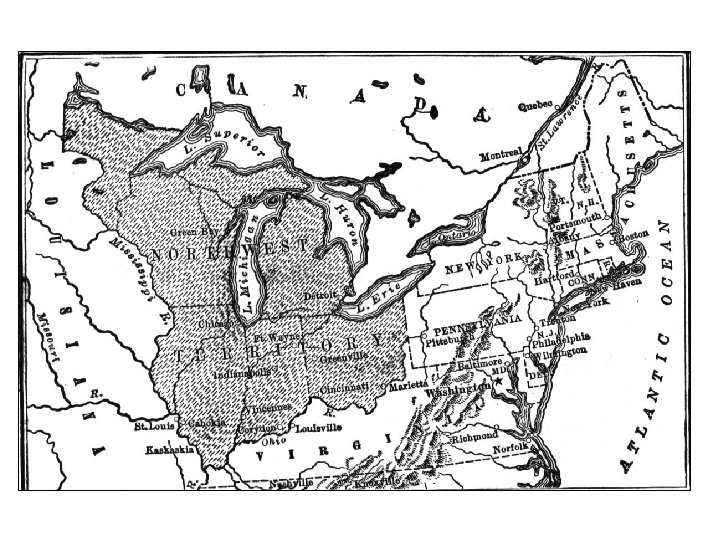
The Old Northwest/Land Ordinance of 1785 • • Large area of land created by the Continental Congress in the Northwest Ordinance of July 13, 1787. The region was later called the Old Northwest. • American settlers poured into the Northwest Territory, which was eventually divided into the states of Ohio, Indiana, Illinois, Michigan, and Wisconsin. • Based on standards set forth in the Land Ordinance of 1785, settlers could buy land in mile-square blocks. • They did so in large numbers. • Slavery was prohibited. • Several British forts nearby led to tensions that eventually broke out into the War of 1812. The American victory in that war ended British claims to any lands in the Northwest Territory. • • It is interesting to note that only two laws of lasting significance were passed during the period of Confederation-the Land Ordinance of 1785 and the Northwest Ordinance of 1787. The 1785 law created the land system of 640 acres to a section (one mile by one mile) thirty-six sections to a Township and one section per Township (Section 16, in most cases) for the support of public schools for all people. The Northwest Ordinance identified the land north of the Ohio River and east of the Mississippi River as the Northwest Territories and stipulated that, after a period of time under Federal control and after attaining a population of at least 60, 000, a portion of the Northwest Territory could petition for statehood as a full and equal part of the USA. No fewer than three nor more than five states could be created under the Northwest Ordinance. It was in that manner that Illinois became a state in 1818 with its first capitol-a tiny, two story house in Kaskaskia. While those brilliant and far-reaching laws were being passed under a failing form of government, this area was still not a frontier, but a pristine wilderness. And, it was only two long lifetimes ago. When the United States purchased the Louisiana Territory from France in 1803, a NEW Northwest was gained, so the area known as the Northwest Territories became forever known as the OLD NORTHWEST.
Also under the Articles… • Native Americans suffered a huge defeat at the Battle of Fallen Timbers in august, 1794. General Anthony Wayne broke the power of the Indian confederacy. In the Treaty of Grenville the Indians gave up their claims to the land in the Northwest Territory.
Weaknesses of the Articles • • • The following are the major challenges to governing through the Articles of Confederation. The Articles of Confederation created a “Firm league of friendship” between the states, not a strong national government. Congress (the central government) was made up of delegates chosen by the states and could conduct foreign affairs, make treaties, declare war, maintain an army and a navy, coin money, and establish post offices. However, measures passed by Congress had to be approved by 9 of the 13 states. Congress was severely limited in its powers. It could not raise money by collecting taxes; it had no control over foreign commerce; it could pass laws but could not force the states to comply with them. Thus, the government was dependent on the willingness of the various states to carry out its measures, and often the states refused to cooperate. The articles were virtually impossible to amend, so problems could not be corrected. There was no executive branch of government.
No power to • Enforce its own laws • Collect taxes or duties • Regulate trade with foreign countries or between states • Raise an army • Set up national courts
The Constitutional Convention/The Miracle in Philadelphia • Delegates showed up in Philadelphia to revise the Articles of Confederation, but James Madison had already decided that a completely new constitution had to be devised. It was Madison’s idea and he wrote the main framework of what will become our Constitution. The Founding Brothers who met were the well-fed, wellread, well-bred, and the well-wed.
Fascinating Facts @ the Constitution • The Constitution has 4, 440 words. It is the oldest and the shortest written constitution of any gov’t in the world. • Neither George Washington nor Thomas Jefferson signed it. • Constitutional Convention met at the State House in Philadelphia, PA. • There were 55 delegates to the Convention. • It was Ben’s humor that quelled many a spat during the convention. • Ben used the carpentry analogy for both sides to arrive at compromise. • Twelve of the Thirteen states were represented. • Rhode Island did not send delegates to the Convention.
Constitution Trivia a la Ben • The Constitution was drafted in 1787. • James Madison is often called the "Father of the Constitution. " • The Constitution became law on June 21, 1788 after 2/3 of the states ratified it. • The first state to ratify the Constitution was Delaware. PA was second. • The ninth state to ratify the Constitution was New Hampshire. • Not all the states had ratified the Constitution by April 30, 1789 when George Washington became the first President of the United States. • The structure of the document has not changed since it was written. • Ben commented upon Washington’s chair—it is indeed a sunrise and not a sunset. • Amendments have provided the flexibility necessary to meet changing circumstances. • The Constitution is preserved for all to view at the National Archives in Washington, DC.
The Constitutional Convention • • • The Philadelphia Convention of 1787 (also known as the Federal Convention or the Constitutional Convention) was a landmark in American and world history. Both its handiwork, the Constitution of the United States, and its example of a people's representatives using reason and experience to decide how to govern themselves had profound influence on subsequent experiments in government. The convention met in the State House (now called Independence Hall) in Philadelphia from May 25 to September 17, 1787. Fifty-five delegates from twelve of the thirteen states (Rhode Island did not send delegates) took part in its deliberations. The convention was the result of a campaign to reform the first charter of government of the United States, the Articles of Confederation. Throughout the 1780 s, politicians who thought in national terms worried that the Confederation faced problems its government was too weak to solve. Former allies, such as France and Spain, and its former adversary, Great Britain, restricted trade with the new nation and hampered America's development of its western territories. The Confederation Congress lacked the power to resolve boundary disputes between the states, to prevent states from imposing tariffs and other restrictions on interstate commerce, or to compel the states to meet requisitions issued to finance the Confederation. The Confederation even lacked an independent source of revenue, and plans in 1781 and 1783 to grant Congress authority to levy a 5 percent tax on imports had failed. Because all thirteen states had to ratify amendments, one state's refusal could block any attempt to amend the Articles.
• Advocates of reform exchanged correspondence to muster support for a convention to revise the Articles, laying the foundation for interstate conferences and conventions seeking similar goals. In 1785, delegates from Maryland Virginia, meeting in the Mount Vernon Conference, set a precedent for interstate conferences on reform. In 1786, hoping to extend this success, some proposed that the states meet in a convention on commercial matters at Annapolis, Maryland. Twelve delegates from five states gathered there in September; their report, written by Alexander Hamilton of New York, urging a general convention spurred the calling of the Federal Convention. • On February 21, 1787, the Confederation Congress adopted a resolution authorizing the convention but limited its mandate to revision of the Articles. Several states already had named their delegates and, citing the Annapolis Convention's report, authorized them to take any measures "to render the constitution of government adequate to the exigencies of the Union. " The convention thus began with an inconsistent mandate.
• The convention consisted of states' governors, chief justices, attorneys general, and many delegates to the Confederation Congress, as well as several distinguished Americans who had agreed to come out of retirement to participate one last time in American politics. Although they followed a wide range of callings—lawyers, physicians, soldiers, clergymen, merchants, and farmers—most of the delegates were well-to-do members of their states' elite; one historian called them the well-bred, well-fed, well-wed, and well-read. • • They fell into several groups: 1. National political figures: Benjamin Franklin of Pennsylvania and George Washington • 2. Senior statesmen of American politics: John Dickinson of Delaware, William Livingston of New Jersey, George Mason of Virginia, John Rutledge of South Carolina, and Roger Sherman of Connecticut were among these men. Veterans of colonial politics, they had helped lead the struggle against Great Britain. They brought with them an ability to compromise and a sensitivity to the clashing interests of the several states. 3. Advocates of state and local interests: These included John Lansing, Jr. , of New York, Luther Martin of Maryland, William Paterson of New Jersey, Charles C. Pinckney of South Carolina, and Robert Yates, Jr. , of New York. Because they spoke for particular interests, they made it necessary at least to consider localist views and interests in framing the new charter of government. 4. Architects of national government: Alexander Hamilton of New York, James Madison of Virginia, Charles Pinckney of South Carolina, and James Wilson of Pennsylvania formed this group. Each of these men hoped to make his ideas the basis of the convention's deliberations. 5. Quiet men: Among these were John Blair of Virginia, Jacob Broome of Delaware, Jared Ingersoll of Pennsylvania, and James Mc. Henry of Maryland. They provided the votes needed to build consensus and to establish grounds for compromise. • • • of Virginia composed this group. Their willingness to place their prestige at risk by attending the convention testified to its legitimacy and to the severity of the problems facing the United States.
• Some leading figures were not present: John Adams and Thomas Jefferson were the American ministers to London and Paris, John Jay was the Confederation's secretary foreign affairs in New York City, and Patrick Henry was elected as a representative, but declined because he “smelt a rat. ” • The convention elected Washington as its president and appointed a committee to prepare rules. Two of these were vital to the convention's success. First, as was customary among legislatures in the Anglo-American world, the convention met in secret, which would permit full and free discussion. Second, the delegates were free to change their minds and reopen any matters for further debate. • The delegates rotated between sessions in full convention and meetings of the Committee of the Whole House, the latter a useful parliamentary procedure permitting informal debate, freedom in stating views, and flexibility in reaching and reconsidering decisions. Select committees worked out compromises, prepared drafts, or formulated a range of solutions to a given problem. The delegates attacked questions piecemeal, debating and deciding on individual aspects. Often a decision on one issue would require them to reconsider other decisions they had reached. They traced a tortuous, crisscrossing route, at times pausing in dismay as they realized that a vote they had just taken had undone the accomplishments of hours or even days of grueling debate.
• Other difficulties facing them included the method of electing the chief executive, or president—solved by the invention of the electoral college; the counting of slaves in the ratio for apportioning representation and taxation among the states—resolved with the "three-fifths" ratio, under which threefifths of the slave population would be added to the free population; and the dispute over the need for a bill of rights, a proposal rejected by the convention in its last week. But the delegates devoted little attention to the powers of the president and almost none to the structure of the judiciary or the executive branch, leaving these matters to the new Congress. • The document approved on September 17, the Constitution of the United States, was a terse outline of government—seven articles of four thousand words. In framing it, the delegates drew on their accumulated experience and memories of colonial, state, and national politics, their familiarity with English constitutional history and classical civilization, and the political ideas of the Age of Enlightenment. Thirty-nine delegates signed the Constitution; the convention sent it to the Confederation Congress for submission to the states, which were to refer it in turn to ratifying conventions chosen by the people. • James Madison took detailed notes of the convention's debates to educate future generations about the difficulties and challenges of constitution making. Together with convention documents, the notes kept by Madison, John Lansing, Jr. , Robert Yates, James Mc. Henry, and other delegates form the basis for the modern understanding of the convention's work. Although these documents had little influence on the workings of the Constitution in its first decades, modern constitutional lawyers use them in preparing arguments about the "original intent" of the Framers.
• The convention discarded the Articles and framed an entirely new constitution. They based their work on a set of resolutions known as the Virginia Plan, largely the work of James Madison. These resolutions proposed the creation of a supreme national government with separate legislative, executive, and judicial branches. • The convention's principal task was the design of the national legislature. The delegates agreed on the powers they wished to lodge in the new Congress, but disagreed about how the states and the American people would be represented in it. Under the Virginia Plan, population or some other proportional measure would determine representation in both houses of Congress. To protect the principle of state equality, small-state delegates rallied behind William Paterson's New Jersey Plan, which would have preserved each state's equal vote in a one-house Congress with augmented powers. Although the delegates rejected the New Jersey Plan on June 19, it took them nearly a month of further argument before they adopted on July 16 what has been called the Great Compromise, under which the House of Representatives would be apportioned based on population and each state would have two votes in the Senate.
Virginia Plan • Under the Virginia Plan, population or some other proportional measure would determine representation in both houses of Congress. To protect the principle of state equality, small-state delegates rallied behind William Paterson's New Jersey Plan, which would have preserved each state's equal vote in a one-house Congress with augmented powers. Although the delegates rejected the New Jersey Plan on June 19, it took them nearly a month of further argument before they adopted on July 16 what has been called the Great Compromise, under which the House of Representatives would be apportioned based on population and each state would have two votes in the Senate. • The Virginia Plan called for a powerful central government, comprised of the executive, legislative, and judicial branches. Smaller states were concerned that this plan would not be truly representative of their needs and interests.
New Jersey Plan • William Paterson proposed that each state regardless of size and population should have one vote to ensure equality. • To protect the principle of state equality, small-state delegates rallied behind William Paterson's New Jersey Plan, which would have preserved each state's equal vote in a one-house Congress with augmented powers. Although the delegates rejected the New Jersey Plan on June 19 th. • The alternative plan, the New Jersey Plan, would revise and amend the Articles of Confederation to allow Congress to control trade and taxes, but still provide states with much control and autonomy at the local level.
The Great Compromise • Also called the Connecticut Compromise was authored by Roger Sherman. It called for proportional representation in the House of Representatives, and one representative (later changed to two) per state in the Senate. • Slaves were to be counted among the population as 3/5 ths of a person, to satisfy the South. • Bicameral legislature—House of Representatives and the Senate • A bicameral lawmaking branch was created. While states were to have equal representation in the Senate regardless of state size, the House of Representatives membership was to be based on state population. In addition to this legislative branch, an executive and judicial branch were formed, and it was agreed that no branch would have more power than the other, through a system of checks and balances. This new plan was known as the Great Compromise. As a result of this work, the Constitution was drafted and presented to the American public on September 17, 1787.
3/5’s Compromise • In order to accommodate the South, population would be counted including the slaves within the state. Slaves were to be counted as 3/5’s of a person—derogatory, definitely, but it did leave the door ajar for better representation of the whole population. • It was basically done by the South to give them a majority and some control. They feared all along that slavery would be abolished and they could not risk that.
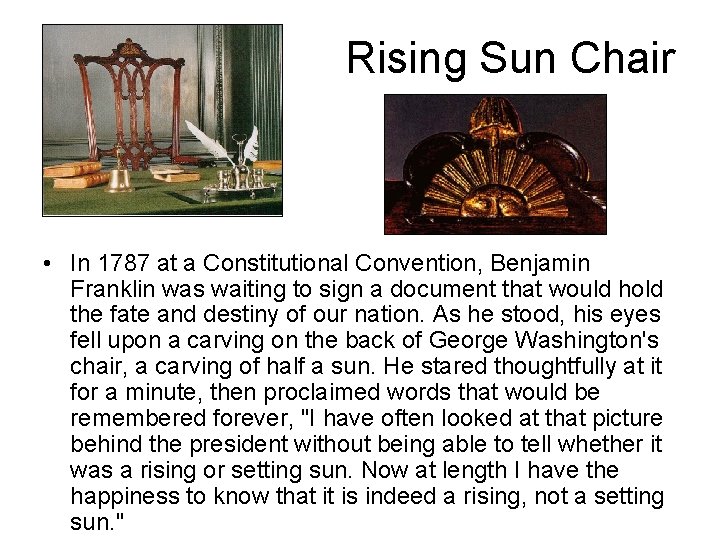
Rising Sun Chair • In 1787 at a Constitutional Convention, Benjamin Franklin was waiting to sign a document that would hold the fate and destiny of our nation. As he stood, his eyes fell upon a carving on the back of George Washington's chair, a carving of half a sun. He stared thoughtfully at it for a minute, then proclaimed words that would be remembered forever, "I have often looked at that picture behind the president without being able to tell whether it was a rising or setting sun. Now at length I have the happiness to know that it is indeed a rising, not a setting sun. "
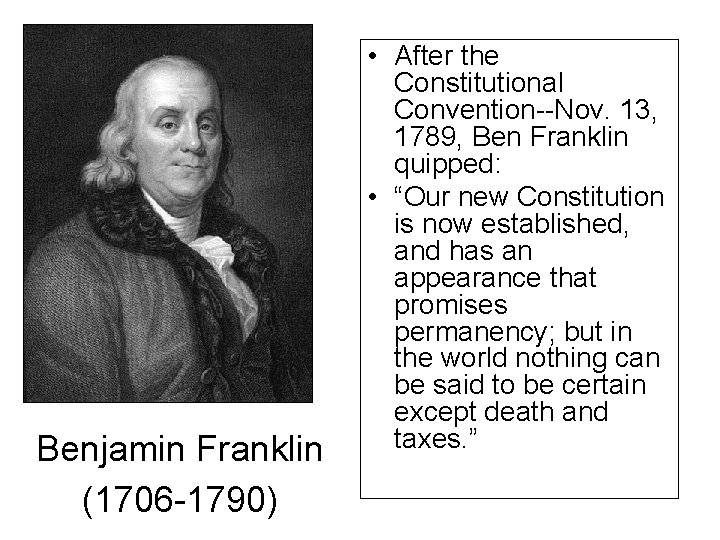
Benjamin Franklin (1706 -1790) • After the Constitutional Convention--Nov. 13, 1789, Ben Franklin quipped: • “Our new Constitution is now established, and has an appearance that promises permanency; but in the world nothing can be said to be certain except death and taxes. ”
ELECTORAL COLLEGE • • • The electoral college is the method stipulated in Article II, Section 1, of the Constitution for electing the president and vice president. Originally each state chose electors equal in number to its representatives and senators. The electors voted for two candidates each, at least one of whom had to be from another state. The person receiving the most votes became president with the runner-up becoming vice president. If no person received a majority, the House of Representatives was to choose the president and vice president from the three leading candidates. The election of 1800, in which Thomas Jefferson and Aaron Burr were tied in the electoral vote, resulted in passage of the Twelfth Amendment (1804). Electors now cast separate votes for president and vice president; in the event of ties the House of Representatives is to choose the president and the Senate the vice president. Modern critics note that the electoral college has several potentially dangerous flaws. For example, a president can be elected with a majority of electoral votes, even though his or her opponent has won a majority of popular votes; this last happened in 1888. Reformers have urged that the electoral college be abolished in favor of direct popular vote for president and vice president, or that the electoral votes of each state be allotted to the candidates in proportion to the popular vote they receive rather than the present winner-take-all system. Defenders of the electoral college reject the dangers as exaggerated and insist that the system has worked far better than one might expect.
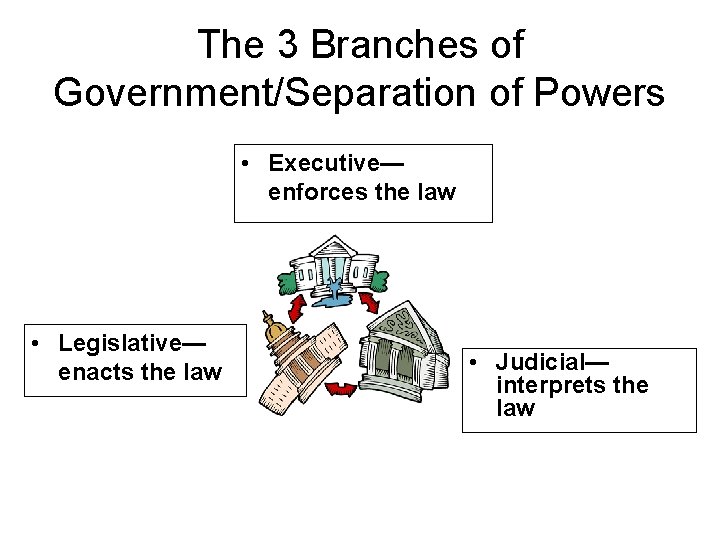
The 3 Branches of Government/Separation of Powers • Executive— enforces the law • Legislative— enacts the law • Judicial— interprets the law
Checks and Balances • Power would be divided among three parts of the gov’t. No person could serve in more than one of those parts at one time. No one part could be a gov’t by itself. The legislature could pass laws but could not enact them by itself. The judiciary could conduct trials but could not make laws to punish the guilty. Each part needed the other parts and so the powers of gov’t were limited and checked by the others.
Checks and Balances in the Federal Government • • • Executive Branch—President May check the Judicial Branch by granting pardons to those who are convicted of federal crimes May check Congress by vetoing bills passed by Congress, sending messages to Congress, appealing to the people. Legislative Branch—Congress May check the Executive Branch by impeaching the President, overriding a veto, refusing to confirm Presidential appointments, approving or failing to approve treaties May check the Judicial Branch by impeaching judges, changing the number of justices on the Supreme Court, proposing an amendment to the Constitution if the Supreme Court finds a law unconstitutional. Judicial Branch—The Supreme Court May check the Executive by interpreting the laws and treaties, ruling that laws and executive acts are unconstitutional May check the Legislative by interpreting laws and treaties, declaring laws unconstitutional.
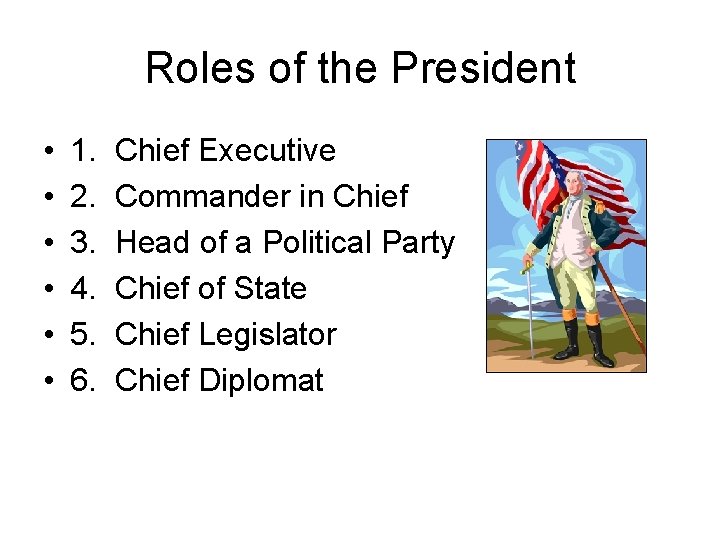
Roles of the President • • • 1. 2. 3. 4. 5. 6. Chief Executive Commander in Chief Head of a Political Party Chief of State Chief Legislator Chief Diplomat
Loose Construction vs. Strict Construction • loose construction : A loose or liberal interpretation of an issue. Commonly applied to that view of the U. S. Constitution that expands federal powers beyond those specifically mentioned in the document. • strict construction : A close or literal interpretation of an issue. Commonly applied to that view of the U. S. Constitution that limits federal powers to those specifically described in that document.
• • • This clause became the center of controversy from the early days of the nation when Alexander Hamilton and Thomas Jefferson tangled over the constitutionality of a national bank. Their arguments, in one form or another, persist to today: The “loose constructionists” (the Hamiltonians or Federalists) viewed Clause 18 as an opportunity to increase federal power The “strict constructionists” (the Jeffersonians or Anti-Federalists) believed that Clause 18 limited federal power. In their opinion, Congress could legitimately exercise only specified functions (Clauses 1 -17); to do otherwise would be a violation of Amendment X, which specified that those powers not delegated to the federal government are reserved to the states or the people. President George Washington sided with Hamilton and supported the establishment of the First Bank of the United States. The Federalist position regarding “implied powers” became part of the national fabric largely through the decisions of the U. S. Supreme Court under John Marshall. Clause 18 is also known as the “elastic clause” or the “necessary and proper clause. ”
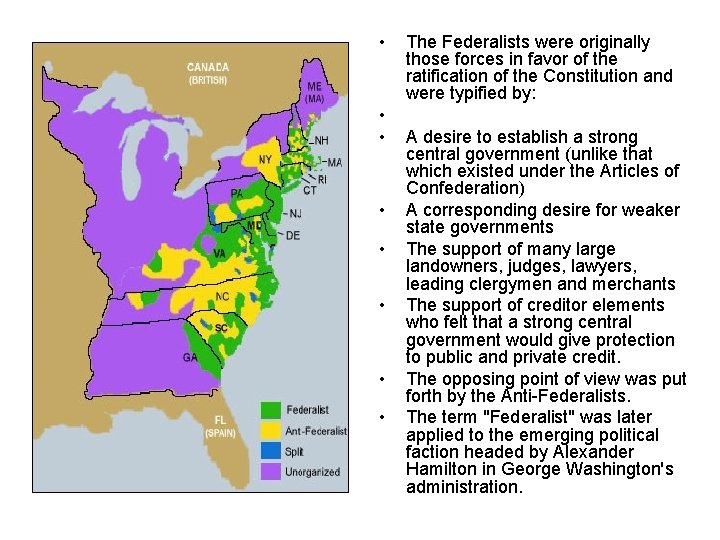
• • The Federalists were originally those forces in favor of the ratification of the Constitution and were typified by: A desire to establish a strong central government (unlike that which existed under the Articles of Confederation) A corresponding desire for weaker state governments The support of many large landowners, judges, lawyers, leading clergymen and merchants The support of creditor elements who felt that a strong central government would give protection to public and private credit. The opposing point of view was put forth by the Anti-Federalists. The term "Federalist" was later applied to the emerging political faction headed by Alexander Hamilton in George Washington's administration.
Federalists vs. Anti-Federalists • Leader--John Adams, Alexander Hamilton • For a strong central gov’t • For the urban, rich bizindustrialism • For a national bank • For a loose interpretation • Pro-England • Leader--Thomas Jefferson • For states’ rights • For the common man—farmeragrarian • For state banks • For strict interpretation • Pro-France • Change name to Democratic. Republicans Jeffersonian Democrats
The Federalist Papers • These are a series of eighty-five letters written to newspapers in 17871788 by Alexander Hamilton, James Madison, and John Jay, urging ratification of the Constitution. • After a new Constitution, intended to replace the ineffectual Articles of Confederation, had been hammered out at the Philadelphia Convention, it was agreed that it would go into effect when nine of the thirteen states had approved it in ratifying conventions. There ensued a nationwide debate over constitutional principles, and the press was inundated with letters condemning or praising the document, among them these articles, signed "Publius. " The three men—chief among them Hamilton, who wrote about two-thirds of the essays— addressed the objections of opponents, who feared a tyrannical central government that would supersede states' rights and encroach on individual liberties. All strong nationalists, the essayists argued that, most important, the proposed system would preserve the Union, now in danger of breaking apart, and empower the federal government to act firmly and coherently in the national interest. Conflicting economic and political interests would be reconciled through a representative Congress, whose legislation would be subject to presidential veto and judicial review. This system of checks and balances and the Constitution's clear delineation of the powers of the federal government—few, limited, and defined, as Madison put it—would protect states' rights and, as they saw it, individual rights. The ultimate protection of individual liberties had to wait for later passage of the Bill of Rights, for these men, as their arguments made plain, distrusted what Madison called "the superior force of an interested and overbearing majority. " Many of the constitutional provisions they praised were intended precisely to dampen democratic "excesses. " The articles, written in the spirit both of propaganda and of logical argument, probably had little influence on public opinion of the day. Nevertheless, the essays, published in book form as The Federalist in 1788, have through the years been widely read and respected for their masterly analysis and interpretation of the Constitution and the principles upon which the government of the United States was established. • •
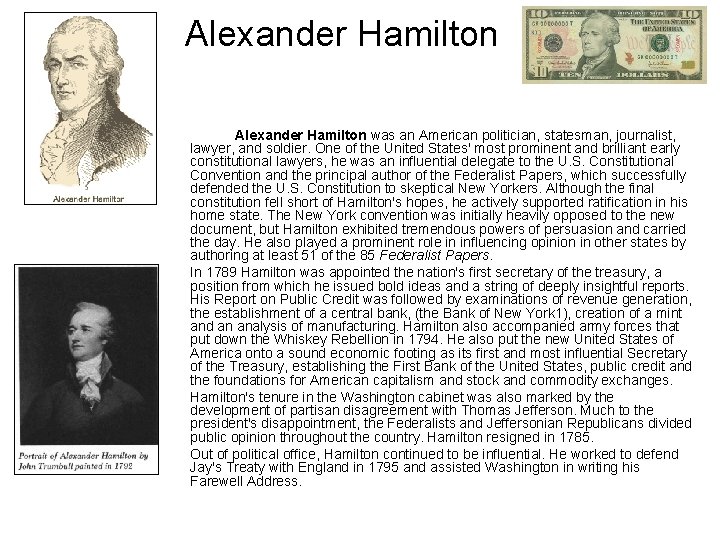
Alexander Hamilton was an American politician, statesman, journalist, lawyer, and soldier. One of the United States' most prominent and brilliant early constitutional lawyers, he was an influential delegate to the U. S. Constitutional Convention and the principal author of the Federalist Papers, which successfully defended the U. S. Constitution to skeptical New Yorkers. Although the final constitution fell short of Hamilton's hopes, he actively supported ratification in his home state. The New York convention was initially heavily opposed to the new document, but Hamilton exhibited tremendous powers of persuasion and carried the day. He also played a prominent role in influencing opinion in other states by authoring at least 51 of the 85 Federalist Papers. In 1789 Hamilton was appointed the nation's first secretary of the treasury, a position from which he issued bold ideas and a string of deeply insightful reports. His Report on Public Credit was followed by examinations of revenue generation, the establishment of a central bank, (the Bank of New York 1), creation of a mint and an analysis of manufacturing. Hamilton also accompanied army forces that put down the Whiskey Rebellion in 1794. He also put the new United States of America onto a sound economic footing as its first and most influential Secretary of the Treasury, establishing the First Bank of the United States, public credit and the foundations for American capitalism and stock and commodity exchanges. Hamilton's tenure in the Washington cabinet was also marked by the development of partisan disagreement with Thomas Jefferson. Much to the president's disappointment, the Federalists and Jeffersonian Republicans divided public opinion throughout the country. Hamilton resigned in 1785. Out of political office, Hamilton continued to be influential. He worked to defend Jay's Treaty with England in 1795 and assisted Washington in writing his Farewell Address.
The Bill of Rights • • • I - Freedom of Speech, Press, Religion and Petition II - Right to keep and bear arms III - Conditions for quarters of soldiers IV - Right of search and seizure regulated V - Provisions concerning prosecution VI - Right to a speedy trial, witnesses, etc. VII - Right to a trial by jury VIII - Excessive bail, cruel punishment IX - Rule of construction of Constitution X - Rights of the States under Constitution
• • I - Freedom of Speech, Press, Religion and Petition Congress shall make no law respecting an establishment of religion, or prohibiting the free exercise thereof; or abridging the freedom of speech, or of the press; or the right of the people peaceably to assemble, and to petition the Government for a redress of grievances. • • II - Right to keep and bear arms A well-regulated militia, being necessary to the security of a free State, the right of the people to keep and bear arms, shall not be infringed. • • III - Conditions for quarters of soldiers No soldier shall, in time of peace be quartered in any house, without the consent of the owner, nor in time of war, but in a manner to be prescribed by law. • • IV - Right of search and seizure regulated The right of the people to be secure in their persons, houses, papers, and effects, against unreasonable searches and seizures, shall not be violated, and no warrants shall issue, but upon probable cause, supported by oath or affirmation, and particularly describing the place to be searched, and the persons or things to be seized. • • V - Provisons concerning prosecution No person shall be held to answer for a capital, or otherwise infamous crime, unless on a presentment or indictment of a Grand Jury, except in cases arising in the land or naval forces, or in the militia, when in actual service in time of war or public danger; nor shall any person be subject for the same offense to be twice put in jeopardy of life or limb; nor shall be compelled in any criminal case to be a witness against himself, nor be deprived of life, liberty, or property, without due process of law; nor shall private property be taken for public use without just compensation.
• • VI - Right to a speedy trial, witnesses, etc. In all criminal prosecutions, the accused shall enjoy the right to a speedy and public trial, by an impartial jury of the State and district wherein the crime shall have been committed, which district shall have been previously ascertained by law, and to be informed of the nature and cause of the accusation; to be confronted with the witnesses against him; to have compulsory process for obtaining witnesses in his favor, and to have the assistance of counsel for his defense. • • VII - Right to a trial by jury In suits at common law, where the value in controversy shall exceed twenty dollars, the right of trial by jury shall be preserved, and no fact tried by a jury shall be otherwise reexamined in any court of the United States, than according to the rules of the common law. • • VIII - Excessive bail, cruel punishment Excessive bail shall not be required, nor excessive fines imposed, nor cruel and unusual punishments inflicted. • • IX - Rule of construction of Constitution The enumeration in the Constitution, of certain rights, shall not be construed to deny or disparage others retained by the people. • • X - Rights of the States under Constitution The powers not delegated to the United States by the Constitution, nor prohibited by it to the States, are reserved to the States respectively, or to the people. • There were two others, but they were not included—one concerned with the abolition of slavery and the other with Congressional salary…
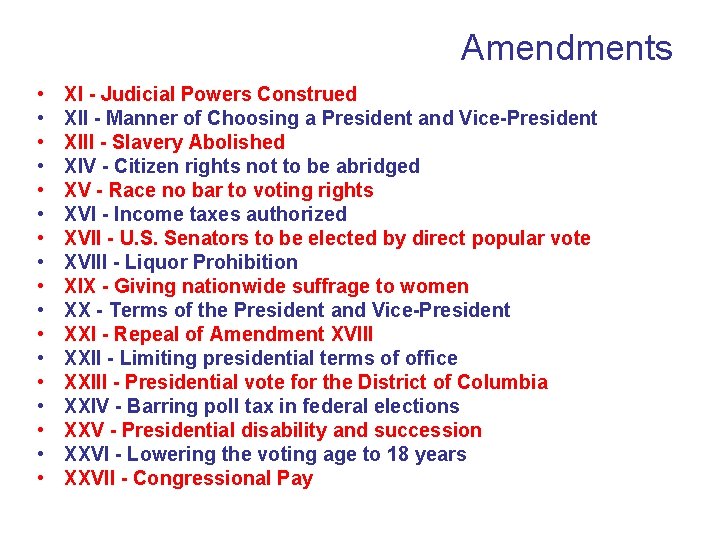
Amendments • • • • • XI - Judicial Powers Construed XII - Manner of Choosing a President and Vice-President XIII - Slavery Abolished XIV - Citizen rights not to be abridged XV - Race no bar to voting rights XVI - Income taxes authorized XVII - U. S. Senators to be elected by direct popular vote XVIII - Liquor Prohibition XIX - Giving nationwide suffrage to women XX - Terms of the President and Vice-President XXI - Repeal of Amendment XVIII XXII - Limiting presidential terms of office XXIII - Presidential vote for the District of Columbia XXIV - Barring poll tax in federal elections XXV - Presidential disability and succession XXVI - Lowering the voting age to 18 years XXVII - Congressional Pay
Reasons why the Constitution was Ratified • The ratification, or adoption, of the Constitution took place between September of 1787 and July of 1788. The Federal Convention, which had drafted the Constitution between May and September 1787, had no authority to impose it on the American people. Article VII of the Constitution and resolutions adopted by the convention on September 17, 1787, detailed a four-stage ratification process: (1) submission of the Constitution to the Confederation Congress, (2) transmission of the Constitution by Congress to the state legislatures, (3) election of delegates to conventions in each state to consider the Constitution, and (4) ratification by the conventions of at least nine of the thirteen states.
Real Reasons Why it was ratified • 1. George Washington was for it and he was usually right. • 2. The Anti-Federalists had no other plan ready… • 3. The Anti-Federalists found it acceptable if the Bill of Rights were added. • 4. There was a deal to sweeten the South—the Federal capital would be located in the South if the South ratified it—also • 5. No mention of slavery is in it. Although Jefferson knew that the issue of slavery—our peculiar institution was “like holding a wolf by the ears”—you dare not let go, although you know the danger. Also he felt it was “a firebell ringing in the night”—a cause of terror and alarm. • 6. The Federal Residency Act— 1790 made the District of Columbia the national capital in the South. The South agreed to ratify under that condition.
The Ratification of the Constitution • • • The ratification controversy pitted supporters of the Constitution, who claimed the name "Federalists, " against a loosely organized group known as "Anti-federalists. " The Anti-federalists denounced the Constitution as a radically centralizing document that would destroy American liberty and betray the principles of the Revolution. The Federalists urged that the nation's problems were directly linked to the frail, inadequate Confederation and that nothing short of the Constitution would enable the American people to preserve their liberty and independence, the fruits of the Revolution. The Federalists—led by Alexander Hamilton, James Madison, John Jay, John Marshall, James Wilson, John Dickinson, and Roger Sherman—had several advantages. In a time of national political crisis, they offered a clear prescription for the nation's ills; they were well organized and well financed; and they were used to thinking in national terms and to working with politicians from other states. They also had the support of the only two truly national political figures, George Washington and Benjamin Franklin. The Anti-federalists—led by Patrick Henry, George Mason, Richard Henry Lee, James Monroe, John Hancock, Samuel Adams, Elbridge Gerry, George Clinton, Willie Jones, and Melancton Smith—counted among their advantages the support of most state politicians and the American people's distrust of strong central government. Their most potent argument against the Constitution was that it lacked a bill of rights.
The Secret Deal • In 1790, as the result of a compromise between a number of Southern congressmen and Alexander Hamilton, then serving as Secretary of the Treasury, the seat of the United States Government was temporarily moved from Federal Hall in New York to Congress Hall in Philadelphia before taking its current residence in Washington, DC. In exchange for locating a permanent capital on the banks of the Potomac River, the congressmen agreed to support Hamilton's financial proposals. • Philadelphia served as the temporary capital for a decade, until 1800, when the Capitol building in the new Federal city of Washington, DC was opened.
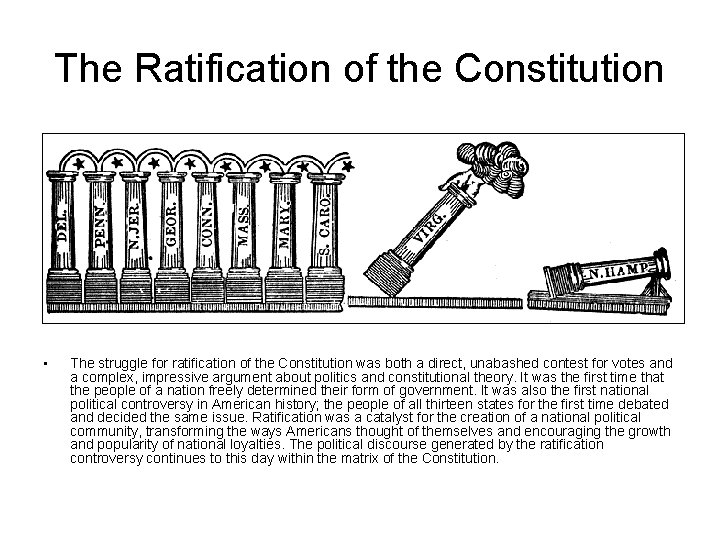
The Ratification of the Constitution • The struggle for ratification of the Constitution was both a direct, unabashed contest for votes and a complex, impressive argument about politics and constitutional theory. It was the first time that the people of a nation freely determined their form of government. It was also the first national political controversy in American history; the people of all thirteen states for the first time debated and decided the same issue. Ratification was a catalyst for the creation of a national political community, transforming the ways Americans thought of themselves and encouraging the growth and popularity of national loyalties. The political discourse generated by the ratification controversy continues to this day within the matrix of the Constitution.
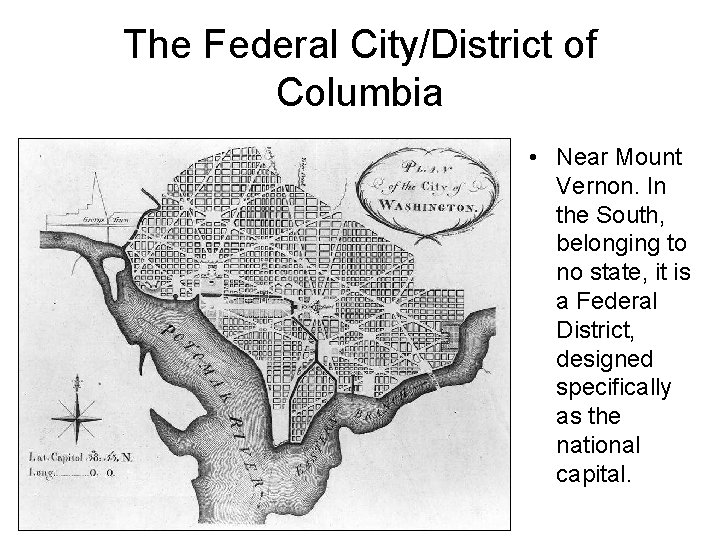
The Federal City/District of Columbia • Near Mount Vernon. In the South, belonging to no state, it is a Federal District, designed specifically as the national capital.
Pierre L’Enfant • • In 1784 L'Enfant came back to America and settled in New York City, where he was soon recognized as an outstanding designer and engineer. In 1791 President Washington picked him to design the nation's new capital city. Three years later, after a series of disagreements and personality clashes with the three commissioners appointed by Washington to oversee the project, he was dismissed by his mentor. He was not paid for his services. L'Enfant later tried to obtain $95, 500 for his work. Congress gave him what it deemed a suitable fee — about $3800. As an old man, L'Enfant lived with friends in Maryland, where he died in 1825, penniless and forgotten. In 1909 his remains were reburied in Arlington National Cemetery, where, at long last, a suitable monument was built to him.
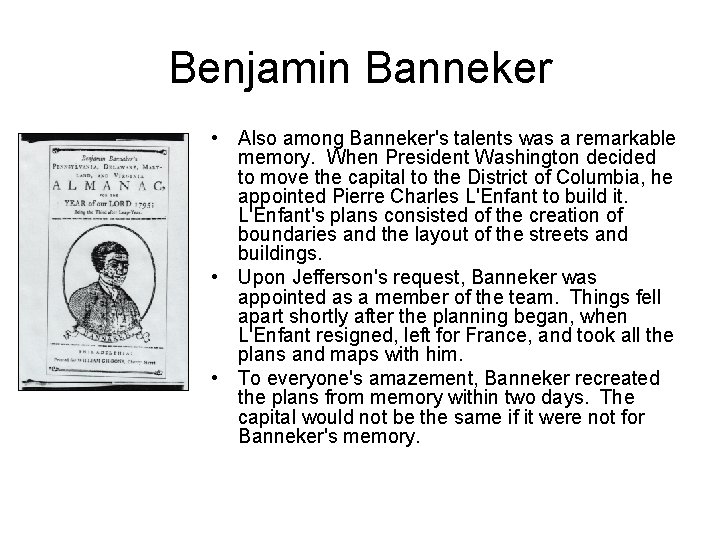
Benjamin Banneker • Also among Banneker's talents was a remarkable memory. When President Washington decided to move the capital to the District of Columbia, he appointed Pierre Charles L'Enfant to build it. L'Enfant's plans consisted of the creation of boundaries and the layout of the streets and buildings. • Upon Jefferson's request, Banneker was appointed as a member of the team. Things fell apart shortly after the planning began, when L'Enfant resigned, left for France, and took all the plans and maps with him. • To everyone's amazement, Banneker recreated the plans from memory within two days. The capital would not be the same if it were not for Banneker's memory.
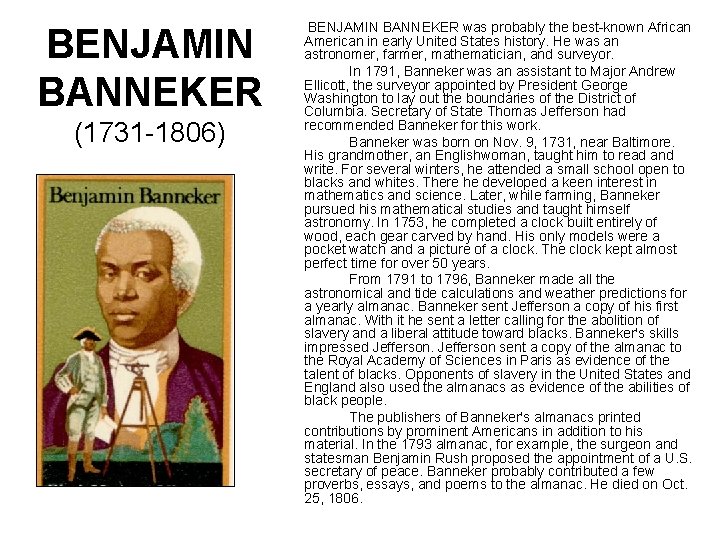
BENJAMIN BANNEKER (1731 -1806) BENJAMIN BANNEKER was probably the best-known African American in early United States history. He was an astronomer, farmer, mathematician, and surveyor. In 1791, Banneker was an assistant to Major Andrew Ellicott, the surveyor appointed by President George Washington to lay out the boundaries of the District of Columbia. Secretary of State Thomas Jefferson had recommended Banneker for this work. Banneker was born on Nov. 9, 1731, near Baltimore. His grandmother, an Englishwoman, taught him to read and write. For several winters, he attended a small school open to blacks and whites. There he developed a keen interest in mathematics and science. Later, while farming, Banneker pursued his mathematical studies and taught himself astronomy. In 1753, he completed a clock built entirely of wood, each gear carved by hand. His only models were a pocket watch and a picture of a clock. The clock kept almost perfect time for over 50 years. From 1791 to 1796, Banneker made all the astronomical and tide calculations and weather predictions for a yearly almanac. Banneker sent Jefferson a copy of his first almanac. With it he sent a letter calling for the abolition of slavery and a liberal attitude toward blacks. Banneker's skills impressed Jefferson sent a copy of the almanac to the Royal Academy of Sciences in Paris as evidence of the talent of blacks. Opponents of slavery in the United States and England also used the almanacs as evidence of the abilities of black people. The publishers of Banneker's almanacs printed contributions by prominent Americans in addition to his material. In the 1793 almanac, for example, the surgeon and statesman Benjamin Rush proposed the appointment of a U. S. secretary of peace. Banneker probably contributed a few proverbs, essays, and poems to the almanac. He died on Oct. 25, 1806.
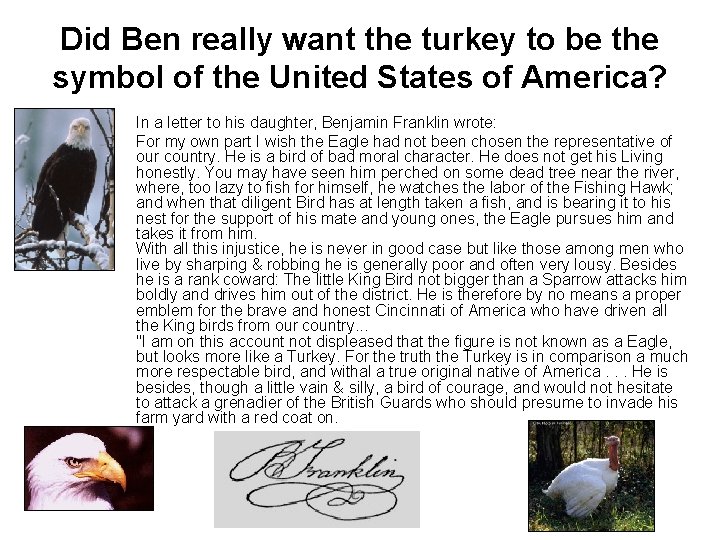
Did Ben really want the turkey to be the symbol of the United States of America? • • In a letter to his daughter, Benjamin Franklin wrote: For my own part I wish the Eagle had not been chosen the representative of our country. He is a bird of bad moral character. He does not get his Living honestly. You may have seen him perched on some dead tree near the river, where, too lazy to fish for himself, he watches the labor of the Fishing Hawk; and when that diligent Bird has at length taken a fish, and is bearing it to his nest for the support of his mate and young ones, the Eagle pursues him and takes it from him. With all this injustice, he is never in good case but like those among men who live by sharping & robbing he is generally poor and often very lousy. Besides he is a rank coward: The little King Bird not bigger than a Sparrow attacks him boldly and drives him out of the district. He is therefore by no means a proper emblem for the brave and honest Cincinnati of America who have driven all the King birds from our country. . . "I am on this account not displeased that the figure is not known as a Eagle, but looks more like a Turkey. For the truth the Turkey is in comparison a much more respectable bird, and withal a true original native of America. . . He is besides, though a little vain & silly, a bird of courage, and would not hesitate to attack a grenadier of the British Guards who should presume to invade his farm yard with a red coat on.
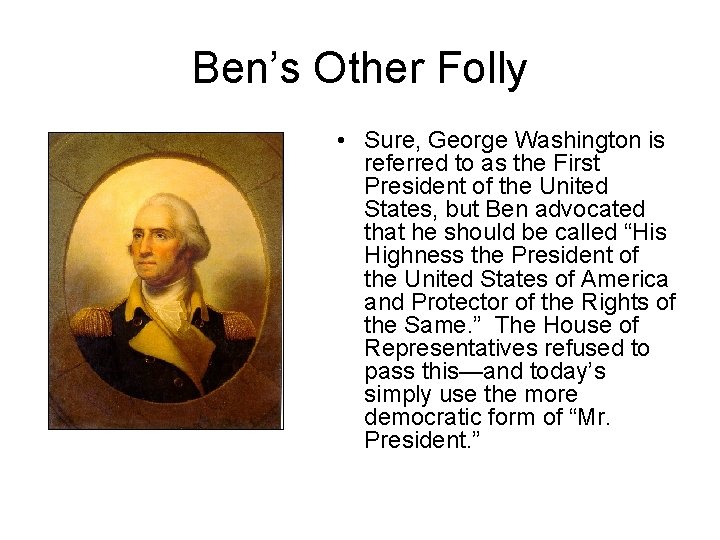
Ben’s Other Folly • Sure, George Washington is referred to as the First President of the United States, but Ben advocated that he should be called “His Highness the President of the United States of America and Protector of the Rights of the Same. ” The House of Representatives refused to pass this—and today’s simply use the more democratic form of “Mr. President. ”
George Washington • Washington’s Administration: • Cabinet: A precedent • Secretary of State: Thomas Jefferson • Attorney General: Edmund Randolph • Secretary of War: Henry Knox • Secretary of the Treasury: • Alexander Hamilton
Presidential Precedents under Washington • • 1. Chooses the Cabinet members. 2. Only served two terms. 3. Adopted Mr. President as the form of address. 4. Established the tariff, national bank, and government bonds. • 5. Establishes the United States Navy. • 6. Named the justices of the Supreme Court, 3 circuit courts, & 13 district courts • 7. Policy of Neutrality during European wars.
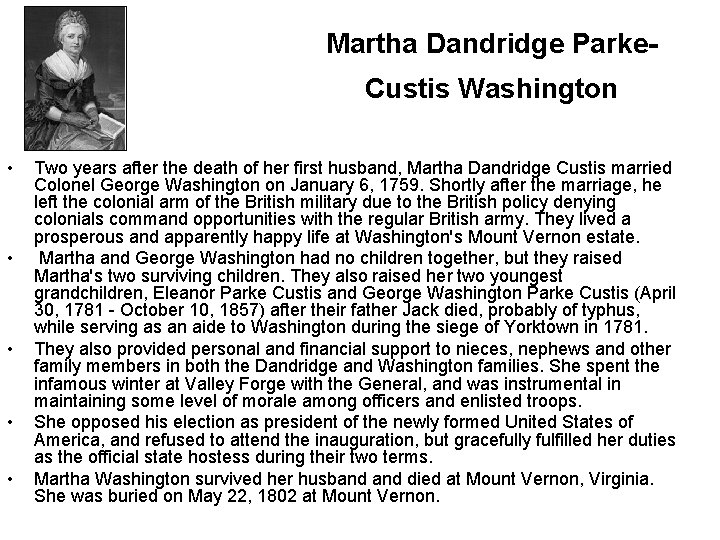
Martha Dandridge Parke. Custis Washington • • • Two years after the death of her first husband, Martha Dandridge Custis married Colonel George Washington on January 6, 1759. Shortly after the marriage, he left the colonial arm of the British military due to the British policy denying colonials command opportunities with the regular British army. They lived a prosperous and apparently happy life at Washington's Mount Vernon estate. Martha and George Washington had no children together, but they raised Martha's two surviving children. They also raised her two youngest grandchildren, Eleanor Parke Custis and George Washington Parke Custis (April 30, 1781 - October 10, 1857) after their father Jack died, probably of typhus, while serving as an aide to Washington during the siege of Yorktown in 1781. They also provided personal and financial support to nieces, nephews and other family members in both the Dandridge and Washington families. She spent the infamous winter at Valley Forge with the General, and was instrumental in maintaining some level of morale among officers and enlisted troops. She opposed his election as president of the newly formed United States of America, and refused to attend the inauguration, but gracefully fulfilled her duties as the official state hostess during their two terms. Martha Washington survived her husband died at Mount Vernon, Virginia. She was buried on May 22, 1802 at Mount Vernon.
Events during Washington’s Administration • • The Report on Public Credit by Alexander Hamilton Neutrality Act—ignore both England & France Citizen Genet—embarrassment and French Jay’s Treaty—supposed to be vs. impressment Pinckney’s Treaty—deal with Spain for Miss. River traffic Whiskey Rebellion—western PA farmers hate excise tax The Farewell Address—warnings have been unheeded! – – a) b) c) d) no foreign entanglements do not split into political factions pay off the national debt two-term limit –sets a precedent
• As the first President, Washington appointed the entire Supreme Court, a feat almost repeated by President Franklin D. Roosevelt during his four terms in office (1933 -1945). Washington appointed the following Justices to the Supreme Court of the United States: • • • John Jay - Chief Justice - 1789 James Wilson - 1789 John Rutledge - 1790 William Cushing - 1790 John Blair - 1790 James Iredell - 1790 Thomas Johnson - 1792 William Paterson - 1793 John Rutledge - Chief Justice, 1795 (an associate justice since 1790) • Samuel Chase - 1796 • Oliver Ellsworth - Chief Justice - 1796
Alexander Hamilton’s Plan • National Debt=National blessing • Assume all of the colonies’ debts at par value—sell bonds • National Bank—to issue money backed by gold • Tariff—tax on all imported goods • Excise tax—on all manufactures • Sale of Western lands brings in $$ to gov’t
First Bank of the United States • The establishment of the Bank raised early questions of constitutionality in the new government. Hamilton, then Secretary of the Treasury, argued that the Bank was an effective means to achieve the authorized powers of the government. Secretary of State Thomas Jefferson argued that the Bank violated traditional property law and that its relevance to constitutionally authorized powers was weak. • Tenets the bank was based on include: • Sound finance, with a balanced government budget deficit, except during wartime emergency • Sound banking, with reserves in gold • Lender last resort availability • The currency notes issued could serve as instruments of national policy • It was located in Philadelphia.
Citizen Genet • Citizen Edmond Genet shows up in Washington to drum up American support for the French Revolution. • Washington tells him to keep a low profile and do not expect help from us since we are Neutral!!! • Genet tries to indoctrinate and enlist American support anyway. We tell him to leave. He does, but soon comes back fleeing the guillotine…
Election of 1792 • • • George WASHINGTON Party: FEDERALIST Home State: VA Electoral Votes: 132 John ADAMS Party: FEDERALIST Home State: MA Electoral Votes: 77 Before the ratification of the 12 th amendment in 1804, the candidate who received the majority of electoral votes became president, and the runner-up was named vice president. See The Electoral Process Before the 12 th Amendment. George CLINTON Party: DEMOCRATIC-REPUBLICAN Home State: NY Electoral Votes: 50 Thomas JEFFERSON Party: DEMOCRATIC-REPUBLICAN Home State: VA Electoral Votes: 4 Aaron BURR Party: DEMOCRATIC-REPUBLICAN Home State: NY Electoral Votes: 1 Not Cast Electoral Votes: 6 From the moment the Constitution was ratified, divisions among those in power arose and political factions developed. The two most prominent factions were the Federalists (with whom Washington and John Adams agreed) who advocated a strong central government, and the Democratic-Republicans who believed the states should hold the most power. George Washington, who had originally wanted to retire after his first presidential term, decided to run again in order to try to halt the rise of political parties. The Democratic-Republicans, who were aware of Washington's obvious and undiminished popularity and who were at the time outnumbered by the Federalists, didn't oppose his reelection. Once again Washington received a vote on every elector's ballot, giving him his second unanimous presidential election.
The Whiskey Rebellion 1794 • • Unrest existed in many areas of the West, particularly west of the Alleghenies. Primary contributing issues included a lack of federal courts in the West, which necessitated long trips to Philadelphia, lack of protection against Native American attacks and a high federal excise tax on domestically produced distilled spirits. At Alexander Hamilton's urging, Congress in 1791 enacted a tax on spirits at twenty-five percent of the liquor's value. Large producers were not pleased with the tax, but generally complied; the small producers were irate and began to organize opposition. In the western counties of Pennsylvania the Scots-Irish farmers were particularly hard-hit; most were grain growers and many were distillers. Mobs tarred and feathered a tax collector and burned the home of another; shots were exchanged. Washington called upon the rebels to disperse, but his plea was ignored. The president then ordered the governors of the surrounding states to summon their militias. A force of nearly 13, 000 men was raised and marched into western Pennsylvania. Opposition quickly faded away, but Hamilton (never reluctant to press federal power) actively directed the capture of more than 100 participants. Eventually two were convicted of treason, but later received presidential pardons. The Whiskey Rebellion was the first test of federal authority in the young republic; it demonstrated the willingness and ability of the federal government to enforce its laws. It also established a precedent when the President called up state militias for federal purposes.
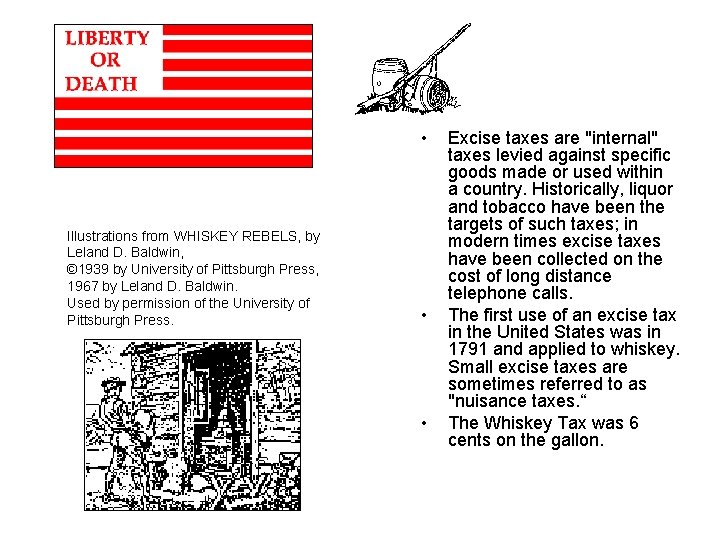
• Illustrations from WHISKEY REBELS, by Leland D. Baldwin, © 1939 by University of Pittsburgh Press, 1967 by Leland D. Baldwin. Used by permission of the University of Pittsburgh Press. • • Excise taxes are "internal" taxes levied against specific goods made or used within a country. Historically, liquor and tobacco have been the targets of such taxes; in modern times excise taxes have been collected on the cost of long distance telephone calls. The first use of an excise tax in the United States was in 1791 and applied to whiskey. Small excise taxes are sometimes referred to as "nuisance taxes. “ The Whiskey Tax was 6 cents on the gallon.
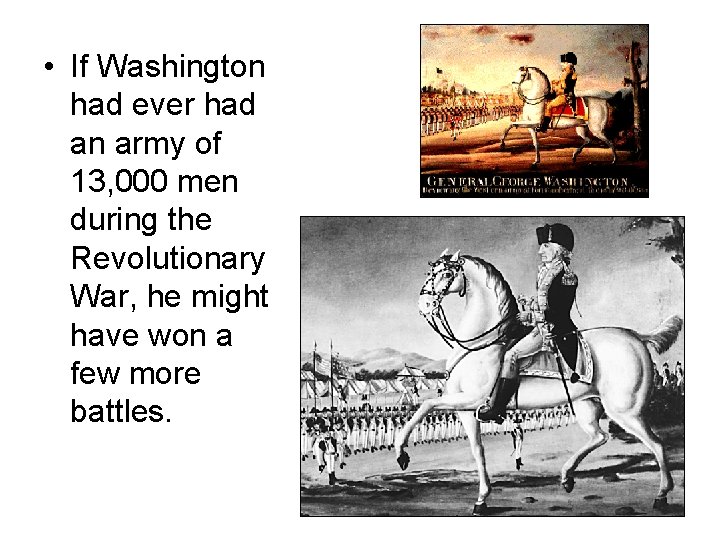
• If Washington had ever had an army of 13, 000 men during the Revolutionary War, he might have won a few more battles.
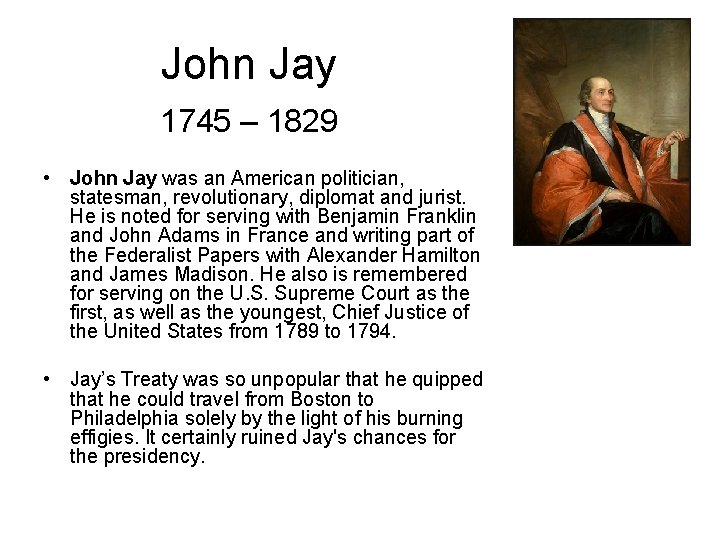
John Jay 1745 – 1829 • John Jay was an American politician, statesman, revolutionary, diplomat and jurist. He is noted for serving with Benjamin Franklin and John Adams in France and writing part of the Federalist Papers with Alexander Hamilton and James Madison. He also is remembered for serving on the U. S. Supreme Court as the first, as well as the youngest, Chief Justice of the United States from 1789 to 1794. • Jay’s Treaty was so unpopular that he quipped that he could travel from Boston to Philadelphia solely by the light of his burning effigies. It certainly ruined Jay's chances for the presidency.
Jay’s Treaty 1795 • Sent by Washington to England to sign a treaty that is concerned with the stopping of impressment against American sailors on American vessels. The British are stopping every ship and taking off 1000’s of our Americans claiming that they are English sailors. Jay comes back with a lovely treaty about trade, but not one word about impressment. Alexander Hamilton, however, convinced Washington it was the best treaty that could be expected, and Washington agreed to sign it an iti is approved by Congress, but there are lots of burnings in effigy for Jay and his treaty. Many Americans were very displeased with this settlement, and there were public protests against Jay and his treaty. One popular cry went: Damn John Jay! Damn everyone that won't damn John Jay! Damn every one that won't put lights in his window and sit up all night damning John Jay!
Pinckney Treaty 1796 • Pinckney's Treaty, October 27, 1795 established intentions of friendship between the United States and Spain. It also defined the boundaries of the U. S. with the Spanish colonies and guaranteed U. S. navigation rights on the Mississippi River. Thomas Pinckney negotiated the treaty for the U. S and Don Manuel de Godoy represented Spain. • By terms of the treaty, Spain and the U. S. agreed that the southern boundary of the U. S. with the Spanish Colonies of East and West Florida was a line beginning on the Mississippi River at the 31 st degree north latitude --the current boundary between the present state of Florida and Georgia and the line from the northern boundary of the Florida panhandle to the northern boundary of that portion of Louisiana east of the Mississippi. • This boundary had been in dispute since the British had expanded the territory of the Florida colonies while it was in possession of them. It had moved the boundary from the 31 st degree latitude northwards to a line drawn due east from the junction of the Yazoo River and the Mississippi (the present day location of Vicksburg, Mississippi). After the American Revolutionary War, Spain claimed the British border adjustment while the U. S. insisted on the original boundary. The treaty set the western boundary of the U. S. , separating it from the Spanish Colony of Louisiana as the middle of the Mississippi River from the northern boundary of the United States to the 31 st degree north latitude. The agreement therefore put the lands of the Chickasaw Nation of American Indians within the new boundaries of the United Sates. The U. S. and Spain agreed to not incite native tribes to warfare. (Previously Spain had been supplying arms to local tribes for many years. ) Navigation of the total Mississippi River length with right of deposit was guaranteed. • •
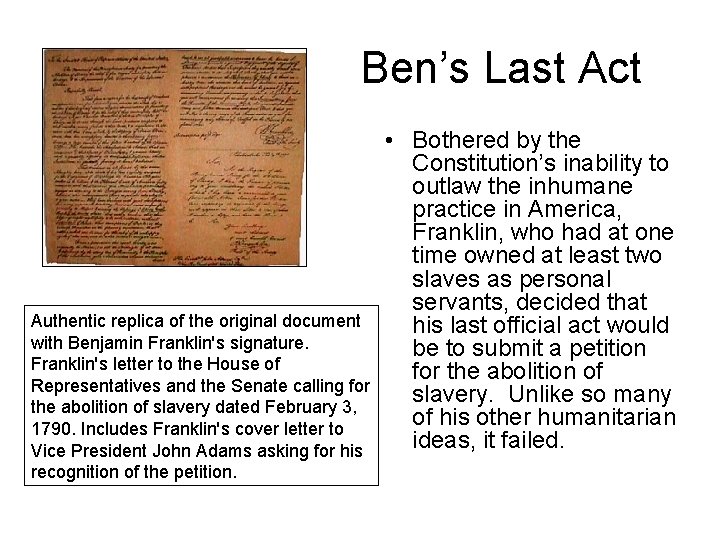
Ben’s Last Act Authentic replica of the original document with Benjamin Franklin's signature. Franklin's letter to the House of Representatives and the Senate calling for the abolition of slavery dated February 3, 1790. Includes Franklin's cover letter to Vice President John Adams asking for his recognition of the petition. • Bothered by the Constitution’s inability to outlaw the inhumane practice in America, Franklin, who had at one time owned at least two slaves as personal servants, decided that his last official act would be to submit a petition for the abolition of slavery. Unlike so many of his other humanitarian ideas, it failed.
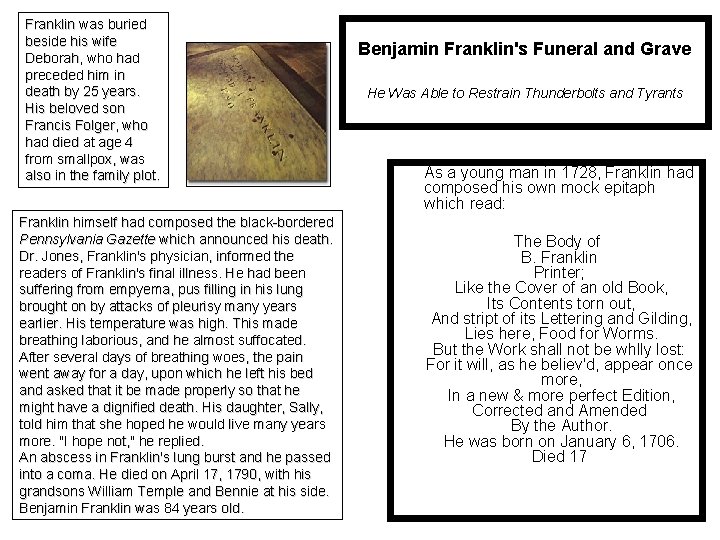
Franklin was buried beside his wife Deborah, who had preceded him in death by 25 years. His beloved son Francis Folger, who had died at age 4 from smallpox, was also in the family plot. Franklin himself had composed the black-bordered Pennsylvania Gazette which announced his death. Dr. Jones, Franklin's physician, informed the readers of Franklin's final illness. He had been suffering from empyema, pus filling in his lung brought on by attacks of pleurisy many years earlier. His temperature was high. This made breathing laborious, and he almost suffocated. After several days of breathing woes, the pain went away for a day, upon which he left his bed and asked that it be made properly so that he might have a dignified death. His daughter, Sally, told him that she hoped he would live many years more. "I hope not, " he replied. An abscess in Franklin's lung burst and he passed into a coma. He died on April 17, 1790, with his grandsons William Temple and Bennie at his side. Benjamin Franklin was 84 years old. Benjamin Franklin's Funeral and Grave He Was Able to Restrain Thunderbolts and Tyrants As a young man in 1728, Franklin had composed his own mock epitaph which read: The Body of B. Franklin Printer; Like the Cover of an old Book, Its Contents torn out, And stript of its Lettering and Gilding, Lies here, Food for Worms. But the Work shall not be whlly lost: For it will, as he believ'd, appear once more, In a new & more perfect Edition, Corrected and Amended By the Author. He was born on January 6, 1706. Died 17
Election of 1796 • • George Washington, worn-out, stung by criticism and yearning for the pleasures of Mount Vernon, refused to consider a third term. He supported his vice president, John Adams, but thought it unseemly to campaign on behalf of any candidate. The Constitution in 1796 required presidential electors to place the names of two individuals on their ballots; the candidate with the highest vote count, if a majority, became the president and the runner up the vice president. It was generally agreed among the leading Federalists that John Adams of Massachusetts should follow the Southerner George Washington. Alexander Hamilton, however, had quarreled with Adams and sought to influence the results. Hamilton much preferred Thomas Pinckney of South Carolina, the presumed vice presidential candidate, and persuaded a number of Southern electors to vote for Pinckney and a lesser candidate, i. e. ignoring Adams. Word leaked out, however, and Adams supporters in New England influenced electors to drop Pinckney's name from their ballots. The results were not anticipated by anyone. Adams won with 71 electoral votes, but was followed by Thomas Jefferson with 68 votes; Thomas Pinckney trailed the leaders with 59. The president was a Federalist, but the vice president was the leader of the Republican opposition – an untidy situation.
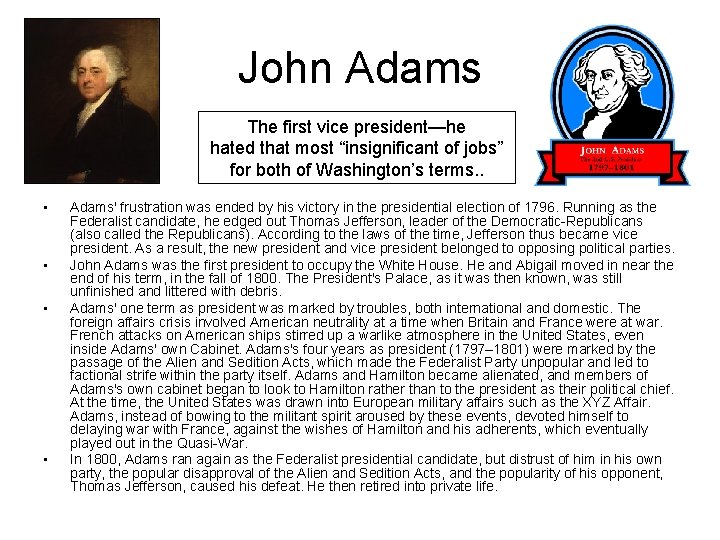
John Adams The first vice president—he hated that most “insignificant of jobs” for both of Washington’s terms. . • • Adams' frustration was ended by his victory in the presidential election of 1796. Running as the Federalist candidate, he edged out Thomas Jefferson, leader of the Democratic-Republicans (also called the Republicans). According to the laws of the time, Jefferson thus became vice president. As a result, the new president and vice president belonged to opposing political parties. John Adams was the first president to occupy the White House. He and Abigail moved in near the end of his term, in the fall of 1800. The President's Palace, as it was then known, was still unfinished and littered with debris. Adams' one term as president was marked by troubles, both international and domestic. The foreign affairs crisis involved American neutrality at a time when Britain and France were at war. French attacks on American ships stirred up a warlike atmosphere in the United States, even inside Adams' own Cabinet. Adams's four years as president (1797– 1801) were marked by the passage of the Alien and Sedition Acts, which made the Federalist Party unpopular and led to factional strife within the party itself. Adams and Hamilton became alienated, and members of Adams's own cabinet began to look to Hamilton rather than to the president as their political chief. At the time, the United States was drawn into European military affairs such as the XYZ Affair. Adams, instead of bowing to the militant spirit aroused by these events, devoted himself to delaying war with France, against the wishes of Hamilton and his adherents, which eventually played out in the Quasi-War. In 1800, Adams ran again as the Federalist presidential candidate, but distrust of him in his own party, the popular disapproval of the Alien and Sedition Acts, and the popularity of his opponent, Thomas Jefferson, caused his defeat. He then retired into private life.
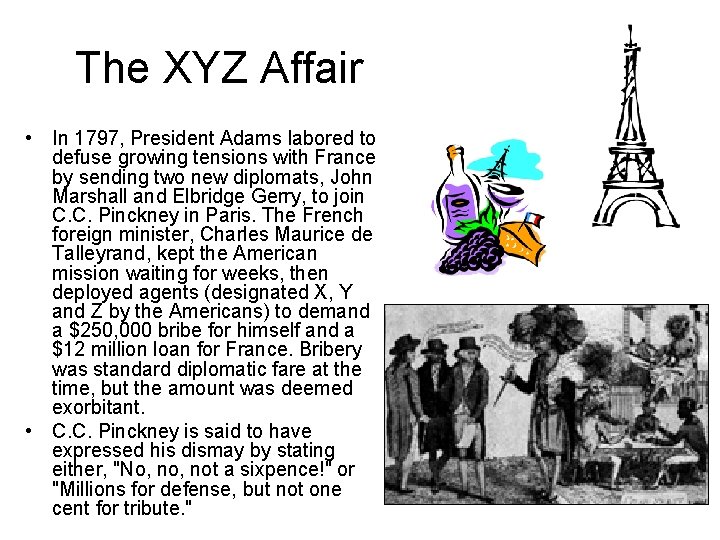
The XYZ Affair • In 1797, President Adams labored to defuse growing tensions with France by sending two new diplomats, John Marshall and Elbridge Gerry, to join C. C. Pinckney in Paris. The French foreign minister, Charles Maurice de Talleyrand, kept the American mission waiting for weeks, then deployed agents (designated X, Y and Z by the Americans) to demand a $250, 000 bribe for himself and a $12 million loan for France. Bribery was standard diplomatic fare at the time, but the amount was deemed exorbitant. • C. C. Pinckney is said to have expressed his dismay by stating either, "No, not a sixpence!" or "Millions for defense, but not one cent for tribute. "
• • • Quasi-War With France In an effort to resolve differences with France that had accumulated between the two nations since the Treaty of Alliance of 1778, President John Adams dispatched a commission of three men to meet with French Minister of Foreign Affairs Talleyrand in 1797. After many delays the American commissioners were approached by three intermediaries of Talleyrand, who demanded apologies for allusions critical of France made by President Adams and payment of a bribe of several million dollars before official negotiations could proceed. Convinced that further negotiations were hopeless the three commissioners returned to the United States, and President Adams released their dispatches to Congress, substituting X, Y, and Z for the names of Talleyrand’s agents. “I will never send another minister to France without assurances that he will be received, respected, and honored, as the representative of a great, free, powerful, and independent nation, ” Adams declared. The American public was outraged at publication of the dispatches, and Congress enacted a series of measures to raise an army and authorize a Navy Department. It also unilaterally abrogated treaties with France, authorizing privateers and public vessels to attack French ships found competing with American commerce. Between 1798 and 1800 the U. S. Navy captured more than 80 French ships although neither country officially declared war.
The Alien and Sedition Acts • • • In 1798, the Federalist-controlled Congress passed a series of laws which, on the surface, were designed to control the activities of foreigners in the United States during a time of impending war. Beneath the surface, however, the real intent of these laws was to destroy Jeffersonian Republicanism. The laws, known collectively as the Alien and Sedition Acts, included: The Naturalization Act, which extended the residency period from 5 to 14 years for those aliens seeking citizenship; this law was aimed at Irish and French immigrants who were often active in Republican politics The Alien Act, which allowed the expulsion of aliens deemed dangerous during peacetime The Alien Enemies Act, which allowed the expulsion or imprisonment of aliens deemed dangerous during wartime; this was never enforced, but it did prompt numerous Frenchmen to return home The Sedition Act, which provided for fines or imprisonment for individuals who criticized the government, Congress or president in speech or print. The Alien Acts were never enforced, but the Sedition Act was. A number of Republican newspaper publishers were convicted under the terms of this law. The Jeffersonians argued quite rightly that the Sedition Act violated the terms of the First Amendment
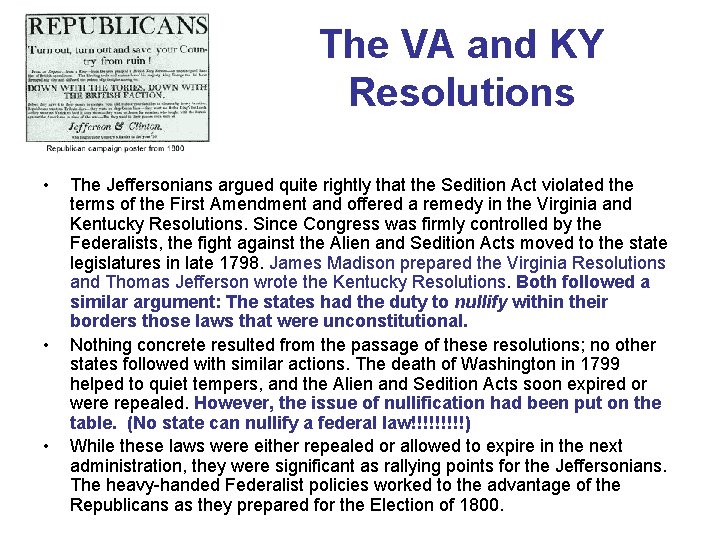
The VA and KY Resolutions • • • The Jeffersonians argued quite rightly that the Sedition Act violated the terms of the First Amendment and offered a remedy in the Virginia and Kentucky Resolutions. Since Congress was firmly controlled by the Federalists, the fight against the Alien and Sedition Acts moved to the state legislatures in late 1798. James Madison prepared the Virginia Resolutions and Thomas Jefferson wrote the Kentucky Resolutions. Both followed a similar argument: The states had the duty to nullify within their borders those laws that were unconstitutional. Nothing concrete resulted from the passage of these resolutions; no other states followed with similar actions. The death of Washington in 1799 helped to quiet tempers, and the Alien and Sedition Acts soon expired or were repealed. However, the issue of nullification had been put on the table. (No state can nullify a federal law!!!!!) While these laws were either repealed or allowed to expire in the next administration, they were significant as rallying points for the Jeffersonians. The heavy-handed Federalist policies worked to the advantage of the Republicans as they prepared for the Election of 1800.
The Election of 1800 • • • The pre-election atmosphere in 1800 was colored by the Alien and Sedition Acts controversy, which had created much ill feeling between the contending parties. The Jeffersonian Republicans triumphed. Since 1796, they had control of New York State thanks largely to Aaron Burr's political skills; he had wrested control of the legislature from Alexander Hamilton. The bad news, however, was that the two Democratic-Republican candidates, Jefferson and Burr, garnered the same number of electoral votes; according to the Constitution, the matter was to be resolved in the House of Representatives. (See Article II, Section 1, Clause 3. ) Candidate Thomas Jefferson (VA) Aaron Burr (NY) John Adams (MA) C. C. Pinckney (SC) John Jay (NY) Party Democratic-Republican Federalist Electoral Vote 73 73 65 64 1 • Thirty-six ballots were cast over five days to reach a decision. Once again Hamilton played a pivotal role, throwing his support to Jefferson, whom he disliked, rather than Burr, whom he truly hated. This election is sometimes referred to as the "Revolution of 1800” because it marked the transition from the Federalists, the only party to have held the presidency to that point, to the Democratic-Republicans of Jefferson. It appeared that major changes were in the offing. • The dilemma posed by two candidates receiving an equal number of electoral votes was later addressed in Amendment XII.
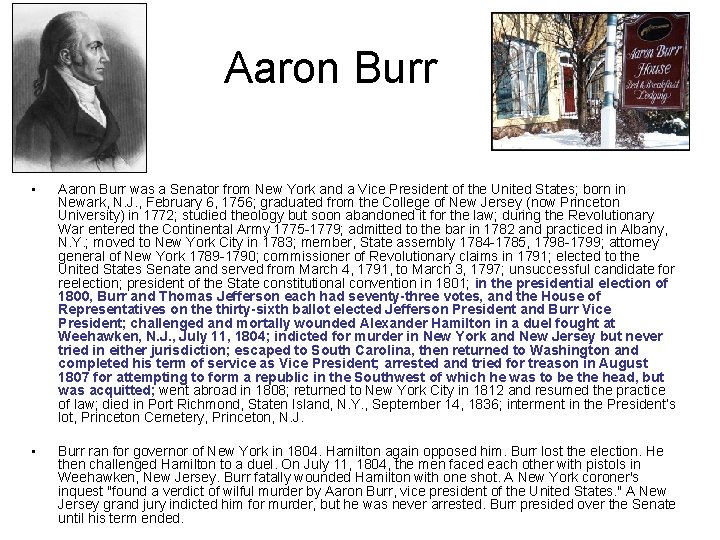
Aaron Burr • Aaron Burr was a Senator from New York and a Vice President of the United States; born in Newark, N. J. , February 6, 1756; graduated from the College of New Jersey (now Princeton University) in 1772; studied theology but soon abandoned it for the law; during the Revolutionary War entered the Continental Army 1775 -1779; admitted to the bar in 1782 and practiced in Albany, N. Y. ; moved to New York City in 1783; member, State assembly 1784 -1785, 1798 -1799; attorney general of New York 1789 -1790; commissioner of Revolutionary claims in 1791; elected to the United States Senate and served from March 4, 1791, to March 3, 1797; unsuccessful candidate for reelection; president of the State constitutional convention in 1801; in the presidential election of 1800, Burr and Thomas Jefferson each had seventy-three votes, and the House of Representatives on the thirty-sixth ballot elected Jefferson President and Burr Vice President; challenged and mortally wounded Alexander Hamilton in a duel fought at Weehawken, N. J. , July 11, 1804; indicted for murder in New York and New Jersey but never tried in either jurisdiction; escaped to South Carolina, then returned to Washington and completed his term of service as Vice President; arrested and tried for treason in August 1807 for attempting to form a republic in the Southwest of which he was to be the head, but was acquitted; went abroad in 1808; returned to New York City in 1812 and resumed the practice of law; died in Port Richmond, Staten Island, N. Y. , September 14, 1836; interment in the President’s lot, Princeton Cemetery, Princeton, N. J. • Burr ran for governor of New York in 1804. Hamilton again opposed him. Burr lost the election. He then challenged Hamilton to a duel. On July 11, 1804, the men faced each other with pistols in Weehawken, New Jersey. Burr fatally wounded Hamilton with one shot. A New York coroner's inquest "found a verdict of wilful murder by Aaron Burr, vice president of the United States. " A New Jersey grand jury indicted him for murder, but he was never arrested. Burr presided over the Senate until his term ended.
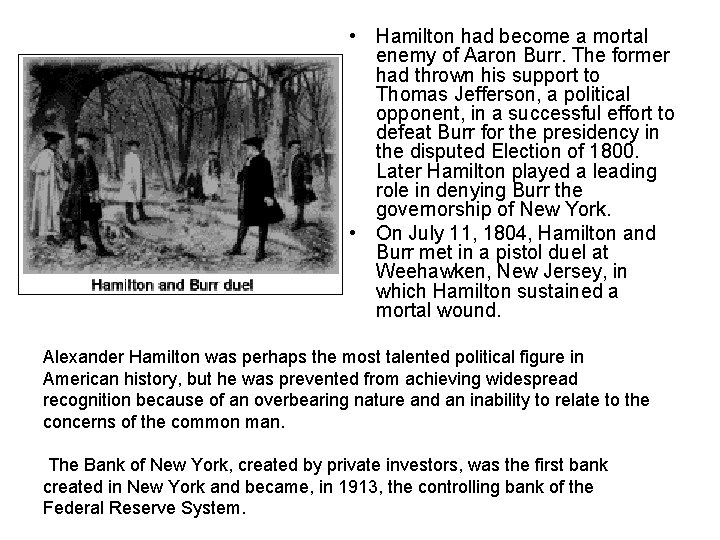
• Hamilton had become a mortal enemy of Aaron Burr. The former had thrown his support to Thomas Jefferson, a political opponent, in a successful effort to defeat Burr for the presidency in the disputed Election of 1800. Later Hamilton played a leading role in denying Burr the governorship of New York. • On July 11, 1804, Hamilton and Burr met in a pistol duel at Weehawken, New Jersey, in which Hamilton sustained a mortal wound. Alexander Hamilton was perhaps the most talented political figure in American history, but he was prevented from achieving widespread recognition because of an overbearing nature and an inability to relate to the concerns of the common man. The Bank of New York, created by private investors, was the first bank created in New York and became, in 1913, the controlling bank of the Federal Reserve System.
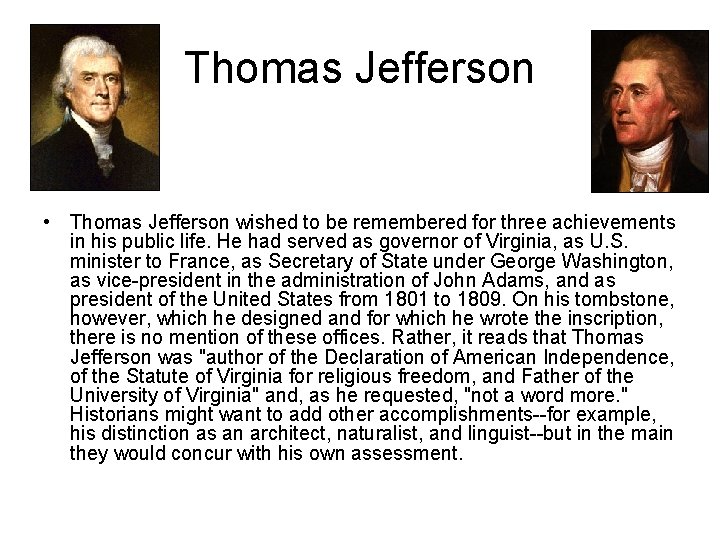
Thomas Jefferson • Thomas Jefferson wished to be remembered for three achievements in his public life. He had served as governor of Virginia, as U. S. minister to France, as Secretary of State under George Washington, as vice-president in the administration of John Adams, and as president of the United States from 1801 to 1809. On his tombstone, however, which he designed and for which he wrote the inscription, there is no mention of these offices. Rather, it reads that Thomas Jefferson was "author of the Declaration of American Independence, of the Statute of Virginia for religious freedom, and Father of the University of Virginia" and, as he requested, "not a word more. " Historians might want to add other accomplishments--for example, his distinction as an architect, naturalist, and linguist--but in the main they would concur with his own assessment.
Thomas Jefferson • Thomas Jefferson was the third President of the United States, second (1797– 1801) Vice President, first (1789– 1795) United States Secretary of State, and an American statesman, ambassador to France, political philosopher, revolutionary, agriculturalist, horticulturist, land owner, architect, etymologist, archaeologist, slave-owner, author, inventor, lawyer and founder of the University of Virginia. He was also the founder and leader of the Democratic-Republican Party, and the first President from that party. The Jeffersonian Republicans, as they were often called, dominated American politics for over a quarter-century. • Jefferson is perhaps best known for being the primary author of the United States Declaration of Independence (1776). Achievements of his presidency include the Louisiana Purchase and the Lewis and Clark Expedition. • Many people consider Jefferson to be among the most brilliant men ever to occupy the Presidency. President John F. Kennedy welcomed 49 Nobel Prize winners to the White House in 1962, saying, "I think this is the most extraordinary collection of talent, of human knowledge, that has ever been gathered at the White House, with the possible exception of when Thomas Jefferson dined alone. "
The Jefferson Administration • • • Midnight Judges Tripolitan War—Barbary Pirates The Louisiana Purchase Lewis and Clark Expedition Aaron Burr—Treason? ? ? The Embargo of 1807
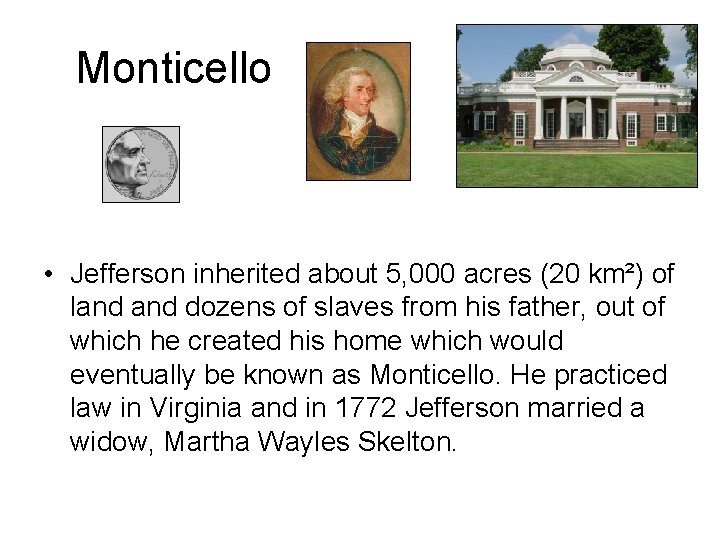
Monticello • Jefferson inherited about 5, 000 acres (20 km²) of land dozens of slaves from his father, out of which he created his home which would eventually be known as Monticello. He practiced law in Virginia and in 1772 Jefferson married a widow, Martha Wayles Skelton.
John Marshall • • The contributions of Marshall as Chief Justice are hard to overestimate. His opinions established the bedrock of constitutional law for the young nation, drawing from the document an array of both specific and implied powers. It was through Marshall that Federalism continued to exist despite the demise of the Federalist political party. The establishment of the judicial review of congressional legislation stemmed from Marbury v Madison (1803). Mc. Culloch v Maryland (1819) set the precedent for setting aside state legislation by invalidating state taxation of a federal agency. The Dartmouth College Case (1819) helped to protect the inviolability of contracts. Gibbons v Ogden (1824) supported federal primacy in the regulation of commerce. His powers of persuasion were so great that his Federalist philosophy dominated the Court in an age of Democratic appointments. • Despite Marshall’s contributions, he remained a partisan political figure, as evidenced in his dealings with his rival Jefferson in Marbury and the Aaron Burr trial, and later with Andrew Jackson and the Cherokee issue. • Marshall also is remembered for authoring a five-volume Life of George Washington (1804 -07).
Sally Hemings • Sally Hemings was a slave, probably born at Guinea Plantation, Cumberland County, Virginia, who was initially owned by John Wayles, who died in 1774, leaving Sally to his daughter Martha Wayles, wife of Thomas Jefferson Martha and Sally were half-sisters: both were fathered by John Wayles. • Martha Jefferson died in 1782, and in 1784 Thomas Jefferson took up residence in Paris as American envoy to France. In 1787 after the death of Lucy Jefferson, Thomas Jefferson sent for 9 year old Mary (Maria) Jefferson. Thomas Jefferson had requested that Isabel, an older woman be sent as a companion for Mary, but as Isabel was pregnant, Mary (Maria) Jefferson was accompanied by 14 year old Sally Hemings instead. • Rumors that Sally Hemings and Thomas Jefferson were sexually involved circulated well before Jefferson assumed office in 1801, and they were published in 1802. The truth of these rumors has long been debated. • Evidence in support of theory that Jefferson was father of Sally Hemings' children is that (1) Jefferson and Hemings were both at Monticello at the time of the conceptions of her children; (2) Madison Hemings, Sally's son, stated in an 1873 interview that Sally named the President as the father of all her children; (3) Sally's children were said to resemble Jefferson physically; and (4) Sally's children, unlike Jefferson's other slaves, were allowed to slip away, or were manumitted, before Jefferson's death, and the two who remained were provided for in Jefferson's will. • Some had argued that the resemblance to Jefferson was because the children had been fathered by one of Jefferson's nephews (Samuel or Peter Carr), sons of Jefferson's sister, by his brother Randolph Jefferson or one of Randolph's five sons.
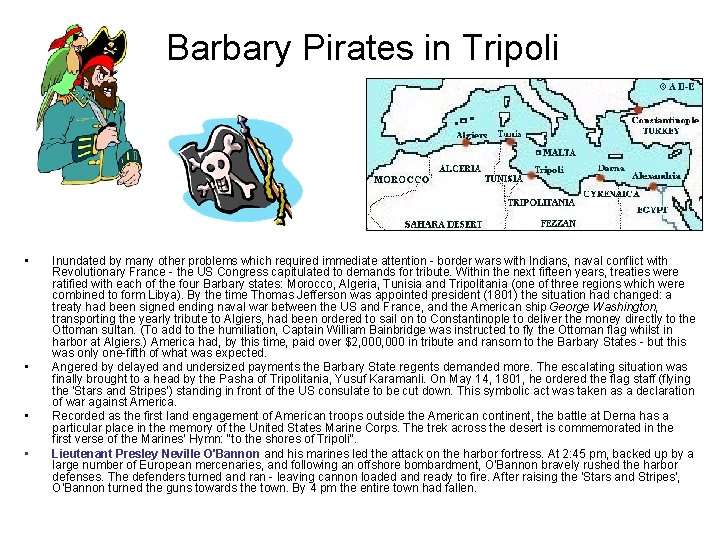
Barbary Pirates in Tripoli • • Inundated by many other problems which required immediate attention - border wars with Indians, naval conflict with Revolutionary France - the US Congress capitulated to demands for tribute. Within the next fifteen years, treaties were ratified with each of the four Barbary states: Morocco, Algeria, Tunisia and Tripolitania (one of three regions which were combined to form Libya). By the time Thomas Jefferson was appointed president (1801) the situation had changed: a treaty had been signed ending naval war between the US and France, and the American ship George Washington, transporting the yearly tribute to Algiers, had been ordered to sail on to Constantinople to deliver the money directly to the Ottoman sultan. (To add to the humiliation, Captain William Bainbridge was instructed to fly the Ottoman flag whilst in harbor at Algiers. ) America had, by this time, paid over $2, 000 in tribute and ransom to the Barbary States - but this was only one-fifth of what was expected. Angered by delayed and undersized payments the Barbary State regents demanded more. The escalating situation was finally brought to a head by the Pasha of Tripolitania, Yusuf Karamanli. On May 14, 1801, he ordered the flag staff (flying the 'Stars and Stripes') standing in front of the US consulate to be cut down. This symbolic act was taken as a declaration of war against America. Recorded as the first land engagement of American troops outside the American continent, the battle at Derna has a particular place in the memory of the United States Marine Corps. The trek across the desert is commemorated in the first verse of the Marines' Hymn: "to the shores of Tripoli". Lieutenant Presley Neville O'Bannon and his marines led the attack on the harbor fortress. At 2: 45 pm, backed up by a large number of European mercenaries, and following an offshore bombardment, O'Bannon bravely rushed the harbor defenses. The defenders turned and ran - leaving cannon loaded and ready to fire. After raising the 'Stars and Stripes', O'Bannon turned the guns towards the town. By 4 pm the entire town had fallen.
The Marine Hymn • The U. S. Marine Corps is the United States' military band of brothers dedicated to warfighting. The proud Brotherhood of Marines is guided by principles, values, virtues, love of country, and its Warrior Culture. This brotherhood of American Patriots has no song. Instead, Marine Warriors have a hymn. When The Marines' Hymn is played, United States Marines stand at attention. They silently show their pride in their fellow Marines, their Corps, their Country, their heritage, and their hymn. The Marines' Hymn is a tribute to Warriors. Marine Warriors stormed fortress Derna, raised the American flag, and gave us "the shores of Tripoli. " Marines fought their way into the castle at Chapultepec and gave us the "halls of Montezuma. " Marines exist for the purpose of warfighting. Fighting is their role in life. They "fight for right and freedom" and "to keep our honor clean. " They fight "in the air, on land, and sea. " The Marine Corps is Valhalla for Warriors. U. S. Marines need no song. They have a hymn. • • From the Halls of Montezuma, To the Shores of Tripoli; We fight our country's battles In the air, on land, and sea; First to fight for right and freedom And to keep our honor clean; We are proud to claim the title Of UNITED STATES MARINES. Our flag's unfurled to every breeze, From dawn to setting sun; We have fought in every clime and place Where we could take a gun; In the snow of far off northern lands And in sunny tropic scenes; You will find us always on the job -The UNITED STATES MARINES. Here's health to you and to our Corps Which we are proud to serve; In many a strife we've fought for life And never lost our nerve; If the Army and the Navy Ever look on Heaven's scenes; They will find the streets are guarded By UNITED STATES MARINES.
Gabriel Prosser • • • Gabriel Prosser (ca. 1775 -1800) was the African American slave leader of an unsuccessful revolt in Richmond, Va. , during the summer of 1800. Gabriel Prosser, the slave of Thomas H. Prosser, was about 25 years old when he came to the attention of Virginia authorities late in August 1800. Little is known of his childhood or family background. He had two brothers and a wife, Nanny, all slaves of Prosser. Gabriel Prosser learned to read and was a serious student of the Bible, where he found inspiration in the accounts of Israel's delivery from slavery. Prosser possessed shrewd judgment, and his master gave him much latitude. He was acknowledged as a leader by many slaves around Richmond. With the help of other slaves, especially Jack Bowler and George Smith, Prosser designed a scheme for a slave revolt. They planned to seize control of Richmond by slaying all whites (except for Methodists, Quakers, and Frenchmen) and then to establish a kingdom of Virginia with Prosser as king. The recent, successful American Revolution and the revolutions in France and Haiti--with their rhetoric of freedom, equality, and brotherhood--supplied examples and inspiration for Prosser's rebellion. In the months preceding the attack Prosser skillfully recruited supporters and organized them into military units. Authorities never discovered how many slaves were involved, but there were undoubtedly several thousand, many armed with swords and pikes made from farm tools by slave blacksmiths. The plan was to strike on the night of Aug. 30, 1800. Men inside Richmond were to set fire to certain buildings to distract whites, and Prosser's force from the country was to seize the armory and government buildings across town. With the firearms thus gained, the rebels would supposedly easily overcome the surprised whites. On the day of the attack the plot was disclosed by two slaves who did not want their masters slain; then Virginia governor James Monroe alerted the militia. That night, as the rebels began congregating outside Richmond, the worst rainstorm in memory flooded roads, washed out bridges, and prevented Prosser's army from assembling. Prosser decided to postpone the attack until the next day, but by then the city was too well defended. The rebels, including Prosser, dispersed. Some slaves, in order to save their own lives, testified against the ringleaders, about 35 of whom were executed. Prosser himself managed to escape by hiding aboard a riverboat on its way to Norfolk. In Norfolk, however, he was betrayed by other slaves, who claimed the large reward for his capture on September 25. Returned to Richmond, Prosser, like most of the other leaders, refused to confess to the plot or give evidence against other slaves. He was tried and found guilty on Oct. 6, 1800, and executed the next day.
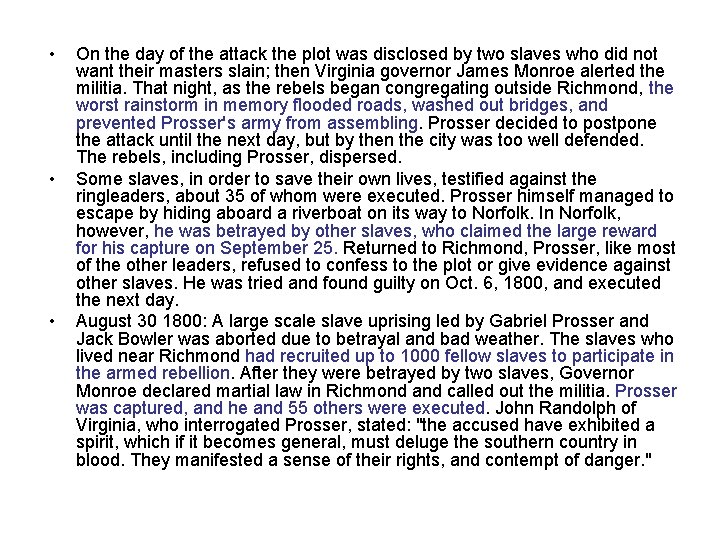
• • • On the day of the attack the plot was disclosed by two slaves who did not want their masters slain; then Virginia governor James Monroe alerted the militia. That night, as the rebels began congregating outside Richmond, the worst rainstorm in memory flooded roads, washed out bridges, and prevented Prosser's army from assembling. Prosser decided to postpone the attack until the next day, but by then the city was too well defended. The rebels, including Prosser, dispersed. Some slaves, in order to save their own lives, testified against the ringleaders, about 35 of whom were executed. Prosser himself managed to escape by hiding aboard a riverboat on its way to Norfolk. In Norfolk, however, he was betrayed by other slaves, who claimed the large reward for his capture on September 25. Returned to Richmond, Prosser, like most of the other leaders, refused to confess to the plot or give evidence against other slaves. He was tried and found guilty on Oct. 6, 1800, and executed the next day. August 30 1800: A large scale slave uprising led by Gabriel Prosser and Jack Bowler was aborted due to betrayal and bad weather. The slaves who lived near Richmond had recruited up to 1000 fellow slaves to participate in the armed rebellion. After they were betrayed by two slaves, Governor Monroe declared martial law in Richmond and called out the militia. Prosser was captured, and he and 55 others were executed. John Randolph of Virginia, who interrogated Prosser, stated: "the accused have exhibited a spirit, which if it becomes general, must deluge the southern country in blood. They manifested a sense of their rights, and contempt of danger. "
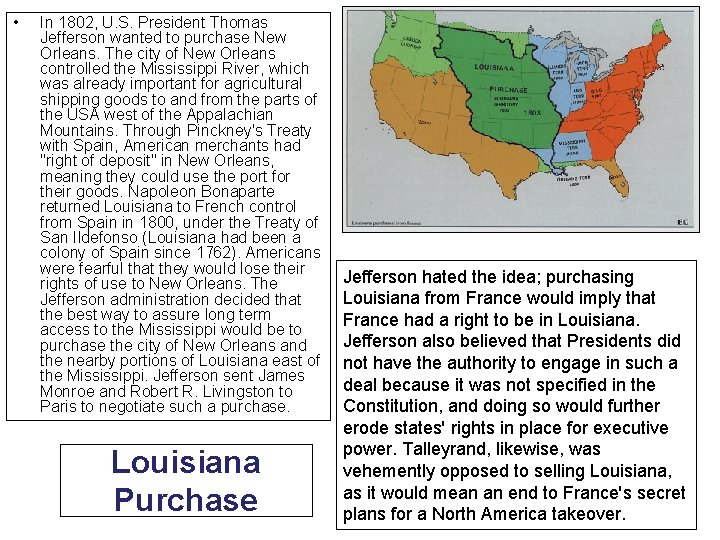
• In 1802, U. S. President Thomas Jefferson wanted to purchase New Orleans. The city of New Orleans controlled the Mississippi River, which was already important for agricultural shipping goods to and from the parts of the USA west of the Appalachian Mountains. Through Pinckney's Treaty with Spain, American merchants had "right of deposit" in New Orleans, meaning they could use the port for their goods. Napoleon Bonaparte returned Louisiana to French control from Spain in 1800, under the Treaty of San Ildefonso (Louisiana had been a colony of Spain since 1762). Americans were fearful that they would lose their rights of use to New Orleans. The Jefferson administration decided that the best way to assure long term access to the Mississippi would be to purchase the city of New Orleans and the nearby portions of Louisiana east of the Mississippi. Jefferson sent James Monroe and Robert R. Livingston to Paris to negotiate such a purchase. Louisiana Purchase Jefferson hated the idea; purchasing Louisiana from France would imply that France had a right to be in Louisiana. Jefferson also believed that Presidents did not have the authority to engage in such a deal because it was not specified in the Constitution, and doing so would further erode states' rights in place for executive power. Talleyrand, likewise, was vehemently opposed to selling Louisiana, as it would mean an end to France's secret plans for a North America takeover.
The Louisiana Purchase • The Louisiana Purchase describes the United States acquisition of more than 529, 911, 680 acres (2, 144, 476 km 2) of territory from France in 1803 for about 3 cents/sq. mile or $15 million in total (which, if adjusted for inflation, would equal approximately $193 million in 2005). • The French territory of Louisiana included far more land than just the current U. S. State of Louisiana; the lands purchased contained parts or all of present-day Arkansas, Missouri, Iowa, Minnesota west of the Mississippi River, North Dakota, South Dakota, Nebraska, New Mexico, northern Texas, Oklahoma, Kansas, the portions of Montana, Wyoming, and Colorado east of the Rocky Mountains, the portions of southern Manitoba, southern Saskatchewan and southern Alberta that drain into the Missouri River, and Louisiana on both sides of the Mississippi River including the city of New Orleans. The land included in the Purchase comprises over one-quarter of the territory of the modern continental United States.
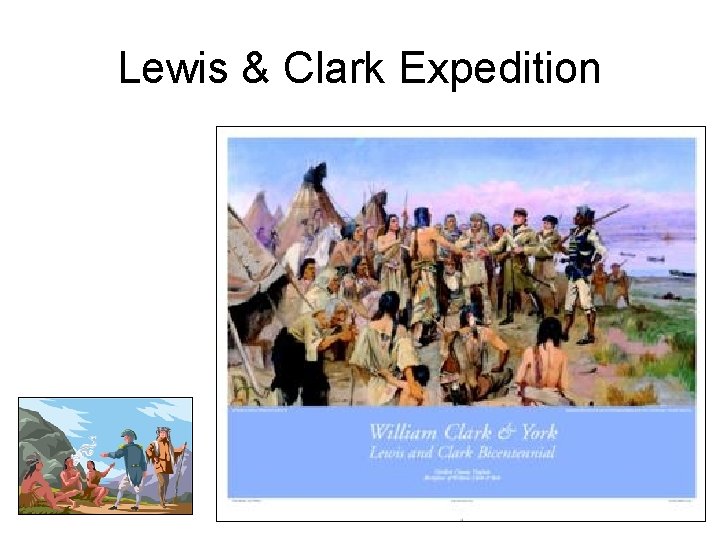
Lewis & Clark Expedition
The Lewis & Clark Corps of Discovery • • • In 1803, President Thomas Jefferson successfully requested $2, 500 from Congress for exploration of the trans-Mississippi west, land soon to become part of the United States through the Louisiana Purchase. The president helped to plan an expedition and appointed his personal secretary, Meriwether Lewis, to lead it. Lewis selected William Clark to share command over the crew of 40 soldiers, boatmen and hunters. Jefferson's aims were to assess the new lands' commercial possibilities, military prospects, and regional flora and fauna. Uppermost, it was hoped that a Northwest Passage, comprising rivers and portages, would be discovered for easy access to the Pacific. The expedition left from St. Louis in late May 1804, proceeded up the Missouri River, across the Rocky Mountains and down the Columbia River to the Pacific Ocean. There they established Fort Clatsop near the present site of Astoria, Oregon. The trek was arduous in the extreme, but only one life was lost (a ruptured appendix) over the course of 28 months and 8, 000 miles on the trail. The findings of the expedition made the nation face the harsh reality that no easy all-water route to the Pacific existed. Nonetheless, the extensive information gained about the natural features, peoples and resources of the new lands would help attract thousands of hardy pioneers in the following decades.
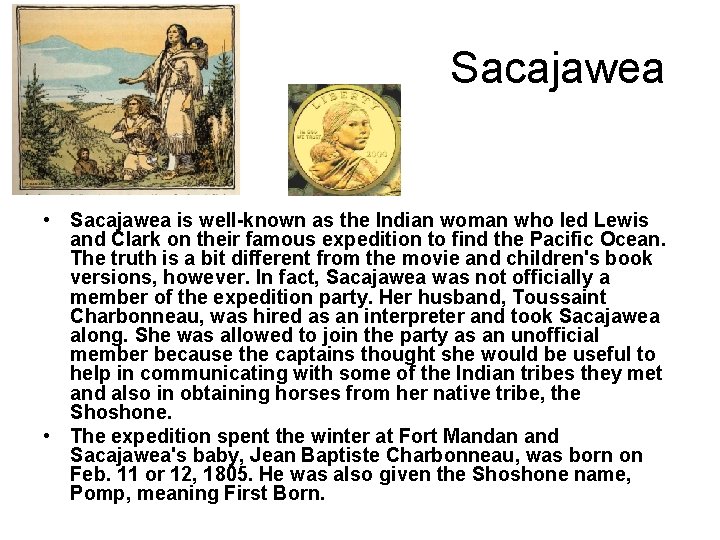
Sacajawea • Sacajawea is well-known as the Indian woman who led Lewis and Clark on their famous expedition to find the Pacific Ocean. The truth is a bit different from the movie and children's book versions, however. In fact, Sacajawea was not officially a member of the expedition party. Her husband, Toussaint Charbonneau, was hired as an interpreter and took Sacajawea along. She was allowed to join the party as an unofficial member because the captains thought she would be useful to help in communicating with some of the Indian tribes they met and also in obtaining horses from her native tribe, the Shoshone. • The expedition spent the winter at Fort Mandan and Sacajawea's baby, Jean Baptiste Charbonneau, was born on Feb. 11 or 12, 1805. He was also given the Shoshone name, Pomp, meaning First Born.
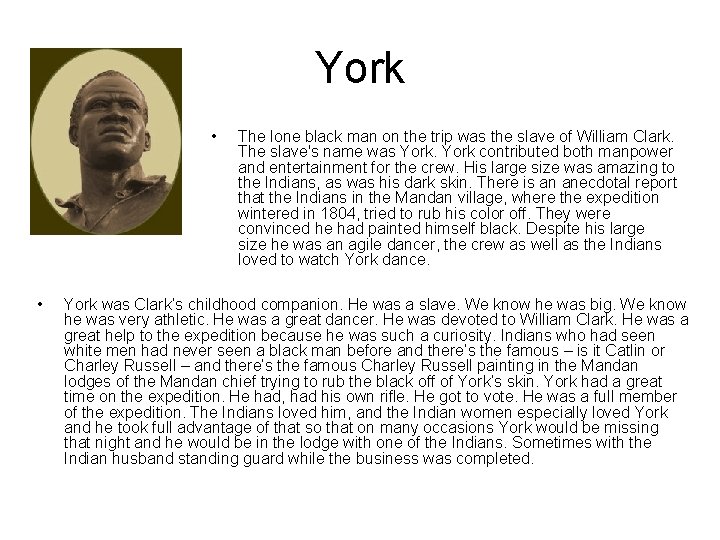
York • • The lone black man on the trip was the slave of William Clark. The slave's name was York contributed both manpower and entertainment for the crew. His large size was amazing to the Indians, as was his dark skin. There is an anecdotal report that the Indians in the Mandan village, where the expedition wintered in 1804, tried to rub his color off. They were convinced he had painted himself black. Despite his large size he was an agile dancer, the crew as well as the Indians loved to watch York dance. York was Clark’s childhood companion. He was a slave. We know he was big. We know he was very athletic. He was a great dancer. He was devoted to William Clark. He was a great help to the expedition because he was such a curiosity. Indians who had seen white men had never seen a black man before and there’s the famous – is it Catlin or Charley Russell – and there’s the famous Charley Russell painting in the Mandan lodges of the Mandan chief trying to rub the black off of York’s skin. York had a great time on the expedition. He had, had his own rifle. He got to vote. He was a full member of the expedition. The Indians loved him, and the Indian women especially loved York and he took full advantage of that so that on many occasions York would be missing that night and he would be in the lodge with one of the Indians. Sometimes with the Indian husband standing guard while the business was completed.
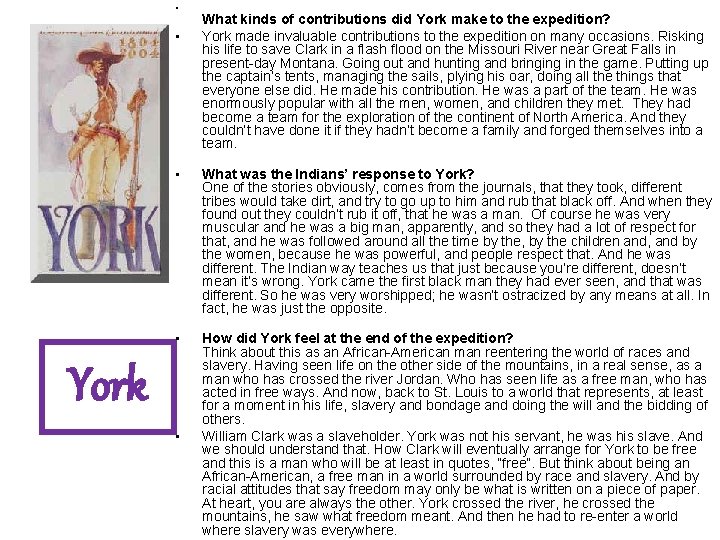
• • What kinds of contributions did York make to the expedition? York made invaluable contributions to the expedition on many occasions. Risking his life to save Clark in a flash flood on the Missouri River near Great Falls in present-day Montana. Going out and hunting and bringing in the game. Putting up the captain’s tents, managing the sails, plying his oar, doing all the things that everyone else did. He made his contribution. He was a part of the team. He was enormously popular with all the men, women, and children they met. They had become a team for the exploration of the continent of North America. And they couldn’t have done it if they hadn’t become a family and forged themselves into a team. • What was the Indians’ response to York? One of the stories obviously, comes from the journals, that they took, different tribes would take dirt, and try to go up to him and rub that black off. And when they found out they couldn’t rub it off, that he was a man. Of course he was very muscular and he was a big man, apparently, and so they had a lot of respect for that, and he was followed around all the time by the, by the children and, and by the women, because he was powerful, and people respect that. And he was different. The Indian way teaches us that just because you’re different, doesn’t mean it’s wrong. York came the first black man they had ever seen, and that was different. So he was very worshipped; he wasn’t ostracized by any means at all. In fact, he was just the opposite. • How did York feel at the end of the expedition? Think about this as an African-American man reentering the world of races and slavery. Having seen life on the other side of the mountains, in a real sense, as a man who has crossed the river Jordan. Who has seen life as a free man, who has acted in free ways. And now, back to St. Louis to a world that represents, at least for a moment in his life, slavery and bondage and doing the will and the bidding of others. William Clark was a slaveholder. York was not his servant, he was his slave. And we should understand that. How Clark will eventually arrange for York to be free and this is a man who will be at least in quotes, “free”. But think about being an African-American, a free man in a world surrounded by race and slavery. And by racial attitudes that say freedom may only be what is written on a piece of paper. At heart, you are always the other. York crossed the river, he crossed the mountains, he saw what freedom meant. And then he had to re-enter a world where slavery was everywhere. York •
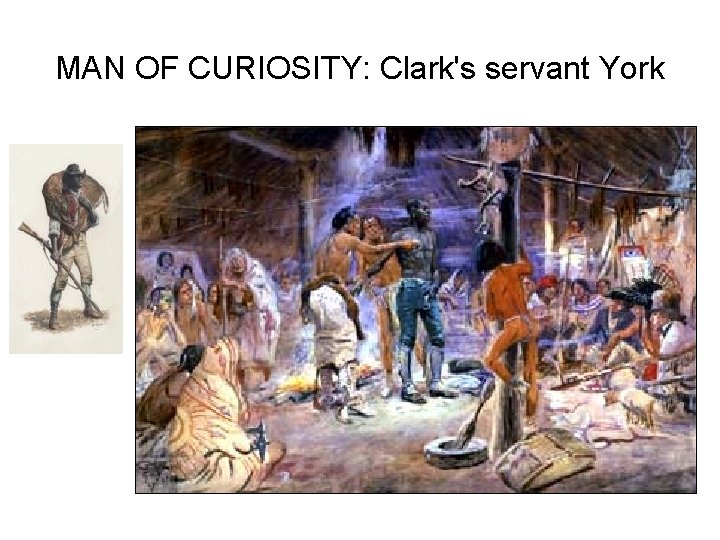
MAN OF CURIOSITY: Clark's servant York
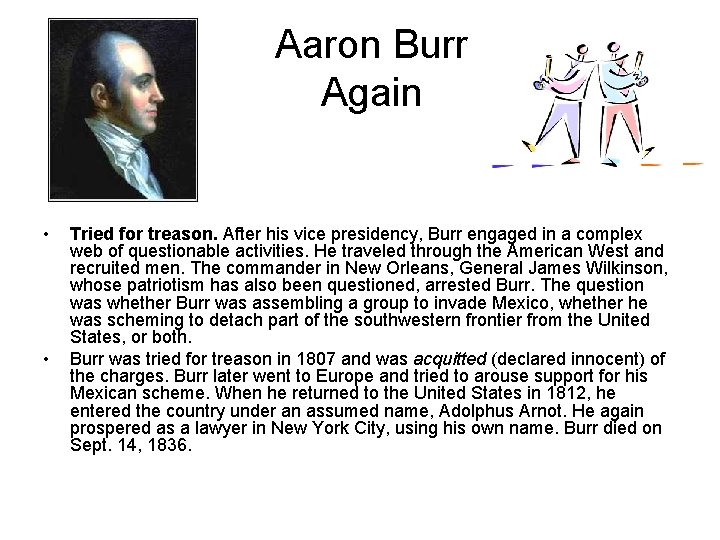
Aaron Burr Again • • Tried for treason. After his vice presidency, Burr engaged in a complex web of questionable activities. He traveled through the American West and recruited men. The commander in New Orleans, General James Wilkinson, whose patriotism has also been questioned, arrested Burr. The question was whether Burr was assembling a group to invade Mexico, whether he was scheming to detach part of the southwestern frontier from the United States, or both. Burr was tried for treason in 1807 and was acquitted (declared innocent) of the charges. Burr later went to Europe and tried to arouse support for his Mexican scheme. When he returned to the United States in 1812, he entered the country under an assumed name, Adolphus Arnot. He again prospered as a lawyer in New York City, using his own name. Burr died on Sept. 14, 1836.
• • • Burr's exact aims are not clear today, but may have involved an effort to capture Spanish possessions in the Southwest or to engineer the secession of western states from the Union, or both. In any event, he worked with two very interesting personalities. One was James Wilkinson, then governor of the Louisiana Territory and a man with a reputation for shady dealing that exceeded even Burr’s. The other associate was Harman Blennerhasset, an Irish immigrant who lived in splendor on an island in the Ohio River (near present-day West Virginia). In 1806, Blennerhasset provided funding for the outfitting of a small fleet of flatboats; Burr’s personal vessel contained all the necessary amenities, including ample wine storage. The assemblage began a cruise down the Ohio River, headed for the Mississippi and eventually for New Orleans. For reasons unknown, Wilkinson reported Burr’s actions to President Jefferson. The president ordered Burr's arrest; he was taken to Richmond for trial on charges of treason. Burr’s trial was presided over by none other than John Marshall, Chief Justice of the Supreme Court. Marshall, always anxious to spite Jefferson, insisted upon the narrowest possible interpretation of treason, requiring an overt act to prove treason and not just a conspiracy to do so. The case was doomed from the start. Despite Jefferson’s stage management, the prosecution’s case was badly mishandled and Burr was acquitted. One significant sidelight of the Burr trial occurred when Chief Justice Marshall subpoenaed Jefferson to testify. The president refused to do so, citing the independent nature of the branches of the government.
Embargo Act of 1807 • • The Embargo Act of 1807 was a United States law prohibiting all export of cargo from US ports. Specifically, the act prohibited American shipping bound foreign ports and all foreign vessels from taking cargo at American ports. It represented President Thomas Jefferson's response to Britain's Orders in Council (1807) and France's Continental System, which were severely hurting America's merchant marines. Although it was designed to force the British and French to change their commercial systems, neither country did. It was followed by the Non-Intercourse Act, lifting all embargoes except for those on Britain and France, and Macon's Bill Number 2, lifting the remaining embargoes. Attempts to enforce them led to near-rebellion in New England, a traditional Federalist stronghold and one of the hardest regions hit by the elimination of foreign trade. Sometimes ridiculed as the Ograb-me (embargo spelled backwards), dambargo, mob rage, or go-bar-'em act. The Embargo Act also had some benefits, especially for America's infant domestic manufacturing industries. Finally, the Embargo Act of 1807 was a precursor to the War of 1812.
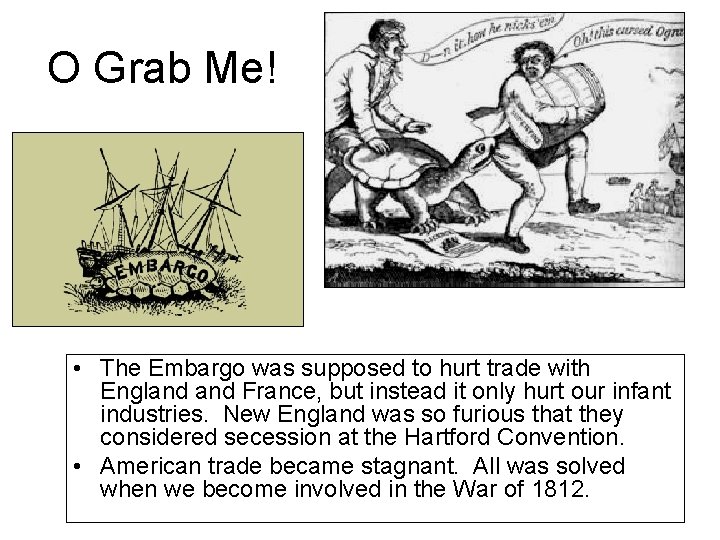
O Grab Me! • The Embargo was supposed to hurt trade with England France, but instead it only hurt our infant industries. New England was so furious that they considered secession at the Hartford Convention. • American trade became stagnant. All was solved when we become involved in the War of 1812.
Adams/Jefferson Feud • Adams would not forgive Jefferson from wresting the presidency from him. He was bitter against his former friend and felt he had been betrayed. • It took years, and Abigail to heal the breach, but they finally did reconcile. • As Adams lay on his death bed, his last words were, "Jefferson still lives. " He was wrong; Jefferson had died a few hours earlier. Both men died on July 4, 1826, the 50 th anniversary of the Declaration of Independence.
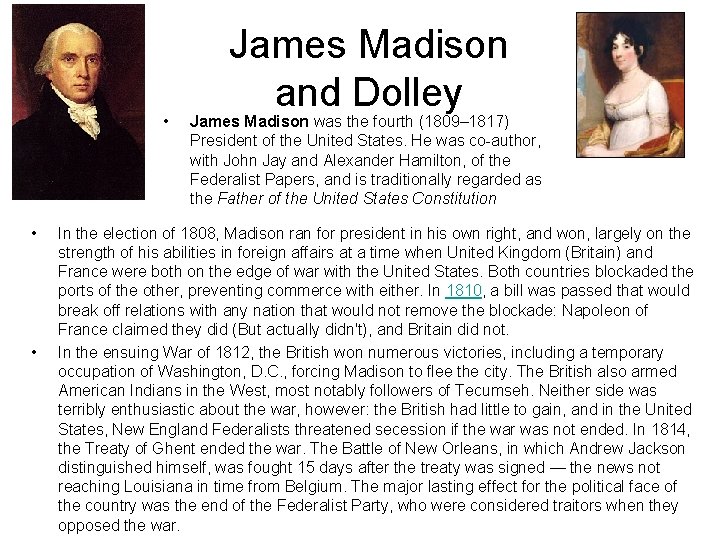
• • • James Madison and Dolley James Madison was the fourth (1809– 1817) President of the United States. He was co-author, with John Jay and Alexander Hamilton, of the Federalist Papers, and is traditionally regarded as the Father of the United States Constitution In the election of 1808, Madison ran for president in his own right, and won, largely on the strength of his abilities in foreign affairs at a time when United Kingdom (Britain) and France were both on the edge of war with the United States. Both countries blockaded the ports of the other, preventing commerce with either. In 1810, a bill was passed that would break off relations with any nation that would not remove the blockade: Napoleon of France claimed they did (But actually didn't), and Britain did not. In the ensuing War of 1812, the British won numerous victories, including a temporary occupation of Washington, D. C. , forcing Madison to flee the city. The British also armed American Indians in the West, most notably followers of Tecumseh. Neither side was terribly enthusiastic about the war, however: the British had little to gain, and in the United States, New England Federalists threatened secession if the war was not ended. In 1814, the Treaty of Ghent ended the war. The Battle of New Orleans, in which Andrew Jackson distinguished himself, was fought 15 days after the treaty was signed — the news not reaching Louisiana in time from Belgium. The major lasting effect for the political face of the country was the end of the Federalist Party, who were considered traitors when they opposed the war.
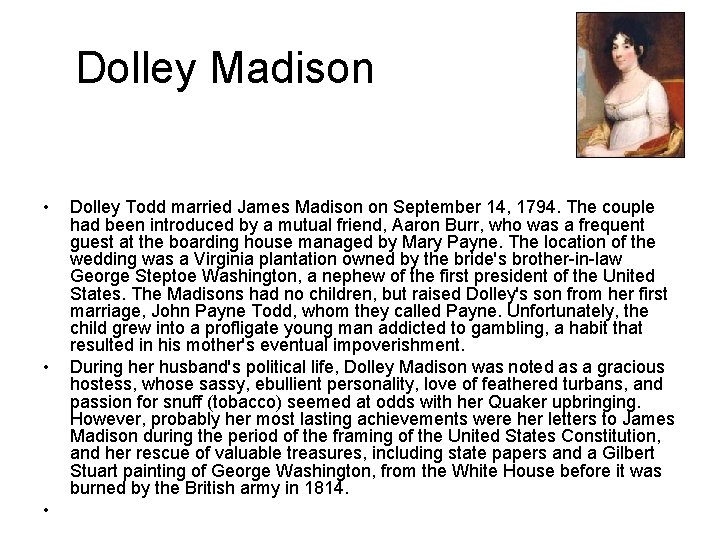
Dolley Madison • • • Dolley Todd married James Madison on September 14, 1794. The couple had been introduced by a mutual friend, Aaron Burr, who was a frequent guest at the boarding house managed by Mary Payne. The location of the wedding was a Virginia plantation owned by the bride's brother-in-law George Steptoe Washington, a nephew of the first president of the United States. The Madisons had no children, but raised Dolley's son from her first marriage, John Payne Todd, whom they called Payne. Unfortunately, the child grew into a profligate young man addicted to gambling, a habit that resulted in his mother's eventual impoverishment. During her husband's political life, Dolley Madison was noted as a gracious hostess, whose sassy, ebullient personality, love of feathered turbans, and passion for snuff (tobacco) seemed at odds with her Quaker upbringing. However, probably her most lasting achievements were her letters to James Madison during the period of the framing of the United States Constitution, and her rescue of valuable treasures, including state papers and a Gilbert Stuart painting of George Washington, from the White House before it was burned by the British army in 1814.
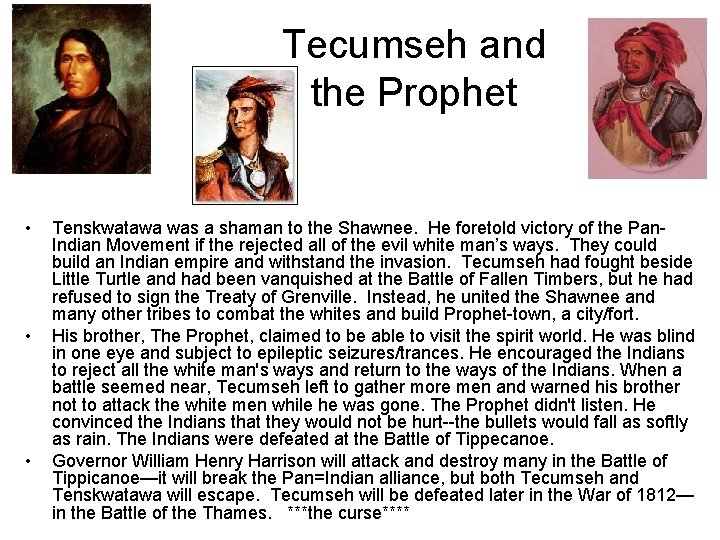
Tecumseh and the Prophet • • • Tenskwatawa was a shaman to the Shawnee. He foretold victory of the Pan. Indian Movement if the rejected all of the evil white man’s ways. They could build an Indian empire and withstand the invasion. Tecumseh had fought beside Little Turtle and had been vanquished at the Battle of Fallen Timbers, but he had refused to sign the Treaty of Grenville. Instead, he united the Shawnee and many other tribes to combat the whites and build Prophet-town, a city/fort. His brother, The Prophet, claimed to be able to visit the spirit world. He was blind in one eye and subject to epileptic seizures/trances. He encouraged the Indians to reject all the white man's ways and return to the ways of the Indians. When a battle seemed near, Tecumseh left to gather more men and warned his brother not to attack the white men while he was gone. The Prophet didn't listen. He convinced the Indians that they would not be hurt--the bullets would fall as softly as rain. The Indians were defeated at the Battle of Tippecanoe. Governor William Henry Harrison will attack and destroy many in the Battle of Tippicanoe—it will break the Pan=Indian alliance, but both Tecumseh and Tenskwatawa will escape. Tecumseh will be defeated later in the War of 1812— in the Battle of the Thames. ***the curse****
The Hartford Convention • New Englanders claimed that the embargo had ruined them. In an effort to find a solution to their economic problems, delegates from several New England states met in a convention in Hartford, CT in Dec 1814 to Jan 1815. They were considering secession or a series of amendments that would protect Northern interests. About the same time, Jackson won the Battle of New Orleans, so they seemed to be unpatriotic and smallminded. It was embarrassing to them when the report got out and it pretty much finished the Federalists.
War of 1812 • • • The War of 1812 was a conflict fought on land in North America and at sea around the world between the United States and United Kingdom from 1812 to 1815. Napoleon's 1812 invasion of Russia is also sometimes referred to as the "War of 1812. " Although the United States was officially at war with Great Britain, more than half of the British forces were made up of Canadian militia. Additionally, "Native Americans" in the United States and "First Nations" in Canada) fought on both sides of the war for reasons of their own. The war formally began on June 18, 1812 with the U. S. declaration of war. The United States launched invasions of the Canadian provinces in 1812 and 1813, but the borders were successfully defended by British and American Indian forces. The United States gained the upper hand in the American Indian part of war with victories at the Battle of the Thames in October 1813 and the Battle of Horseshoe Bend in March 1814, but by this time Napoleon had been defeated in Europe, and the British were finally able to divert more resources to North America. British invasions of American territory resulted in the burning of Washington, D. C. and the capture of part of the District of Maine, but the British counteroffensive was turned back at Lake Champlain, Baltimore, and New Orleans. The Treaty of Ghent (ratified in 1815) restored the status quo ante bellum between the combatants.
• Although the War of 1812 ended as a stalemate and is often only dimly remembered, it had many effects on the futures of those involved. The war created a greater sense of nationalism in both Canada and the United States. The successful defense of the Canadian provinces against American invasion ultimately ensured the survival of Canada as a distinct nation, and the end of the war marked the decline of a longstanding desire of many Americans to see the British Empire expelled from North America. Peace between the United States and British North America also meant that American Indians could no longer use conflicts between the two powers to defend native lands against the expansion of white settlement.
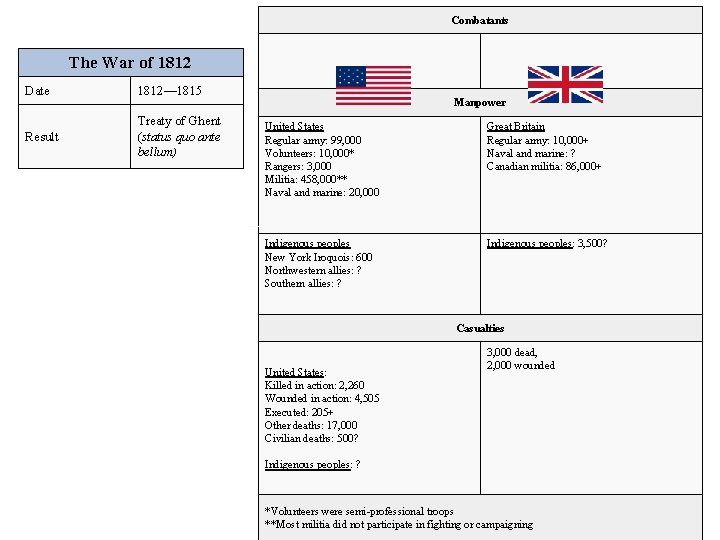
Combatants The War of 1812 Date 1812— 1815 Result Treaty of Ghent (status quo ante bellum) Manpower United States Regular army: 99, 000 Volunteers: 10, 000* Rangers: 3, 000 Militia: 458, 000** Naval and marine: 20, 000 Great Britain Regular army: 10, 000+ Naval and marine: ? Canadian militia: 86, 000+ Indigenous peoples New York Iroquois: 600 Northwestern allies: ? Southern allies: ? Indigenous peoples: 3, 500? Casualties United States: Killed in action: 2, 260 Wounded in action: 4, 505 Executed: 205+ Other deaths: 17, 000 Civilian deaths: 500? 3, 000 dead, 2, 000 wounded Indigenous peoples: ? *Volunteers were semi-professional troops **Most militia did not participate in fighting or campaigning
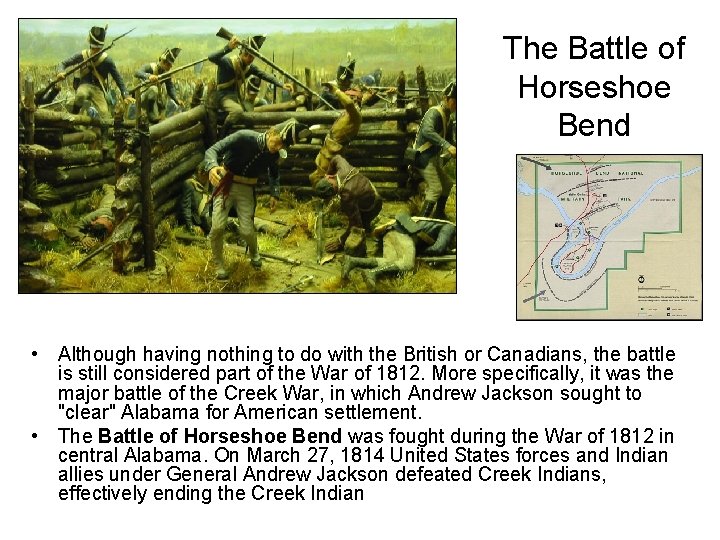
The Battle of Horseshoe Bend • Although having nothing to do with the British or Canadians, the battle is still considered part of the War of 1812. More specifically, it was the major battle of the Creek War, in which Andrew Jackson sought to "clear" Alabama for American settlement. • The Battle of Horseshoe Bend was fought during the War of 1812 in central Alabama. On March 27, 1814 United States forces and Indian allies under General Andrew Jackson defeated Creek Indians, effectively ending the Creek Indian
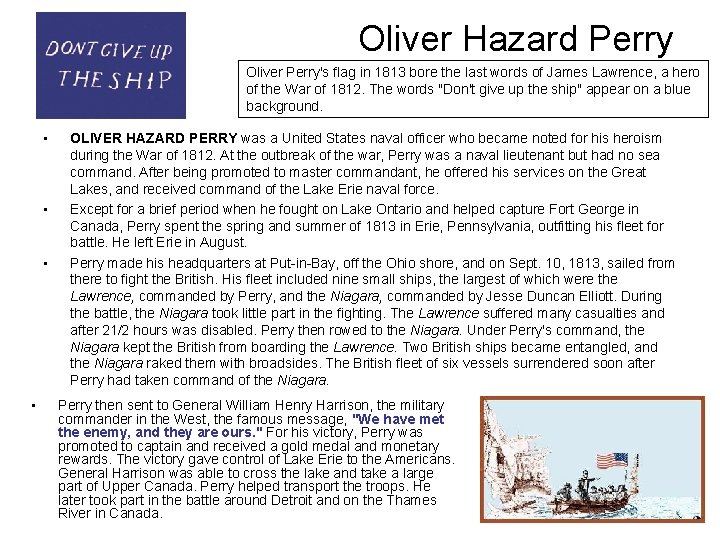
Oliver Hazard Perry Oliver Perry's flag in 1813 bore the last words of James Lawrence, a hero of the War of 1812. The words "Don't give up the ship" appear on a blue background. • • OLIVER HAZARD PERRY was a United States naval officer who became noted for his heroism during the War of 1812. At the outbreak of the war, Perry was a naval lieutenant but had no sea command. After being promoted to master commandant, he offered his services on the Great Lakes, and received command of the Lake Erie naval force. Except for a brief period when he fought on Lake Ontario and helped capture Fort George in Canada, Perry spent the spring and summer of 1813 in Erie, Pennsylvania, outfitting his fleet for battle. He left Erie in August. Perry made his headquarters at Put-in-Bay, off the Ohio shore, and on Sept. 10, 1813, sailed from there to fight the British. His fleet included nine small ships, the largest of which were the Lawrence, commanded by Perry, and the Niagara, commanded by Jesse Duncan Elliott. During the battle, the Niagara took little part in the fighting. The Lawrence suffered many casualties and after 21/2 hours was disabled. Perry then rowed to the Niagara. Under Perry's command, the Niagara kept the British from boarding the Lawrence. Two British ships became entangled, and the Niagara raked them with broadsides. The British fleet of six vessels surrendered soon after Perry had taken command of the Niagara. Perry then sent to General William Henry Harrison, the military commander in the West, the famous message, "We have met the enemy, and they are ours. " For his victory, Perry was promoted to captain and received a gold medal and monetary rewards. The victory gave control of Lake Erie to the Americans. General Harrison was able to cross the lake and take a large part of Upper Canada. Perry helped transport the troops. He later took part in the battle around Detroit and on the Thames River in Canada.
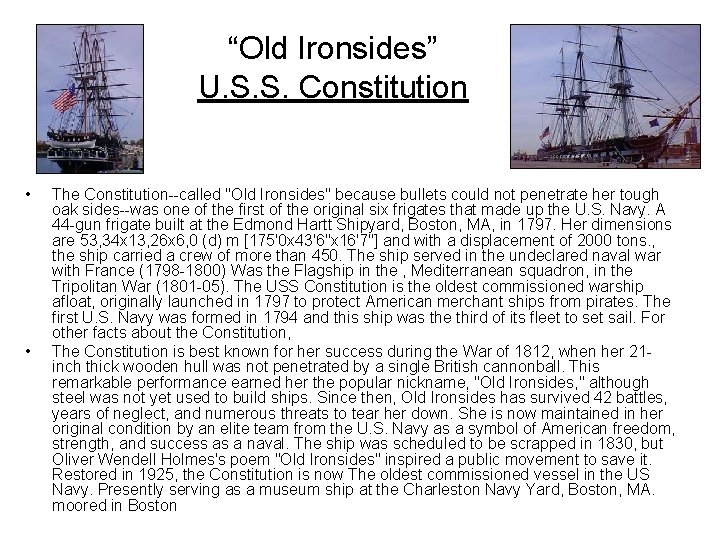
“Old Ironsides” U. S. S. Constitution • • The Constitution--called "Old Ironsides" because bullets could not penetrate her tough oak sides--was one of the first of the original six frigates that made up the U. S. Navy. A 44 -gun frigate built at the Edmond Hartt Shipyard, Boston, MA, in 1797. Her dimensions are 53, 34 x 13, 26 x 6, 0 (d) m [175'0 x 43'6"x 16'7"] and with a displacement of 2000 tons. , the ship carried a crew of more than 450. The ship served in the undeclared naval war with France (1798 -1800) Was the Flagship in the , Mediterranean squadron, in the Tripolitan War (1801 -05). The USS Constitution is the oldest commissioned warship afloat, originally launched in 1797 to protect American merchant ships from pirates. The first U. S. Navy was formed in 1794 and this ship was the third of its fleet to set sail. For other facts about the Constitution, The Constitution is best known for her success during the War of 1812, when her 21 inch thick wooden hull was not penetrated by a single British cannonball. This remarkable performance earned her the popular nickname, "Old Ironsides, " although steel was not yet used to build ships. Since then, Old Ironsides has survived 42 battles, years of neglect, and numerous threats to tear her down. She is now maintained in her original condition by an elite team from the U. S. Navy as a symbol of American freedom, strength, and success as a naval. The ship was scheduled to be scrapped in 1830, but Oliver Wendell Holmes's poem "Old Ironsides" inspired a public movement to save it. Restored in 1925, the Constitution is now The oldest commissioned vessel in the US Navy. Presently serving as a museum ship at the Charleston Navy Yard, Boston, MA. moored in Boston
Francis Scott Key FRANCIS SCOTT KEY was a well-known Washington lawyer and amateur verse writer. He became famous for writing the words of "The Star-Spangled Banner, " the national anthem of the United States. He wrote the poem during the War of 1812. When the British retreated from Washington during the war, they took Key's friend William Beanes with them. President James Madison gave Key permission to intercede with the British for Beanes's release. Key boarded a U. S. flag of truce ship in September 1814. From this vantage point, Key witnessed the British fleet's bombardment of Fort Mc. Henry in Baltimore Harbor throughout the night. The next morning, he saw that "our flag was still there" despite the ordeal. His joy inspired him to write a poem about it. To set it to music, Key borrowed the tune from a popular English drinking song, "To Anacreon in Heaven. " Congress adopted his song, "The Star. Spangled Banner, " as the national anthem of the United States in 1931.
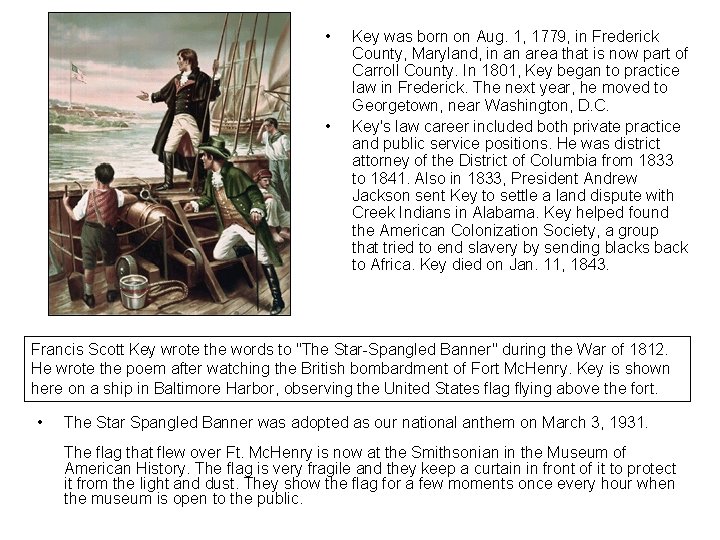
• • Key was born on Aug. 1, 1779, in Frederick County, Maryland, in an area that is now part of Carroll County. In 1801, Key began to practice law in Frederick. The next year, he moved to Georgetown, near Washington, D. C. Key's law career included both private practice and public service positions. He was district attorney of the District of Columbia from 1833 to 1841. Also in 1833, President Andrew Jackson sent Key to settle a land dispute with Creek Indians in Alabama. Key helped found the American Colonization Society, a group that tried to end slavery by sending blacks back to Africa. Key died on Jan. 11, 1843. Francis Scott Key wrote the words to "The Star-Spangled Banner" during the War of 1812. He wrote the poem after watching the British bombardment of Fort Mc. Henry. Key is shown here on a ship in Baltimore Harbor, observing the United States flag flying above the fort. • The Star Spangled Banner was adopted as our national anthem on March 3, 1931. The flag that flew over Ft. Mc. Henry is now at the Smithsonian in the Museum of American History. The flag is very fragile and they keep a curtain in front of it to protect it from the light and dust. They show the flag for a few moments once every hour when the museum is open to the public.
Treaty of Ghent 1814 • During the War of 1812, a team of American diplomats had been negotiating with the British. The Americans had little success until the British became alarmed by the American victories on the Great Lakes. On December 24, 1814, they signed the peace treaty in Ghent, Belgium —because England had just battled Napoleon and was adverse to anything to do with the French. We felt that we had won the war because: • We had lost no territory • We had defeated Tecumseh and the Native Americans • We had defended our American independence. • The Battle of New Orleans took place on January 8, 1815—two weeks after the war had officially ended, but Jackson was propelled into status of national hero. No one knew that the war had ended at the time of the battle, since communications were so slow and inefficient.
The Battle of New Orleans • • • The Battle of New Orleans took place on January 8, 1815 during the War of 1812, when the United States forces defeated the British. The Treaty of Ghent, which ended the war, had been signed over two weeks earlier, but the news had not yet reached the battlefront. In December of 1814, British forces under Major General Sir Edward Packenham landed along the lower Mississippi River. At first, they met with only minor resistance. The Americans, led by Colonel Andrew Jackson, set up defensive positions at Chalmette, Louisiana, some five miles (8 km) downriver from the city of New Orleans. The first British troops reached the American position on January 1, and in an exchange of artillery fire, the Americans held their ground. Packenham decided to wait for his entire force of over 10, 000 men (which included Native American members) to assemble, before launching an attack. On the 8 th of January, Packenham ordered three large, direct-assaults on the American positions; all of his attacks were cut down by American fire. Packenham himself was mortally wounded in the third attack. Throughout the battle, the Americans were greatly aided by Jean Lafitte and his pirates. Lafitte's men fought alongside the Americans, their pirating in the seas south of Louisiana having been largely-ignored by the US government; as the pirates, as a rule, attacked only the Spanish and other pirates. It is an interesting side-note that Lafitte's men wore red shirts as their uniform, which caused much confusion in the British ranks, who were also clothed in red. Some daring pirates came down from Gen. Jackson's ramparts and merged with the British ranks, thus allowing them to kill small pockets of isolated troops, before the British realized there was an intruder. Also aiding the Americans were quite a few liberated Haitian slaves, a "black regiment" recruited from New Orleans, "several" Choctaws, and a group of men from the mountains of Kentucky, wielding long rifles, which they used to deadly effect. Over 2, 000 British, but only 8 Americans were killed.
The Battle of New Orleans song • • The victory was celebrated with great enthusiasm in the United States, and gave Andrew Jackson the reputation of a war hero (by defeating the top military force in the world, the regular British army), which later propelled him to the presidency. In 1814 we took a little trip Along with Colonel Jackson down the mighty Mississip. We took a little bacon and we took a little beans And we caught the bloody British in the town of New Orleans. [Chorus: ] We fired our guns and the British kept a'comin. There wasn't nigh as many as there was a while ago. We fired once more and they began to runnin' on Down the Mississippi to the Gulf of Mexico. We looked down the river and we see'd the British come. And there must have been a hundred of'em beatin' on the drum. They stepped so high and they made the bugles ring. We stood by our cotton bales and didn't say a thing. • Old Hickory said we could take 'em by surprise If we didn't fire our muskets 'til we looked 'em in the eye We held our fire 'til we see'd their faces well. Then we opened up with squirrel guns and really gave 'em. . . well Yeah, they ran through the briars and they ran through the brambles And they ran through the bushes where a rabbit couldn't go. They ran so fast that the hounds couldn't catch 'em Down the Mississippi to the Gulf of Mexico. ** We fired our cannon 'til the barrel melted down. So we grabbed an alligator and we fought another round. We filled his head with cannon balls, and powdered his behind And when we touched the powder off, the gator lost his mind. Yeah, they ran through the briars and they ran through the brambles And they ran through the bushes where a rabbit couldn't go. They ran so fast that the hounds couldn't catch 'em Down the Mississippi to the Gulf of Mexico.
The Rush-Bagot Agreement 1817 • Britain and the United States would cut back on the number of warships they kept on the Great Lakes. Many obstacles to trade between the two were removed. • The result of this and subsequent agreements and treaties, the boundary between the US and Canada the longest unfortified boundary in the world. Another agreement negotiated a friendly division of the Oregon Country. Bad feelings and conflicts between Britain and US seemed to be over at last.
End of the Federalists • There was one main casualty of the War of 1812—and that was the end of the Federalist Party. For a bit there will be only one political party—the Democratic. Republicans, thus we will have peaceful harmony in politics for a time—called the Era of Good Feelings. This will last until Jackson’s defeat in the Election of 1824 and when Jackson is elected in 1828.
The Era of Good Feelings • In 1816, James Monroe easily won the election. He was the 3 rd Democratic. Republican to be elected as President in a row. There was little or no opposition to Monroe, therefore a Boston newspaper coined the phrase “the country was living in the Era of Good Feelings”. • This is the postwar period through 1820
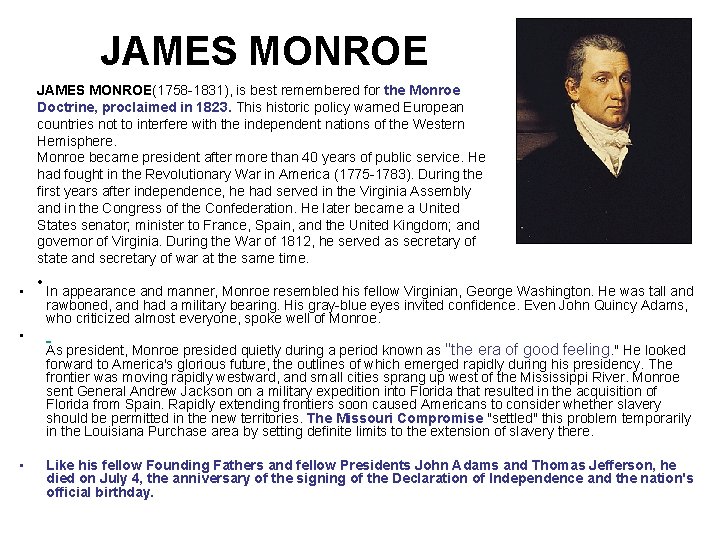
JAMES MONROE(1758 -1831), is best remembered for the Monroe Doctrine, proclaimed in 1823. This historic policy warned European countries not to interfere with the independent nations of the Western Hemisphere. Monroe became president after more than 40 years of public service. He had fought in the Revolutionary War in America (1775 -1783). During the first years after independence, he had served in the Virginia Assembly and in the Congress of the Confederation. He later became a United States senator; minister to France, Spain, and the United Kingdom; and governor of Virginia. During the War of 1812, he served as secretary of state and secretary of war at the same time. • • In appearance and manner, Monroe resembled his fellow Virginian, George Washington. He was tall and rawboned, and had a military bearing. His gray-blue eyes invited confidence. Even John Quincy Adams, who criticized almost everyone, spoke well of Monroe. As president, Monroe presided quietly during a period known as "the era of good feeling. " He looked forward to America's glorious future, the outlines of which emerged rapidly during his presidency. The frontier was moving rapidly westward, and small cities sprang up west of the Mississippi River. Monroe sent General Andrew Jackson on a military expedition into Florida that resulted in the acquisition of Florida from Spain. Rapidly extending frontiers soon caused Americans to consider whether slavery should be permitted in the new territories. The Missouri Compromise "settled" this problem temporarily in the Louisiana Purchase area by setting definite limits to the extension of slavery there. Like his fellow Founding Fathers and fellow Presidents John Adams and Thomas Jefferson, he died on July 4, the anniversary of the signing of the Declaration of Independence and the nation's official birthday.
Adams-Onis Treaty 1819 • An agreement between Spain and the US negotiated by Secretary of State John Quincy Adams and Luis Onis that gave both East and West Florida to US. • Andrew Jackson had forced the issue during the so-called Seminole War. Jackson had invaded FL with an army of 3, 000 plus 2, 000 Native allies, seized Pensacola, and raised the American flag—all without any right or authority to do any of those things. • Since Jackson had been successful, Monroe officially had to back him (but he did not like the recklessness of it).
Missouri Compromise 1820 • • Through the efforts of Henry Clay, "the great pacificator, " a compromise was finally reached on March 3, 1820. The debate was over the expansion of slavery in the newly acquired LA Purchase. South, pro slavery; North, anti-slavery. The issue was resolved with a two-part compromise. The northern part of Massachusetts became Maine and was admitted to the Union as a free state at the same time that Missouri was admitted as a slave state, thereby maintaining a balance of 12 slave and 12 free states. In addition, an imaginary line was drawn at 36 degrees 30 minutes north latitude, and any portions of the Louisiana Territory lying north of the compromise line would be free; however, the act provided that fugitive slaves "escaping into any. . . state or territory of the United States. . . may be lawfully reclaimed and conveyed to the person claiming his or her labor or service" -- and even in the free territories, "slavery and involuntary servitude. . . in the punishment of crimes" was not prohibited. • Fascinating Fact: The Missouri Compromise was repealed by the 1854 Kansas. Nebraska Act and declared unconstitutional in the 1857 Dred Scott decision.
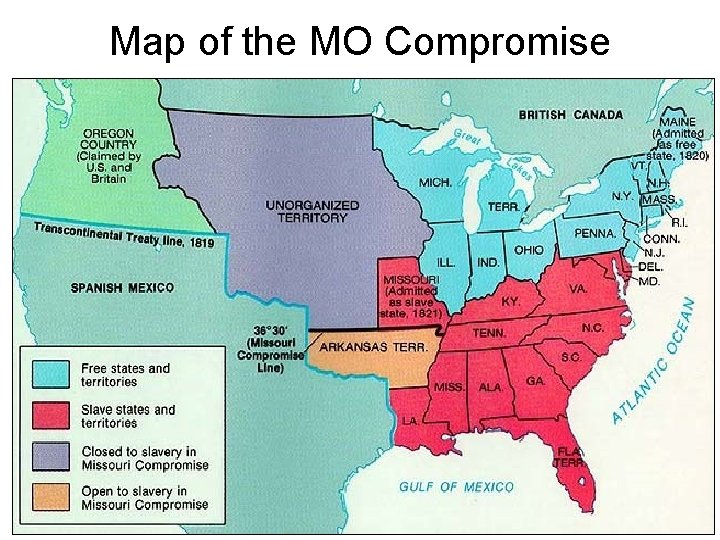
Map of the MO Compromise
Henry Clay • • • Henry Clay was born April 12, 1777 in Hanover County, Virginia – died June 29, 1852 in Washington, D. C. He was an American statesman and orator who served in both the House of Representatives and Senate. He also made five failed bids for the presidency, but was nevertheless extremely influential in U. S. politics. From the beginning of his career, he was in favor of internal improvements as a means of opening up the fertile but inaccessible West, and he opposed the spoils system as an abuse of official patronage. But Clay applied himself most to the struggles of slavery, politics, and protecting domestic industries. Throughout his public life, he proved his passionate devotion to the Union and his willingness to compromise in order to save it. Henry Clay's American System was a plan to strengthen the nation's economy by tying the North, South, and West together. It called for: Federal funding of infrastructure improvements such as the Erie Canal and a series of highways funded by a raised tariff on imported goods. Using protective tariffs to encourage development of domestic industry. Reliance on domestic financial resources and for a stiff protective tariff. Henry Clay believed that slavery was the "deepest stain upon the character of the country, " opposition to which could not be repressed except by "blowing out the moral lights around us" and "eradicating from the human soul the light of reason and the law of liberty. " As Speaker of the House, Clay was regarded as the leader of the War Hawks. Clay is remembered as "The Great Compromiser" for his ability to bring others to agreement.
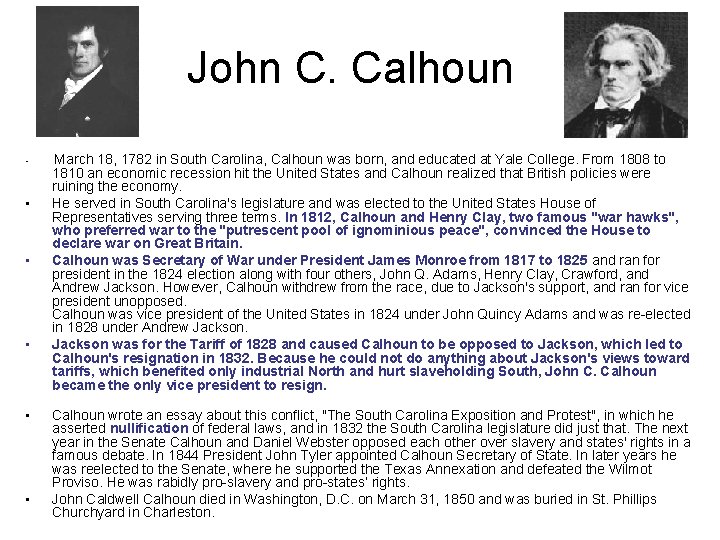
John C. Calhoun • • • March 18, 1782 in South Carolina, Calhoun was born, and educated at Yale College. From 1808 to 1810 an economic recession hit the United States and Calhoun realized that British policies were ruining the economy. He served in South Carolina's legislature and was elected to the United States House of Representatives serving three terms. In 1812, Calhoun and Henry Clay, two famous "war hawks", who preferred war to the "putrescent pool of ignominious peace", convinced the House to declare war on Great Britain. Calhoun was Secretary of War under President James Monroe from 1817 to 1825 and ran for president in the 1824 election along with four others, John Q. Adams, Henry Clay, Crawford, and Andrew Jackson. However, Calhoun withdrew from the race, due to Jackson's support, and ran for vice president unopposed. Calhoun was vice president of the United States in 1824 under John Quincy Adams and was re-elected in 1828 under Andrew Jackson was for the Tariff of 1828 and caused Calhoun to be opposed to Jackson, which led to Calhoun's resignation in 1832. Because he could not do anything about Jackson's views toward tariffs, which benefited only industrial North and hurt slaveholding South, John C. Calhoun became the only vice president to resign. Calhoun wrote an essay about this conflict, "The South Carolina Exposition and Protest", in which he asserted nullification of federal laws, and in 1832 the South Carolina legislature did just that. The next year in the Senate Calhoun and Daniel Webster opposed each other over slavery and states' rights in a famous debate. In 1844 President John Tyler appointed Calhoun Secretary of State. In later years he was reelected to the Senate, where he supported the Texas Annexation and defeated the Wilmot Proviso. He was rabidly pro-slavery and pro-states’ rights. John Caldwell Calhoun died in Washington, D. C. on March 31, 1850 and was buried in St. Phillips Churchyard in Charleston.
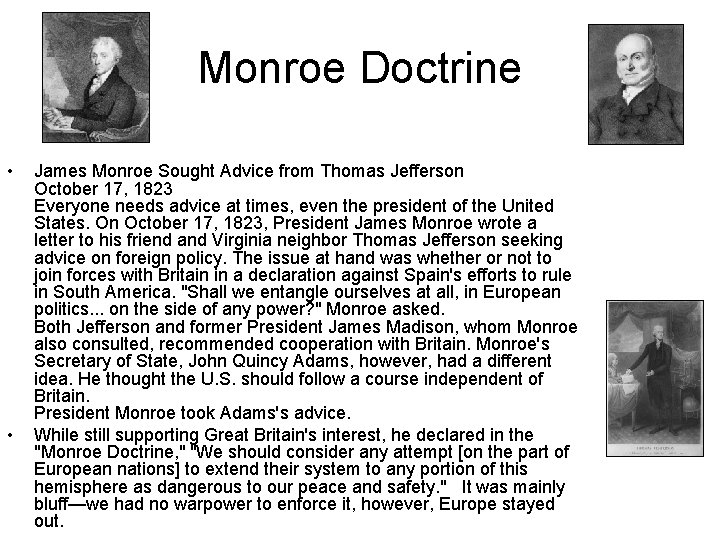
Monroe Doctrine • • James Monroe Sought Advice from Thomas Jefferson October 17, 1823 Everyone needs advice at times, even the president of the United States. On October 17, 1823, President James Monroe wrote a letter to his friend and Virginia neighbor Thomas Jefferson seeking advice on foreign policy. The issue at hand was whether or not to join forces with Britain in a declaration against Spain's efforts to rule in South America. "Shall we entangle ourselves at all, in European politics. . . on the side of any power? " Monroe asked. Both Jefferson and former President James Madison, whom Monroe also consulted, recommended cooperation with Britain. Monroe's Secretary of State, John Quincy Adams, however, had a different idea. He thought the U. S. should follow a course independent of Britain. President Monroe took Adams's advice. While still supporting Great Britain's interest, he declared in the "Monroe Doctrine, " "We should consider any attempt [on the part of European nations] to extend their system to any portion of this hemisphere as dangerous to our peace and safety. " It was mainly bluff—we had no warpower to enforce it, however, Europe stayed out.
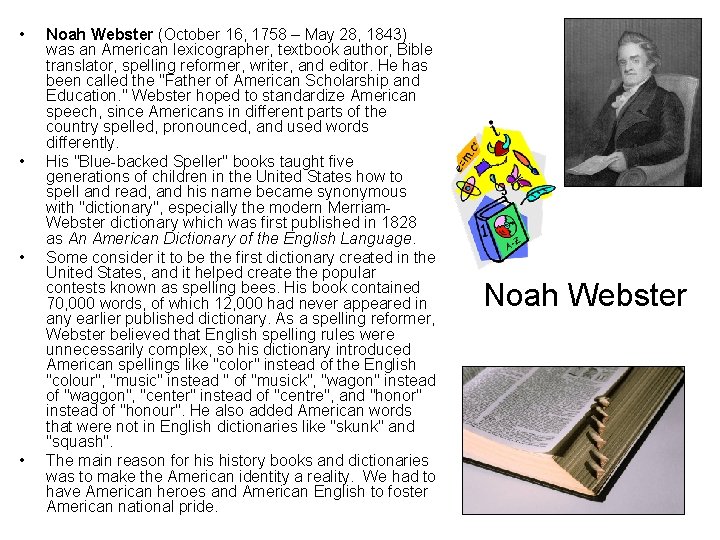
• • Noah Webster (October 16, 1758 – May 28, 1843) was an American lexicographer, textbook author, Bible translator, spelling reformer, writer, and editor. He has been called the "Father of American Scholarship and Education. " Webster hoped to standardize American speech, since Americans in different parts of the country spelled, pronounced, and used words differently. His "Blue-backed Speller" books taught five generations of children in the United States how to spell and read, and his name became synonymous with "dictionary", especially the modern Merriam. Webster dictionary which was first published in 1828 as An American Dictionary of the English Language. Some consider it to be the first dictionary created in the United States, and it helped create the popular contests known as spelling bees. His book contained 70, 000 words, of which 12, 000 had never appeared in any earlier published dictionary. As a spelling reformer, Webster believed that English spelling rules were unnecessarily complex, so his dictionary introduced American spellings like "color" instead of the English "colour", "music" instead " of "musick", "wagon" instead of "waggon", "center" instead of "centre", and "honor" instead of "honour". He also added American words that were not in English dictionaries like "skunk" and "squash". The main reason for history books and dictionaries was to make the American identity a reality. We had to have American heroes and American English to foster American national pride. Noah Webster
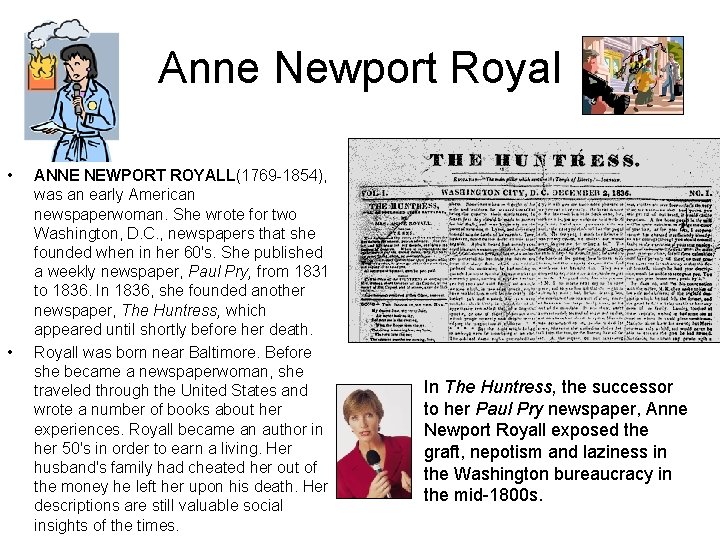
Anne Newport Royal • • ANNE NEWPORT ROYALL(1769 -1854), was an early American newspaperwoman. She wrote for two Washington, D. C. , newspapers that she founded when in her 60's. She published a weekly newspaper, Paul Pry, from 1831 to 1836. In 1836, she founded another newspaper, The Huntress, which appeared until shortly before her death. Royall was born near Baltimore. Before she became a newspaperwoman, she traveled through the United States and wrote a number of books about her experiences. Royall became an author in her 50's in order to earn a living. Her husband's family had cheated her out of the money he left her upon his death. Her descriptions are still valuable social insights of the times. • In The Huntress, the successor to her Paul Pry newspaper, Anne Newport Royall exposed the graft, nepotism and laziness in the Washington bureaucracy in the mid-1800 s.
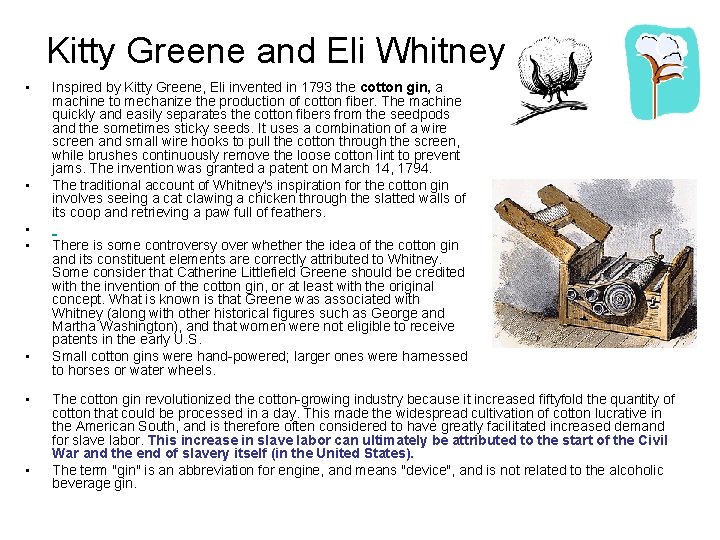
Kitty Greene and Eli Whitney • • Inspired by Kitty Greene, Eli invented in 1793 the cotton gin, a machine to mechanize the production of cotton fiber. The machine quickly and easily separates the cotton fibers from the seedpods and the sometimes sticky seeds. It uses a combination of a wire screen and small wire hooks to pull the cotton through the screen, while brushes continuously remove the loose cotton lint to prevent jams. The invention was granted a patent on March 14, 1794. The traditional account of Whitney's inspiration for the cotton gin involves seeing a cat clawing a chicken through the slatted walls of its coop and retrieving a paw full of feathers. There is some controversy over whether the idea of the cotton gin and its constituent elements are correctly attributed to Whitney. Some consider that Catherine Littlefield Greene should be credited with the invention of the cotton gin, or at least with the original concept. What is known is that Greene was associated with Whitney (along with other historical figures such as George and Martha Washington), and that women were not eligible to receive patents in the early U. S. Small cotton gins were hand-powered; larger ones were harnessed to horses or water wheels. The cotton gin revolutionized the cotton-growing industry because it increased fiftyfold the quantity of cotton that could be processed in a day. This made the widespread cultivation of cotton lucrative in the American South, and is therefore often considered to have greatly facilitated increased demand for slave labor. This increase in slave labor can ultimately be attributed to the start of the Civil War and the end of slavery itself (in the United States). The term "gin" is an abbreviation for engine, and means "device", and is not related to the alcoholic beverage gin.
- Slides: 131