
Building the Balanced Scorecard Introduction Balanced Scorecards provide
Building the Balanced Scorecard

Introduction Ø Balanced Scorecards provide a framework for communicating strategy in operating terms (measurements and targets). Ø You must communicate strategy in operating terms if you expect people to execute on your strategy. Ø When people are asked about strategy, they reach for their balanced scorecard.
Why do we need Balanced Scorecard…? ? ? ü Improves how you communicate strategy ü Superimposes a discipline whereby you capture cause-effect; otherwise you create pockets of under-performance. ü Forces to think about strategic measurement as opposed to tactical or operating type measurements
HOW TO BEGIN…. !! v Begin with strategic plan – what things are critical to future success? v Focus on customers – what values will we add to our customers v Define the processes – how will we deliver these services to our customers v Build the organization – what capabilities must we put in place
Strategic Goals Ø The first components of any strategy are goals. Ø Strategic goals establish direction in concrete terms. Ø Strategic goals anchor the rest of the process. Ø Strategic goals should fit with the vision and mission of the organization.
Attributes of a Goal ü Should be a very short statement ü Directly relates to the mission ü Broad in scope ü Covers long time period (such as 3 years) ü Examples: - Improve Customer Service - Leverage Core Competencies - Develop more innovative products
Strategic Objectives v Once first anchor (goals) are established, develop a set of strategic objectives. v Strategic objectives define what actions must be taken to reach the strategic goals. v Objectives are critical to future success. For example, in order to grow revenues, we must introduce new products and expand our market share.
Objective Attributes Ø Longer statement than goal statement Ø More specific than goal statement Ø Relationship to mission Ø Covers shorter time period than goal (such as 6 months or 1 year) Ø Example: - We will expand call center services to include technical support

Strategic Themes o Based on strategic goals, three to five strategic themes should emerge. o From these themes, develop a strategic map. o Four common strategic themes are: Operating Efficiencies, Customer Relations, Product Innovation, and Growing the Business.
Strategic Models can emerge from four principles: 1. Translate strategies into operating terms. 2. Link strategies throughout the entire organization. 3. Commit everyone to implementing strategy. 4. Make strategizing a continuous process of learning and adjusting to change.
4 Perspectives of BSC v Financial: Top layer in the map, represents financial outcomes (profits, revenues, etc. ) v Customer: Next layer down, enables financial results (service, image, price, quality, etc. ) v Internal Processes: The values added to customers, such as delivery, production, distribution, etc. v Learning & Growth: The people, systems, and organization that enable processes.

Strategic Mapping ü Strategic Maps are the foundation of the Balanced Scorecard. ü You will need one strategic map for each strategic theme. ü Maps are constructed over four perspectives. ü Strategic objectives are mapped over the four perspectives, linked together.
Linking BSC to Business Strategy v Strategic objectives should be placed in the Strategic Map according to which perspective fits with the objective. v Objectives may cross over more than one perspective. v Start at the top with outcomes and work our way down, looking at what drives the outcome.
Approval of Maps Ø After strategic maps are done, get approval from executive management. Ask questions likes…. “Does this map accurately tell the story of our strategy? ” Ø If management disagrees with the map, go back and redo the maps.
Measurements Ø For each strategic objective, you need one measurement. Ø Measurement provides us with feedback on meeting the strategic objective.
Measurement Criteria ü Measurements should drive change, providing teeth to our strategy. ü Measurements define objectives in specific terms. A good measurement should tell you what your objective is. ü Measurements should be SMART. . !!
Examples of Good Measurements Customer satisfaction: - Response Time to service customer - Customer Satisfaction Survey Scores Process Efficiency: - Cycle time - Downtime (time / ratio) - No. of Restarts
Targets Setting Ø Once measurements are established, you need to set a target for each measurement. Ø Targets push the organization to a required level of performance. Ø Targets put focus on the strategy, expressing the specifics of the strategy. Ø When an organization hits targets, then it has successfully implemented its strategy.
Examples of Targets ü Total Time to Recruit New Employees: Less than “x” days by 2005 ü Utilization of rental facilities: Increase to 90% during peak summer months ü Growth in top line revenues: 12% increase than 2004 ü Improve overall customer satisfaction: Total scores on satisfaction exceed 85%
Initiatives Takers v In order for things to happen in an organization, you must initiate major projects or programs. v Once you launch appropriate initiatives, you should be able to meet your strategic objectives. This closes the loopholes and everything is linked.
Initiative Attributes ü Sponsored by Top Management ü Designated project(s) owners ü Includes deliverables or milestones ü Has some deadlines
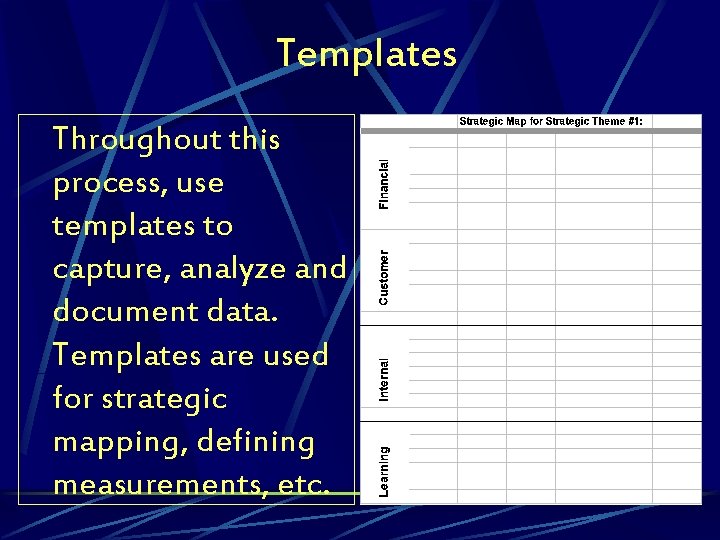
Templates Throughout this process, use templates to capture, analyze and document data. Templates are used for strategic mapping, defining measurements, etc.

Pointers to keep in mind…. !! v Scorecards are built around three teams: Leadership Team (upper level management), Core Team (middle level management) and Measurement Team (lower level functional personnel). v Scorecards are built around frequent group meetings: Kick Off Meeting followed by one meeting for each of the three teams.
Implementation Ø The minimum time for developing a balanced scorecard is 3 months. Ø Full deployment of scorecards throughout the entire organization can take one year or even more than that. Ø The best place to start building a scorecard is where all components of the value chain are in place: Customer, Innovation, Production, Delivery, Services, etc.
Summary Ø Balanced Scorecards are the best way of putting organization in its place. Ø Scorecards rely on a fully integrated approach: Goals, Objectives, Mapping, Measurements, Targets, and Initiatives. Ø The building of a balanced scorecard can be experimental, whereby you test your strategies, refine, and make changes as you get feedback and learn what works.

THANK YOU
- Slides: 26