
Building Systems of Care A Primer on Designing
Building Systems of Care: A Primer on Designing and Implementing Effective Systems of Care Elizabeth Manley The TA Network for Children’s Behavioral Health The Institute for Innovation and Implementation Hennepin County Technical Assistance Visit
This training is hosted by the National TA Network for Children’s Behavioral Health, operated by and coordinated through the University of Maryland. This presentation was prepared by the National Technical Assistance Network for Children’s Behavioral Health under contract with the U. S. Department of Health and Human Services, Substance Abuse and Mental Health Services Administration, Contract #HHSS 280201500007 C. The views, opinions, and content expressed in this presentation do not necessarily reflect the views, opinions, or policies of the Center for Mental Health Services (CMHS), the Substance Abuse and Mental Health Services Administration (SAMHSA), or the U. S. Department of Health and Human Services (HHS). 2
Definition, History, Values, Populations
Definition of a System of Care A system of care incorporates a broad, flexible array of effective services and supports for a defined population that is organized into a coordinated network, integrates care planning and management across multiple levels, is culturally and linguistically competent, builds meaningful partnerships with families and youth at service delivery, management, and policy levels, has supportive policy and management infrastructure, and is data-driven. Pires, S. (2010). Building systems of care: A primer, 2 nd Edition. Washington, D. C. : Human Service Collaborative for Georgetown University National Technical Assistance Center for Children’s Mental Health.
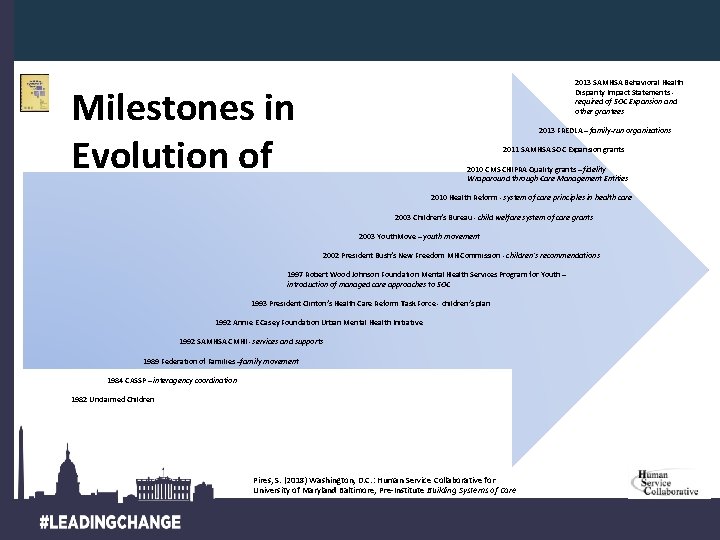
Milestones in Evolution of Systems of Care 2013 SAMHSA Behavioral Health Disparity Impact Statements required of SOC Expansion and other grantees 2013 FREDLA – family-run organizations 2011 SAMHSA SOC Expansion grants 2010 CMS CHIPRA Quality grants – fidelity Wraparound through Care Management Entities 2010 Health Reform - system of care principles in health care 2003 Children’s Bureau - child welfare system of care grants 2003 Youth. Move – youth movement 2002 President Bush’s New Freedom MH Commission - children’s recommendations 1997 Robert Wood Johnson Foundation Mental Health Services Program for Youth – introduction of managed care approaches to SOC 1993 President Clinton’s Health Care Reform Task Force - children’s plan 1992 Annie E Casey Foundation Urban Mental Health Initiative 1992 SAMHSA CMHI - services and supports 1989 Federation of Families –family movement 1984 CASSP – interagency coordination 1982 Unclaimed Children Pires, S. (2018) Washington, D. C. : Human Service Collaborative for University of Maryland Baltimore, Pre-Institute Building Systems of Care
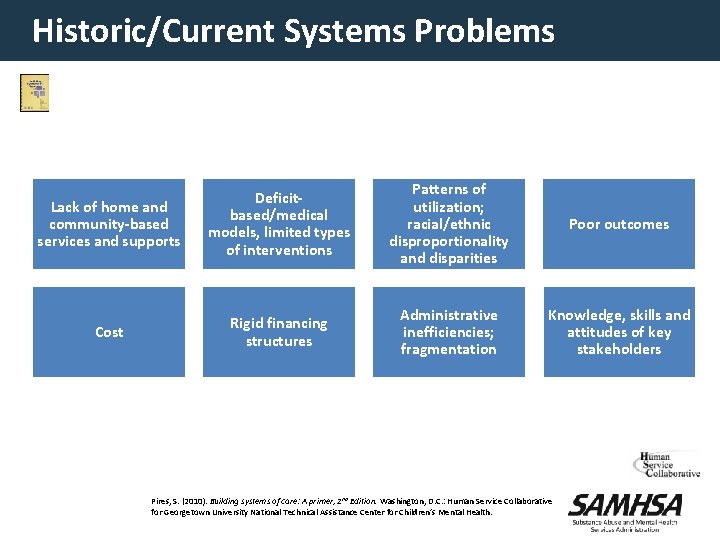
Historic/Current Systems Problems Lack of home and community-based services and supports Deficitbased/medical models, limited types of interventions Patterns of utilization; racial/ethnic disproportionality and disparities Poor outcomes Cost Rigid financing structures Administrative inefficiencies; fragmentation Knowledge, skills and attitudes of key stakeholders Pires, S. (2010). Building systems of care: A primer, 2 nd Edition. Washington, D. C. : Human Service Collaborative for Georgetown University National Technical Assistance Center for Children’s Mental Health.
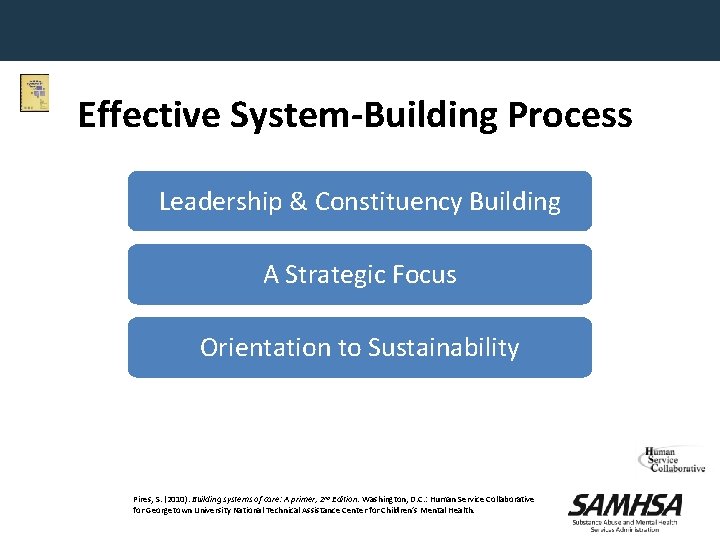
Effective. System-Building. Process Leadership & Constituency Building A Strategic Focus Orientation to Sustainability Pires, S. (2010). Building systems of care: A primer, 2 nd Edition. Washington, D. C. : Human Service Collaborative for Georgetown University National Technical Assistance Center for Children’s Mental Health.
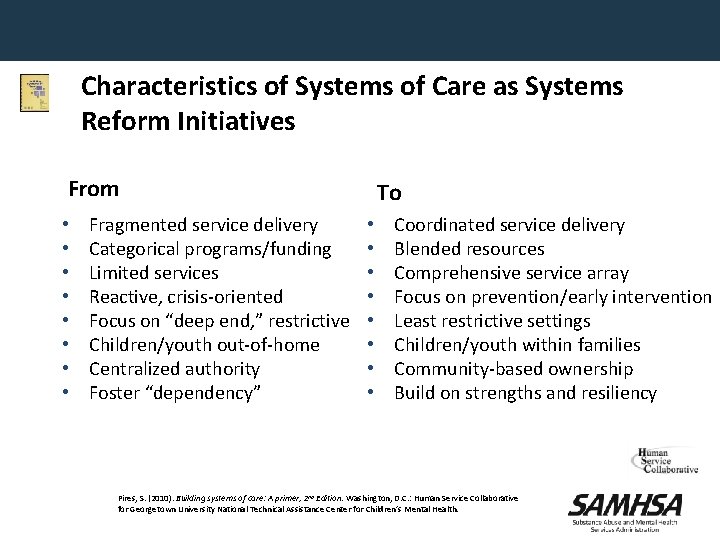
Characteristics of Systems of Care as Systems Reform Initiatives From • • Fragmented service delivery Categorical programs/funding Limited services Reactive, crisis-oriented Focus on “deep end, ” restrictive Children/youth out-of-home Centralized authority Foster “dependency” To • • Coordinated service delivery Blended resources Comprehensive service array Focus on prevention/early intervention Least restrictive settings Children/youth within families Community-based ownership Build on strengths and resiliency Pires, S. (2010). Building systems of care: A primer, 2 nd Edition. Washington, D. C. : Human Service Collaborative for Georgetown University National Technical Assistance Center for Children’s Mental Health.
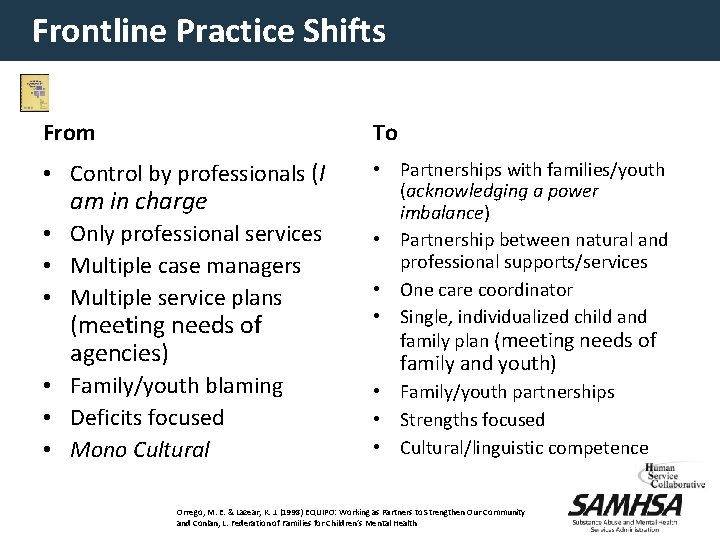
Frontline Practice Shifts From To • Control by professionals (I • Partnerships with families/youth (acknowledging a power imbalance) • Partnership between natural and professional supports/services • One care coordinator • Single, individualized child and family plan (meeting needs of am in charge • Only professional services • Multiple case managers • Multiple service plans (meeting needs of agencies) • Family/youth blaming • Deficits focused • Mono Cultural family and youth) • Family/youth partnerships • Strengths focused • Cultural/linguistic competence Orrego, M. E. & Lazear, K. J. (1998) EQUIPO: Working as Partners to Strengthen Our Community and Conlan, L. Federation of Families for Children’s Mental Health
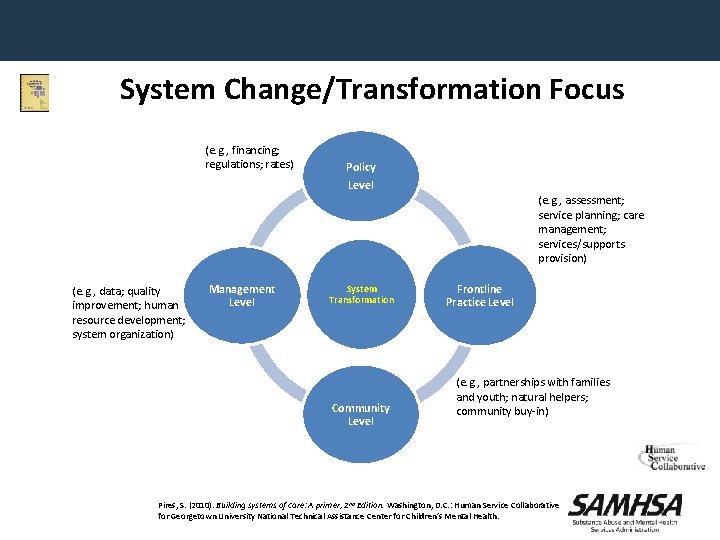
System Change/Transformation Focus (e. g. , financing; regulations; rates) Policy Level (e. g. , assessment; service planning; care management; services/supports provision) (e. g. , data; quality improvement; human resource development; system organization) Management Level System Transformation Community Level Frontline Practice Level (e. g. , partnerships with families and youth; natural helpers; community buy-in) Pires, S. (2010). Building systems of care: A primer, 2 nd Edition. Washington, D. C. : Human Service Collaborative for Georgetown University National Technical Assistance Center for Children’s Mental Health.
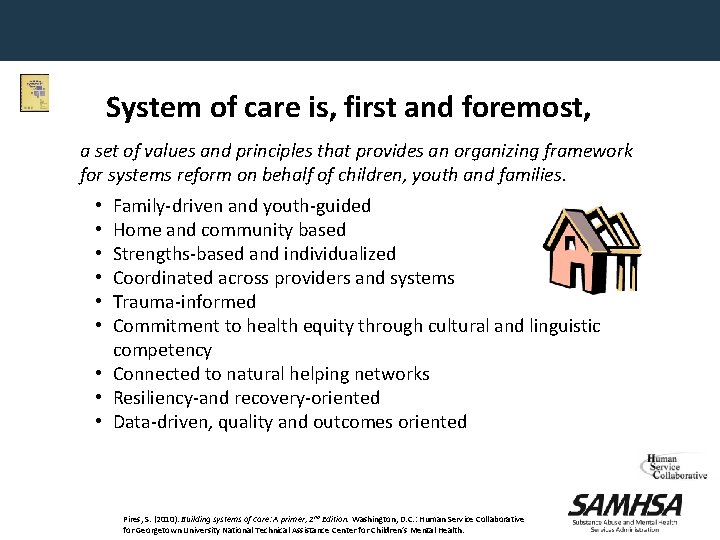
System of care is, first and foremost, a set of values and principles that provides an organizing framework for systems reform on behalf of children, youth and families. Family-driven and youth-guided Home and community based Strengths-based and individualized Coordinated across providers and systems Trauma-informed Commitment to health equity through cultural and linguistic competency • Connected to natural helping networks • Resiliency-and recovery-oriented • Data-driven, quality and outcomes oriented • • • Pires, S. (2010). Building systems of care: A primer, 2 nd Edition. Washington, D. C. : Human Service Collaborative for Georgetown University National Technical Assistance Center for Children’s Mental Health.
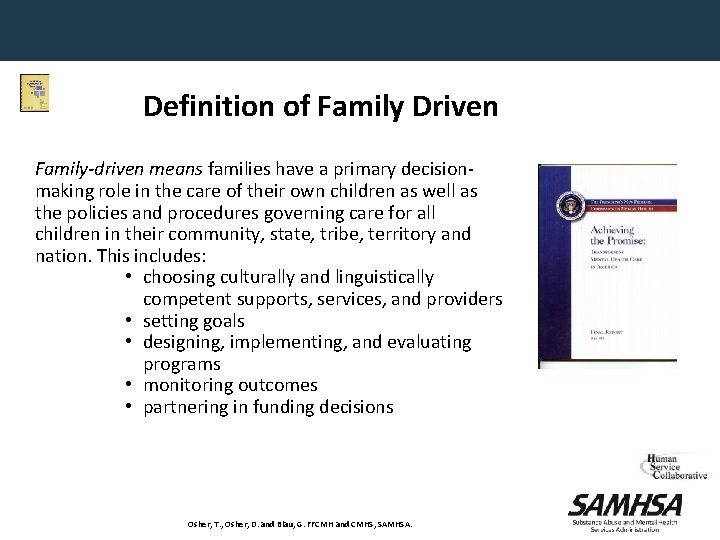
Definition of Family Driven Family-driven means families have a primary decisionmaking role in the care of their own children as well as the policies and procedures governing care for all children in their community, state, tribe, territory and nation. This includes: • choosing culturally and linguistically competent supports, services, and providers • setting goals • designing, implementing, and evaluating programs • monitoring outcomes • partnering in funding decisions Osher, T. , Osher, D. and Blau, G. FFCMH and CMHS, SAMHSA.
Definition of Youth Guided “Youth Guided means to value youth as experts, respect their voice, and to treat them as equal partners in creating system change at the individual, state, and national level. ” www. youthmovenational. org
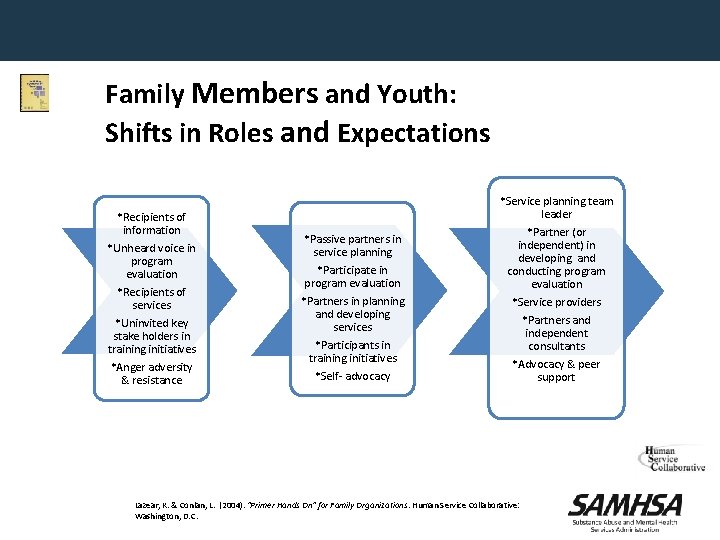
Family Members and Youth: Shifts in Roles and Expectations *Recipients of information *Unheard voice in program evaluation *Recipients of services *Uninvited key stake holders in training initiatives *Anger adversity & resistance *Service planning team leader *Passive partners in service planning *Participate in program evaluation *Partners in planning and developing services *Participants in training initiatives *Self- advocacy *Partner (or independent) in developing and conducting program evaluation *Service providers *Partners and independent consultants *Advocacy & peer support Lazear, K. & Conlan, L. (2004). “Primer Hands On” for Family Organizations. Human Service Collaborative: Washington, D. C.
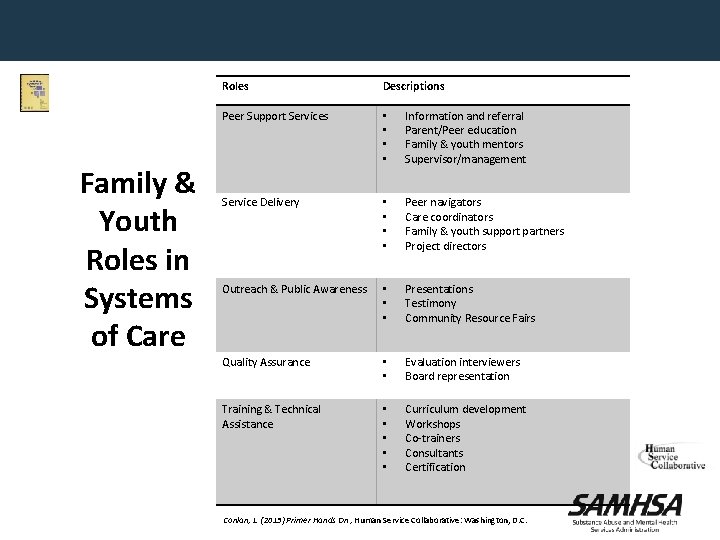
Family & Youth Roles in Systems of Care Roles Descriptions Peer Support Services • • Information and referral Parent/Peer education Family & youth mentors Supervisor/management Service Delivery • • Peer navigators Care coordinators Family & youth support partners Project directors Outreach & Public Awareness • • • Presentations Testimony Community Resource Fairs Quality Assurance • • Evaluation interviewers Board representation Training & Technical Assistance • • • Curriculum development Workshops Co-trainers Consultants Certification Conlan, L. (2013) Primer Hands On , Human Service Collaborative: Washington, D. C.
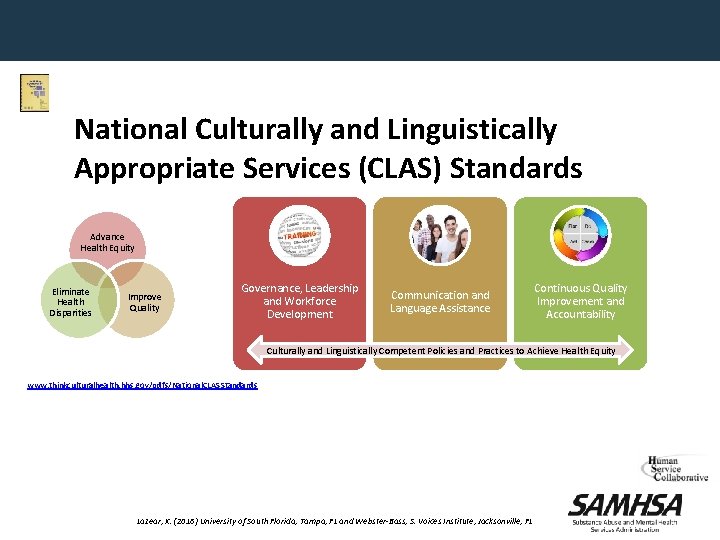
National Culturally and Linguistically Appropriate Services (CLAS) Standards Advance Health Equity Eliminate Health Disparities Improve Quality Governance, Leadership and Workforce Development Communication and Language Assistance Continuous Quality Improvement and Accountability Culturally and Linguistically Competent Policies and Practices to Achieve Health Equity www. thinkculturalhealth. hhs. gov/pdfs/National. CLASStandards Lazear, K. (2016) University of South Florida, Tampa, FL and Webster-Bass, S. Voices Institute, Jacksonville, FL
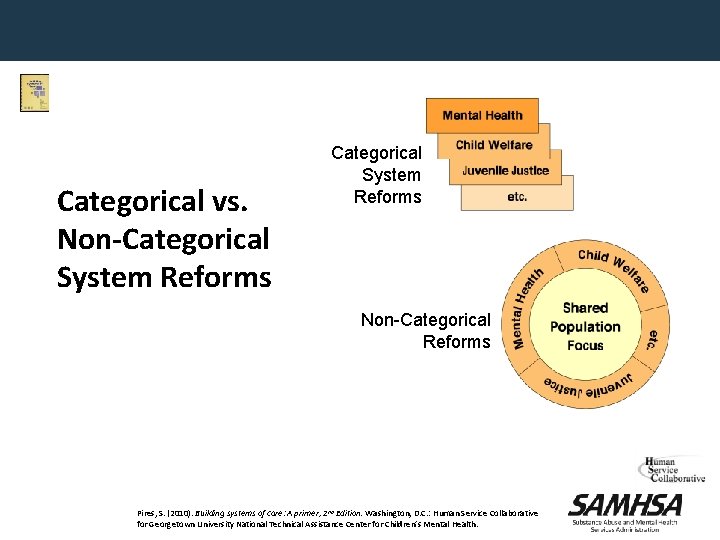
Categorical vs. Non-Categorical System Reforms Non-Categorical Reforms Pires, S. (2010). Building systems of care: A primer, 2 nd Edition. Washington, D. C. : Human Service Collaborative for Georgetown University National Technical Assistance Center for Children’s Mental Health.
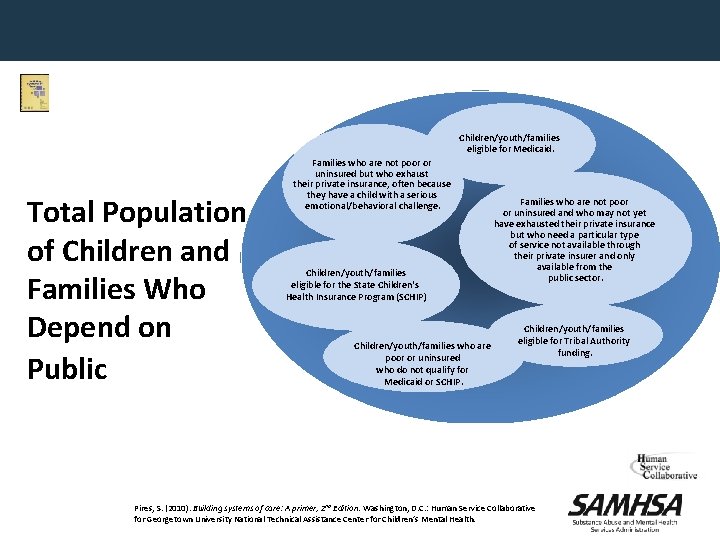
Children/youth/families eligible for Medicaid. Total Population of Children and Families Who Depend on Public Systems Families who are not poor or uninsured but who exhaust their private insurance, often because they have a child with a serious emotional/behavioral challenge. Children/youth/families eligible for the State Children's Health Insurance Program (SCHIP) Children/youth/families who are poor or uninsured who do not qualify for Medicaid or SCHIP. Families who are not poor or uninsured and who may not yet have exhausted their private insurance but who need a particular type of service not available through their private insurer and only available from the public sector. Children/youth/families eligible for Tribal Authority funding. Pires, S. (2010). Building systems of care: A primer, 2 nd Edition. Washington, D. C. : Human Service Collaborative for Georgetown University National Technical Assistance Center for Children’s Mental Health.
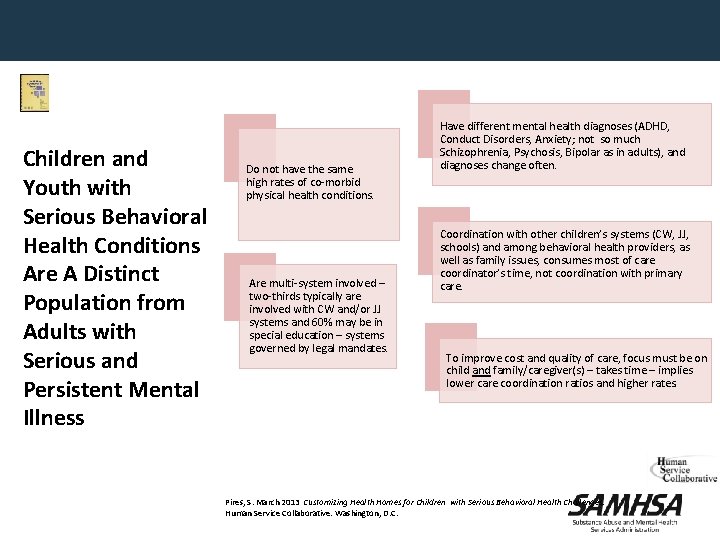
Children and Youth with Serious Behavioral Health Conditions Are A Distinct Population from Adults with Serious and Persistent Mental Illness Do not have the same high rates of co-morbid physical health conditions. Are multi-system involved – two-thirds typically are involved with CW and/or JJ systems and 60% may be in special education – systems governed by legal mandates. Have different mental health diagnoses (ADHD, Conduct Disorders, Anxiety; not so much Schizophrenia, Psychosis, Bipolar as in adults), and diagnoses change often. Coordination with other children’s systems (CW, JJ, schools) and among behavioral health providers, as well as family issues, consumes most of care coordinator’s time, not coordination with primary care. To improve cost and quality of care, focus must be on child and family/caregiver(s) – takes time – implies lower care coordination ratios and higher rates. Pires, S. March 2013 Customizing Health Homes for Children with Serious Behavioral Health Challenges. Human Service Collaborative. Washington, D. C.
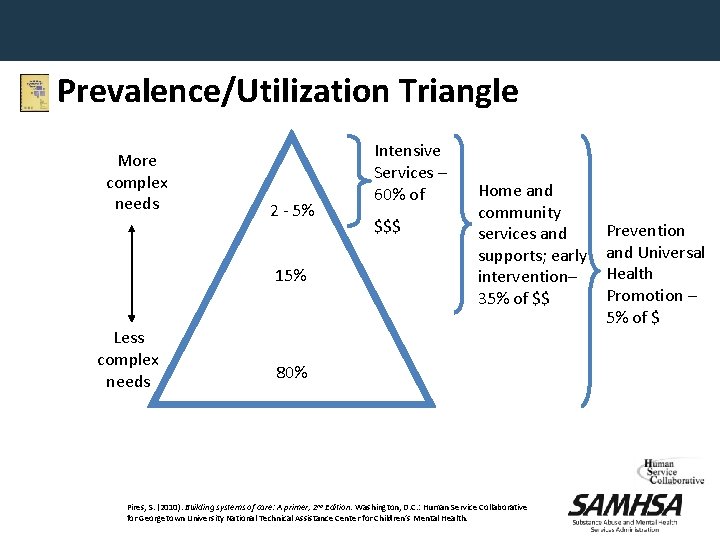
Prevalence/Utilization Triangle More complex needs 2 - 5% 15% Less complex needs Intensive Services – 60% of $$$ Home and community services and supports; early intervention– 35% of $$ 80% Pires, S. (2010). Building systems of care: A primer, 2 nd Edition. Washington, D. C. : Human Service Collaborative for Georgetown University National Technical Assistance Center for Children’s Mental Health. Prevention and Universal Health Promotion – 5% of $
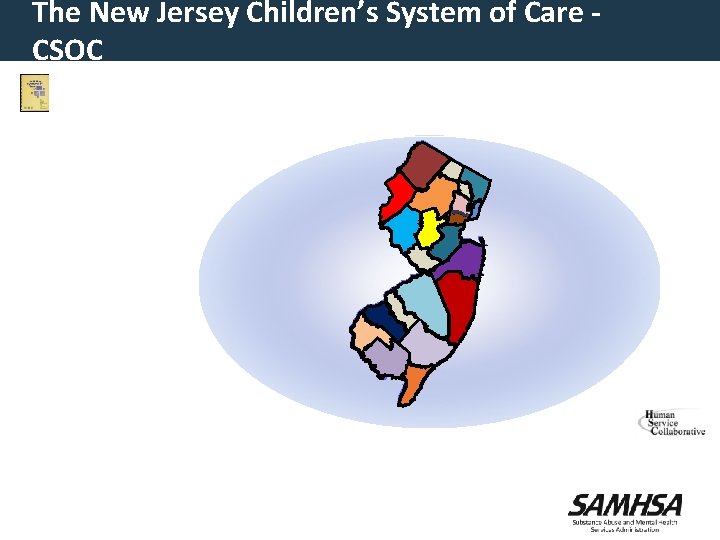
The New Jersey Children’s System of Care CSOC
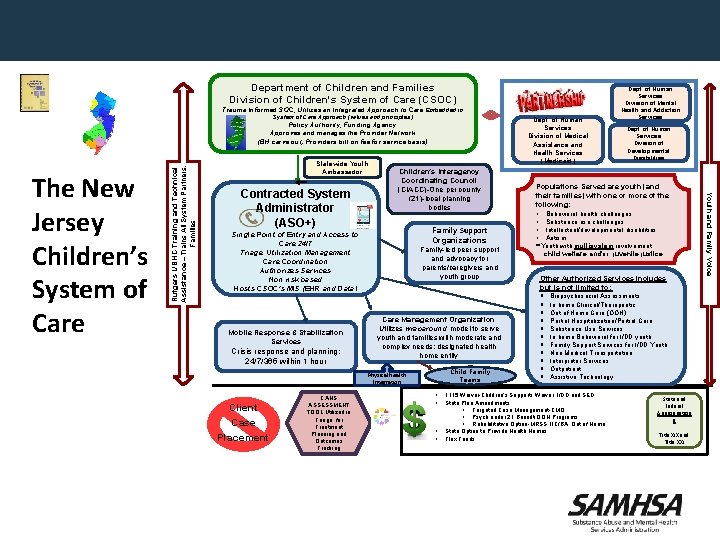
Department of Children and Families Division of Children's System of Care (CSOC) Trauma Informed SOC, Utilizes an Integrated Approach to Care Embedded in System of Care Approach (values and principles) Dept. of Human Services Division of Medical Assistance and Health Services (Medicaid) Statewide Youth Ambassador Contracted System Administrator (ASO+) Children’s Interagency Coordinating Council (CIACC)-One per county (21)-local planning bodies Family Support Organizations Single Point of Entry and Access to Care 24/7 Triage, Utilization Management Care Coordination Authorizes Services Non risk based Hosts CSOC’s MIS (EHR and Data) Mobile Response & Stabilization Services Crisis response and planning; 24/7/365 within 1 hour Family-led peer support and advocacy for parents/caregivers and youth group Care Management Organization Utilizes wraparound model to serve youth and families with moderate and complex needs; designated health home entity Child Family Teams Physical Health Integration Client Case Placement CANS ASSESSMENT TOOL Utilized in Triage, for Treatment Planning and Outcomes Tracking • • Dept. of Human Services Division of Developmental Disabilities Populations Served are youth (and their families) with one or more of the following: • Behavioral health challenges • Substance use challenges • Intellectual/developmental disabilities • Autism **Youth with multisystem involvement: child welfare and/or juvenile justice Other Authorized Services includes but is not limited to: § Biopsychosocial Assessments § In home Clinical/Therapeutic § Out of Home Care (OOH) § Partial Hospitalization/Partial Care § Substance Use Services § In home Behavioral for I/DD youth § Family Support Services for I/DD Youth § Non Medical Transportation § Interpreter Services § Outpatient § Assistive Technology 1115 Waiver-Children’s Supports Waiver, I/DD and SED State Plan Amendments • Targeted Case Management-CMO • Psych under 21 Benefit-OOH Programs • Rehabilitative Option-MRSS, IIC/BA, Out of Home State Option to Provide Health Homes Flex Funds State and Federal Appropriation s Title XIX and Title XXI Youth and Family Voice The New Jersey Children’s System of Care Rutgers UBHC Training and Technical Assistance --Trains All System Partners, Families Policy Authority, Funding Agency Approves and manages the Provider Network (BH carve out; Providers bill on fee for service basis) Dept. of Human Services Division of Mental Health and Addiction Services
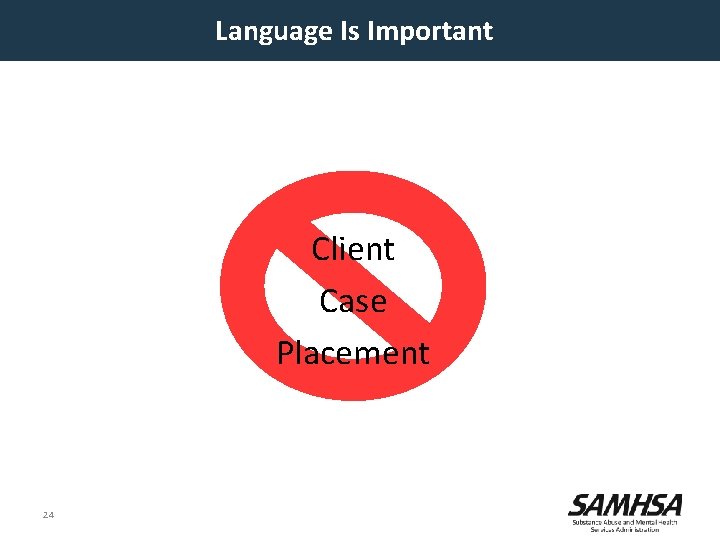
Language Is Important Client Case Placement 24
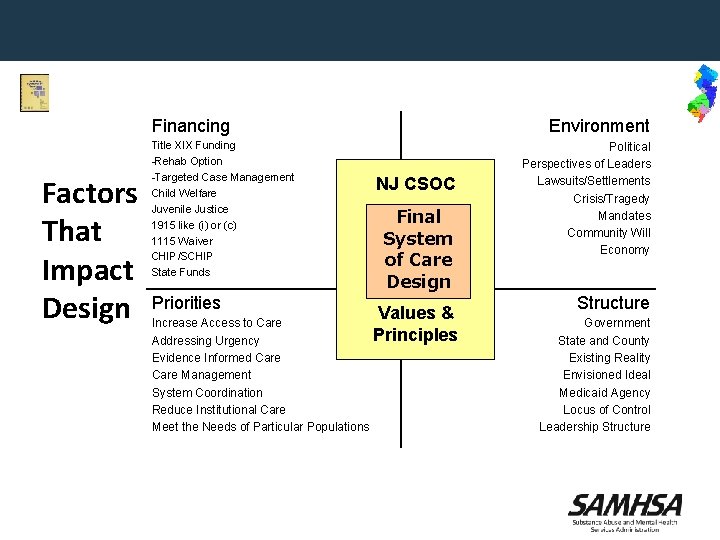
Financing Factors That Impact Design Title XIX Funding -Rehab Option -Targeted Case Management Child Welfare Juvenile Justice 1915 like (i) or (c) 1115 Waiver CHIP/SCHIP State Funds Priorities Increase Access to Care Addressing Urgency Evidence Informed Care Management System Coordination Reduce Institutional Care Meet the Needs of Particular Populations Environment NJ CSOC Final System of Care Design Values & Principles Political Perspectives of Leaders Lawsuits/Settlements Crisis/Tragedy Mandates Community Will Economy Structure Government State and County Existing Reality Envisioned Ideal Medicaid Agency Locus of Control Leadership Structure
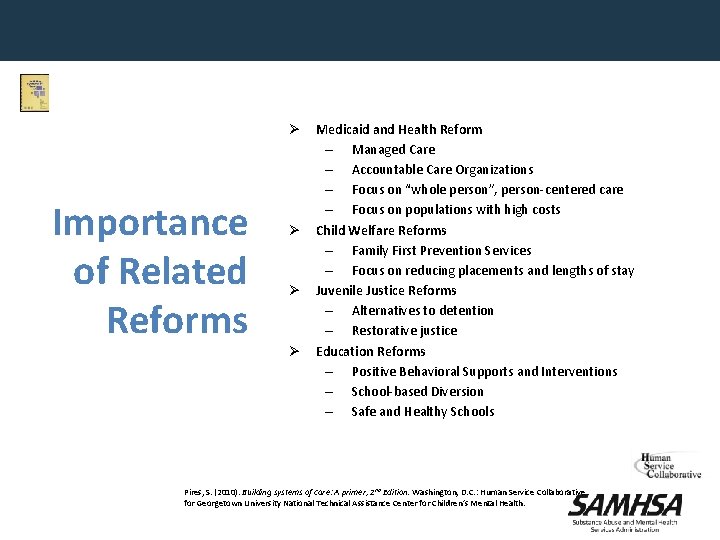
Ø Importance of Related Reforms Ø Ø Ø Medicaid and Health Reform – Managed Care – Accountable Care Organizations – Focus on “whole person”, person-centered care – Focus on populations with high costs Child Welfare Reforms – Family First Prevention Services – Focus on reducing placements and lengths of stay Juvenile Justice Reforms – Alternatives to detention – Restorative justice Education Reforms – Positive Behavioral Supports and Interventions – School-based Diversion – Safe and Healthy Schools Pires, S. (2010). Building systems of care: A primer, 2 nd Edition. Washington, D. C. : Human Service Collaborative for Georgetown University National Technical Assistance Center for Children’s Mental Health.
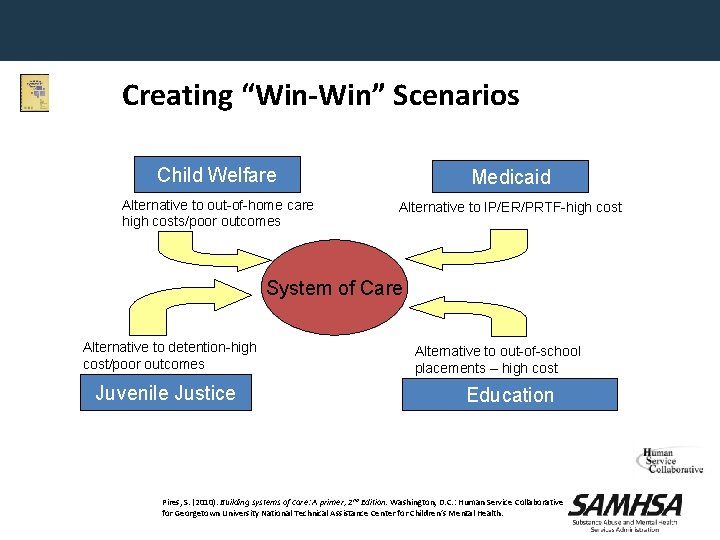
Creating “Win-Win” Scenarios Child Welfare Medicaid Alternative to out-of-home care high costs/poor outcomes Alternative to IP/ER/PRTF-high cost System of Care Alternative to detention-high cost/poor outcomes Juvenile Justice Alternative to out-of-school placements – high cost Education Pires, S. (2010). Building systems of care: A primer, 2 nd Edition. Washington, D. C. : Human Service Collaborative for Georgetown University National Technical Assistance Center for Children’s Mental Health.
Planning and Governance
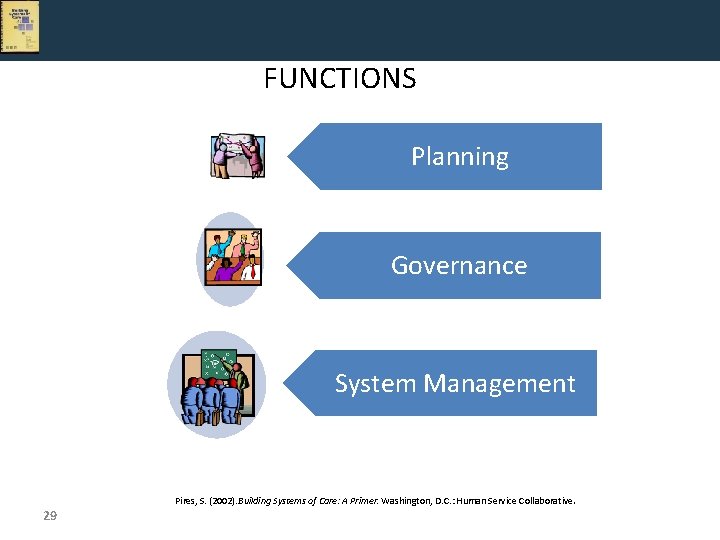
FUNCTIONS Planning Governance System Management 29 Pires, S. (2002). Building Systems of Care: A Primer. Washington, D. C. : Human Service Collaborative.
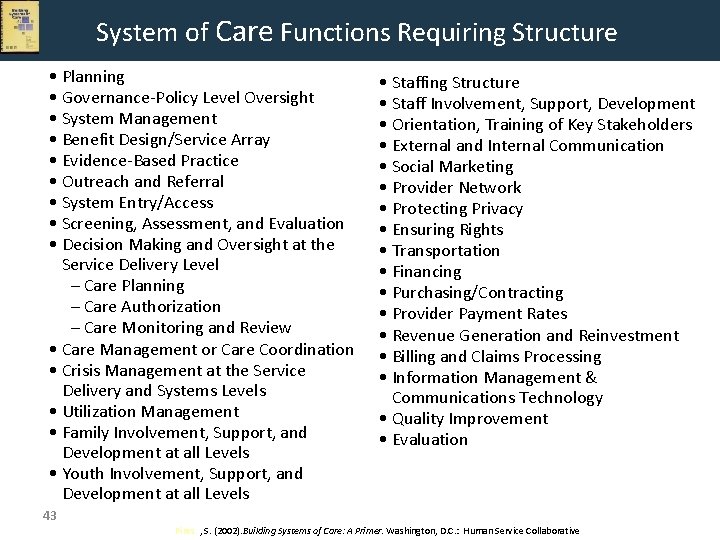
System of Care Functions Requiring Structure • Planning • Governance-Policy Level Oversight • System Management • Benefit Design/Service Array • Evidence-Based Practice • Outreach and Referral • System Entry/Access • Screening, Assessment, and Evaluation • Decision Making and Oversight at the Service Delivery Level – Care Planning – Care Authorization – Care Monitoring and Review • Care Management or Care Coordination • Crisis Management at the Service Delivery and Systems Levels • Utilization Management • Family Involvement, Support, and Development at all Levels • Youth Involvement, Support, and Development at all Levels 43 • Staffing Structure • Staff Involvement, Support, Development • Orientation, Training of Key Stakeholders • External and Internal Communication • Social Marketing • Provider Network • Protecting Privacy • Ensuring Rights • Transportation • Financing • Purchasing/Contracting • Provider Payment Rates • Revenue Generation and Reinvestment • Billing and Claims Processing • Information Management & Communications Technology • Quality Improvement • Evaluation • System Exit • Technical Assistance and Consultation • Cultural and Linguistic Competence Pires. , S. (2002). Building Systems of Care: A Primer. Washington, D. C. : Human Service Collaborative
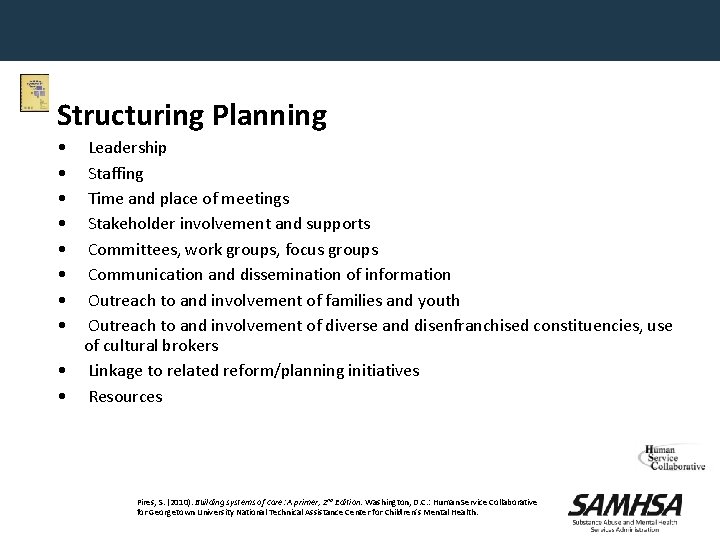
Structuring Planning • • Leadership Staffing Time and place of meetings Stakeholder involvement and supports Committees, work groups, focus groups Communication and dissemination of information Outreach to and involvement of families and youth Outreach to and involvement of diverse and disenfranchised constituencies, use of cultural brokers • Linkage to related reform/planning initiatives • Resources Pires, S. (2010). Building systems of care: A primer, 2 nd Edition. Washington, D. C. : Human Service Collaborative for Georgetown University National Technical Assistance Center for Children’s Mental Health.
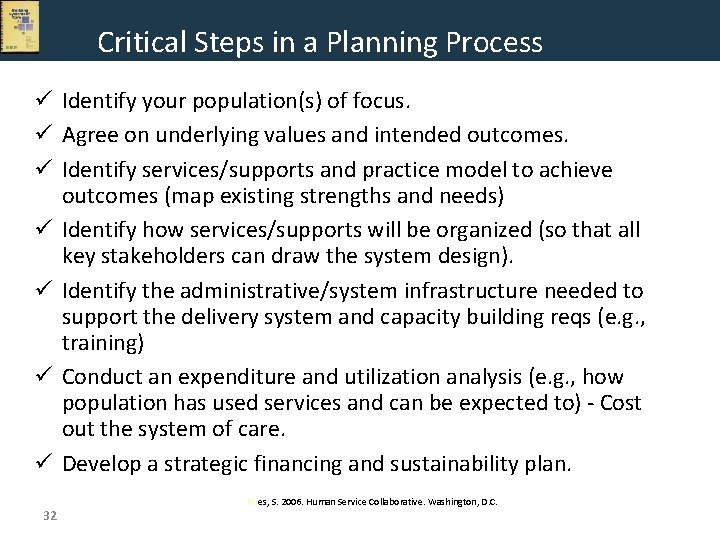
Critical Steps in a Planning Process ü Identify your population(s) of focus. ü Agree on underlying values and intended outcomes. ü Identify services/supports and practice model to achieve outcomes (map existing strengths and needs) ü Identify how services/supports will be organized (so that all key stakeholders can draw the system design). ü Identify the administrative/system infrastructure needed to support the delivery system and capacity building reqs (e. g. , training) ü Conduct an expenditure and utilization analysis (e. g. , how population has used services and can be expected to) - Cost out the system of care. ü Develop a strategic financing and sustainability plan. 32 Pires, S. 2006. Human Service Collaborative. Washington, D. C.
Governance Decision making at a policy level that has legitimacy, authority, and accountability. System Management Day-to-day operational decision making Pires, S. (1995). Definition of governance. Washington, DC: Human Service Collaborative. 33
Key Issues for Governing Bodies • Has authority to govern • • • 34 Is clear about what it is governing Is representative Has the capacity to govern Has the credibility to govern Assumes shared accountability across systems for population(s) of focus Pires, S. (2000). Key issues for governing bodies. Washington, DC: Human Service Collaborative.
System Management: Day-to-Day Operational Decision Making Key Issues • Is the reporting relationship to the governing body clear? • Are expectations clear regarding what is to be managed and what outcomes are expected? • Does the system management structure have the capacity to manage? • Does the system management structure have the credibility to manage? 35 Pires, S. (2002). Building systems of care: A primer. Washington, D. C. : Human Service Collaborative.
Family and Youth Partnership in Governance and System Management • Input/evaluation of key management • Input/evaluation of quality of services and programs • Local system of care input • Input into resource allocation decisions • Service planning and implementation • Policies and procedures • Grievance and resolution procedures 36 Conlan, L. (2003). Implementing family involvement. Burlington, VT: Vermont Federation of Families for Children’s Mental Health.
Structuring the Array of Services and Supports
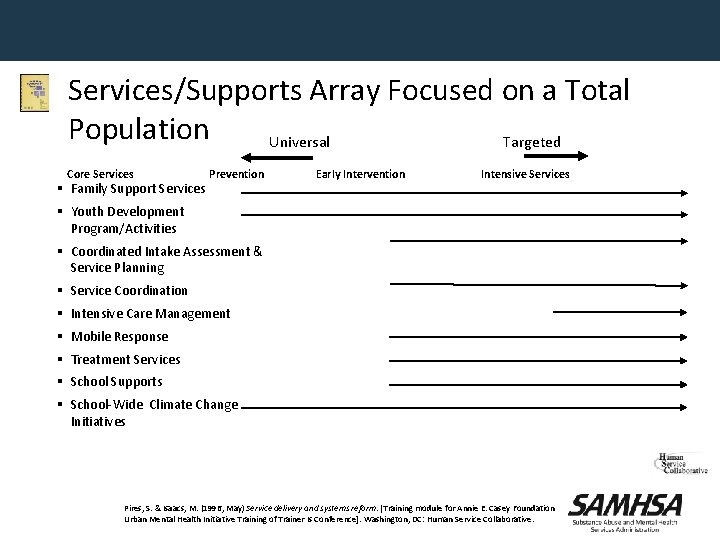
Services/Supports Array Focused on a Total Population Universal Targeted Core Services § Family Support Services Prevention Early Intervention Intensive Services § Youth Development Program/Activities § Coordinated Intake Assessment & Service Planning § Service Coordination § Intensive Care Management § Mobile Response § Treatment Services § School Supports § School-Wide Climate Change Initiatives Pires, S. & Isaacs, M. (1996, May) Service delivery and systems reform. [Training module for Annie E. Casey Foundation Urban Mental Health Initiative Training of Trainer Is Conference]. Washington, DC: Human Service Collaborative.
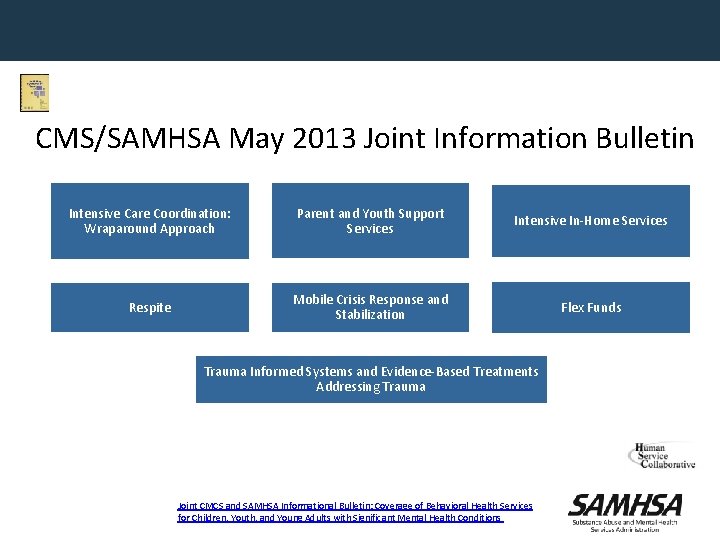
CMS/SAMHSA May 2013 Joint Information Bulletin Intensive Care Coordination: Wraparound Approach Parent and Youth Support Services Intensive In-Home Services Respite Mobile Crisis Response and Stabilization Flex Funds Trauma Informed Systems and Evidence-Based Treatments Addressing Trauma Joint CMCS and SAMHSA Informational Bulletin: Coverage of Behavioral Health Services for Children, Youth, and Young Adults with Significant Mental Health Conditions
Home and Community-Based Services, Peer and Recovery Supports, Evidence-Informed Practices, Trauma-Informed Approaches Emphasized in. . – – – Medicaid: CMCS/SAMHSA May 7 2013 and January 26 2015 Joint Information Bulletins IV-E (Child Welfare) Waivers and Family First Prevention Act Juvenile Detention Alternatives Federal Discretionary Grant Programs EPSDT (Medicaid) and Child Welfare Lawsuits
Service Array Considerations Trauma-Informed Systems and Evidence-Based Trauma Treatments • Increased awareness of the impact of trauma • Children and youth with most challenging mental health needs often have experienced significant trauma Telehealth and Mobile Technology • Using communications technology to provide access to • health/behavioral health assessment, diagnosis, intervention, • consultation, supervision, education, care coordination and • peer support across distance Managing and Adapting Practice Systemic approach to raising the quality of “usual care” 41
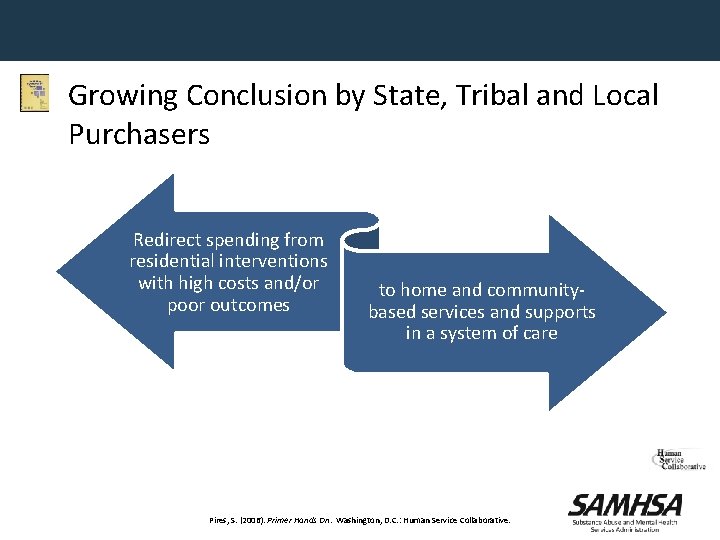
Growing Conclusion by State, Tribal and Local Purchasers Redirect spending from residential interventions with high costs and/or poor outcomes to home and communitybased services and supports in a system of care Pires, S. (2006). Primer Hands On. Washington, D. C. : Human Service Collaborative.
Implications for Residential Interventions • Movement away from “placement” orientation and long lengths of stay • Residential as part of an integrated continuum, connected to community • Shared decision making with families/youth and other providers and agencies • Individualized treatment approaches through a child and family team process • Trauma-informed care For more information, go to Building Bridges Initiative: www. buildingbridges 4 youth. org Data Trends #127, February 2006, University of South Florida.
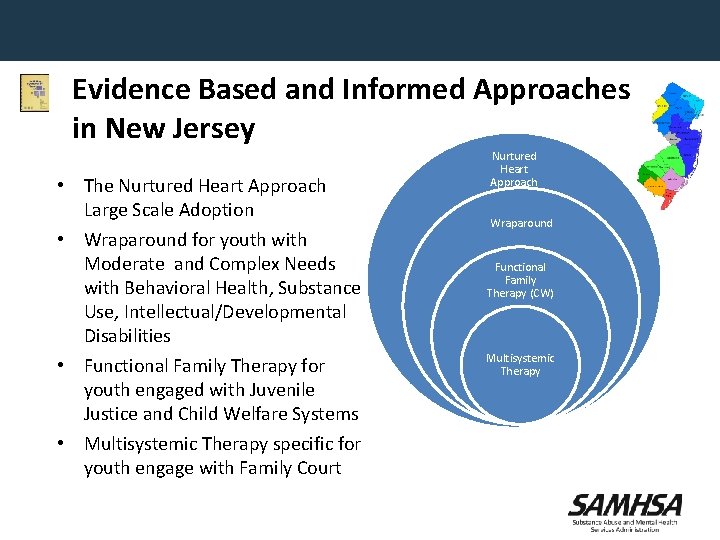
Evidence Based and Informed Approaches in New Jersey • The Nurtured Heart Approach Large Scale Adoption • Wraparound for youth with Moderate and Complex Needs with Behavioral Health, Substance Use, Intellectual/Developmental Disabilities • Functional Family Therapy for youth engaged with Juvenile Justice and Child Welfare Systems • Multisystemic Therapy specific for youth engage with Family Court Nurtured Heart Approach Wraparound Functional Family Therapy (CW) Multisystemic Therapy
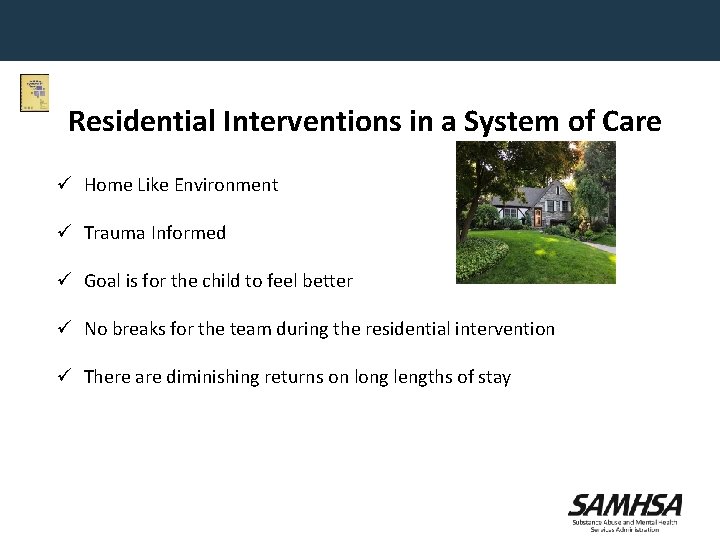
Residential Interventions in a System of Care ü Home Like Environment ü Trauma Informed ü Goal is for the child to feel better ü No breaks for the team during the residential intervention ü There are diminishing returns on long lengths of stay
Structuring Care Coordination
Unmet Need • Unmet need for care coordination is high for children and youth with mental health conditions American Academy of Pediatrics (Brown, N. et. al. 2013) • Family-centered care can be mitigating
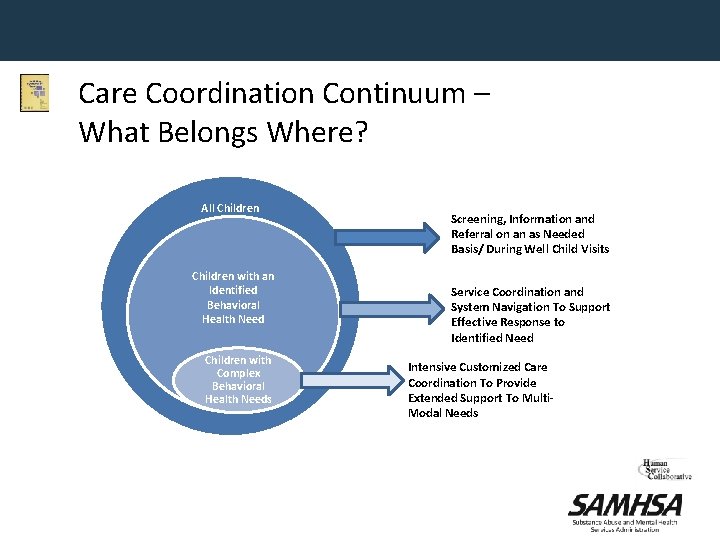
Care Coordination Continuum – What Belongs Where? All Children with an Identified Behavioral Health Need Children with Complex Behavioral Health Needs Screening, Information and Referral on an as Needed Basis/ During Well Child Visits Service Coordination and System Navigation To Support Effective Response to Identified Need Intensive Customized Care Coordination To Provide Extended Support To Multi. Modal Needs
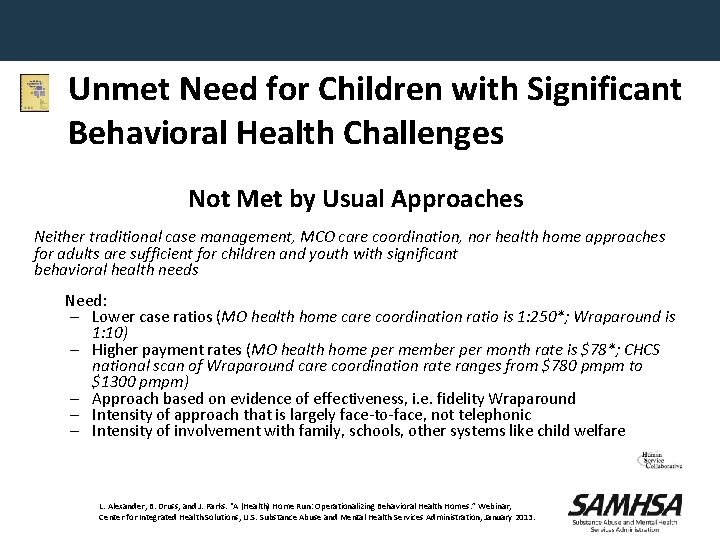
Unmet Need for Children with Significant Behavioral Health Challenges Not Met by Usual Approaches Neither traditional case management, MCO care coordination, nor health home approaches for adults are sufficient for children and youth with significant behavioral health needs Need: – Lower case ratios (MO health home care coordination ratio is 1: 250*; Wraparound is 1: 10) – Higher payment rates (MO health home per member per month rate is $78*; CHCS national scan of Wraparound care coordination rate ranges from $780 pmpm to $1300 pmpm) – Approach based on evidence of effectiveness, i. e. fidelity Wraparound – Intensity of approach that is largely face-to-face, not telephonic – Intensity of involvement with family, schools, other systems like child welfare L. Alexander, B. Druss, and J. Parks. “A (Health) Home Run: Operationalizing Behavioral Health Homes. ” Webinar, Center for Integrated Health Solutions, U. S. Substance Abuse and Mental Health Services Administration, January 2013.
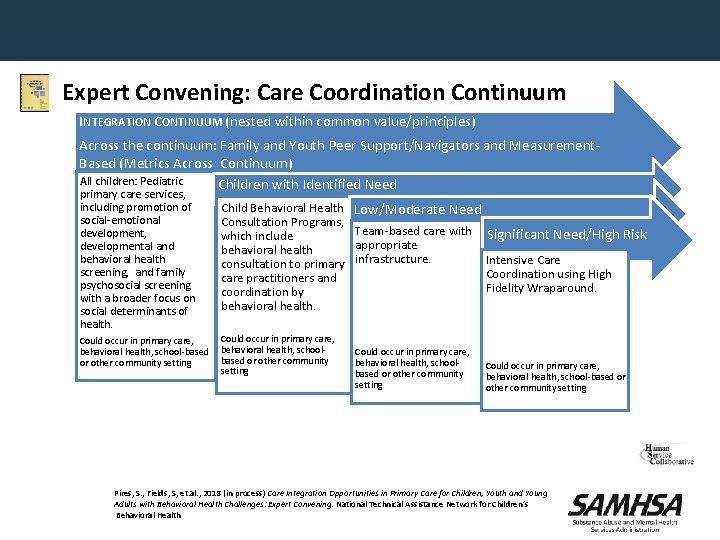
Expert Convening: Care Coordination Continuum INTEGRATION CONTINUUM (nested within common value/principles) Across the continuum: Family and Youth Peer Support/Navigators and Measurement. Based (Metrics Across Continuum) All children: Pediatric Children with Identified Need primary care services, including promotion of social-emotional development, developmental and behavioral health screening, and family psychosocial screening with a broader focus on social determinants of health. Child Behavioral Health Consultation Programs, which include behavioral health consultation to primary care practitioners and coordination by behavioral health. Could occur in primary care, behavioral health, school-based or other community setting Could occur in primary care, behavioral health, schoolbased or other community setting Low/Moderate Need Team-based care with appropriate infrastructure. Could occur in primary care, behavioral health, schoolbased or other community setting Significant Need/High Risk Intensive Care Coordination using High Fidelity Wraparound. Could occur in primary care, behavioral health, school-based or other community setting Pires, S. , Fields, S, et. al. , 2018 (in process) Care Integration Opportunities in Primary Care for Children, Youth and Young Adults with Behavioral Health Challenges: Expert Convening. National Technical Assistance Network for Children’s Behavioral Health
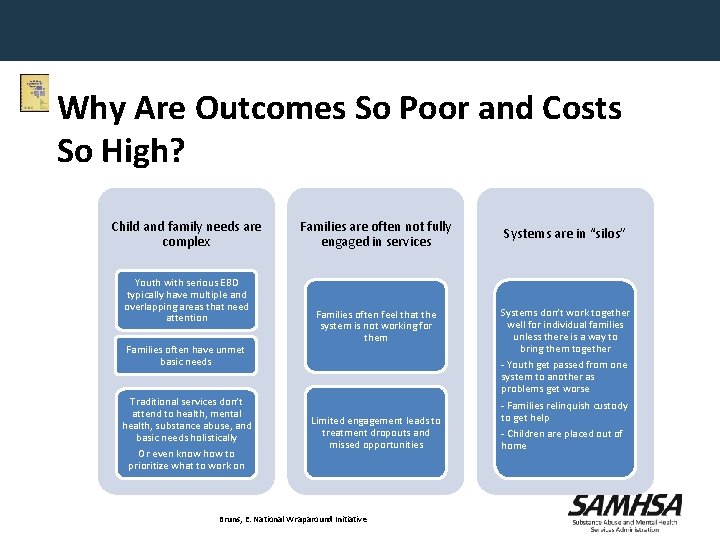
Why Are Outcomes So Poor and Costs So High? Youth with serious EBD typically have multiple and overlapping areasneeds are Child and family that need attention complex Youth with serious EBD typically have multiple and overlapping areas that need attention Families often have unmet basic needs Traditional services don’t attend to health, mental health, substance abuse, and basic needs holistically Or even know how to prioritize what to work on Families are often not fully engaged in services Families often feel that the system is not working for them Limited engagement leads to treatment dropouts and missed opportunities Bruns, E. National Wraparound Initiative Systems are in “silos” Systems don’t work together well for individual families unless there is a way to bring them together - Youth get passed from one system to another as problems get worse - Families relinquish custody to get help - Children are placed out of home
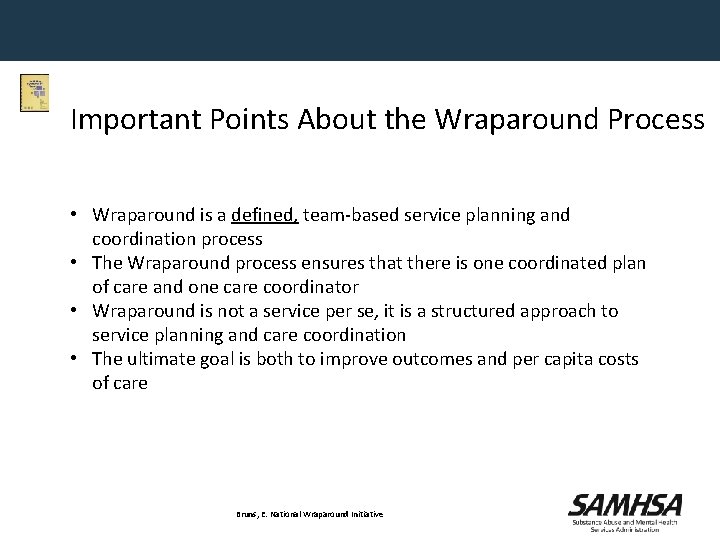
Important Points About the Wraparound Process • Wraparound is a defined, team-based service planning and coordination process • The Wraparound process ensures that there is one coordinated plan of care and one care coordinator • Wraparound is not a service per se, it is a structured approach to service planning and care coordination • The ultimate goal is both to improve outcomes and per capita costs of care Bruns, E. National Wraparound Initiative
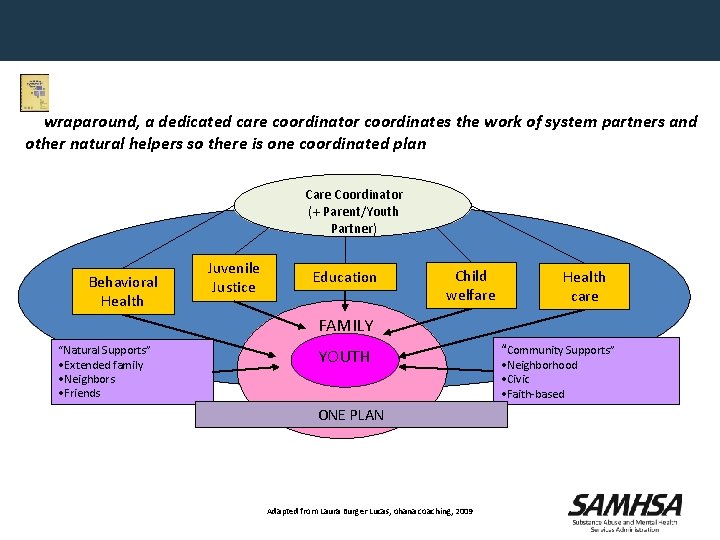
In wraparound, a dedicated care coordinator coordinates the work of system partners and other natural helpers so there is one coordinated plan Care Coordinator (+ Parent/Youth Partner) Behavioral Health Juvenile Justice Education Child welfare Health care FAMILY “Natural Supports” • Extended family • Neighbors • Friends YOUTH ONE PLAN Adapted from Laura Burger Lucas, ohana coaching, 2009 “Community Supports” • Neighborhood • Civic • Faith-based
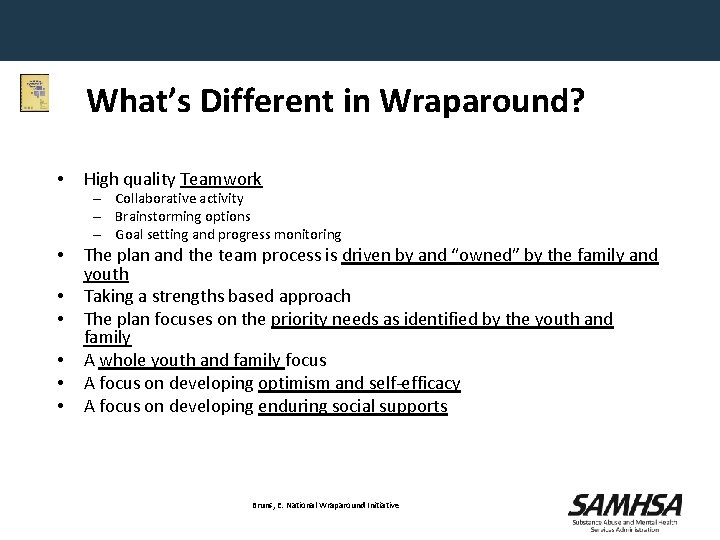
What’s Different in Wraparound? • High quality Teamwork – Collaborative activity – Brainstorming options – Goal setting and progress monitoring • • • The plan and the team process is driven by and “owned” by the family and youth Taking a strengths based approach The plan focuses on the priority needs as identified by the youth and family A whole youth and family focus A focus on developing optimism and self-efficacy A focus on developing enduring social supports Bruns, E. National Wraparound Initiative
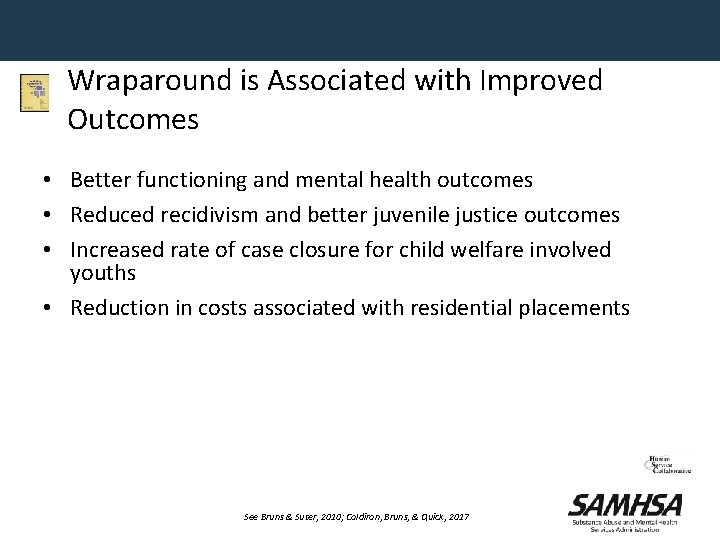
Wraparound is Associated with Improved Outcomes • Better functioning and mental health outcomes • Reduced recidivism and better juvenile justice outcomes • Increased rate of case closure for child welfare involved youths • Reduction in costs associated with residential placements See Bruns & Suter, 2010; Coldiron, Bruns, & Quick, 2017
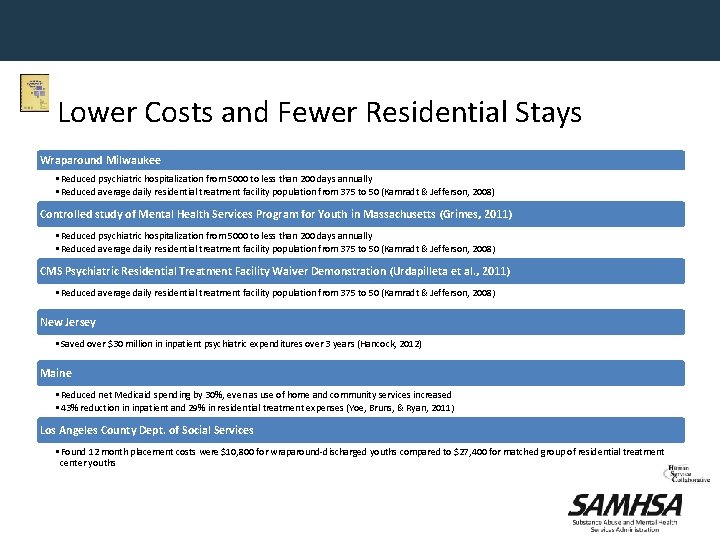
Lower Costs and Fewer Residential Stays Wraparound Milwaukee • Reduced psychiatric hospitalization from 5000 to less than 200 days annually • Reduced average daily residential treatment facility population from 375 to 50 (Kamradt & Jefferson, 2008) Controlled study of Mental Health Services Program for Youth in Massachusetts (Grimes, 2011) • Reduced psychiatric hospitalization from 5000 to less than 200 days annually • Reduced average daily residential treatment facility population from 375 to 50 (Kamradt & Jefferson, 2008) CMS Psychiatric Residential Treatment Facility Waiver Demonstration (Urdapilleta et al. , 2011) • Reduced average daily residential treatment facility population from 375 to 50 (Kamradt & Jefferson, 2008) New Jersey • Saved over $30 million in inpatient psychiatric expenditures over 3 years (Hancock, 2012) Maine • Reduced net Medicaid spending by 30%, even as use of home and community services increased • 43% reduction in inpatient and 29% in residential treatment expenses (Yoe, Bruns, & Ryan, 2011 ) Los Angeles County Dept. of Social Services • Found 12 month placement costs were $10, 800 for wraparound-discharged youths compared to $27, 400 for matched group of residential treatment center youths
However, Outcomes Depend on Implementation Studies indicate that Wraparound teams often fail to: – Engage key individuals in the Wraparound team – Connect youth in community activities and things they do well; activities to help develop friendships – Use family/community strengths – Incorporate natural supports, such as extended family members and community members – Use evidence-based clinical strategies to meet needs – Continuously assess progress, satisfaction, and outcomes Bruns, E. NWI
“Full Fidelity” is Critical • Research shows – Provider staff whose families experience better outcomes score higher on fidelity tools (Bruns, Rast et al. , 2006) – Wraparound initiatives with positive fidelity assessments demonstrate more positive outcomes (Bruns, Leverentz-Brady, & Suter, 2008) • Much of wraparound implementation is in name only – Don’t invest in workforce development such as training and coaching to accreditation – Don’t follow the research-based practice model – Don’t monitor fidelity and outcomes and use the data for CQI – Don’t have the necessary support conditions to succeed (e. g. , fiscal supports, comprehensive service array) Bruns, E. NWI
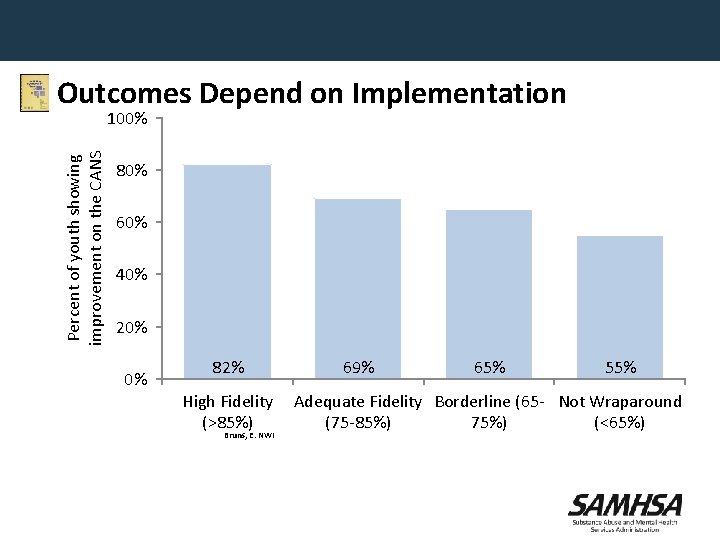
Outcomes Depend on Implementation Percent of youth showing improvement on the CANS 100% 80% 60% 40% 20% 0% 82% High Fidelity (>85%) Bruns, E. NWI 69% 65% 55% Adequate Fidelity Borderline (65 - Not Wraparound (75 -85%) 75%) (<65%)
National Standards are grounded in a strong foundation of implementation science research and based on research evidence. Across seven implementation related areas there are 43 indicators with definitions that can be used as a self assessment as well as monitoring of quality indicators throughout the implementation process. Outcomes are highly dependent on program and system factors – Eligibility (do we have the right population? ) – Funding (do we have the right rate? ) – Staffing ratios (1: 10) – Workforce development (hiring, training and skill development) – System policies that create climates and cultures that support practice implementation efforts and providers 60 Wraparound Implementation and Practice Quality Standards (Coldiron, Bruns, Hensley, & Paragoris, 2016) created to support analysis of crucial factors associated with success.
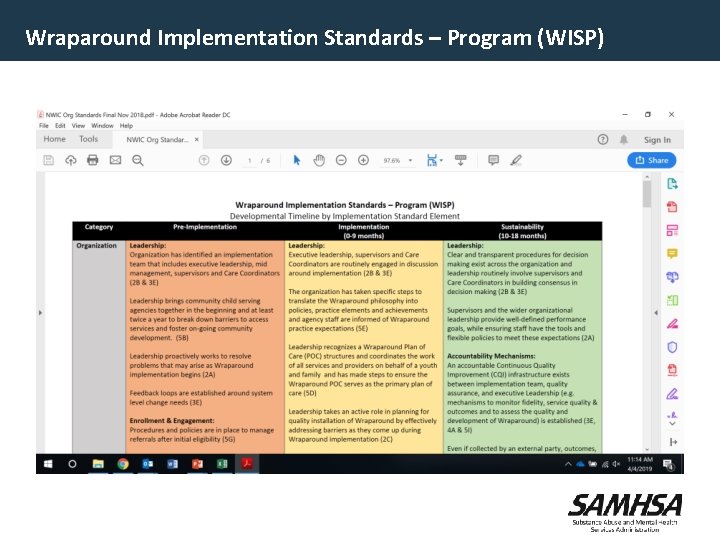
Wraparound Implementation Standards – Program (WISP)
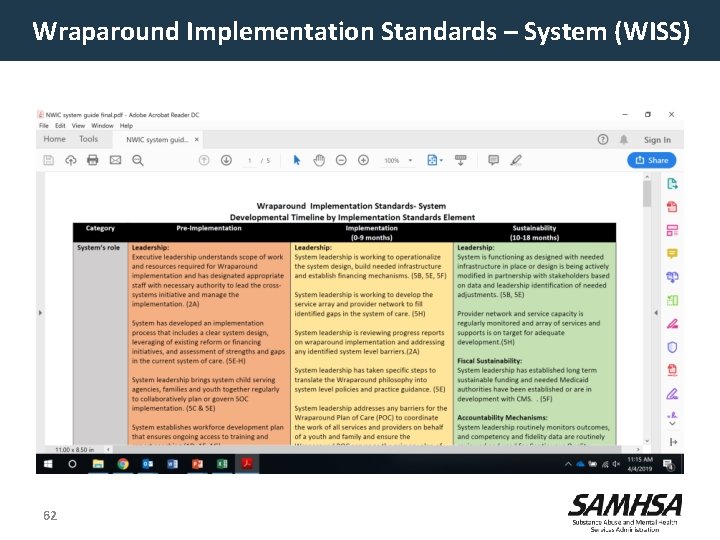
Wraparound Implementation Standards – System (WISS) 62
Family & Youth Partners • • Build relationship based on mutuality and trust Promote self-advocacy: voice & choice Identify and build natural supports Bridge of communication with providers Service navigation and securing community resources Connect to support groups and education-skills based trainings Assist with completing care plan goals and action steps Celebrate accomplishments Conlan, L. 2018. Parent Support Network of Rhode Island
Workforce and Provider Network Development
Characteristics of Effective Provider Networks • Responsive to the population(s) of focus • Encompass both clinical treatment service providers and natural supports, such as mentors and respite workers • Include both traditional and non traditional, indigenous providers • Include culturally and linguistically diverse providers • Operate from multicultural, intersectionality and cultural humility perspectives • Include families and youth as providers of services and supports • Are flexible, structured in a way that allows for additions/deletions • Are accountable, structured to serve the system of care • Committed to evidence-based and promising practices • Are trauma-informed • Encompass choice for families and youth Pires, S. (2010). Building systems of care: A primer, 2 nd Edition. Washington, D. C. : Human Service Collaborative for Georgetown University National Technical Assistance Center for Children’s Mental Health
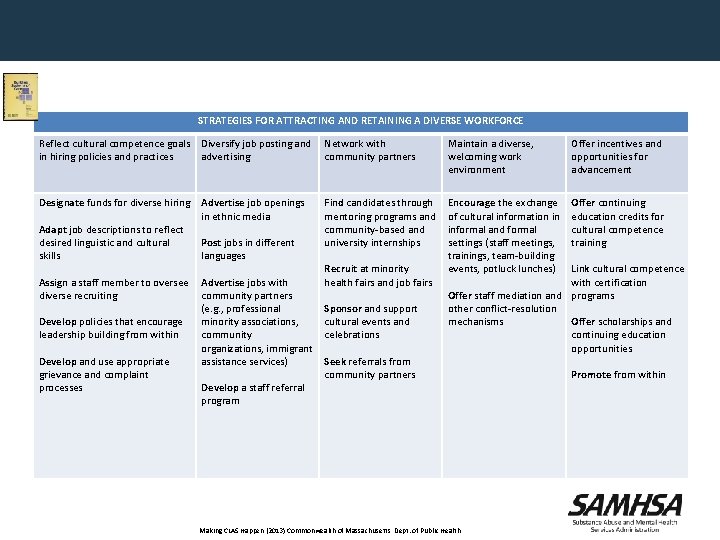
STRATEGIES FOR ATTRACTING AND RETAINING A DIVERSE WORKFORCE Reflect cultural competence goals in hiring policies and practices Diversify job posting and advertising Network with community partners Maintain a diverse, welcoming work environment Offer incentives and opportunities for advancement Designate funds for diverse hiring Advertise job openings in ethnic media Find candidates through mentoring programs and community-based and university internships Encourage the exchange of cultural information in informal and formal settings (staff meetings, trainings, team-building events, potluck lunches) Offer continuing education credits for cultural competence training Adapt job descriptions to reflect desired linguistic and cultural skills Assign a staff member to oversee diverse recruiting Develop policies that encourage leadership building from within Develop and use appropriate grievance and complaint processes Post jobs in different languages Advertise jobs with community partners (e. g. , professional minority associations, community organizations, immigrant assistance services) Develop a staff referral program Recruit at minority health fairs and job fairs Sponsor and support cultural events and celebrations Seek referrals from community partners Link cultural competence with certification Offer staff mediation and programs other conflict-resolution mechanisms Offer scholarships and continuing education opportunities Making CLAS Happen (2013) Commonwealth of Massachusetts, Dept. of Public Health Promote from within
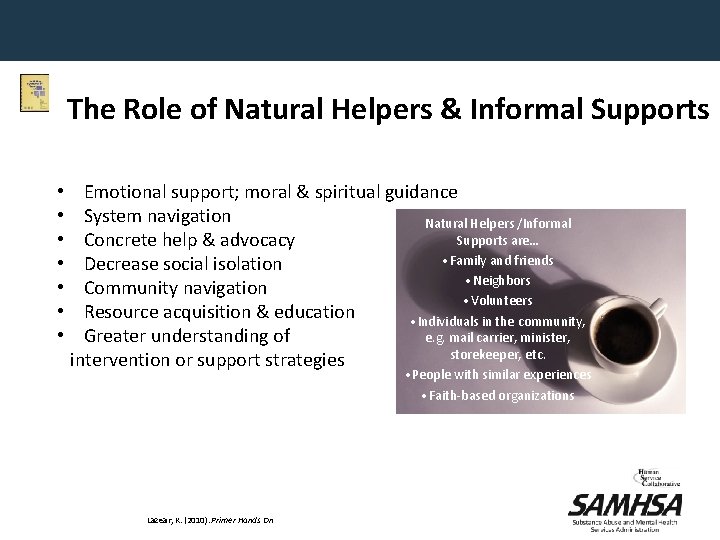
The Role of Natural Helpers & Informal Supports • • Emotional support; moral & spiritual guidance System navigation Natural Helpers /Informal Supports are… Concrete help & advocacy • Family and friends Decrease social isolation • Neighbors Community navigation • Volunteers Resource acquisition & education • Individuals in the community, Greater understanding of e. g. mail carrier, minister, storekeeper, etc. intervention or support strategies • People with similar experiences • Faith-based organizations Lazear, K. (2010). Primer Hands On
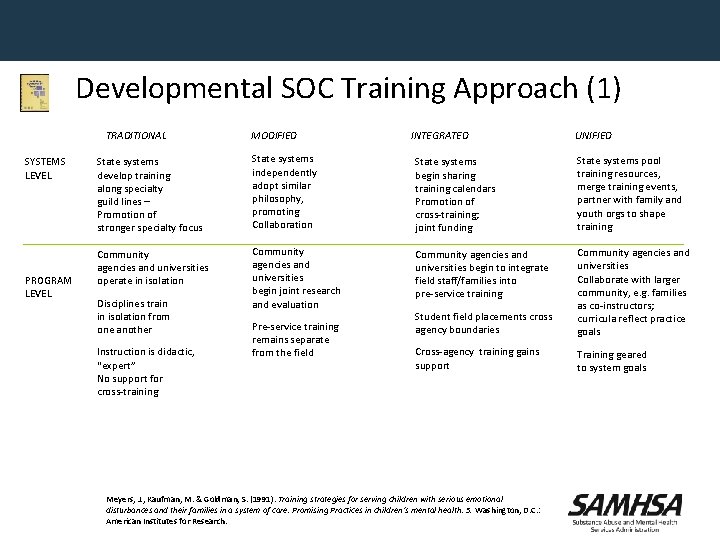
A Developmental TRADITIONAL SYSTEMS LEVEL PROGRAM LEVEL SOC Training Approach (1) MODIFIED INTEGRATED UNIFIED State systems develop training along specialty guild lines – Promotion of stronger specialty focus State systems independently adopt similar philosophy, promoting Collaboration State systems begin sharing training calendars Promotion of cross-training; joint funding State systems pool training resources, merge training events, partner with family and youth orgs to shape training Community agencies and universities operate in isolation Community agencies and universities begin joint research and evaluation Community agencies and universities begin to integrate field staff/families into pre-service training Student field placements cross agency boundaries Community agencies and universities Collaborate with larger community, e. g. families as co-instructors; curricula reflect practice goals Cross-agency training gains support Training geared to system goals Disciplines train in isolation from one another Instruction is didactic, “expert” No support for cross-training Pre-service training remains separate from the field Meyers, J. , Kaufman, M. & Goldman, S. (1991). Training strategies for serving children with serious emotional disturbances and their families in a system of care. Promising Practices in children’s mental health. 5. Washington, D. C. : American Institutes for Research.
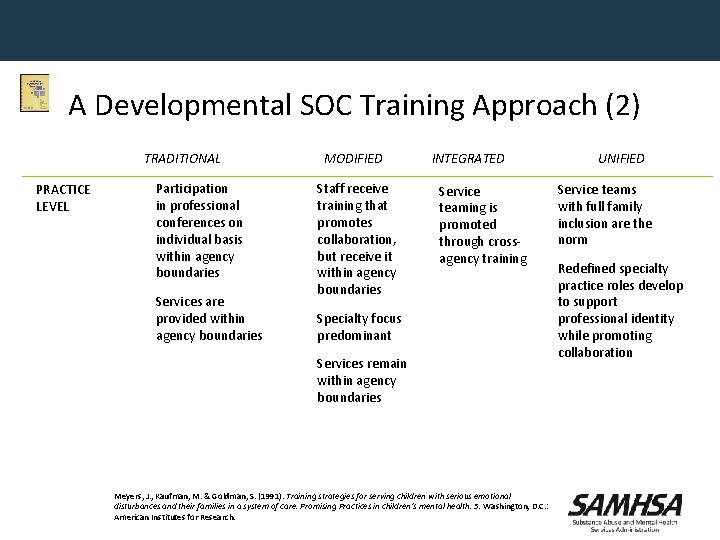
A Developmental SOC Training Approach (2) TRADITIONAL PRACTICE LEVEL Participation in professional conferences on individual basis within agency boundaries Services are provided within agency boundaries MODIFIED Staff receive training that promotes collaboration, but receive it within agency boundaries INTEGRATED Service teaming is promoted through crossagency training Specialty focus predominant Services remain within agency boundaries Meyers, J. , Kaufman, M. & Goldman, S. (1991). Training strategies for serving children with serious emotional disturbances and their families in a system of care. Promising Practices in children’s mental health. 5. Washington, D. C. : American Institutes for Research. UNIFIED Service teams with full family inclusion are the norm Redefined specialty practice roles develop to support professional identity while promoting collaboration
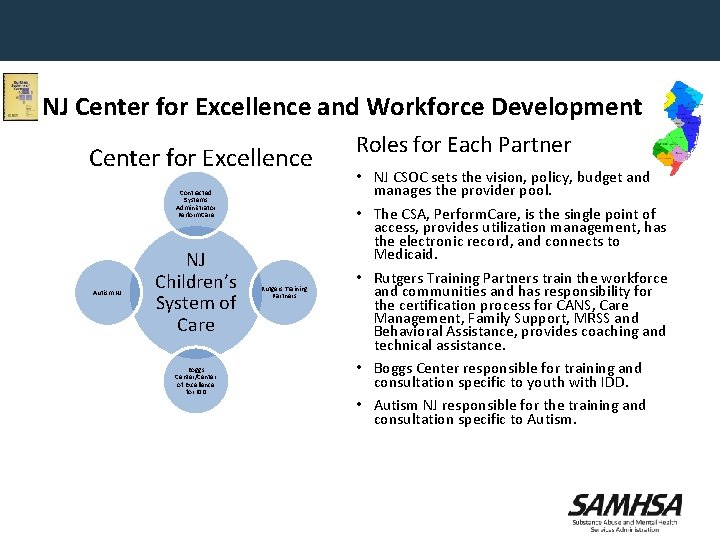
NJ Center for Excellence and Workforce Development Center for Excellence Contracted Systems Administrator Perform. Care Autism NJ NJ Children’s System of Care Boggs Center/Center of Excellence for IDD Rutgers Training Partners Roles for Each Partner • NJ CSOC sets the vision, policy, budget and manages the provider pool. • The CSA, Perform. Care, is the single point of access, provides utilization management, has the electronic record, and connects to Medicaid. • Rutgers Training Partners train the workforce and communities and has responsibility for the certification process for CANS, Care Management, Family Support, MRSS and Behavioral Assistance, provides coaching and technical assistance. • Boggs Center responsible for training and consultation specific to youth with IDD. • Autism NJ responsible for the training and consultation specific to Autism.
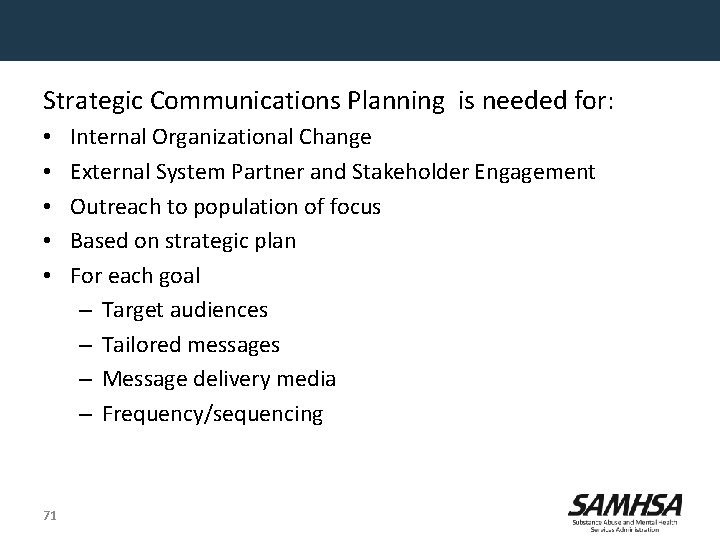
Strategic Communications Planning is needed for: • • • 71 Internal Organizational Change External System Partner and Stakeholder Engagement Outreach to population of focus Based on strategic plan For each goal – Target audiences – Tailored messages – Message delivery media – Frequency/sequencing
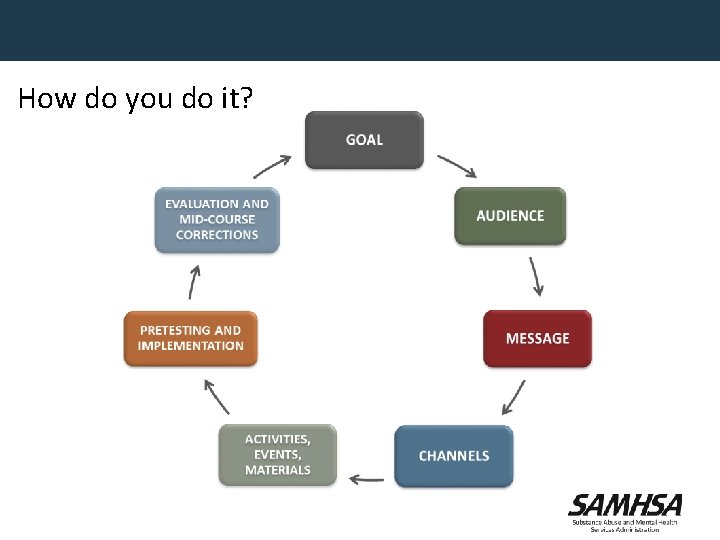
How do you do it? 72
Financing
Strategic Financing Agenda Move from a mentality of “funding programs and providing grants” to “collaborative financing to support a strategic agenda” How do you want to use your dollars to promote a unified agenda and achieve outcomes for shared populations of focus? Pires, S. (2010). Building systems of care: A primer, 2 nd Edition. Washington, D. C. : Human Service Collaborative for Georgetown University National Technical Assistance Center for Children’s Mental Health
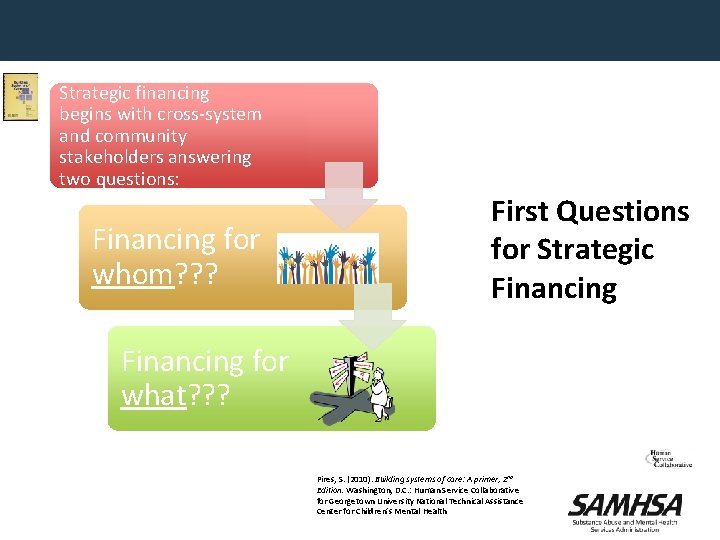
Strategic financing begins with cross-system and community stakeholders answering two questions: Financing for whom? ? ? First Questions for Strategic Financing for what? ? ? Pires, S. (2010). Building systems of care: A primer, 2 nd Edition. Washington, D. C. : Human Service Collaborative for Georgetown University National Technical Assistance Center for Children’s Mental Health
Financing for Whom? Identify and understand population(s) of focus • Demographics , e. g. , culture/race/ethnicity, economics, etc. • Size • Strengths, issues and needs Analyze Data (quantitative and qualitative) The more you understand about your population(s) of focus, the more strategic you can be about financing.
Financing for What? What are the outcomes you want to achieve with respect to your identified population(s) of focus? This is governed by your values – is there consensus?
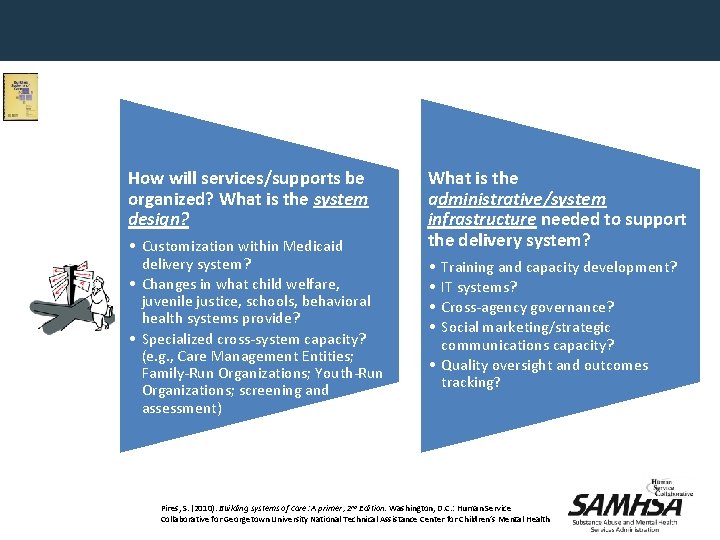
Financin. How will services/supports be What is the system g for organized? design? What? • Customization within Medicaid delivery system? • Changes in what child welfare, juvenile justice, schools, behavioral health systems provide? • Specialized cross-system capacity? (e. g. , Care Management Entities; Family-Run Organizations; Youth-Run Organizations; screening and assessment) What is the administrative/system infrastructure needed to support the delivery system? • • Training and capacity development? IT systems? Cross-agency governance? Social marketing/strategic communications capacity? • Quality oversight and outcomes tracking? Pires, S. (2010). Building systems of care: A primer, 2 nd Edition. Washington, D. C. : Human Service Collaborative for Georgetown University National Technical Assistance Center for Children’s Mental Health
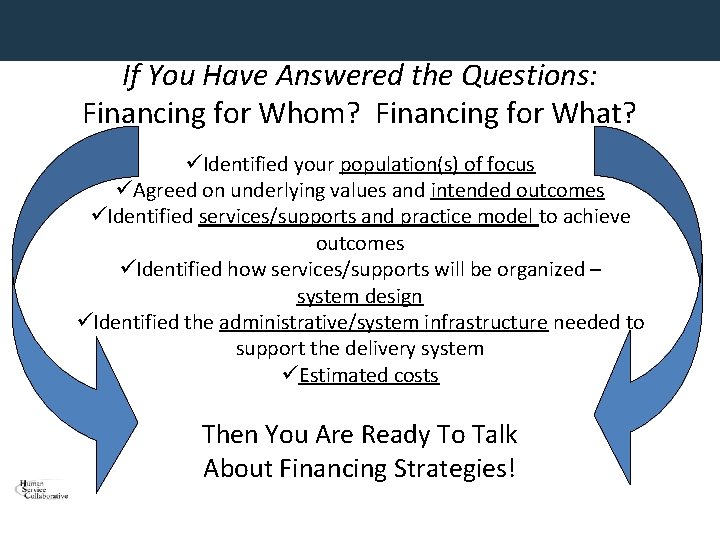
If You Have Answered the Questions: Financing for Whom? Financing for What? üIdentified your population(s) of focus üAgreed on underlying values and intended outcomes üIdentified services/supports and practice model to achieve outcomes üIdentified how services/supports will be organized – system design üIdentified the administrative/system infrastructure needed to support the delivery system üEstimated costs Then You Are Ready To Talk About Financing Strategies!
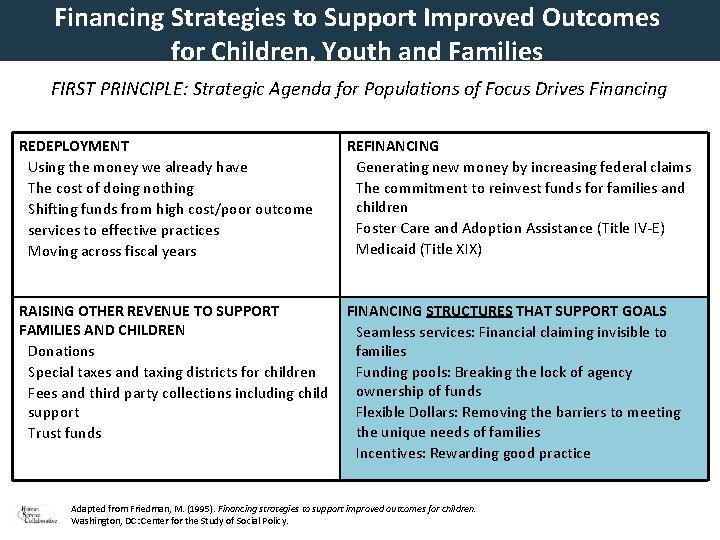
Financing Strategies to Support Improved Outcomes for Children, Youth and Families FIRST PRINCIPLE: Strategic Agenda for Populations of Focus Drives Financing REDEPLOYMENT Using the money we already have The cost of doing nothing Shifting funds from high cost/poor outcome services to effective practices Moving across fiscal years REFINANCING Generating new money by increasing federal claims The commitment to reinvest funds for families and children Foster Care and Adoption Assistance (Title IV-E) Medicaid (Title XIX) RAISING OTHER REVENUE TO SUPPORT FAMILIES AND CHILDREN Donations Special taxes and taxing districts for children Fees and third party collections including child support Trust funds FINANCING STRUCTURES THAT SUPPORT GOALS Seamless services: Financial claiming invisible to families Funding pools: Breaking the lock of agency ownership of funds Flexible Dollars: Removing the barriers to meeting the unique needs of families Incentives: Rewarding good practice Adapted from Friedman, M. (1995). Financing strategies to support improved outcomes for children. Washington, DC: Center for the Study of Social Policy.
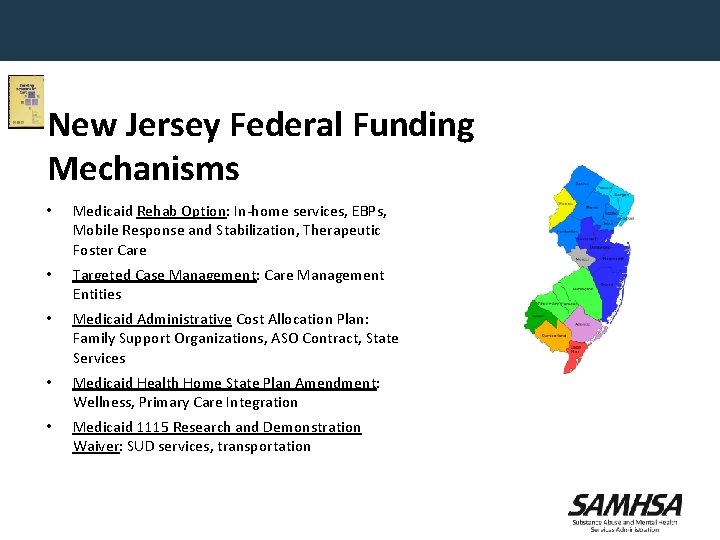
New Jersey Federal Funding Mechanisms • Medicaid Rehab Option: In-home services, EBPs, Mobile Response and Stabilization, Therapeutic Foster Care • Targeted Case Management: Care Management Entities • Medicaid Administrative Cost Allocation Plan: Family Support Organizations, ASO Contract, State Services • Medicaid Health Home State Plan Amendment: Wellness, Primary Care Integration • Medicaid 1115 Research and Demonstration Waiver: SUD services, transportation
Summary of Financing Strategies • Maximize Medicaid • Blend, braid or intentionally coordinate funding streams across systems • Redirect spending from high cost and/or poor outcome services to effective practices • Manage dollars through managed care arrangements that are tied to values and goals • Risk adjust payment for complex populations of children (e. g. , risk-adjusted capitation rates to MCOs; case rates to providers) • Finance: • Locus of accountability, e. g. , care management entities for most complex, crosssystem • • • Family and youth partnerships at policy, management and service levels Training, capacity building, quality and outcomes monitoring Broad, flexible array of services and supports
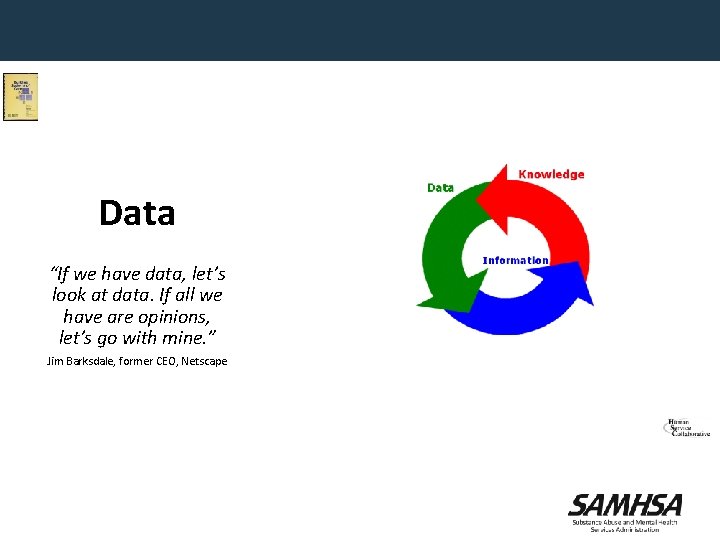
Data “If we have data, let’s look at data. If all we have are opinions, let’s go with mine. ” Jim Barksdale, former CEO, Netscape
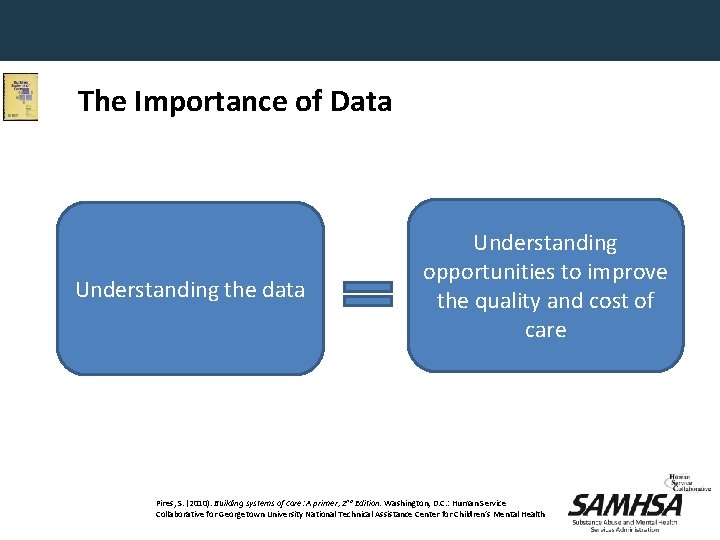
The Importance of Data Understanding the data Understanding opportunities to improve the quality and cost of care Pires, S. (2010). Building systems of care: A primer, 2 nd Edition. Washington, D. C. : Human Service Collaborative for Georgetown University National Technical Assistance Center for Children’s Mental Health
Guiding Implementation • Referrals and enrollment by geographic area and by agency tracked over time • Wraparound provider certification and quality review • Use of peer support services • Network development of key services- number and distribution of providers • Number and length of stay in inpatient settings • Use of home and community based services 85
Guiding Implementation Qualitative Data Can Tell You How families and youth experience the system Strengths and weaknesses in the provider network How providers experience the system How key system partners experience the system (e. g. child welfare workers, juvenile probation officers, school personnel, court personnel) • Recommendations for improvement • • 86
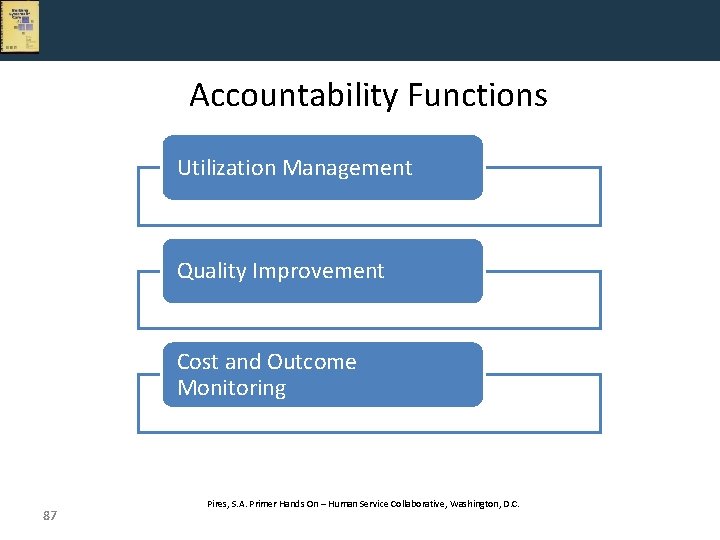
Accountability Functions Utilization Management Quality Improvement Cost and Outcome Monitoring 87 Pires, S. A. Primer Hands On – Human Service Collaborative, Washington, D. C.
Demonstrating Value Build support for sustainability and expansion • Educate leadership and funders • To build internal staff support • Build stakeholder support • Support of agency leadership • Show return on investment 88
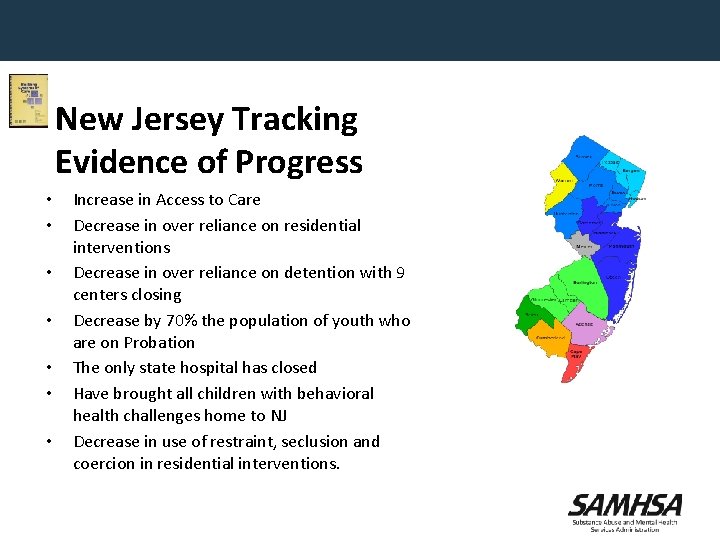
New Jersey Tracking Evidence of Progress • • Increase in Access to Care Decrease in over reliance on residential interventions Decrease in over reliance on detention with 9 centers closing Decrease by 70% the population of youth who are on Probation The only state hospital has closed Have brought all children with behavioral health challenges home to NJ Decrease in use of restraint, seclusion and coercion in residential interventions.
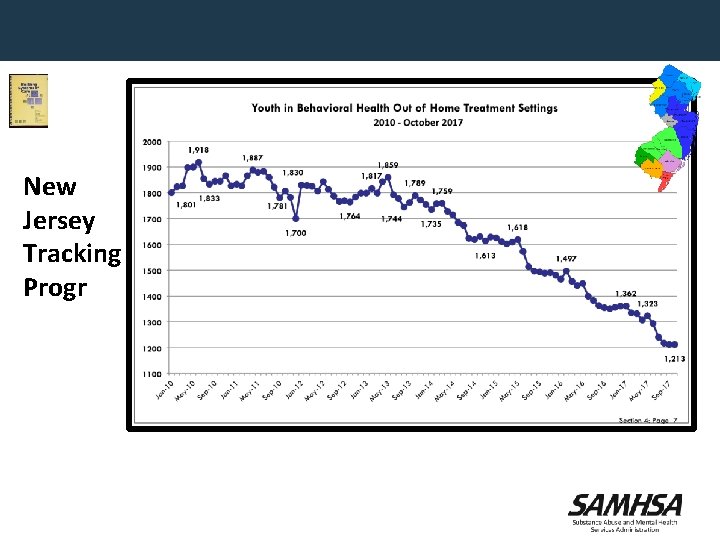
New Jersey Tracking Progress
Lessons from the Field: Set the vision and don’t move away from the vision Communicate, communicate Youth and family voices are the drivers to innovation The building blocks to systems of care work in coordination and not as well in isolation • Community engagement and participation is essential • It is not a program, but systems transformation • Anything and all things are possible, just look at NJ • •
Final Thoughts?
References: • Blau, Caldwell, Lieberman (2014). Residential Interventions for Children, Adolescents, and Families. • • Routledge, NY and London. Making the Case for a Comprehensive Children’s Crisis Continuum of Care; NASMHPD 2018; https: //www. nasmhpd. org/sites/default/files/TACPaper 8_Childrens. Crisis. Continuumof. Care_508 C. pdf Pires, Sheila; Building Systems of Care: A Primer; 2002; https: //gucchd. georgetown. edu/products/PRIMER_Complete. Book. pdf Pires, Sheila; Customizing Health Homes for Children with Serious Behavioral Health Challenges; 2013; https: //nwi. pdx. edu/pdf/Customizing. Health. Homes. pdf Intensive Care Coordination Using High Quality Wraparound: Rates and Billing Structure; TA Network; 2015; https: //theinstitute. umaryland. edu/media/ssw/institute/national-center-documents/Intensive. Care-Coordination-Using-HQ-Wraparound-Rates-and-Billing-Structure. pdf Stroul, B. A. , & Blau, G. M. (Eds. ). (2008). The system of care handbook: Transforming mental health services for children, youth and families, Baltimore, MD: Paul H. Brookes Publishing Co. Glasser, H. (2018). The nurtured heart approach. Retrieved from https: //childrenssuccessfoundation. com Huckshorn, K. (2008). Six Core Strategies to Reduce Seclusion and Restraint Use. Retrieved from https: //www. nasmhpd. org/content/six-core-strategies-reduce-seclusion-and-restraint-use Georgia System of Care State Plan 2017; Georgia Health Policy Center; https: //dbhdd. georgia. gov/sites/dbhdd. georgia. gov/files/related_files/site_page/SOC%20 State%20 Pl an%202017_FINAL%20%28002%29. pdf
References Continued • • • Arauz, Eric C. , An American’s Resurrection: My Pilgrimage from Child Abuse and Mental Illness to Salvation. Treehouse Publishing, St. Louis, MO, 2012. Armstrong M. I. , Blase, K. , Caldwell, B. Holt. W. , King-Miller, T. , Kuppinger, A. , Obrochta, C. , Policella, D. N. , &Wallace, F. (2006). Final report: Independent assessment of the New Jersey’s children’s behavioral health care system. Tampa, FL The University of South Florida. Louis de la Parte Florida Mental Health Institute. (FMHI Publication #239) Berrick, Ken and Sprinson, John S. Unconditional Care; Relationship-Based, Behavioral Intervention with Vulnerable Children and Families, Seneca Center. Oxford University Press, NY 2010 Burns, Barbara and Kimberly Hoagwood. Community Treatment for Youth: Evidence-Based Interventions for Severe Emotional Disturbance. Oxford Press, NY, 2007. Dennis, Karl and Lourie, Ira. Everything is Normal Until Proven Otherwise: A Book About Wraparound Services. CWLA Press, Washington, D. C. , 2006. Lyons, John S. Redressing the Emperor: Improving Our Children’s Public Mental Health System. Praeger Publishers. Westport, Connecticut and London. 2004 Perry, Bruce D. M. D. , Ph. D. and Szalavitz. The Boy Who Was Raised as a Dog and other stories from a Child Psychiatrist’s Notebook. Basic Books. New York, NY, 2006. Saxe, G. , Ellis, H. , Brown, A. Trauma Systems Therapy for Children and Teens. The Guilford Press, NY 2016. Siegel, Daniel J. M. D. Mindsight: The New Science of Personal Transformation. Bantam Books, NY 2010. Solomon, Andrew. Far From the Tree: Parents, Children, and the Search for Identity. Scribner. NY, NY 2012. Stroul, B. , Dodge, J. , Goldman, S. , Rider, F. , & Friedman, R. (2015). Toolkit for Expanding the System of Care Approach. Washington, DC: Georgetown University Center for Child and Human Development, National Technical Assistance Center for Children’s Mental Health.
References Continued: https: //www. casey. org/nj-mobile-response-stabilization-services/ https: //www. state. nj. us/dcf/documents/home/childdata/behavioral/DC BHS 10 yr. Review. pdf https: //www. nj. gov/dcf/about/divisions/dcsc/CSOC_15. Year. Conference. Presentation. pdf https: //www. medicaid. gov/federal-policy-guidance/downloads/cib-0507 -2013. pdf https: //www. nj. gov/dcf/about/divisions/dcsc/Childrens. Initiative. Concep t. Paper. pdf
Thank you Elizabeth Manley elizabeth. manley@ssw. umaryland. edu
SAMHSA’s mission is to reduce the impact of substance abuse and mental illness on America’s communities. Liz Manley The TA Network for Children’s Behavioral Health elizabeth. manley@sww. umaryland. edu www. samhsa. gov 1 -877 -SAMHSA-7 (1 -877 -726 -4727) ● 1 -800 -487 -4889 (TDD) 97
SAMHSA’s mission is to reduce the impact of substance abuse and mental illness on America’s communities. www. samhsa. gov 1 -877 -SAMHSA-7 (1 -877 -726 -4727) ● 1 -800 -487 -4889 (TDD) 98
- Slides: 98