
Building System Models for RE Chapter 10 Modeling
Building System Models for RE Chapter 10 Modeling Conceptual Objects with Class Diagrams

Building models for RE Chap. 8: Goals Chap. 9: Risks why ? how ? Chap. 10: Conceptual objects on what? Chap. 11: Agents who ?
The object model • Structural view of the system being modeled (as-is or tobe) • Roughly, shows how relevant system concepts are structured and interrelated • Represented by UML class diagram. . . – “objects”, classes not in the OO design sense: RE is concerned with the problem world only ! – classes with no operations: data encapsulation is a design concern; no design decisions here ! • Multiple uses. . . – precise definition of system concepts involved in other views, their structure & descriptive properties – state variables manipulated in other views – common vocabulary – basis for generating a glossary of terms
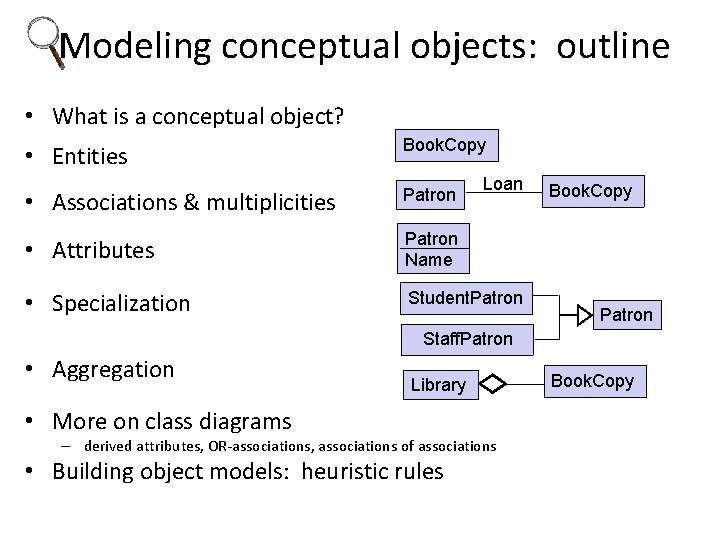
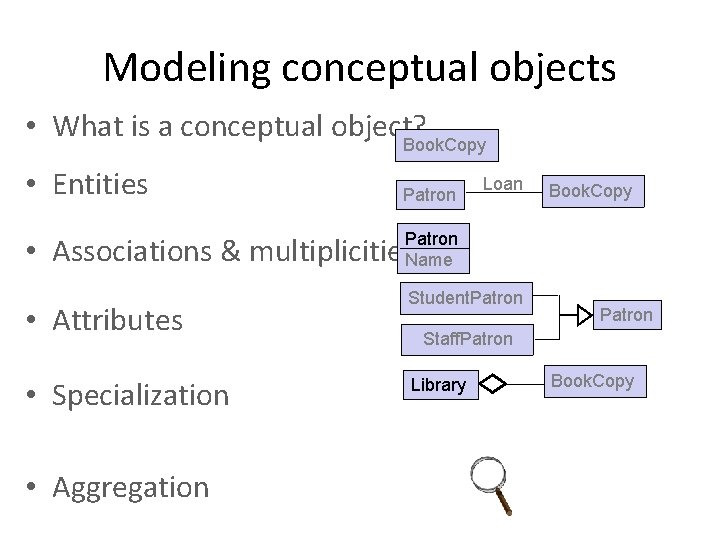
Modeling conceptual objects: outline • What is a conceptual object? • Entities Book. Copy • Associations & multiplicities Patron • Attributes Patron Name • Specialization Student. Patron Loan Book. Copy Patron Staff. Patron • Aggregation Library • More on class diagrams – derived attributes, OR-associations, associations of associations • Building object models: heuristic rules Book. Copy
What is a conceptual object? • Set of instances of a system-specific concept. . . – distinctly identifiable • immutable, built-in identity • e. g. 2 string instances “Justine Henin” are the same, but 2 Patron instances named Justine Henin are different – can be enumerated in any system state • in any state we can list all instances of the Patron concept currently involved in the system – share similar features • common name, name definition, definition type, type domain properties, properties • common attributes, attributes associations: associations see details later e. g. Email attrib of Patron; Loan assoc linking Patron and Book. Copy – may differ in their individual states and state transitions
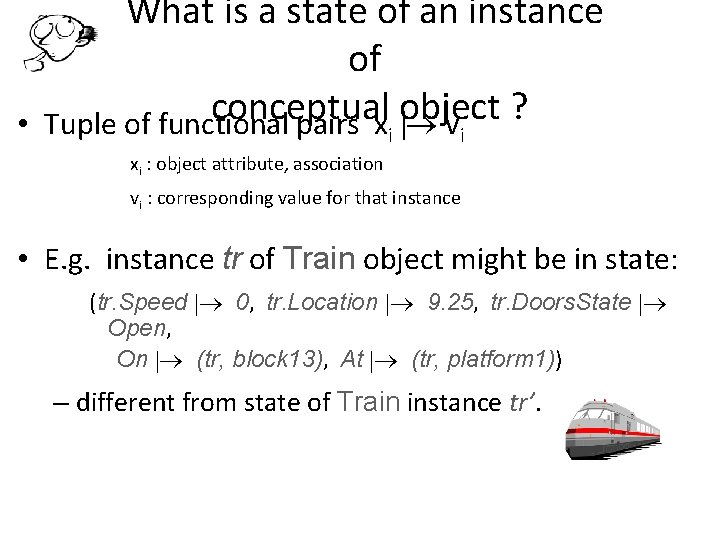
What is a state of an instance of conceptual object ? • Tuple of functional pairs xi |® vi xi : object attribute, association vi : corresponding value for that instance • E. g. instance tr of Train object might be in state: (tr. Speed |® 0, tr. Location |® 9. 25, tr. Doors. State |® Open, On |® (tr, block 13), At |® (tr, platform 1)) – different from state of Train instance tr’.
Object instantiation: classes & current instances • Every conceptual object has a built-in semantic relation telling which instances are currently members of the object: Instance. Of (o, Ob) iff o is currently an instance of Ob – kept implicit in the object model, used for Def specification – “current” state = some arbitrarily chosen system state – e. g. Instance. Of (bc, Book. Copy) says bc is currently member of set Book. Copy of book copies manimulated in the library system – might not be the case 3 weeks earlier or 1 year later. . . • A set of object instances may evolve over time • An instance may migrate from one object to
• Object instantiation: classes & current instances (2) Every concept in object model must be defined by Def annotation specifying the necessary & sufficient condition for an individual to satisfy Instance. Of (o, Ob) – i. e. specific conditions for individual to appear & disappear as instance of this object – e. g. “ A patron is any person who has registered to the corresponding library for the corresponding period of time and has not been excluded since then“ • When an individual becomes instance of an object, the object’s attributes & associations get instantiated as state variables to characterize it e. g. Instance. Of (tr, Train) ® tr. Speed, tr. Doors. State, On (tr, . . . ) • State variables of the system = set of state variables of all conceptual objects declared in the object model
Types of conceptual object • Entity: Entity autonomous, passive object – instances may exist in system independently of instances of other objects – instances cannot control behavior of other objects – e. g. Book, Book. Copy ; Train, Platform, . . . – represented as UML class • Association: Association object dependent on objects it links – instances are conceptual links among object instances – e. g. Loan linking Patron & Book. Copy Copy linking Book. Copy & Book At linking Train & Platform On linking Train & Block – represented as UML association
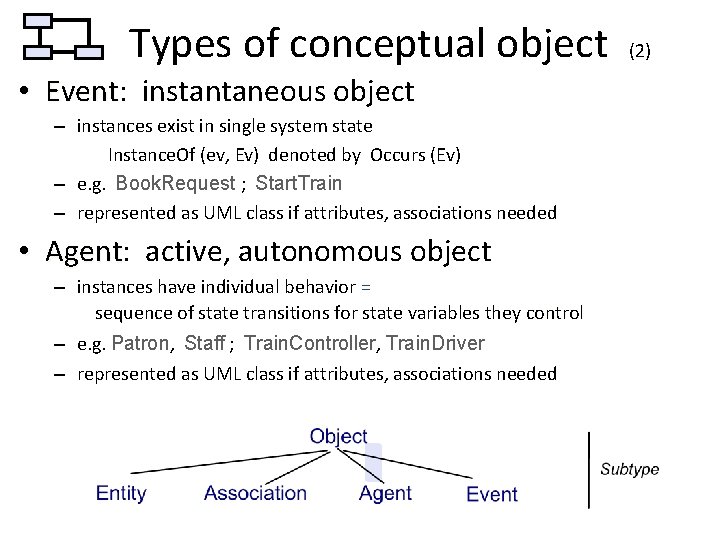
Types of conceptual object • Event: Event instantaneous object – instances exist in single system state Instance. Of (ev, Ev) denoted by Occurs (Ev) – e. g. Book. Request ; Start. Train – represented as UML class if attributes, associations needed • Agent: Agent active, autonomous object – instances have individual behavior = sequence of state transitions for state variables they control – e. g. Patron, Staff ; Train. Controller, Train. Driver – represented as UML class if attributes, associations needed (2)
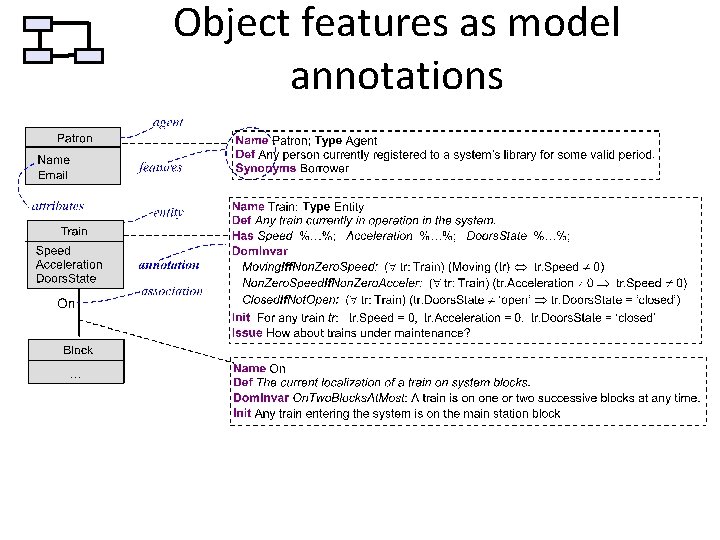
Object features as model annotations
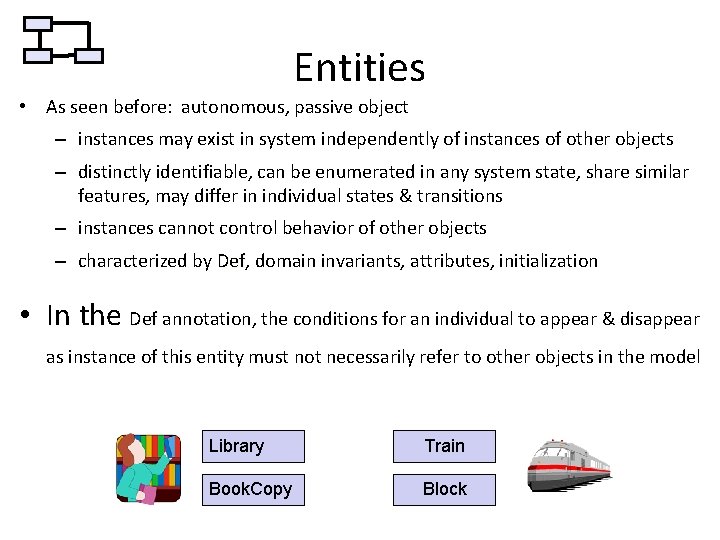
Entities • As seen before: autonomous, passive object – instances may exist in system independently of instances of other objects – distinctly identifiable, can be enumerated in any system state, share similar features, may differ in individual states & transitions – instances cannot control behavior of other objects – characterized by Def, Def domain invariants, attributes, initialization • In the Def annotation, the conditions for an individual to appear & disappear as instance of this entity must not necessarily refer to other objects in the model Library Train Book. Copy Block
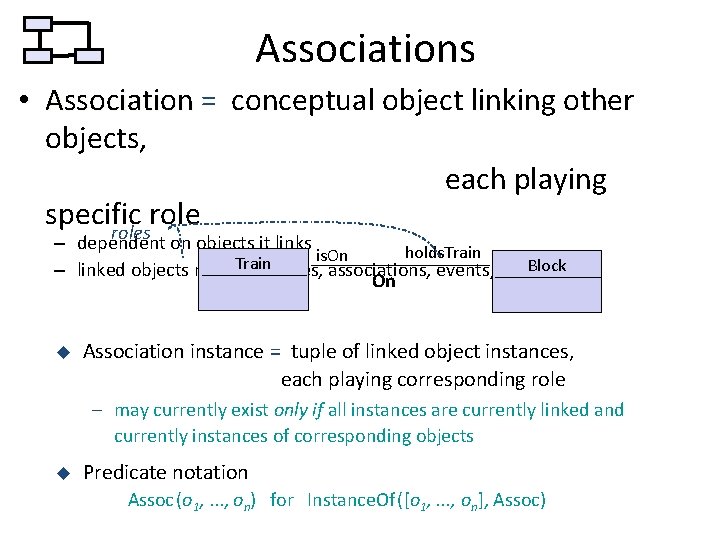
Associations • Association = conceptual object linking other objects, each playing specific roles – dependent on objects it links holds. Train is. On Train Block – linked objects may be entities, associations, events, agents On u Association instance = tuple of linked object instances, each playing corresponding role – may currently exist only if all instances are currently linked and currently instances of corresponding objects u Predicate notation Assoc (o 1, . . . , on) for Instance. Of ([o 1, . . . , on], Assoc)
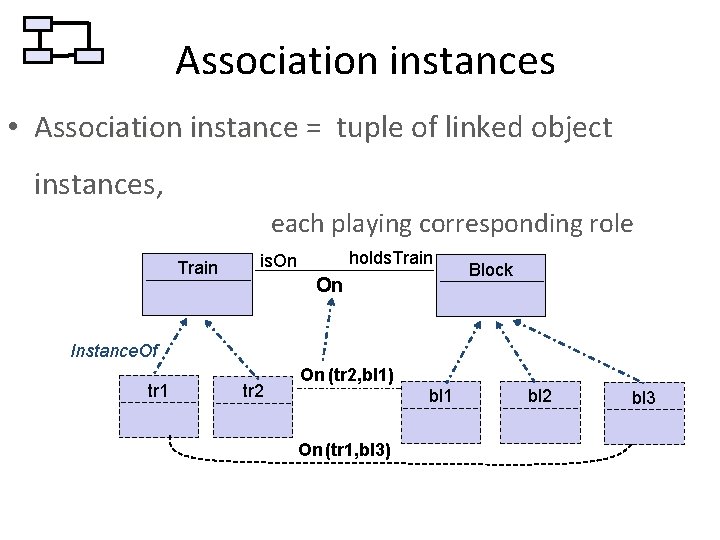
Association instances • Association instance = tuple of linked object instances, each playing corresponding role Train holds. Train is. On On Block Instance. Of tr 1 tr 2 On (tr 2, bl 1) bl 1 On (tr 1, bl 3) bl 2 bl 3
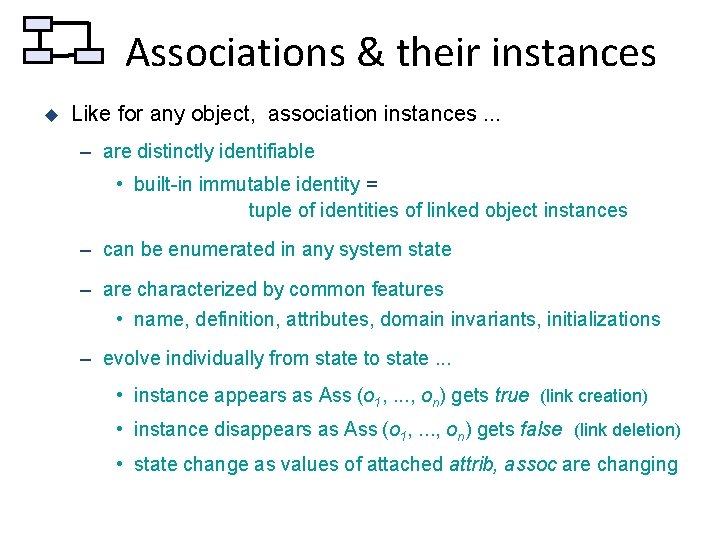
Associations & their instances u Like for any object, association instances. . . – are distinctly identifiable • built-in immutable identity = tuple of identities of linked object instances – can be enumerated in any system state – are characterized by common features • name, definition, attributes, domain invariants, initializations – evolve individually from state to state. . . • instance appears as Ass (o 1, . . . , on) gets true (link creation) appears • instance disappears as Ass (o 1, . . . , on) gets false (link deletion) disappears • state change as values of attached attrib, assoc are changing state change
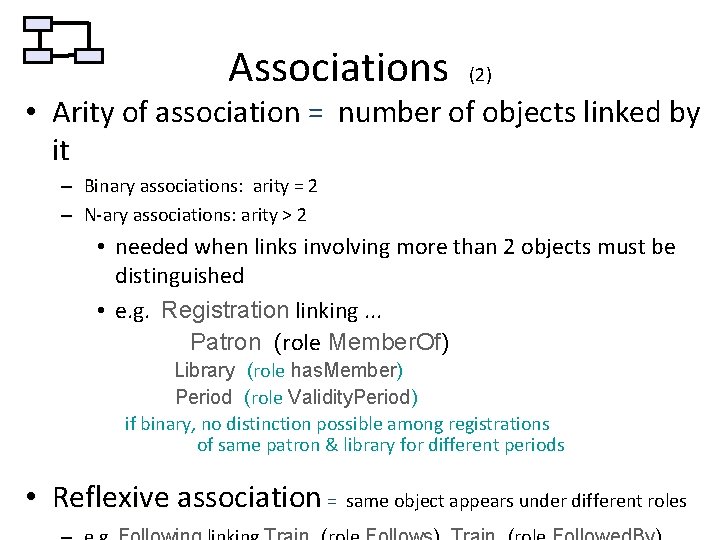
Associations (2) • Arity of association = number of objects linked by it – Binary associations: arity = 2 – N-ary associations: arity > 2 • needed when links involving more than 2 objects must be distinguished • e. g. Registration linking. . . Patron (role Member. Of) Library (role has. Member) Period (role Validity. Period) if binary, no distinction possible among registrations of same patron & library for different periods • Reflexive association = same object appears under different roles
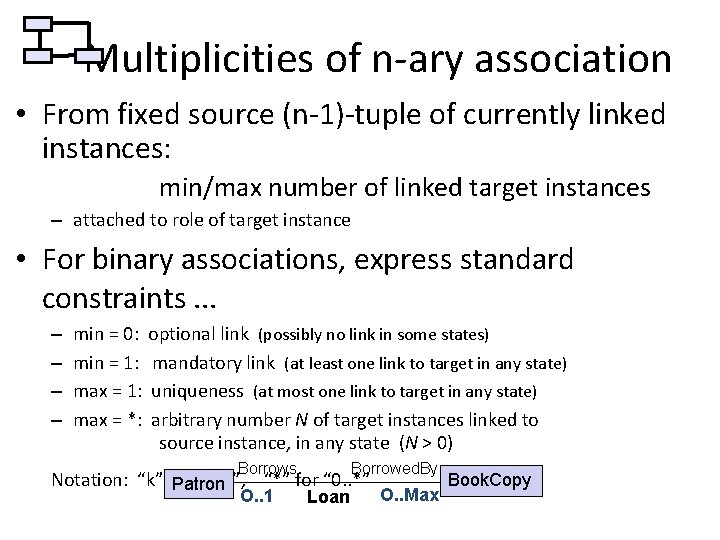
Multiplicities of n-ary association • From fixed source (n-1)-tuple of currently linked instances: min/ min max number of linked target instances – attached to role of target instance • For binary associations, express standard constraints. . . – – min = 0: optional link (possibly no link in some states) min = 1: mandatory link (at least one link to target in any state) max = 1: uniqueness (at most one link to target in any state) max = *: arbitrary number N of target instances linked to source instance, in any state (N > 0) Borrows Borrowed. By Notation: “k” for “k. . k”, “*” for “ 0. . *” Patron O. . 1 Loan O. . Max Book. Copy
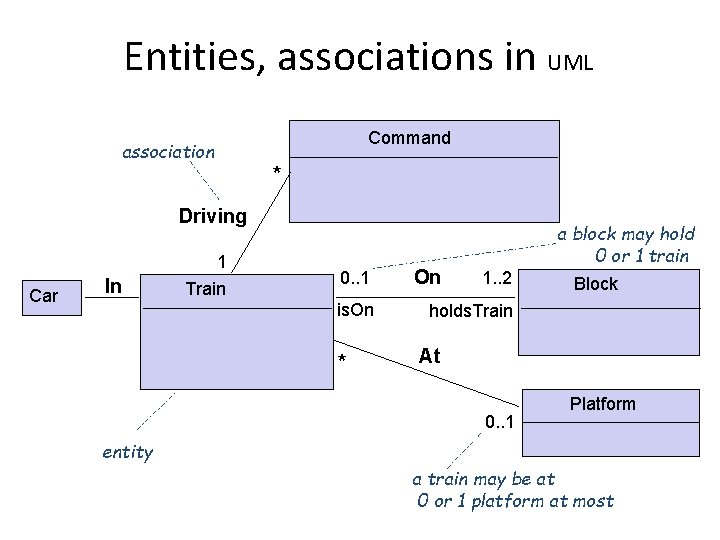
Entities, associations in UML association Command * Driving Car In 1 Train 0. . 1 is. On * On a block may hold 0 or 1 train 1. . 2 Block holds. Train At 0. . 1 Platform entity a train may be at 0 or 1 platform at most
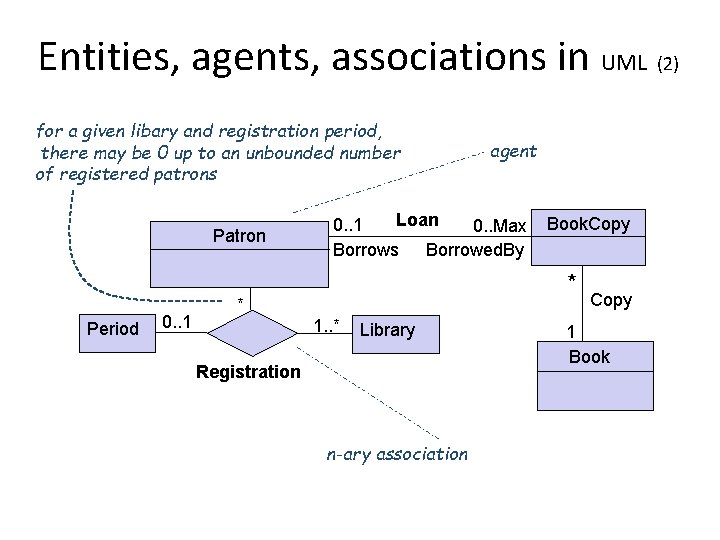
Entities, agents, associations in UML (2) for a given libary and registration period, there may be 0 up to an unbounded number of registered patrons Patron Period 0. . 1 agent Loan 0. . 1 0. . Max Borrows Borrowed. By Book. Copy * * 1. . * Library Registration n-ary association Copy 1 Book
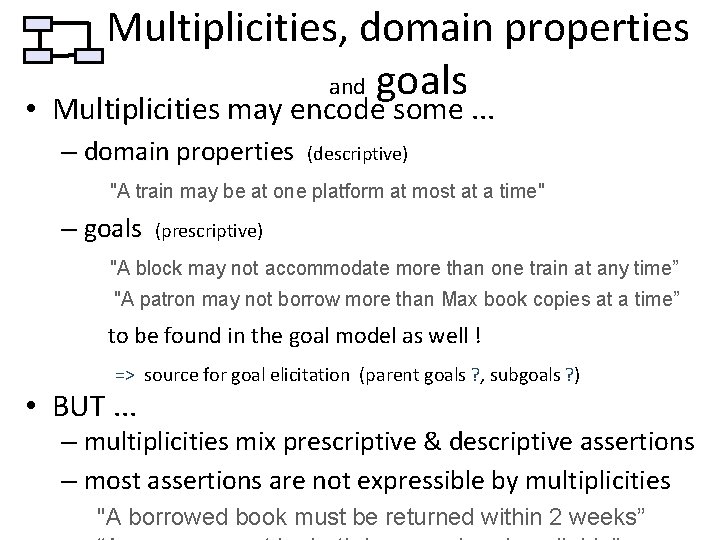
Multiplicities, domain properties and goals • Multiplicities may encode some. . . – domain properties (descriptive) "A train may be at one platform at most at a time" – goals (prescriptive) "A block may not accommodate more than one train at any time” "A patron may not borrow more than Max book copies at a time” to be found in the goal model as well ! => source for goal elicitation (parent goals ? , subgoals ? ) • BUT. . . – multiplicities mix prescriptive & descriptive assertions – most assertions are not expressible by multiplicities "A borrowed book must be returned within 2 weeks”
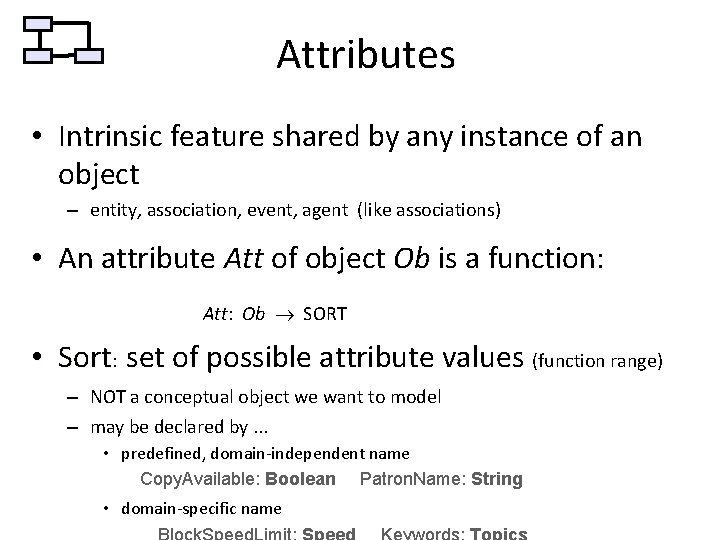
Attributes • Intrinsic feature shared by any instance of an object – entity, association, event, agent (like associations) • An attribute Att of object Ob is a function: Att: Ob ® SORT • Sort: set of possible attribute values (function range) – NOT a conceptual object we want to model – may be declared by. . . • predefined, domain-independent name Copy. Available: Boolean Patron. Name: String • domain-specific name
Attributes (2) • Elementary attribute: sort is a set of atomic values – e. g. Doors. State: {open, closed} • Structured attribute: sort defined with type constructor – Tuple, Set. Of, Sequence. Of, Union – e. g. Keywords: Set. Of [Topic] , date. Range: Seq. Of [Date] • Precise, domain-specific semantics of attribute must be defined in Has annotations • Attribute multiplicity: multiplicity min/max number of values the attribute may take
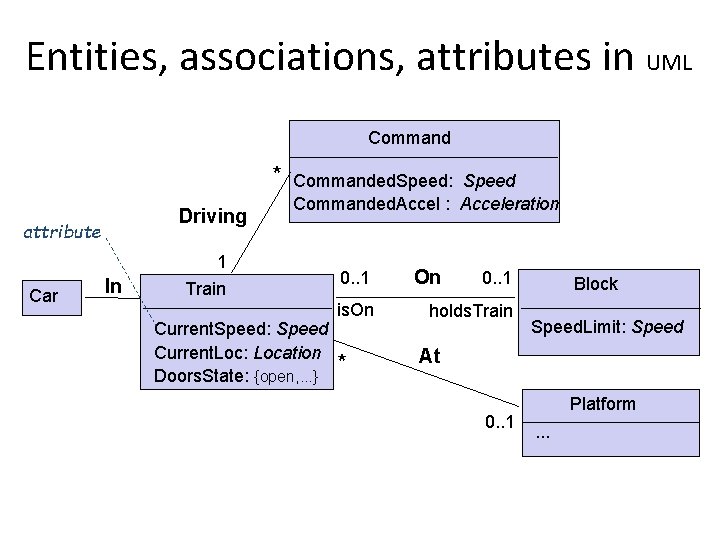
Entities, associations, attributes in UML Command * Driving attribute Car In Commanded. Speed: Speed Commanded. Accel : Acceleration 1 Train Current. Speed: Speed Current. Loc: Location Doors. State: {open, . . . } 0. . 1 is. On * On 0. . 1 holds. Train Block Speed. Limit: Speed At 0. . 1 Platform. . .
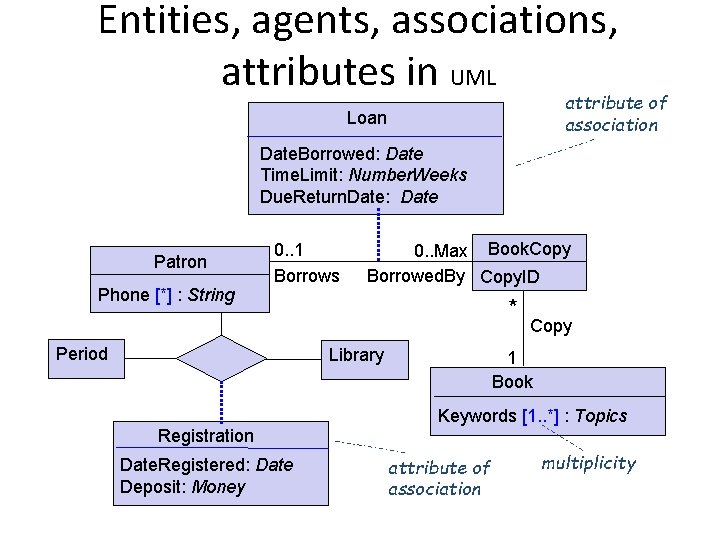
Entities, agents, associations, attributes in UML attribute of association Loan Date. Borrowed: Date Time. Limit: Number. Weeks Due. Return. Date: Date Patron Phone [*] : String 0. . 1 Borrows Period 0. . Max Book. Copy Borrowed. By Copy. ID * Library Copy 1 Book Keywords [1. . *] : Topics Registration Date. Registered: Date Deposit: Money attribute of association multiplicity
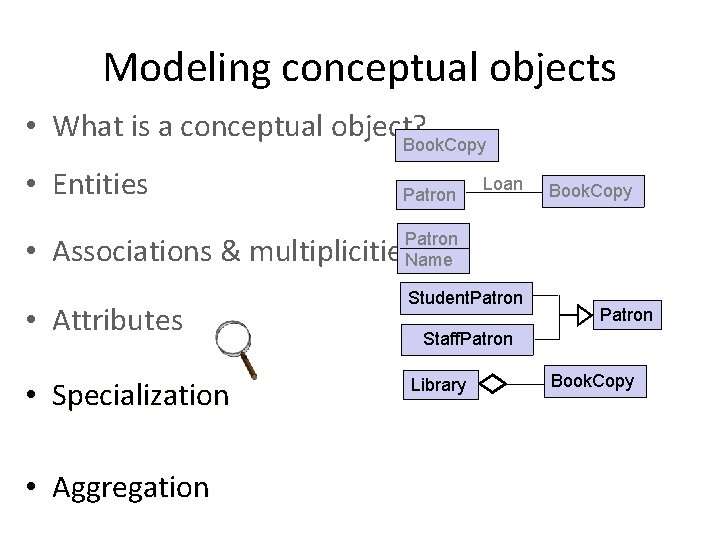
Modeling conceptual objects • What is a conceptual object? Book. Copy • Entities Patron Loan Book. Copy Patron Name • Associations & multiplicities • Attributes • Specialization • Aggregation Student. Patron Staff. Patron Library Book. Copy
Built-in associations for structuring object models • Object specialization/generalization, decomposition/aggregation – applicable to entities, agents, events, associations • Specialization = subclassing: object Sub. Ob is a specialization of object Super. Ob iff for any individual o: Instance. Of (o, Sub. Ob) Þ Instance. Of (o, Super. Ob) • Sub. Ob specializes Super. Ob, Super. Ob generalizes Sub. Ob • amounts to set inclusion on set of current instances • Feature inheritance as a consequence. . . – by default, Sub. Ob inherits from Super. Ob all its attributes, associations, domain properties • while have its own distinguishing features – may be inhibited by compatible redefinition of feature with same name within specialized Sub. Ob (“override”)
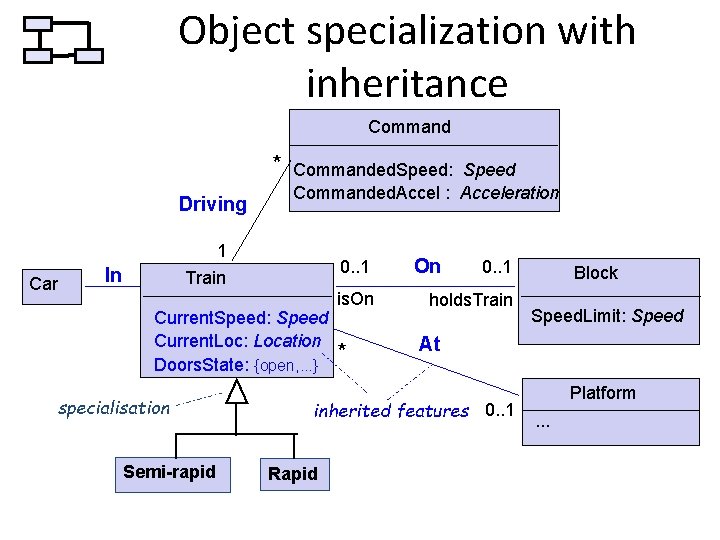
Object specialization with inheritance Command * Driving Car Commanded. Speed: Speed Commanded. Accel : Acceleration 1 Train In 0. . 1 Current. Speed: Speed Current. Loc: Location Doors. State: {open, . . . } specialisation Semi-rapid is. On * On 0. . 1 holds. Train Speed. Limit: Speed At inherited features 0. . 1 Rapid Block Platform. . .
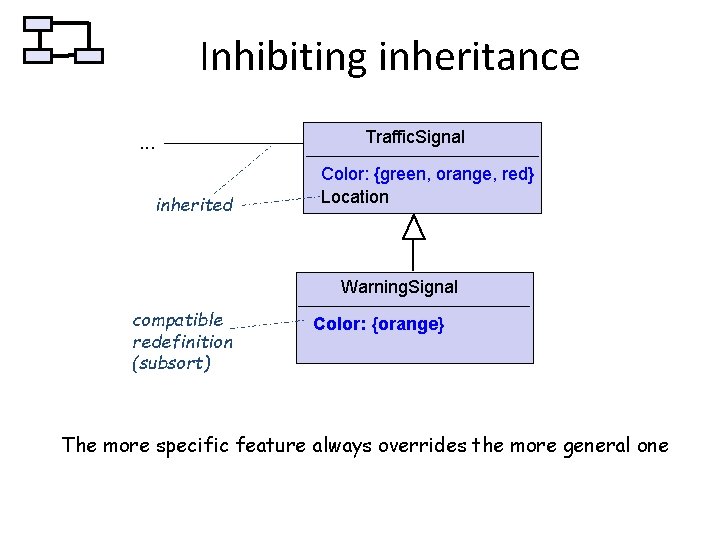
Inhibiting inheritance Traffic. Signal . . . inherited Color: {green, orange, red} Location Warning. Signal compatible redefinition (subsort) Color: {orange} The more specific feature always overrides the more general one
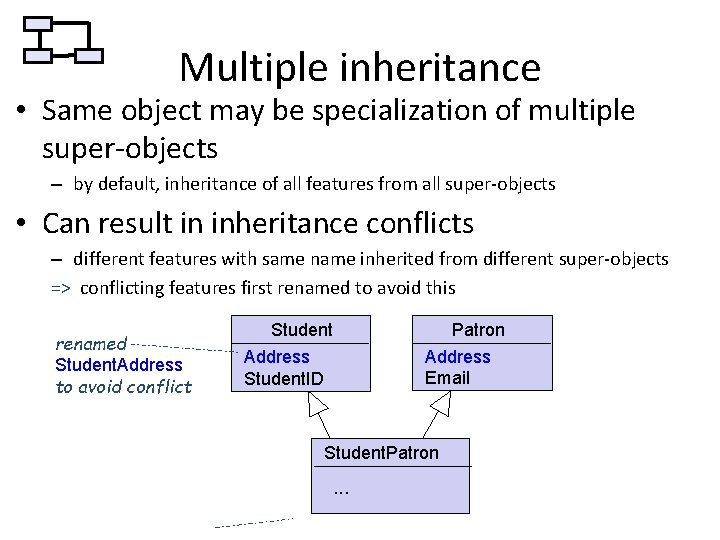
Multiple inheritance • Same object may be specialization of multiple super-objects – by default, inheritance of all features from all super-objects • Can result in inheritance conflicts – different features with same name inherited from different super-objects => conflicting features first renamed to avoid this renamed Student. Address to avoid conflict Patron Student Address Email Address Student. ID Student. Patron . . .
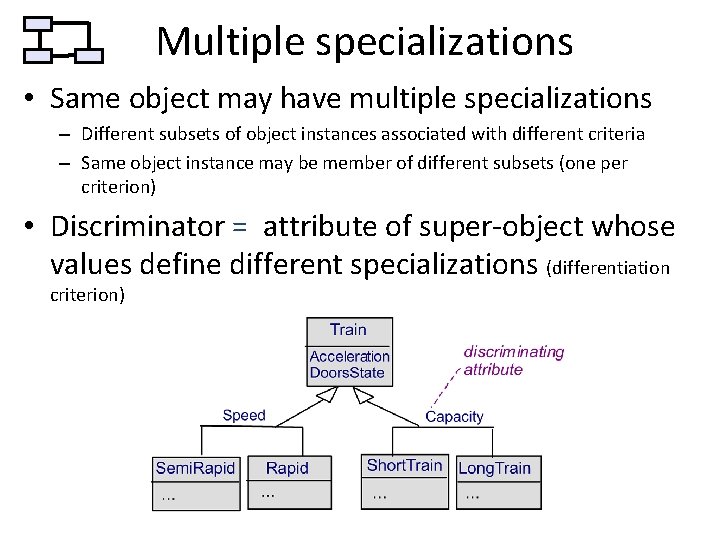
Multiple specializations • Same object may have multiple specializations – Different subsets of object instances associated with different criteria – Same object instance may be member of different subsets (one per criterion) • Discriminator = attribute of super-object whose values define different specializations (differentiation criterion)
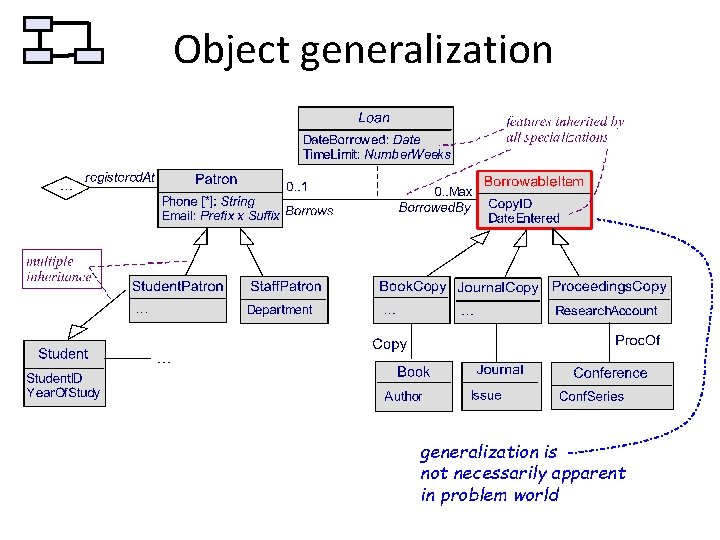
Object generalization is not necessarily apparent in problem world
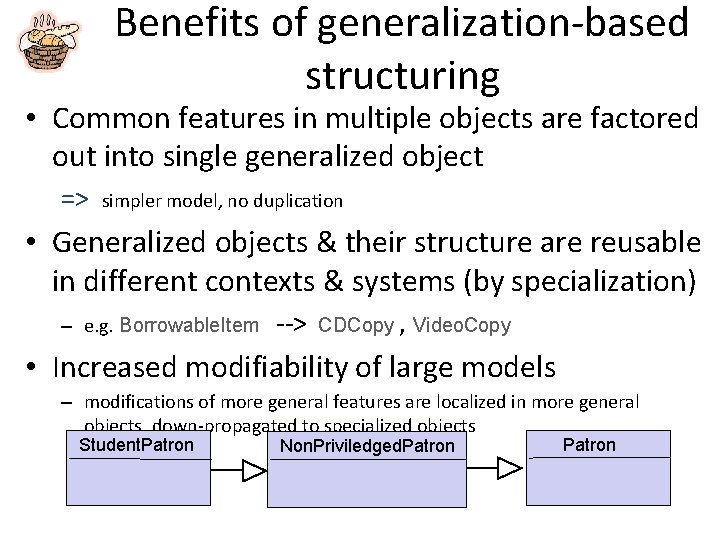
Benefits of generalization-based structuring • Common features in multiple objects are factored out into single generalized object => simpler model, no duplication • Generalized objects & their structure are reusable in different contexts & systems (by specialization) – e. g. Borrowable. Item --> CDCopy , Video. Copy • Increased modifiability of large models – modifications of more general features are localized in more general objects, down-propagated to specialized objects Student. Patron Non. Priviledged. Patron
Object aggregation • Aggregation = composite object whose components are objects rts”) Instance. Of (ob, Aggr. Ob) Þ ob = Tuple (o 1, . . . , on) (“pa with Instance. Of (oi , Part. Obi ) – applicable to entities, agents, events, associations – multiplicities may be attached to part-to-aggregation links – transitive, antisymmetrical links • Composition: aggregation & parts
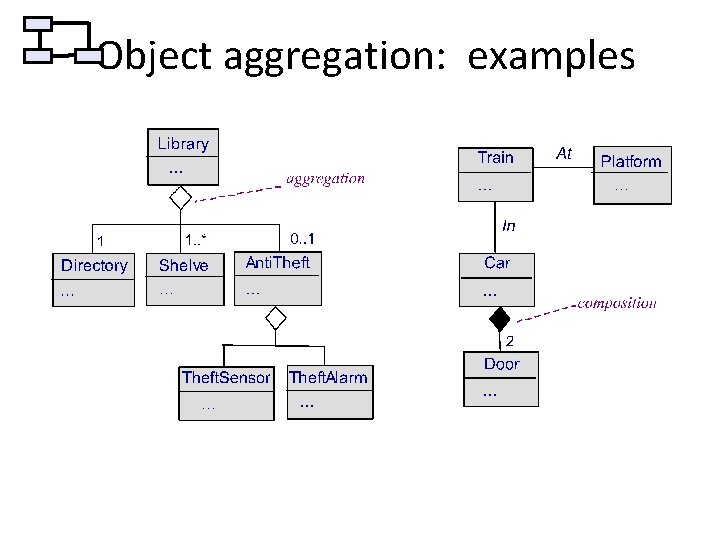
Object aggregation: examples
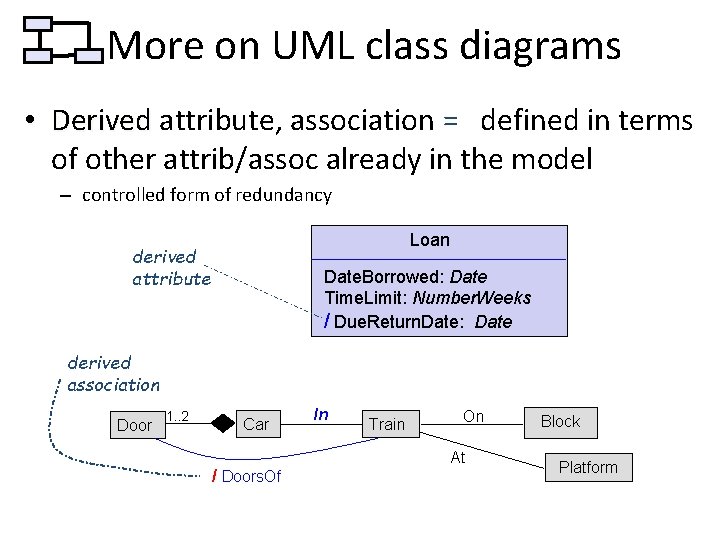
More on UML class diagrams • Derived attribute, association = defined in terms of other attrib/assoc already in the model – controlled form of redundancy Loan derived attribute Date. Borrowed: Date Time. Limit: Number. Weeks / Due. Return. Date: Date derived association Door 1. . 2 Car In Train On At / Doors. Of Block Platform
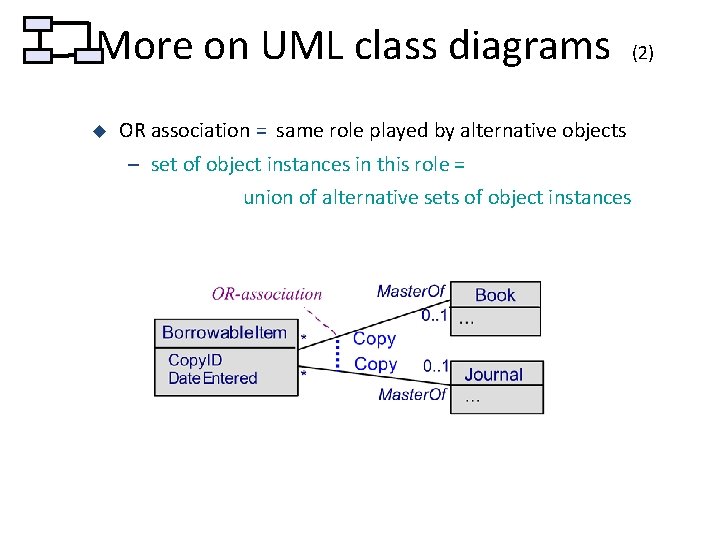
More on UML class diagrams u (2) OR association = same role played by alternative objects – set of object instances in this role = union of alternative sets of object instances
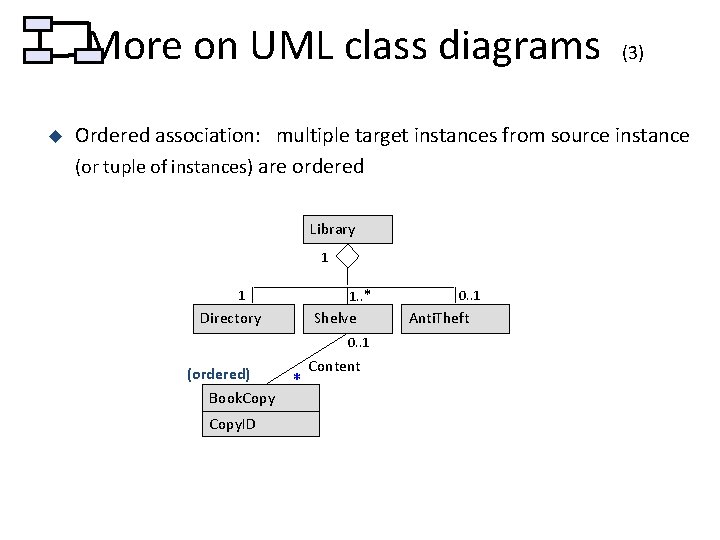
More on UML class diagrams u (3) Ordered association: multiple target instances from source instance (or tuple of instances) are ordered Library 1 1. . * 1 Directory Shelve 0. . 1 (ordered) Book. Copy. ID * Content 0. . 1 Anti. Theft
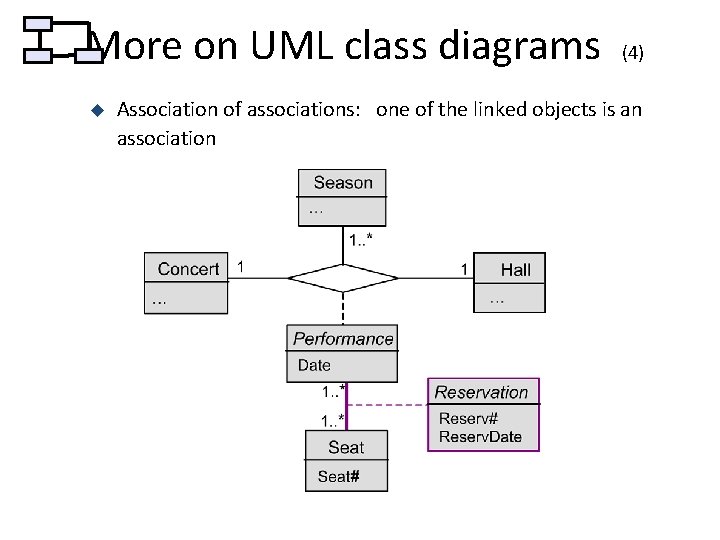
More on UML class diagrams u (4) Association of associations: associations one of the linked objects is an association
Modeling conceptual objects • What is a conceptual object? Book. Copy • Entities Patron Loan Book. Copy Patron Name • Associations & multiplicities • Attributes • Specialization • Aggregation Student. Patron Staff. Patron Library Book. Copy
Building object models: heuristic rules • Deriving pertinent & complete object models from goal models – deriving objects, associations, attributes – introducing software-environment tracking associations – identifying associations from domain invariants on multiple objects • Object or attribute ? • Entity, association, agent, or event ? • Attribute of a linked object or of a linking association ?
Deriving objects, associations, attributes fromofthe model F Review all specs goalsgoal & domain properties in goal model. . . – take all referenced concepts meeting criteria for object, and only those • instances distinctly identifiable, enumerable in any state, sharing similar features, differing in individual states – consider the others as candidate qualifying attributes • values are NOT concept instances to be characterized by common attributes, associations – identify associations + participating objects from linking expressions in these specs <source. Obj> <linking. Verb> <target. Obj(s)>
![Deriving objects, associations, attributes from goal specs: example Goal Maintain [Block. Speed. Limited] Def](http://slidetodoc.com/presentation_image_h/b826ff33482257373ca7a07671df27c1/image-42.jpg "Deriving objects, associations, attributes from goal specs: example Goal Maintain [Block. Speed. Limited] Def")
Deriving objects, associations, attributes from goal specs: example Goal Maintain [Block. Speed. Limited] Def The speed of a train on a block may never exceed the limit associated with that block Train Speed: Speed. Unit . . . On Block Speed. Limit: Speed. Unit . . . u Rephrasing sometimes needed to highlight linking expressions u Yet another reason for goal specs to be precise !
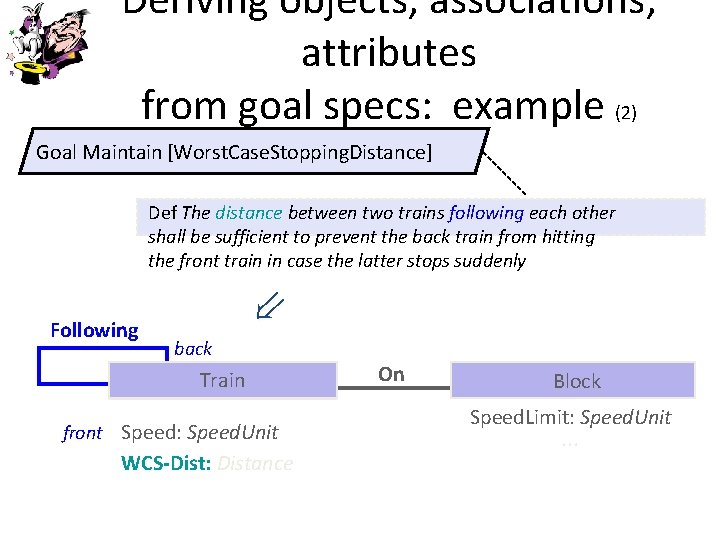
Deriving objects, associations, attributes from goal specs: example (2) Goal Maintain [Worst. Case. Stopping. Distance] Def The distance between two trains following each other shall be sufficient to prevent the back train from hitting the front train in case the latter stops suddenly Following back Train front Speed: Speed. Unit WCS-Dist: Distance On Block Speed. Limit: Speed. Unit . . .
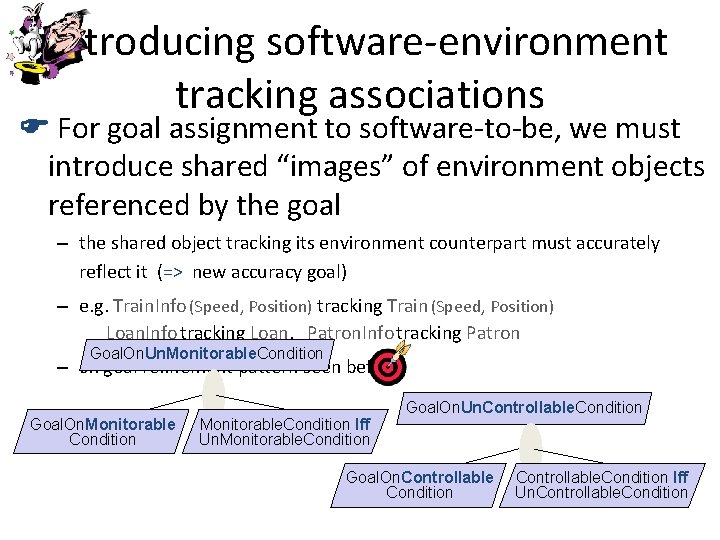
Introducing software-environment tracking associations F For goal assignment to software-to-be, we must introduce shared “images” of environment objects referenced by the goal – the shared object tracking its environment counterpart must accurately reflect it (=> new accuracy goal) – e. g. Train. Info (Speed, Position) tracking Train (Speed, Position) Loan. Info tracking Loan, Patron. Info tracking Patron Goal. On. Un. Monitorable. Condition – cf. goal refinement pattern seen before: Goal. On. Monitorable Condition Monitorable. Condition Iff Un. Monitorable. Condition Goal. On. Un. Controllable. Condition Goal. On. Controllable Condition Controllable. Condition Iff Un. Controllable. Condition
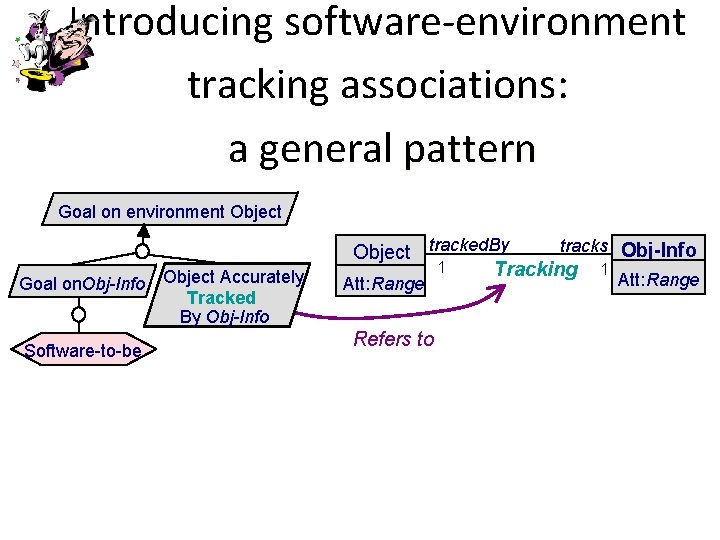
Introducing software-environment tracking associations: a general pattern Goal on environment Object Goal on. O bj-Info Object Accurately Tracked By Obj-Info Software-to-be tracks Obj-Info Object tracked. By 1 Tracking 1 … Att: Range Refers to Att: Range
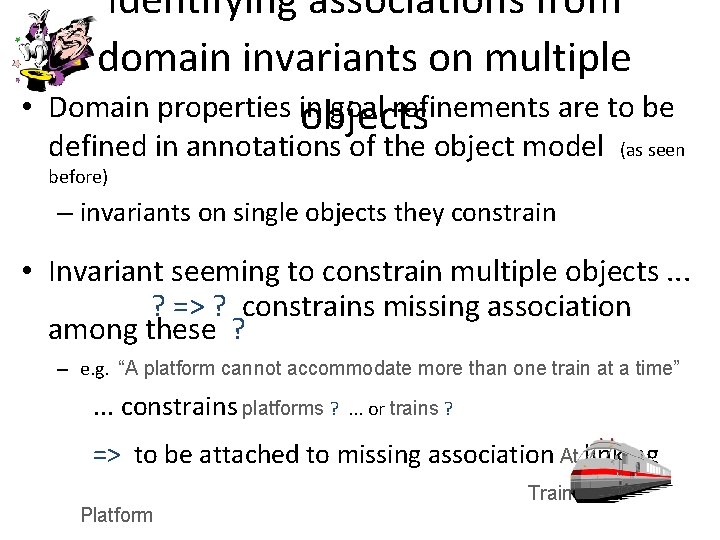
• Identifying associations from domain invariants on multiple Domain properties in goal refinements are to be objects defined in annotations of the object model (as seen before) – invariants on single objects they constrain • Invariant seeming to constrain multiple objects. . . ? => ? constrains missing association among these ? – e. g. “A platform cannot accommodate more than one train at a time” . . . constrains platforms ? . . . or trains ? => to be attached to missing association At At linking Train and Platform
Derivation links between goal model & object model are bidirectional • From goals to objects. . . – as just seen • From objects to goals. . . – Domain concepts that should “obviously” appear in object model. . . WHY? => missing goals in goal model – Systematic association decoration with multiplicities. . . prescriptive? => missing goals in goal model WHY? => parent goals HOW? => subgoals
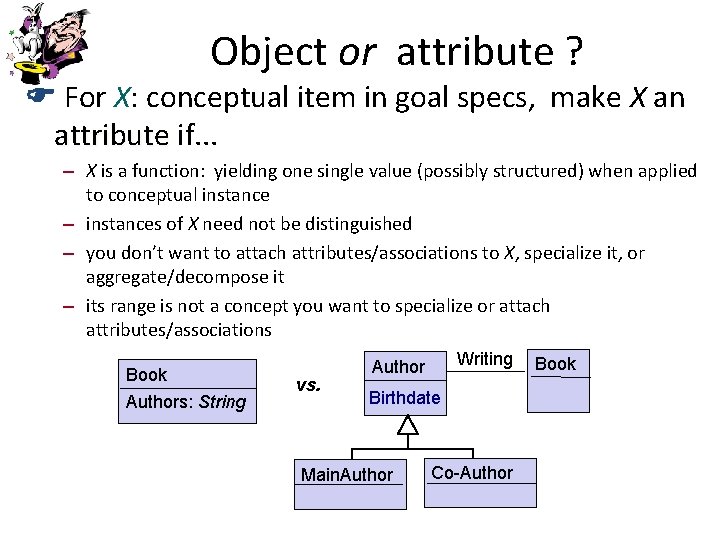
Object or attribute ? F For X: conceptual item in goal specs, make X an attribute if. . . – X is a function: yielding one single value (possibly structured) when applied to conceptual instance – instances of X need not be distinguished – you don’t want to attach attributes/associations to X, specialize it, or aggregate/decompose it – its range is not a concept you want to specialize or attach attributes/associations Book Authors: String vs. Writing Author Birthdate Main. Author Co-Author Book
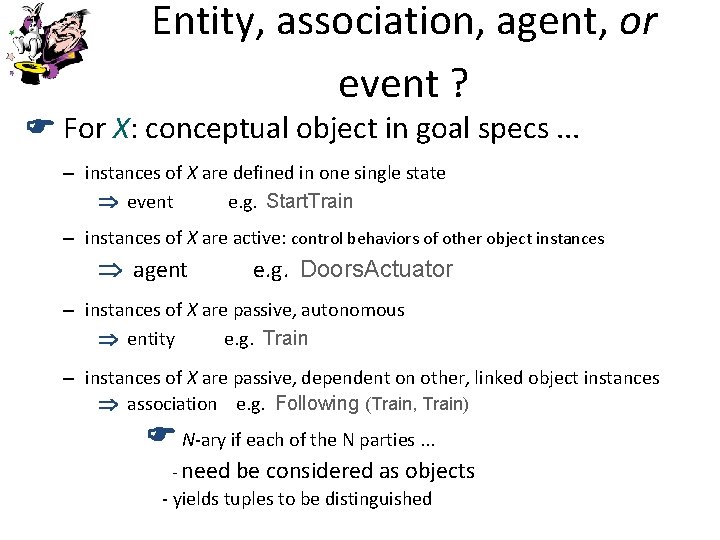
Entity, association, agent, or event ? F For X: conceptual object in goal specs. . . – instances of X are defined in one single state Þ event e. g. Start. Train – instances of X are active: control behaviors of other object instances Þ agent e. g. Doors. Actuator – instances of X are passive, autonomous Þ entity e. g. Train – instances of X are passive, dependent on other, linked object instances Þ association e. g. Following (Train, Train) F N-ary if each of the N parties. . . - need be considered as objects - yields tuples to be distinguished
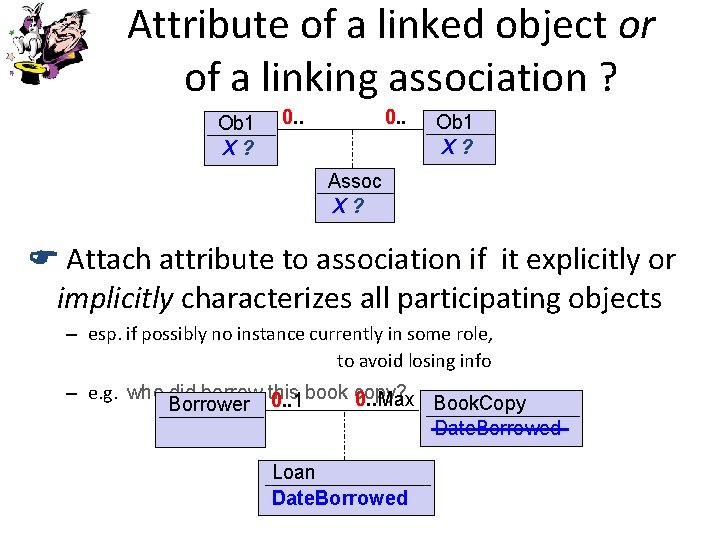
Attribute of a linked object or of a linking association ? Ob 1 X ? 0. . Ob 1 X ? Assoc X ? F Attach attribute to association if it explicitly or implicitly characterizes all participating objects – esp. if possibly no instance currently in some role, to avoid losing info – e. g. who did borrow this book copy? 0. . Max Book. Copy Borrower 0. . 1 Date. Borrowed Loan Date. Borrowed
Aggregation or association ? F For X a structural link between "composite" & "component" objects, make it an association if any of these holds. . . – X has a domain-specific Instance. Of semantics – component & composite objects seem independent • component not subordinate to composite as in composition – attributes or associations need be attached to the link type – in case of doubt e. g. In (Car, Train)
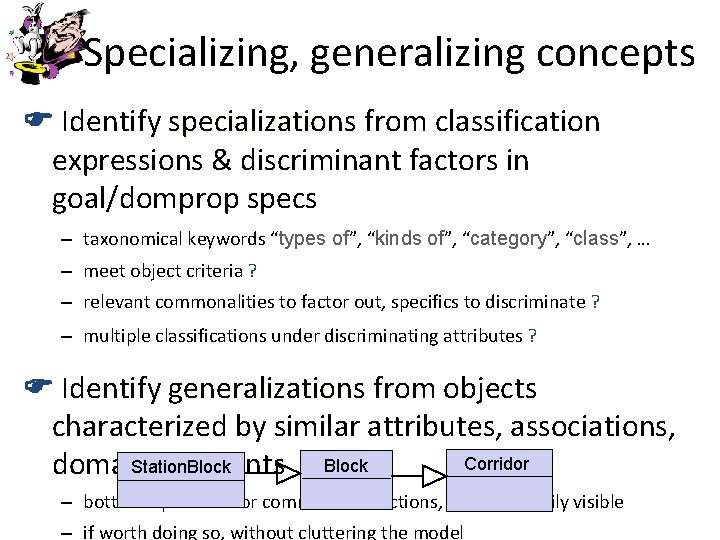
Specializing, generalizing concepts F Identify specializations from classification expressions & discriminant factors in goal/domprop specs – taxonomical keywords “types of”, “kinds of”, “category”, “class”, . . . – meet object criteria ? – relevant commonalities to factor out, specifics to discriminate ? – multiple classifications under discriminating attributes ? F Identify generalizations from objects characterized by similar attributes, associations, Corridor Station. Block domain invariants Block – bottom-up search for common abstractions, not necessarily visible – if worth doing so, without cluttering the model
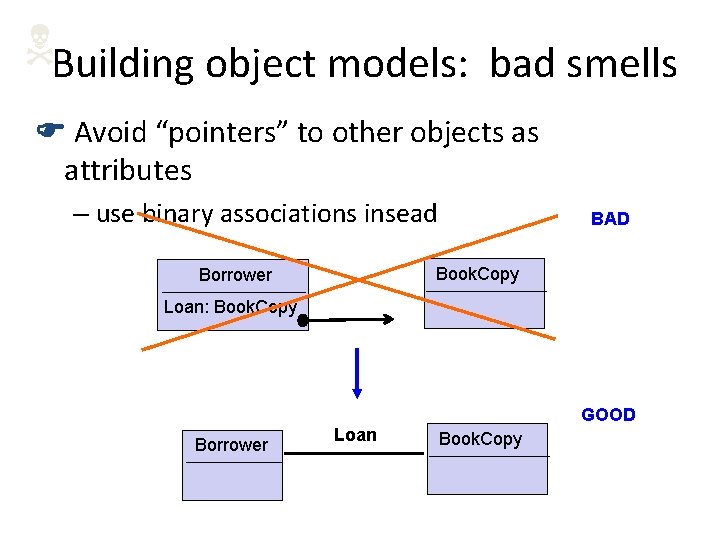
NBuilding object models: bad smells F Avoid “pointers” to other objects as attributes – use binary associations insead Book. Copy Borrower Loan: Book. Copy Borrower BAD Loan GOOD Book. Copy
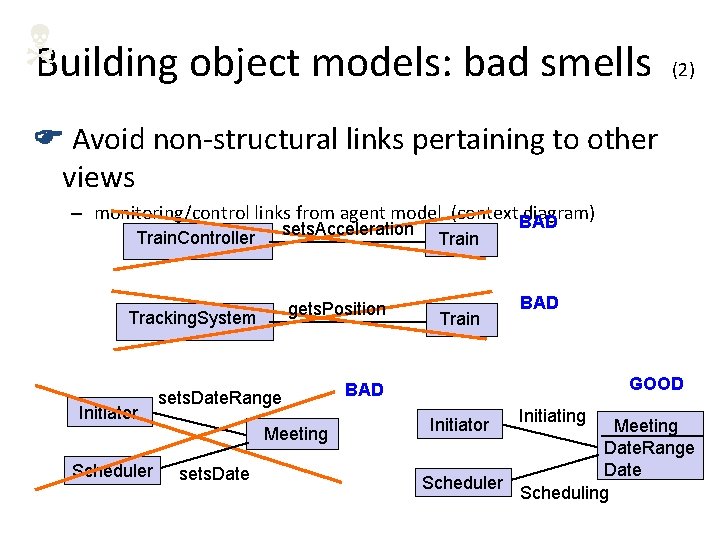
NBuilding object models: bad smells (2) F Avoid non-structural links pertaining to other views – monitoring/control links from agent model (context BAD diagram) Train. Controller sets. Acceleration Train Tracking. System gets. Position Train BAD Initiator sets. Date. Range Meeting Scheduler sets. Date GOOD BAD Initiator Initiating Meeting Date. Range Date Scheduler Scheduling
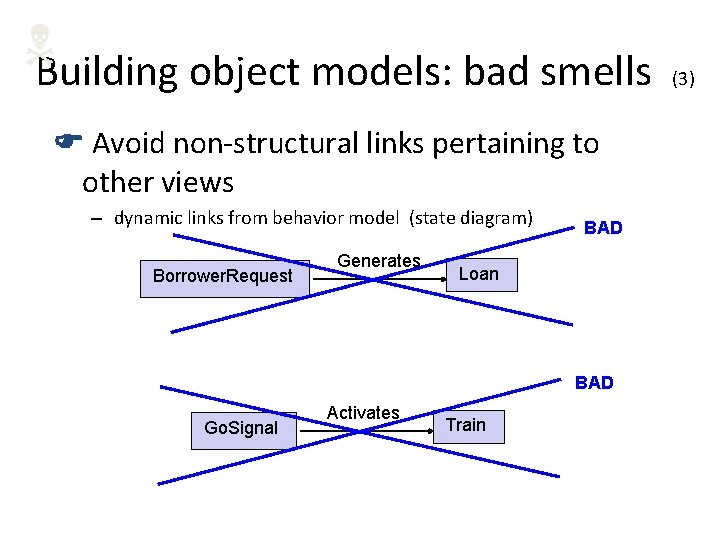
NBuilding object models: bad smells F Avoid non-structural links pertaining to other views – dynamic links from behavior model (state diagram) Borrower. Request Generates BAD Loan BAD Go. Signal Activates Train (3)
NBuilding object models: bad smells F Avoid obscure names for objects & attributes – suggestive shortcut of their annotated definition • don’t forget precise definition! • don’t confuse terms ! e. g. Book vs. Book. Copy – from problem world, NOT implementation-oriented JPEG_File , Book_File Good Picture , Directory Bad – specific, NOT vague Bad Good Person , Form Patron , Registration. Form – commonly used, NOT invented Bad Good Personal. Identification. Card, Conference. Book Student. Card, Proceedings (4)
- Slides: 56