
Building StandardsAligned ReadAlouds Recognizing and Developing Standards Aligned
Building Standards-Aligned Read-Alouds (Recognizing and Developing Standards. Aligned Instructional Sequences) Grades P – 3 ELA Winter 2018 Days 4 and 5

We know from experience the hard work teachers face every day as they strive to help their students meet the challenges set by higher standards. We are dedicated to empowering teachers by providing free, high-quality standards-aligned resources for the classroom, the opportunity for immersive training through our Institute, and the option of support through our website offerings. We are a team of current and former classroom teachers, curriculum writers, school leaders and education experts who have worked in the public, private, and nonprofit sectors. 2
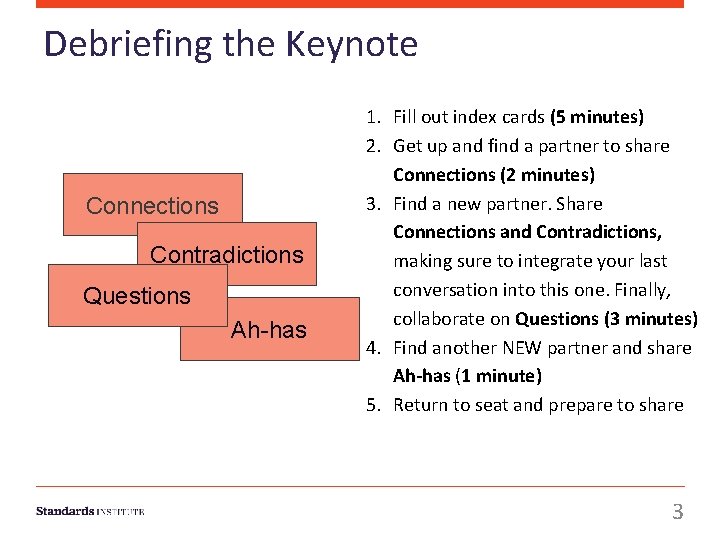
Debriefing the Keynote Connections Contradictions Questions Ah-has 1. Fill out index cards (5 minutes) 2. Get up and find a partner to share Connections (2 minutes) 3. Find a new partner. Share Connections and Contradictions, making sure to integrate your last conversation into this one. Finally, collaborate on Questions (3 minutes) 4. Find another NEW partner and share Ah-has (1 minute) 5. Return to seat and prepare to share 3

Objectives and Agenda I. Evaluating • accurately identify equitable Instructional instructional practice that aligns Practices to shifts and standards II. Reflecting on Equity • apply and identify the shifts in the III. Lunch classroom using the Instructional IV. Analyzing Practice Guide Coaching Tool Instructional (IPG) Practices • confidently select appropriate V. Read Aloud Project text from which to develop rigorous read-alouds to build word and world knowledge Participants will be able to: • 4
Revisiting Equity • Equity is engaging in practices that meet students where they are and advances their learning by giving them what they need. It’s about fairness, not sameness. • Equity ensures that all children – regardless of circumstances – are receiving high-quality and standards-aligned instruction with access to high-quality materials and resources. • We want to ensure that standards-aligned instruction is a pathway to the equitable practices needed to close the gaps caused by systemic and systematic racism, bias, and poverty. • All week, we will explore our learning through an equity lens, and we will capture those moments visibly here in our room. 5

Equity, Language, and Learners 1) Students need well-structured opportunities to practice language to learn it. Amplify, do not simplify, language. 2) Content and language develop inseparably and in integrated ways; language development occurs over time and in a nonlinear manner. 3) Scaffold students toward independence with complex tasks; do not scaffold by simplifying text language and task complexity. 4) We are the gatekeepers of language in the classroom as teachers and leaders. 5) Acquiring the language for the masterful use of standard English in writing and speaking benefits all students. 6) All students bring valuable knowledge and culture to the classroom. 6

Norms that Support Our Learning • Take responsibility for yourself as a learner • Honor timeframes (start, end, activity) • Be an active and hands-on learner • Use technology to enhance learning • Strive for equity of voice • Contribute to a learning environment in which it is “safe to not know” 7

Feedback on Feedback Plus Delta 8
Bringing it Together: A 360 View 1. Evaluate the Text Complexity of Is Summer Break Necessary? 2. View the Video through the lens of student engagement and productive struggle 3. Review the Lesson Plan 4. Discuss: What made this possible? 5. Discuss: Implications for planning and implementation 9
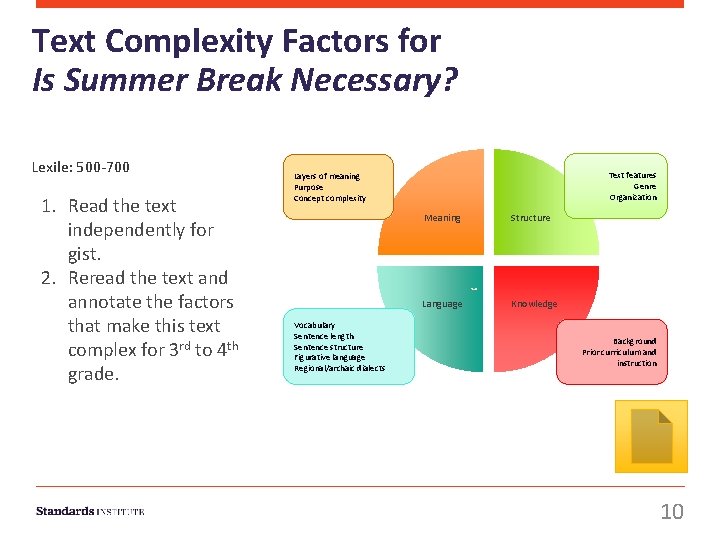
Text Complexity Factors for Is Summer Break Necessary? Lexile: 500 -700 1. Read the text independently for gist. 2. Reread the text and annotate the factors that make this text complex for 3 rd to 4 th grade. Text features Genre Organization Layers of meaning Purpose Concept complexity Vocabulary Sentence length Sentence structure Figurative language Regional/archaic dialects Meaning Structure Language Knowledge Background Prior curriculum and instruction 10
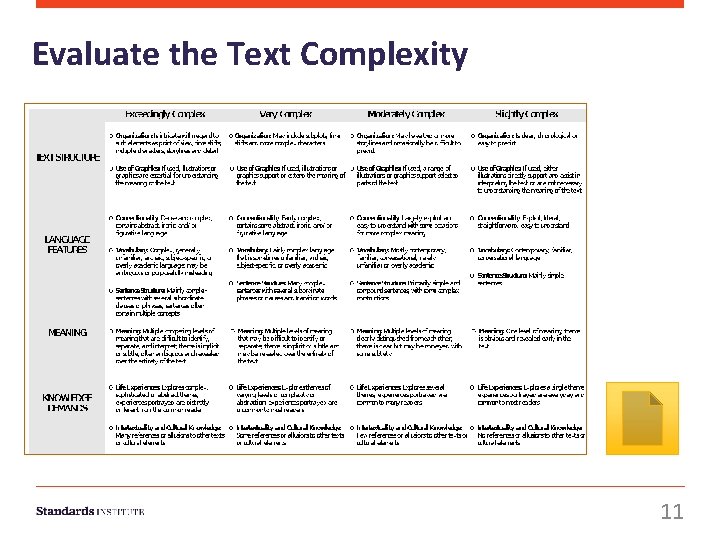
Evaluate the Text Complexity 11
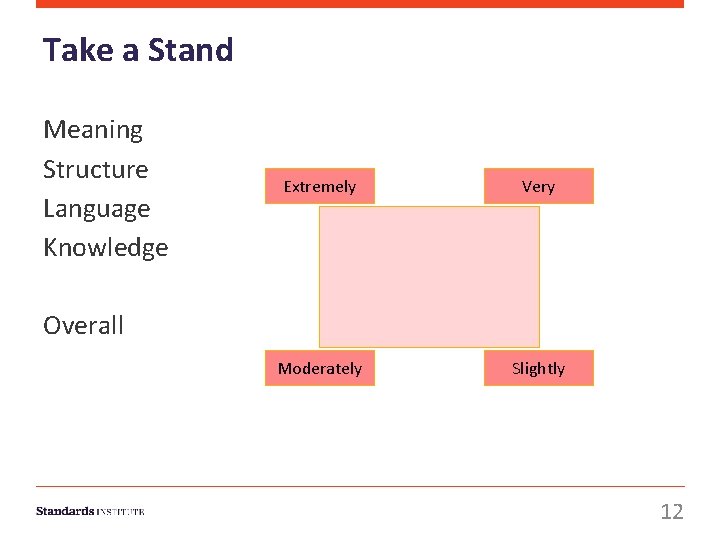
Take a Stand Meaning Structure Language Knowledge Extremely Very Moderately Slightly Overall 12

13
Knowing What You Are Seeing A. The teacher keeps all students persevering with challenging tasks. . . B. The teacher expects evidence and precision from students and probes students’ answers accordingly. . . C. The teacher encourages reasoning and problem solving by posing challenging questions and tasks that offer opportunities for productive struggle. . . D. The teacher demonstrates awareness and appropriate action regarding the variations present in student progress toward reading independently. . . E. When appropriate, the teacher explicitly attends to strengthening students’ language and reading foundational skills. . . 14
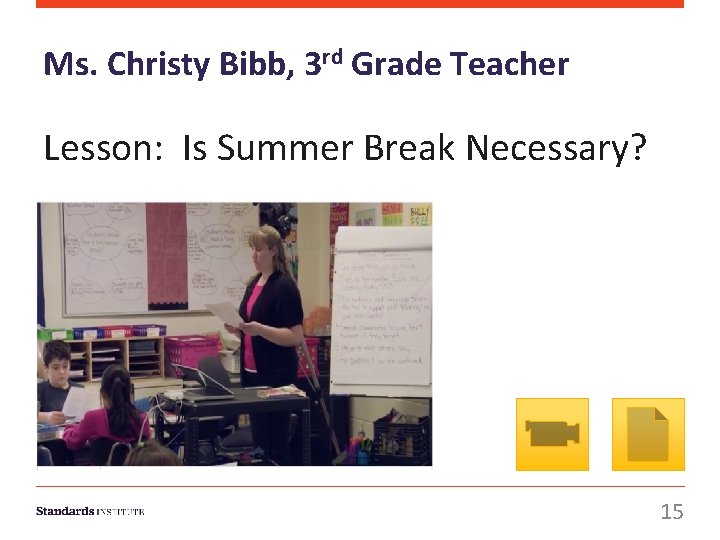
Ms. Christy Bibb, 3 rd Grade Teacher Lesson: Is Summer Break Necessary? 15

Table Discussion • Review your notes and discuss evidence to support your claims for each of the indicators • Be prepared to share with the larger group 16
Write First: Focus on Equity • How does the teacher empower students with language in the classroom? • How does the teacher scaffold students toward independence with complex tasks instead of simplifying text language and task complexity? • How does the teacher provide students with wellstructured opportunities to practice using evidence to support claims? 17
Stronger Every Turn Each time you talk to a partner, you build from and borrow the ideas and language of previous partners. Try to make your answer stronger each time with better and better evidence, examples, and explanations. 5 minutes Bring your notes. Form triads with people you have not yet spent time with. Share and discuss your written reflection with your partners. Jot down ideas that they share that improve your own discussion or you think are important that you did not consider 5 minutes Find a new triad with two new partners. Repeat the process, incorporating your previous partners’ feedback into the conversation where appropriate 2 minutes Revise your notes or reconsider your positions based on the conversations. Be prepared to share out. 18
Morning Take-Aways 19

LUNCH 20
The Instructional Practice Guide (IPG): Design and Structure CCSS Instructional Practice Guides: Coaching – ELA/literacy (K-2 and 3 – 12) – Mathematics (K-8, HS) Each CCSS Instructional Practice Guide: Coaching – Is a tool for a single lesson – Describes 3 – 4 Core Actions online – Each Core Action includes 3 -6 indicators 21
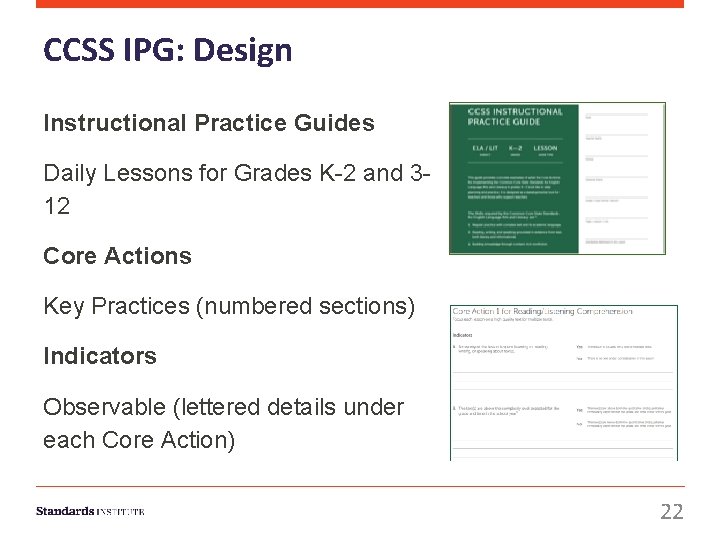
CCSS IPG: Design Instructional Practice Guides Daily Lessons for Grades K-2 and 312 Core Actions Key Practices (numbered sections) Indicators Observable (lettered details under each Core Action) 22
Implications What are the implications for teachers? 23
Partner Share • Find a partner who you have not spoken to much so far this week • Share your favorite read-aloud and why • Be prepared to share your partner’s answer 24
Revisiting Benefits of Read Alouds for Students Take one minute at your table and popcorn out benefits of reading aloud in elementary school 25
Developing A Rigorous Read Aloud For the remainder of our time together, we are going to select a text and develop an instructional read-aloud sequence that encompasses the learning we have done throughout the week. We first are going to select a text worthy of revisiting over several days, then…. • Assess complexity • Identify challenging areas that may require additional support and scaffolds • Create the big idea, key understanding, and synopsis of the text • Make sure it’s accessible to all students 26
How do we begin? Choosing the right book! • Should not be anything students can read on their own • Rule of thumb: 2 -3 years above grade level of class, in some cases can be even more • Worth reading multiple times and able to withstand multiple dives for different purposes! • Rich in opportunities to build knowledge • Rich in opportunities to build vocabulary 27

Building Knowledge • From the standards, “…texts within and across grade levels need to be selected from topics and themes that systematically develop the knowledge base of students. ” • Also from the standards, “Within a grade level, there should be an adequate number of titles on a single topic that would allow students to study that topic for a sustained period. ” • This does not mean the death of Goodnight Moon or Dr. Seuss; but we read those for different purposes. 28

What Makes a Read-Aloud Complex? Text features Genre Organization Layers of meaning Purpose Concept complexity Vocabulary Sentence length Sentence structure Figurative language Regional/archaic dialects Meaning Structure Language Knowledge Background Prior curriculum and instruction 29
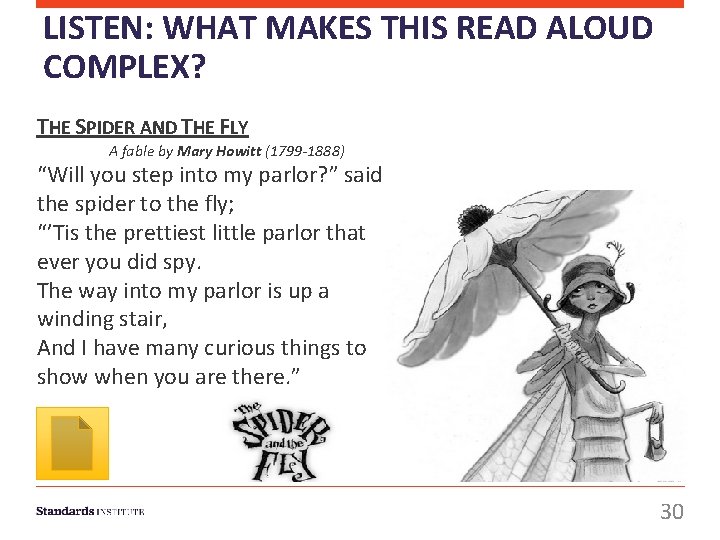
LISTEN: WHAT MAKES THIS READ ALOUD COMPLEX? THE SPIDER AND THE FLY A fable by Mary Howitt (1799 -1888) “Will you step into my parlor? ” said the spider to the fly; “’Tis the prettiest little parlor that ever you did spy. The way into my parlor is up a winding stair, And I have many curious things to show when you are there. ” 30
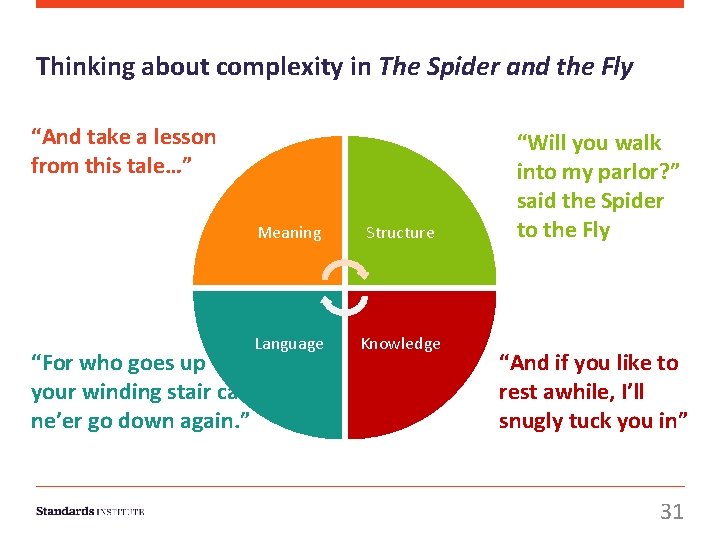
Thinking about complexity in The Spider and the Fly “And take a lesson from this tale…” “For who goes up your winding stair can ne’er go down again. ” Meaning Structure Language Knowledge “Will you walk into my parlor? ” said the Spider to the Fly “And if you like to rest awhile, I’ll snugly tuck you in” 31

Example from The Spider and the Fly LEXILE: Grade 4 -5 Band • SCREEN SHOT OF DIANA’S COMPLETED WHAT MAKES THIS READ ALOUD COMPLEX PAGE 32

Reader and Task Considerations What will challenge my students most in this text? What supports can I provide? The archaic and figurative language structure and vocabulary will be challenging. Support using repeated readings, questions to clarify word meanings and careful attention to how the illustrations and text connect. Build in frequent opportunities for drama and drawing to visualize complex sentences. How will help my students build knowledge about the world? There are several lines and images from this iconic poem that may transfer to other readings later on (”Come into my parlor…” and “He wove a subtle web”) Students familiar with this story and its language will have a basis for understanding expressions and imagery they may encounter later in conversations and literature. Some of these lines and images may be additionally complex for English learners. This book also teaches an important life lesson. 33
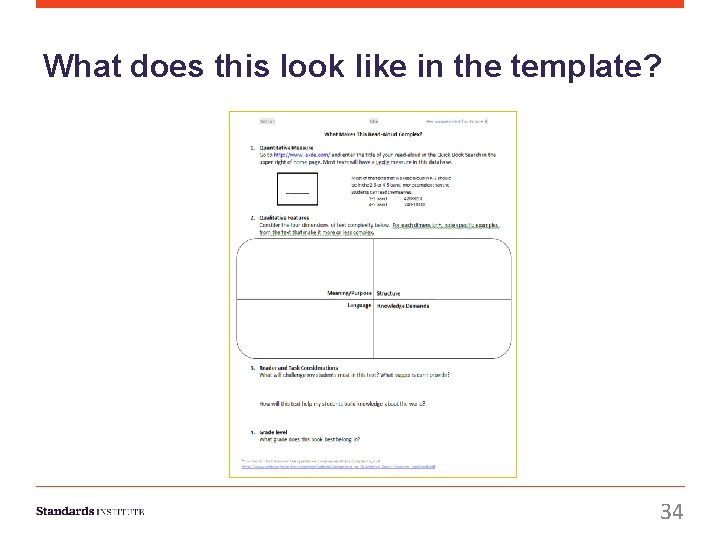
What does this look like in the template? 34

You try! Work with all of the members of your writing team to: 1. Read your book out loud. Enjoy it! 2. Complete the “What Makes This Read-Aloud Complex” page in the template. Refer to Step #1 and #2 on the Checklist 35

Begin with the end in mind. Identify a “Big Idea”… FOCUSING QUESTION: What do I want my students to learn? 36

What’s the Big Idea? • Reverse-engineered or backward-designed • Crucial for creating a sequenced set of questions, activities, and tasks – line of inquiry • Identify the Standard(s) on which you will focus • Critical for creating an appropriate culminating assignment 37
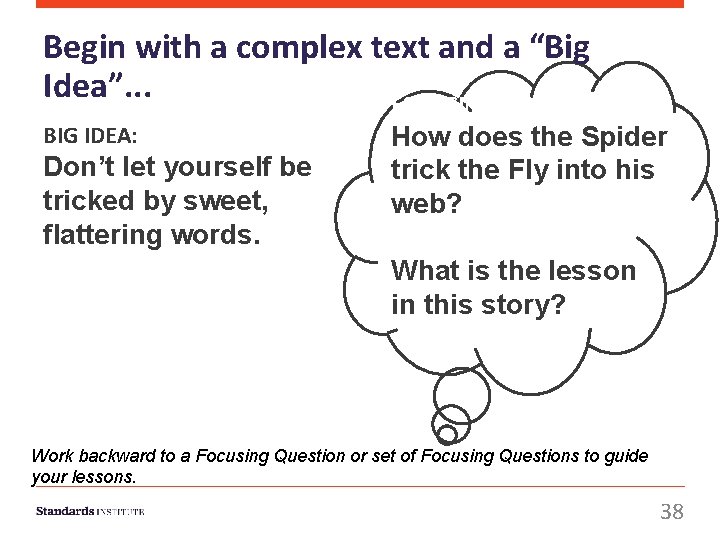
Begin with a complex text and a “Big Idea”. . . FOCUSING QUESTION: BIG IDEA: QUESTION: Don’t let yourself be tricked by sweet, flattering words. How does the Spider trick the Fly into his web? What is the lesson in this story? Work backward to a Focusing Question or set of Focusing Questions to guide your lessons. 38
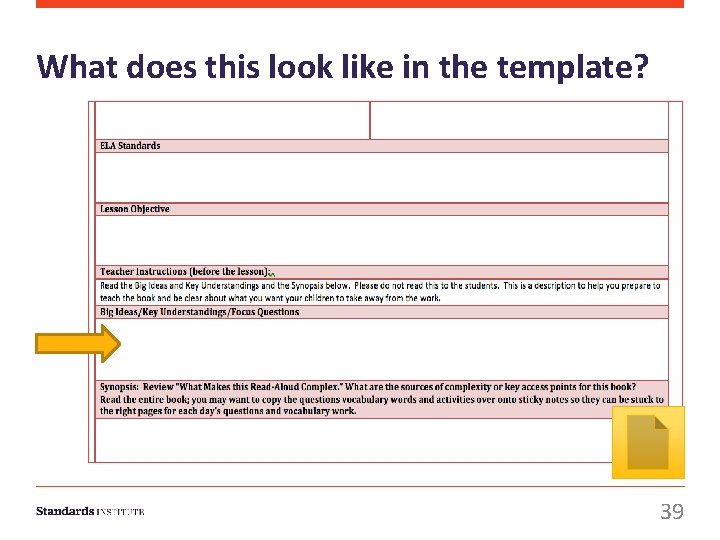
What does this look like in the template? 39

How does the Spider trick the Fly into his web? What is this story trying to teach us? Lesson Objective: Students will listen to an illustrated narrative poem read aloud and use literacy skills (reading, writing, discussing and listening) to understand the central message of the poem. Teacher Instructions: (Before the Lesson) Read the Big Ideas and Key Understandings in the Synopsis below. Please do not read this to the students. This is a description to help you prepare to teach the book and be clear about what you want your students to take away from the work. Big Idea/ Key Understanding/ Focusing Questions: How does the Spider trick the Fly into his web? The spider uses flattery to trick the Fly into his web. What is this story trying to teach us? Don’t let yourself be tricked by sweet, flattering words. 40
You try! Work with all of the members of your writing team to: 1. Come to consensus about the “Big Idea” of your book. 1. Write the Big Idea and Synopsis in the template. Refer to Step #3 on the Checklist 41

42
Begin With the End (and the Standards) in Mind: Creating a Culminating Task How will students show you they understand the “Big Idea”? • Write? • Draw? • Discuss? • Present? 43
Example of a Culminating Task What is “the lesson of this tale”? What is this story trying to teach us? Use pictures and words to show what the author wants us to learn from the story in this book. Circulate as students work, encouraging them to tell you more about their drawings and writing. Share responses in small groups or display on a bulletin board. 44
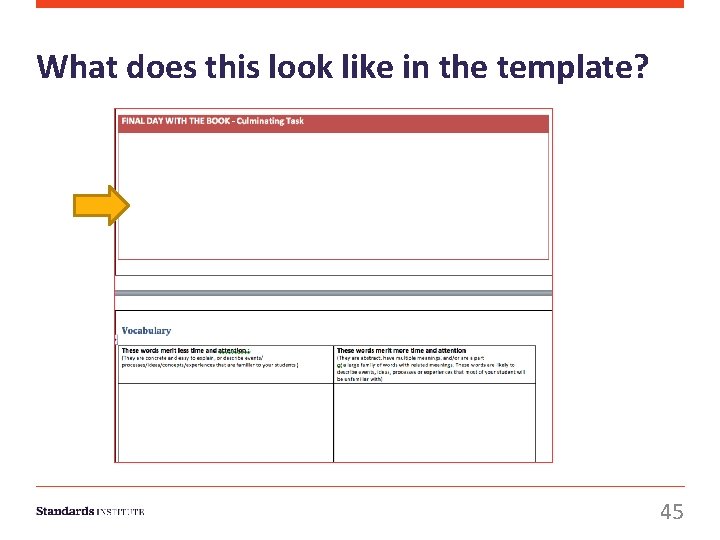
What does this look like in the template? 45

You try! Work with all of the members of your writing team to: 1. Brainstorm possible Culminating Tasks that will show students understand the “Big Idea” of your book. 2. Write the Culminating Task in the template. Refer to Step #4 on the Checklist 46
Now that “the end” is clearly in mind… How do we get there? Go back to the text! 47

A reminder of where we are headed FOCUSING QUESTION: How does the Spider trick the Fly into his web? 48
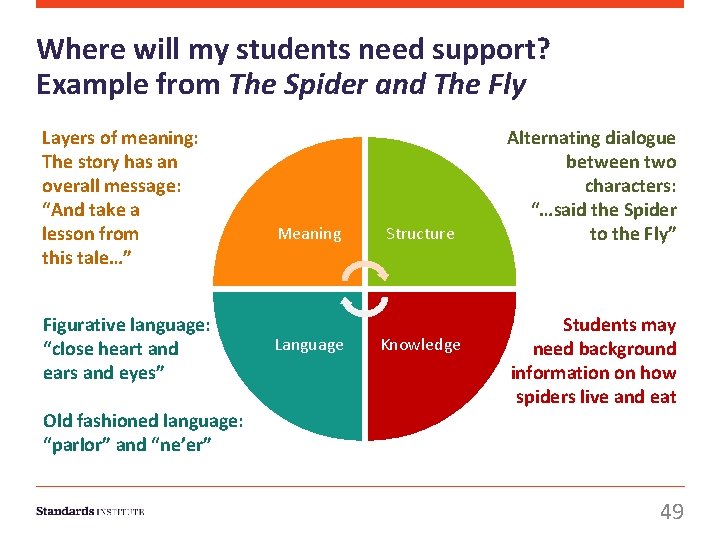
Where will my students need support? Example from The Spider and The Fly Layers of meaning: The story has an overall message: “And take a lesson from this tale…” Figurative language: “close heart and ears and eyes” Old fashioned language: “parlor” and “ne’er” Meaning Language Structure Knowledge Alternating dialogue between two characters: “…said the Spider to the Fly” Students may need background information on how spiders live and eat 49

How can I help students to understand the lesson in the story? Layers of meaning: the lesson in this tale Meaning A Set of Repeating Text-Dependent Questions: • How does the Spider try to trick the Fly? • What does the Fly do? 50
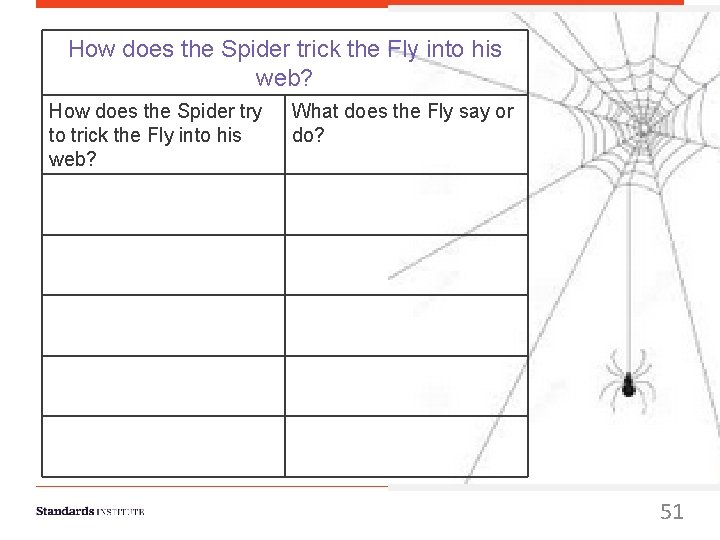
How does the Spider trick the Fly into his web? How does the Spider try to trick the Fly into his web? What does the Fly say or do? 51
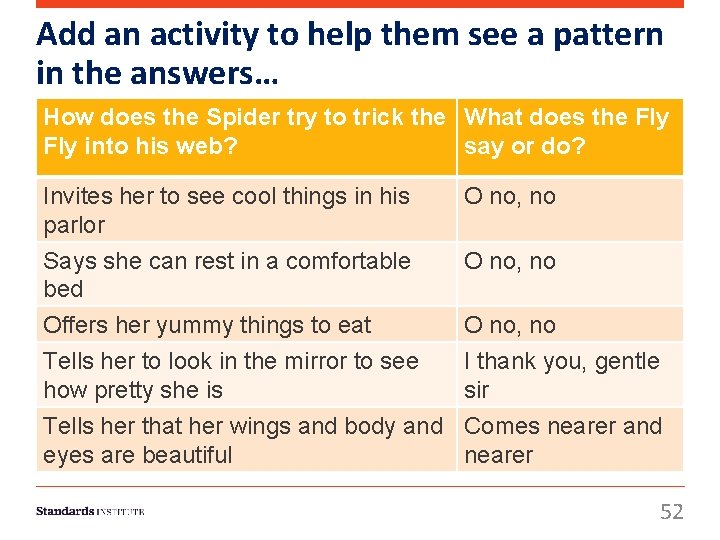
Add an activity to help them see a pattern in the answers… How does the Spider try to trick the What does the Fly into his web? say or do? Invites her to see cool things in his parlor O no, no Says she can rest in a comfortable bed O no, no Offers her yummy things to eat O no, no Tells her to look in the mirror to see how pretty she is I thank you, gentle sir Tells her that her wings and body and Comes nearer and eyes are beautiful nearer 52

Notes can be taken, depending on the grade level and standards • by individual students or by the teacher to record the thinking of the full class • using illustrations or drawings How does the Spider try to trick What does the Fly say or do? the fly into his web? 53
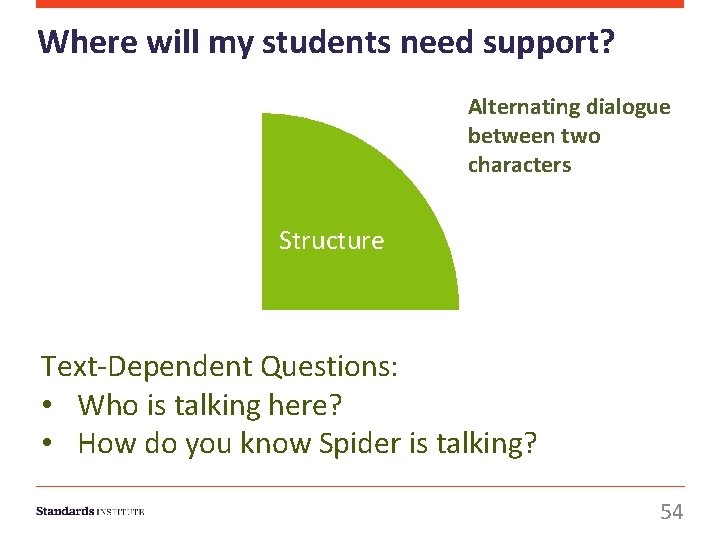
Where will my students need support? Alternating dialogue between two characters Structure Text-Dependent Questions: • Who is talking here? • How do you know Spider is talking? 54

Add an activity to help them “feel” the structure… Hold up your puppet to show me who is talking. http: //diterlizzi. com/home/project/the-spider-and-the-fly/ 55
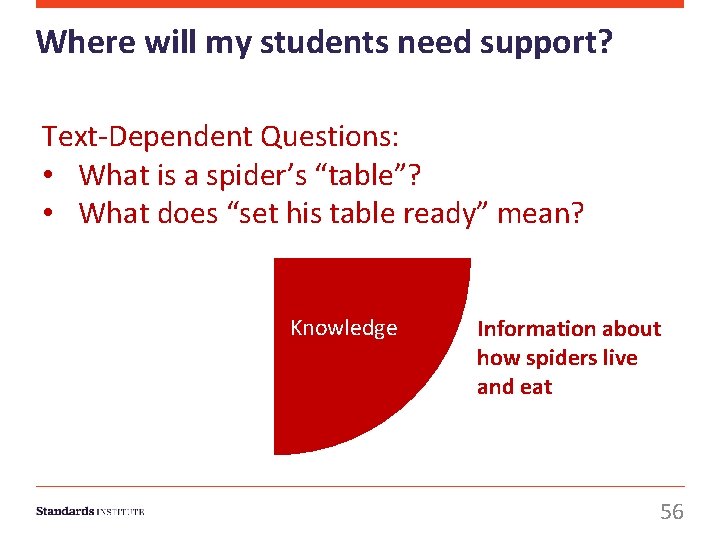
Where will my students need support? Text-Dependent Questions: • What is a spider’s “table”? • What does “set his table ready” mean? Knowledge Information about how spiders live and eat 56
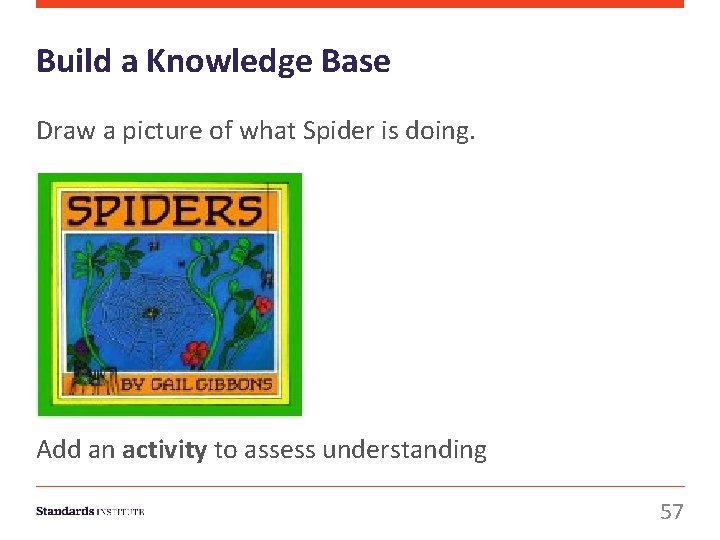
Build a Knowledge Base Draw a picture of what Spider is doing. Add an activity to assess understanding 57
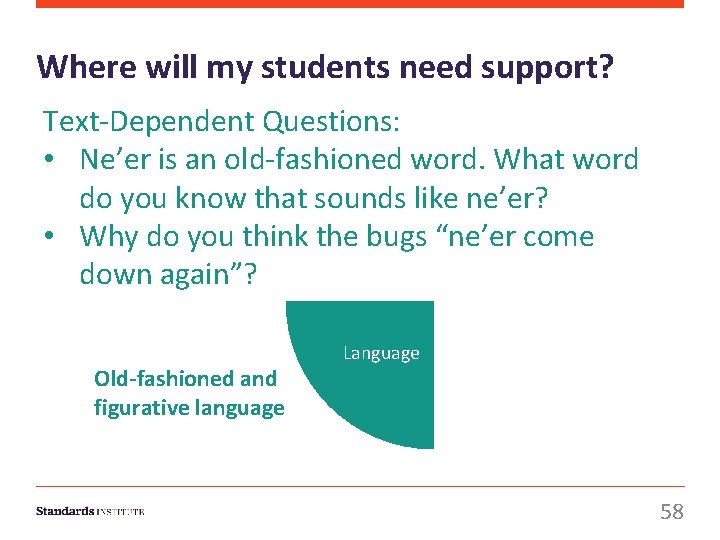
Where will my students need support? Text-Dependent Questions: • Ne’er is an old-fashioned word. What word do you know that sounds like ne’er? • Why do you think the bugs “ne’er come down again”? Old-fashioned and figurative language Language 58
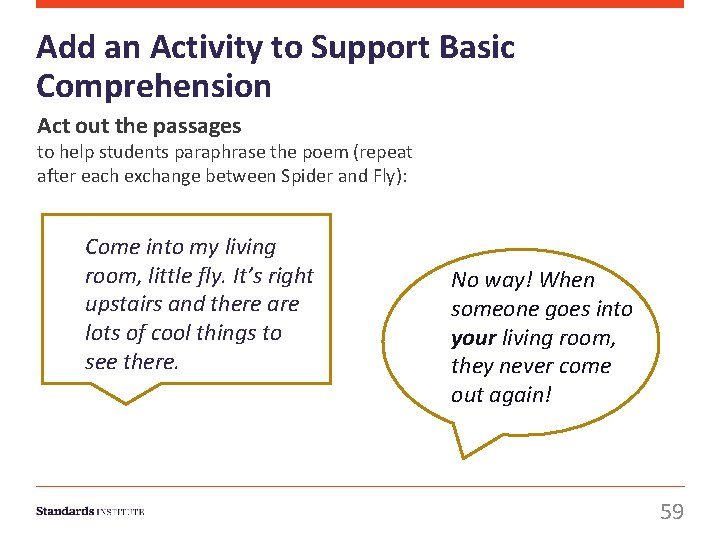
Add an Activity to Support Basic Comprehension Act out the passages to help students paraphrase the poem (repeat after each exchange between Spider and Fly): Come into my living room, little fly. It’s right upstairs and there are lots of cool things to see there. No way! When someone goes into your living room, they never come out again! 59
Emphasize Vocabulary Which words should be taught? • Essential to text • Likely to appear in future texts students will choose or be asked to read Which words should get relatively more time and attention? • Part of semantic word family (grow, grows, grown, growing, growth; mix, mixes, mixed) • Relatively more abstract (symbols, doubt, control) • Refer to an idea, concept, event likely less familiar to many students at that grade level (symbol, “break through”, doubt) 60
Emphasize Vocabulary Which words get relatively less time and attention • Concrete: twirling, huge, • Refer to an idea, concept, event likely more familiar or easy for most students to visualize: circle (verb), tossed, huge, together 61
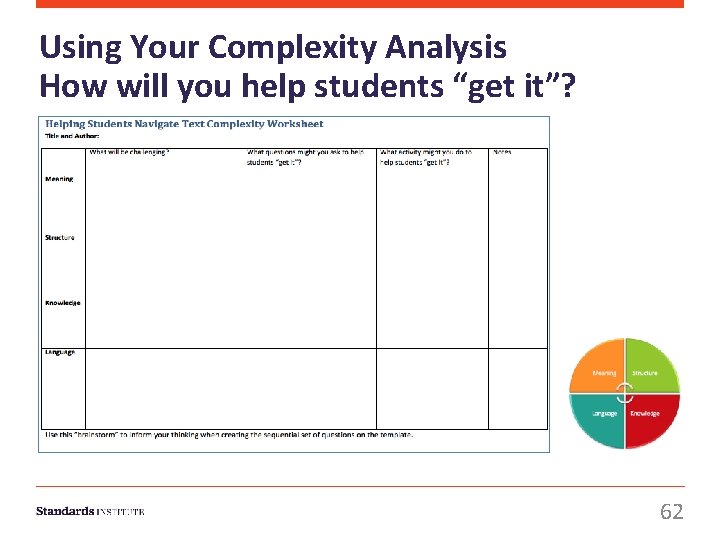
Using Your Complexity Analysis How will you help students “get it”? 62

A Model to Support the Work 63

You try! Work with all of the members of your writing team to: 1. Brainstorm ideas for addressing the complexities you identified. 2. Record your ideas in the “Helping Students Navigate Text Complexity Worksheet”. Refer to Step #5 on the Checklist 64

Reflect How will this type of planning help your students to better understand complex text? 65
Day 4: Objectives Have we met our Objectives? Participants will be able to: • accurately identify equitable instructional practice that aligns to shifts and standards • apply and identify the shifts in the classroom using the Instructional Practice Guide Coaching Tool (IPG) • confidently select appropriate text from which to develop rigorous readalouds to build word and world knowledge 66

We Take Data Seriously Thursday – 10 minute online Knowledge Survey Post-Test. Winter 2018 Post Knowledge Survey 67

Building Standards-Aligned Read-Alouds (Recognizing and Developing Standards. Aligned Instructional Sequences) Grades P – 3 ELA Winter 2018 Day 5

We know from experience the hard work teachers face every day as they strive to help their students meet the challenges set by higher standards. We are dedicated to empowering teachers by providing free, high-quality standards-aligned resources for the classroom, the opportunity for immersive training through our Institute, and the option of support through our website offerings. We are a team of current and former classroom teachers, curriculum writers, school leaders and education experts who have worked in the public, private, and nonprofit sectors. 69
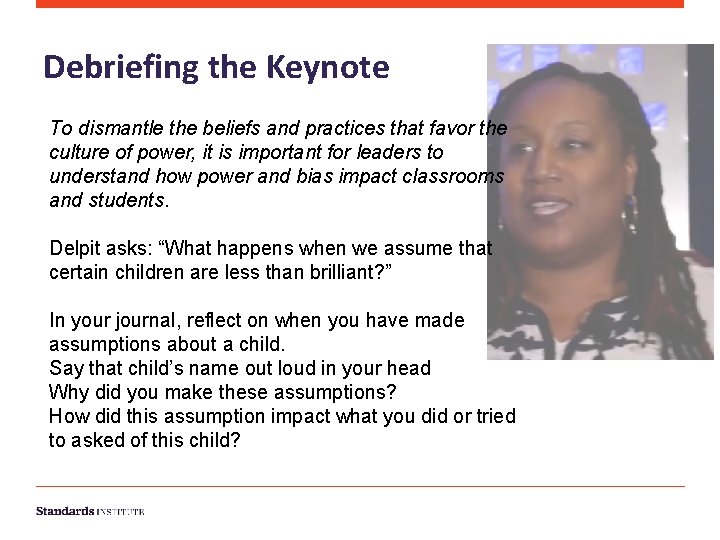
Debriefing the Keynote To dismantle the beliefs and practices that favor the culture of power, it is important for leaders to understand how power and bias impact classrooms and students. Delpit asks: “What happens when we assume that certain children are less than brilliant? ” In your journal, reflect on when you have made assumptions about a child. Say that child’s name out loud in your head Why did you make these assumptions? How did this assumption impact what you did or tried to asked of this child?
Revisiting Equity, Language and Learners 1. The language gap (the gap between the masterful use standard English in speaking and writing) exists for all students, not just English learners and linguistically marginalized students. 2. We are the gatekeepers of language in the classroom as teachers and leaders. 3. All students bring valuable knowledge and culture to the classroom. 4. Scaffold students toward independence with complex tasks; do not scaffold by simplifying text language and task complexity. 5. Content and language develop inseparably and in integrated ways; language development occurs over time and in a nonlinear manner. 6. Students need well-structured opportunities to practice language to learn it. Amplify, do not simplify, language. 71

Norms that Support Our Learning • Take responsibility for yourself as a learner • Honor timeframes (start, end, activity) • Be an active and hands-on learner • Use technology to enhance learning • Strive for equity of voice • Contribute to a learning environment in which it is “safe to not know” 72
Feedback on Feedback Plus Delta 73
Day 5 Objectives and Agenda Participants will be able to: • Create a sequence of text dependent questions, activities, and tasks based on the writing, pictures and features unique to the text that aligned to the ELA Standards. Agenda I. Where we’ve been and what’s up next II. Collaborative Planning III. Share Out • Design a culminating activity aligned to the big idea and key understanding. 74

What have we accomplished so far? RAP: Checklist for Completing the Template √ Check each step as it is completed. Read the book/text closely. What standard does this text align to? Complete the What Makes This Text Complex page. Write the Synopsis and clearly state the Big Ideas, Key Understandings, or Focusing Question in the template. Think about what students will know and do as a result of this read-aloud. Create the Culminating Task. What will students do to show you they understand the Big Idea? Brainstorm ideas for helping students overcome the challenges in reading this complex text by completing the Helping Students Navigate Text Complexity Worksheet. Carefully re-read the book, and divide the book into four or more “chunks” for instruction. Create a sequence of questions, activities, and tasks in the template. While working, identify and categorize vocabulary using the Vocabulary table in the template (Note: this can be done while creating text dependent questions, or while rereading the text solely for vocabulary). 75
Preparing to Complete the Template Break the text down into manageable “chunks” for rereading. With your group, reread the text, dividing it into four (or more) logical sections for instruction. Refer to Step #6 on the Checklist 76
And finally… Design the sequence of text-dependent questions and activities that will lead students to a deeper understanding of the text and your “Big Idea”. Make sure these questions either all build to a specific standard in its entirety, or address a diversity of standards. Keep in mind the importance of language amplification for English learners. 77
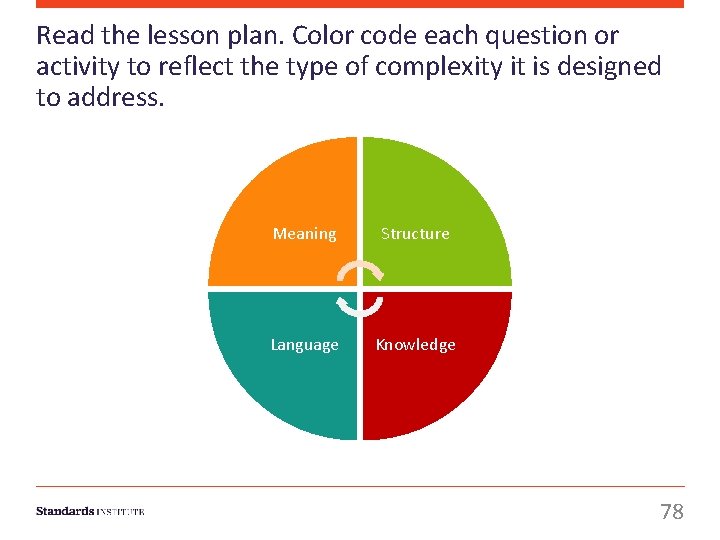
Read the lesson plan. Color code each question or activity to reflect the type of complexity it is designed to address. Meaning Structure Language Knowledge 78

Putting It All Together in the Template FIRST READING: Questions/Activities/Vocabulary/Tasks Pull the students together or use a document camera so that all can enjoy the illustrations. Read aloud the entire book with minimal interruption. Since the poem is written as a dialogue between the Spider and the Fly, consider pulling in a second reader and taking parts, or reading in two distinct voices. After the first reading, have each student create two stick puppets, one of Spider and one of Fly to use during subsequent readings. 79 Expected Outcome or Response (for each) The goal here is for students to enjoy the book – the words, the rhythm and the pictures, and to experience it as a whole. Don’t be concerned if students understand very little on this first reading. The idea is to give them some context and a sense of the characters and story before they dive into examining parts of the book more carefully. Puppets are downloadable from the author’s website http: //diterlizzi. com/home/project/thespider-and-the-fly/, or can be drawn by the students and attached to popsicle sticks.

Text-Dependent Questions, Activities, and Tasks • • Pull students back to the text. • Focus on word, sentence, and paragraph, as well as larger ideas, themes, or events. • Focus on difficult portions of text in order to enhance reading proficiency. • Lead students to a larger understanding – often culminate in prompts for writing or discussion. • Clearly align to specific standards. Can be literal (checking for understanding) but must also involve analysis, synthesis, evaluation. 80
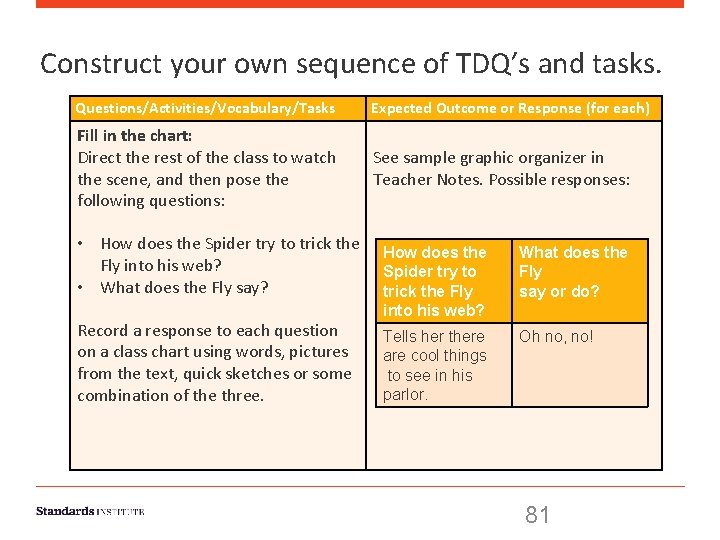
Construct your own sequence of TDQ’s and tasks. Questions/Activities/Vocabulary/Tasks Expected Outcome or Response (for each) Fill in the chart: Direct the rest of the class to watch the scene, and then pose the following questions: See sample graphic organizer in Teacher Notes. Possible responses: • How does the Spider try to trick the Fly into his web? • What does the Fly say? Record a response to each question on a class chart using words, pictures from the text, quick sketches or some combination of the three. How does the Spider try to trick the Fly into his web? What does the Fly say or do? Tells her there are cool things to see in his parlor. Oh no, no! 81

What does this look like in the template? 82

You try! Work with all of the members of your writing team to: 1. Develop a series of text-specific questions, activities, tasks, and vocabulary. 2. This will take quite a bit of time… 3. Be sure to capture your ideas in the template. Refer to Step #7 on the Checklist 83

Morning Take-Aways What do you now know that you did not know before? What do you now think that you did not think before? What will you now do that you did not do before? 84

LUNCH 85

Let’s Share! • Book • Big Idea • Standard Focus • Culminating Task • Questions/Activities to Address Complexity • Meaning, Language, Structure, Knowledge • Strongest Sequence of Questions 86

The Standards 87
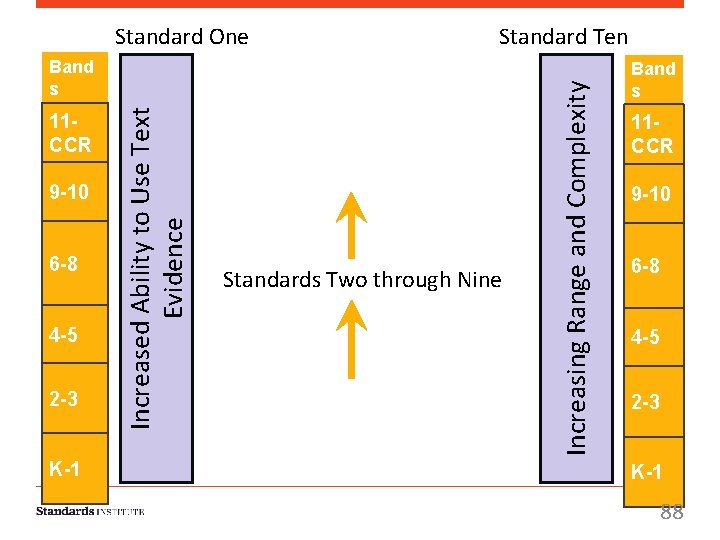
Standard Ten 11 CCR 9 -10 6 -8 4 -5 2 -3 K-1 Increased Ability to Use Text Evidence Band s Standards Two through Nine Increasing Range and Complexity Standard One Band s 11 CCR 9 -10 6 -8 4 -5 2 -3 K-1 88

Tools for Both/And Elements of Aligned Instruction • Fluency Guides • Fluency Rubric • 44 Sounds / 150 Spellings Table • Juicy Sentence Process • Creating Text Dependent Questions Handout • Complexity Wheel • Read Aloud Project • What else will help you? 89

Day 5: Have we met the Objectives? Participants will be able to: • Create a sequence of text dependent question, activities, and task based on the writing, pictures and features unique to the text that aligned to the ELA Standards. • Design a culminating activity aligned to the big idea and key understanding. 90

Feedback Please fill out the survey located here: www. standardsinstitutes. org • Click “Winter 2018” on the top of the page. • Click “Details” on the center of the page. 91

Image Credits Slide 26 -28: Amy. Rudat Slide 39: VWC Slide 40: Amy Rudat Slide 47: http: //diterlizzi. com/home/project/the-spider-and-the-fly/ 92
- Slides: 92