
Building Science Principles of Light What is Light
Building Science Principles of Light
What is Light • Light is energy in the form of particular wavelengths of electromagnetic radiation • Light is detected by the human sense of sight • The effect depends on the sensitivity of the eye • Light radiates in three dimensions
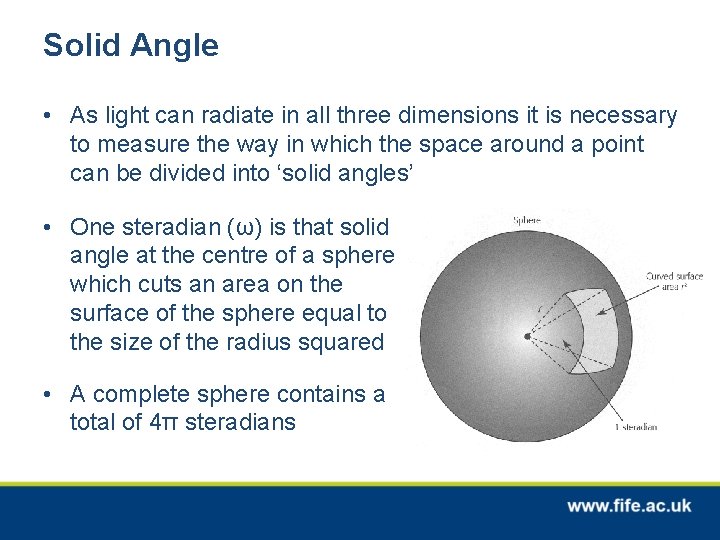
Solid Angle • As light can radiate in all three dimensions it is necessary to measure the way in which the space around a point can be divided into ‘solid angles’ • One steradian (ω) is that solid angle at the centre of a sphere which cuts an area on the surface of the sphere equal to the size of the radius squared • A complete sphere contains a total of 4π steradians

Luminous Intensity (I) • The power of a light source, or illuminated surface to emit light in a particular direction • Used to compare different light sources and measure their ‘strength’ • Unit: candela (cd) • 1 candela is approximately the same as 1 candlepower • 100 candela is approximately the same as 100 w bulb
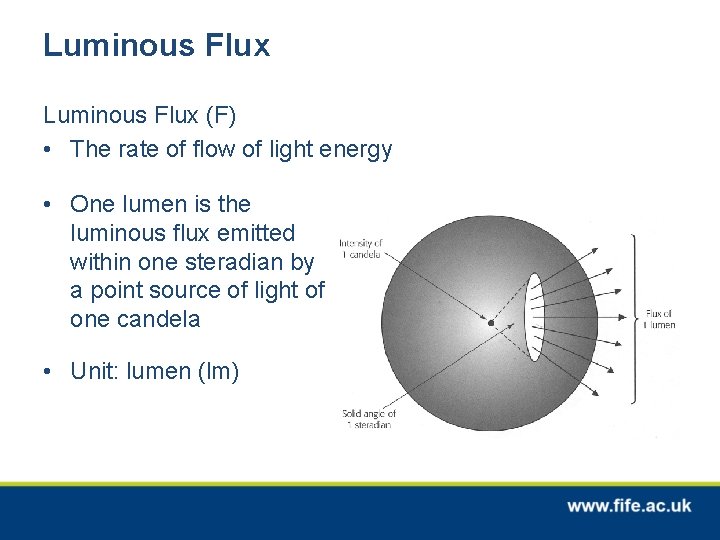
Luminous Flux (F) • The rate of flow of light energy • One lumen is the luminous flux emitted within one steradian by a point source of light of one candela • Unit: lumen (lm)
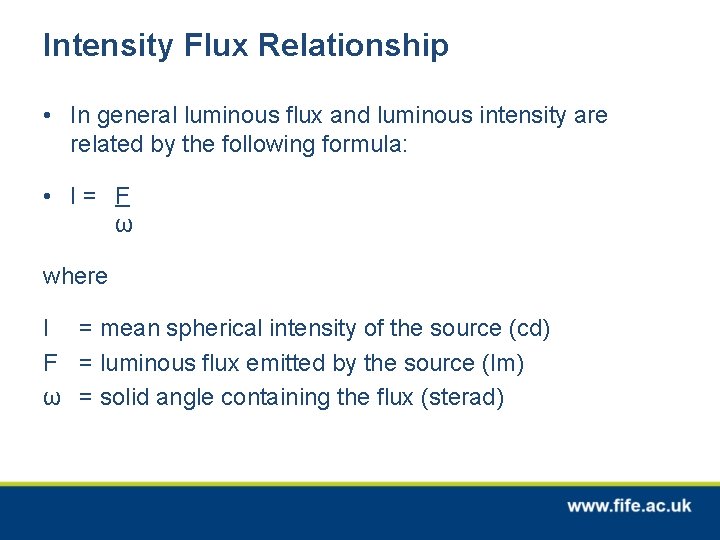
Intensity Flux Relationship • In general luminous flux and luminous intensity are related by the following formula: • I= F ω where I = mean spherical intensity of the source (cd) F = luminous flux emitted by the source (lm) ω = solid angle containing the flux (sterad)

Intensity Flux Relationship • In the common case of a point source emitting flux in all directions, the total solid angle around the point is 4π steradians • Substitute the value of 4π and rearranging the formula • I= F ω 4π • F = I x 4π
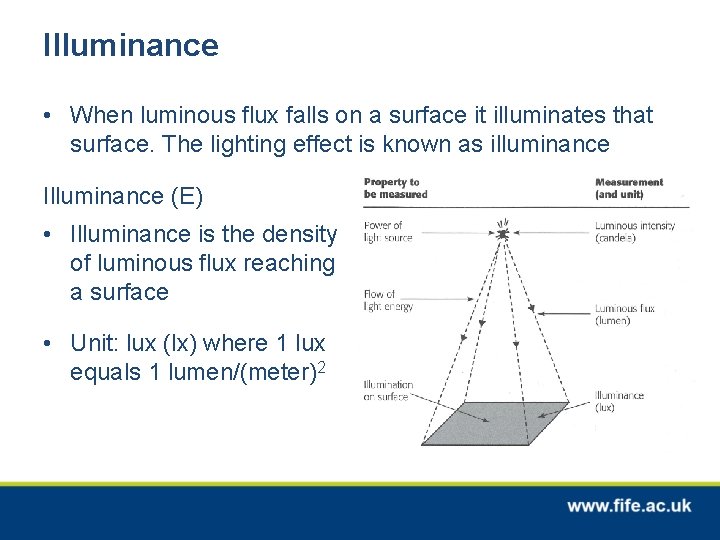
Illuminance • When luminous flux falls on a surface it illuminates that surface. The lighting effect is known as illuminance Illuminance (E) • Illuminance is the density of luminous flux reaching a surface • Unit: lux (lx) where 1 lux equals 1 lumen/(meter)2
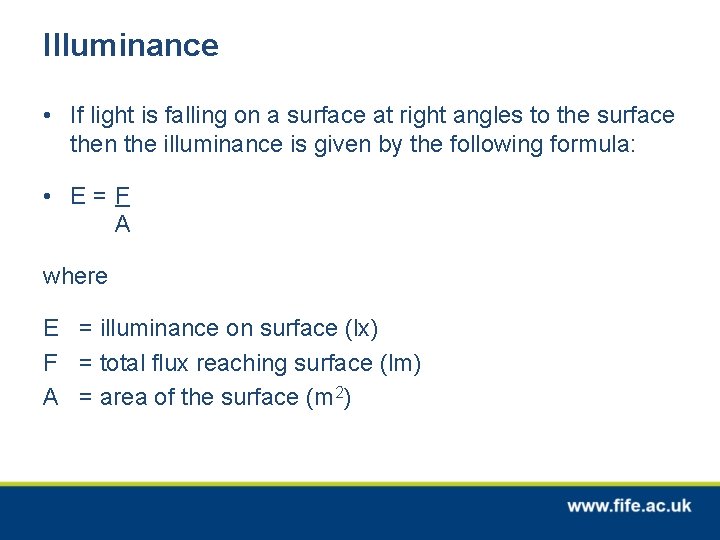
Illuminance • If light is falling on a surface at right angles to the surface then the illuminance is given by the following formula: • E=F A where E = illuminance on surface (lx) F = total flux reaching surface (lm) A = area of the surface (m 2)

Illuminance Values Typical Environment Lighting Value (lx) Moonlight 0. 1 Street Lighting 10 Low Domestic Lighting 50 Office Lighting 300 Overcast Day 100 Bright Daylight 50, 000 Direct Sunlight 100, 000

Luminous Flux / Illuminance Example A small source of light has a mean spherical intensity of 100 cd. One-quarter of the total flux emitted from the source falls at right angles onto a surface measuring 3 m by 0. 7 m. Calculate a) the total luminous flux given out by the source; and b) the illuminance produced on the surface I = 100 cd ω = 4π Using the formula for intensity and substituting F=?
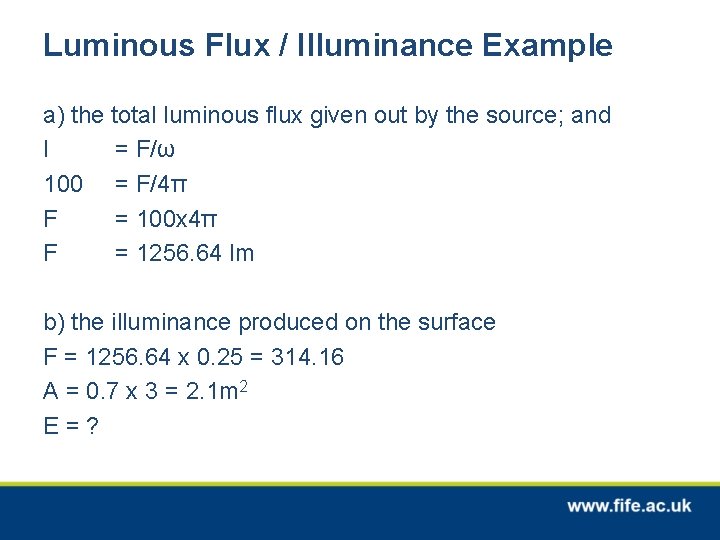
Luminous Flux / Illuminance Example a) the total luminous flux given out by the source; and I = F/ω 100 = F/4π F = 100 x 4π F = 1256. 64 lm b) the illuminance produced on the surface F = 1256. 64 x 0. 25 = 314. 16 A = 0. 7 x 3 = 2. 1 m 2 E=?
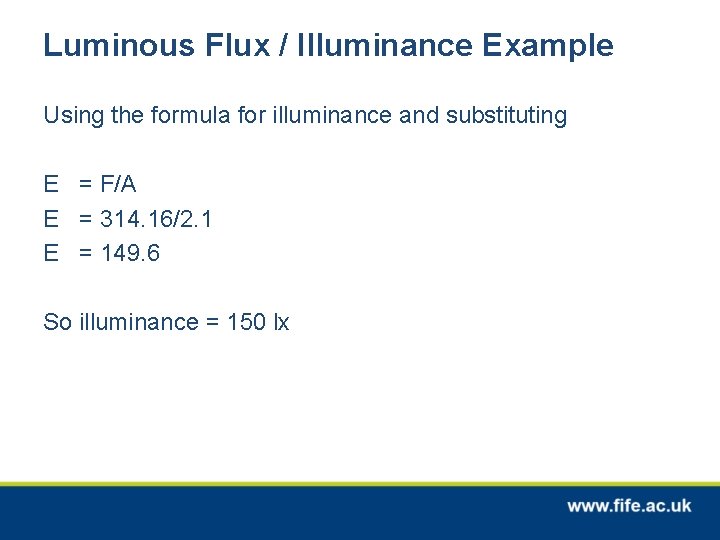
Luminous Flux / Illuminance Example Using the formula for illuminance and substituting E = F/A E = 314. 16/2. 1 E = 149. 6 So illuminance = 150 lx
- Slides: 13