
Building Resilience and Selfesteem Part 1 Security Aims
Building Resilience and Self-esteem Part 1 - Security
Aims of this session To develop an understanding of: • What we mean by resilience • The importance of security and key relationships • Techniques to support the development of relationships
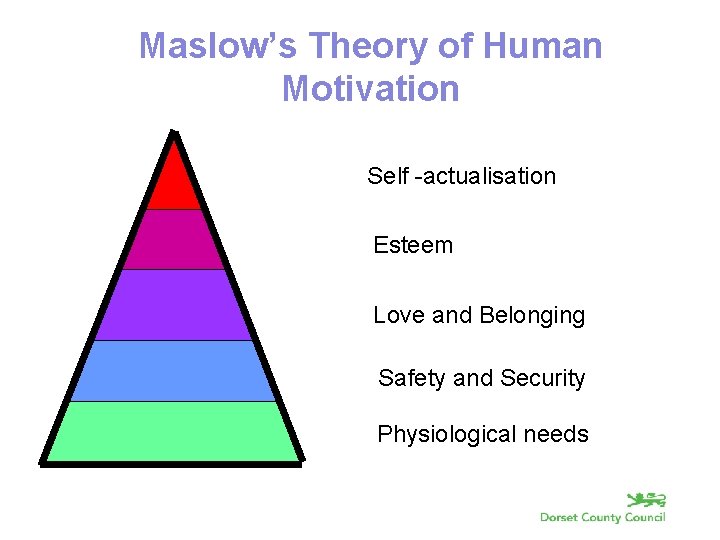
Maslow’s Theory of Human Motivation Self -actualisation Esteem Love and Belonging Safety and Security Physiological needs
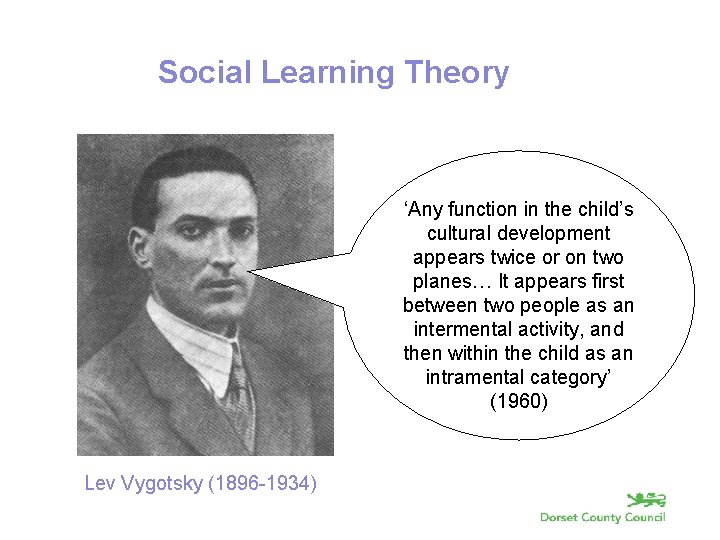
Social Learning Theory ‘Any function in the child’s cultural development appears twice or on two planes… It appears first between two people as an intermental activity, and then within the child as an intramental category’ (1960) Lev Vygotsky (1896 -1934)
Activity What is resilience?
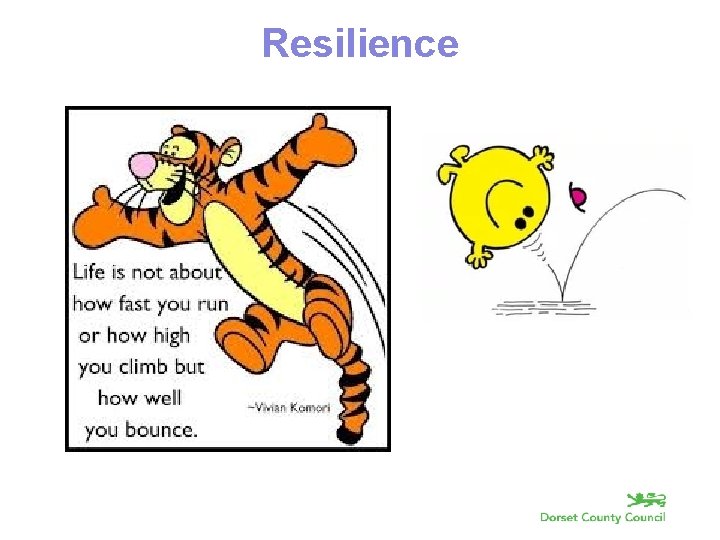
Resilience
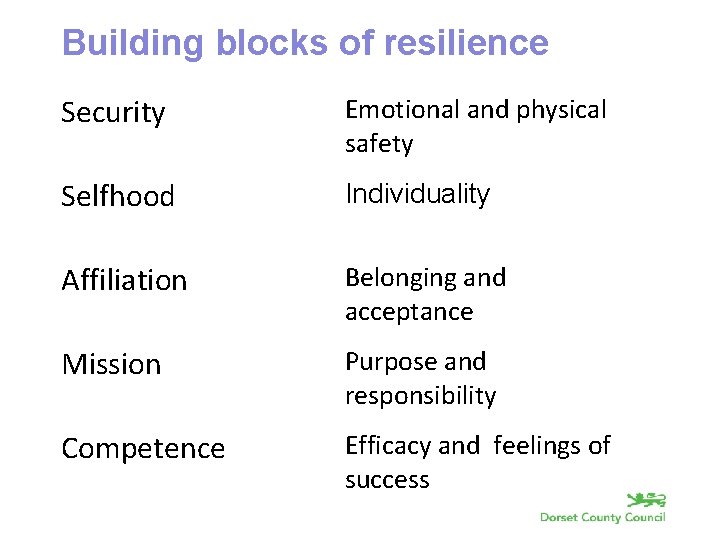
Building blocks of resilience Security Emotional and physical safety Selfhood Individuality Affiliation Belonging and acceptance Mission Purpose and responsibility Competence Efficacy and feelings of success
What do we mean by security ? In pairs discuss what we mean by security in terms of: - Physical security - Emotional security What can we do to help develop a sense of security?
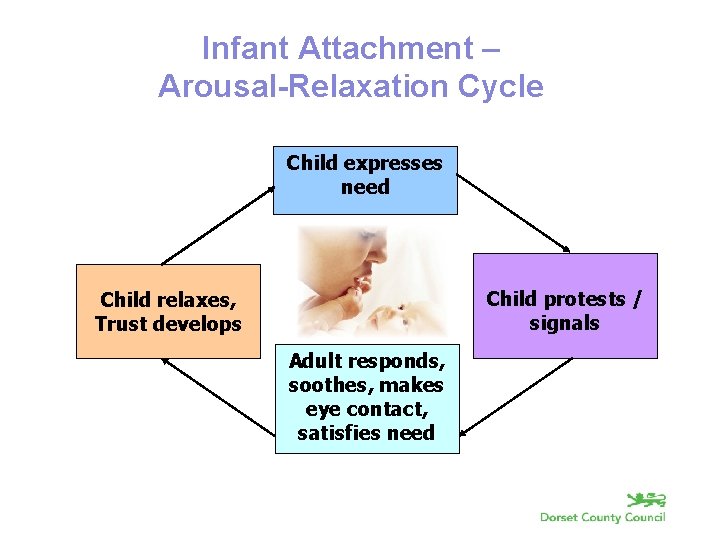
Infant Attachment – Arousal-Relaxation Cycle Child expresses need Child protests / signals Child relaxes, Trust develops Adult responds, soothes, makes eye contact, satisfies need
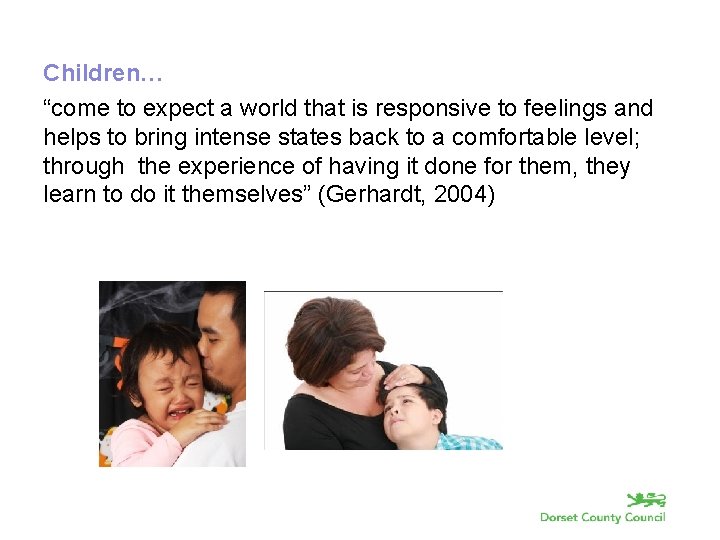
Children… “come to expect a world that is responsive to feelings and helps to bring intense states back to a comfortable level; through the experience of having it done for them, they learn to do it themselves” (Gerhardt, 2004)
When things go well in the relationship, the infant develops a internal working model… • of himself as lovable, special, competent, and able to make an impact on the world • of others as being loving, caring, responsive and trustworthy • of the world as a safe exciting place to explore
Attachment Behaviour ‘Attachment behaviour’ is any behaviour designed to get children into a close and protective relationship with their attachment figure when they experience anxiety, fear or distress.
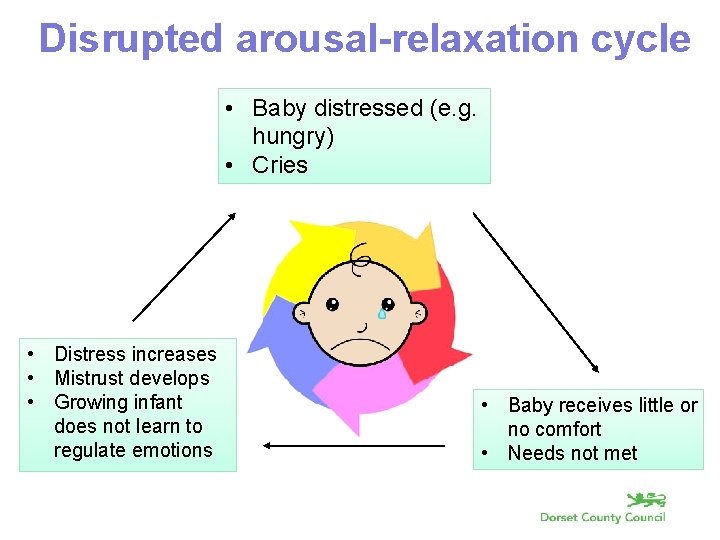
Disrupted arousal-relaxation cycle • Baby distressed (e. g. hungry) • Cries • Distress increases • Mistrust develops • Growing infant does not learn to regulate emotions • Baby receives little or no comfort • Needs not met
When things do not go well in the relationship, the infant develops an inner representation… • of himself as unlovable and incompetent • of others as uncaring and untrustworthy • of the world as unsafe and full of threat
The impact of stress The instinctive stress responses, which are controlled by the ‘primitive brain’, are to: – Face it and fight (FIGHT) – Flee from a dangerous situation (FLIGHT) – To FREEZE
The impact of chronic stress over time • When a child experiences regular, high levels of stress, the brain stem triggers the release of high levels of cortisol • If stress continues, the brain stem becomes enlarged and triggers even greater levels of cortisol • This makes the child over-react to even mild stress and can lead to hyperactivity and the development of behaviour problems • The brain becomes “wired for stress”
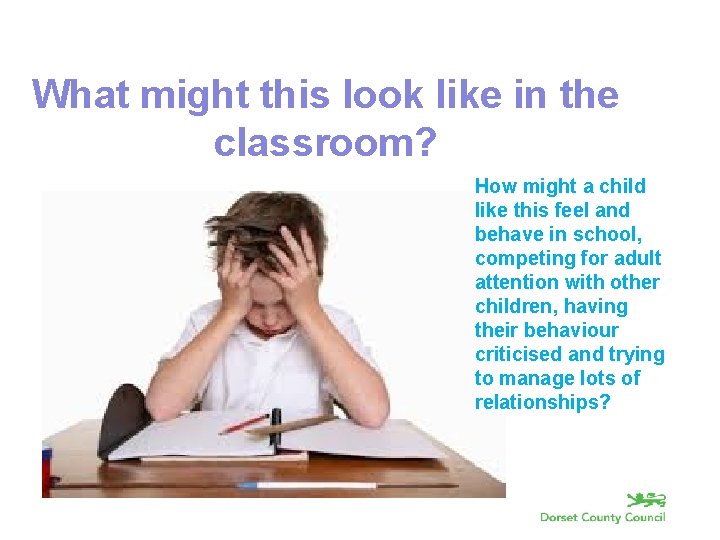
What might this look like in the classroom? How might a child like this feel and behave in school, competing for adult attention with other children, having their behaviour criticised and trying to manage lots of relationships?
The ‘good enough’ relationship Research shows that brain development is not static. “It is encouraging to know that neurons can grow in the pre-frontal cortex at any stage of life in the presence of a ‘good enough’ relationship with someone. Education can play a significant part in this growth if adequate support and information is available. ” (Louise Bomber, 2004)
How to build security § Activity (3/4 s) § How could you help a child who is insecure begin to trust you?
Relationships The key approach is to help the child to develop relationships of trust over time Enabling the child to experience “unconditional positive regard”
Developing empathy and social skills • Disapproving faces trigger stress hormones that prevent the generation of pleasurable feelings (Score, 2006). Traumatised children are always ‘on guard’, their normality is a state of high arousal that could leave them unable to think straight, liable to misread a troubled expression on an adult’s face as anger and disapproval, and suffering shame at their lack of control. • The brain has to experience empathy in order to show it.
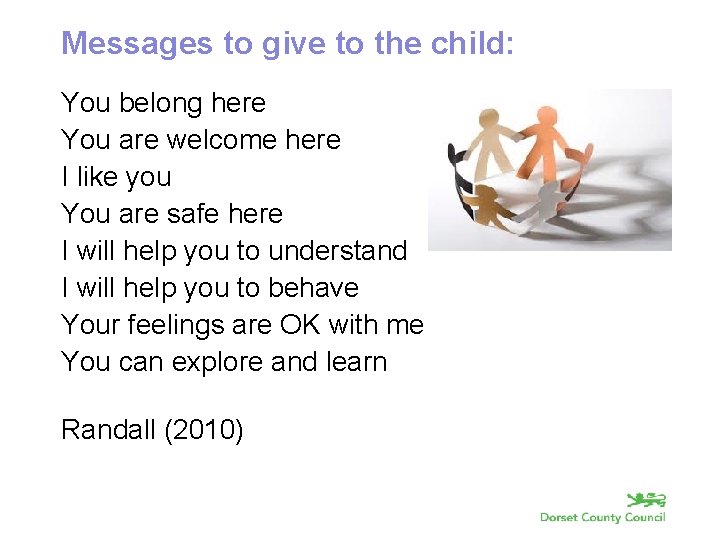
Messages to give to the child: You belong here You are welcome here I like you You are safe here I will help you to understand I will help you to behave Your feelings are OK with me You can explore and learn Randall (2010)
Activity In pairs consider and share information about a child you are working with who needs to develop a sense of security. • From this identify a SMART target • How could you measure change? • Feedback

Learning triangle (Geddes, 2006) In any learning experience, there is a triangle between teacher, pupil and task. Pupil Adult Task Some children find it difficult to trust adults and will want to focus on the task. • A shared focus on the task can be less threatening to the pupil Some children find it difficult to focus on the task and are preoccupied with maintaining adult attention. The task should be broken down into small steps These children need repeated reminders they are being held in mind by the adult
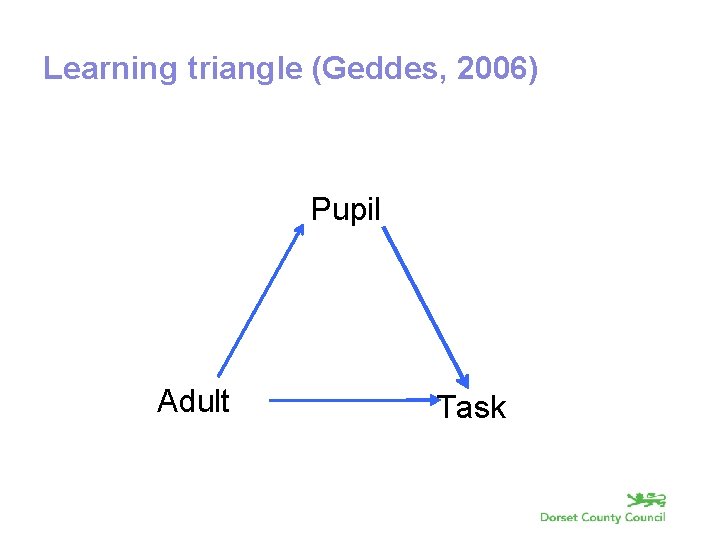
Learning triangle (Geddes, 2006) Pupil Adult Task
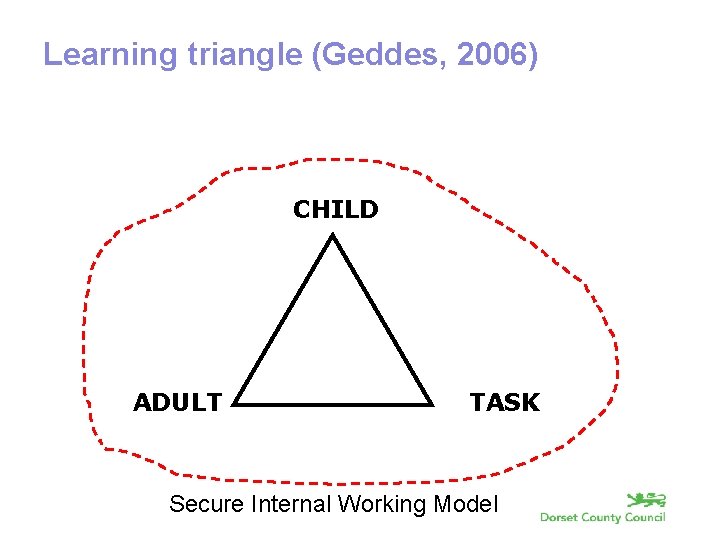
Learning triangle (Geddes, 2006) CHILD ADULT TASK Secure Internal Working Model

Insecure Internal Working Model 1 PUPIL TEACHER TASK
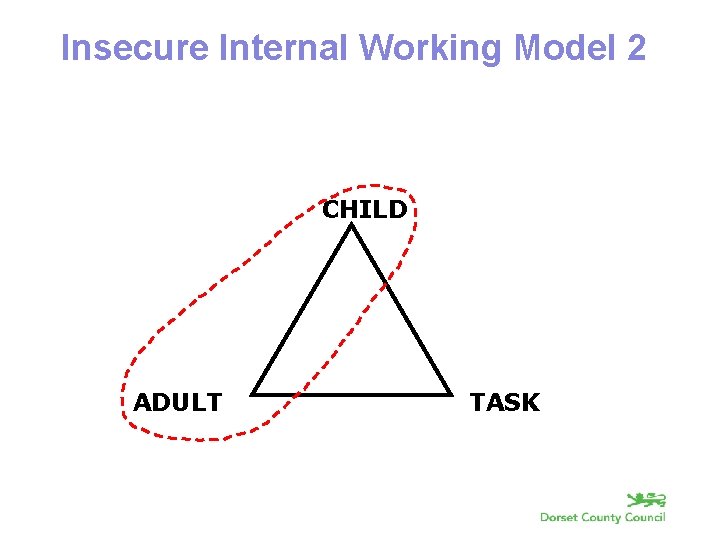
Insecure Internal Working Model 2 CHILD ADULT TASK
Building a relationship through a non-directive approach • Develop understanding of child’s need for love, reassurance and positive attention • Enter into and encourage child’s interests • Allow child to lead shared play • Create regular ‘special time’ • Present choices • Manage challenge positively
Special Time – what is it? • A non-directive approach which can facilitate: – security – initiation and communication development (non-verbal and verbal) – relaxation and enjoyment – play skills – self-concept
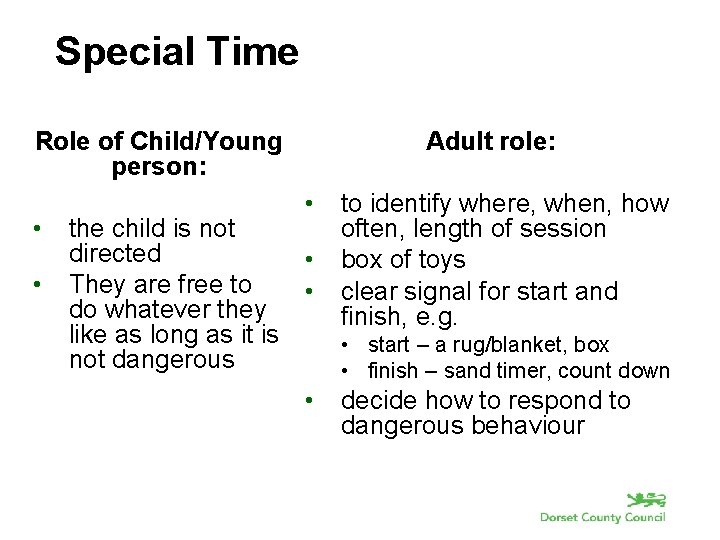
Special Time Adult role: Role of Child/Young person: • • • the child is not directed • They are free to • do whatever they like as long as it is not dangerous • to identify where, when, how often, length of session box of toys clear signal for start and finish, e. g. • start – a rug/blanket, box • finish – sand timer, count down decide how to respond to dangerous behaviour
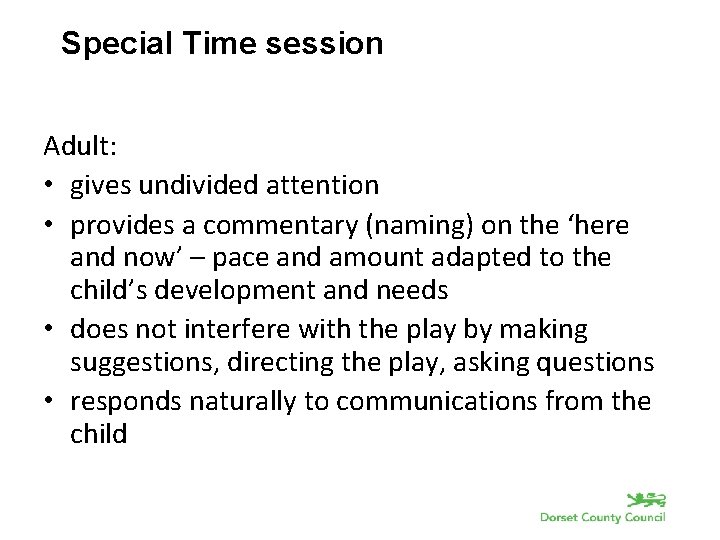
Special Time session Adult: • gives undivided attention • provides a commentary (naming) on the ‘here and now’ – pace and amount adapted to the child’s development and needs • does not interfere with the play by making suggestions, directing the play, asking questions • responds naturally to communications from the child
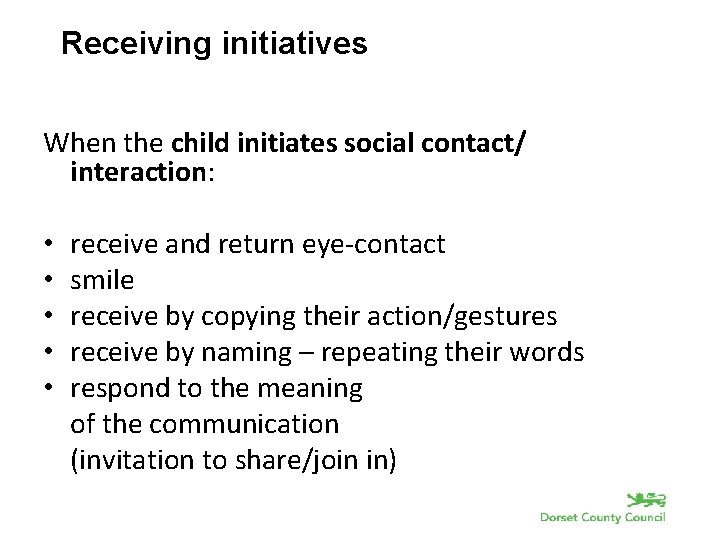
Receiving initiatives When the child initiates social contact/ interaction: • • • receive and return eye-contact smile receive by copying their action/gestures receive by naming – repeating their words respond to the meaning of the communication (invitation to share/join in)
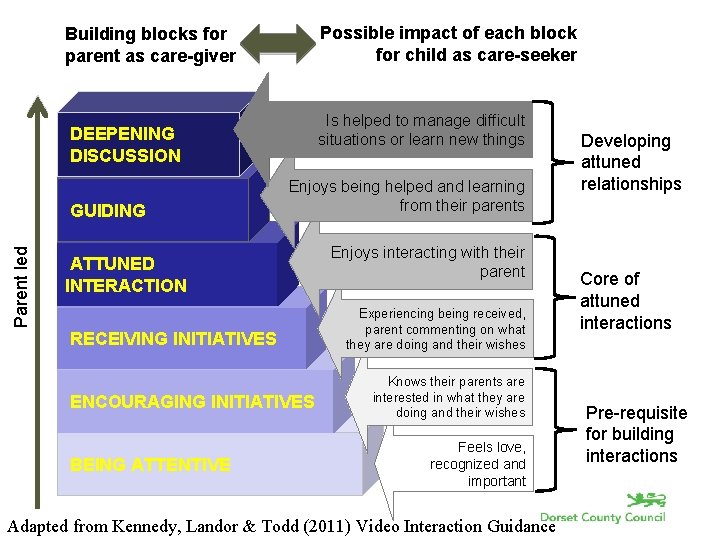
Possible impact of each block for child as care-seeker Building blocks for parent as care-giver Is helped to manage difficult situations or learn new things DEEPENING DISCUSSION Parent led GUIDING Enjoys being helped and learning from their parents ATTUNED INTERACTION RECEIVING INITIATIVES ENCOURAGING INITIATIVES BEING ATTENTIVE Enjoys interacting with their parent Experiencing being received, parent commenting on what they are doing and their wishes Knows their parents are interested in what they are doing and their wishes Feels love, recognized and important Adapted from Kennedy, Landor & Todd (2011) Video Interaction Guidance Developing attuned relationships Core of attuned interactions Pre-requisite for building interactions
Attunement / mentalizing • Adults can communicate understanding and acceptance of a child’s feelings • It is important to read signals to help the child feel understood, to reduce stress and increase feelings of safety • Expressing feelings in words helps the child to develop an emotional vocabulary • If they become better at talking about how they feel there will be less need to communicate their feelings by acting them out
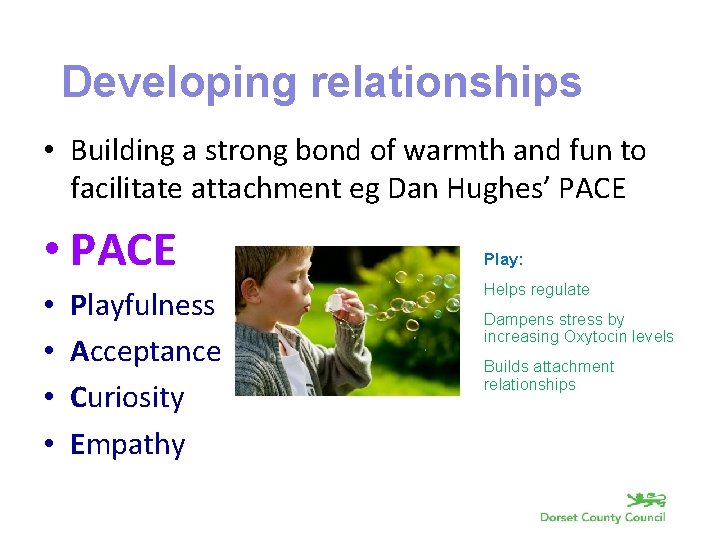
Developing relationships • Building a strong bond of warmth and fun to facilitate attachment eg Dan Hughes’ PACE • PACE • • Playfulness Acceptance Curiosity Empathy Play: Helps regulate Dampens stress by increasing Oxytocin levels Builds attachment relationships
Structure - to organise or regulate the child’s experience. The adult sets limits, defines body boundaries, keeps the child safe and helps complete sequences of activities. Ideas? - Cotton ball blow – into hands - Cotton ball hockey – sit opposite each other. - Mirroring – stand opposite each other, an adult takes the lead and the child mirrors their movements. Then the child takes the lead and the adult mirrors their movements. - Pop the bubble - take turns. . Catch on the wand, use different body parts to pop - Stack of hands
Play activities Engagement - These activities help the adult to connect with the child in a playful, positive way, to focus intently on the child and to encourage the child to enjoy new experiences Ideas? - Hand clapping games – ‘A sailor went to sea, sea’ etc - Row, row your boat - Create a special handshake – take turns to add new gestures e. g. high five, clasp hands, wiggle fingers etc – beginning and ending ritual
Play activities Nurture - Reinforce the message that the child is worthy of care and that adults will provide care without the child having to ask. Nurturing activities help to calm and regulate the anxious child and enhance feelings of self -worth Ideas? - Pizza – draw a pizza on each other’s back: knead the pretend dough on the back, spread tomato onto the pizza with your hand, sprinkle cheese using the tips of your fingers, draw on the topping when you have found out what the child would like, cut the pizza with a finger and pretend to take a slice to eat! - Weather – draw the weather on each other’s back
Play activities Challenge - Encourage the child to take age appropriate risks in order to foster feelings of competence and mastery Ideas? - Balloon Tennis – keep in the air using specified body parts e. g. hands, heads, shoulders, no hands, feet (lying on the floor) – see how long you can keep it in the air - Bubble Tennis - Cooperative Cotton Ball Race - Straight face challenge - Karate chop – hold a length of newspaper in front of the child and have him/her chop it in half when you give a signal
Activity • Activity in pairs - look at handouts • Share how you already use some of these ideas and how you might develop/use them with specific pupils in your sessions to meet individual targets
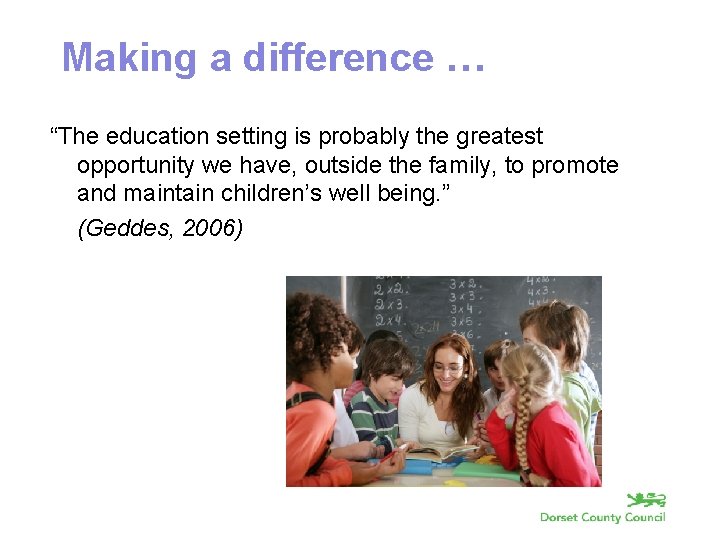
Making a difference … “The education setting is probably the greatest opportunity we have, outside the family, to promote and maintain children’s well being. ” (Geddes, 2006)
- Slides: 42