
Building Reading Comprehension Jeff Minneti Associate Professor of
Building Reading Comprehension Jeff Minneti Associate Professor of Legal Skills and Director of Academic Success Stetson University College of Law minneti@law. stetson. edu
Objectives � Understand the process of reading comprehension � Build reading comprehension � Link reading comprehension to learning
Understanding Reading Comprehension--Process � Reading comprehension = constructing meaning from text ◦ Cascade of skills ◦ Skills cascade draws upon verbal working memory
Build Reading Comprehension � Increase vocabulary ◦ Latin phrases �Mens rea �Res ipsa loquitor ◦ Legal terms �Promissory estoppel �Per stirpes � Efficiently construct meaning ◦ From word to sentence to paragraph to case or statute
Build Reading Comprehension � Increase vocabulary ◦ Decode word �Pronounce word ◦ Define word �Link word to previously learned material �Incorporate word into understanding of concept ◦ Rehearse word in context �Write it �Use it in conversation
Build Reading Comprehension � Efficiently constructing meaning ◦ Requires that you actively engage the text ◦ Employ rhetorical reading strategies �As you read, frequently step beyond the text �Evaluate �Synthesize �Link meaning to purpose �Appreciate the context �Resolve confusion
Build Reading Comprehension ◦ Employ problematizing strategies �Frequently question the text to set your expectations regarding the text’s content �Ask questions �Talk back �Make predictions �Hypothesize
Build Reading Comprehension � Avoid predominately relying on default reading strategies ◦ ◦ Highlighting or underlining Paraphrasing Margin notes Noting aspects of structure or specific detail � Beware of ◦ Overreliance on background knowledge ◦ Potential mismatches
Link Reading Comprehension to Learning � Blooms Taxonomy � Learning Theory
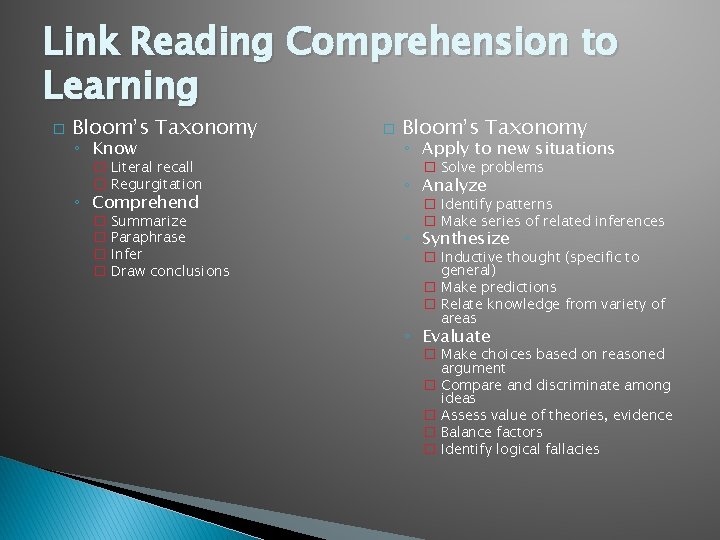
Link Reading Comprehension to Learning � Bloom’s Taxonomy ◦ Know � Literal recall � Regurgitation ◦ Comprehend � Summarize � Paraphrase � Infer � Draw conclusions � Bloom’s Taxonomy ◦ Apply to new situations � Solve problems ◦ Analyze � Identify patterns � Make series of related inferences ◦ Synthesize � Inductive thought (specific to general) � Make predictions � Relate knowledge from variety of areas ◦ Evaluate � Make choices based on reasoned argument � Compare and discriminate among ideas � Assess value of theories, evidence � Balance factors � Identify logical fallacies
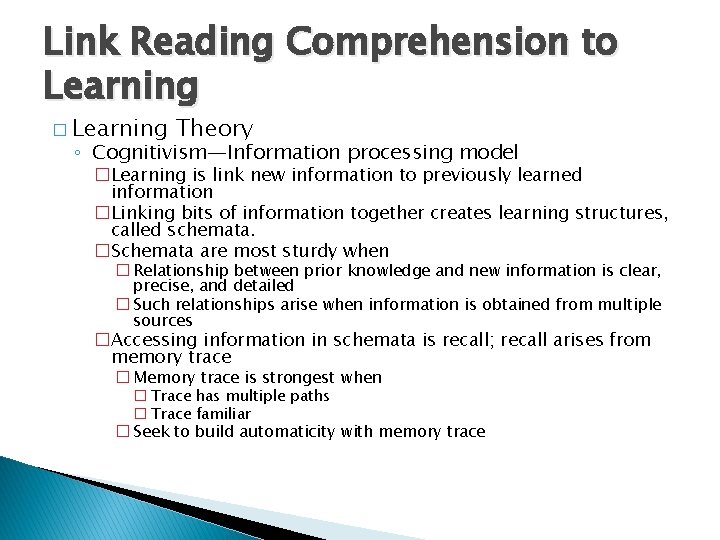
Link Reading Comprehension to Learning � Learning Theory ◦ Cognitivism—Information processing model �Learning is link new information to previously learned information �Linking bits of information together creates learning structures, called schemata. �Schemata are most sturdy when � Relationship between prior knowledge and new information is clear, precise, and detailed � Such relationships arise when information is obtained from multiple sources �Accessing information in schemata is recall; recall arises from memory trace � Memory trace is strongest when � Trace has multiple paths � Trace familiar � Seek to build automaticity with memory trace
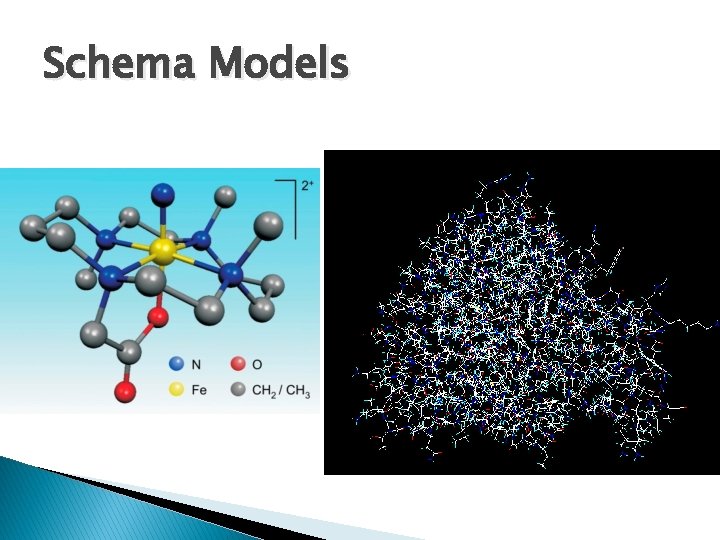
Schema Models
Link Reading Comprehension to Learning � Connecting Cognitivism Reading Comprehension and ◦ Engage in “pre-reading” �Before you begin reading, access the schema you have on the topic by ◦ As you read, enhance the memory trace �Employ rhetorical and problematizing strategies �Transfer information into a new modality ◦ When you finish reading, reflect �If there is material you do not understand, list your questions and make a plan for answering them
Link Reading Comprehension to Learning � Learning Theory ◦ Constructivism �Learning arises from the student’s experience with the information, not from the instructor’s dissemination of information �Learning environment is optimal when it provides �Authentic experiences �Collaborative experiences �Problem solving opportunities

Link Reading Comprehension to Learning � Connecting Reading Comprehension to Constructivism ◦ Create authentic experiences �Utilize rhetorical reading strategies �Complete practice questions �Collaborate with classmates
Review � Understand the process of reading comprehension � Build reading comprehension � Link reading comprehension to learning
Practice � View Critically Reading Cases presentation � Read and brief cases included on webpage � Develop reading comprehension with legal and non-legal texts
- Slides: 17