
Building Rapport with Children AND Preparing and Assisting

Building Rapport with Children AND Preparing and Assisting the Child and Parent/Caregiver During and After the SANE Exam Julie Fonferek Certified Child Life Specialists - Children’s Hospital of Wisconsin, Milwaukee Child Advocacy Center Email: Jfonferek@chw. org Office Number: 414 -277 -8995

Child Life Services “Child life specialists are trained professionals with expertise in helping children and their families overcome life’s most challenging events. ” Child Life Council, 2010 We support children and families by promoting positive coping through play, self expression, preparation and education.
Child Life Specialists (Child Life Council, 2010) �Are experts in child development �Promote effective coping through play, preparation, education, and self-expression activities �Provide emotional support for families �Encourage optimum development of children facing a broad range of challenging experiences, particularly those related to healthcare and hospitalization �Provide information, support and guidance to parents, siblings, and other family members �Play a vital role in educating caregivers, administrators, and the general public about the needs of children under stress
Child Life Specialist in SANE Exams �Prepares children for physical/sexual abuse exams in an age-appropriate manner and provides support/distraction during exam. �Allows parents and children to ask questions to promote further understanding of their visit or exam. �Provides emotional support to encourage positive coping with CAC visit. �Provides distraction and therapeutic play for patients to help alleviate the stress and anxiety of the visit.
Raise your hand if: • • You have ever been bullied or known someone who was bullied. Keep your hand up if you told someone.

Now think about your most recent sexual experience… What would it be like to share every detail of that experience? • Could you memory allow you to recall those details? • Why would you tell? • Who would you tell and what would make you comfortable to tell that person? •

Building Rapport with Children
Therapeutic Play • Purpose is to meet the social and emotional needs of children and families • Decreases stress and increases coping and mastery of hospital experiences • Includes: creative activities, diversional play, health care play
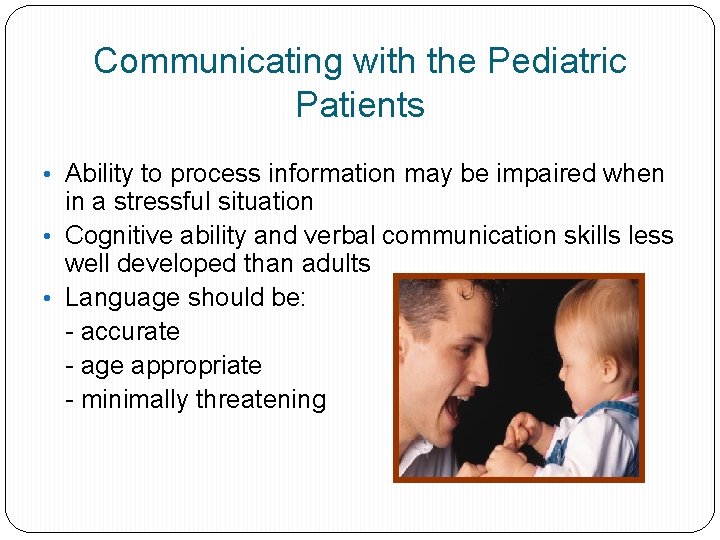
Communicating with the Pediatric Patients • Ability to process information may be impaired when in a stressful situation • Cognitive ability and verbal communication skills less well developed than adults • Language should be: - accurate - age appropriate - minimally threatening
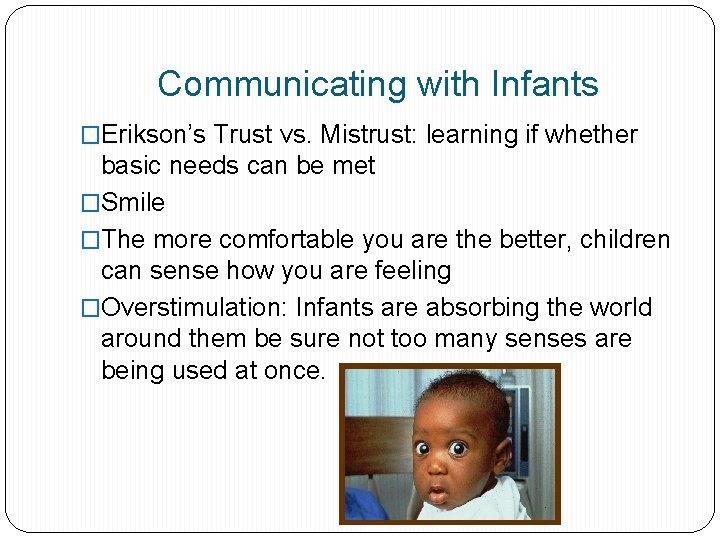
Communicating with Infants �Erikson’s Trust vs. Mistrust: learning if whether basic needs can be met �Smile �The more comfortable you are the better, children can sense how you are feeling �Overstimulation: Infants are absorbing the world around them be sure not too many senses are being used at once.
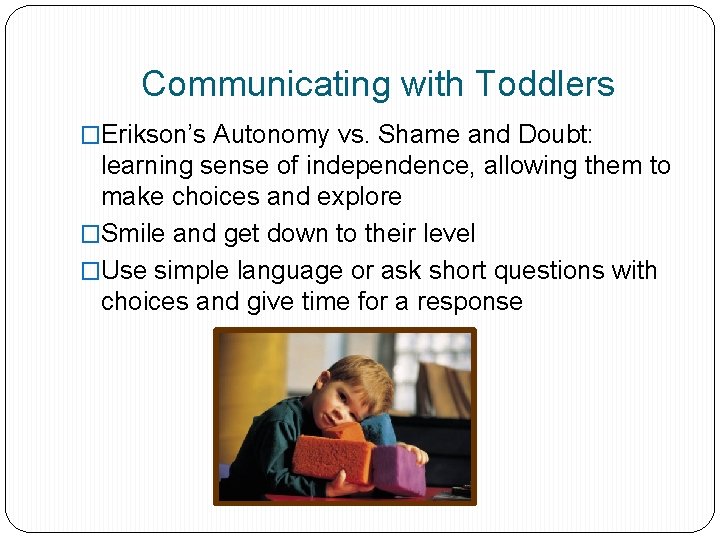
Communicating with Toddlers �Erikson’s Autonomy vs. Shame and Doubt: learning sense of independence, allowing them to make choices and explore �Smile and get down to their level �Use simple language or ask short questions with choices and give time for a response
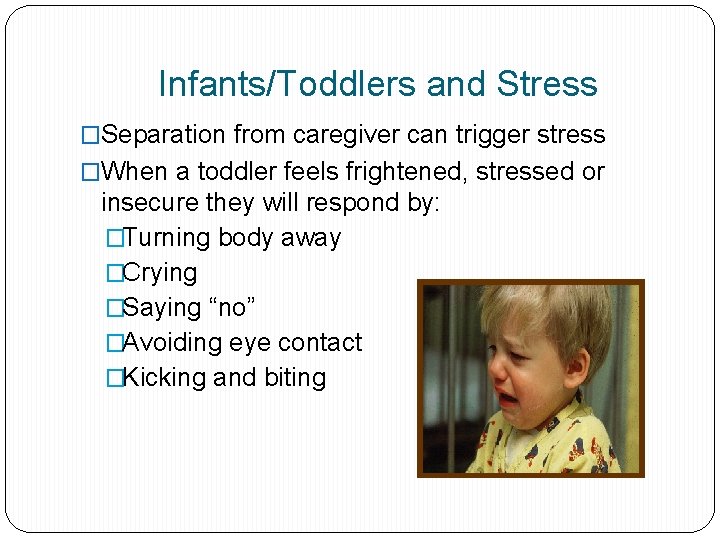
Infants/Toddlers and Stress �Separation from caregiver can trigger stress �When a toddler feels frightened, stressed or insecure they will respond by: �Turning body away �Crying �Saying “no” �Avoiding eye contact �Kicking and biting
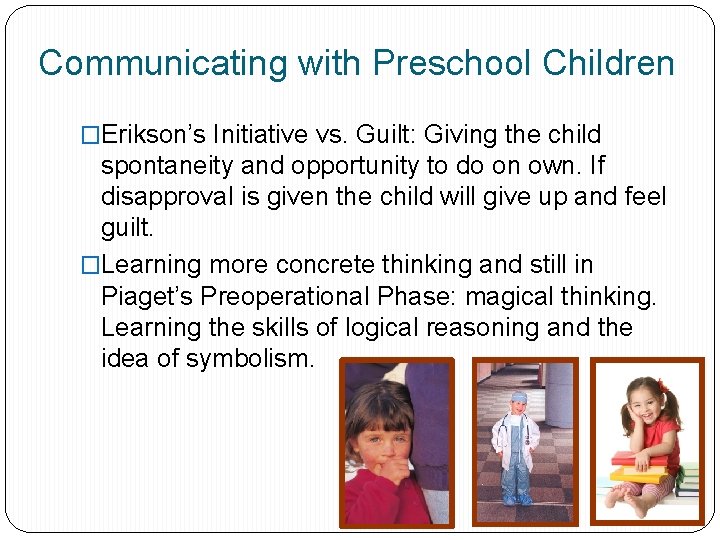
Communicating with Preschool Children �Erikson’s Initiative vs. Guilt: Giving the child spontaneity and opportunity to do on own. If disapproval is given the child will give up and feel guilt. �Learning more concrete thinking and still in Piaget’s Preoperational Phase: magical thinking. Learning the skills of logical reasoning and the idea of symbolism.
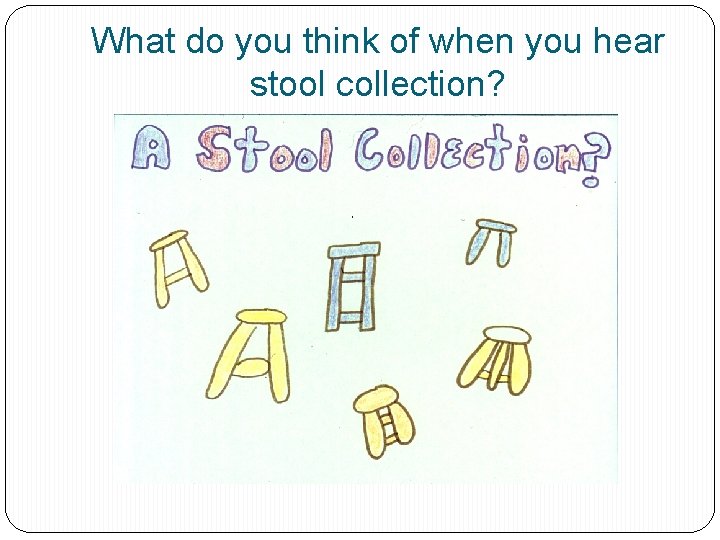
What do you think of when you hear stool collection?
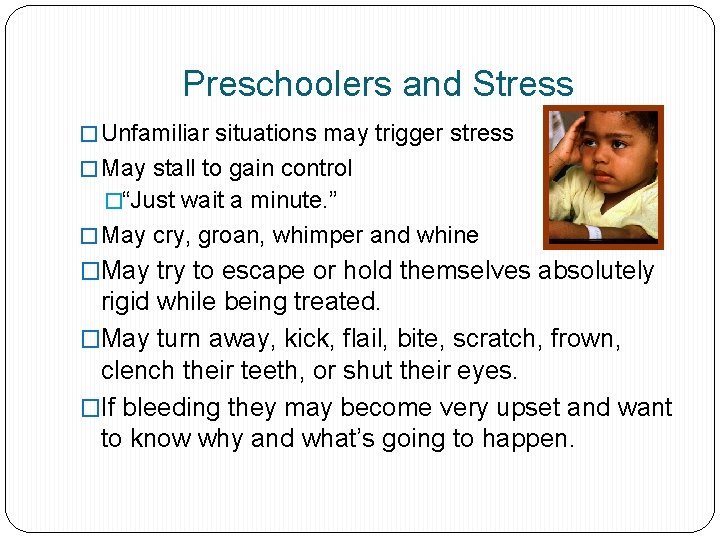
Preschoolers and Stress � Unfamiliar situations may trigger stress � May stall to gain control �“Just wait a minute. ” � May cry, groan, whimper and whine �May try to escape or hold themselves absolutely rigid while being treated. �May turn away, kick, flail, bite, scratch, frown, clench their teeth, or shut their eyes. �If bleeding they may become very upset and want to know why and what’s going to happen.
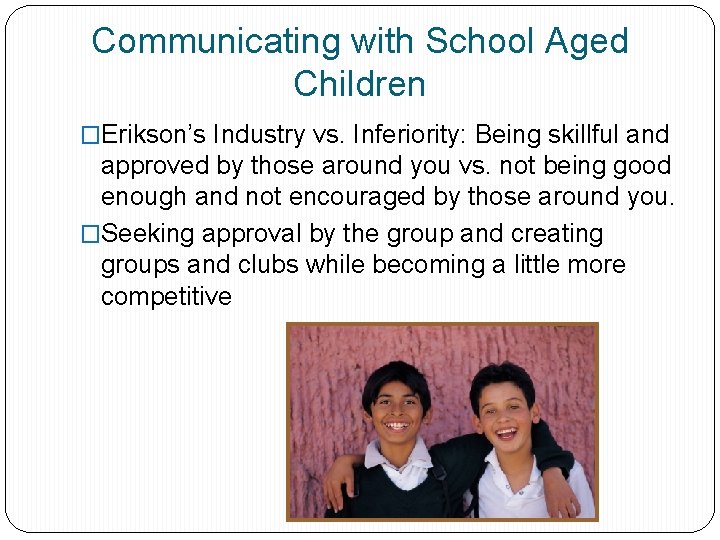
Communicating with School Aged Children �Erikson’s Industry vs. Inferiority: Being skillful and approved by those around you vs. not being good enough and not encouraged by those around you. �Seeking approval by the group and creating groups and clubs while becoming a little more competitive
School-Age and Stress �May be triggered by loss of control, want to be involved, need honest and accurate information, emotional support, may regress �Kids love to learn new words. �They want to know what a colposcope is all about. �They want to understand special vocabulary. �May attempt to gain control through bargaining or delay tactics, while trying to appear brave. �Will attempt to gather information about the elements of their care.
School-Age and Stress �Exhibit the same verbal and nonverbal behaviors as younger children �Are able to use specific words to acknowledge pain, and express fear and anger. �Bodily contact important (having hand held, being touched gently, gladly accepts help) �Some kids this age may regress during times of stress �Sucking thumb, biting nails �Doesn’t mean they are babies, just means they are looking for security
School-Age and Stress �You can lessen initial fears by: �Maintaining a friendly, reassuring attitude and always remember to be HONEST and ACCURATE when telling the child what you are doing. �You want to make sure to gain their trust!
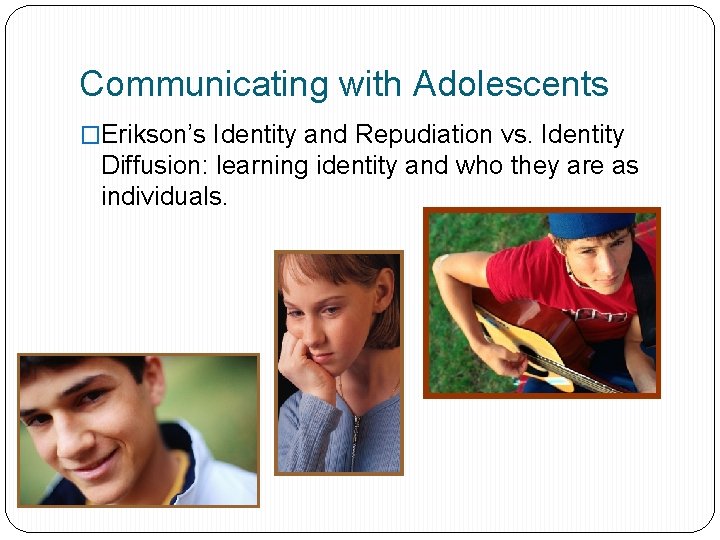
Communicating with Adolescents �Erikson’s Identity and Repudiation vs. Identity Diffusion: learning identity and who they are as individuals.
Adolescents and Stress �Talk to them not over them, want their opinions listened to and recognized �May not always be able to abide by their wishes, but important to allow them to express selves and feel heard and have some control over the situation �Include them in conversation if possible �If talking to parents in another area come back and tell teen what was discussed �You don’t need to include everything, but at least acknowledge that you talked to their parents
Adolescents and Stress �Teens are especially concerned about self-image �They may want to know whether you can tell if they are still a virgin…be honest! �Modesty is a big factor. If exposed try to cover them up if at all possible.

Preparing and Assisting the Child and Parent/Caregiver During and After the SANE Exam
Activity • Describe what that was like? • How did that make you feel?
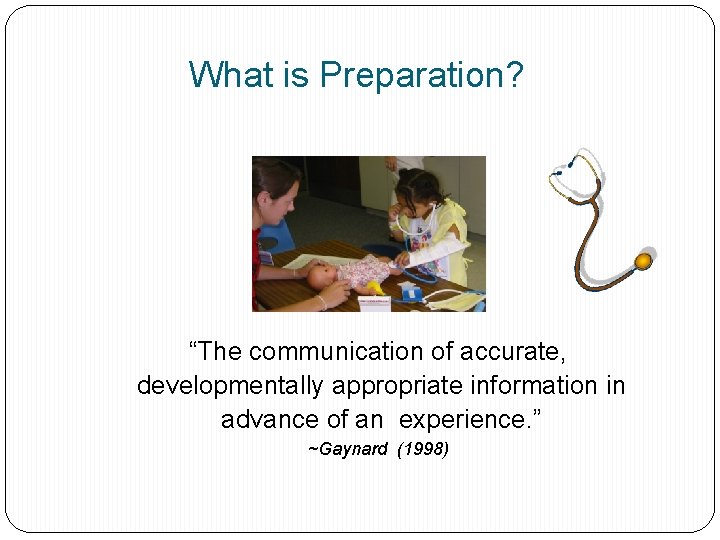
What is Preparation? “The communication of accurate, developmentally appropriate information in advance of an experience. ” ~Gaynard (1998)
Goals of Preparation �Reduce fear and anxiety �Promote long term coping and adjustment to future health care challenges �Important to assess patient prior to procedure �Preparation must be individualized (Child Life Council Evidence-Based Practice Statement Summary: Preparing Children and Adolescents for Medical Procedures, August 2007)

What Does the Evidence Tell Us? �“Participation in a preparation program has been shown to reduce significantly the negative psychological sequelae experienced by children both immediately before and after the procedure and for up to a month later. ” Child Life Council Evidence-Based Practice Statement Preparing Children and Adolescents for Medical Procedures –Submitted by: Donna Koller, Ph. D, Academic and Clinical Specialist in Child Life, Hospital for Sick Children, Toronto, Ontario, Canada

Assessment: Key Considerations �Age/developmental level �Personality �Ability to cope with new situations �Prior healthcare experiences �Diagnosis/complexity of the procedure �Family support system �Cultural considerations

Preparation • Preparation provides structured interventions with specific objectives • Tools used in preparation: - pictures - dolls - books - medical equipment
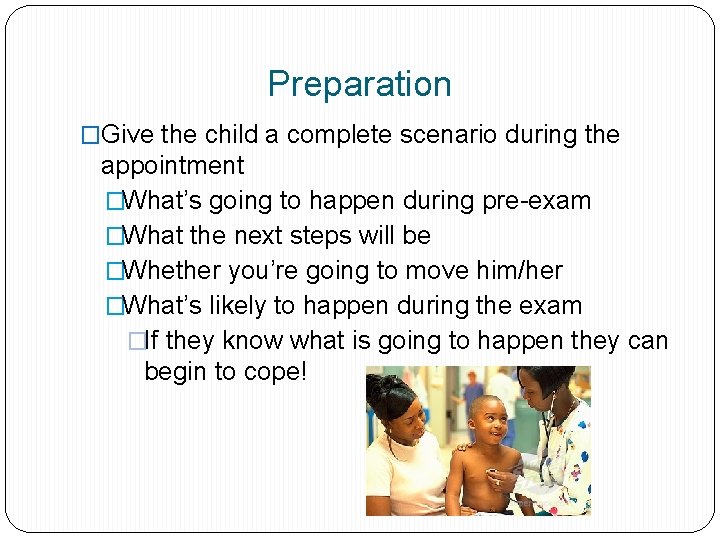
Preparation �Give the child a complete scenario during the appointment �What’s going to happen during pre-exam �What the next steps will be �Whether you’re going to move him/her �What’s likely to happen during the exam �If they know what is going to happen they can begin to cope!
Preparation �Provide sensory information to prepare the child about what happens next. �Use phrases like: First we will…. . Then we will…. . �We are to go to an appointment and while we wait there you can play with the toys and talk to some nice people. �You are going to meet a lot of people today it is important you answer their questions the best you can. �Talk with children about what they will see, feel, hear, smell and taste during their experience. �Be as honest as possible, especially when the child ask
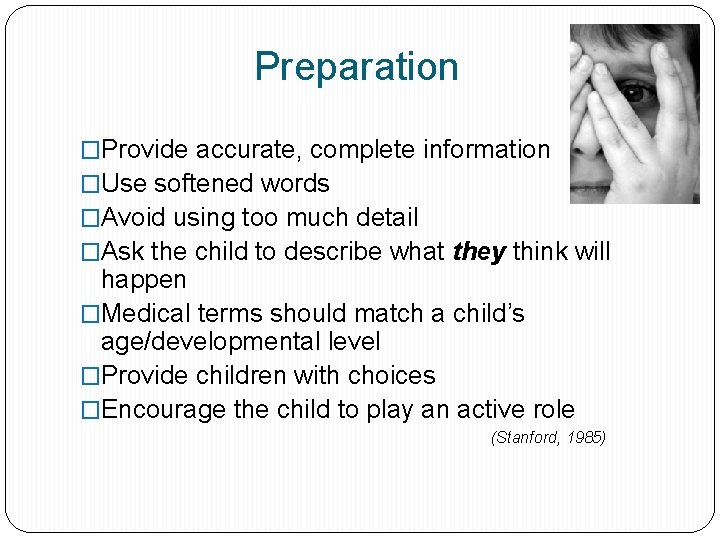
Preparation �Provide accurate, complete information �Use softened words �Avoid using too much detail �Ask the child to describe what they think will happen �Medical terms should match a child’s age/developmental level �Provide children with choices �Encourage the child to play an active role (Stanford, 1985)
Considerations in Choosing Language �Words with dual meanings can be confusing �Check in with the child to assess understanding �Be sensitive to each child and their learning needs �Let the child judge their experience

Misconceptions �Ask children what they think is going to happen. Children often misinterpret things they see or overhear. �If their perceptions are inaccurate, gently explain what will actually occur, in terms they can understand. � Determine role of parents/healthcare providers � Create coping plan

Techniques -Choices �Give choices when choices are available �Would you like to sit on the table or the chair? �Would you like to bring your stuffed animal back with us when you have your check up or leave it here until we are done? �Would you like me to look in your left ear or your right ear first? �We have to go for an appointment and when we get there you get to choose if you want to sit in the chairs by me or play with the toys. �Avoid statements that start with “can you”

How would you prepare a child? • What are the steps to the exam? • What words do you use that a child may not know? • What are some things to keep in mind for infants, toddlers, preschoolers, school aged and teens?
What I say… Infants �Typically nothing. �I do preparents if present. �The more calm a caregiver is the better and when under stress simple preparation for them can be helpful.
What I say… Toddlers �I prepare toddlers in real time �I show the item then the medical staff does uses it

What I say… Preschool � Today I will be looking at your skin from your head to your toes, looking at your arms, legs, back, and belly to make sure your skin is healthy. � The last part on your skin I will look at is where you go pee and poop from. � When I do this part of the check up I will have you sit a special way making butter fly legs. You do this by laying down and putting your feet together and letting your knees fall to the outside. Would you like to try? � Sitting like that helps me to see better. Another tool that helps me see better is this big light. It shines on your skin and makes everything look bigger. This light doesn’t touch you or hurt it will shines on the part of the skin I would like to see better. � You will feel my hands touching to move the skin around to help me see better. � When I am checking your private parts I will use something that looks like a Q-tip. The q-tips has a longer handle so that our I don't drop them. I will rub it on the outside of your skin by your private area to make sure there are no germs. Some kids tell me it may feel a little cold and wet and tickle a little, can you tell me after what it feels like? � While I am looking what would you like to play with? Look at a book or check out a ball I have? � When I am done looking you can sit up and I will do one last tickle in your throat. It is real quick. � After the check up I will leave the room to give you privacy to change back into the clothes you came in.
What I say… School Aged � Today I will be looking at your skin from your head to your toes, looking at your arms, legs, back, and belly to make sure your skin is healthy. � The last part on your skin I will look at is the private parts on your body where you go pee and poop (or where your underwear covers). � When I do this part of the check up I will have you sit a special way making butter fly legs. You do this by laying down and putting your feet together and letting your knees fall to the outside. � Sitting like that helps me to see better. Another tool that helps me see better is the colopscope. This is a machine that shines on your skin and makes everything look bigger. This light doesn’t touch you or hurt it will shines on the part of the skin I would like to see better. � You will feel my hands touching to move the skin around to help me see better. Nothing during your check should hurt or feel uncomfortable and if it does tell me and I will stop and readjust. � When I am checking your private parts I will use something that looks like a Q-tip. The only difference from the q-tips you have at home is the ones here have a longer handle so that our I don't drop them. A little water will be put on the Q-tip and then they will rub it on the outside of your skin in your private area to make sure there are no germs or infections. Some kids tell me it may feel a little cold and wet and tickle a little, can you tell me after what it feels like? � When I am done looking you can sit up and I will do one last tickle in your throat. When I am done I will leave the room to give you privacy to change back into the clothes you came in. � After the check up I will leave the room to give you privacy to change back into the clothes you came in.
What I say… Teenager �Today I will be checking your body to make sure it is healthy. �I will look at all the skin on your body including your genitals. �When I do that I will use a colposcope that is a light to magnify the area to help see better. The light doesn’t hurt and won’t touch you. �I will use Qtips and touch the areas by your genitals to check for infections. �Nothing I do should hurt, if it does please tell me so I can stop and readjust as needed.
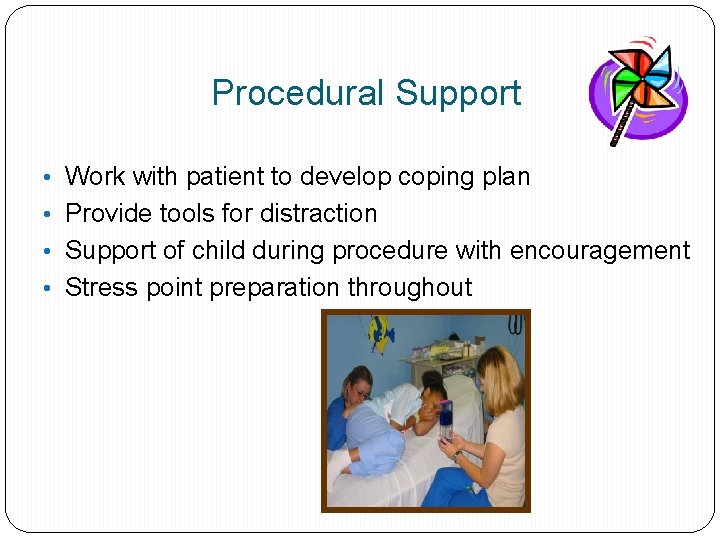
Procedural Support • Work with patient to develop coping plan • Provide tools for distraction • Support of child during procedure with encouragement • Stress point preparation throughout
Techniques -Directives �Provide positive reinforcement throughout the visit. �I really like how you are using your walking feet, thank you. �You are doing a great job talking to me today. �Thank you for following directions today. �Use positive directives. �You need to use your walking feet so you don’t fall and get hurt. �The ball is rolled inside and we are inside. �Avoid using negative words like don’t, stop, no, I’m sorry
Choosing a Distraction Method �Note age/developmental level �Use parents as information source when choosing tools for distraction �Talk with the patient and offer choices �Distraction helps to give the child something to focus on/control during procedure �Give parents or caregivers a role
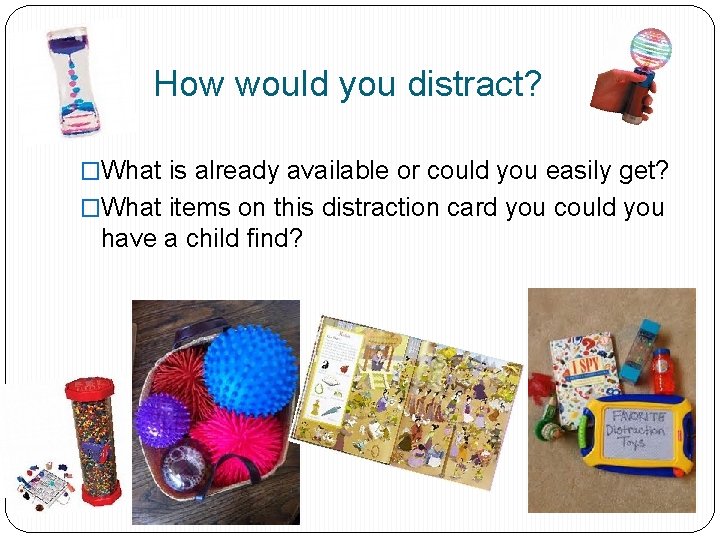
How would you distract? �What is already available or could you easily get? �What items on this distraction card you could you have a child find?
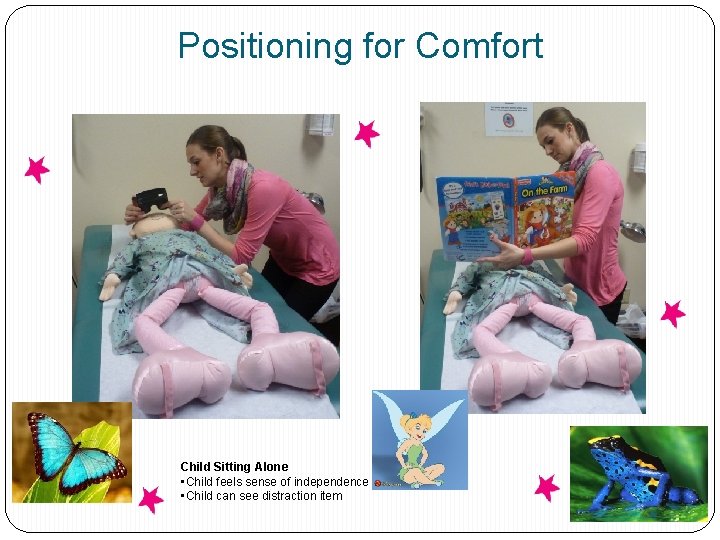
Positioning for Comfort Child Sitting Alone • Child feels sense of independence • Child can see distraction item
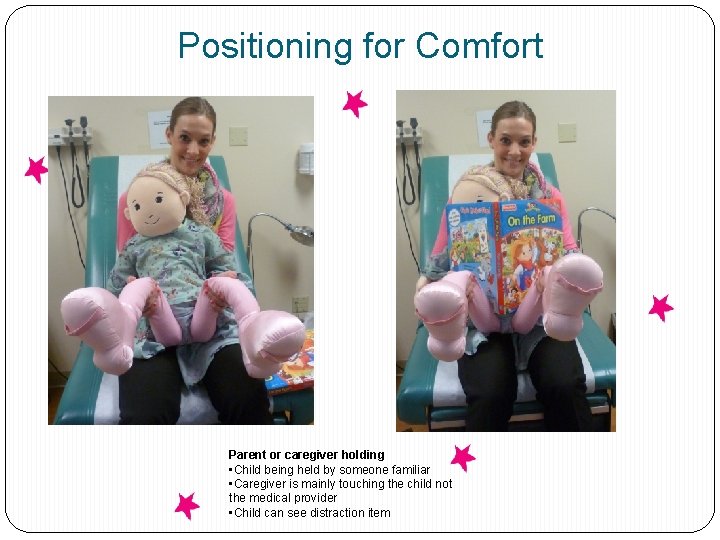
Positioning for Comfort Parent or caregiver holding • Child being held by someone familiar • Caregiver is mainly touching the child not the medical provider • Child can see distraction item
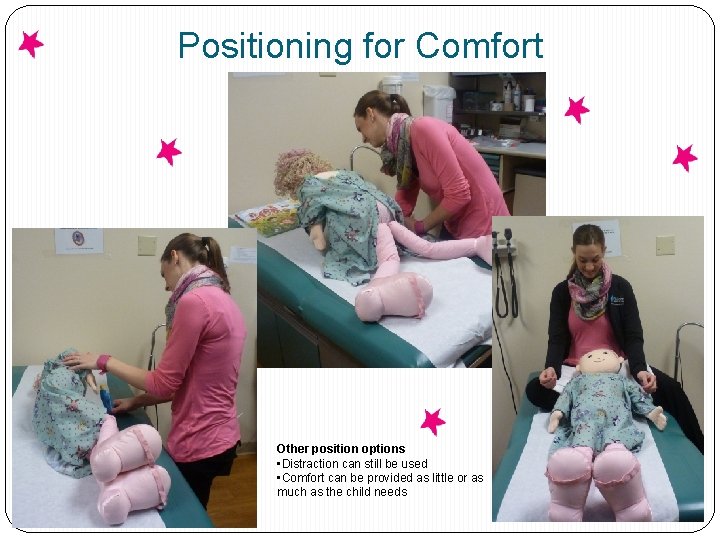
Positioning for Comfort Other position options • Distraction can still be used • Comfort can be provided as little or as much as the child needs
One Voice http: //childrensomaha. org/body. cfm? id=210 �One voice heard during procedure �Need for parental involvement �Education patient beforehand about what will happen �Validate with words �Offer comfortable, non-threatening position �Individualize plan according to patient’s needs �Choose appropriate distraction �Eliminate unnecessary staff not actively involved in procedure
�One Voice �Sensory Overload
Resources �Child Life Program www. chw. org/childlife �“A Guide For the Caregiver of the Hospitalized Child” �“Helping Kids and Teens Understand Medical Language” �One Voice �Positioning for Comfort �Best Distractions JIT �Comfort Care JIT �About Child Life (Child Life Council)
- Slides: 52