
Building Python Programs Chapter 5 Logic and Indefinite
Building Python Programs Chapter 5: Logic and Indefinite Loops
Fencepost loops
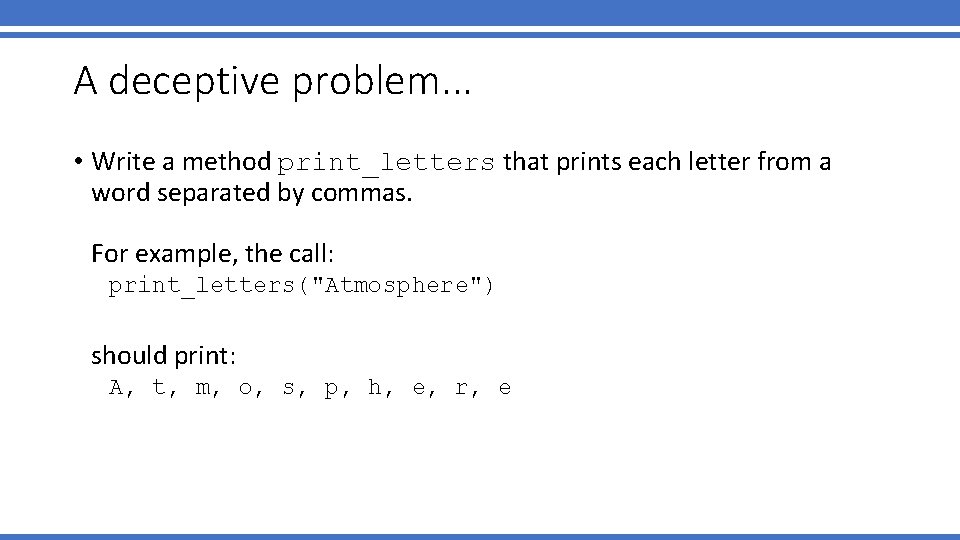
A deceptive problem. . . • Write a method print_letters that prints each letter from a word separated by commas. For example, the call: print_letters("Atmosphere") should print: A, t, m, o, s, p, h, e, r, e
![Flawed solutions • def print_letters(word): for i in range(0, len(word)): print(word[i] + ", ",](http://slidetodoc.com/presentation_image_h2/141b9ed1ba34a370412219e329fdd974/image-4.jpg "Flawed solutions • def print_letters(word): for i in range(0, len(word)): print(word[i] + \", \",")
Flawed solutions • def print_letters(word): for i in range(0, len(word)): print(word[i] + ", ", end='') print() # end line • Output: A, t, m, o, s, p, h, e, r, e, • def print_letters(word): for i in range(0, len(word)): print(", " + word[i], end='') print() # end line • Output: , A, t, m, o, s, p, h, e, r, e
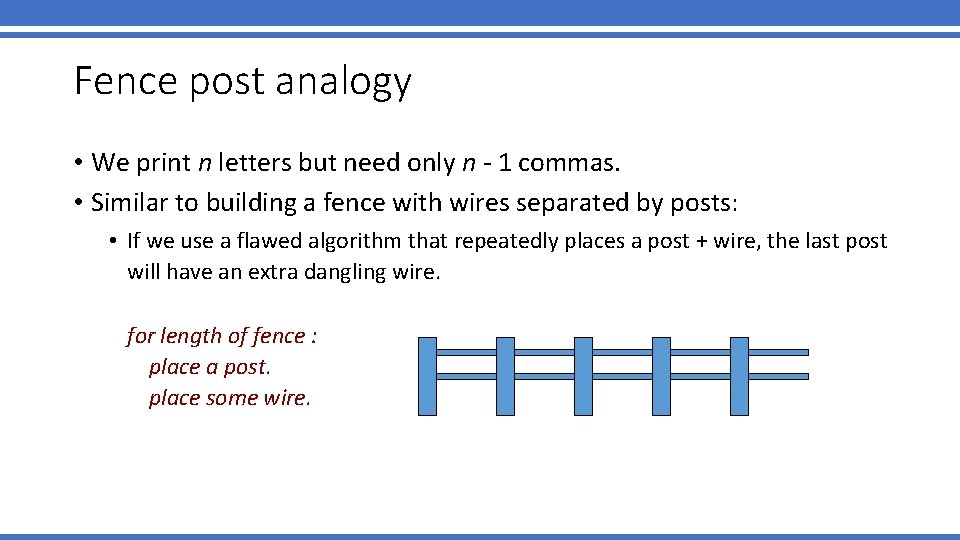
Fence post analogy • We print n letters but need only n - 1 commas. • Similar to building a fence with wires separated by posts: • If we use a flawed algorithm that repeatedly places a post + wire, the last post will have an extra dangling wire. for length of fence : place a post. place some wire.
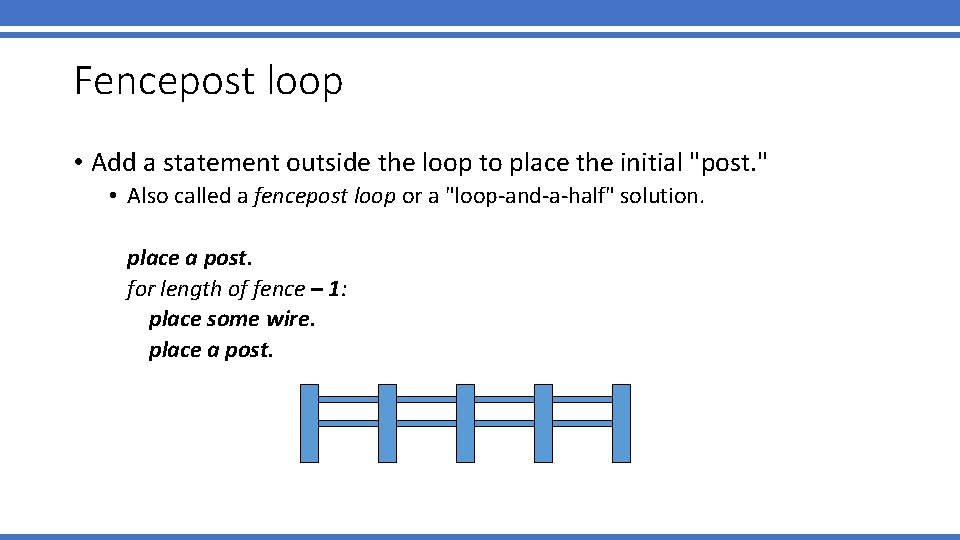
Fencepost loop • Add a statement outside the loop to place the initial "post. " • Also called a fencepost loop or a "loop-and-a-half" solution. place a post. for length of fence – 1: place some wire. place a post.
![Fencepost function solution • def print_letters(word): print(word[0]) for i in range(1, len(word)): print(", "](http://slidetodoc.com/presentation_image_h2/141b9ed1ba34a370412219e329fdd974/image-7.jpg "Fencepost function solution • def print_letters(word): print(word[0]) for i in range(1, len(word)): print(\", \"")
Fencepost function solution • def print_letters(word): print(word[0]) for i in range(1, len(word)): print(", " + word[i], end='') print() # end line • Alternate solution: Either first or last "post" can be taken out: def print_letters(word): for i in range(0, len(word) - 1): print(word[i] + ", ", end='') last = len(word) – 1 print(word[last]) # end line
while loops
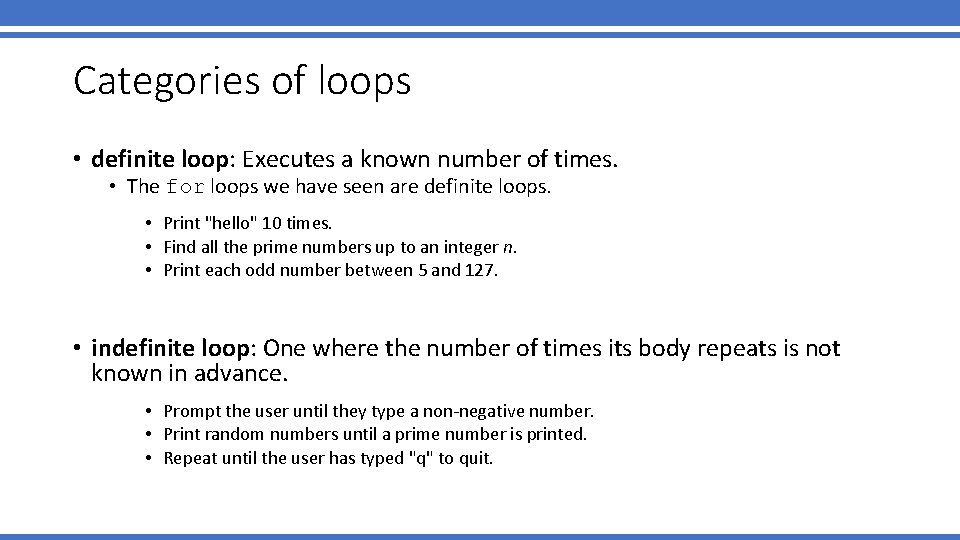
Categories of loops • definite loop: Executes a known number of times. • The for loops we have seen are definite loops. • Print "hello" 10 times. • Find all the prime numbers up to an integer n. • Print each odd number between 5 and 127. • indefinite loop: One where the number of times its body repeats is not known in advance. • Prompt the user until they type a non-negative number. • Print random numbers until a prime number is printed. • Repeat until the user has typed "q" to quit.
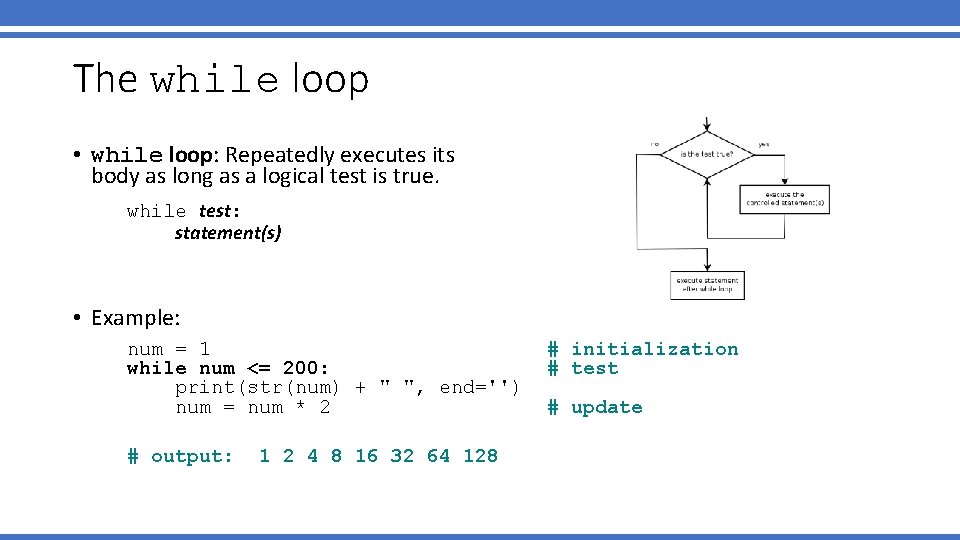
The while loop • while loop: Repeatedly executes its body as long as a logical test is true. while test: statement(s) • Example: num = 1 while num <= 200: print(str(num) + " ", end='') num = num * 2 # output: 1 2 4 8 16 32 64 128 # initialization # test # update
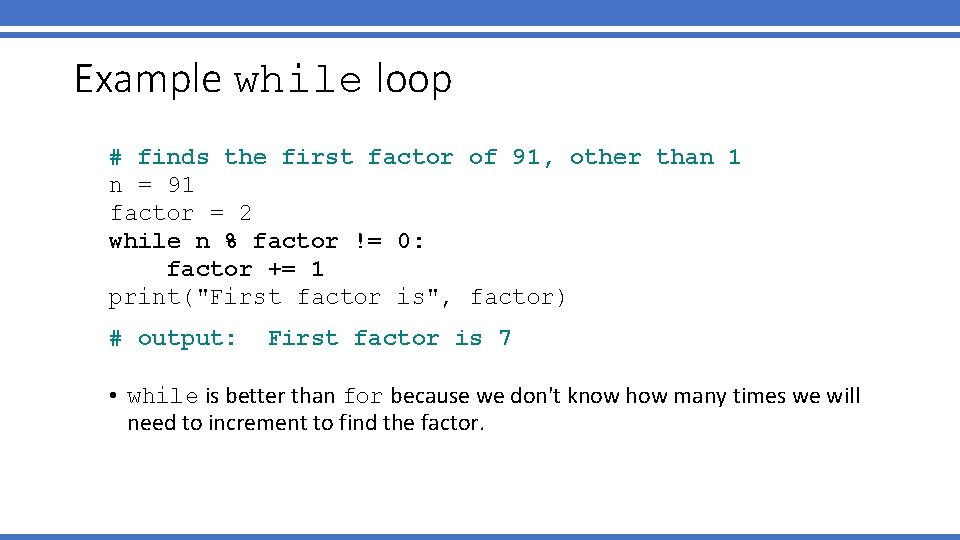
Example while loop # finds the first factor of 91, other than 1 n = 91 factor = 2 while n % factor != 0: factor += 1 print("First factor is", factor) # output: First factor is 7 • while is better than for because we don't know how many times we will need to increment to find the factor.
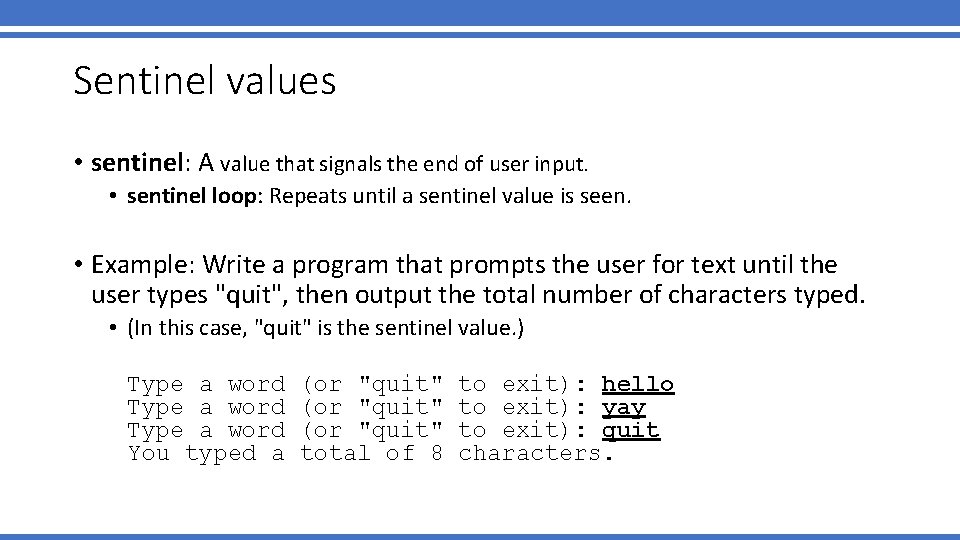
Sentinel values • sentinel: A value that signals the end of user input. • sentinel loop: Repeats until a sentinel value is seen. • Example: Write a program that prompts the user for text until the user types "quit", then output the total number of characters typed. • (In this case, "quit" is the sentinel value. ) Type a word You typed a (or "quit" total of 8 to exit): hello to exit): yay to exit): quit characters.
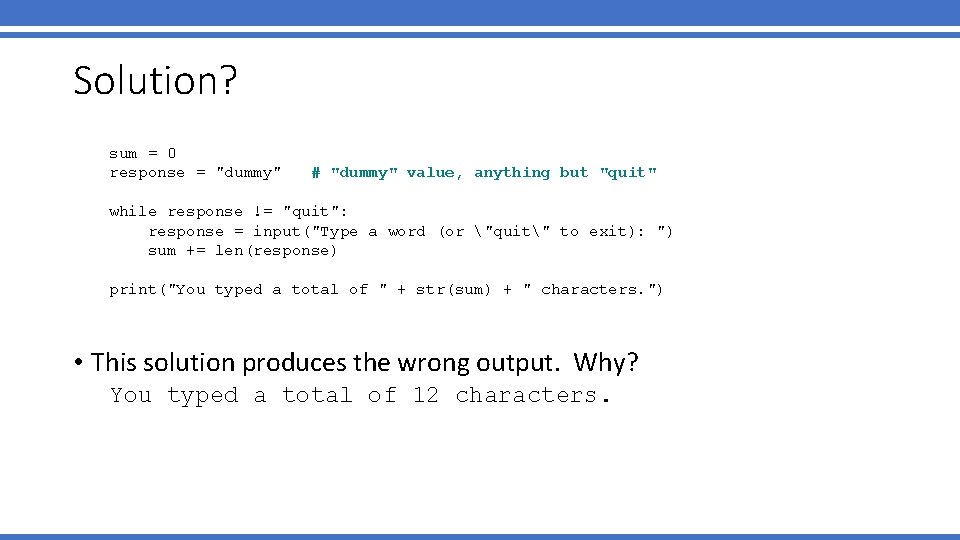
Solution? sum = 0 response = "dummy" # "dummy" value, anything but "quit" while response != "quit": response = input("Type a word (or "quit" to exit): ") sum += len(response) print("You typed a total of " + str(sum) + " characters. ") • This solution produces the wrong output. Why? You typed a total of 12 characters.
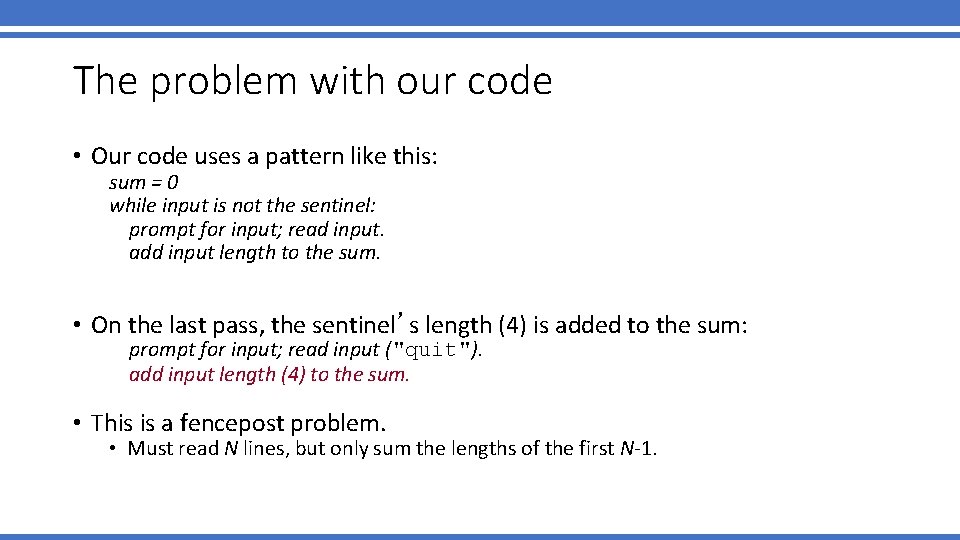
The problem with our code • Our code uses a pattern like this: sum = 0 while input is not the sentinel: prompt for input; read input. add input length to the sum. • On the last pass, the sentinel’s length (4) is added to the sum: prompt for input; read input ("quit"). add input length (4) to the sum. • This is a fencepost problem. • Must read N lines, but only sum the lengths of the first N-1.
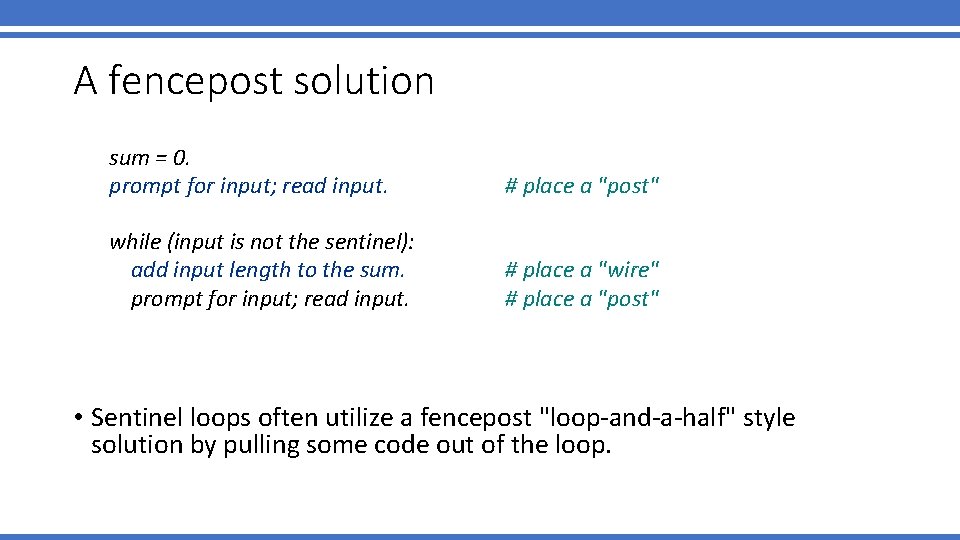
A fencepost solution sum = 0. prompt for input; read input. # place a "post" while (input is not the sentinel): add input length to the sum. prompt for input; read input. # place a "wire" # place a "post" • Sentinel loops often utilize a fencepost "loop-and-a-half" style solution by pulling some code out of the loop.
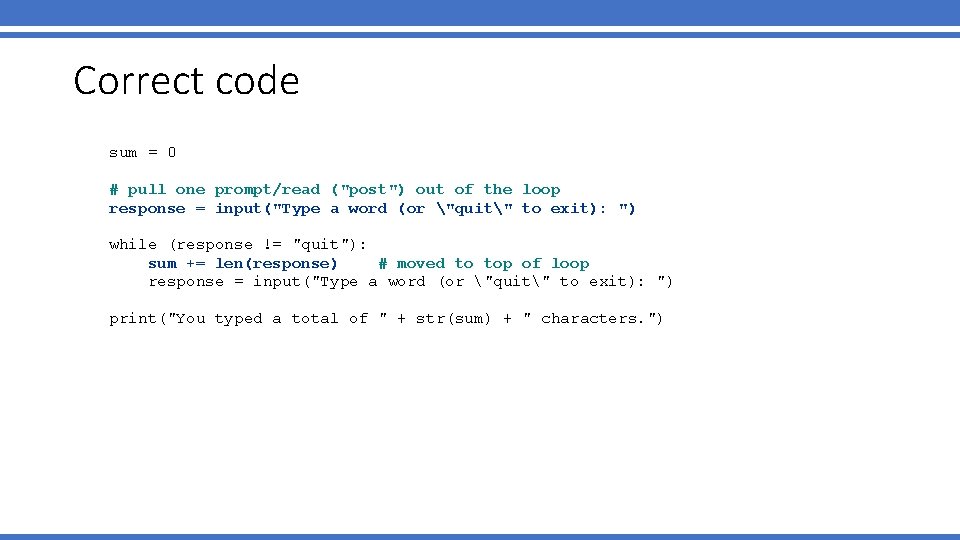
Correct code sum = 0 # pull one prompt/read ("post") out of the loop response = input("Type a word (or "quit" to exit): ") while (response != "quit"): sum += len(response) # moved to top of loop response = input("Type a word (or "quit" to exit): ") print("You typed a total of " + str(sum) + " characters. ")
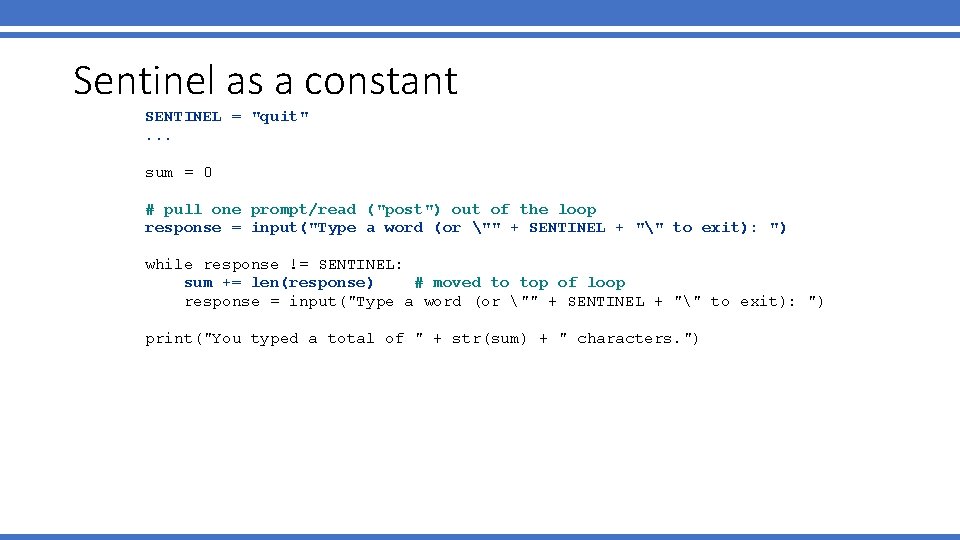
Sentinel as a constant SENTINEL = "quit". . . sum = 0 # pull one prompt/read ("post") out of the loop response = input("Type a word (or "" + SENTINEL + "" to exit): ") while response != SENTINEL: sum += len(response) # moved to top of loop response = input("Type a word (or "" + SENTINEL + "" to exit): ") print("You typed a total of " + str(sum) + " characters. ")
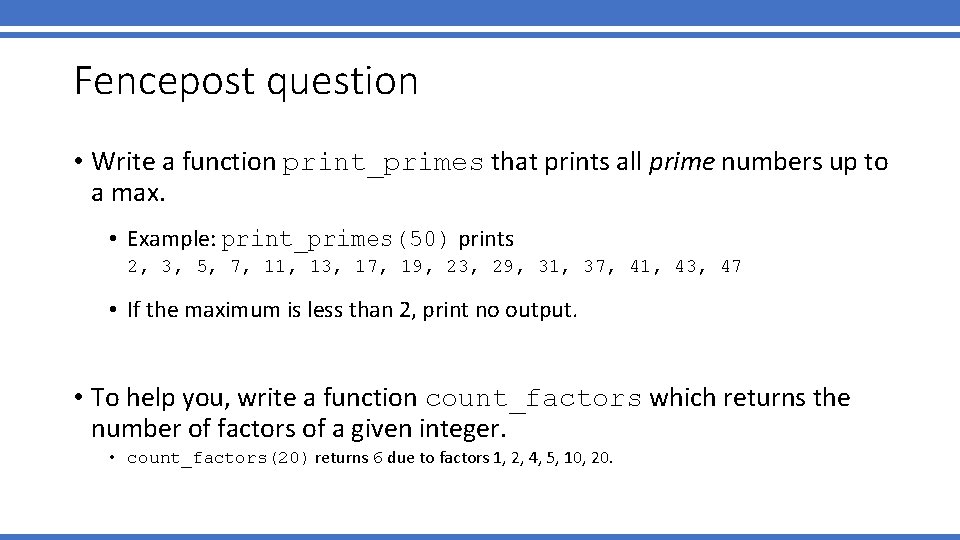
Fencepost question • Write a function print_primes that prints all prime numbers up to a max. • Example: print_primes(50) prints 2, 3, 5, 7, 11, 13, 17, 19, 23, 29, 31, 37, 41, 43, 47 • If the maximum is less than 2, print no output. • To help you, write a function count_factors which returns the number of factors of a given integer. • count_factors(20) returns 6 due to factors 1, 2, 4, 5, 10, 20.
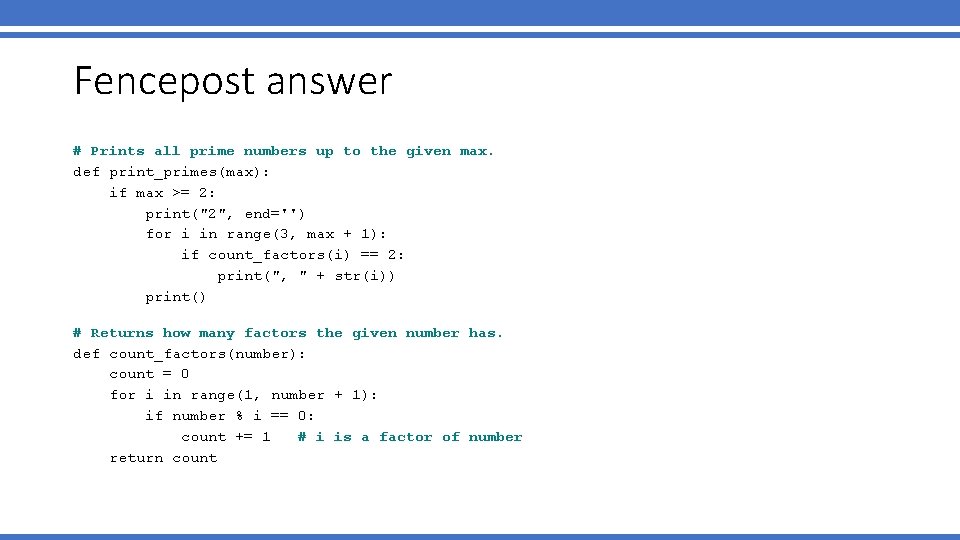
Fencepost answer # Prints all prime numbers up to the given max. def print_primes(max): if max >= 2: print("2", end='') for i in range(3, max + 1): if count_factors(i) == 2: print(", " + str(i)) print() # Returns how many factors the given number has. def count_factors(number): count = 0 for i in range(1, number + 1): if number % i == 0: count += 1 # i is a factor of number return count
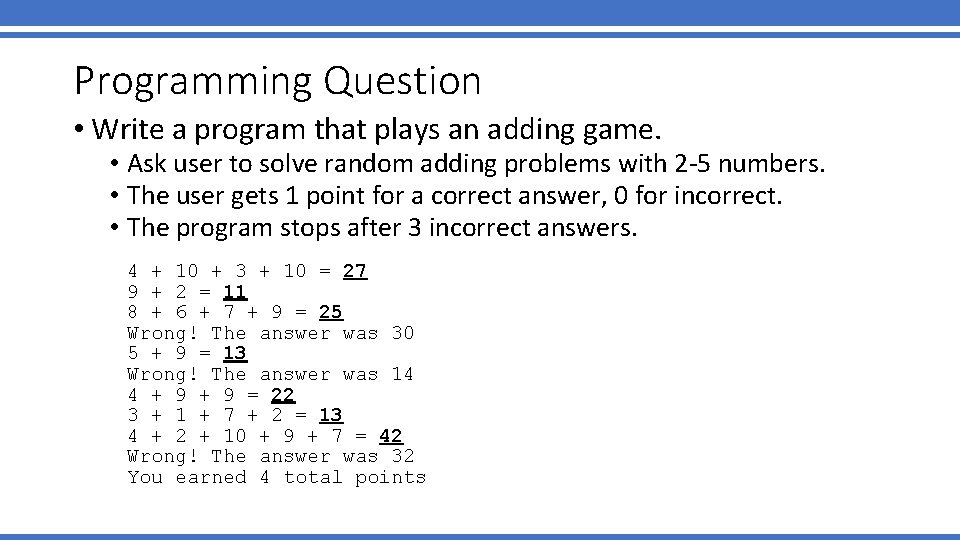
Programming Question • Write a program that plays an adding game. • Ask user to solve random adding problems with 2 -5 numbers. • The user gets 1 point for a correct answer, 0 for incorrect. • The program stops after 3 incorrect answers. 4 + 10 + 3 + 10 = 27 9 + 2 = 11 8 + 6 + 7 + 9 = 25 Wrong! The answer was 30 5 + 9 = 13 Wrong! The answer was 14 4 + 9 = 22 3 + 1 + 7 + 2 = 13 4 + 2 + 10 + 9 + 7 = 42 Wrong! The answer was 32 You earned 4 total points
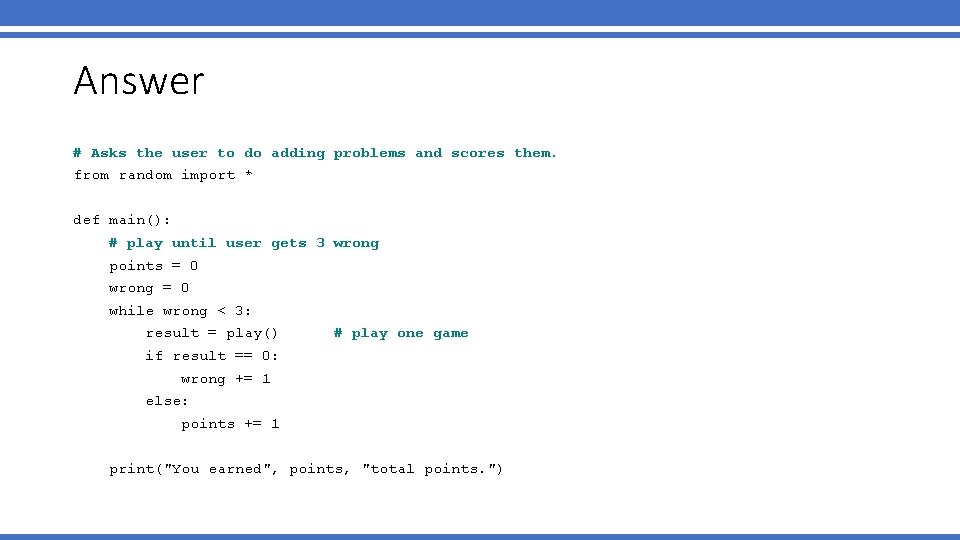
Answer # Asks the user to do adding problems and scores them. from random import * def main(): # play until user gets 3 wrong points = 0 wrong = 0 while wrong < 3: result = play() # play one game if result == 0: wrong += 1 else: points += 1 print("You earned", points, "total points. ")
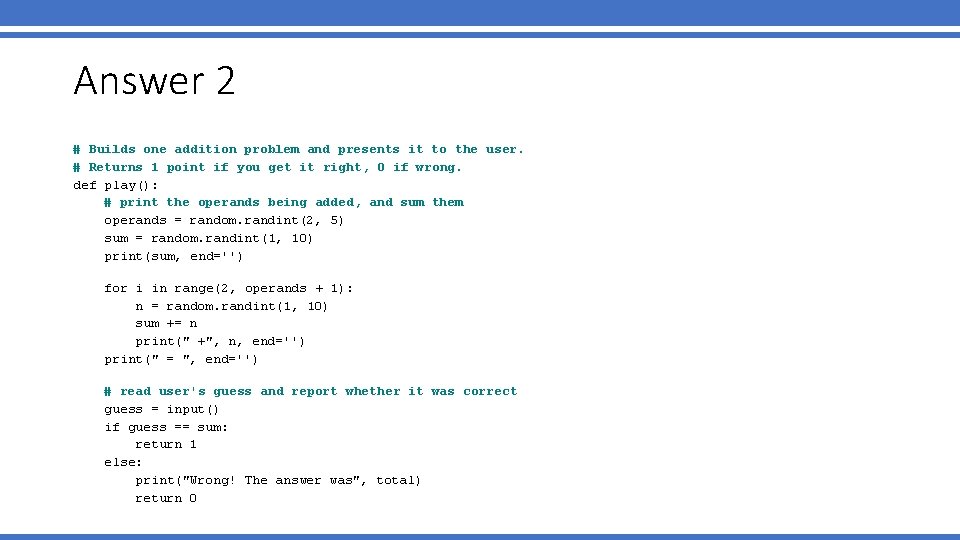
Answer 2 # Builds one addition problem and presents it to the user. # Returns 1 point if you get it right, 0 if wrong. def play(): # print the operands being added, and sum them operands = random. randint(2, 5) sum = random. randint(1, 10) print(sum, end='') for i in range(2, operands + 1): n = random. randint(1, 10) sum += n print(" +", n, end='') print(" = ", end='') # read user's guess and report whether it was correct guess = input() if guess == sum: return 1 else: print("Wrong! The answer was", total) return 0
Boolean Logic
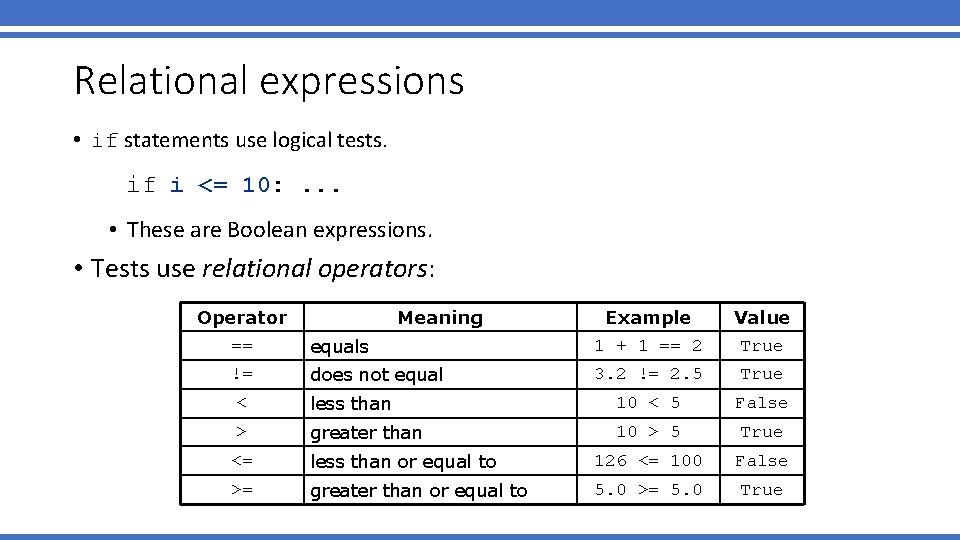
Relational expressions • if statements use logical tests. if i <= 10: . . . • These are Boolean expressions. • Tests use relational operators: Operator == != Meaning equals Example 1 + 1 == 2 Value True does not equal 3. 2 != 2. 5 True < less than 10 < 5 False > greater than 10 > 5 True <= less than or equal to 126 <= 100 False >= greater than or equal to 5. 0 >= 5. 0 True
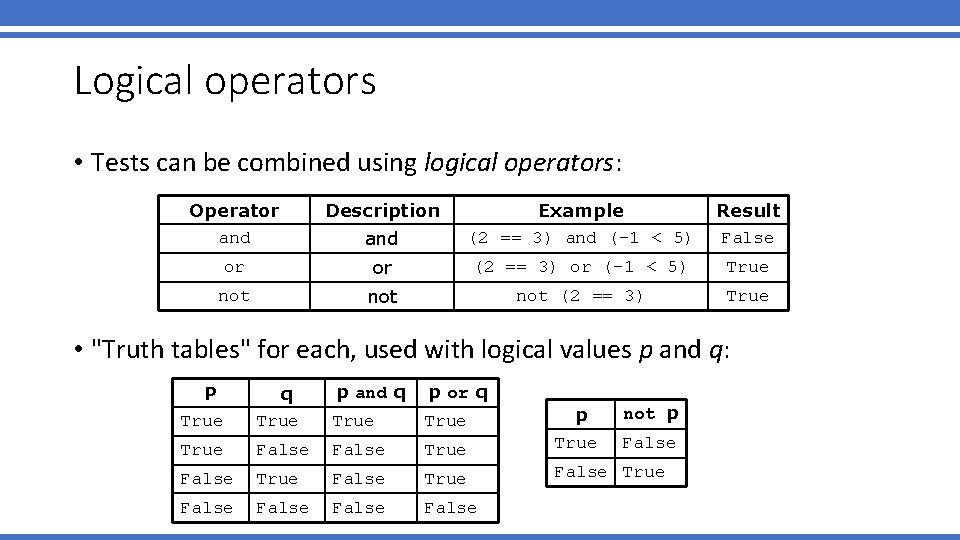
Logical operators • Tests can be combined using logical operators: Operator and Description and Example (2 == 3) and (-1 < 5) Result False or or (2 == 3) or (-1 < 5) True not not (2 == 3) True • "Truth tables" for each, used with logical values p and q: P True q True p and q p or q True False True p True False False not p False
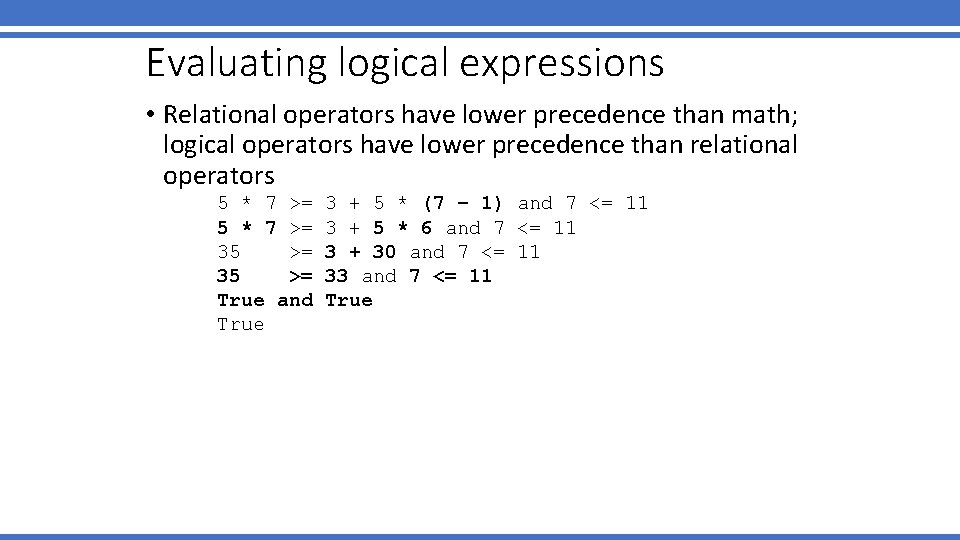
Evaluating logical expressions • Relational operators have lower precedence than math; logical operators have lower precedence than relational operators 5 * 7 >= 35 >= True and True 3 + 5 * (7 – 1) and 7 <= 11 3 + 5 * 6 and 7 <= 11 3 + 30 and 7 <= 11 33 and 7 <= 11 True
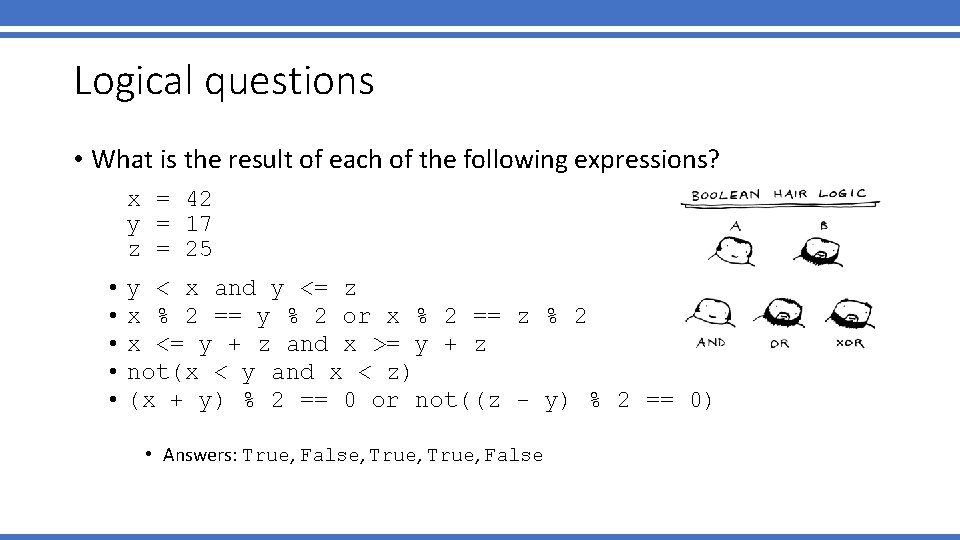
Logical questions • What is the result of each of the following expressions? x = 42 y = 17 z = 25 • • • y < x and y <= z x % 2 == y % 2 or x % 2 == z % 2 x <= y + z and x >= y + z not(x < y and x < z) (x + y) % 2 == 0 or not((z - y) % 2 == 0) • Answers: True, False, True, False
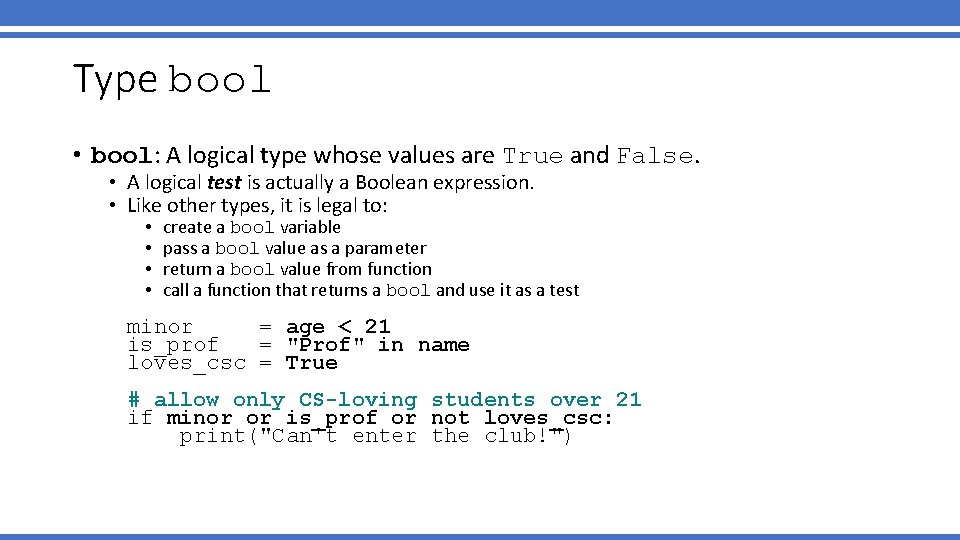
Type bool • bool: A logical type whose values are True and False. • A logical test is actually a Boolean expression. • Like other types, it is legal to: • • create a bool variable pass a bool value as a parameter return a bool value from function call a function that returns a bool and use it as a test minor = age < 21 is_prof = "Prof" in name loves_csc = True # allow only CS-loving students over 21 if minor or is_prof or not loves_csc: print("Can't enter the club!")
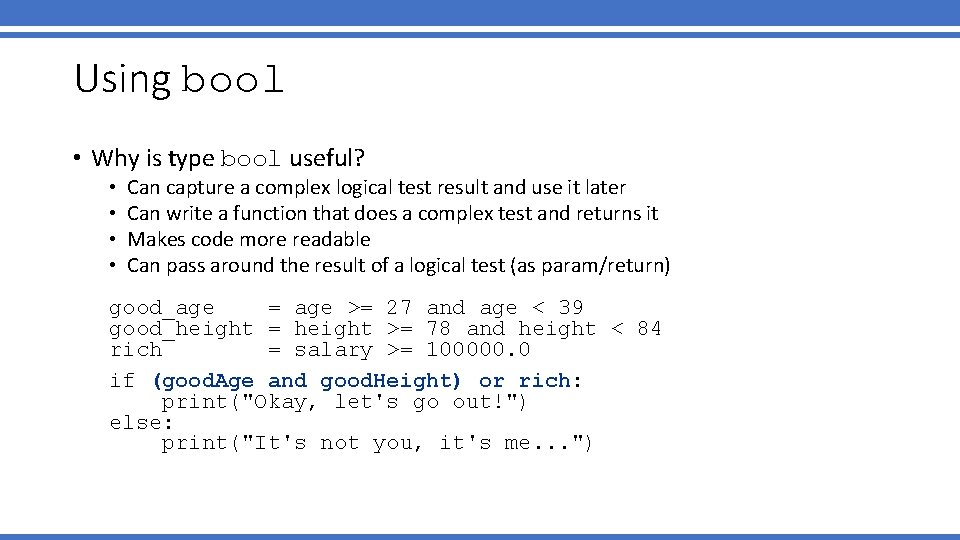
Using bool • Why is type bool useful? • • Can capture a complex logical test result and use it later Can write a function that does a complex test and returns it Makes code more readable Can pass around the result of a logical test (as param/return) good_age = age >= 27 and age < 39 good_height = height >= 78 and height < 84 rich = salary >= 100000. 0 if (good. Age and good. Height) or rich: print("Okay, let's go out!") else: print("It's not you, it's me. . . ")
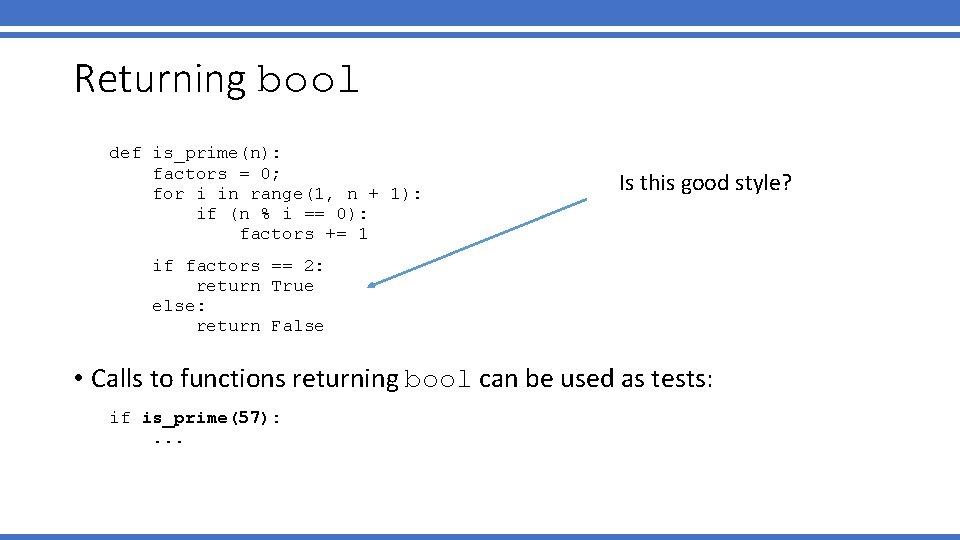
Returning bool def is_prime(n): factors = 0; for i in range(1, n + 1): if (n % i == 0): factors += 1 Is this good style? if factors == 2: return True else: return False • Calls to functions returning bool can be used as tests: if is_prime(57): . . .
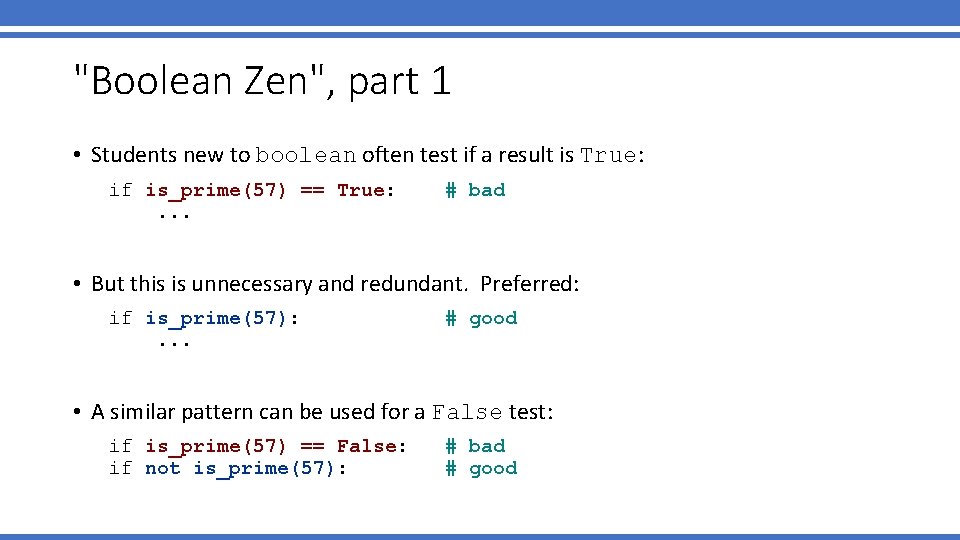
"Boolean Zen", part 1 • Students new to boolean often test if a result is True: if is_prime(57) == True: . . . # bad • But this is unnecessary and redundant. Preferred: if is_prime(57): . . . # good • A similar pattern can be used for a False test: if is_prime(57) == False: if not is_prime(57): # bad # good
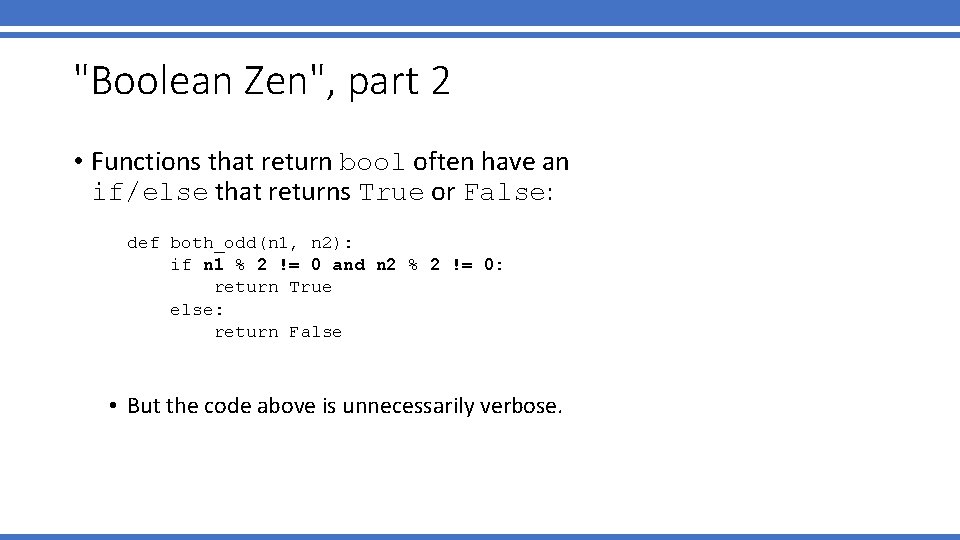
"Boolean Zen", part 2 • Functions that return bool often have an if/else that returns True or False: def both_odd(n 1, n 2): if n 1 % 2 != 0 and n 2 % 2 != 0: return True else: return False • But the code above is unnecessarily verbose.
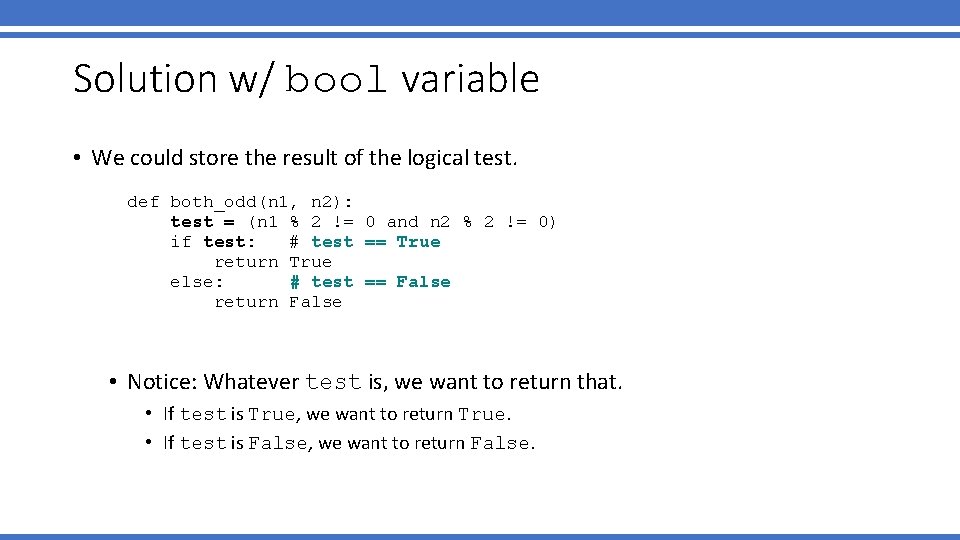
Solution w/ bool variable • We could store the result of the logical test. def both_odd(n 1, n 2): test = (n 1 % 2 != 0 and n 2 % 2 != 0) if test: # test == True return True else: # test == False return False • Notice: Whatever test is, we want to return that. • If test is True, we want to return True. • If test is False, we want to return False.
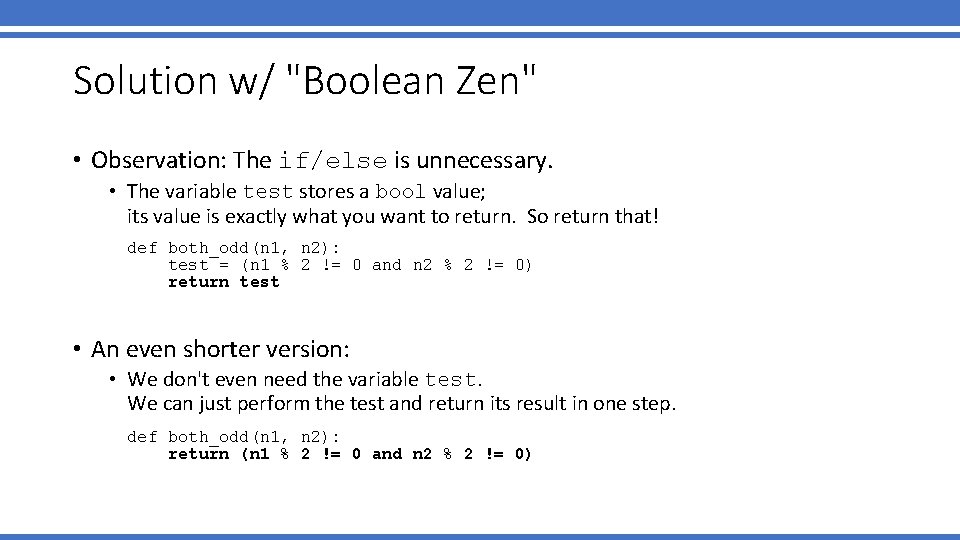
Solution w/ "Boolean Zen" • Observation: The if/else is unnecessary. • The variable test stores a bool value; its value is exactly what you want to return. So return that! def both_odd(n 1, n 2): test = (n 1 % 2 != 0 and n 2 % 2 != 0) return test • An even shorter version: • We don't even need the variable test. We can just perform the test and return its result in one step. def both_odd(n 1, n 2): return (n 1 % 2 != 0 and n 2 % 2 != 0)
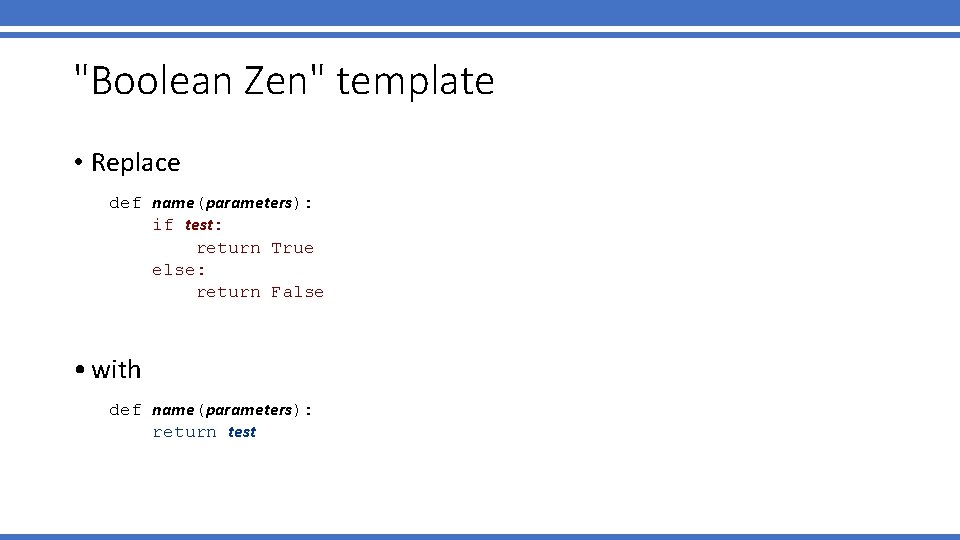
"Boolean Zen" template • Replace def name(parameters): if test: return True else: return False • with def name(parameters): return test
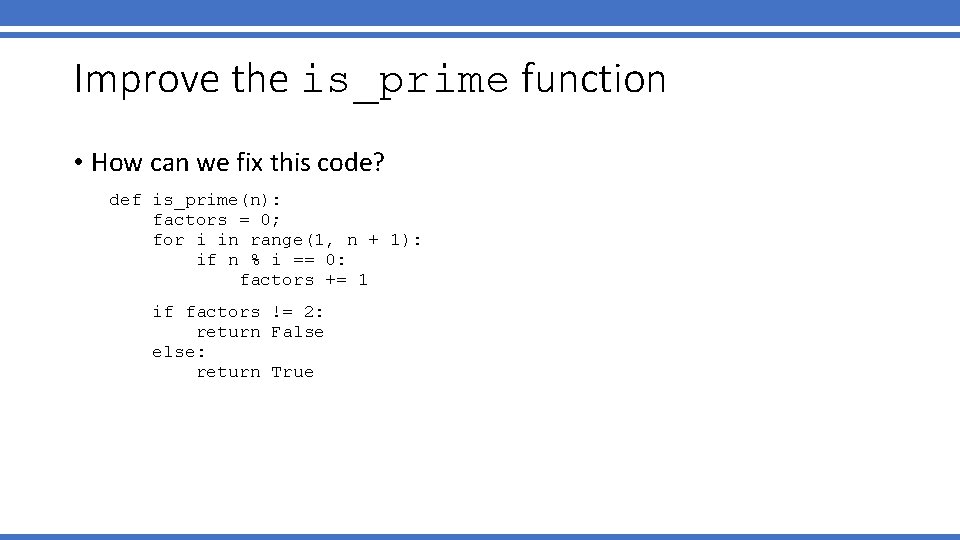
Improve the is_prime function • How can we fix this code? def is_prime(n): factors = 0; for i in range(1, n + 1): if n % i == 0: factors += 1 if factors != 2: return False else: return True
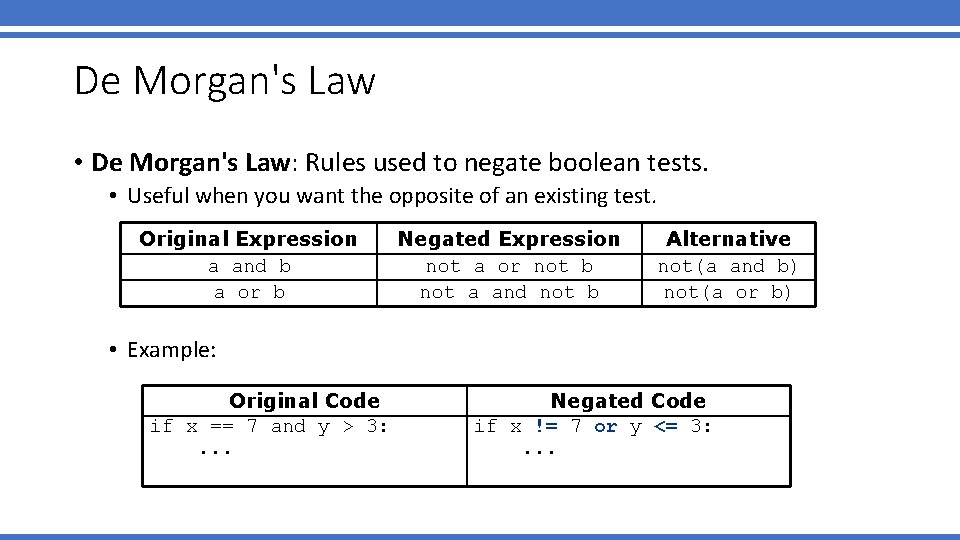
De Morgan's Law • De Morgan's Law: Rules used to negate boolean tests. • Useful when you want the opposite of an existing test. Original Expression a and b a or b Negated Expression not a or not b not a and not b Alternative not(a and b) not(a or b) • Example: Original Code if x == 7 and y > 3: . . . Negated Code if x != 7 or y <= 3: . . .
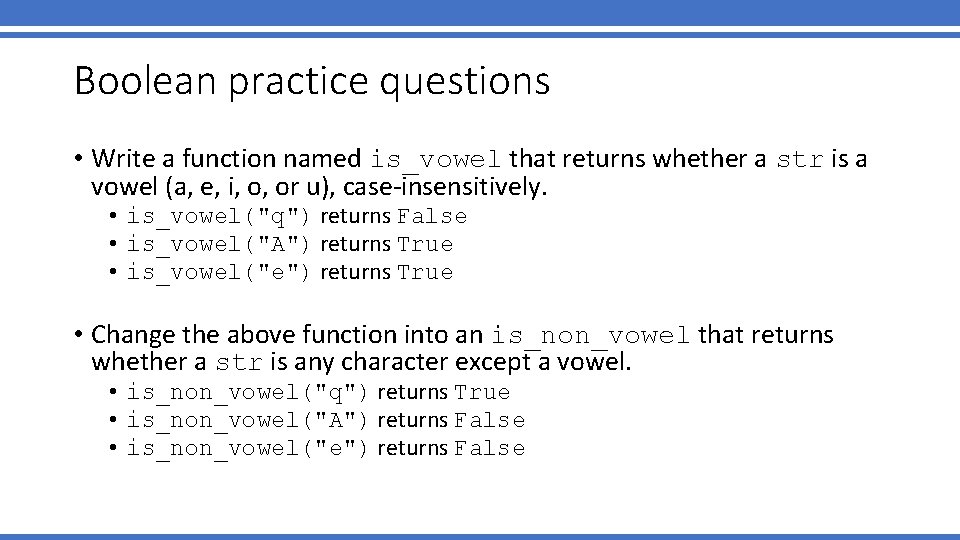
Boolean practice questions • Write a function named is_vowel that returns whether a str is a vowel (a, e, i, o, or u), case-insensitively. • is_vowel("q") returns False • is_vowel("A") returns True • is_vowel("e") returns True • Change the above function into an is_non_vowel that returns whether a str is any character except a vowel. • is_non_vowel("q") returns True • is_non_vowel("A") returns False • is_non_vowel("e") returns False
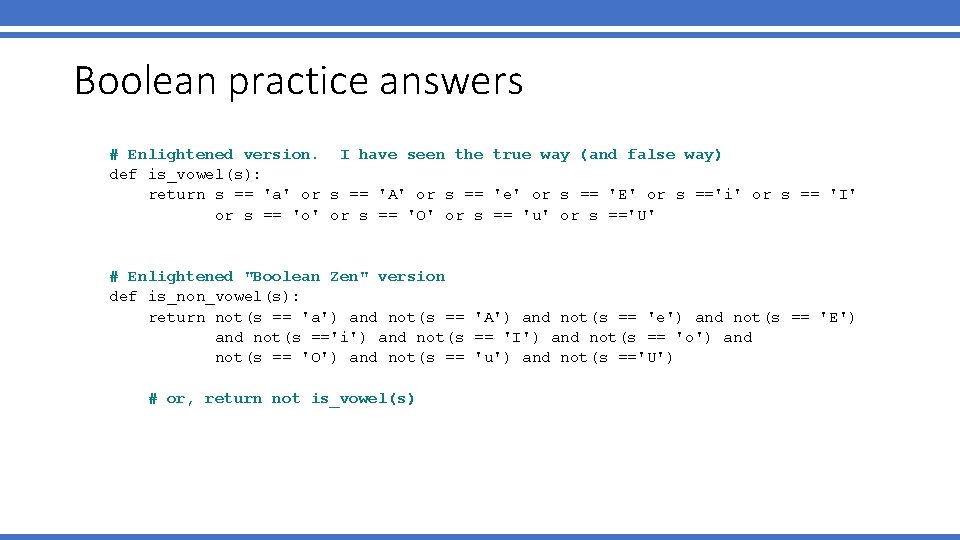
Boolean practice answers # Enlightened version. I have seen the true way (and false way) def is_vowel(s): return s == 'a' or s == 'A' or s == 'e' or s == 'E' or s =='i' or s == 'I' or s == 'o' or s == 'O' or s == 'u' or s =='U' # Enlightened "Boolean Zen" version def is_non_vowel(s): return not(s == 'a') and not(s == 'A') and not(s == 'e') and not(s == 'E') and not(s =='i') and not(s == 'I') and not(s == 'o') and not(s == 'O') and not(s == 'u') and not(s =='U') # or, return not is_vowel(s)
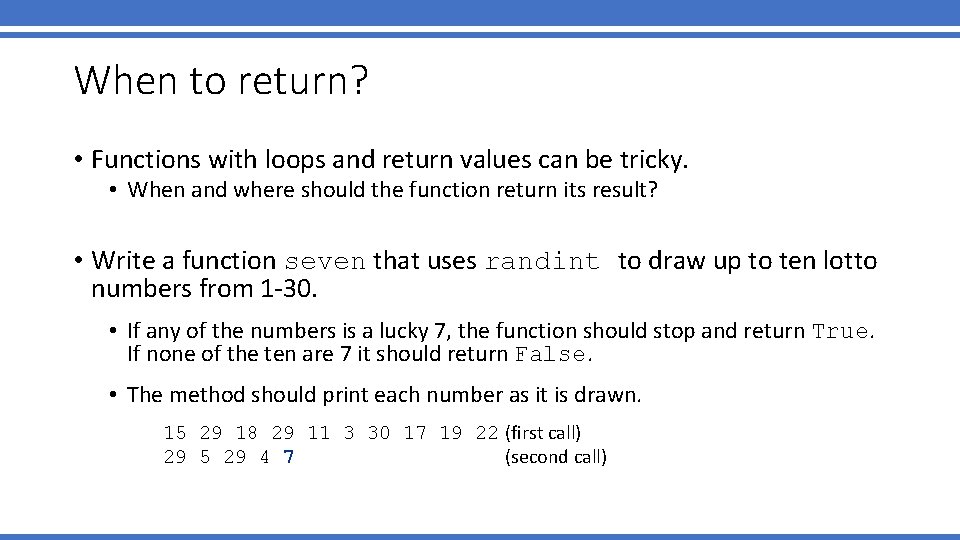
When to return? • Functions with loops and return values can be tricky. • When and where should the function return its result? • Write a function seven that uses randint to draw up to ten lotto numbers from 1 -30. • If any of the numbers is a lucky 7, the function should stop and return True. If none of the ten are 7 it should return False. • The method should print each number as it is drawn. 15 29 18 29 11 3 30 17 19 22 (first call) 29 5 29 4 7 (second call)
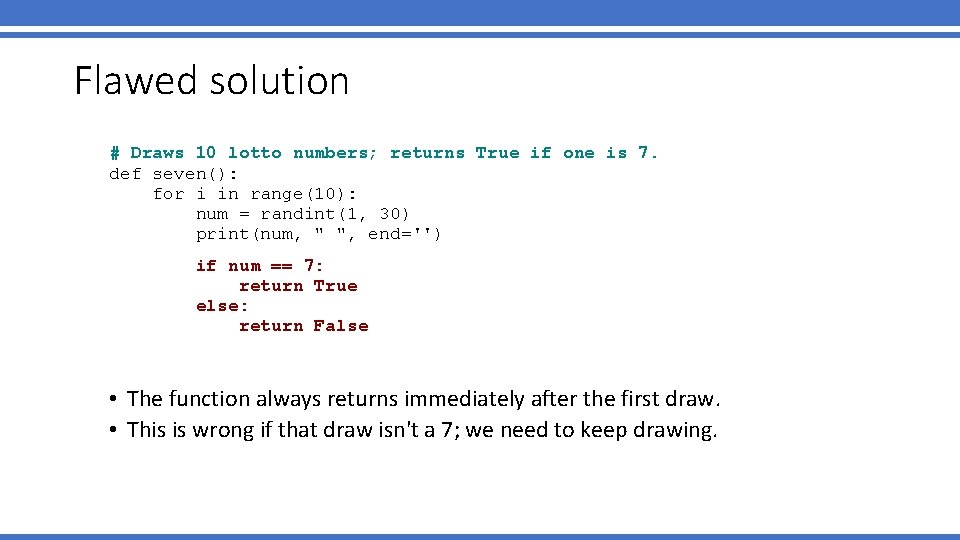
Flawed solution # Draws 10 lotto numbers; returns True if one is 7. def seven(): for i in range(10): num = randint(1, 30) print(num, " ", end='') if num == 7: return True else: return False • The function always returns immediately after the first draw. • This is wrong if that draw isn't a 7; we need to keep drawing.
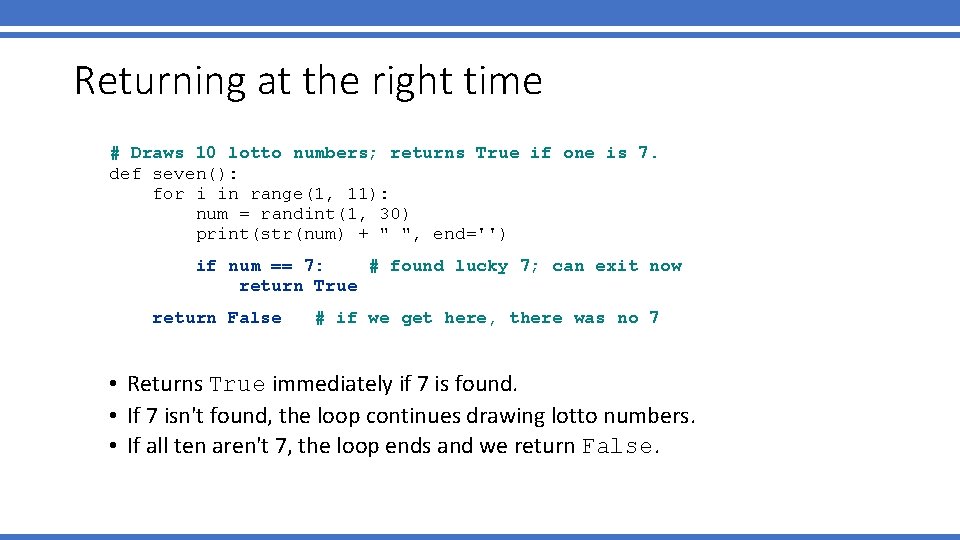
Returning at the right time # Draws 10 lotto numbers; returns True if one is 7. def seven(): for i in range(1, 11): num = randint(1, 30) print(str(num) + " ", end='') if num == 7: # found lucky 7; can exit now return True return False # if we get here, there was no 7 • Returns True immediately if 7 is found. • If 7 isn't found, the loop continues drawing lotto numbers. • If all ten aren't 7, the loop ends and we return False.
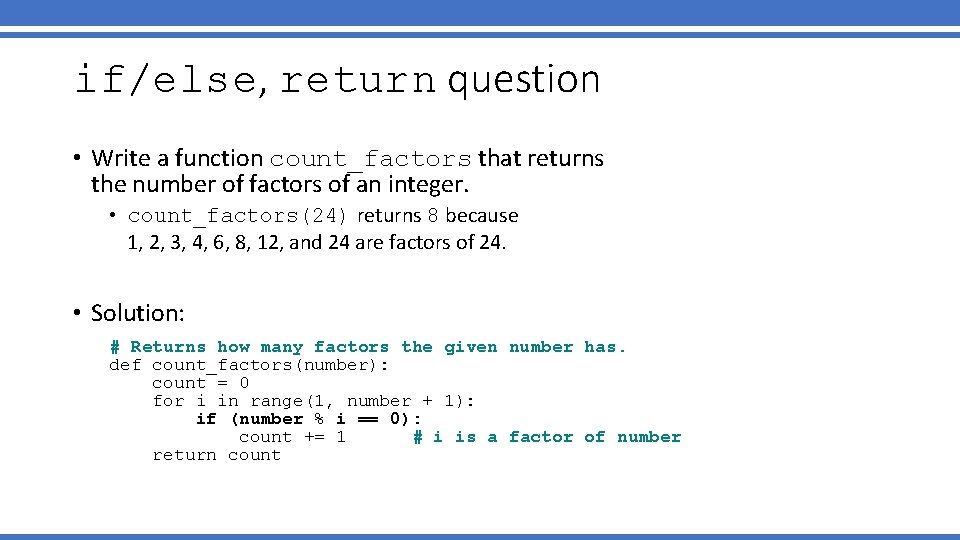
if/else, return question • Write a function count_factors that returns the number of factors of an integer. • count_factors(24) returns 8 because 1, 2, 3, 4, 6, 8, 12, and 24 are factors of 24. • Solution: # Returns how many factors the given number has. def count_factors(number): count = 0 for i in range(1, number + 1): if (number % i == 0): count += 1 # i is a factor of number return count
Assertions
Logical assertions • assertion: A statement that is either true or false. Examples: • Python was created in 1995. • The sky is purple. • 23 is a prime number. • 10 is greater than 20. • x divided by 2 equals 7. (depends on the value of x) • An assertion might be false ("The sky is purple" above), but it is still an assertion because it is a true/false statement.
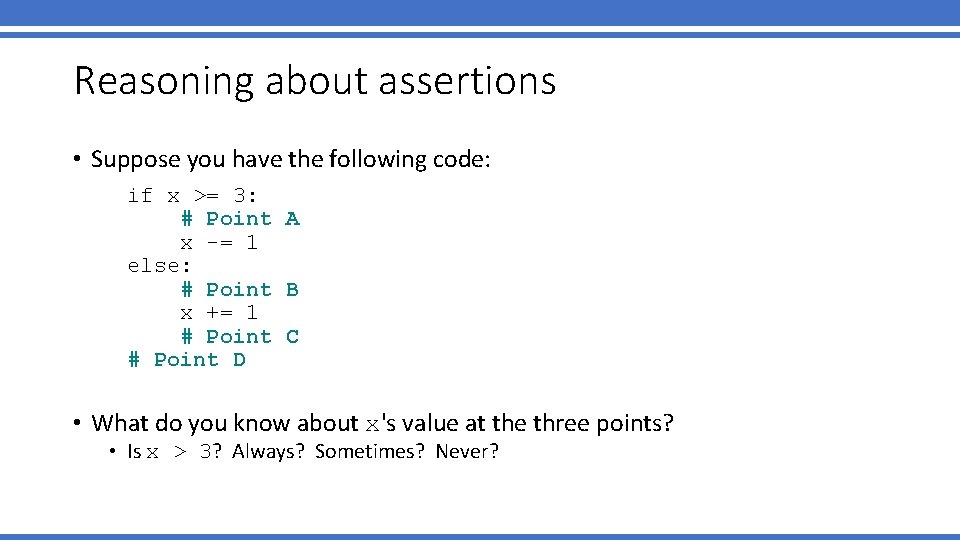
Reasoning about assertions • Suppose you have the following code: if x >= 3: # Point A x -= 1 else: # Point B x += 1 # Point C # Point D • What do you know about x's value at the three points? • Is x > 3? Always? Sometimes? Never?
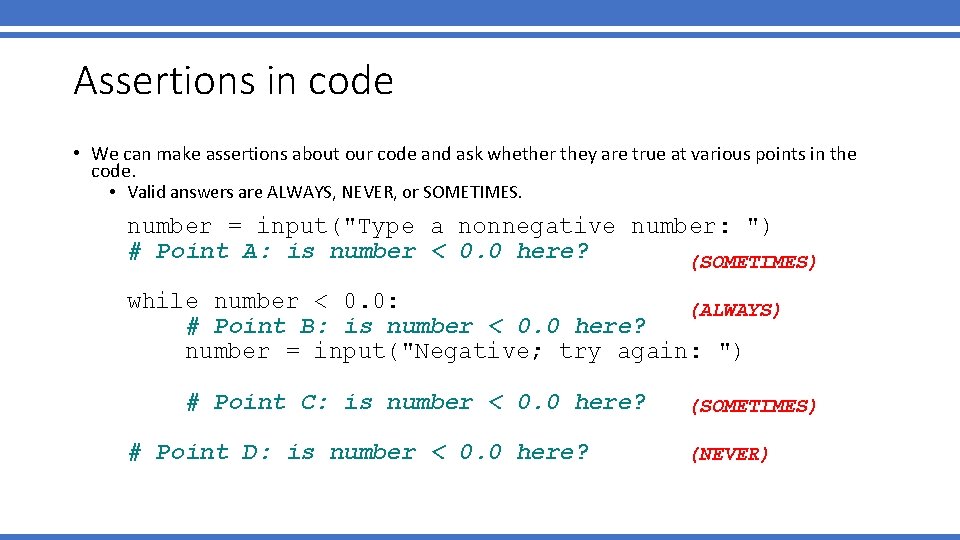
Assertions in code • We can make assertions about our code and ask whether they are true at various points in the code. • Valid answers are ALWAYS, NEVER, or SOMETIMES. number = input("Type a nonnegative number: ") # Point A: is number < 0. 0 here? (SOMETIMES) while number < 0. 0: (ALWAYS) # Point B: is number < 0. 0 here? number = input("Negative; try again: ") # Point C: is number < 0. 0 here? # Point D: is number < 0. 0 here? (SOMETIMES) (NEVER)
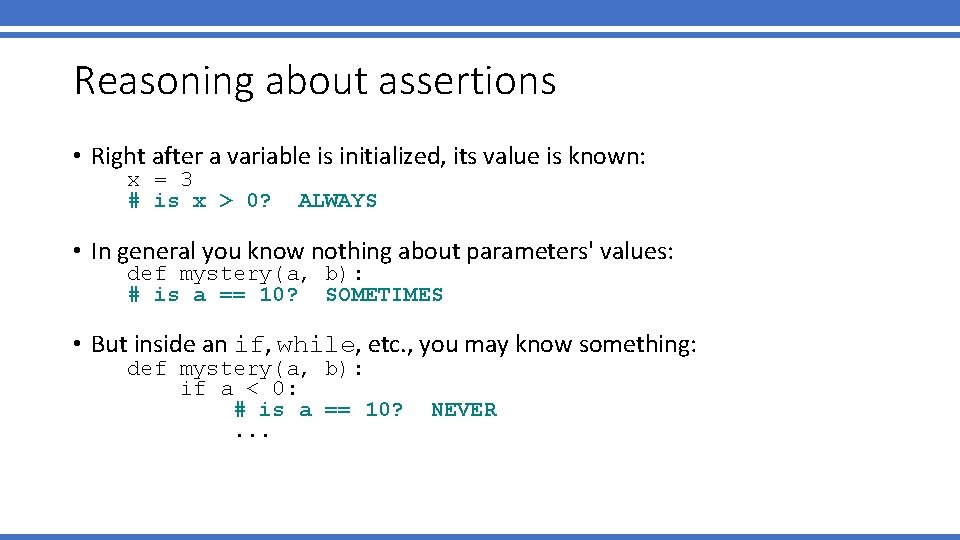
Reasoning about assertions • Right after a variable is initialized, its value is known: x = 3 # is x > 0? ALWAYS • In general you know nothing about parameters' values: def mystery(a, b): # is a == 10? SOMETIMES • But inside an if, while, etc. , you may know something: def mystery(a, b): if a < 0: # is a == 10? . . . NEVER
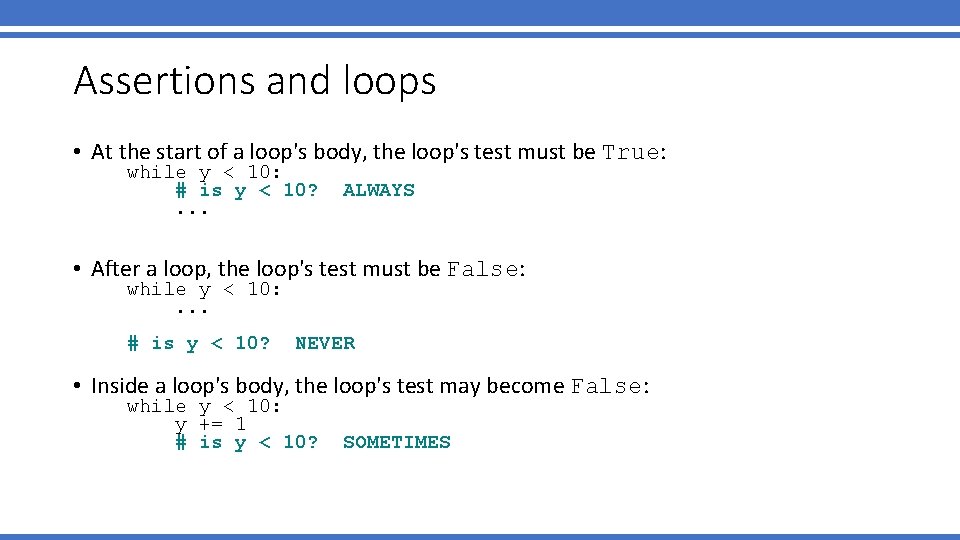
Assertions and loops • At the start of a loop's body, the loop's test must be True: while y < 10: # is y < 10? . . . ALWAYS • After a loop, the loop's test must be False: while y < 10: . . . # is y < 10? NEVER • Inside a loop's body, the loop's test may become False: while y < 10: y += 1 # is y < 10? SOMETIMES
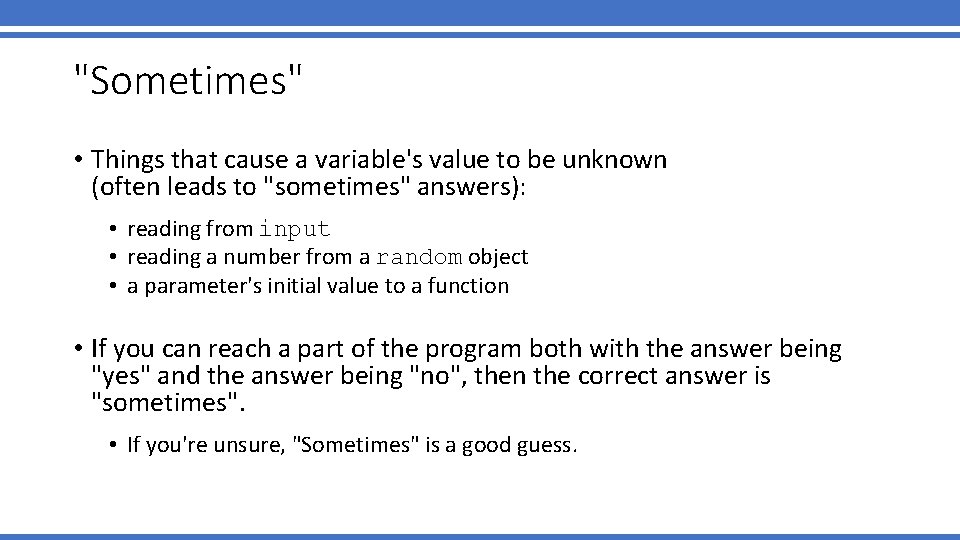
"Sometimes" • Things that cause a variable's value to be unknown (often leads to "sometimes" answers): • reading from input • reading a number from a random object • a parameter's initial value to a function • If you can reach a part of the program both with the answer being "yes" and the answer being "no", then the correct answer is "sometimes". • If you're unsure, "Sometimes" is a good guess.
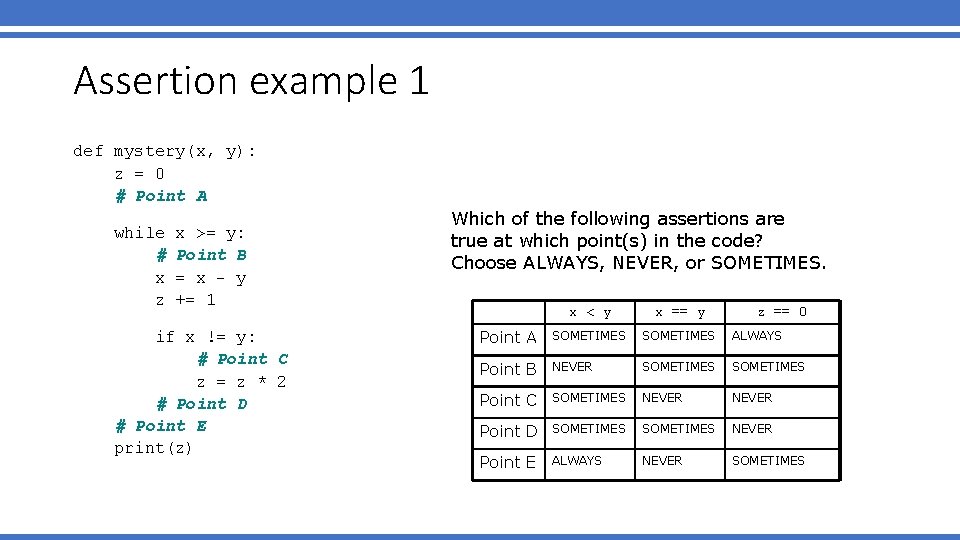
Assertion example 1 def mystery(x, y): z = 0 # Point A while # x z x >= y: Point B = x - y += 1 if x != y: # Point C z = z * 2 # Point D # Point E print(z) Which of the following assertions are true at which point(s) in the code? Choose ALWAYS, NEVER, or SOMETIMES. x < y x == y z == 0 Point A SOMETIMES ALWAYS Point B NEVER SOMETIMES Point C SOMETIMES NEVER Point D SOMETIMES NEVER Point E ALWAYS NEVER SOMETIMES
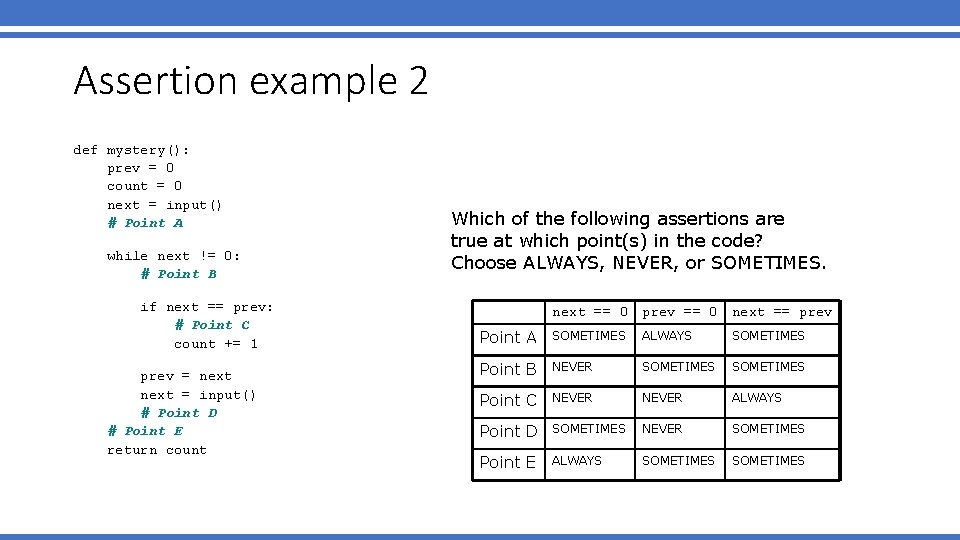
Assertion example 2 def mystery(): prev = 0 count = 0 next = input() # Point A while next != 0: # Point B if next == prev: # Point C count += 1 prev = next = input() # Point D # Point E return count Which of the following assertions are true at which point(s) in the code? Choose ALWAYS, NEVER, or SOMETIMES. next == 0 prev == 0 next == prev Point A SOMETIMES ALWAYS SOMETIMES Point B NEVER SOMETIMES Point C NEVER ALWAYS Point D SOMETIMES NEVER SOMETIMES Point E ALWAYS SOMETIMES
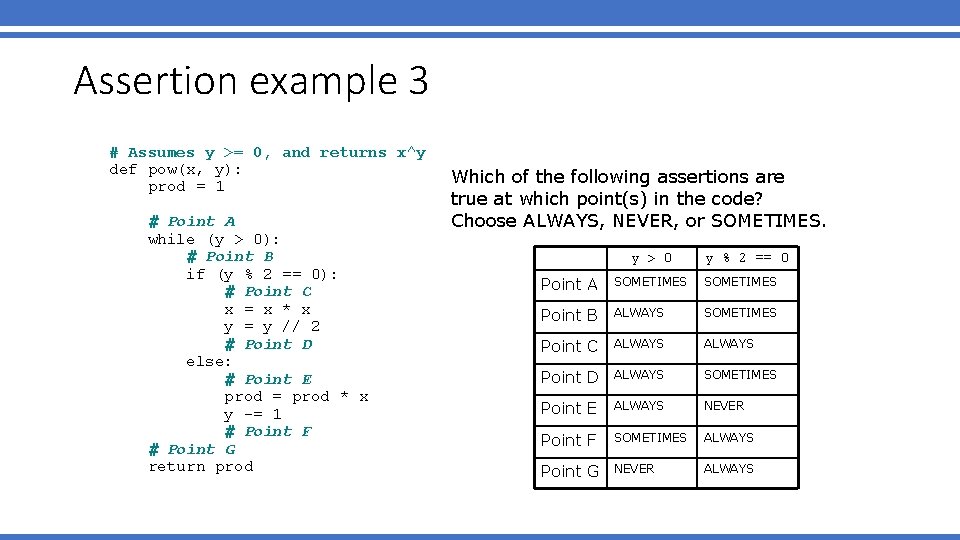
Assertion example 3 # Assumes y >= 0, and returns x^y def pow(x, y): prod = 1 # Point A while (y > 0): # Point B if (y % 2 == 0): # Point C x = x * x y = y // 2 # Point D else: # Point E prod = prod * x y -= 1 # Point F # Point G return prod Which of the following assertions are true at which point(s) in the code? Choose ALWAYS, NEVER, or SOMETIMES. y > 0 y % 2 == 0 Point A SOMETIMES Point B ALWAYS SOMETIMES Point C ALWAYS Point D ALWAYS SOMETIMES Point E ALWAYS NEVER Point F SOMETIMES ALWAYS Point G NEVER ALWAYS
- Slides: 53