
Building Public Policy Together ConsensusBased Policy Creation Employers
Building Public Policy Together: Consensus-Based Policy Creation, Employers & Employees Welcome Learn about types of consensus-based policy creation that bring together employers, government agencies, advocates and workingwomen and men to work together to create common ground solutions to workplace issues. This process of consensus-based policy creation is especially important when building public policy that helps build equitable, flexible and diverse workplaces. Presented by: Jim Hudson, Program Director, Center for Lobbying in the Public Interest Katie Corrigan, Co-Director, Workplace Flexibility 2010, Georgetown University Law Center Tricia Dwyer-Morgan, Director of Programs, BPW Foundation August 30, 2007
Consensus-Based Policy Creation We must hang together, or we shall surely hang separately. - Benjamin Franklin August 30, 2007
Consensus-Based Decision-Making A consensual agreement or win-win outcome of collaborative problem-solving and conflict resolution (www. biol. tsukuba. ac. jp? ~macer/biodict. htm) August 30, 2007
Informal vs. Formal Consensus-Based Policymaking Informal…deliberately reaching out to various stakeholder groups and building policy that reflects a perceived consensus among the offered opinions Formal… banding together to develop common ground and influence policy A spectrum of options…not either/or August 30, 2007
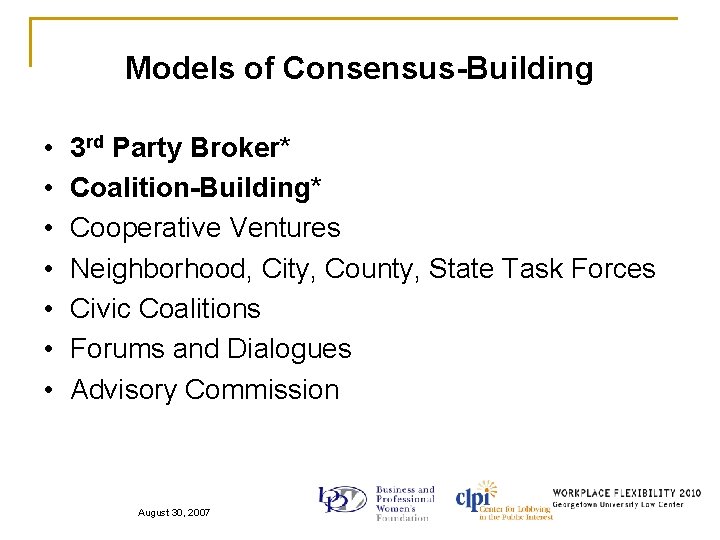
Models of Consensus-Building • • 3 rd Party Broker* Coalition-Building* Cooperative Ventures Neighborhood, City, County, State Task Forces Civic Coalitions Forums and Dialogues Advisory Commission August 30, 2007
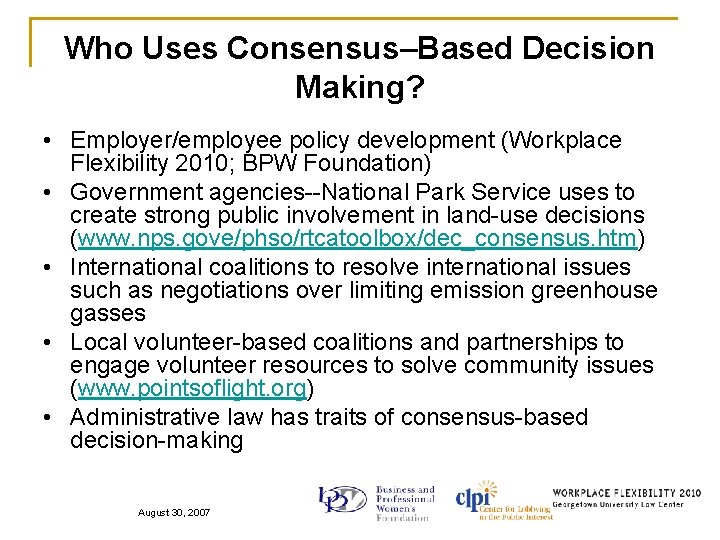
Who Uses Consensus–Based Decision Making? • Employer/employee policy development (Workplace Flexibility 2010; BPW Foundation) • Government agencies--National Park Service uses to create strong public involvement in land-use decisions (www. nps. gove/phso/rtcatoolbox/dec_consensus. htm) • International coalitions to resolve international issues such as negotiations over limiting emission greenhouse gasses • Local volunteer-based coalitions and partnerships to engage volunteer resources to solve community issues (www. pointsoflight. org) • Administrative law has traits of consensus-based decision-making August 30, 2007
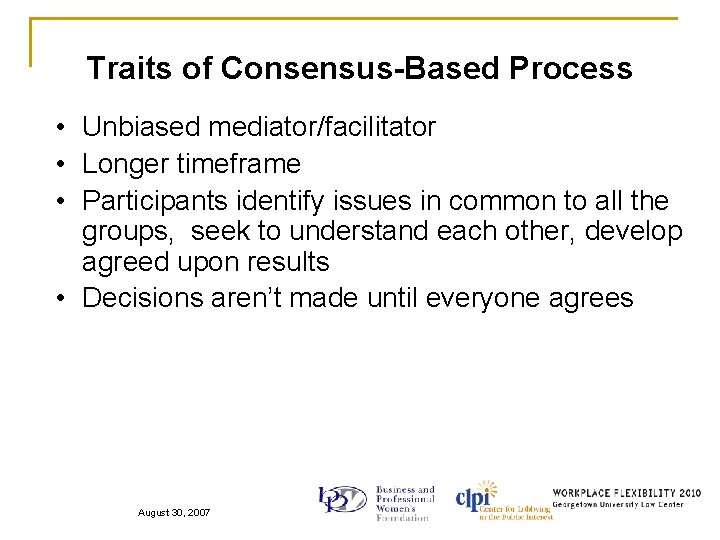
Traits of Consensus-Based Process • Unbiased mediator/facilitator • Longer timeframe • Participants identify issues in common to all the groups, seek to understand each other, develop agreed upon results • Decisions aren’t made until everyone agrees August 30, 2007
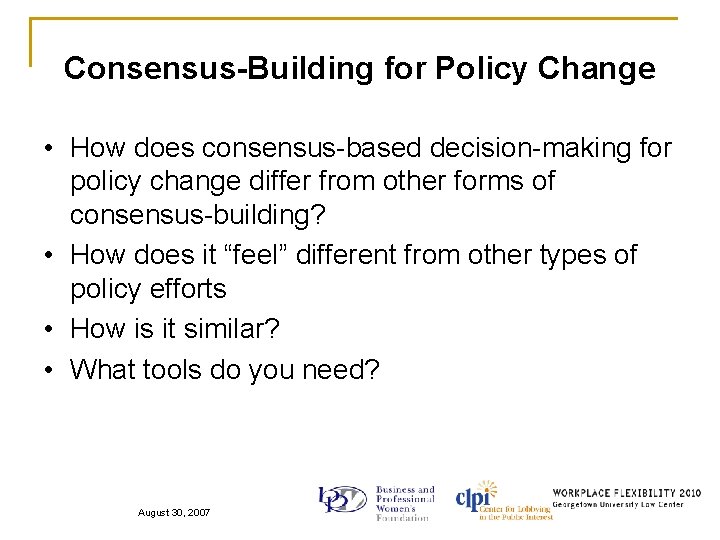
Consensus-Building for Policy Change • How does consensus-based decision-making for policy change differ from other forms of consensus-building? • How does it “feel” different from other types of policy efforts • How is it similar? • What tools do you need? August 30, 2007
Third Party Case Study August 30, 2007
Tools for the Campaign – Six Steps for Advocacy • Vision and Strategy – what is the coalition’s mission and how will it achieve success? • Lobbying – how will the coalition effectively persuade policymakers? • Policy Management – how will the coalition negotiate to move its policy goals forward? • Policy Research – what data is available to strengthen the coalition’s argument? • Outreach – how will the coalition gain constituency and/or grassroots support? • Communications – how will the coalition frame its message to increase awareness of and support for its mission? August 30, 2007
3 rd Party Brokers Case Study – Workplace Flexibility 2010 • Our mission: To achieve – by the year 2010 – consensus-based policy solutions on workplace flexibility that work for both business and families. August 30, 2007
Case Study – Workplace Flexibility 2010 • Our goal: an accepted norm of workplace flexibility, which includes: • • Flexibility in the scheduling of work hours; Flexibility in the amount of hours worked; Career flexibility over a lifetime; Ability to deal with emergent needs. August 30, 2007
Case Study – Workplace Flexibility 2010 • Our challenges: • To define workplace flexibility as a compelling public policy issue, not simply an individual problem • To bring together stakeholders – including employers and employees – with very different perspectives on workplace policies and the role of government in framing them • To engage those stakeholders in meaningful dialogue on workplace flexibility, while remaining a neutral facilitator of those discussions August 30, 2007
Case Study – Workplace Flexibility 2010 • Our consensus-based process: A combination of formal and informal consensus-building August 30, 2007
Case Study – Workplace Flexibility 2010 • In order to build support for comprehensive workplace flexibility policy, we have: • Built a substantive knowledge base on workplace flexibility, so we can serve as a resource for stakeholders and educate policymakers • Expanded the constituency base that cares about workplace flexibility – by engaging groups not ordinarily associated with workplace issues • Begun meaningful conversations between employers and employees on workplace flexibility – by convening working groups that equally represent those perspectives August 30, 2007
Case Study – Workplace Flexibility 2010 • Our Lessons Learned: • When and where you can, take advantage of the longer timeline a consensus-based approach provides – to build your institutional knowledge and your understanding of the playing field • Provide opportunities for meaningful discussion without pressing for immediate consensus • Reach out to individuals and organizations who you might not ordinarily identity as an ally August 30, 2007
Focusing on Coalitions Building a coalition of key stakeholders is one strategy used to bring together key stakeholders to affect policy development August 30, 2007
What is a coalition? August 30, 2007
What forms can these partnerships take? • Ad hoc task force • Legally recognized associations/federations • Partners in efficiency: – shared resources (space, staff, talent) • Information sharing network • Advocacy coalition August 30, 2007
WHY? ? ? Coalitions Build Power • • Greater scale, reach, impact Increased resources and capacity Creates momentum Mutual success fosters formidable perceptions • Individual organizations gain: credibility, power, recognition and CONTACTS. August 30, 2007
Collaboration Requires • Common goals • Structures for planning, decision making, and action • Clear definition of roles and responsibilities. • Shared risks and rewards • General understandings and accepted agreements August 30, 2007
Obtaining Benefits of Coalitions Tips! 1. 2. 3. 4. 5. 6. 7. 8. 9. Identify the Issue and the Stakeholders Anticipate Conflicts; Agree to Disagree Identify Capacity; Define Roles and Responsibilities Ascertain: Is this Workable for Everyone? Identify Your Logistical Capacity Identify Your Place In the Policy Process Organize Get Down to Work Pay Attention to Legal Considerations August 30, 2007
Tip 1: Identify the Issue and the Stakeholders 1. Do we have a history of collaborating with others in our community? Can we transform that collaboration? 2. Who are the current convening groups or leaders in the community? 3. Are there any risks that come with this association? 4. Approach them! August 30, 2007
Tip 2: Anticipate Conflicts; Agree to Disagree Address the following immediately: • Acknowledge any competing interests • Acknowledge mutual respect and trust • Acknowledge that coalition serves selfinterests as well as common interests. August 30, 2007
Tip 3: Identify Capacity; Define Roles and Responsibilities • Identify each partners strengths and weaknesses. • Establish a structure for deciding and defining roles and policies which builds on strengths. • Create the understanding that the coalition must be tolerant of dissent, nimble, flexible, and adaptable. August 30, 2007
Tip 4: Is this Workable for Everyone? • Yes – Rural Groups • Chamber, hospitals, fraternal, booster clubs, state level affinity organizations – Urban Groups • Neighborhood associations, ethnic associations, unions, church – State Groups • Local organizations give voice and credibility – National Groups • State and local groups demonstrate representation. August 30, 2007
Tip 5: Identify Your Logistical Capacity Identify how you will communicate, track, organize and mobilize. • Desktop Availability? • Website? • Other means of communication? • Who is responsible, and for which piece? • What and how are we tracking our effort? August 30, 2007
Tip 6: Identify the Policy Process Learn the Basics of the system you intend to influence • You don’t have to be political scientist • School House Rock is the key • Use your lack of knowledge to foster relationships and trust • Surf the internet • Determine you insertion points August 30, 2007
Tip 7: Organize • • Find an ally and commit them to assisting Delegate and assign responsibility Reach out to those who know Predict and prepare for positive and negative responses • Structure the organization so that it becomes institutional not peripheral August 30, 2007
Tip 8: Get Down to Work Manage the coalition and get them to work • Choose issues based on common ground • Build towards success – Put up a “stop sign” before you move the highway • Fight today’s battles • Fight with today’s tools and today’s insights August 30, 2007
Tip 9: Legal Considerations, What Works Best Depends on the Mission • What’s the purpose – Legislative advocacy – New power base? – Ballot Initiative? – Electoral Activities? August 30, 2007
Tip 9: Legal Considerations II • It alway$ $eem$ to come down to the $$$ – Who’ll act as the fiduciary? – Is there any benefit to having a (c)(4)? – Tax deductibility – Will the coalition even qualify as a (c)(3)? – Would we be better of remaining unofficial? August 30, 2007
Interactive Exercise - Use the following August 30, 2007
Next Steps… Is there any situation or issue in your community that would benefit from consensus-based policy building? August 30, 2007
- Slides: 34