
Building Positive Relationships with your Children A Workshop
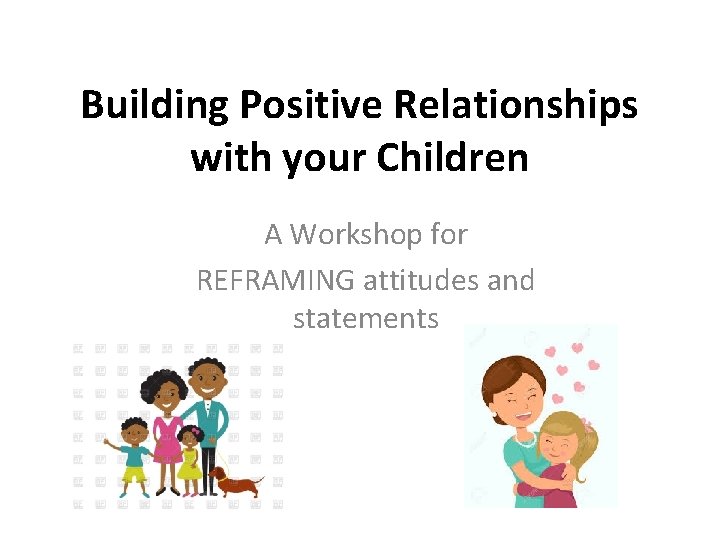
Building Positive Relationships with your Children A Workshop for REFRAMING attitudes and statements
Agenda • • • Introduction of the topic Hot Button Activity Challenging Behaviors and their functions Reframing Activity Using Positive Statements Q and A
Examining Attitudes about Challenging Behaviors HOT BUTTON ACTIVITY: Group sharing What pushes your buttons? • How do these behaviors make you feel? • What is your response when these behaviors occur? • How does this impact your relationship with other people?
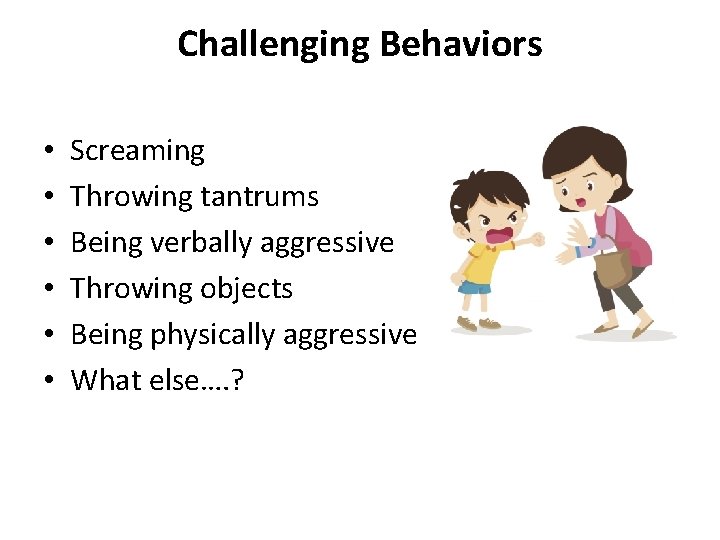
Challenging Behaviors • • • Screaming Throwing tantrums Being verbally aggressive Throwing objects Being physically aggressive What else…. ?
Challenging Behavior Basic Assumptions • Challenging behavior usually has a message- I am bored, I am sad, you hurt my feelings, I need some attention. – Children often use challenging behavior when they don’t have the social or communication skills they need to engage in more appropriate interactions. – Behavior that persists over time is usually working for the child. – We need to focus on teaching children what to do in place of the challenging behavior (replacement skills)
Challenging Behavior Works • Children engage in challenging behavior because “it works” for them. • Challenging behavior results in the child gaining access to something or someone (i. e. , obtain/request) or avoiding something or someone (i. e. , escape/protest).
Function of the Behavior • To get attention • To request something e. g. , object • To avoid a task (does not want to clean up after playing) • To avoid demands (does not want to do homework) • To express an emotion • To escape sensory overload
Changing Our View • Take the problem away from the child and ask: –Why is this behavior happening? • What changes can I make to prevent the problem from occurring and teach the child new skills?
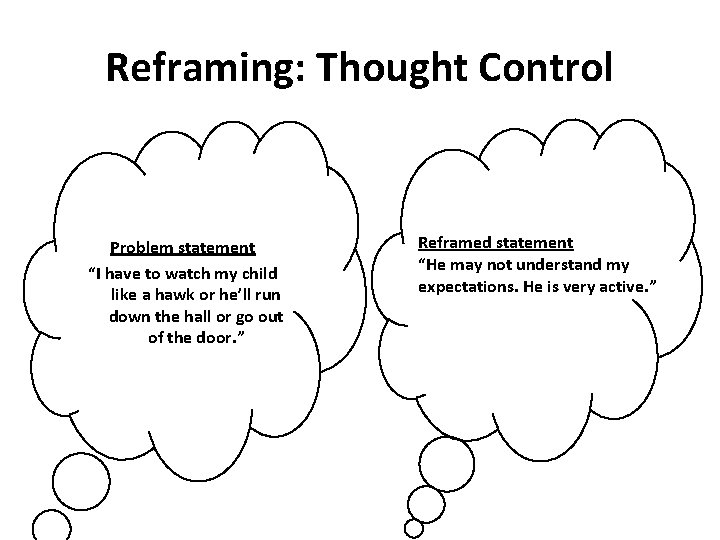
Reframing: Thought Control Problem statement “I have to watch my child like a hawk or he’ll run down the hall or go out of the door. ” Reframed statement “He may not understand my expectations. He is very active. ”
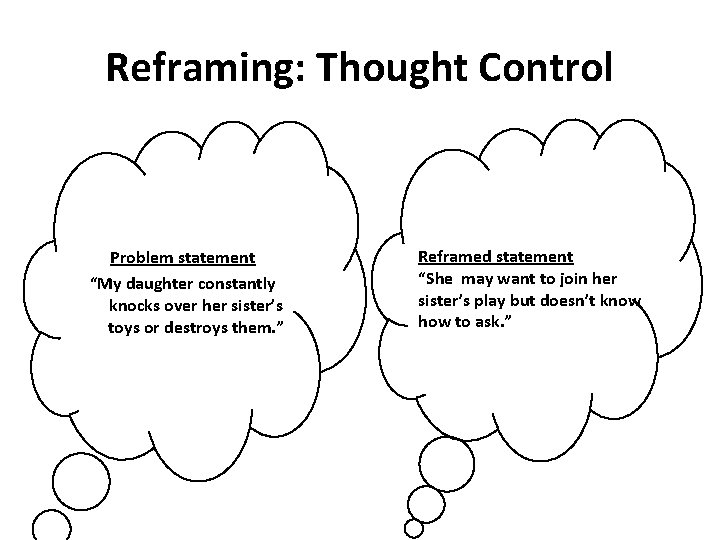
Reframing: Thought Control Problem statement “My daughter constantly knocks over her sister’s toys or destroys them. ” Reframed statement “She may want to join her sister’s play but doesn’t know how to ask. ”
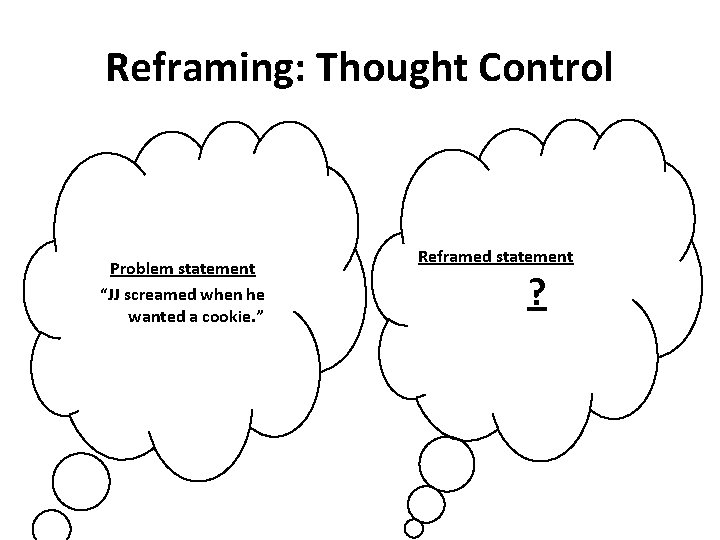
Reframing: Thought Control Problem statement “JJ screamed when he wanted a cookie. ” Reframed statement ?
Reframing Activity In small groups: –Talk about your “hot buttons, ” and consider how you can reframe the behavior. –In reframing the challenging behaviors, do not come up with solutions but rather restate the behaviors to make them more manageable. –Be prepared to share your ideas with the large group.
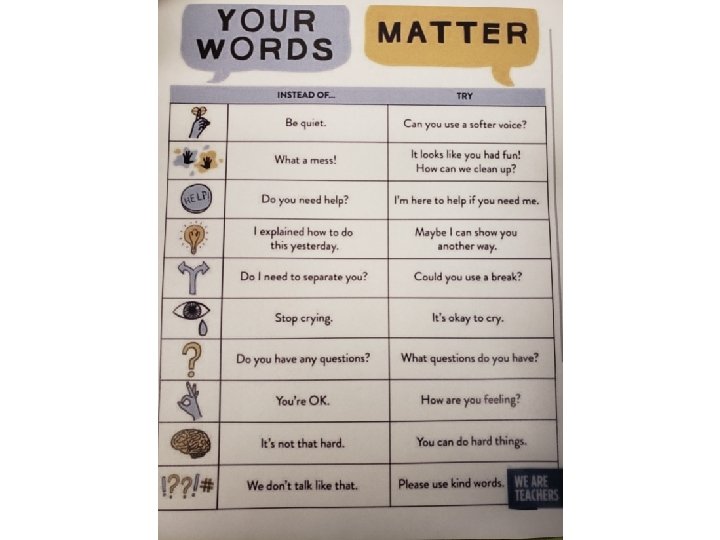
Use Positive Words • Tell the child what to do instead of what not to do. • Clearly and simply state what you expect your child to do. • Have age –appropriate expectations. • Use age-appropriate language.
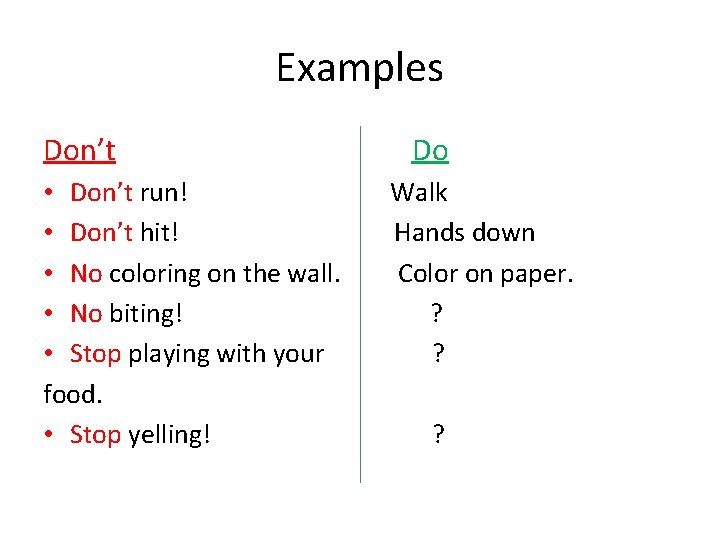
Examples Don’t • Don’t run! • Don’t hit! • No coloring on the wall. • No biting! • Stop playing with your food. • Stop yelling! Do Walk Hands down Color on paper. ? ? ?
Building Positive Relationships by Making Deposits Maintain a 5: 1 (positive to negative) Give attention when the child is engaged in appropriate behaviors
Building relationships: Ideas for Making Deposits • Talk to your child after a difficult day and say, “I’m sorry you had a tough day today. I know tomorrow is going to be better!” • Give hugs, high fives and thumbs up for accomplishing tasks. • Acknowledge children’s efforts. • Give compliments liberally. • Play with children, follow their lead.
Positive Adult-Child Interactions • Acknowledge child’s communication (verbal or non-verbal) • Engage in one-to-one interactions, at eye level • Use a pleasant, calm voice and simple language • Provide warm, responsive physical contact • Follow the child’s lead and interests during play • Listen to children and encourage them to listen to others
It All Adds Up Deposits: – Active Listening – Modeling – Using positive language – Providing verbal praise – Providing hugs, high fives, thumbs up when they do something good. Withdrawals: No Don’t Stop Demands - directions Using a loud voice Intimidating request Threats
The Benefits! • Influence a child’s emotional, cognitive, and social development • Help children develop secure relationships with other adults • Help children develop good peer relationships • Help reduce the frequency of behavior problems • Help children develop positive self-esteem • Results in higher rates of child engagement
Something to keep in mind…. “When you see a child differently, you see a different child. ”
RESOURCES • http: //csefel. vanderbilt. edu/resources/trainin g_preschool. html#mod 1 • http: //challengingbehavior. cbcs. usf. edu/Imple mentation/family. html • https: //www. tolerance. org/magazine/publicat ions/reframing-classroom-management-atoolkit-for-educators
- Slides: 22