
Building Personal ContextAware Systems Realizing ACAS infrastructure for
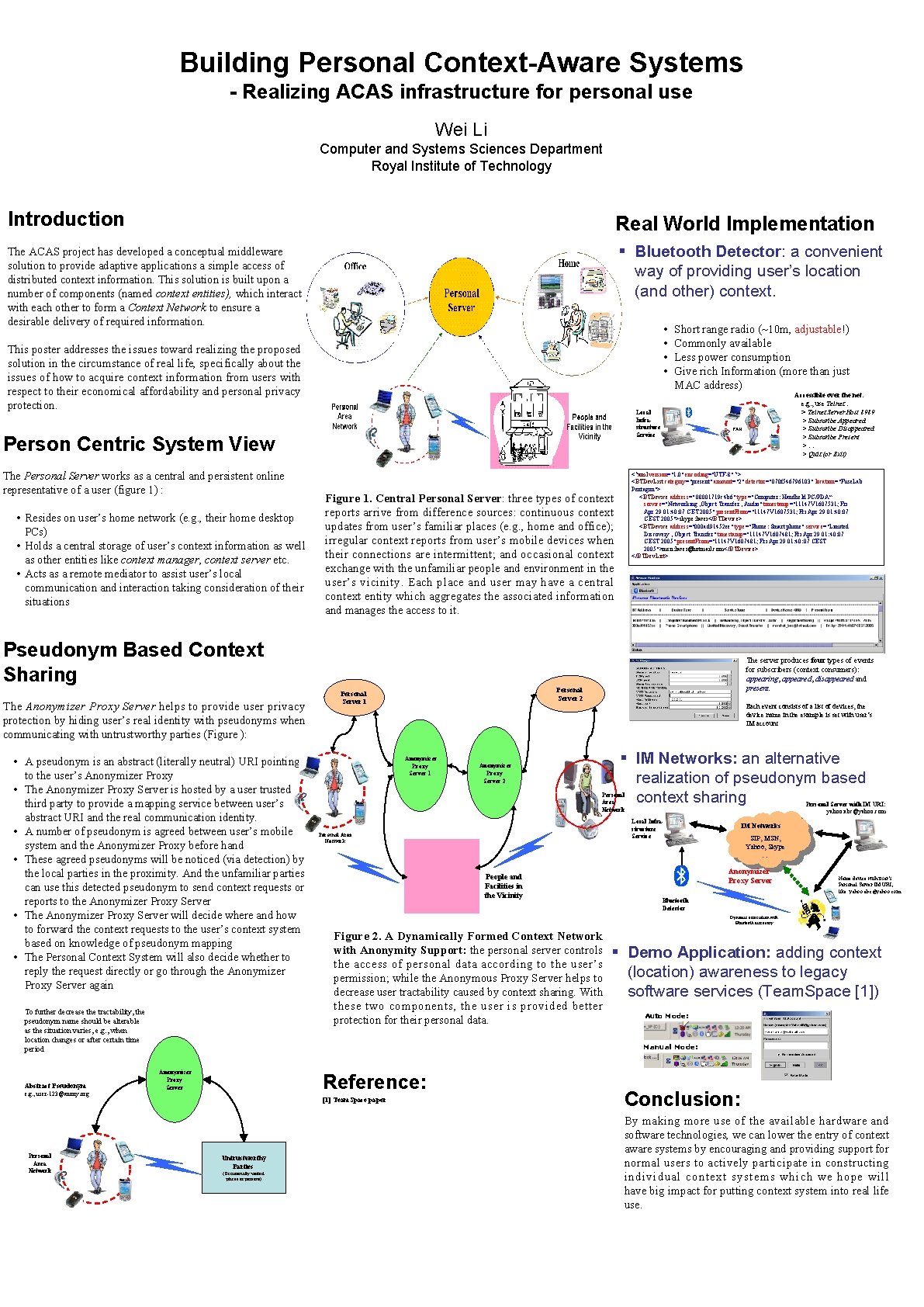
Building Personal Context-Aware Systems - Realizing ACAS infrastructure for personal use Wei Li Computer and Systems Sciences Department Royal Institute of Technology Introduction Real World Implementation The ACAS project has developed a conceptual middleware solution to provide adaptive applications a simple access of distributed context information. This solution is built upon a number of components (named context entities), which interact with each other to form a Context Network to ensure a desirable delivery of required information. § Bluetooth Detector: a convenient way of providing user’s location (and other) context. • • This poster addresses the issues toward realizing the proposed solution in the circumstance of real life, specifically about the issues of how to acquire context information from users with respect to their economical affordability and personal privacy protection. Local Infrastructure Service Person Centric System View The Personal Server works as a central and persistent online representative of a user (figure 1) : • Resides on user’s home network (e. g. , their home desktop PCs) • Holds a central storage of user’s context information as well as other entities like context manager, context server etc. • Acts as a remote mediator to assist user’s local communication and interaction taking consideration of their situations Short range radio (~10 m, adjustable!) Commonly available Less power consumption Give rich Information (more than just MAC address) PAN <? xml version="1. 0" encoding="UTF-8" ? > <BTDev. List category="present" amount="2" detector="070 f 546796103" location="Fuse. Lab Pentagon"> <BTDevice address=" 08001719 c 4 b 6" type="Computer: Handheld PC/PDA“ service="Networking , Object Transfer , Audio" timestamp="11147 V 1607531; Fri Apr 29 01: 40: 07 CET 2005" present. From="11147 V 1607531; Fri Apr 29 01: 40: 07 CEST 2005">skype: liwei</BTDevice> <BTDevice address="000 ad 91452 ee" type="Phone: Smart phone" service="Limited Discovery , Object Transfer" timestamp="11147 V 1607481; Fri Apr 29 01: 40: 07 CEST 2005" present. From="11147 V 1607481; Fri Apr 29 01: 40: 07 CEST 2005">msn: liwei@hotmail. com</BTDevice> </BTDev. List> Figure 1. Central Personal Server: three types of context reports arrive from difference sources: continuous context updates from user’s familiar places (e. g. , home and office); irregular context reports from user’s mobile devices when their connections are intermittent; and occasional context exchange with the unfamiliar people and environment in the user’s vicinity. Each place and user may have a central context entity which aggregates the associated information and manages the access to it. Pseudonym Based Context Sharing The Anonymizer Proxy Server helps to provide user privacy protection by hiding user’s real identity with pseudonyms when communicating with untrustworthy parties (Figure ): • A pseudonym is an abstract (literally neutral) URI pointing to the user’s Anonymizer Proxy • The Anonymizer Proxy Server is hosted by a user trusted third party to provide a mapping service between user’s abstract URI and the real communication identity. • A number of pseudonym is agreed between user’s mobile system and the Anonymizer Proxy before hand • These agreed pseudonyms will be noticed (via detection) by the local parties in the proximity. And the unfamiliar parties can use this detected pseudonym to send context requests or reports to the Anonymizer Proxy Server • The Anonymizer Proxy Server will decide where and how to forward the context requests to the user’s context system based on knowledge of pseudonym mapping • The Personal Context System will also decide whether to reply the request directly or go through the Anonymizer Proxy Server again To further decrease the tractability, the pseudonym name should be alterable as the situation varies, e. g. , when location changes or after certain time period Abstract Pseudonym e. g. , user-123@anony. org Personal Area Network The server produces four types of events for subscribers (context consumers): appearing, appeared, disappeared and present. Personal Server 2 Personal Server 1 Accessible over the net: e. g. , use Telnet : > Telnet Server. Host 8989 > Subscribe Appeared > Subscribe Disappeared > Subscribe Present >… > Quit (or Exit) Each event consists of a list of devices, the device name in the example is set with user’s IM account Anonymizer Proxy Server 1 Anonymizer Proxy Server 2 § IM Networks: an alternative realization of pseudonym based context sharing Personal Area Network Personal Server with IM URI: yahoo: abc@yahoo. com Local Infrastructure Service Personal Area Network People and Facilities in the Vicinity IM Networks SIP, MSN, Yahoo, Skype … Anonymizer Proxy Server Name device with user’s Personal Server IM URI, like: yahoo: abc@yahoo. com Bluetooth Detector Dynamic association with Bluetooth discovery Figure 2. A Dynamically Formed Context Network with Anonymity Support: the personal server controls the access of personal data according to the user’s permission; while the Anonymous Proxy Server helps to decrease user tractability caused by context sharing. With these two components, the user is provided better protection for their personal data. § Demo Application: adding context (location) awareness to legacy software services (Team. Space [1]) Auto Mode: Manual Mode: Anonymizer Proxy Server Reference: [1] Team. Space paper Untrustworthy Parties (Occasionally visited places or persons) Conclusion: By making more use of the available hardware and software technologies, we can lower the entry of context aware systems by encouraging and providing support for normal users to actively participate in constructing individual context systems which we hope will have big impact for putting context system into real life use.
- Slides: 1