
Building on Your Strengths A Career Development Process
Building on Your Strengths A Career Development Process Utilizing Appreciative Inquiry 1
Session One Agenda Introductions Career Development Appreciative Approach Core Processes Choose the Positive Stories of Life-Giving Forces Locating Themes Looking Ahead Adjourn 2
Goal of the Process Create an action plan that honors your strengths and articulates your hopes for your future. 3
Managing Expectations § This workshop combines career development theory with Appreciative Inquiry (a systems tool applied to individual career development in this case) § The process for the workshop draws on guided interviews and discussions with other members in the workshop § This workshop is not about utilizing any electronic/Web tools to key in an assessment which then suggests careers for you § It is also not about how to change your job classification or move up in a specific personnel system § It is also not connected to any commercial packages that are available § Are there any questions before we get started? 4
Caveats This is not a tool intended to fit every situation It requires that you are able and comfortable making observations about yourself, your behaviors, and the behaviors of others The cultural bias embedded in this approach suggests that self-knowledge and understanding is important if growth and development is the goal This process is not set up to question your experiences at home, in the community or in a workplace; it is focused on listening and searching for a positive topic around which you want to do career planning You may uncover more information or emotion than you were prepared to address – please let the leader know if something comes up and you would like some private space or time to discuss 5
Careers are “unique to each person and created by what one chooses or does not choose. They [careers] are dynamic and unfold throughout life. They [careers] include not only occupations but prevocational and postvocational concerns as well as integration of work with other roles: family, community, leisure. ” (Herr, Cramer & Niles, 2004, p. 42) 6
Career Development “The total constellation of psychological, sociological, educational, physical, economic, and chance factors that combine to shape the career of any given individual over the life span. ” (Sears, 1982, p. 139) 7

Integrative Life Planning Helps people see the “big picture” of their lives, their communities, and the larger society Six important principles: it is a way of seeing the world that takes into account both personal development and the contexts within which we live; a focus on valuing diversity and inclusivity; it involves the examination of the relationship goals and achievement goals relative to society, the organization, the family, and the individual; it explores connections and links between work and family; it introduces spirituality, meaning, and purpose as key aspects of life planning; and it emphasizes helping people manage change and understand their life choices, decisions, and transitions in a societal context (Hansen, 1997, pp. 11 -18) 8
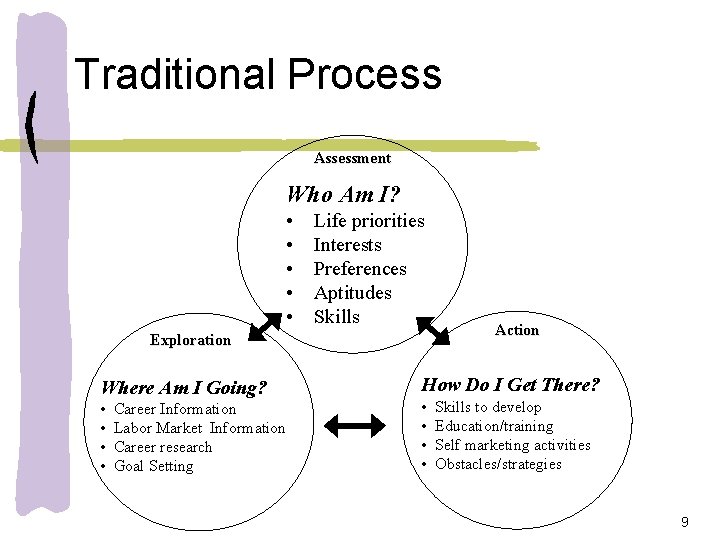
Traditional Process Assessment Who Am I? • • • Life priorities Interests Preferences Aptitudes Skills Exploration Where Am I Going? • • Career Information Labor Market Information Career research Goal Setting Action How Do I Get There? • • Skills to develop Education/training Self marketing activities Obstacles/strategies 9
What is Appreciative Inquiry is, essentially, a collaborative and highly participative, system-wide approach to seeking, identifying, and enhancing the “lifegiving forces” that are present when a system is performing optimally in human, economic, and organizational terms. (Watkins, Mohr, & Kelly, 2011, p. 22) 10
Life-Giving Forces Distinctive strengths that give your organization life and vitality when it is functioning at its best (Watkins, Mohr, & Kelly, 2011, p. 146) Elements or experiences within your past and/or present that represent your strengths when operating at your very best Could be a single moment in time or any aspect that contributes to your highest points and most valued experiences or characteristics (Cooperrider, Whitney, & Stavros, 2005, p. 418) 11
The Approach Believes all systems have untapped, rich stories Seeks that which is going right and builds on those strengths Is different from approaches that identify “fixes” or deficits that need to be overcome Views language as a powerful source for creating social reality Invites conversations that continually create new images that lead to new actions and behaviors 12
Appreciative Inquiry Concepts v Something works v Our focus becomes our reality v Multiple realities are created every moment v Asking questions influences our behavior v We are confident with the future when we know the past v Carry forward the best v Embrace the uniqueness of what we offer v Language creates our reality (Hammond, 2013) 13
Questions as Interventions The key point is that the way we know is fateful. The questions we ask, the things we choose to focus on, the topics we choose determine what we find. (Cooperrider, Whitney, & Stavros, 2005, p. 85) 14

Guiding Principles Every system works to some degree Seek out the positive, life-giving forces Appreciate the “best of what is” Process and outcome of the inquiry are interrelated and inseparable Make the process collaborative Support full voice participation at all levels See affirmative process as a viable change process Systems are capable of becoming more than they are Systems learn and guide their own evolution View change as an ongoing commitment 15
Appreciative Inquiry Processes Strategy for intentional change Identifies the best of “what is” and possibilities of “what could be” Process for engaging people Choose consciously to seek out inquiry into that which is generative and life enriching Engaging people to build an organization in which they want to work Way of seeing Attentive to and affirming of the best and highest qualities Cooperative search Strengths Passions Life-giving forces 16
In Other Words… Capitalize on your strengths and manage around your weaknesses. 17
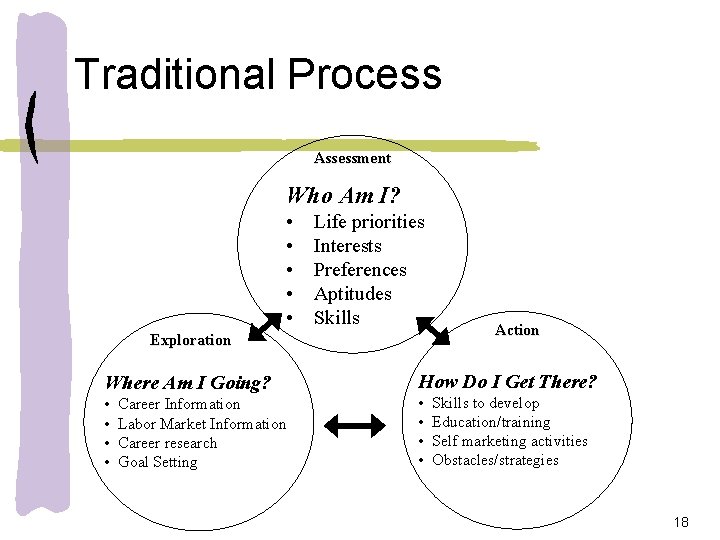
Traditional Process Assessment Who Am I? • • • Life priorities Interests Preferences Aptitudes Skills Exploration Where Am I Going? • • Career Information Labor Market Information Career research Goal Setting Action How Do I Get There? • • Skills to develop Education/training Self marketing activities Obstacles/strategies 18
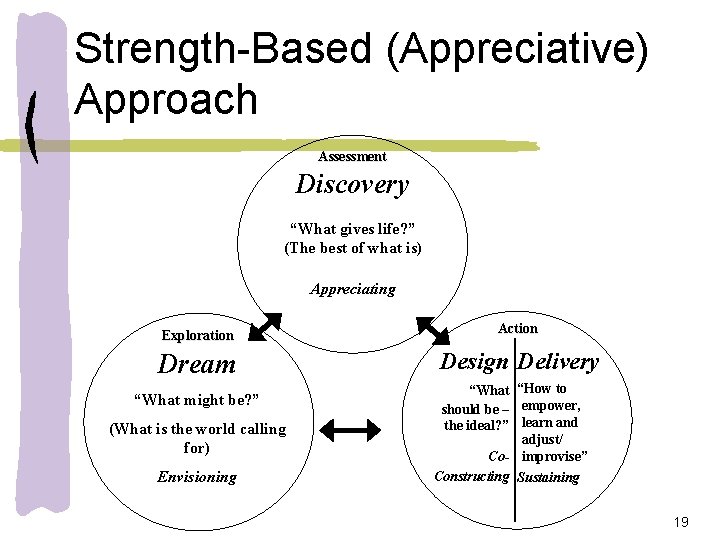
Strength-Based (Appreciative) Approach Assessment Discovery “What gives life? ” (The best of what is) Appreciating Exploration Action Dream Design Delivery “What might be? ” (What is the world calling for) Envisioning “What “How to should be – empower, the ideal? ” learn and adjust/ Co- improvise” Constructing Sustaining 19
![Process Outline Discovery Phase [Session One] The Appreciative Interview Introduction to the Interview format](http://slidetodoc.com/presentation_image/5ddf446d3ce948f418d6a20a6e3a561c/image-20.jpg "Process Outline Discovery Phase [Session One] The Appreciative Interview Introduction to the Interview format")
Process Outline Discovery Phase [Session One] The Appreciative Interview Introduction to the Interview format Interview partner and create summary [Session Two Begins Here] Images of My Positive Future Guided imagery activity Identify themes from the activity Dream Phase Locating My Personal Themes Synthesize themes Identify most exciting and engaging possibilities My Ideal Work-Life Scenario 20
Process Outline Design Phase Innovative Ways to Create My Future: My Sequence for Success Change, adapt, or adopt Ten times more bold Sequence for Success: Shoulds, Wants, & Will Action Plan: My “WILL DO” Goal Cultivating My Sequence for Success Delivery Phase Possible Bumps in the Road to Building on My Strengths Sustaining My Positive Possibilities Valuing the Building on Your Strengths Process 21
Keys Finding the seeds of excellence on which to build Creating images of excellence in hopes that the individual moves toward those images Changing our pictures of ourselves and creating new images 22
Building on Your Strengths Interview Please find the “Building on Your Strengths Interview Guide” Process 1. 2. 3. Review the introduction Please find a partner Interview your partner a) b) 4. 5. Take notes Feel free to use the prompt questions Switch roles and complete the interview Complete the Summary Sheet 23
Selecting Your Partner Please find a partner whom you do not know well You will be each be interviewing the other using the Guide Interviewer’s role is to ask questions, encourage the interviewee to be very descriptive, and to expand on her or his story The interviewee is encouraged to tell the story in language that evokes the feelings and experience so that the interviewer can fully understand the story After one person shares, then switch roles 24
Building on Your Strengths Interview Process Please read each question, or say it in your own words and then allow time for the interviewee to reflect and answer Encourage your interviewee to talk Take notes as you go When the interview is complete, share with your interviewee what you learned that most interested you and thank the person for her or his time Please be sure to give the interviewee her or his Interview Guide and the Interview Summary Sheet that you completed Enjoy the experience 25
Summary Sheet 1. What did you hear the person describing in the interview as her or his life-giving forces? 2. Identify three to five major themes or patterns that emerged from the interview. 3. What were the most quotable quotes that came from your conversation? 4. Please summarize what you heard, felt, or saw as the interviewee's strengths. 26
Session Two Agenda Re-Introductions Guided Imagery Locating My Personal Themes My Ideal Work-Life Scenario My Sequence for Success Adjourn 27
Guided Imagery Serves as an additional source of “data” Alternate sources might include past feedback From school From work From family 28
Locating My Personal Themes Review and complete the Locating My Personal Themes sheet Reconnect with your dialogue partner to discuss themes you have identified 29
Process Look at experiences and times when things are going well – times when you felt excited and successful Create an image of what you want Understand how others work with successful situations Create a common image that can be continually regenerated 30
Creating My Ideal Work-Life Scenario Best work situation? Most important to carry forward? My ideal work-life scenario… Present tense Positive Energizing language Bold & provocative Give energy and feeling of purpose 31
Innovative Ways: My Sequence for Success What could you change, adapt or adopt to get to the ideal work-life scenario? If you were to be 10 X more bold, what would you do? 32
Shoulds, Wants, Will 5 – Things you should do 3 – Things you want to do 1 – Thing you will commit to do 33
Cultivating “WILL DO” Goals For each of your goals, identify two or three action steps necessary to get that goal moving and heading in the right direction. Identify the goals and action steps that draw on your strengths, life-giving forces, and wishes. Also, identify those goals that will require you to draw on your larger support system? Identify which of the goals and action steps you are able to do something about and are within your ability to influence the outcome. What is the smallest step (an action, a decision, a behavior) you could take that would have the largest impact? 34
My Sequence for Success Possible Bumps in the Road Ignore Respond later Sustaining & Valuing 35
Goal of the Process Create an action plan that honors your strengths and articulates your hopes for your future. 36
Appreciative Inquiry Resources Hammond, S. A. (2013). The thin book of Appreciative Inquiry (3 rd ed. ). Bend, OR: Thin Book Publishing Co. Cooperrider, D. L. , Whitney, D. , & Stavros, J. M. (2005). Appreciative Inquiry handbook: The first in a series of AI workbooks for leaders of change. Brunswick, OH: Crown Custom Publishing, Inc. , & San Francisco: Berrett-Koehler Publishers, Inc. Watkins, J. M. , Mohr, B. , & Kelly, R. (2011). Appreciative Inquiry: Change at the speed of imagination (2 nd ed. ). San Francisco, CA: John Wiley and Sons, Inc. doi: 10. 1002/9781118256060. Whitney, D. , Trosten-Bloom, A. , Cooperrider, D. , & Kaplin, B. S. (2013). Encyclopedia of positive questions: Using Appreciative Inquiry to bring out the best in your organization (2 nd ed. ). Euclid, OH: Lakeshore Communications. 37
Online AI Opportunities Appreciative Inquiry Commons https: //appreciativeinquiry. champlain. edu/ What is Appreciative Inquiry? https: //www. thinbook. com/appreciative-inquiry/ What is Appreciative Inquiry? | David L. Cooperrider http: //www. davidcooperrider. com/ai-process/# 38
References Cooperrider, D. L. , Whitney, D. , & Stavros, J. M. (2005). Appreciative Inquiry handbook: The first in a series of AI workbooks for leaders of change. Brunswick, OH: Crown Custom Publishing, Inc. , & San Francisco: Berrett-Koehler Publishers, Inc. Hansen, L. S. (1997). Integrative life planning: Critical tasks for career development and changing life patterns. San Francisco: Jossey-Bass Publishers, Inc. Herr, E. L. , Cramer, S. H. , & Niles, S. G. (2004). Career guidance and counseling through the lifespan: Systematic approaches (6 th ed. ). Boston, MA: Pearson Education, Inc. Sears, S. (1982). A Definition of Career Guidance Terms: A National Vocational Guidance Association Perspective. Vocational Guidance Quarterly, 31, 137– 143. doi: 10. 1002/j. 2164 -585 X. 1982. tb 01305. x Watkins, J. M. , Mohr, B. , & Kelly, R. (2011). Appreciative Inquiry: Change at the speed of imagination (2 nd ed. ). San Francisco, CA: John Wiley and Sons, Inc. doi: 10. 1002/9781118256060. Zenger, J. H. , & Folkman, J. (2002). The extraordinary leader: Turning good managers into great leaders. New York, NY: The Mc. Graw Hill Companies, Inc. 39
Valuing the Process Please complete the “Valuing the Building on Your Strengths Process” sheet 40
Questions & Comments? Thank you for your time & attention! 41
- Slides: 41